REVIEW 3 major objections 5 minor 1 cited by
Quantum-inspired super-resolution of fluorescent point-like sources
T0 review · 3 major / 5 minor · reviewed 2026-08-11 · deepseek-v4-flash
Pith's one-line read This paper shows that a polarization-filtered image inversion interferometer can separate pairs of real fluorescent emitters far below the diffraction limit, with experimental Fisher information gains of roughly 17x over direct imaging at…
desk verdict A genuinely new polarization-filtered image inversion interferometer scheme, but the headline Fisher information gain is computed from a processed, symmetrized look-up table and needs a raw-data check before the number is bulletproof. read the letter →
The pith
A machine-rendered reading of the paper's core claim, the machinery that carries it, and where it could break.
The reading
What carries the argument
Image inversion interferometry (III): an interferometer with two oppositely oriented Dove prisms that superposes a scene with its inverted copy, splitting light into an even-parity channel and an odd-parity channel so that a small separation imprints a bright bowtie on an otherwise dark fringe. The load-bearing addition is azimuthal polarization filtering at a Fourier plane: a vortex half-wave plate converts azimuthally polarized light to vertical and radially polarized light to horizontal, and a linear polarizer rejects the horizontal part. This guarantees that the light reaching the interferometer is entirely antisymmetric under inversion, restoring the dark-fringe sensitivity that unpolarized III loses for isotropic dipole emitters.
What would settle it
Repeat the separation-estimation benchmark with two real emitters placed at a known subdiffraction separation (for example, dye molecules or quantum dots on a DNA ruler), and compare estimator variance under polarized III versus direct imaging at equal photon counts; if the variance ratio does not show an order-of-magnitude improvement, or if deliberately unequal source brightness removes the advantage, the synthetic-pair assumption is the culprit.
Extended reading notes
Core claim
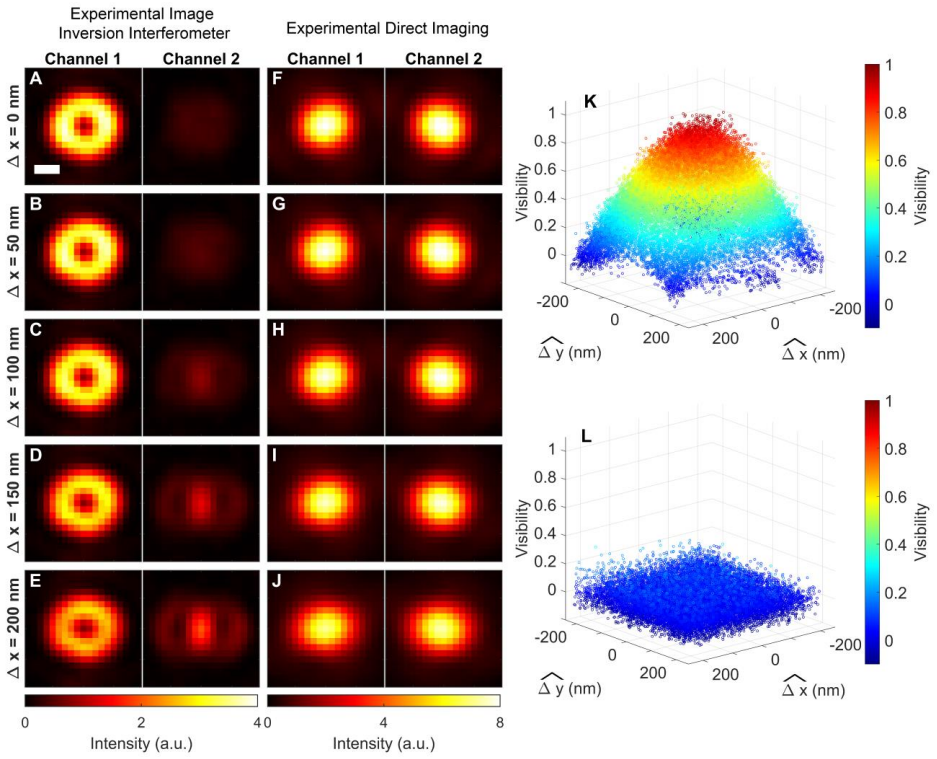
On the paper's own terms, the discovery is that the phase information lost by direct imaging of two incoherent dipolar sources can be recovered by an image inversion interferometer once the radially polarized emission is discarded. The azimuthally polarized component of the collected field is guaranteed to be anti-symmetric under inversion, so after a vortex half-wave plate rotates it to a linear polarization and a linear polarizer rejects the orthogonal radial component, the interferometer can again sit on a dark fringe. In experiments on 40-nm beads whose images at opposite positions were combined in post-processing to emulate subdiffraction source pairs, the realized Fisher information at 5 nm separation is about 17 times that of the direct-imaging control, and the mean-squared error of separation estimates is about 16 times smaller; the control shows the gain comes from the interferometer, not from the donut-shaped point-spread function alone.
Load-bearing premise
The experiments emulate a source pair by summing images of the same bead recorded at opposite positions, so the central premise is that two real fluorophores behave like two identical, equally bright, mutually incoherent copies of that bead; if real pairs differ in dipole orientation, wobble, or brightness, the measured information gain may not transfer.
Editorial extensions
If this is right
- For scenes known to contain exactly two point sources, separation can be estimated from many fewer detected photons than direct imaging, because the relevant Fisher information is more than an order of magnitude higher at small separations.
- The technique works without sequential photoswitching or blinking, so fluorescent labels that cannot be switched -- or switching that is too slow -- become usable for super-resolution tracking.
- Throwing away the radially polarized light costs roughly half the collected photons, yet the remaining information still beats direct imaging by about 17x at 5 nm in the experiment.
- The realized information advantage is largest in the deep subdiffraction regime and shrinks as separation grows, matching the theoretical curves.
Reading between the lines
- A natural first biological application is tracking two gene loci in diploid cells, where the scene is known to be a pair and the no-photoswitching requirement permits faster image acquisition than PALM/STORM.
- The same dark-fringe argument could extend to estimating the size, aspect ratio, and orientation of subdiffraction extended objects, since those parameters also imprint on the odd-parity channel.
- An adaptive version that recovers and reuses the rejected radial polarization could close the remaining factor-of-2.6 gap to the quantum limit, at the cost of added interferometer complexity.
- Because the experimental evidence rests on synthetic pairs made from one bead, the most informative next test is with genuinely different emitters of unequal brightness; if unequal brightness erases the gain, the method's practical floor will be set by real-sample heterogeneity.
Signed reviews
Editorial analysis
A structured set of objections, weighed in public.
Referee Report
Summary. The authors develop a vectorial diffraction theory for image inversion interferometry (III) applied to two incoherent isotropic point-like dipolar emitters, showing that the standard (unpolarized) III loses most of its advantage over direct imaging when realistic dipole emission is considered. They propose rejecting radially polarized light at a Fourier plane by combining a vortex half-wave plate with a linear polarizer, which restores the ability to sit on a dark fringe and yields a Fisher information (FI) within a factor of about 2.6 of the quantum limit. The experimental section describes a custom III microscope with two Dove prisms, a vortex half-wave plate, and a linear polarizer. Because true subdiffraction pairs of fluorescent beads cannot be positioned reliably, the authors emulate a source pair by adding images of a single 40-nm bead recorded at opposite stage positions. From a denoised, symmetrized look-up table (LUT) built with Gaussian filtering and per-pixel quartic polynomial fits, they report an FI for separation at 5 nm that is about 17 times larger than that of a direct-imaging control, and a median mean-squared-error (MSE) improvement of about 16 times over direct imaging. Control experiments in which the coherence between interferometer arms is spoiled attribute the gain to the interferometer rather than to the donut-shaped point-spread function.
Significance. The theoretical contribution is significant: it correctly identifies that the standard III cannot beat Rayleigh's curse for randomly oriented dipoles and provides a physical remedy (azimuthal polarization filtering) that nearly saturates the quantum Fisher information. The experimental setup and control experiments are thoughtfully designed, and the MSE analysis using raw paired images is a useful end-to-end check. If the reported FI gain is robust to the processing pipeline, the work would be an important step toward practical, photoswitching-free super-resolution in fluorescence microscopy. However, the headline 'order-of-magnitude FI improvement' is computed from a heavily processed and symmetrized LUT with no uncertainty quantification, and the experimental demonstration uses synthetic source pairs rather than real two-fluorophore samples; both points limit the strength of the central claim as currently presented.
major comments (3)
- [Results and Discussion, Fig. 4A; Materials and Methods, Data Analysis (Eq. S12)] The recovered Fisher information in Fig. 4A is computed directly from the symmetrized LUT images, which are produced by Gaussian filtering, per-pixel quartic polynomial fitting, the Eq. S12 symmetrization, and a second Gaussian blur. Since FI depends on the derivative of the mean intensity with respect to separation, each of these smoothing operations can change the result, and the paper provides neither the FI formula nor a comparison against an FI estimate computed from the raw image bank with a Poisson noise model. Without such a robustness check, the central quantitative claim that polarized III improves FI by over an order of magnitude is not yet established for the unprocessed measurement. Please provide raw-data-based FI estimates (e.g., bootstrap or direct evaluation from the paired noisy images) and state the exact FI expression and noise model used for the LUT-based curves.
- [Results and Discussion, Fig. 4A] The phrase 'the FI for polarized III in this display has already been diminished by a factor of 0.36 in order to assess a penalty for throwing away the radially polarized light' is ambiguous and potentially double-counting. The theoretical red curve in Fig. 1C is already computed for the azimuthally filtered measurement, i.e., it already accounts for the discarded radial light; if the experimental LUT images are recorded with the same polarizing elements, the FI derived from them is already at the filtered-photon level. The origin of the factor 0.36 (fraction of total intensity retained by the azimuthal filter? transmission efficiency of the vortex plate and polarizer?) must be stated, and it must be clarified whether the dashed theoretical curves in Fig. 4A are scaled by the same factor.
- [Abstract; Results and Discussion; Materials and Methods (Eqs. S13-S15)] The experiment does not actually image a pair of fluorescent sources; the source pair is emulated by adding images of a single bead recorded at opposing stage positions (Eqs. S13-S15). The abstract's statement that the paper reports 'experimental super-resolution of pairs of point-like fluorescent sources' is therefore stronger than what was demonstrated. Real fluorophore pairs can have unequal brightness, different dipole orientation and wobble, and possible mutual coherence, none of which is tested by this synthetic-pair procedure. Please reword the abstract and conclusion to state explicitly that the pair is emulated in post-processing, and discuss the implications for transferring the demonstrated gain to genuine two-molecule samples.
minor comments (5)
- [Fig. 4A caption] The dashed lines in Fig. 4A are described as 'predictions from theory' in the main text but are not defined in the caption; please specify which theoretical model and which photon budget they correspond to.
- [Eq. (1)] Equation (1) for the fringe visibility contains typesetting artifacts in the subscripts and superscripts; the formula as printed is hard to parse and should be re-typeset.
- [Materials and Methods, Data Analysis] The terms SL, SR, DL, and DR are introduced only in the supplement; the main text references the interferometer outputs without defining these abbreviations, making it difficult for a reader of the main text to follow the analysis.
- [Materials and Methods, Data Analysis] The Gaussian filter width (0.5 pixels) and the quartic 'poly44' fit are described as heuristic; the sensitivity of the recovered FI and MSE to these parameters should be stated or at least briefly discussed, since they directly affect the derivatives used in the FI computation.
- [Throughout] The notations Δx, Δy, Δr, and r-bar are used interchangeably in places; please define them explicitly at first use and keep the notation consistent between the main text and the supplement.
Circularity Check
No significant circularity: the experimental FI comparison is a self-contained measurement, not a derivation that feeds its own output back as input.
full rationale
The paper's central claim is an experimental comparison of realized Fisher information between polarized image-inversion interferometry and direct imaging. The FI curves in Fig. 4A are computed from experimentally derived look-up tables (LUTs) that are smoothed and symmetrized (Eq. S12), but this is a transparent data-processing pipeline, not a circular derivation: no fitted parameter is subsequently renamed as a prediction, and the theoretical FI curves (dashed) are independent vectorial-diffraction calculations. The 'ground truth' separation is acknowledged to contain localization error, which the authors note raises the MSE floor. The self-citation to Ref. 39 for the vortex-plate polarization conversion is not load-bearing: the same azimuthal/radial decomposition is supported by independent Ref. 38 and by the paper's own calculations. The symmetrized-LUT computation of FI is a robustness limitation (the headline number depends on the heuristic smoothing), but it does not reduce to an input-output equivalence. Therefore the derivation chain is self-contained against external benchmarks and no circular step is exhibited.
Assumptions & free parameters
free parameters (3)
- FI penalty factor for discarded radial light =
0.36
- Gaussian filter width for image library denoising =
0.5 pixels
- Quartic polynomial fit type for LUT construction =
poly44
assumptions (5)
- domain assumption An isotropic point source is equivalent to an incoherent equal-weight mixture of x, y, and z oriented dipole emitters.
- domain assumption The azimuthally polarized component of the collected dipole emission is anti-symmetric under image inversion, while all asymmetry is carried by the radial component.
- domain assumption A source pair can be modeled as two identical, mutually incoherent, equally bright point sources with known centroid aligned to the optical axis.
- domain assumption Classical vectorial diffraction theory with a Green's tensor for a dipole near an air-glass interface correctly describes the collected field.
- standard math The Cramér-Rao bound and Fisher information provide the relevant performance measure for unbiased estimation of separation.
Cite this review
Pith. "Pith review of Quantum-inspired super-resolution of fluorescent point-like sources." pith.science (2026). https://pith.science/paper/57YO5YEQ
@misc{pith2026241216835,
  author       = {Pith},
  title        = {Pith review of: Quantum-inspired super-resolution of fluorescent point-like sources},
  year         = {2026},
  howpublished = {\url{https://pith.science/paper/57YO5YEQ}},
  note         = {Machine review of arXiv:2412.16835}
}
read the original abstract
We report the experimental super-resolution of pairs of point-like fluorescent sources using a modified image inversion interferometer microscope. The technique is inspired by recent developments in the application of quantum parameter estimation theory to semiclassical imaging problems. We find that the image inversion technique requires special polarization filtering to account for the dipolar nature of the emission. Using an azimuthal polarizer, we obtain improvements in the Fisher information of point-source separation by over an order of magnitude relative to direct imaging. Unlike established super-resolution fluorescence techniques, the method does not require sequential photoswitching/blinking of the fluorophores, and thus could facilitate significant speed-ups for certain biological imaging/tracking tasks.
Figures


Figures from the paper (1 more)

Forward citations
Cited by 1 Pith paper
-
Quantifying classical and quantum bounds for resolving closely spaced, non-interacting, simultaneously emitting dipole sources in optical microscopy
For two dipolar emitters in high-NA microscopy, polarization-filtered image-inversion interferometry nearly saturates the quantum Fisher-information bound on estimating their separation, for arbitrary orientations.
Reference graph
Works this paper leans on
-
[1]
M. A. Lieb, J. M. Zavislan, L. Novotny, Single-molecule orientations determined by direct emission pattern imaging. JOSA B 21, 1210–1215 (2004)
work page 2004
-
[2]
D. Axelrod, Fluorescence excitation and imaging of single molecules near dielectric-coated and bare surfaces: a theoretical study. J. Microsc. 247, 147–160 (2012)
work page 2012
-
[3]
A. S. Backer, W. E. Moerner, Extending Single-Molecule Microscopy Using Optical Fourier Processing. J. Phys. Chem. B 118, 8313–8329 (2014)
work page 2014
- [4]
-
[5]
X. Wang, F. Yang, J. Yin, P. Ferrand, S. Brasselet, Quantifying the polarization properties of non-depolarizing optical elements with virtual distorting elements. Appl. Opt. 56, 2589 (2017)
work page 2017
-
[6]
o” marking the fiducial and “x
M. R. Grace, Z. Dutton, A. Ashok, S. Guha, Approaching quantum-limited imaging resolution without prior knowledge of the object location. J. Opt. Soc. Am. A 37, 1288 (2020). 10 Fig. S1. Coordinate definitions for discussion on the effect of dipolar emission. (A) Dipole vector ††[ ] cos s ,,, in sin sin ,cos[]x y z = = μ defined in terms of t...
work page 2020
Reviewed August 11, 2026 · model on record in the stance chip above.
Discussion (0). Continue with ORCID to comment.