REVIEW 3 major objections 5 minor 1 cited by
Probing medium response via strangeness enhancement around quenched jets
T0 review · 3 major / 5 minor · reviewed 2026-08-11 · deepseek-v4-flash
Pith's one-line read The paper claims that jets in heavy-ion collisions are surrounded by enhanced strange-hadron yields that grow with centrality and distance from the jet axis, a proposed new signature of jet-induced medium excitation.
desk verdict A clean, falsifiable AMPT prediction of strangeness enhancement around quenched jets; the radial trend needs a closer look at background subtraction. read the letter →
The pith
A machine-rendered reading of the paper's core claim, the machinery that carries it, and where it could break.
The reading
What carries the argument
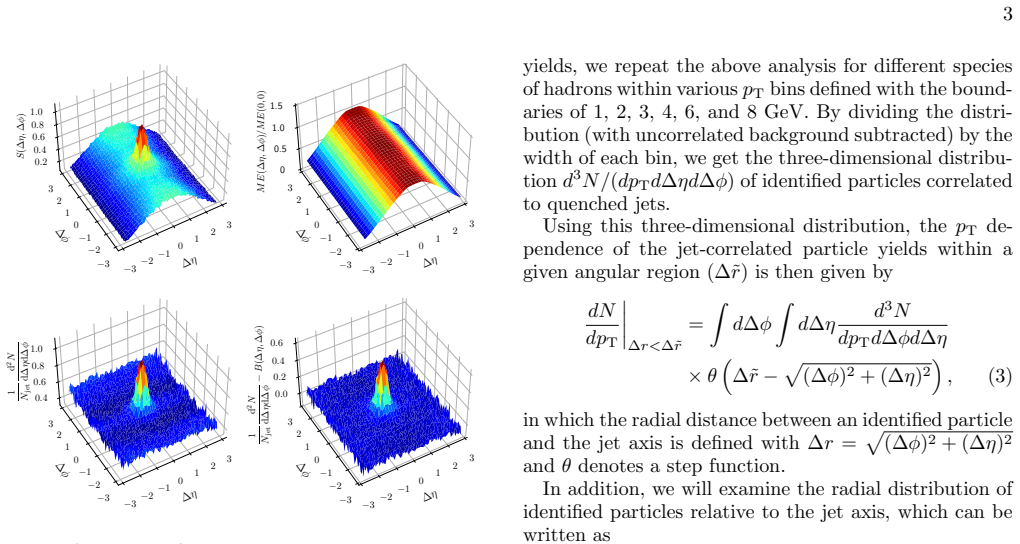
The analysis rests on the AMPT string-melting parton cascade: initial hadrons are melted into quark degrees of freedom, which undergo elastic two-body scatterings with a partonic cross-section set to 1.5 mb, then recombine into hadrons by spatial coalescence of two or three nearby quarks, followed by hadronic rescattering. Jet-particle correlations are built with the anti-$k_T$ jet algorithm (cone size $R=0.4$, jet $\mathrm{p}_T>120$ GeV), corrected for acceptance by mixed events and for background by a side-band average, giving per-trigger yields of pions, kaons, lambdas, xis, and phi mesons as functions of particle $\mathrm{p}_T$ and $\Delta r$. The load-bearing ratios are $K/\pi$, $\Lambda/\pi$, $\Xi/\pi$, $\phi/\pi$, and $\phi/K$ differences between Pb+Pb and pp collisions.
What would settle it
Measure the $(K^+ + K^-)/(\pi^+ + \pi^-)$ ratio around $R=0.4$ jets with $\mathrm{p}_T > 120$ GeV in $p+p$ and 0-10% Pb+Pb collisions at $\sqrt{s_{NN}}=5.02$ TeV as a function of $\Delta r$ and $\mathrm{p}_T$; if the Pb+Pb ratio is not larger than the $p+p$ ratio, or if the excess does not grow with $\Delta r$ and centrality, the predicted strangeness-enhancement signature of medium response is ruled out.
Extended reading notes
Core claim
In the simulation, jets with $\mathrm{p}_T > 120$ GeV in Pb+Pb collisions at $\sqrt{s_{NN}}=5.02$ TeV are correlated with more strange hadrons per pion than jets in pp collisions: the differences in $K/\pi$, $\Lambda/\pi$, $\Xi/\pi$, and $\phi/\pi$ ratios are positive, largest for 0-30% central collisions, strongest at particle transverse momenta of 2-4 GeV for the heavier strange hadrons, and increasing as the annular distance $\Delta r$ from the jet axis grows from 0.2 to 1. The $\phi/K$ ratio, which isolates double-strange enrichment from baryon effects, shows the same centrality and $\Delta r$ trends. The authors interpret the excess as medium response: energy lost by the jet thermalizes in the quark-gluon plasma, producing strange quarks abundantly, and quark coalescence assembles these into the observed strange hadrons.
Load-bearing premise
The central prediction depends on the assumption that the AMPT simulation with a 1.5 mb parton cross-section and quark-coalescence hadronization correctly reproduces how much of the jet's lost energy turns into strange quarks and how that energy spreads in angle.
Editorial extensions
If this is right
- If confirmed, strangeness around jets becomes an observable sensitive to the energy and angular distribution of jet-induced medium excitation.
- The centrality dependence gives a handle: comparing 0-30%, 30-50%, and 50-100% bins tests how medium response scales with system size and density.
- The growth with $\Delta r$ implies jet-energy diffusion to large angles, measurable via annular yields rather than only inside the jet cone.
- The intermediate-$\mathrm{p}_T$ peak ties the signal to coalescence hadronization, so the observable can discriminate coalescence versus fragmentation at the jet-medium boundary.
- The $\phi/K$ ratio provides a baryon-independent strangeness probe, avoiding the baryon-enhancement contamination that affects $\Lambda/\pi$ and $\Xi/\pi$.
Reading between the lines
- A direct experimental test could use existing heavy-ion data: compare the kaon-to-pion ratio around jets in pp and Pb+Pb; the paper shows one preliminary Pb+Pb data point but no pp baseline, so the enhancement prediction is not yet tested.
- Because the model omits medium-induced gluon radiation and uses coalescence only, the absolute size of the ratio enhancement at high $\mathrm{p}_T$ may shift; the qualitative radial and centrality trends are more robust than the normalization.
- If confirmed, this signal may help disentangle medium response from color-flow or color-reconnection effects, which the paper argues would produce different $\mathrm{p}_T$ and $\Delta r$ dependence.
- The same correlation technique could be applied to charm or bottom hadrons around jets, where strangeness enhancement from medium response might be separated from flavor-tagged fragmentation.
Editorial analysis
A structured set of objections, weighed in public.
Referee Report
Summary. Using the AMPT string-melting model at sqrt(s_NN) = 5.02 TeV, the paper computes per-trigger jet-hadron correlations for identified pions, kaons, Lambda, Xi, and phi mesons around anti-kT jets with pT > 120 GeV and R = 0.4. The correlations are corrected with a mixed-event acceptance correction and a side-band background subtraction (1.5 < |Delta(eta)| < 2.5). From these distributions the authors construct K/pi, Lambda/pi, Xi/pi, phi/pi, and phi/K ratios around jets in p+p and in Pb+Pb for three centrality classes, and report that the Pb+Pb minus p+p differences grow with centrality and with radial distance Delta(r) from the jet axis and peak at intermediate pT (2-4 GeV). They interpret this as evidence of jet-induced medium excitation combined with quark coalescence, and compare the in-cone K/pi ratio with ALICE preliminary data.
Significance. The proposed observable is timely and falsifiable: strangeness enhancement around quenched jets is an experimentally accessible channel that could discriminate between models with and without medium response. The study uses a standard experimental correlation pipeline, the ALICE comparison in Fig. 5 provides a useful first anchor, and the predicted ratios are emergent outputs rather than refits of the same observable, so the central prediction is not circular. The claim is nevertheless model-based and currently lacks statistical uncertainties and a validation of the radial trend, so its significance is conditional on those points being addressed.
major comments (3)
- [Section III, Figs. 2 and 3] No statistical uncertainties are shown for any of the AMPT curves in Figs. 2-4. The claimed effects are small differences between ratios, e.g. the Xi/pi enhancement is at the 0.002-0.01 level and the Delta(r) bins are only 0.1 wide, so without error bars or a stated number of simulated events one cannot tell whether the monotonic radial increase in Fig. 3 is a physical trend or Monte-Carlo noise. A test with independent statistical samples or bootstrap resampling should be added before the central claim is accepted.
- [Section II, side-band subtraction and Figs. 3] The side-band background B(Delta(eta),Delta(phi)) is taken from 1.5 < |Delta(eta)| < 2.5 and subtracted from the signal region |Delta(eta)| < 1. This assumes the background is Delta(eta)-independent in the acceptance-corrected correlation, but in 0-30% Pb+Pb the background contains anisotropic flow harmonics, long-range correlations, and residual acceptance effects that vary with Delta(eta). The jet-induced contribution at Delta(r) = 0.6-1.0 is a small excess over a large background, so a modest error in B would produce exactly the kind of rising radial enhancement reported in Fig. 3. The paper should validate the subtraction with a closure test in AMPT, vary the side-band range, or compare with an alternative background estimator; as written, the radial trend is not yet established.
- [Section III, paragraph following Fig. 2] The manuscript explicitly states that AMPT lacks medium-induced gluon emission and that high-pT hadron production is not reliably described because only coalescence is implemented. These are not merely high-pT caveats: the observed radial rise of the enhancement is produced by the interplay of medium excitation and coalescence, and a different treatment of radiative energy loss or hadronization could change the angular distribution of strange hadrons. The authors should either quantify this model dependence, for example by comparing with a version that includes fragmentation or radiation, or soften the claim that the radial increase is a robust property of medium response rather than a feature of this particular AMPT implementation.
minor comments (5)
- [Abstract and Section IV] The word 'significant' is used in the abstract although the results are shown without statistical uncertainties; please rephrase or report uncertainties.
- [Fig. 5] The comparison covers only Pb+Pb data, with no p+p measurement, and only Delta(r) < 0.4, so it does not directly test the enhancement or the radial trend claimed in Figs. 2-4; the caption should state this limitation.
- [Eq. (3) and surrounding text] The notation d3N/(dpT dDelta(eta) dDelta(phi)) is introduced after dN/(dDelta(eta) dDelta(phi)) and the pT bin widths; please make the definition of the three-dimensional distribution explicit.
- [Section IV] The phrase 'an access of the strange hadron production' should read 'an excess of strange hadron production'.
- [Figs. 2 and 3 captions] The captions should use proper centrality ranges, such as 0-30%, rather than '0 square 30%', and should indicate whether any statistical uncertainties are available.
Circularity Check
No circularity: the strangeness ratios are emergent AMPT outputs, not refits of the same observable, and self-citations are not load-bearing.
full rationale
The paper's central observables — the Pb+Pb versus pp differences of K/π, Λ/π, Ξ/π, φ/π, and φ/K around jets — are emergent outputs of the AMPT simulation rather than quantities defined in terms of the model inputs. The ZPC parton cross-section (1.5 mb) is fixed by earlier comparisons to jet nuclear modification and dijet asymmetry, not by fitting the strangeness ratios that are later presented as predictions. The mixed-event acceptance correction and side-band background subtraction are standard correlation techniques applied identically to pp and Pb+Pb events, so the difference between the two systems is not engineered by the analysis procedure. The comparison to ALICE data in Fig. 5 is an external benchmark, not a fitted input. Self-citations such as Ref. [75] (prior baryon-enhancement study) and Refs. [94,95] (parameter context) are published, externally falsifiable model results; they do not assert the strangeness-enhancement claim itself, and no uniqueness theorem or ansatz is imported to forbid alternatives. Concerns about the side-band subtraction or the coalescence mechanism are model-correctness risks, not circularity.
Assumptions & free parameters
free parameters (2)
- ZPC partonic scattering cross-section sigma =
1.5 mb
- ART hadronic cascade maximum time =
30 fm
assumptions (4)
- domain assumption The AMPT string-melting model with ZPC and quark coalescence gives a reliable description of jet-QGP interactions and hadron chemistry in the relevant pT range.
- domain assumption The side-band background subtraction isolates the jet-induced signal.
- domain assumption The p+p AMPT baseline accurately represents vacuum jet fragmentation and its strangeness content.
- domain assumption Strangeness enhancement in a hot QCD medium and its transfer into hadrons via coalescence are general features independent of model details.
Cite this review
Pith. "Pith review of Probing medium response via strangeness enhancement around quenched jets." pith.science (2026). https://pith.science/paper/Q4WXXHZT
@misc{pith2026241219283,
  author       = {Pith},
  title        = {Pith review of: Probing medium response via strangeness enhancement around quenched jets},
  year         = {2026},
  howpublished = {\url{https://pith.science/paper/Q4WXXHZT}},
  note         = {Machine review of arXiv:2412.19283}
}
read the original abstract
Jet-induced medium excitation is a crucial part of jet interactions with the quark-gluon plasma (QGP) in relativistic heavy-ion collisions, and has recently been confirmed by experiment for the first time. Based on the AMPT model simulation, we propose the strangeness enhancement around quenched jets as a novel signature of jet-induced medium excitation. By applying the jet-particle correlation techniques, we calculate jet-induced particle yields around the jets and find a significant enhancement of the strange-to-non-strange-hadron ratio and the double-to-single-strange-hadron ratio correlated with jets in relativistic nucleus-nucleus collisions relative to proton-proton collisions. This enhancement increases with both the strength of jet-QGP interactions and the radial distance from jet axis. These observations align with the features of jet-induced medium excitation and parton coalescence in hadron formation, and await experimental validation in the future measurements.
Figures


Figures from the paper (2 more)


Forward citations
Cited by 1 Pith paper
-
An improved linear Boltzmann transport model for hadron and jet suppression in ultrarelativistic heavy-ion collisions
An improved LBT model with an earlier medium-scale insertion and color-flow tracking reproduces hadron and jet nuclear modification factors together in 5.02 TeV Pb+Pb collisions.
Reference graph
Works this paper leans on
-
[1]
M. Gyulassy and L. McLerran, Nucl. Phys. A 750, 30 (2005), arXiv:nucl-th/0405013
arXiv 2005
-
[2]
P. Jacobs and X.-N. Wang, Prog. Part. Nucl. Phys. 54, 443 (2005), arXiv:hep-ph/0405125
arXiv 2005
- [3]
- [4]
-
[5]
Wang and M
X.-N. Wang and M. Gyulassy, Phys. Rev. Lett.68, 1480 (1992)
1992
-
[6]
S. A. Bass et al., Phys. Rev. C 79, 024901 (2009), arXiv:0808.0908
arXiv 2009
-
[7]
G.-Y. Qin and X.-N. Wang, Int. J. Mod. Phys. E 24, 1530014 (2015), arXiv:1511.00790
arXiv 2015
-
[8]
A. Majumder and M. Van Leeuwen, Prog. Part. Nucl. Phys. 66, 41 (2011), arXiv:1002.2206
arXiv 2011
Show all 105 references
-
[9]
Blaizot and Y
J.-P. Blaizot and Y. Mehtar-Tani, Int. J. Mod. Phys. E 24, 1530012 (2015), arXiv:1503.05958
2015 arXiv
-
[10]
Cao and X.-N
S. Cao and X.-N. Wang, Rept. Prog. Phys. 84, 024301 (2021), arXiv:2002.04028
2021 arXiv
-
[11]
Qin and B
G.-Y. Qin and B. Muller, Phys. Rev. Lett. 106, 162302 (2011), arXiv:1012.5280, [Erratum: Phys.Rev.Lett. 108, 189904 (2012)]
2011 arXiv
-
[12]
Majumder and C
A. Majumder and C. Shen, Phys. Rev. Lett. 109, 202301 (2012), arXiv:1103.0809
2012 arXiv
-
[13]
W. Dai, I. Vitev, and B.-W. Zhang, Phys. Rev. Lett. 110, 142001 (2013), arXiv:1207.5177
2013 arXiv
-
[14]
Blaizot, E
J.-P. Blaizot, E. Iancu, and Y. Mehtar-Tani, Phys. Rev. Lett. 111, 052001 (2013), arXiv:1301.6102
2013 arXiv
-
[15]
Chien and I
Y.-T. Chien and I. Vitev, Phys. Rev. Lett. 119, 112301 (2017), arXiv:1608.07283
2017 arXiv
-
[16]
Caucal, E
P. Caucal, E. Iancu, A. H. Mueller, and G. Soyez, Phys. Rev. Lett. 120, 232001 (2018), arXiv:1801.09703
2018 arXiv
-
[17]
W.-J. Xing, S. Cao, G.-Y. Qin, and H. Xing, Phys. Lett. B 805, 135424 (2020), arXiv:1906.00413
2020 arXiv
- [18]
-
[19]
Mehtar-Tani, D
Y. Mehtar-Tani, D. Pablos, and K. Tywoniuk, Phys. Rev. Lett. 127, 252301 (2021), arXiv:2101.01742
2021 arXiv
-
[20]
W. Zhao, W. Ke, W. Chen, T. Luo, and X.-N. Wang, Phys. Rev. Lett. 128, 022302 (2022), arXiv:2103.14657
2022 arXiv
-
[21]
S. Cao, A. Majumder, R. Modarresi-Yazdi, I. Soudi, and Y. Tachibana, Int. J. Mod. Phys. E 33, 2430002 (2024), arXiv:2401.10026
2024 arXiv
-
[22]
Schenke, C
B. Schenke, C. Gale, and S. Jeon, Phys. Rev. C 80, 054913 (2009), arXiv:0909.2037
2009 arXiv
-
[23]
K. C. Zapp, Eur. Phys. J. C 74, 2762 (2014), arXiv:1311.0048
2014 arXiv
-
[24]
Casalderrey-Solana, D
J. Casalderrey-Solana, D. C. Gulhan, J. G. Milhano, D. Pablos, and K. Rajagopal, JHEP 10, 019 (2014), arXiv:1405.3864, [Erratum: JHEP 09, 175 (2015)]
2014 arXiv
- [25]
-
[26]
Cao et al., Phys
JETSCAPE, S. Cao et al., Phys. Rev. C 96, 024909 (2017), arXiv:1705.00050
2017 arXiv
-
[27]
J. H. Putschke et al., (2019), arXiv:1903.07706. 8
2019 arXiv
-
[28]
T. Luo, Y. He, S. Cao, and X.-N. Wang, Phys. Rev. C 109, 034919 (2024), arXiv:2306.13742
2024 arXiv
-
[29]
Karpenko, A
I. Karpenko, A. Lind, M. Rohrmoser, J. Aichelin, and P.-B. Gossiaux, (2024), arXiv:2404.14579
2024 arXiv
-
[30]
JET, K. M. Burke et al., Phys. Rev. C 90, 014909 (2014), arXiv:1312.5003
2014 arXiv
-
[31]
Cao et al., Phys
JETSCAPE, S. Cao et al., Phys. Rev. C 104, 024905 (2021), arXiv:2102.11337
2021 arXiv
-
[32]
M. Xie, W. Ke, H. Zhang, and X.-N. Wang, Phys. Rev. C 108, L011901 (2023), arXiv:2206.01340
2023 arXiv
-
[33]
B. Chen, X. Chen, X. Li, Z.-R. Zhu, and K. Zhou, (2024), arXiv:2404.18217
2024 arXiv
-
[34]
Karmakar et al., Phys
B. Karmakar et al., Phys. Rev. C 110, 044906 (2024), arXiv:2403.17817
2024 arXiv
-
[35]
Karmakar et al., Phys
B. Karmakar et al., Phys. Rev. C 108, 044907 (2023), arXiv:2305.11318
2023 arXiv
-
[36]
Liu, X.-Y
F.-L. Liu, X.-Y. Wu, S. Cao, G.-Y. Qin, and X.- N. Wang, Phys. Lett. B 848, 138355 (2024), arXiv:2304.08787
2024 arXiv
-
[37]
Cao and G.-Y
S. Cao and G.-Y. Qin, Ann. Rev. Nucl. Part. Sci. 73, 205 (2023), arXiv:2211.16821
2023 arXiv
- [38]
-
[39]
Kumar et al., Phys
JETSCAPE, A. Kumar et al., Phys. Rev. C 107, 034911 (2023), arXiv:2204.01163
2023 arXiv
- [40]
-
[41]
Casalderrey-Solana, D
J. Casalderrey-Solana, D. Gulhan, G. Milhano, D. Pab- los, and K. Rajagopal, JHEP 03, 135 (2017), arXiv:1609.05842
2017 arXiv
-
[42]
Tachibana, N.-B
Y. Tachibana, N.-B. Chang, and G.-Y. Qin, Phys. Rev. C 95, 044909 (2017), arXiv:1701.07951
2017 arXiv
-
[43]
Kunnawalkam Elayavalli and K
R. Kunnawalkam Elayavalli and K. C. Zapp, JHEP 07, 141 (2017), arXiv:1707.01539
2017 arXiv
-
[44]
Milhano, U
G. Milhano, U. A. Wiedemann, and K. C. Zapp, Phys. Lett. B 779, 409 (2018), arXiv:1707.04142
2018 arXiv
-
[45]
W. Chen, S. Cao, T. Luo, L.-G. Pang, and X.-N. Wang, Phys. Lett. B 810, 135783 (2020), arXiv:2005.09678
2020 arXiv
-
[46]
C. Park, S. Jeon, and C. Gale, Nucl. Phys. A 982, 643 (2019), arXiv:1807.06550
2019 arXiv
-
[47]
T. Luo, S. Cao, Y. He, and X.-N. Wang, Phys. Lett. B 782, 707 (2018), arXiv:1803.06785
2018 arXiv
-
[48]
Casalderrey-Solana, G
J. Casalderrey-Solana, G. Milhano, D. Pablos, and K. Rajagopal, JHEP 01, 044 (2020), arXiv:1907.11248
2020 arXiv
-
[49]
Chang, Y
N.-B. Chang, Y. Tachibana, and G.-Y. Qin, Phys. Lett. B 801, 135181 (2020), arXiv:1906.09562
2020 arXiv
-
[50]
Tachibana, C
Y. Tachibana, C. Shen, and A. Majumder, Phys. Rev. C 106, L021902 (2022), arXiv:2001.08321
2022 arXiv
-
[51]
Z. Yang, Y. He, I. Moult, and X.-N. Wang, Phys. Rev. Lett. 132, 011901 (2024), arXiv:2310.01500
2024 arXiv
-
[52]
W.-J. Xing, S. Cao, G.-Y. Qin, and X.-N. Wang, (2024), arXiv:2409.12843
2024 arXiv
-
[53]
Casalderrey-Solana, E
J. Casalderrey-Solana, E. V. Shuryak, and D. Teaney, J. Phys. Conf. Ser. 27, 22 (2005), arXiv:hep-ph/0411315
2005 arXiv
-
[54]
A. K. Chaudhuri and U. Heinz, Phys. Rev. Lett. 97, 062301 (2006), arXiv:nucl-th/0503028
2006 arXiv
-
[55]
Ruppert and B
J. Ruppert and B. Muller, Phys. Lett. B 618, 123 (2005), arXiv:hep-ph/0503158
2005 arXiv
-
[56]
S. S. Gubser, S. S. Pufu, and A. Yarom, Phys. Rev. Lett. 100, 012301 (2008), arXiv:0706.4307
2008 arXiv
-
[57]
P. M. Chesler and L. G. Yaffe, Phys. Rev. Lett. 99, 152001 (2007), arXiv:0706.0368
2007 arXiv
-
[58]
G. Y. Qin, A. Majumder, H. Song, and U. Heinz, Phys. Rev. Lett. 103, 152303 (2009), arXiv:0903.2255
2009 arXiv
-
[59]
R. B. Neufeld and B. Muller, Phys. Rev. Lett. 103, 042301 (2009), arXiv:0902.2950
2009 arXiv
-
[60]
H. Li, F. Liu, G.-l. Ma, X.-N. Wang, and Y. Zhu, Phys. Rev. Lett. 106, 012301 (2011), arXiv:1006.2893
2011 arXiv
- [61]
-
[62]
Casalderrey-Solana, J
J. Casalderrey-Solana, J. G. Milhano, D. Pablos, K. Rajagopal, and X. Yao, JHEP 05, 230 (2021), arXiv:2010.01140
2021 arXiv
-
[63]
R. B. Neufeld, Phys. Rev. C 79, 054909 (2009), arXiv:0807.2996
2009 arXiv
-
[64]
Bouras, B
I. Bouras, B. Betz, Z. Xu, and C. Greiner, Phys. Rev. C 90, 024904 (2014), arXiv:1401.3019
2014 arXiv
-
[65]
B. Betz, J. Noronha, G. Torrieri, M. Gyulassy, and D. H. Rischke, Phys. Rev. Lett. 105, 222301 (2010), arXiv:1005.5461
2010 arXiv
-
[66]
Tachibana and T
Y. Tachibana and T. Hirano, Phys. Rev. C 93, 054907 (2016), arXiv:1510.06966
2016 arXiv
-
[67]
R. B. Neufeld and I. Vitev, Phys. Rev. C 86, 024905 (2012), arXiv:1105.2067
2012 arXiv
- [68]
- [69]
-
[70]
W. Chen, S. Cao, T. Luo, L.-G. Pang, and X.-N. Wang, Phys. Lett. B 777, 86 (2018), arXiv:1704.03648
2018 arXiv
- [71]
-
[72]
Z. Yang, T. Luo, W. Chen, L.-G. Pang, and X.-N. Wang, Phys. Rev. Lett. 130, 052301 (2023), arXiv:2203.03683
2023 arXiv
-
[73]
CMS, CMS-PAS-HIN-23-006 (2024)
2024
-
[74]
W. Chen, S. Cao, T. Luo, L.-G. Pang, and X.-N. Wang, Nucl. Phys. A 1005, 121934 (2021)
2021
-
[75]
Luo, Y.-X
A. Luo, Y.-X. Mao, G.-Y. Qin, E.-K. Wang, and H.-Z. Zhang, Phys. Lett. B 837, 137638 (2023), arXiv:2109.14314
2023 arXiv
-
[76]
Sirimanna et al., Phys
C. Sirimanna et al., Phys. Rev. C 108, 014911 (2023), arXiv:2211.15553
2023 arXiv
-
[77]
Dale-Gau, PoS HardProbes2023, 173 (2024), arXiv:2312.11362
STAR, G. Dale-Gau, PoS HardProbes2023, 173 (2024), arXiv:2312.11362
2024 arXiv
-
[78]
Rafelski and B
J. Rafelski and B. Muller, Phys. Rev. Lett. 48, 1066 (1982), [Erratum: Phys.Rev.Lett. 56, 2334 (1986)]
1982
-
[79]
R. J. Fries, B. Muller, C. Nonaka, and S. A. Bass, Phys. Rev. C 68, 044902 (2003), arXiv:nucl-th/0306027
2003 arXiv
-
[80]
R. J. Fries, B. Muller, C. Nonaka, and S. A. Bass, Phys. Rev. Lett. 90, 202303 (2003), arXiv:nucl-th/0301087
2003 arXiv
-
[81]
Greco, C
V. Greco, C. M. Ko, and P. Levai, Phys. Rev. C 68, 034904 (2003), arXiv:nucl-th/0305024
2003 arXiv
-
[82]
Z.-W. Lin, C. M. Ko, B.-A. Li, B. Zhang, and S. Pal, Phys. Rev. C 72, 064901 (2005), arXiv:nucl-th/0411110
2005 arXiv
-
[83]
Zhang, L.-W
B. Zhang, L.-W. Chen, and C.-M. Ko, Phys. Rev. C 72, 024906 (2005), arXiv:nucl-th/0502056
2005 arXiv
- [84]
-
[85]
L.-W. Chen, C. M. Ko, and Z.-W. Lin, Phys. Rev. C 69, 031901 (2004), arXiv:nucl-th/0312124
2004 arXiv
- [86]
- [87]
- [88]
- [89]
- [90]
-
[91]
Wang and M
X.-N. Wang and M. Gyulassy, Phys. Rev. D 44, 3501 (1991)
1991
-
[92]
Gyulassy and X.-N
M. Gyulassy and X.-N. Wang, Comput. Phys. Commun. 83, 307 (1994), arXiv:nucl-th/9502021
1994 arXiv
- [93]
-
[94]
Z. Gao, A. Luo, G.-L. Ma, G.-Y. Qin, and H.-Z. Zhang, Phys. Rev. C 97, 044903 (2018), arXiv:1612.02548
2018 arXiv
-
[95]
Luo, Y.-X
A. Luo, Y.-X. Mao, G.-Y. Qin, E.-K. Wang, and H.-Z. Zhang, Eur. Phys. J. C 82, 156 (2022), arXiv:2107.11751
2022 arXiv
- [96]
-
[97]
Khachatryan et al., JHEP 11, 055 (2016), arXiv:1609.02466
CMS, V. Khachatryan et al., JHEP 11, 055 (2016), arXiv:1609.02466
2016 arXiv
-
[98]
Khachatryan et al., JHEP 02, 156 (2016), arXiv:1601.00079
CMS, V. Khachatryan et al., JHEP 02, 156 (2016), arXiv:1601.00079
2016 arXiv
-
[99]
CMS, A. M. Sirunyan et al., JHEP 05, 006 (2018), arXiv:1803.00042
2018 arXiv
-
[100]
CMS, A. M. Sirunyan et al., JHEP 05, 116 (2021), arXiv:2101.04720
2021 arXiv
- [101]
-
[102]
Cacciari, G
M. Cacciari, G. P. Salam, and G. Soyez, Eur. Phys. J. C 72, 1896 (2012), arXiv:1111.6097
2012 arXiv
-
[103]
Aad et al., Phys
ATLAS, G. Aad et al., Phys. Rev. C 100, 064901 (2019), arXiv:1908.05264, [Erratum: Phys.Rev.C 101, 059903 (2020)]
2019 arXiv
-
[104]
ALICE, ALI-PREL-582548 (2024)
2024
-
[105]
Sapeta and U
S. Sapeta and U. A. Wiedemann, Eur. Phys. J. C 55, 293 (2008), arXiv:0707.3494
2008 arXiv
Reviewed August 11, 2026 · model on record in the stance chip above.
Discussion (0). Continue with ORCID to comment.