REVIEW 3 major objections 4 minor 68 references
Interacted Object Grounding in Spatio-Temporal Human-Object Interactions
T0 review · 3 major / 4 minor · reviewed 2026-08-11 · deepseek-v4-flash
Pith's one-line read The paper claims that 4D-QA grounds interacted objects in video far better than image-only baselines, using a new 1,098-class benchmark.
desk verdict GIO is a valuable new benchmark, but the 4D-QA superiority claim rests on an asymmetric baseline comparison. read the letter →
The pith
A machine-rendered reading of the paper's core claim, the machinery that carries it, and where it could break.
The reading
What carries the argument
The central mechanism is the 4D question-answering framework (4D-QA), which turns bounding-box regression into mask selection. SAM generates fine-grained candidate object masks; a reconstructed 4D human-object layout—human SMPL meshes from PHALP aligned with ZoeDepth scene point clouds and encoded by BPS—provides the spatial prior; and a 2D then 3D transformer decoder, whose queries combine the human tracklet and an optional language interaction feature, scores each mask by cosine similarity. A GIoU distance term biases selection toward masks near the person, and depth-based clustering merges the selected masks into the final box.
What would settle it
Run the strongest baseline, GroundingDINO, with the ground-truth human tracklet and interaction verb supplied as input, and compare mAP@0.5 and mIoUw on the same GIO test split; if the gap with 4D-QA collapses, the paper's central claim of 4D superiority would be refuted.
Extended reading notes
Core claim
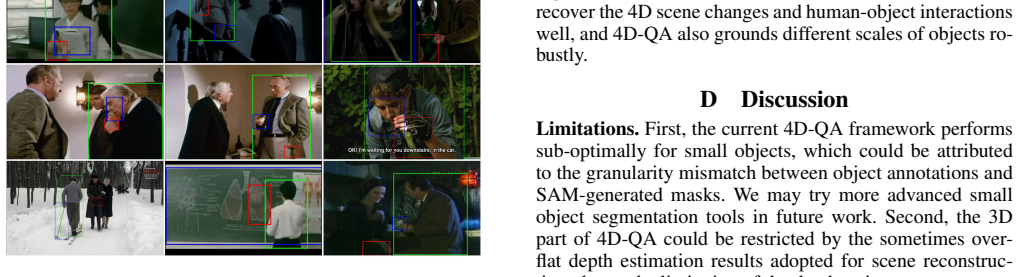
In the paper's own terms, the discovery is that interacted object grounding—finding the object a person is interacting with in a video, given the person's tracklet and the interaction verb—can be cast as a mask-selection question-answering problem rather than a box-regression problem, and that adding a reconstructed 4D human-object layout to the selection process yields large gains over image-based grounding. The 4D-QA pipeline feeds the video clip into SAM to produce up to 255 candidate masks per keyframe, extracts spatiotemporal context features with SlowFast, lifts the scene into 3D through human mesh recovery (PHALP), monocular depth estimation (ZoeDepth), and alignment, encodes the point clouds with BPS, and then grounds the interacted object with a two-stage 2D/3D transformer decoder whose queries combine human and verb features. The resulting mask scores, combined with a GIoU distance prior, select the interacted object. The paper argues that the 4D layout resolves occlusion and spatial ambiguities that image-only baselines cannot, and that the QA formulation makes the task robust to missing annotations in the original ST-HOI formulation.
Load-bearing premise
The comparison is fair: 4D-QA receives the true human tracklet as input, while the baselines receive only a frame and a text prompt, so the reported lead may come partly from that extra information rather than from 4D reasoning.
Editorial extensions
If this is right
- If 4D-QA's gains replicate, interaction-aware grounding systems should treat object localization as a candidate-selection problem over dense masks rather than direct regression.
- The GIO benchmark provides a long-tailed, open-world testbed (1,098 classes, 98 unseen at inference) that can expose where current grounding models fail on rare and temporally hidden objects.
- The reported superiority implies that temporal and 3D cues are not optional for HOI: they resolve cases like a chair occluded by a sitting person that later becomes visible.
- The 4D layout branch is a plug-in that could be added to other detection and grounding models, potentially improving their performance on occluded-object scenarios.
- The QA formulation's insensitivity to missing annotations makes it a more reliable evaluation protocol than full ST-HOI triplet detection.
Reading between the lines
- A direct test of whether the reported advantage comes from 4D cues or from the extra human-tracklet input would be to feed the same tracklet to GroundingDINO; the paper does not include this condition.
- The paper's own ablations show the 3D feature branch adds about 0.7 mAP over the 2D-only version, so the 4D reconstruction's marginal effect is modest relative to the large gap over image baselines.
- The GIO protocol could be adapted to egocentric or hand-object datasets, extending open-world interacted object grounding beyond third-view whole-body interactions.
- The benchmark's long-tailed object distribution, with 42.66% of instances outside the COCO class pool, could serve as a lens for studying how vision-language models handle rare-object interactions.
Editorial analysis
A structured set of objections, weighed in public.
Referee Report
Summary. The paper introduces GIO, a new third-view video benchmark for open-world interacted-object grounding, built on AVA with 1,098 object classes and 290K frame-level human-verb-object annotations. It defines a grounding task in which, given a human actor tracklet and optional interaction semantics, a system must localize the interacted object. The authors also propose 4D-QA, which combines SAM mask proposals, SlowFast video features, a reconstructed 3D human-scene layout, and a two-stage 2D/3D transformer decoder to select the interacted mask. Experiments on GIO report that 4D-QA outperforms several image/video grounding and HOI baselines, e.g., 23.38 mAP@0.5 and 29.71 mIoUw versus 17.53 and 20.41 for GroundingDINO.
Significance. The dataset is a potentially valuable resource for ST-HOI research: it is substantially larger in object-class diversity than existing third-view HOI benchmarks, explicitly targets long-tail and open-world objects, and the authors plan to release data and code. The proposed grounding task is a sensible reformulation that avoids the annotation-missing problems of full ST-HOI detection. The 4D-QA method is an interesting combination of segment-proposal and 4D reconstruction, and the paper includes a useful ablation of its components. However, the empirical evidence for the central claim of 'significant superiority' is not yet controlled enough: the main comparison mixes differences in training data and input information with differences in method design, so the reported gap does not by itself establish that spatio-temporal/4D cues are responsible.
major comments (3)
- [Sec. 5.3 and Table 2] 4D-QA is trained on the GIO train split (Sec. 5.2), whereas the baselines are used off-the-shelf: Sec. 5.3 describes protocols for adapting GroundingDINO, Qwen-VL, Detic, and CG-STVG, but not fine-tuning them on GIO. The reported gap (e.g., 23.38 vs 17.53 mAP@0.5 for GroundingDINO, and 29.71 vs 20.41 mIoUw) therefore conflates the value of the proposed architecture with the value of training on the target dataset. Please report baselines fine-tuned on the GIO train set under the same task protocol (including the optional interaction semantics), or explicitly reframe the claim as superiority over zero-shot baselines and adjust the abstract and conclusion accordingly.
- [Sec. 5.3 and Eqs. (1)-(2)] The task defined in Sec. 3.4 provides the GT human tracklet T_h, and 4D-QA uses it in the human query Q_h via ROIAlign (Sec. 4.4), in the GIoU distance S_d (Eq. 5), and in the 3D alignment centered on the pelvis (Sec. 4.3). Among the strongest baselines, GroundingDINO, Qwen-VL, Detic, and CG-STVG are not conditioned on T_h; only PViC and Gaze receive a human box. The post-hoc distance re-ranking described in Sec. 5.4 uses the GT human box for scoring only, not for detection or attention. To support the claim that spatio-temporal/4D cues drive the improvement, please add a controlled baseline that supplies the human tracklet to these methods (e.g., a box-prompted GroundingDINO or a human-cropped variant) and report the resulting mAP and mIoUw.
- [Supplementary Sec. B, 'Other Details'] The three post-processing hyperparameters gamma, tau, and beta are chosen by grid search 'to identify the optimal values that maximize the model's performance,' but the manuscript does not state whether the search is performed on a held-out validation split or on the test set. If the latter, the reported numbers in Table 2 and Table 3 are optimistically biased. Please specify the split used for tuning and include a sensitivity analysis, for example results for neighboring grid values, so readers can judge the stability of the reported gains.
minor comments (4)
- [Abstract] The data URL in the abstract contains an apparent typo ('HAKE-A V A.' with a space); it should be given consistently as https://github.com/DirtyHarryLYL/HAKE-AVA.
- [Sec. 3.2] The word 'traklet' should be 'tracklet'; the description of multi-object linking would also be clearer if the rule for multiple objects in a sub-clip were stated before defining the ST-HOI tracklet label.
- [Sec. 5.1 and Table 2] The metric definitions are non-standard: the mAP described in Sec. 5.1 is a rank-based 'first-hit' average, not the standard detection mAP, and the table header 'mAPs' is inconsistent with the text. Please define the metric unambiguously in the main text and avoid the plural 'mAPs'.
- [Fig. 2] The caption contains 'Tacking Align', which appears to be a typo for 'tracking/alignment'; the figure would also benefit from a clearer indication of where the optional GroundingDINO feature enters the pipeline.
Circularity Check
No significant circularity: 4D-QA is trained with supervised BCE loss, validated by within-paper ablations and an external VidHOI transfer, and its reported superiority is not an identity with its inputs.
full rationale
The claimed derivation chain is: define the GIO task (Eq. 1: predict interacted object tracklet given clip, GT human tracklet, and optional interaction semantics); generate SAM mask proposals; extract 2D, 3D, and context features; score candidate masks by Eq. 5 (cosine similarity plus GIoU distance to the human); and train with BCE loss. No prediction in this chain is defined as a fit from the target label; the object box is selected from SAM proposals by a learned decoder, and the distance term is a heuristic prior that is ablated in Table 3 (removing it degrades mAP from 23.38 to 22.07). The ablation table and the VidHOI zero-shot/fine-tuned evaluation (14.23/25.35 mAP and 22.66/29.61 mIoUw) provide checks that are independent of the GIO test-set fitting. The author-overlap citations (e.g., Li et al. 2020a for 3D HOI representation, and the HAKE-AVA data URL) motivate but do not carry the central claim: the 3D contribution is verified in-paper rather than assumed from the citation. The main confounds are evaluation-fairness/rigor issues rather than circularity: 4D-QA receives the GT human tracklet in Eq. 1-2 while GroundingDINO, Qwen-VL, Detic, and CG-STVG are not given that tracklet, and the appendix grid-searches the post-processing hyperparameters (gamma, tau, beta) to maximize performance without stating a validation split. These concerns affect how strongly the reported gap can be attributed to 4D/spatio-temporal cues, but they do not make any equation or result equivalent to its own input by construction.
Assumptions & free parameters
free parameters (4)
- gamma (GIoU distance weight) =
not reported
- tau (mask acceptance threshold) =
not reported
- beta (depth clustering threshold) =
not reported
- positive BCE loss weight =
10
assumptions (4)
- domain assumption AVA human boxes and action labels are accurate enough to serve as ground truth for GIO.
- domain assumption SAM produces a candidate mask that covers each interacted object with enough IoU (ratio > 0.9 for GT), including small and occluded objects.
- domain assumption The 4D reconstruction from PHALP and ZoeDepth, after alignment, is accurate enough to benefit grounding.
- domain assumption Annotator judgments and the WordNet-based clustering produce valid object class labels for 1,098 classes.
Cite this review
Pith. "Pith review of Interacted Object Grounding in Spatio-Temporal Human-Object Interactions." pith.science (2026). https://pith.science/paper/TF2TZWNC
@misc{pith2026241219542,
  author       = {Pith},
  title        = {Pith review of: Interacted Object Grounding in Spatio-Temporal Human-Object Interactions},
  year         = {2026},
  howpublished = {\url{https://pith.science/paper/TF2TZWNC}},
  note         = {Machine review of arXiv:2412.19542}
}
read the original abstract
Spatio-temporal Human-Object Interaction (ST-HOI) understanding aims at detecting HOIs from videos, which is crucial for activity understanding. However, existing whole-body-object interaction video benchmarks overlook the truth that open-world objects are diverse, that is, they usually provide limited and predefined object classes. Therefore, we introduce a new open-world benchmark: Grounding Interacted Objects (GIO) including 1,098 interacted objects class and 290K interacted object boxes annotation. Accordingly, an object grounding task is proposed expecting vision systems to discover interacted objects. Even though today's detectors and grounding methods have succeeded greatly, they perform unsatisfactorily in localizing diverse and rare objects in GIO. This profoundly reveals the limitations of current vision systems and poses a great challenge. Thus, we explore leveraging spatio-temporal cues to address object grounding and propose a 4D question-answering framework (4D-QA) to discover interacted objects from diverse videos. Our method demonstrates significant superiority in extensive experiments compared to current baselines. Data and code will be publicly available at https://github.com/DirtyHarryLYL/HAKE-AVA.
Figures


Figures from the paper (11 more)




Reference graph
Works this paper leans on
-
[1]
, " * write output.state after.block = add.period write newline
ENTRY address archivePrefix author booktitle chapter edition editor eid eprint howpublished institution isbn journal key month note number organization pages publisher school series title type volume year label extra.label sort.label short.list INTEGERS output.state before.all mid.sentence after.sentence after.block FUNCTION init.state.consts #0 'before.a...
-
[2]
write newline
" write newline "" before.all 'output.state := FUNCTION n.dashify 't := "" t empty not t #1 #1 substring "-" = t #1 #2 substring "--" = not "--" * t #2 global.max substring 't := t #1 #1 substring "-" = "-" * t #2 global.max substring 't := while if t #1 #1 substring * t #2 global.max substring 't := if while FUNCTION word.in bbl.in capitalize " " * FUNCT...
-
[3]
Bai, J.; Bai, S.; Yang, S.; Wang, S.; Tan, S.; Wang, P.; Lin, J.; Zhou, C.; and Zhou, J. 2023. Qwen-VL: A Versatile Vision-Language Model for Understanding, Localization, Text Reading, and Beyond. arXiv:2308.12966
arXiv 2023
-
[4]
Baradel, F.; Neverova, N.; Wolf, C.; Mille, J.; and Mori, G. 2018. Object level visual reasoning in videos. In ECCV
work page 2018
-
[5]
F.; Birkl, R.; Wofk, D.; Wonka, P.; and M \"u ller, M
Bhat, S. F.; Birkl, R.; Wofk, D.; Wonka, P.; and M \"u ller, M. 2023. Zoedepth: Zero-shot transfer by combining relative and metric depth. arXiv preprint arXiv:2302.12288
arXiv 2023
-
[6]
Bras \'o , G.; and Leal-Taix \'e , L. 2020. Learning a neural solver for multiple object tracking. In CVPR
work page 2020
-
[7]
Caba Heilbron, F.; Escorcia, V.; Ghanem, B.; and Carlos Niebles, J. 2015. Activitynet: A large-scale video benchmark for human activity understanding. In CVPR
work page 2015
-
[8]
Chao, Y.-W.; Liu, Y.; Liu, X.; Zeng, H.; and Deng, J. 2018. Learning to Detect Human-Object Interactions. In WACV
work page 2018
Show all 68 references
-
[9]
W.; Wang, Z.; He, Y.; Wang, J.; and Deng, J
Chao, Y. W.; Wang, Z.; He, Y.; Wang, J.; and Deng, J. 2015. HICO: A Benchmark for Recognizing Human-Object Interactions in Images. In ICCV
2015
-
[10]
Chen, Y.; Cao, Y.; Hu, H.; and Wang, L. 2020 a . Memory Enhanced Global-Local Aggregation for Video Object Detection. In CVPR
2020
-
[11]
Chen, Z.; Zhong, B.; Li, G.; Zhang, S.; and Ji, R. 2020 b . Siamese Box Adaptive Network for Visual Tracking. In CVPR
2020
-
[12]
Chiou, M.-J.; Liao, C.-Y.; Wang, L.-W.; Zimmermann, R.; and Feng, J. 2021. ST-HOI: A Spatial-Temporal Baseline for Human-Object Interaction Detection in Videos. In Proceedings of the 2021 Workshop on Intelligent Cross-Data Analysis and Retrieval, 9–17
2021
-
[13]
Damen, D.; Doughty, H.; Maria Farinella, G.; Fidler, S.; Furnari, A.; Kazakos, E.; Moltisanti, D.; Munro, J.; Perrett, T.; Price, W.; et al. 2018. Scaling egocentric vision: The epic-kitchens dataset. In ECCV
2018
-
[14]
Fan, H.; Lin, L.; Yang, F.; Chu, P.; Deng, G.; Yu, S.; Bai, H.; Xu, Y.; Liao, C.; and Ling, H. 2019. Lasot: A high-quality benchmark for large-scale single object tracking. In CVPR
2019
-
[15]
Fan, Q.; Zhuo, W.; Tang, C.-K.; and Tai, Y.-W. 2020. Few-Shot Object Detection with Attention-RPN and Multi-Relation Detector. In CVPR
2020
-
[16]
Feichtenhofer, C.; Fan, H.; Malik, J.; and He, K. 2019. Slowfast networks for video recognition. In ICCV
2019
-
[17]
F.; Kuo, W.-c.; Efros, A
Fouhey, D. F.; Kuo, W.-c.; Efros, A. A.; and Malik, J. 2018. From lifestyle vlogs to everyday interactions. In CVPR
2018
-
[18]
Girdhar, R.; Carreira, J.; Doersch, C.; and Zisserman, A. 2019. Video action transformer network. In CVPR
2019
-
[19]
Gkioxari, G.; Girshick, R.; Doll \'a r, P.; and He, K. 2018. Detecting and recognizing human-object interactions. In CVPR
2018
-
[20]
Something Something
Goyal, R.; Kahou, S. E.; Michalski, V.; Materzynska, J.; Westphal, S.; Kim, H.; Haenel, V.; Fruend, I.; Yianilos, P.; Mueller-Freitag, M.; et al. 2017. The" Something Something" Video Database for Learning and Evaluating Visual Common Sense. In ICCV
2017
-
[21]
A.; Vondrick, C.; Pantofaru, C.; Li, Y.; Vijayanarasimhan, S.; Toderici, G.; Ricco, S.; Sukthankar, R.; Schmid, C.; and Malik, J
Gu, C.; Sun, C.; Ross, D. A.; Vondrick, C.; Pantofaru, C.; Li, Y.; Vijayanarasimhan, S.; Toderici, G.; Ricco, S.; Sukthankar, R.; Schmid, C.; and Malik, J. 2018. Ava: A video dataset of spatio-temporally localized atomic visual actions. In CVPR
2018
-
[22]
Gu, X.; Fan, H.; Huang, Y.; Luo, T.; and Zhang, L. 2024. Context-Guided Spatio-Temporal Video Grounding. In Proceedings of the IEEE/CVF Conference on Computer Vision and Pattern Recognition, 18330--18339
2024
-
[23]
Hu, H.; Gu, J.; Zhang, Z.; Dai, J.; and Wei, Y. 2018. Relation networks for object detection. In CVPR
2018
-
[24]
Ji, J.; Krishna, R.; Fei-Fei, L.; and Niebles, J. C. 2020. Action Genome: Actions As Compositions of Spatio-Temporal Scene Graphs. In CVPR
2020
-
[25]
Kato, K.; Li, Y.; and Gupta, A. 2018. Compositional learning for human object interaction. In ECCV
2018
-
[26]
Kim, C.; Li, F.; Ciptadi, A.; and Rehg, J. M. 2015. Multiple hypothesis tracking revisited. In ICCV
2015
-
[27]
Kim, D.; Lee, G.; Jeong, J.; and Kwak, N. 2020. Tell Me What They're Holding: Weakly-Supervised Object Detection with Transferable Knowledge from Human-Object Interaction. In AAAI
2020
-
[29]
C.; Lo, W.-Y.; et al
Kirillov, A.; Mintun, E.; Ravi, N.; Mao, H.; Rolland, C.; Gustafson, L.; Xiao, T.; Whitehead, S.; Berg, A. C.; Lo, W.-Y.; et al. 2023 b . Segment anything. arXiv preprint arXiv:2304.02643
2023 arXiv
-
[30]
H.; Zhang, P.; Zhang, H.; Yang, J.; Li, C.; Zhong, Y.; Wang, L.; Yuan, L.; Zhang, L.; Hwang, J.-N.; et al
Li, L. H.; Zhang, P.; Zhang, H.; Yang, J.; Li, C.; Zhong, Y.; Wang, L.; Yuan, L.; Zhang, L.; Hwang, J.-N.; et al. 2022 a . Grounded language-image pre-training. In Proceedings of the IEEE/CVF Conference on Computer Vision and Pattern Recognition, 10965--10975
2022
-
[31]
Li, Y.-L.; Liu, X.; Lu, H.; Wang, S.; Liu, J.; Li, J.; and Lu, C. 2020 a . Detailed 2D-3D Joint Representation for Human-Object Interaction. In CVPR
2020
-
[32]
Li, Y.-L.; Liu, X.; Wu, X.; Huang, X.; Xu, L.; and Lu, C. 2022 b . Transferable Interactiveness Knowledge for Human-Object Interaction Detection. In TPAMI
2022
-
[33]
Li, Y.-L.; Liu, X.; Wu, X.; Li, Y.; and Lu, C. 2020 b . HOI Analysis: Integrating and Decomposing Human-Object Interaction. In NeurIPS
2020
-
[34]
Li, Y.-L.; Xu, L.; Liu, X.; Huang, X.; Xu, Y.; Chen, M.; Ma, Z.; Wang, S.; Fang, H.-S.; and Lu, C. 2019 a . Hake: Human activity knowledge engine. arXiv preprint arXiv:1904.06539
2019 arXiv
-
[35]
Li, Y.-L.; Xu, L.; Liu, X.; Huang, X.; Xu, Y.; Wang, S.; Fang, H.-S.; Ma, Z.; Chen, M.; and Lu, C. 2020 c . PaStaNet: Toward Human Activity Knowledge Engine. In CVPR
2020
-
[36]
Li, Y.-L.; Zhou, S.; Huang, X.; Xu, L.; Ma, Z.; Fang, H.-S.; Wang, Y.; and Lu, C. 2019 b . Transferable interactiveness knowledge for human-object interaction detection. In CVPR
2019
-
[37]
Y.; Maire, M.; Belongie, S.; Hays, J.; Perona, P.; Ramanan, D.; Dollár, P.; and Zitnick, C
Lin, T. Y.; Maire, M.; Belongie, S.; Hays, J.; Perona, P.; Ramanan, D.; Dollár, P.; and Zitnick, C. L. 2014. Microsoft COCO: Common Objects in Context. In ECCV
2014
-
[38]
Liu, C.; Jin, Y.; Xu, K.; Gong, G.; and Mu, Y. 2020. Beyond Short-Term Snippet: Video Relation Detection with Spatio-Temporal Global Context. In CVPR
2020
-
[39]
Liu, S.; Zeng, Z.; Ren, T.; Li, F.; Zhang, H.; Yang, J.; Li, C.; Yang, J.; Su, H.; Zhu, J.; et al. 2023. Grounding dino: Marrying dino with grounded pre-training for open-set object detection. arXiv preprint arXiv:2303.05499
2023 arXiv
-
[40]
Liu, X.; Li, Y.-L.; and Lu, C. 2022. Highlighting Object Category Immunity for the Generalization of Human-Object Interaction Detection. In AAAI 2022
2022
-
[41]
Liu, X.; Li, Y.-L.; Wu, X.; Tai, Y.-W.; Lu, C.; and Tang, C.-K. 2022. Interactiveness Field in Human-Object Interactions. In CVPR
2022
-
[42]
Loper, M.; Mahmood, N.; Romero, J.; Pons-Moll, G.; and Black, M. J. 2015. SMPL : A Skinned Multi-Person Linear Model. ACM Trans. Graphics (Proc. SIGGRAPH Asia)
2015
-
[43]
Materzynska, J.; Xiao, T.; Herzig, R.; Xu, H.; Wang, X.; and Darrell, T. 2020. Something-Else: Compositional Action Recognition with Spatial-Temporal Interaction Networks. In CVPR
2020
-
[44]
Miller, G. A. 1995. WordNet: a lexical database for English. Communications of the ACM
1995
-
[45]
Ni, Z.; Valls Mascar\'o , E.; Ahn, H.; and Lee, D. 2023. Human–Object Interaction Prediction in Videos through Gaze Following. Computer Vision and Image Understanding, 233: 103741
2023
-
[46]
Prokudin, S.; Lassner, C.; and Romero, J. 2019. Efficient Learning on Point Clouds With Basis Point Sets. In ECCV
2019
-
[47]
Qi, S.; Wang, W.; Jia, B.; Shen, J.; and Zhu, S.-C. 2018. Learning human-object interactions by graph parsing neural networks. In ECCV
2018
-
[48]
Rajasegaran, J.; Pavlakos, G.; Kanazawa, A.; and Malik, J. 2022. Tracking People by Predicting 3 D Appearance, Location & Pose. In CVPR
2022
-
[49]
Redmon, J.; Divvala, S.; Girshick, R.; and Farhadi, A. 2016. You only look once: Unified, real-time object detection. In CVPR
2016
-
[50]
Ren, S.; He, K.; Girshick, R.; and Sun, J. 2015. Faster r-cnn: Towards real-time object detection with region proposal networks. In NIPS
2015
-
[51]
Rezatofighi, H.; Tsoi, N.; Gwak, J.; Sadeghian, A.; Reid, I.; and Savarese, S. 2019. Generalized Intersection over Union. The IEEE Conference on Computer Vision and Pattern Recognition (CVPR)
2019
-
[52]
Ristani, E.; Solera, F.; Zou, R.; Cucchiara, R.; and Tomasi, C. 2016. Performance measures and a data set for multi-target, multi-camera tracking. In ECCV
2016
-
[53]
Sadeghian, A.; Alahi, A.; and Savarese, S. 2017. Tracking the untrackable: Learning to track multiple cues with long-term dependencies. In CVPR
2017
-
[54]
Sadhu, A.; Chen, K.; and Nevatia, R. 2020. Video Object Grounding using Semantic Roles in Language Description. In CVPR
2020
-
[55]
Shan, D.; Geng, J.; Shu, M.; and Fouhey, D. F. 2020. Understanding Human Hands in Contact at Internet Scale. In CVPR
2020
-
[56]
Shang, X.; Ren, T.; Guo, J.; Zhang, H.; and Chua, T.-S. 2017. Video visual relation detection. In ACMMM
2017
-
[57]
A.; Varol, G.; Wang, X.; Farhadi, A.; Laptev, I.; and Gupta, A
Sigurdsson, G. A.; Varol, G.; Wang, X.; Farhadi, A.; Laptev, I.; and Gupta, A. 2016. Hollywood in homes: Crowdsourcing data collection for activity understanding. In ECCV
2016
-
[58]
Wang, L.; Huang, B.; Zhao, Z.; Tong, Z.; He, Y.; Wang, Y.; Wang, Y.; and Qiao, Y. 2023. VideoMAE V2: Scaling Video Masked Autoencoders With Dual Masking. In Proceedings of the IEEE/CVF Conference on Computer Vision and Pattern Recognition (CVPR)
2023
-
[59]
Wang, X.; and Gupta, A. 2018. Videos as space-time region graphs. In ECCV
2018
-
[60]
Weinzaepfel, P.; Martin, X.; and Schmid, C. 2016. Human action localization with sparse spatial supervision. arXiv preprint arXiv:1605.05197
2016 arXiv
-
[61]
Wu, X.; Li, Y.-L.; Liu, X.; Zhang, J.; Wu, Y.; and Lu, C. 2022. Mining Cross-Person Cues for Body-Part Interactiveness Learning in HOI Detection. In ECCV
2022
-
[62]
Xu, X.; Li, Y.-L.; and Lu, C. 2022. Learning to Anticipate Future with Dynamic Context Removal. In CVPR
2022
-
[63]
Yang, Z.; Mahajan, D.; Ghadiyaram, D.; Nevatia, R.; and Ramanathan, V. 2019. Activity driven weakly supervised object detection. In CVPR
2019
-
[64]
Yao, L.; Han, J.; Wen, Y.; Liang, X.; Xu, D.; Zhang, W.; Li, Z.; Xu, C.; and Xu, H. 2022. Detclip: Dictionary-enriched visual-concept paralleled pre-training for open-world detection. Advances in Neural Information Processing Systems, 35: 9125--9138
2022
-
[65]
Yuan, Y.; Liang, X.; Wang, X.; Yeung, D.-Y.; and Gupta, A. 2017. Temporal dynamic graph LSTM for action-driven video object detection. In ICCV
2017
-
[66]
Z.; Yuan, Y.; Campbell, D.; Zhong, Z.; and Gould, S
Zhang, F. Z.; Yuan, Y.; Campbell, D.; Zhong, Z.; and Gould, S. 2023. Exploring Predicate Visual Context in Detecting Human–Object Interactions. In ICCV
2023
-
[67]
M.; and Shum, H.-Y
Zhang, H.; Li, F.; Liu, S.; Zhang, L.; Su, H.; Zhu, J.; Ni, L. M.; and Shum, H.-Y. 2022. Dino: Detr with improved denoising anchor boxes for end-to-end object detection. arXiv preprint arXiv:2203.03605
2022 arXiv
-
[68]
a henb \
Zhou, X.; Girdhar, R.; Joulin, A.; Kr \"a henb \"u hl, P.; and Misra, I. 2022. Detecting Twenty-thousand Classes using Image-level Supervision. In ECCV
2022
-
[69]
Zhuo, T.; Cheng, Z.; Zhang, P.; Wong, Y.; and Kankanhalli, M. 2019. Explainable video action reasoning via prior knowledge and state transitions. In ACMMM
2019
Reviewed August 11, 2026 · model on record in the stance chip above.
Discussion (0). Continue with ORCID to comment.