REVIEW 3 major objections 4 minor 1 cited by
A Neural Network-Based Search for Unmodeled Transients in LIGO-Virgo-KAGRA's Third Observing Run
T0 review · 3 major / 4 minor · reviewed 2026-08-10 · deepseek-v4-flash
Pith's one-line read A neural-network search of LIGO-Virgo-KAGRA O3 data finds no statistically significant unmodeled gravitational-wave bursts after excluding known compact binary coalescences.
desk verdict A useful first application of an autoencoder-based unmodeled search to O3 data, but the missing train/search split could bias the FAR and sensitivity numbers. read the letter →
The pith
A machine-rendered reading of the paper's core claim, the machinery that carries it, and where it could break.
The reading
What carries the argument
The carrier of the argument is the GWAK embedded space: five recurrent autoencoders are trained separately on background noise, glitches, binary-black-hole waveforms, and low- and high-frequency sine-Gaussian injections, and their reconstruction losses plus a frequency-domain correlation between the two detectors form the detection features. A linear classifier combines these features into the GWAK score. A small heuristic model, trained on about 1,000 years of time-shifted background events and injected signals, reweights that score using one-second context features and per-detector score asymmetries, suppressing coincident glitches. False alarm rates are then computed by running the reweighted statistic over about 10,000 years of time-shifted background data.
What would settle it
Re-run the analysis with the heuristic model's training background strictly removed from the background pool used for the final false-alarm rates; if any non-CBC candidate then reaches an inverse false alarm rate of 100 years or more, the null conclusion would be overturned.
Extended reading notes
Core claim
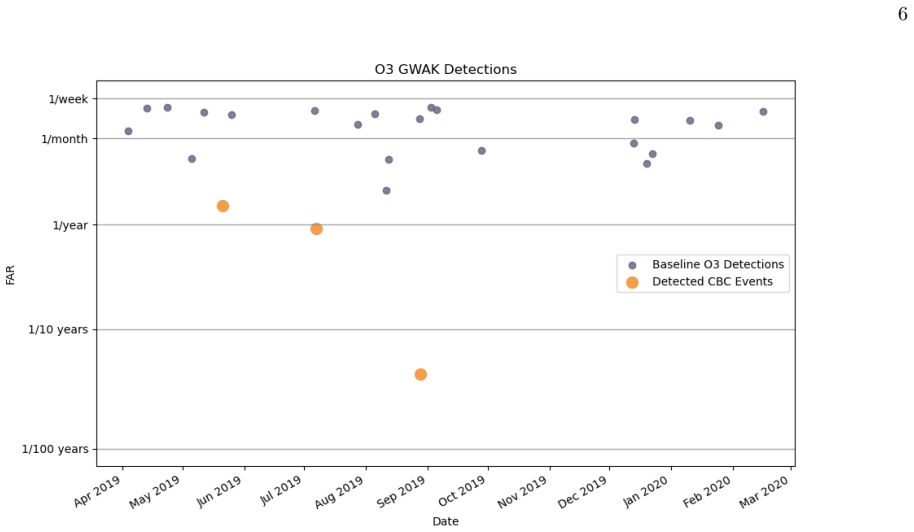
The central claim is that a semi-supervised autoencoder search, GWAK, can be applied directly to real O3 data and both reproduce established detections and bound what remains. Five recurrent autoencoders are trained separately on background noise, glitches, binary-black-hole mergers, and low- and high-frequency sine-Gaussian injections; their reconstruction losses, combined with a frequency-domain correlation between the two detectors, define a detection metric. A small heuristic model reweights events using one-second context and per-detector score asymmetries to suppress coincident glitches. Analyzing 203.3 days of Hanford-Livingston data, GWAK detects the known CBCs, most prominently GW190828_063405, and the loudest non-CBC candidate has an inverse false alarm rate of about one month and is identified as a glitch. The paper's conclusion is that, once known CBCs are excluded, the O3 data contain no statistically significant unmodeled gravitational-wave bursts, with 50% detection efficiency at a 1-per-100-year false alarm rate reaching $h_{\rm rss} \approx 0.55 \times 10^{-22}\,\mathrm{Hz}^{-1/2}$ for high-frequency sine-Gaussians.
Load-bearing premise
The reported false-alarm rates assume the roughly 1,000 years of time-shifted background events used to train the glitch-reweighting model were not also counted in the roughly 10,000 years of time-shifted background used to compute the final rates, and the paper does not explicitly say they were excluded.
Editorial extensions
If this is right
- GWAK recovers the known compact binary coalescences in O3, including GW190828_063405, so the method can serve as an independent check on template-based detections.
- The search remains background-consistent even when vetoed CAT2 periods are included, meaning future analyses need not discard those data.
- At a false alarm rate of one per hundred years, 50% detection efficiency is reached at $h_{\rm rss} \approx 0.55 \times 10^{-22}\,\mathrm{Hz}^{-1/2}$ for high-frequency sine-Gaussians, giving a concrete benchmark for other burst pipelines.
- After excluding known CBCs, no non-CBC event reaches the 1-in-100-year significance threshold, so the O3 data show no statistically significant unmodeled transient within GWAK's sensitivity.
Reading between the lines
- The sensitivity values in Table II could be converted into population upper limits for burst sources such as cosmic-string cusps or supernovae during O3, but the paper stops at reporting efficiency.
- Because the frequency-domain correlation replaces the costly time-sliding correlation, a low-latency version of the same search could plausibly run during O4, although real-time operation is not demonstrated here.
- Retraining the five autoencoders on each future run's own background would let the method track non-stationary detector noise without changing the architecture, a step the paper leaves for later work.
Editorial analysis
A structured set of objections, weighed in public.
Referee Report
Summary. The paper applies the GWAK semi-supervised neural-network framework to a search for unmodeled short-duration gravitational-wave transients in the H1 and L1 data from the third LIGO-Virgo-KAGRA observing run (O3). Five recurrent autoencoders are trained on background noise, glitches, and three injected signal classes (BBH, low-frequency sine-Gaussians, high-frequency sine-Gaussians); a linear classifier combines reconstruction losses and a frequency-domain correlation into a detection statistic, and a heuristic model reweights that statistic to suppress coincident and single-detector glitches. The search claims to recover three known CBCs and numerous glitches, to find no statistically significant unmodeled burst candidates after excluding known CBCs, and to achieve the sensitivity levels listed in Table II for several ad hoc burst morphologies.
Significance. If the methodology is sound, this is a useful demonstration that a semi-supervised machine-learning search can run on real GW detector data, recover known CBCs, and set burst-sensitivity benchmarks that are directly comparable with standard pipelines. The external verifiability of the recovered CBC events and the consistency of the cumulative FAR distribution with Poisson background are genuine strengths. The sensitivity numbers in Table II and the null result, however, inherit their validity from the false-alarm-rate estimation, and that estimation is exactly where the manuscript leaves a critical ambiguity. The paper therefore has the potential to be a valuable reference for ML-based unmodeled searches, but the central claims require an explicit and verifiable out-of-sample treatment of the training data.
major comments (3)
- [Section III.B and III.C] The autoencoders are trained on O3 background data, and the search is then run on the same O3 data and on timeslides built from that same data, but the manuscript never states that the segments used for training were excluded from the analyzed 203.3 days or from the timeslide pool used for the FAR calculation. If the networks have seen the exact noise realizations they are later scored on, their reconstruction errors are in-sample and the background score distribution is artificially favorable; this biases the mapping from detection statistic to FAR, which is load-bearing for the null result in Fig. 2 and for the sensitivities in Table II. The authors should either state explicitly that disjoint train and search segments were used, or rerun the evaluation on segments and timeslides that were never used to train the autoencoders.
- [Section III.D] The heuristic reweighting model is trained on a randomly sampled subset of the timeslides analyzed for the FAR calculation, but the text does not say that this subset was held out from the 10,000-year evaluation pool. Even if the subset was held out, the engineered features and the model architecture were chosen after inspecting the full 10,000-year background, so the evaluation pool informed model selection. This is not merely a cosmetic issue: the final detection statistic is the product of the GWAK score and the heuristic score, so any in-sample tuning of the heuristic directly changes the reported FARs and the Table II hrss thresholds. The authors need to clarify the holdout status and, if the subset was not held out, repeat the FAR estimation with a properly separated training and evaluation set.
- [Section IV and Fig. 2] The cumulative FAR plot in Fig. 2 compares the observed events with the expected mean background and Poisson bands derived from the same timeslide pipeline. If the training/evaluation overlap described above exists, the background model itself is biased and the agreement shown in Fig. 2 is not an independent validation of the null result. A clean test would be to recompute the FARs using timeslides built only from data segments never used in training, or to show that the background distribution is stable when the training set is resampled. Without such a check, the quoted 1-in-100-year threshold and the conclusion that no candidate passes it are not yet established.
minor comments (4)
- [Section III.A / III.B] The reader is told that the method improves on [43] by using 'real background data instead of simulated noise,' but the paper does not specify how much real background data was used for each autoencoder or how the training set was split by time; adding those numbers would make the in-sample risk much easier to assess.
- [Section III.C] The GPS range for O3b is printed as '125665561–1269363618'; the first number appears to be missing a digit (presumably 1256655618).
- [Section IV] The text uses 'iFAR' without defining it, and in one place says 'iFAR≥ 100 years' where it presumably means an inverse false-alarm rate of 1 per 100 years; please define the quantity and correct the phrasing.
- [Table II] The sensitivity entries are quoted without statistical uncertainties or the number of injections per morphology; adding these would make the comparison with other pipelines more meaningful.
Circularity Check
FAR calibration and Table II sensitivity are in-sample: the heuristic rejection model is trained on a subset of the very timeslide pool used to compute the reported false alarm rates, with no stated holdout.
-
fitted input called prediction
[Section III.D (Heuristic Model and Features), applied in Section III.C and Table II]
"To train this model, we used a randomly sampled subset of the timeslides analyzed for the false alarm rate calculations, consisting of ∼ 1000 years of background events as our negative examples, and a set of injected astrophysical signals as our positive examples."
The final detection statistic is the GWAK score multiplied by the heuristic score, and the heuristic is trained on background events drawn from the same timeslide pool that is then used to estimate the false alarm rates. Because the paper never states that the ~1000-year training subset was excluded from the 10,000-year evaluation pool, the score-to-FAR mapping is in-sample: the background model is fitted to the data on which the background rate is predicted. This directly calibrates the 1/100-year thresholds underlying Table II and the significance statements in Section IV, so the reported sensitivities and null result are partially forced by the fit rather than independently measured.
-
fitted input called prediction
[Section III.B (Training Dataset) and Section III.C (Computational limitations)]
"The excised glitches were assigned to a dedicated AE class, while the remaining background data served as the background for injections into the three signal classes and was also used to train the final background AE."
The background autoencoder is trained on O3 background data, and the same O3 data, time-shifted to produce timeslides, is used to evaluate the algorithm and compute 10,000 years of false-alarm statistics. No train/search split is stated. Each per-detector timeslide segment has therefore been seen in training, so background reconstruction errors can be artificially favorable, biasing the background score distribution and the FAR estimate. This is a train/evaluation overlap rather than a definitional equivalence, but it makes the background 'prediction' on the evaluation data partly an output of the training fit.
full rationale
The paper's central null result and its sensitivity table are not self-definitional: GWAK is applied to real O3 data, independently known CBCs are recovered, and the cumulative event rate is compared with a Poisson expectation. Those checks give the analysis external grounding. However, the statistical calibration is in-sample in two places. First, the heuristic reweighting model is trained on ~1000 years of timeslides 'randomly sampled' from the timeslides analyzed for the FAR calculation; without an explicit holdout, the FAR estimates and the 1/100-year efficiency values in Table II are computed on data that the classifier has already been fit to. Second, the background autoencoder is trained on O3 background and then evaluated on timeslides built from that same O3 background, again with no stated exclusion. Both effects mean the reported FARs and the sensitivity thresholds are partially determined by the training fit rather than being predictions on unseen data. The omissions are notational and easily fixed by a holdout statement, but as written they constitute a fitted input whose output is presented as a measured false-alarm rate. Self-citations to [43] for the GWAK architecture are not load-bearing circularity: the method reference is prior peer-reviewed work and the current paper's claims do not reduce to it. Score 6 reflects partial in-sample calibration of the central significance estimates, not equivalence of the whole derivation to its inputs.
Assumptions & free parameters
free parameters (5)
- Heuristic model weights =
not provided
- Delta (asymmetry offset) =
2
- L (scaled sigmoid sharpness) =
40
- Analysis window and frequency band =
50 ms, 30-1500 Hz
- Injection prior ranges (Table I) =
e.g., BBH chirp mass 25-100 Msun; SG Q=25-75, f=64-512 and 512-1024 Hz
assumptions (5)
- domain assumption Timeslide time shifts model the coincident noise background for false alarm rates
- domain assumption The five training classes (background, glitch, BBH, low/high-frequency SG) are representative enough for unmodeled burst sensitivity
- domain assumption Heuristic model training subset is not part of the FAR evaluation pool
- domain assumption Fourier-domain correlation captures the same inter-detector timing information as the time-domain Pearson statistic
- standard math Standard signal processing and neural-network training assumptions
Cite this review
Pith. "Pith review of A Neural Network-Based Search for Unmodeled Transients in LIGO-Virgo-KAGRA's Third Observing Run." pith.science (2026). https://pith.science/paper/YRITSSHT
@misc{pith2026241219883,
  author       = {Pith},
  title        = {Pith review of: A Neural Network-Based Search for Unmodeled Transients in LIGO-Virgo-KAGRA's Third Observing Run},
  year         = {2026},
  howpublished = {\url{https://pith.science/paper/YRITSSHT}},
  note         = {Machine review of arXiv:2412.19883}
}
read the original abstract
This paper presents the results of a Neural Network (NN)-based search for short-duration gravitational-wave transients in data from the third observing run of LIGO, Virgo, and KAGRA. The search targets unmodeled transients with durations of milliseconds to a few seconds in the 30-1500 Hz frequency band, without assumptions about the incoming signal direction, polarization, or morphology. Using the Gravitational Wave Anomalous Knowledge (GWAK) method, three compact binary coalescences (CBCs) identified by existing pipelines are successfully detected, along with a range of detector glitches. The algorithm constructs a low-dimensional embedded space to capture the physical features of signals, enabling the detection of CBCs, detector glitches, and unmodeled transients. This study demonstrates GWAK's ability to enhance gravitational-wave searches beyond the limits of existing pipelines, laying the groundwork for future detection strategies.
Figures


Figures from the paper (3 more)


Forward citations
Cited by 1 Pith paper
-
Searching for binary black hole mergers with deep learning in Advanced LIGO's third observing run
A hybrid matched-filter/deep-learning pipeline recovers 31 known O3 events and reports a new tentative high-mass candidate, with sensitivity comparable to existing searches only for chirp masses above 25 solar masses.
Reference graph
Works this paper leans on
-
[1]
B. P. Abbott et al. (LIGO Scientific Collaboration and Virgo Collaboration), Observation of gravitational waves from a binary black hole merger, Phys. Rev. Lett. 116, 061102 (2016)
2016
-
[2]
T. L. S. Collaboration and J. A. et al., Advanced LIGO, Classical and Quantum Gravity 32, 074001 (2015)
work page 2015
-
[3]
F. A. et al., Advanced virgo: a second-generation in- terferometric gravitational wave detector, Classical and Quantum Gravity 32, 024001 (2014)
work page 2014
-
[4]
Y. Aso, Y. Michimura, K. Somiya, M. Ando, O. Miyakawa, T. Sekiguchi, D. Tatsumi, and H. Ya- mamoto, Interferometer design of the kagra gravitational wave detector, Physical Review D 88, 10.1103/phys- revd.88.043007 (2013)
doi:10.1103/phys- 2013
-
[5]
R. Abbott et al. (LIGO Scientific, Virgo), GWTC-2: Compact Binary Coalescences Observed by LIGO and Virgo During the First Half of the Third Observing Run, Phys. Rev. X 11, 021053 (2021), arXiv:2010.14527 [gr- qc]
arXiv 2021
-
[6]
R. Abbott et al. (LIGO Scientific, VIRGO), GWTC-2.1: Deep extended catalog of compact binary coalescences observed by LIGO and Virgo during the first half of the third observing run, Phys. Rev. D 109, 022001 (2024), arXiv:2108.01045 [gr-qc]
arXiv 2024
-
[7]
B. P. Abbott, R. Abbott, and T. D. e. a. Abbott (LIGO Scientific Collaboration and Virgo Collaboration), Gwtc- 1: A gravitational-wave transient catalog of compact bi- nary mergers observed by LIGO and virgo during the first and second observing runs, Phys. Rev. X 9, 031040 (2019)
work page 2019
-
[8]
C. W. Helstrom, Statistical Theory of Signal Detection, 2nd ed. (Pergamon Press, 1968)
work page 1968
Show all 59 references
-
[9]
Allen et al., FINDCHIRP: An Algorithm for detection of gravitational waves from inspiraling compact binaries, Phys
B. Allen et al., FINDCHIRP: An Algorithm for detection of gravitational waves from inspiraling compact binaries, Phys. Rev. D 85, 122006 (2012), arXiv:gr-qc/0509116
2012 arXiv
-
[10]
Klimenko, I
S. Klimenko, I. Yakushin, A. Mercer, and G. Mitsel- makher, Coherent method for detection of gravitational wave bursts, Class. Quant. Grav. 25, 114029 (2008), arXiv:0802.3232 [gr-qc]
2008 arXiv
-
[11]
Lynch, S
R. Lynch, S. Vitale, R. Essick, E. Katsavounidis, and F. Robinet, Information-theoretic approach to the gravitational-wave burst detection problem, Phys. Rev. D 95, 104046 (2017), arXiv:1511.05955 [gr-qc]
2017 arXiv
-
[12]
Macquet, M.-A
A. Macquet, M.-A. Bizouard, N. Christensen, and M. Coughlin, Searches for long-duration gravitational wave transients in LIGO and Virgo data, in55th Rencon- tres de Moriond on Gravitation(2021) arXiv:2108.10033 [gr-qc]
2021 arXiv
-
[13]
N. J. Cornish and T. B. Littenberg, BayesWave: Bayesian Inference for Gravitational Wave Bursts and Instrument Glitches, Class. Quant. Grav. 32, 135012 (2015), arXiv:1410.3835 [gr-qc]
2015 arXiv
-
[14]
t. V. C. The LIGO Scientific Collaboration and the KAGRA Collaboration, All-sky search for short gravitational-wave bursts in the third advanced LIGO and advanced virgo run, Physical Review D 104, 10.1103/physrevd.104.122004 (2021)
2021 doi
-
[15]
Abbott et al
R. Abbott et al. (KAGRA, VIRGO, LIGO Scien- tific), All-sky search for long-duration gravitational-wave bursts in the third Advanced LIGO and Advanced Virgo run, Phys. Rev. D 104, 102001 (2021), arXiv:2107.13796 [gr-qc]
2021 arXiv
-
[16]
P. T. Baker, S. Caudill, K. A. Hodge, D. Talukder, C. Capano, and N. J. Cornish, Multivariate Classification with Random Forests for Gravitational Wave Searches of Black Hole Binary Coalescence, Phys. Rev. D 91, 062004 (2015), arXiv:1412.6479 [gr-qc]
2015 arXiv
-
[17]
George and E
D. George and E. Huerta, Deep Neural Networks to En- able Real-time Multimessenger Astrophysics, Phys. Rev. D 97, 044039 (2018), arXiv:1701.00008 [astro-ph.IM]
2018 arXiv
-
[18]
S. J. Kapadia, T. Dent, and T. Dal Canton, Classi- fier for gravitational-wave inspiral signals in nonideal single-detector data, Phys. Rev. D 96, 104015 (2017), arXiv:1709.02421 [astro-ph.IM]
2017 arXiv
-
[19]
George and E
D. George and E. Huerta, Deep Learning for Real-time Gravitational Wave Detection and Parameter Estima- tion: Results with Advanced LIGO Data, Phys. Lett. B 778, 64 (2018), arXiv:1711.03121 [gr-qc]
2018 arXiv
-
[20]
Gabbard et al., Matching matched filtering with deep networks for gravitational-wave astronomy, Phys
H. Gabbard et al., Matching matched filtering with deep networks for gravitational-wave astronomy, Phys. Rev. Lett. 120, 141103 (2018), arXiv:1712.06041 [astro- ph.IM]
2018 arXiv
-
[21]
A. L. Miller et al., How effective is machine learning to detect long transient gravitational waves from neutron stars in a real search?, Phys. Rev. D 100, 062005 (2019), arXiv:1909.02262 [astro-ph.IM]
2019 arXiv
-
[22]
Jadhav, N
S. Jadhav, N. Mukund, B. Gadre, S. Mitra, and S. Abra- ham, Improving significance of binary black hole mergers in Advanced LIGO data using deep learning: Confirma- tion of GW151216, Phys. Rev. D 104, 064051 (2021), arXiv:2010.08584 [gr-qc]
2021 arXiv
-
[23]
E. A. Huerta et al., Accelerated, scalable and repro- ducible AI-driven gravitational wave detection, Nature Astron. 5, 1062 (2021), arXiv:2012.08545 [gr-qc]
2021 arXiv
-
[24]
Jiang and Y
L. Jiang and Y. Luo, Convolutional transformer for fast and accurate gravitational wave detection, in 2022 26th International Conference on Pattern Recognition (ICPR) (2022) pp. 46–53
2022
-
[25]
Beveridge, Damon and McLeod, Alistair and Wen, Lin- qing and Wicenec, Andreas, A Novel Deep Learning Ap- proach to Detecting Binary Black Hole Mergers, (2023), arXiv:2308.08429 [gr-qc]
2023 arXiv
-
[26]
Marx et al., A machine-learning pipeline for real-time detection of gravitational waves from compact binary co- alescences, (2024), arXiv:2403.18661 [gr-qc]
E. Marx et al., A machine-learning pipeline for real-time detection of gravitational waves from compact binary co- alescences, (2024), arXiv:2403.18661 [gr-qc]
2024 arXiv
-
[27]
McLeod, D
A. McLeod, D. Beveridge, L. Wen, and A. Wicenec, A binary neutron star merger search pipeline powered by deep learning (2024), arXiv:2409.06266 [gr-qc]
2024 arXiv
-
[28]
Ormiston, T
R. Ormiston, T. Nguyen, M. Coughlin, R. X. Adhikari, and E. Katsavounidis, Noise Reduction in Gravitational- wave Data via Deep Learning, Phys. Rev. Res. 2, 033066 (2020), arXiv:2005.06534 [astro-ph.IM]
2020 arXiv
-
[29]
Bacon, A
P. Bacon, A. Trovato, and M. Bejger, Denoising gravitational-wave signals from binary black holes with dilated convolutional autoencoder, (2022), arXiv:2205.13513 [gr-qc]
2022 arXiv
-
[30]
Saleem et al., Demonstration of Machine Learning- assisted real-time noise regression in gravitational wave detectors, (2023), arXiv:2306.11366 [gr-qc]
M. Saleem et al., Demonstration of Machine Learning- assisted real-time noise regression in gravitational wave detectors, (2023), arXiv:2306.11366 [gr-qc]
2023 arXiv
-
[31]
Gunny, D
A. Gunny, D. Rankin, J. Krupa, M. Saleem, T. Nguyen, M. Coughlin, P. Harris, E. Katsavounidis, S. Timm, and B. Holzman, Hardware-accelerated Inference for Real- 10 Time Gravitational-Wave Astronomy, Nature Astron. 6, 529 (2022), arXiv:2108.12430 [gr-qc]
2022 arXiv
-
[32]
Liao and F.-L
C.-H. Liao and F.-L. Lin, Deep generative models of grav- itational waveforms via conditional autoencoder, Phys. Rev. D 103, 124051 (2021)
2021
-
[33]
Chatterjee, L
C. Chatterjee, L. Wen, F. Diakogiannis, and K. Vinsen, Extraction of binary black hole gravitational wave signals from detector data using deep learning, Physical Review D 104, 10.1103/physrevd.104.064046 (2021)
2021 doi
-
[34]
Sankarapandian and B
S. Sankarapandian and B. Kulis, β-Annealed Variational Autoencoder for glitches, (2021), arXiv:2107.10667 [cs.LG]
2021 arXiv
-
[35]
Morawski et al., Anomaly detection in gravitational waves data using convolutional autoencoders, Machine Learning: Science and Technology (2021)
F. Morawski et al., Anomaly detection in gravitational waves data using convolutional autoencoders, Machine Learning: Science and Technology (2021)
2021
-
[36]
Moreno, Source-Agnostic Gravitational-Wave Detec- tion with Recurrent Autoencoders: BBH Dataset (2021)
E. Moreno, Source-Agnostic Gravitational-Wave Detec- tion with Recurrent Autoencoders: BBH Dataset (2021)
2021
-
[37]
Verma, A
C. Verma, A. Reza, G. Gaur, D. Krishnaswamy, and S. Caudill, Detection of gravitational wave signals from precessing binary black hole systems using convolutional neural network (2024), arXiv:2206.12673 [gr-qc]
2024 arXiv
-
[38]
Baltus, J
G. Baltus, J. Janquart, M. Lopez, A. Reza, S. Caudill, and J.-R. Cudell, Convolutional neural networks for the detection of the early inspiral of a gravitational-wave sig- nal, Phys. Rev. D 103, 102003 (2021)
2021
-
[39]
P. G. Krastev, Real-time detection of gravitational waves from binary neutron stars using artificial neural net- works, Physics Letters B 803, 135330 (2020)
2020
-
[40]
George and E
D. George and E. A. Huerta, Deep neural networks to enable real-time multimessenger astrophysics, Phys. Rev. D 97, 044039 (2018)
2018
-
[41]
Nousi, A
P. Nousi, A. E. Koloniari, N. Passalis, P. Iosif, N. Ster- gioulas, and A. Tefas, Deep residual networks for gravita- tional wave detection, Phys. Rev. D 108, 024022 (2023)
2023
-
[42]
Skliris, M
V. Skliris, M. R. K. Norman, and P. J. Sutton, Real-time detection of unmodelled gravitational-wave transients using convolutional neural networks (2024), arXiv:2009.14611 [astro-ph.IM]
2024
-
[43]
Raikman et al., GW AK: gravitational-wave anomalous knowledge with recurrent autoencoders, Mach
R. Raikman et al., GW AK: gravitational-wave anomalous knowledge with recurrent autoencoders, Mach. Learn. Sci. Tech. 5, 025020 (2024), arXiv:2309.11537 [astro- ph.IM]
2024 arXiv
-
[44]
B. P. Abbott et al. (LIGO Scientific Collaboration and Virgo Collaboration), Optically targeted search for grav- itational waves emitted by core-collapse supernovae dur- ing the first and second observing runs of advanced LIGO and advanced Virgo, Phys. Rev. D 101, 084002 (2020)
2020
-
[45]
B. P. Abbott et al. (LIGO Scientific Collaboration and Virgo Collaboration), Search for transient gravitational- wave signals associated with magnetar bursts during ad- vanced ligo’s second observing run, Astrophys. J. 874, 163 (2019)
2019
-
[46]
Abadie et al
J. Abadie et al. (LIGO Scientific Collaboration), Search for gravitational waves associated with the August 2006 timing glitch of the Vela pulsar, Phys. Rev. D 83, 042001 (2011)
2011
-
[47]
Ebersold and S
M. Ebersold and S. Tiwari, Search for nonlinear memory from subsolar mass compact binary mergers, Phys. Rev. D 101, 104041 (2020)
2020
-
[48]
Abbott et al
R. Abbott et al. (LIGO Scientific Collaboration, Virgo Collaboration and KAGRA Collaboration), Constraints on cosmic strings using data from the third Advanced LIGO-Virgo observing run, Phys. Rev. Lett. 126, 241102 (2021)
2021
-
[49]
B. P. Abbott et al.(LIGO Scientific Collaboration, Virgo Collaboration), All-sky search for short gravitational- wave bursts in the second advanced LIGO and advanced virgo run, Phys. Rev. D 100, 024017 (2019)
2019
-
[50]
Abbott et al
R. Abbott et al. (LIGO Scientific Collaboration, Virgo Collaboration and KAGRA Collaboration), Intermediate mass black hole binary search in the third observing run of advanced LIGO and advanced virgo, arXiv e-prints (2021), arXiv:2105.15120 [astro-ph]
2021 arXiv
-
[51]
t. V. C. The LIGO Scientific Collaboration and the KA- GRA Collaboration, Open data from the third observing run of LIGO, virgo, kagra, and geo, The Astrophysical Journal Supplement Series 267, 29 (2023)
2023
-
[52]
Buikema et al., Sensitivity and performance of the ad- vanced LIGO detectors in the third observing run, Phys
A. Buikema et al., Sensitivity and performance of the ad- vanced LIGO detectors in the third observing run, Phys. Rev. D 102, 062003 (2020)
2020
-
[53]
B. P. Abbott et al., Characterization of transient noise in advanced LIGO relevant to gravitational wave signal gw150914, Class. Quant. Grav. 33, 134001 (2016)
2016
-
[54]
Nguyen et al
P. Nguyen et al. , Environmental noise in advanced LIGO detectors, arXiv e-prints (2021), arXiv:2101.09935 [astro-ph.IM]
2021 arXiv
-
[55]
Effler, R
A. Effler, R. M. S. Schofield, V. V. Frolov, G. Gonz´ alez, K. Kawabe, J. R. Smith, J. Birch, and R. McCarthy, En- vironmental influences on the LIGO gravitational wave detectors during the 6th science run, Class. Quant. Grav. 32, 035017 (2015)
2015
-
[56]
B. P. Abbott et al. (LIGO Scientific Collaboration and Virgo Collaboration), Effects of data quality vetoes on a search for compact binary coalescences in advanced ligo’s first observing run, Class. Quant. Grav. 35, 065010 (2018)
2018
-
[57]
Aasi et al
J. Aasi et al. (LIGO Scientific), Advanced LIGO, Class. Quant. Grav. 32, 074001 (2015), arXiv:1411.4547 [gr-qc]
2015 arXiv
-
[58]
Robinet, N
F. Robinet, N. Arnaud, N. Leroy, A. Lundgren, D. Macleod, and J. McIver, Omicron: a tool to char- acterize transient noise in gravitational-wave detectors, SoftwareX 12, 100620 (2020), arXiv:2007.11374 [astro- ph.IM]
2020 arXiv
-
[59]
Nitz et al., gwastro/pycbc: Pycbc release v1.16.9 (2020)
A. Nitz et al., gwastro/pycbc: Pycbc release v1.16.9 (2020)
2020
Reviewed August 10, 2026 · model on record in the stance chip above.
Discussion (0). Continue with ORCID to comment.