REVIEW 4 major objections 5 minor 67 references
Hybrid Fourier Neural Operator-Plasma Fluid Model for Fast and Accurate Multiscale Simulations of High Power Microwave Breakdown
T0 review · 4 major / 5 minor · reviewed 2026-08-05 · deepseek-v4-flash
Pith's one-line read A neural network that replaces the electromagnetic field solver reproduces microwave streamer growth and runs roughly 60 times faster than the full FDTD-plasma fluid model.
desk verdict A useful proof-of-concept for embedding an FNO surrogate in a coupled EM-plasma fluid solver, with a credible 60x speedup and good qualitative streamer agreement, but the paper overstates its closed-loop fidelity and has a normalization leakage that should be fixed. read the letter →
The pith
A machine-rendered reading of the paper's core claim, the machinery that carries it, and where it could break.
The reading
What carries the argument
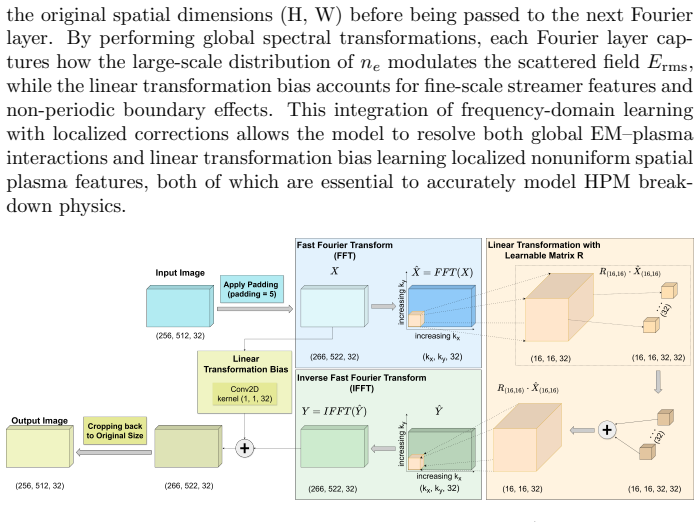
The load-bearing component is a Fourier Neural Operator used as an image-to-image surrogate: the input is a two-channel image of normalized plasma density and incident electric field, and the output is the scattered RMS electric field. Four Fourier layers, each retaining 16 low-frequency modes, learn the global EM-plasma coupling in the spectral domain, while a pointwise convolution bias captures localized streamer-tip features. In the closed loop, the surrogate replaces the per-wave-cycle FDTD EM update; the C-based plasma solver advances electron density once per EM wave cycle using transport coefficients computed from the predicted RMS field.
What would settle it
Run the closed-loop hybrid and the full FDTD-fluid model on the same unseen case, say E0 = 2.75 MV/m, but continue past the paper's 80%-of-domain termination condition; if streamer length or tip field diverges from the reference after the training horizon, the no-error-accumulation assumption fails.
Extended reading notes
Core claim
The paper's central claim is that the expensive finite-difference time-domain electromagnetic solver inside a coupled EM-plasma fluid model for high-power microwave breakdown can be replaced by a Fourier Neural Operator surrogate without losing the physics of streamer formation. Trained on scattered-field snapshots from an in-house FDTD-plasma fluid solver, the surrogate maps a two-channel snapshot of plasma density and incident field to the RMS scattered electric field. When cycled against the unchanged plasma continuity solver, the hybrid reproduces streamer length, streamer growth rate, and tip electric field enhancement for unseen incident fields of 2.55, 2.65, 2.75, 2.85, and 2.95 MV/m,
Load-bearing premise
That the roughly 12 percent average error in each predicted field snapshot does not compound through the nonlinear field–plasma feedback into uncontrolled streamer growth over the hundreds of update cycles of a full simulation.
Editorial extensions
If this is right
- A 10λ × 10λ domain that the paper estimates at roughly 500 days with the reference FDTD-fluid model would become a few days of computation at the measured speedup.
- Parameter sweeps over incident field amplitude inside the trained 2.5–3.0 MV/m range could be run quickly, making breakdown-threshold and streamer-dynamics studies practical.
- The hybrid retains the plasma continuity equation solver, so the acceleration comes without replacing the fluid description of plasma evolution.
- The demonstrated Python–shared-library–C interface offers a template for retrofitting other legacy compiled EM-plasma codes with machine-learning surrogates.
Reading between the lines
- The 60x figure is tied to the EM update consuming more than 99 percent of runtime; a problem where other physics takes a larger share would show a smaller speedup.
- Training and testing cover only 2.5–3.0 MV/m at 110 GHz and 760 Torr, so behavior outside that interval of field amplitude, pressure, or frequency remains an open question.
- At a reported per-cycle average percent error near 12 percent, the long-horizon reliability of the closed loop depends on error cancellation; measuring the growth rate of streamer-length error over many cycles would make that assumption quantitative.
- Because the surrogate predicts time-averaged RMS fields, sub-cycle electromagnetic dynamics that matter for gas heating or higher-harmonic effects are outside what this architecture captures.
Signed reviews
Editorial analysis
A structured set of objections, weighed in public.
Referee Report
Summary. The paper presents a hybrid simulation framework for high-power microwave (HPM) breakdown in which a Fourier Neural Operator (FNO) replaces the FDTD-based electromagnetic solver inside an established EM-plasma fluid model. The FNO maps a two-channel input (plasma density and incident electric field) to the scattered RMS electric field; the plasma continuity solver and the Python/C coupling are retained. The FNO is trained on data generated by the same FDTD-fluid solver, and the hybrid model is tested on incident amplitudes (2.55, 2.65, 2.75, 2.85, 2.95 MV/m) not used in training. The authors report FNO stand-alone metrics (MSE 0.0394, APE 0.12, SSIM 0.9999), near-perfect overlap of streamer length, growth rate, and tip field between the hybrid and full FDTD-fluid models, and a speedup of roughly 57-63x. The manuscript also documents a modular Python-C implementation that may facilitate adoption of ML surrogates in legacy plasma codes.
Significance. If the central claims survive scrutiny, the paper demonstrates a practical and transferable strategy for accelerating multiscale EM-plasma simulations: the FNO surrogate is coupled in a closed loop with a conventional plasma-fluid solver, achieving an order-of-magnitude speedup while closely matching the reference solution. The work's strengths include the use of an established FDTD plasma-fluid model for data generation, a non-trivial closed-loop coupling, and a concrete runtime comparison (Table 2). The reported speedup is attractive for parametric studies and for extending simulations to larger domains. However, the validation is limited in important ways: the FNO is trained on and compared against the same numerical solver, the test amplitudes are interpolated within the training range, the normalization uses test-set statistics, and the closed-loop error accumulation is not quantified. These issues do not invalidate the framework but materially weaken the current evidence for 'near-perfect' fidelity and broad generalization.
major comments (4)
- [Section 4.1] The min-max normalization is performed using global minimum and maximum values computed over the entire training and testing sets, for both the input channels and the output Erms. This is a data-leakage issue: the test-set statistics are used during training preprocessing, which can artificially improve the reported MSE/APE/SSIM. Since the incident-field channel encodes E0 directly and the test E0 values lie between training values, the benefit may be substantial. The authors should re-normalize using training-set statistics only and report the resulting metrics.
- [Section 4.1 / Table 1] The five 'unseen' incident amplitudes, 2.55, 2.65, 2.75, 2.85, and 2.95 MV/m, are exactly the midpoints between the training amplitudes (2.5, 2.6, ..., 3.0 MV/m). This is an interpolation test, not a test of generalization to 'any electric field within the specified range' or to new physical regimes. Because the FNO input includes the incident field amplitude, the model can exploit the local linearity of the training sweep. The claims of generalization should be restricted to interpolation within the tested range, and the authors should include an extrapolation case (e.g., E0=3.1 MV/m) or a test with a different frequency/domain to support broader claims.
- [Section 5, Section 5.2] The closed-loop stability of the FNO-fluid coupling is not quantitatively established. The manuscript itself warns that 'even a small discontinuity or mismatch in prediction of E_rms could lead to uncontrolled plasma streamer growth over long durations' (Section 5). The standalone APE is about 12%, and the plasma update (Eq. 6) is nonlinear and ionization-dominated; errors in the predicted Erms can be amplified or rectified over hundreds of update cycles. The current validation overlays streamer length, growth rate, and tip-field curves but provides no per-cycle error measured along the actual hybrid trajectory, no perturbed-initial-condition experiments, and no error-growth bound. Without such an analysis, the statement that hybrid predictions show 'almost perfect overlap' is not yet supported. At minimum, the authors should report error bars or quantiles for the curves in Figures 11-12
- [Sections 3 and 5.1] It is ambiguous whether the FNO predicts the scattered Erms or the total Erms. The text in Section 3 says the FNO 'predict the scattered electric field (E_rms)', while Section 5.1 compares 'FNO predicted and actual FDTD generated E_rms data'. In the coupled model, the plasma solver needs the total (or effective) field to compute ionization and transport coefficients, but if the FNO outputs only the scattered field, the incident contribution must be added analytically. The paper does not clearly state which quantity is used in Eq. (6). This is essential for interpreting the reported MSE/APE and for reproducing the hybrid implementation. Please clarify the output definition and how the total Erms is assembled in the loop.
minor comments (5)
- [Abstract / throughout] Typos: 'sceince' in the abstract, 'suare' in Section 2.2, 'therfore' in Section 2.1. Please proofread.
- [Section 5.2 / Table 2 / Conclusion] The speedup numbers are inconsistent: Section 5.2 reports 57.10-62.77x, the abstract says 'of the order of 60X', and the conclusion says 'between 55x to 60x'. The Table 2 values should be cited consistently.
- [Section 2.2] The text refers to 'Figure 2 (a)' when discussing plasma density evolution and streamer dynamics, but the relevant panels appear to be in Figure 3. Please correct the cross-references.
- [Section 4.2.1] The description of the Fourier layer is inconsistent: it says only the lowest m=16 modes are retained, but Eq. (8) says 'leaving higher modes unchanged'. Please clarify whether higher modes are set to zero, retained, or processed differently.
- [Section 4.1] All metrics (MSE, APE, SSIM) are computed on the min-max normalized, 0-255-rescaled images. Reporting values on this scale, rather than in physical units (V/m and m^-3), makes the errors harder to interpret. Please report at least one error metric in physical units.
Circularity Check
No significant circularity: the FNO is a surrogate for the FDTD solver and is evaluated on held-out incident amplitudes; the closed-loop streamer agreement is an emergent, nontrivial result despite sharing the same reference solver.
full rationale
The paper's derivation chain is a supervised surrogate construction, not a first-principles derivation. Section 4.1 states 'The data required for model training and testing has been generated using the FDTD-based HPM breakdown simulation described in subsection 2.2,' and Section 5.2 validates by comparing hybrid predictions against 'the FDTD-based plasma fluid model.' At first glance this looks like validating on the training-data source, but the test protocol uses electric-field amplitudes '2.55, 2.65, 2.75, 2.85 and 2.95 MV/m' that were not used during training (Section 4.1), and the compared quantities -- streamer length, growth rate, and tip Erms in Figures 11-12 -- are not direct FNO outputs; they emerge from the closed-loop iteration of the FNO field surrogate with the unchanged plasma continuity solver (Eq. 6). Thus the near-overlap is not forced by construction: the FNO could have drifted in the nonlinear ionization-diffusion feedback loop. The physical model and transport coefficients are cited to prior work including the authors' own [9,10,11], but those are standard, externally published plasma-fluid models, not an imported uniqueness theorem that forbids alternatives; no load-bearing self-citation chain is used to justify the central claim. The absence of a quantitative closed-loop error-amplification bound (the paper itself warns in Section 5 that 'even a small discontinuity or mismatch in prediction of Erms could lead to uncontrolled plasma streamer growth over long durations') is a correctness/stability concern, not a circularity. Score 1 reflects only minor self-citations for the base physical model and scaling estimates, none of which make the result equivalent to its inputs.
Assumptions & free parameters
free parameters (3)
- FNO neural network weights =
Learned during training
- FNO hyperparameters =
4 Fourier layers, 16 modes, 32 latent channels, zero-padding 5, lr 1e-3, batch 32, 300 epochs
- Min-max normalization bounds =
Computed from training and test sets combined
assumptions (6)
- domain assumption Plasma is quasi-neutral and ion current is negligible
- domain assumption Cycle-averaged plasma continuity equation with only diffusive flux
- domain assumption Electron temperature is constant at 2 eV and gas temperature stays constant
- domain assumption Effective field approximation determines transport coefficients
- standard math Scattered-field FDTD with Mur absorbing boundary conditions is the reference solver
- ad hoc to paper FNO can learn the mapping (ne, incident field) -> Erms and generalize over the tested range
Cite this review
Pith. "Pith review of Hybrid Fourier Neural Operator-Plasma Fluid Model for Fast and Accurate Multiscale Simulations of High Power Microwave Breakdown." pith.science (2026). https://pith.science/paper/247K6EBZ
@misc{pith2026250905799,
  author       = {Pith},
  title        = {Pith review of: Hybrid Fourier Neural Operator-Plasma Fluid Model for Fast and Accurate Multiscale Simulations of High Power Microwave Breakdown},
  year         = {2026},
  howpublished = {\url{https://pith.science/paper/247K6EBZ}},
  note         = {Machine review of arXiv:2509.05799}
}
read the original abstract
Modeling and simulation of High Power Microwave (HPM) breakdown, a multiscale phenomenon, is computationally expensive and requires solving Maxwell's equations (EM solver) coupled with a plasma continuity equation (plasma solver). In this work, we present a hybrid modeling approach that combines the accuracy of a differential equation-based plasma fluid solver with the computational efficiency of FNO (Fourier Neural Operator) based EM solver. Trained on data from an in-house FDTD-based plasma-fluid solver, the FNO replaces computationally expensive EM field updates, while the plasma solver governs the dynamic plasma response. The hybrid model is validated on microwave streamer formation, due to diffusion ionization mechanism, in a 2D scenario for unseen incident electric fields corresponding to entirely new plasma streamer simulations not included in model training, showing excellent agreement with FDTD based fluid simulations in terms of streamer shape, velocity, and temporal evolution. This hybrid FNO based strategy delivers significant acceleration of the order of 60X compared to traditional simulations for the specified problem size and offers an efficient alternative for computationally demanding multiscale and multiphysics simulations involved in HPM breakdown. Our work also demonstrate how such hybrid pipelines can be used to seamlessly to integrate existing C-based simulation codes with Python-based machine learning frameworks for simulations of plasma science and engineering problems.
Figures


Figures from the paper (9 more)




Reference graph
Works this paper leans on
-
[1]
A. D. Macdonald.”Microwave breakdown in gases”. Wiley, New York, 1966
work page 1966
- [2]
-
[3]
A. I. Saifutdinov, A. G. Karpenko, and V. A. Lashkov. Dynamics of focused pulsed microwave discharge in air.Plasma Phys. Rep., 45(6):602–609, jun 2019
work page 2019
-
[4]
A. I. Saifutdinov and E. V. Kustova. Dynamics of plasma formation and gas heating in a focused-microwave discharge in nitrogen.J. Appl. Phys., 129(2):023301, 2021
work page 2021
-
[5]
A. M. Cook, J. S. Hummelt, M. A. Shapiro, and R. J. Temkin. Mea- surements of electron avalanche formation time in W-band microwave air breakdown.Phys. Plasmas, 18(8):080707, 2011
work page 2011
-
[6]
R. Anirudh, R. Archibald, M. Asif, M. Becker, S. Benkadda, P.-T. Bremer, R. Bud´ e, C. Chang, L. Chen, R. Churchill, J. Citrin, J. Gaffney, A. Gainaru, W. Gekelman, T. Gibbs, S. Hamaguchi, C. Hill, K. Humbird, S. Jalas, and X. Zhang. 2022 review of data-driven plasma science.IEEE Transactions on Plasma Science, PP:1–89, 07 2023
work page 2022
- [7]
-
[8]
B. Chaudhury, A. Gupta, H. Shah, and S. Bhadani. Accelerated simulation of microwave breakdown in gases on Xeon Phi based cluster-application to self-organized plasma pattern formation.Comput. Phys. Commun., 229:20 – 35, 2018. 24
work page 2018
Show all 67 references
-
[9]
Chaudhury, J
B. Chaudhury, J. P. Boeuf, and G. Q. Zhu. Pattern formation and propa- gation during microwave breakdown.Phys. Plasmas, 17(12):123505, 2010
2010
-
[10]
Chaudhury, J
B. Chaudhury, J. P. Boeuf, G. Q. Zhu, and O. Pascal. Physics and mod- elling of microwave streamers at atmospheric pressure.J. Appl. Phys., 110(11):113306, 2011
2011
-
[11]
Chaudhury and J-P Boeuf
B. Chaudhury and J-P Boeuf. Computational Studies of Filamentary Pat- tern Formation in a High Power Microwave Breakdown Generated Air Plasma.IEEE Transactions on Plasma Science, 38(9):2281–2288, 2010
2010
-
[12]
Brovkin and P
V. Brovkin and P. Vedenin. Study of the microwave streamer evolution using a new semi-analytical model.Journal of Applied Physics, 128:113301, 09 2020
2020
-
[13]
Brunton and J
S. Brunton and J. Kutz.Data-Driven Science and Engineering: Machine Learning, Dynamical Systems, and Control. 06 2022
2022
-
[14]
Carleo, I
G. Carleo, I. Cirac, K. Cranmer, L. Daudet, M. Schuld, N. Tishby, L. Vogt, and L. Zdeborova. Machine learning and the physical sciences.Reviews of Modern Physics, 91, 12 2019
2019
-
[15]
Chinesta and E
F. Chinesta and E. Cueto. Empowering engineering with data, machine learning and artificial intelligence: a short introductive review.Advanced Modeling and Simulation in Engineering Sciences, 9:21, 10 2022
2022
-
[16]
A. Cook, M. Shapiro, and R. Temkin. Pressure dependence of plasma structure in microwave gas breakdown at 110 ghz.Applied Physics Letters - APPL PHYS LETT, 97:1504–011504, 07 2010
2010
-
[17]
Desai, P
M. Desai, P. Ghosh, A. Kumar, and B. Chaudhury. Deep-learning architecture-based approach for 2-d-simulation of microwave plasma inter- action.IEEE Transactions on Microwave Theory and Techniques, PP:1–10, 12 2022
2022
-
[18]
Fukunari.Experimental Studies of Microwave Discharge Induced by Gyrotron, pages 105–141
M. Fukunari.Experimental Studies of Microwave Discharge Induced by Gyrotron, pages 105–141. 05 2024
2024
-
[19]
Fukunari, S
M. Fukunari, S. Tanaka, R. Shinbayashi, Y. Yamaguchi, Y. Tatematsu, and T. Saito. Observation of a comb-shaped filamentary plasma array under subcritical condition in 303-ghz millimetre-wave air discharge.Scientific Reports, 9:17972, 11 2019
2019
-
[20]
Fuster, G
L. Fuster, G. Hagelaar, R. Pascaud, A. Simon, P. Hoffmann, L. Liard, O. Pascal, and T. Callegari. Plasma-based microwave power limitation in a printed transmission line: a self-consistent model compared with experi- mental data.Plasma Sources Science and Technology, 31, 02 2022
2022
-
[21]
G. Mur. Absorbing Boundary Conditions for the Finite-Difference Ap- proximation of the Time-Domain Electromagnetic-Field Equations.IEEE Trans. Electromagn. Compat., EMC-23(4):377–382, Nov 1981. 25
1981
-
[22]
Ghosh and B
P. Ghosh and B. Chaudhury. Efficient dynamic mesh refinement technique for simulation of hpm breakdown-induced plasma pattern formation.IEEE Transactions on Plasma Science, 51(1):66–74, 2023
2023
-
[23]
Ghosh, B
P. Ghosh, B. Chaudhury, S. Purohit, V. Joshi, A. Kothari, and D. Shetran- jiwala. Deep learning assisted microwave-plasma interaction based tech- nique for plasma density estimation.Journal of Physics D: Applied Physics, 57, 10 2023
2023
-
[24]
Gopakumar, S
V. Gopakumar, S. Pamela, L. Zanisi, Z. Li, A. Gray, D. Brennand, N. Bha- tia, G. Stathopoulos, M. Kusner, M. Deisenroth, and A. Anandkumar. Plasma surrogate modelling using fourier neural operators.Nuclear Fu- sion, 64, 04 2024
2024
-
[25]
J. B. Michael, A. Dogariu, M. N. Shneider, and R. B. Miles. Subcriti- cal microwave coupling to femtosecond and picosecond laser ionization for localized, multipoint ignition of methane/air mixtures.J. Appl. Phys., 108(9):093308, 2010
2010
-
[26]
J. Benford. Space Applications of High-Power Microwaves.IEEE Trans Plasma Sci, 36:569 – 581, 07 2008
2008
-
[27]
J. P. Boeuf, B. Chaudhury, and G. Q. Zhu. Theory and Modeling of Self- Organization and Propagation of Filamentary Plasma Arrays in Microwave Breakdown at Atmospheric Pressure.Phys. Rev. Lett., 104:015002, Jan 2010
2010
-
[28]
Kourtzanidis, J
K. Kourtzanidis, J. P. Boeuf and F. Rogier. Three dimensional simula- tions of pattern formation during high-pressure, freely localized microwave breakdown in air.Phys. Plasmas, 21(12):123513, 2014
2014
-
[29]
Kurtzanidis, F
K. Kurtzanidis, F. Rogier, and J. P. Boeuf. Gas heating effects on the formation and propagation of a microwave streamer in air.J. Appl. Phys., 118:103301, 09 2015
2015
-
[30]
K. S. Yee. Numerical solution of initial boundary value problems involving maxwell’s equations in isotropic media.IEEE Trans. Antennas Propag., 14(3):302–307, 1966
1966
-
[31]
K. V. Aleksandrov, L. P. Grachev, I. I. Esakov, V. V. Fedorov, and K. V. Khodataev. Domains of existence of various types of microwave discharge in quasi-optical electromagnetic beams.Tech. Phys., 51(11):1448–1456, Nov 2006
2006
-
[32]
K. V. Khodataev. Microwave Discharges and Possible Applications in Aerospace Technologies.J. Propuls. Power, 24(5):962–972, 2008
2008
-
[33]
Karniadakis, Y
G. Karniadakis, Y. Kevrekidis, L. Lu, P. Perdikaris, S. Wang, and L. Yang. Physics-informed machine learning.Nature Reviews Physics, pages 1–19, 05 2021. 26
2021
-
[34]
Kunz and R.J
K.S. Kunz and R.J. Luebbers.The Finite Difference Time Domain Method for Electromagnetics. Taylor & Francis, 1993
1993
-
[35]
G. Li, T. Shu, C. Yuan, J. Yang, J. Yang, Z. Jin, Y. Yin, D. Wu, J. Zhu, H. Ren, and J. Yang. Coupling output of multichannel high power mi- crowaves.Physics of Plasmas, 17:123110–123110, 12 2010
2010
-
[36]
Z. Li, N. Kovachki, K. Azizzadenesheli, B. Liu, K. Bhattacharya, A. Stu- art, and A. Anandkumar. Fourier neural operator for parametric partial differential equations.arXiv preprint arXiv:2010.08895, 2020
2010 arXiv
-
[37]
M. Lino, S. Fotiadis, A. Bharath, and C. Cantwell. Current and emerging deep-learning methods for the simulation of fluid dynamics.Proceedings of the Royal Society A, 479, 07 2023
2023
-
[38]
Fukunari, T
M. Fukunari, T. Yamaguchi, Y. Nakamura, K. Komurasaki, Y. Oda, K. Kajiwara, K. Takahashi, and K. Sakamoto. Thrust generation experiments on microwave rocket with a beam concentrator for long distance wireless power feeding.Acta Astronaut., 145:263–267, Apr. 2018
2018
-
[39]
Takahashi and N
M. Takahashi and N. Ohnishi. Gas propellant dependency of plasma structure and thrust performance of microwave rocket.J. Appl. Phys., 125(16):163303, 2019
2019
-
[40]
Takahashi, Y
M. Takahashi, Y. Kageyama, and N. Ohnishi. Joule-heating-supported plasma filamentation and branching during subcritical microwave irradia- tion.AIP Adv., 7(5):055206, 2017
2017
-
[41]
C. Meng, S. Griesemer, D. Cao, S. Seo, and Y. Liu. When physics meets machine learning: a survey of physics-informed machine learning.Machine Learning for Computational Science and Engineering, 1, 05 2025
2025
-
[42]
Bulat, I
P. Bulat, I. Esakov, L. Grachev and K. Volkov and I. Volobuev. Experimen- tal Study of Air Breakdown Induced by Subcritical Streamer Microwave Discharge.IEEE Trans. Plasma Sci., 49(3):1041–1049, 2021
2021
-
[43]
Ghosh and B
P. Ghosh and B. Chaudhury. Mesh Refinement Based Simulation of Com- plex Plasma Dynamics during High Power Millimeter Wave Breakdown. In 2020 IEEE MTT-S Int. Conf. Numer. Electromagn. Multiphys. Modeling and Optimization (NEMO), pages 1–4, Dec 2020
2020
-
[44]
Ghosh and B
P. Ghosh and B. Chaudhury. Computational Investigation of Microwave Breakdown in HPM Switching and Protection. In2021 IEEE MTT-S In- ternational Microwave and RF Conference (IMARC), pages 1–4, 2021
2021
-
[45]
Zhao , C
P. Zhao , C. Liao, W. Lin, L. Chang, and H. Fu. Numerical studies of the high power microwave breakdown in gas using the fluid model with a mod- ified electron energy distribution function.Phys. Plasmas, 18(10):102111, 2011. 27
2011
-
[46]
Zhou and Z
Q. Zhou and Z. Dong. Modeling study on pressure dependence of plasma structure and formation in 110 GHz microwave air breakdown.Appl. Phys. Lett., 98(16):161504, 2011
2011
-
[47]
S. C. Schaub, J. S. Hummelt, W. C. Guss, M. A. Shapiro and R. J. Temkin. Electron density and gas density measurements in a millimeter-wave dis- charge.Phys. Plasmas, 23(8):083512, 2016
2016
-
[48]
Gold and G
S. Gold and G. Nusinovich. Review of high-power microwave source re- search.Rev. Sci. Instrum., 68:3945–3974, 11 1997
1997
-
[49]
S. K. Nam and J. P. Verboncoeur. Theory of Filamentary Plasma Array Formation in Microwave Breakdown at Near-Atmospheric Pressure.Phys. Rev. Lett., 103:055004, Jul 2009
2009
-
[50]
S. Yan , A. D. Greenwood, and J. Jin. Simulation of High-Power Microwave Air Breakdown Modeled by a Coupled Maxwell Euler System With a Non- Maxwellian EEDF.IEEE Trans. Antennas Propag., 66(4):1882–1893, April 2018
2018
-
[51]
S. Yan, A. D. Greenwood, and J. Jin. Modeling of Plasma Formation During High-Power Microwave Breakdown in Air Using the Discontinu- ous Galerkin Time-Domain Method.IEEE J. Multiscale and Multiphys. Comput. Techn., 1:2–13, 2016
2016
-
[52]
Saifutdinov and E
A. Saifutdinov and E. Kustova. Simulation of filamentation dynamics of microwave discharge in nitrogen.Plasma Sources Science and Technology, 32, 12 2023
2023
-
[53]
Sharma, R
A. Sharma, R. Upadhyay, A. Karpatne, V. Subramaniam, D. Breden, and L. Raja. Modeling of atmospheric gas-stream processing using a microwave excited all-dielectric resonant plasma discharge.Journal of Physics D: Ap- plied Physics, 54, 08 2021
2021
-
[54]
Gedney.Introduction to the Finite-Difference Time-Domain (FDTD) Method for Electromagnetics
Stephen D. Gedney.Introduction to the Finite-Difference Time-Domain (FDTD) Method for Electromagnetics. Morgan & Claypool, 2011
2011
-
[55]
Suzuki, M
S. Suzuki, M. Matsukura, T. Yamada, Y. Masuda, M. Takahashi, K. Shi- mamura, R. Minami, and T. Kariya. Experimental demonstration of in- terferometric discharge structure identification of atmospheric millimeter- wave discharge at subcritical conditions using 28 ghz gyrotron.P...
2025
-
[56]
T. Tang, C. Liao, P. Zhao, Q. Gao and Y. Wu. Breakdown characteristics of ultra-wideband high-power microwave transmission through the lower atmosphere. In2010 Int. Conf. Microw. Millim. Wave Technol., pages 805–808, 2010. 28
2010
-
[57]
Tabata, A
K. Tabata, A. Manabe, K. Komurasaki, and Y. Oda. Observation of atmospheric millimeter-wave discharges at 94 ghz and comparison with other microwave and millimeter-wave frequencies.Applied Physics Letters, 124:263903, 06 2024
2024
-
[58]
Takahashi
M. Takahashi. Discharge from a high-intensity millimeter wave beam and its application to propulsion.Advances in Physics: X, 3:1417744, 01 2018
2018
-
[59]
Takahashi and Y
M. Takahashi and Y. Nakamura.Modeling and Theoretical Studies on Beamed-Induced Plasma, pages 143–178. Springer Nature Singapore, Sin- gapore, 2024
2024
-
[60]
V. E. Semenov, E. I. Rakova, M Yu Glyavin and G. S. Nusinovich. Study of a Stationary Breakdown Wave Under the Conditions of Noticeable Reflec- tion of the Incident Electromagnetic Wave from a Gas-Discharge Plasma. Radiophys. Quantum Electron., 58(5):327–338, Oct. 2015
2015
-
[61]
J. M. Woo, M. Ju, and J.-B. Lee. Plasma-discharge-integrated slot structure for microwave power limiter.Scientific Reports, 13, 06 2023
2023
-
[62]
Hidaka, E
Y. Hidaka, E. M. Choi, I. Mastovsky, M. A. Shapiro, J. R. Sirigiri, and R. J.Temkin. Observation of Large Arrays of Plasma Filaments in Air Break- down by 1.5-MW 110-GHz Gyrotron Pulses.Phys. Rev. Lett., 100:035003, Jan 2008
2008
-
[63]
Nakamura, K
Y. Nakamura, K. Komurasaki, M. Fukunari and H. Koizumi. Numerical analysis of plasma structure observed in atmospheric millimeter-wave dis- charge at under-critical intensity.J. Appl. Phys., 124(3):033303, 2018
2018
-
[64]
Y. Oda, K. Komurasaki, K. Takahashi, A.Kasugai, and K. Sakamoto. Plasma generation using high-power millimeter-wave beam and its appli- cation for thrust generation.J. Appl. Phys., 100(11):113307, 2006
2006
-
[65]
Y. Oda, M. Takahashi, N. Ohnishi, K. Komurasaki, K. Sakamoto, and T. Imai. A study on the macroscopic self-organized structure of high- power millimeter-wave breakdown plasma.Plasma Sources Sci. Technol., 29(7):075010, jul 2020
2020
-
[66]
Y.Hidaka, E. M. Choi, I.Mastovsky, M. A. Shapiro, J. R. Sirigiri, R. J. Temkin, G. F. Edmiston, A. A. Neuber, and Y. Oda. Plasma structures observed in gas breakdown using a 1.5 MW, 110 GHz pulsed gyrotron. Phys. Plasmas, 16(5):055702, 2009
2009
-
[67]
Zheng, T
X. Zheng, T. J. Peng, J. Hou, Y. Zhang, L. Chen, S. L. Qin, Y. Q. Mao, W. B. Lu, J. N. Zhang, J. W. You, and T. J. Cui. Hybrid physics-data- driven neural network for accurate modeling of scattering problems.IEEE Transactions on Antennas and Propagation, pages 1–1, 2025. 29
2025
Reviewed August 5, 2026 · model on record in the stance chip above.
Discussion (0). Continue with ORCID to comment.