REVIEW 2 minor 1 cited by
MAEPose shows that self-supervised masked autoencoding on raw mmWave spectrogram videos can produce more accurate human pose estimates than supervised methods using pre-processed features.
Reviewed by Pith at T0; open to challenge. T0 means a machine referee read the full paper against a public rubric. the ladder, T0–T4 →
MAEPose is a self-supervised masked autoencoder operating on mmWave spectrogram videos that learns motion representations and decodes multi-frame poses, outperforming baselines by up to 22.1% MPJPE.
T0 review reviewed 2026-07-01 challenge →
load-bearing objection MAEPose applies masked autoencoding to mmWave spectrogram videos and reports clear gains over supervised baselines, but the work is mostly an application rather than a fundamental advance.
MAEPose: Self-Supervised Spatiotemporal Learning for Human Pose Estimation on mmWave Video
The pith
A machine-rendered reading of the paper's core claim, the machinery that carries it, and where it could break.
The reading
Core claim
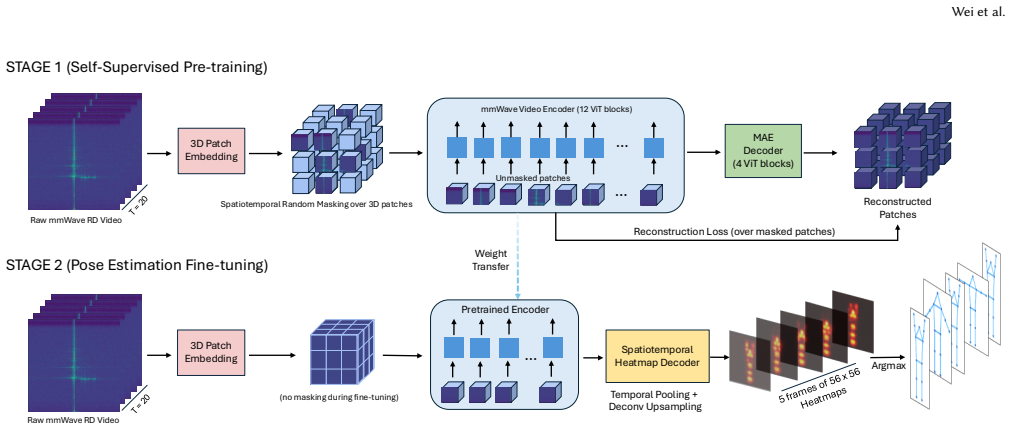
MAEPose learns spatiotemporal motion-aware generalized representations from unlabelled radar video using masked autoencoding pre-training on mmWave spectrogram videos, and leverages its heatmap decoder for multi-frame pose estimation predictions, outperforming state-of-the-art baselines.
What carries the argument
The masked autoencoding pre-training paired with a heatmap decoder. It works by training the model to reconstruct masked sections of the spectrogram video, thereby learning useful spatiotemporal features that the decoder converts into pose heatmaps.
Load-bearing premise
Masked autoencoding pre-training on unlabeled mmWave spectrogram videos produces generalized spatiotemporal representations that yield superior multi-frame pose estimates when paired with a heatmap decoder.
What would settle it
An experiment on the same three datasets showing that supervised baselines achieve equal or lower MPJPE than MAEPose under leave-one-person-out cross-validation with p greater than 0.05.
If this is right
- Leveraging Range-Doppler video as input achieves better pose estimation performance than Range-Azimuth or their fusion, with lower computational cost.
- Both the pre-training and the heatmap decoder contribute substantially to the overall performance.
- The approach maintains robust accuracy under zero-shot bystander interference with only a 6.5% error increase.
- It consistently outperforms state-of-the-art baselines by up to 22.1% in MPJPE with p<0.05 across three datasets.
Where Pith is reading between the lines
- This suggests that direct operation on raw radar video streams preserves information lost in traditional feature extraction pipelines.
- The method may scale well to larger amounts of unlabeled data collected in everyday environments.
- Similar self-supervised techniques could be applied to other radar sensing tasks beyond pose estimation.
- The reduced error under interference indicates potential for deployment in multi-person scenarios without additional training.
Editorial analysis
A structured set of objections, weighed in public.
Referee Report
Summary. The paper introduces MAEPose, a masked autoencoding (MAE) based self-supervised approach that learns spatiotemporal representations directly from unlabeled mmWave spectrogram videos for human pose estimation. It pairs the pre-trained encoder with a heatmap decoder for multi-frame predictions, evaluates on three datasets via leave-one-person-out cross-validation with statistical testing, and claims up to 22.1% MPJPE improvement over SOTA baselines (p<0.05), 6.5% error increase under zero-shot bystander interference, plus ablations confirming the value of pre-training and the decoder, with Range-Doppler video outperforming other modalities.
Significance. If the quantitative results and ablations hold under the reported evaluation protocol, the work provides evidence that self-supervised MAE pre-training on raw mmWave radar video can yield generalized representations superior to supervised baselines relying on pre-extracted features. This could influence privacy-preserving sensing research by showing benefits of operating end-to-end on video streams without intermediate signal processing steps. The inclusion of leave-one-person-out evaluation, statistical testing, and modality ablations is a positive aspect of the experimental design.
minor comments (2)
- [Abstract] Abstract: the claim of evaluation 'across three datasets' would be clearer if the dataset names, sizes, and the exact list of compared baselines were stated, even briefly.
- [Abstract] The abstract reports a p-value but does not mention whether error bars or standard deviations accompany the MPJPE figures; adding this detail would strengthen the presentation of the main result.
Simulated Author's Rebuttal
We thank the referee for the positive summary, recognition of the experimental design (leave-one-person-out, statistical testing, modality ablations), and recommendation of minor revision. The assessment that the work provides evidence for self-supervised MAE pre-training on raw mmWave radar video is appreciated.
Circularity Check
No significant circularity detected
full rationale
The paper applies standard masked autoencoding pre-training on unlabeled mmWave spectrogram videos followed by supervised fine-tuning of a heatmap decoder. No load-bearing steps reduce by construction to fitted parameters, self-definitions, or self-citation chains; ablations and leave-one-person-out evaluation with statistical testing provide independent support for the claimed gains. The derivation remains self-contained against external benchmarks and does not invoke uniqueness theorems or ansatzes from prior author work.
Axiom & Free-Parameter Ledger
Cite this review
Pith. "Pith review of MAEPose: Self-Supervised Spatiotemporal Learning for Human Pose Estimation on mmWave Video." pith.science (2026). https://pith.science/paper/24ZSBNZ2
@misc{pith2026260500242,
  author       = {Pith},
  title        = {Pith review of: MAEPose: Self-Supervised Spatiotemporal Learning for Human Pose Estimation on mmWave Video},
  year         = {2026},
  howpublished = {\url{https://pith.science/paper/24ZSBNZ2}},
  note         = {Machine review of arXiv:2605.00242}
}
read the original abstract
Millimetre-wave (mmWave) radar offers a more privacy-preserving alternative to RGB-based human pose estimation. However, existing methods typically rely on pre-extracted intermediate representations such as sparse point clouds or spectrogram images, where the rich spatiotemporal information naturally present in radar video streams is discarded for model learning, while such signal processing adds system complexity. In addition, existing solutions are mainly conducted in an end-to-end supervised manner without leveraging unlabelled raw video streams to learn generalized representations. In this study, we present MAEPose, a masked autoencoding-based human pose estimation approach that operates directly on mmWave spectrogram videos. MAEPose learns spatiotemporal motion-aware generalized representations from unlabelled radar video, and leverages its heatmap decoder for multi-frame pose estimation predictions. We evaluate it across three datasets based on leave-one-person-out cross-validation with rigorous statistical testing. MAEPose consistently outperforms state-of-the-art baselines by up to 22.1% in MPJPE p<0.05, and maintains robust accuracy under zero-shot bystander interference with only a 6.5% error increase. Ablation studies confirm that both the pre-training and the heatmap decoder contribute substantially, while modality analysis indicates that leveraging Range-Doppler video as input achieves better pose estimation performance than Range-Azimuth or their fusion, with lower computational cost.
Figures


Forward citations
Cited by 1 Pith paper
-
Wave2Body: Rethinking mmWave Human Pose Estimation as Radar-to-Body Token Translation
Radar-to-body token translation with a frozen, pose-pretrained body tokenizer beats direct coordinate regression on mmWave pose benchmarks and cuts FLOPs dramatically.
Reference graph
Works this paper leans on
-
[1]
Hangbo Bao, Li Dong, Songhao Piao, and Furu Wei. 2021. Beit: Bert pre-training of image transformers.arXiv preprint arXiv:2106.08254(2021)
work page internal anchor Pith review Pith/arXiv arXiv 2021
-
[2]
D. K. Barton and H. R. Ward. 1969.Handbook of Radar Measurement
work page 1969
-
[3]
1988.Statistical Power Analysis for the Behavioral Sciences(2nd ed.)
Jacob Cohen. 1988.Statistical Power Analysis for the Behavioral Sciences(2nd ed.). Lawrence Erlbaum Associates
work page 1988
-
[4]
Jacob Devlin, Ming-Wei Chang, Kenton Lee, and Kristina Toutanova. 2019. BERT: Pre-training of Deep Bidirectional Transformers for Language Understanding. In Proceedings of the 2019 Conference of the North American Chapter of the Association for Computational Linguistics: Human Language Technologies (NAACL-HLT). 4171–4186
work page 2019
-
[5]
Alexey Dosovitskiy, Lucas Beyer, Alexander Kolesnikov, Dirk Weissenborn, Xi- aohua Zhai, Thomas Unterthiner, Mostafa Dehghani, Matthias Minderer, Georg Heigold, Sylvain Gelly, et al. 2020. An image is worth 16x16 words: Transformers for image recognition at scale.arXiv preprint arXiv:2010.11929(2020)
work page internal anchor Pith review Pith/arXiv arXiv 2020
-
[6]
Junqiao Fan, Jianfei Yang, Yuecong Xu, and Lihua Xie. 2024. Diffusion model is a good pose estimator from 3D RF-vision. InEuropean Conference on Computer Vision. Springer, 259–276
work page 2024
-
[7]
Yuan Fang, Fangzhan Shi, Xijia Wei, Qingchao Chen, Kevin Chetty, and Si- mon Julier. 2025. CubeDN: Real-Time Drone Detection in 3D Space from Dual mmWave Radar Cubes. In2025 IEEE International Conference on Robotics and Automation (ICRA). IEEE, 3977–3983
work page 2025
-
[8]
Christoph Feichtenhofer, Yanghao Li, Kaiming He, et al. 2022. Masked autoen- coders as spatiotemporal learners.Advances in neural information processing systems35 (2022), 35946–35958
work page 2022
-
[9]
Milton Friedman. 1937. The use of ranks to avoid the assumption of normality implicit in the analysis of variance.Journal of the american statistical association 32, 200 (1937), 675–701
work page 1937
-
[10]
Kaiming He, Xinlei Chen, Saining Xie, Yanghao Li, Piotr Dollár, and Ross Girshick
-
[11]
Masked autoencoders are scalable vision learners. (2022), 16000–16009
work page 2022
-
[12]
Jonathan Ho, Ajay Jain, and Pieter Abbeel. 2020. Denoising diffusion probabilistic models.Advances in neural information processing systems33 (2020), 6840–6851
work page 2020
-
[13]
Po-Yao Huang, Hu Xu, Juncheng Li, Alexei Baevski, Michael Auli, Wojciech Galuba, Florian Metze, and Christoph Feichtenhofer. 2022. Masked autoencoders that listen.Advances in Neural Information Processing Systems35 (2022), 28708– 28720
work page 2022
-
[14]
C. Iovescu and S. Rao. 2017. The Fundamentals of Millimeter Wave Radar Sensors. https://www.ti.com/lit/wp/spyy005a/spyy005a.pdf
work page 2017
-
[15]
Niraj Prakash Kini, Shih-Po Lee, and Jenq-Neng Hwang. 2026. milliMamba: Multi- frame mmWave radar pose estimation with state-space models. InProceedings of the IEEE/CVF Winter Conference on Applications of Computer Vision
work page 2026
-
[16]
Shih-Po Lee, Niraj Prakash Kini, Wen-Hsiao Peng, Ching-Wen Ma, and Jenq-Neng Hwang. 2023. Hupr: A benchmark for human pose estimation using millimeter wave radar. InProceedings of the IEEE/CVF Winter Conference on Applications of Computer Vision. 5715–5724
work page 2023
-
[17]
M Mahbubur Rahman, Dario Martelli, and Sevgi Z Gurbuz. 2023. Radar-based human skeleton estimation with CNN-LSTM network trained with limited data. In2023 IEEE EMBS International Conference on Biomedical and Health Informatics (BHI). IEEE, 1–4
work page 2023
-
[18]
Nornadiah Mohd Razali, Yap Bee Wah, et al. 2011. Power comparisons of shapiro- wilk, kolmogorov-smirnov, lilliefors and anderson-darling tests.Journal of statistical modeling and analytics2, 1 (2011), 21–33
work page 2011
-
[19]
Zhiyao Sheng, Huatao Xu, Qian Zhang, and Dong Wang. 2022. Facilitating radar- based gesture recognition with self-supervised learning. In2022 19th Annual IEEE International Conference on Sensing, Communication, and Networking (SECON). IEEE, 154–162
work page 2022
-
[20]
A Soumya, C Krishna Mohan, and Linga Reddy Cenkeramaddi. 2023. Recent advances in mmWave-radar-based sensing, its applications, and machine learning techniques: A review.Sensors23, 21 (2023), 8901
work page 2023
-
[21]
Zhan Tong, Yibing Song, Jue Wang, and Limin Wang. 2022. Videomae: Masked autoencoders are data-efficient learners for self-supervised video pre-training. Advances in neural information processing systems35 (2022), 10078–10093
work page 2022
-
[22]
Limin Wang, Bingkun Huang, Zhiyu Zhao, Zhan Tong, Yinan He, Yi Wang, Yali Wang, and Yu Qiao. 2023. VideoMAE V2: Scaling video masked autoencoders with dual masking. InProceedings of the IEEE/CVF Conference on Computer Vision and Pattern Recognition. 14549–14560
work page 2023
-
[23]
Xijia Wei, Yuan Fang, Kevin Chetty, Youngjun Cho, and Nadia Bianchi-Berthouze
-
[24]
InProceedings of the 2025 ACM Workshop on Access Networks with Artificial Intelligence
Vomee: A Multimodal Sensing Platform for Video, Audio, mmWave and Skeleton Data Capturing. InProceedings of the 2025 ACM Workshop on Access Networks with Artificial Intelligence. 36–40
work page 2025
-
[25]
Xijia Wei, Yuan Fang, Zihan Liu, Xiyue Zhu, Jiawei Wang, Yifu Liu, Bruna Petreca, Sharon Baurley, Kevin Chetty, Youngjun Cho, et al. 2025. mmWaveTryOn: The first mmWave-RGB Dataset for Clothes Try-On Multimodal Gesture Recognition. InProceedings of the 2025 ACM Workshop on Access Networks with Artificial Intelligence. 31–35
work page 2025
-
[26]
Xijia Wei, Yuan Fang, Fangzhan Shi, Shuang Wu, Amanda Williams, Nicolas Gold, Kevin Chetty, Youngjun Cho, and Nadia Bianchi-Berthouze. 2025. WiProt: A WiFi-RGBD Fusion System for Robust Protective Behaviour Recognition. InProceedings of the Second International Workshop on Radio Frequency (RF) Computing. 6–11
work page 2025
-
[27]
Xijia Wei, Temitayo Olugbade, Fangzhan Shi, Shuang Wu, Amanda William, Nicolas Gold, Youngjun Cho, Kevin Chetty, and Nadia Bianchi-Berthouze. 2023. Leveraging WiFi Sensing toward Automatic Recognition of Pain Behaviors. In2023 11th International Conference on Affective Computing and Intelligent Interaction Workshops and Demos (ACIIW). IEEE, 1–8
work page 2023
-
[28]
Xijia Wei and Valentin Radu. 2019. Calibrating recurrent neural networks on smartphone inertial sensors for location tracking. In2019 International Conference on Indoor Positioning and Indoor Navigation (IPIN). IEEE, 1–8
work page 2019
-
[29]
Xijia Wei, Zhiqiang Wei, and Valentin Radu. 2021. Sensor-fusion for smartphone location tracking using hybrid multimodal deep neural networks.Sensors21, 22 (2021), 7488
work page 2021
-
[30]
Eric W Weisstein. 2004. Bonferroni correction.https://mathworld. wolfram. com/ (2004)
work page 2004
-
[31]
Robert F Woolson. 2007. Wilcoxon signed-rank test.Wiley encyclopedia of clinical trials(2007), 1–3
work page 2007
-
[32]
Yufei Xu, Jing Zhang, Qiming Zhang, and Dacheng Tao. 2022. Vitpose: Simple vision transformer baselines for human pose estimation.Advances in neural information processing systems35 (2022), 38571–38584
work page 2022
-
[33]
Jia Zhang, Rui Xi, Yuan He, Yimiao Sun, Xiuzhen Guo, Weiguo Wang, Xin Na, Yunhao Liu, Zhenguo Shi, and Tao Gu. 2023. A survey of mmWave-based human sensing: Technology, platforms and applications.IEEE Communications Surveys & Tutorials25, 4 (2023), 2052–2087
work page 2023
-
[34]
Peijun Zhao, Chris Xiaoxuan Lu, Bing Wang, Niki Trigoni, and Andrew Markham
-
[35]
Cubelearn: End-to-end learning for human motion recognition from raw mmwave radar signals.IEEE Internet of Things Journal10, 12 (2023), 10236–10249
work page 2023
-
[36]
Ce Zheng, Sijie Zhu, Matias Mendieta, Taojiannan Yang, Chen Chen, and Zheng- ming Ding. 2021. 3d human pose estimation with spatial and temporal transform- ers. InProceedings of the IEEE/CVF international conference on computer vision. 11656–11665
work page 2021
- [37]
This paper was first reviewed by grok-4.3 on July 1, 2026.
discussion (0)
Sign in with ORCID, Apple, or X to comment. Anyone can read and Pith papers without signing in.