REVIEW 4 major objections 6 minor 52 references
CNC: Cross-modal Normality Constraint for Unsupervised Multi-class Anomaly Detection
T0 review · 4 major / 6 minor · reviewed 2026-08-10 · deepseek-v4-flash
Pith's one-line read A text 'normal' anchor lifts multi-class defect detection to 98.6
desk verdict A well-ablated integration of CLIP prompts and gated MoE into reverse distillation that delivers consistent gains on two AD benchmarks; the mechanism is plausible but under-tested. read the letter →
The pith
A machine-rendered reading of the paper's core claim, the machinery that carries it, and where it could break.
The reading
What carries the argument
The load-bearing mechanism is the cross-modal normality constraint built on CLIP. The paper uses class-agnostic learnable prompts $p_n$ ('normal object') and $p_a$ ('damaged object'), encoded by the frozen CLIP text encoder into text features $g_n$ and $g_a$. Two alignment losses, $\mathcal{L}^1_c$ and $\mathcal{L}^2_c$, push the global features of encoded and decoded visual patches toward $g_n$ rather than $g_a$; a dynamic anchor in text space therefore pulls the decoder back to a shared 'normal' direction. The feature-level normality promotion computes a control coefficient $\Psi(\alpha_i,\beta_i)=\tfrac12(1+\tanh(\alpha_i-\beta_i))$, where $\alpha_i$ and $\beta_i$ are patch-level similarities to $g_n$ and $g_a$, and adds $\lambda\Psi$ to encoded and decoded features before the distillation loss. The gated mixture-of-experts module takes a multi-layer fusion of encoded features and routes each patch to the top two of five expert MLPs, with an importance loss to keep routing balanced; the total loss is $\mathcal{L}_{\text{total}}=\mathcal{L}_{\text{distill}}+\mathcal{L}_{\text{constraint}}+\mathcal{L}_{\text{moe}}$.
What would settle it
For each MVTec AD class, compute the CLIP cosine similarity between the learned 'normal' prompt embedding and the encoded features of normal versus anomalous patches; if there is a class where anomalous patches are closer to the 'normal' text than normal patches are, the cross-modal normality assumption fails for that class and the constraint would be expected to hurt rather than help.
Extended reading notes
Core claim
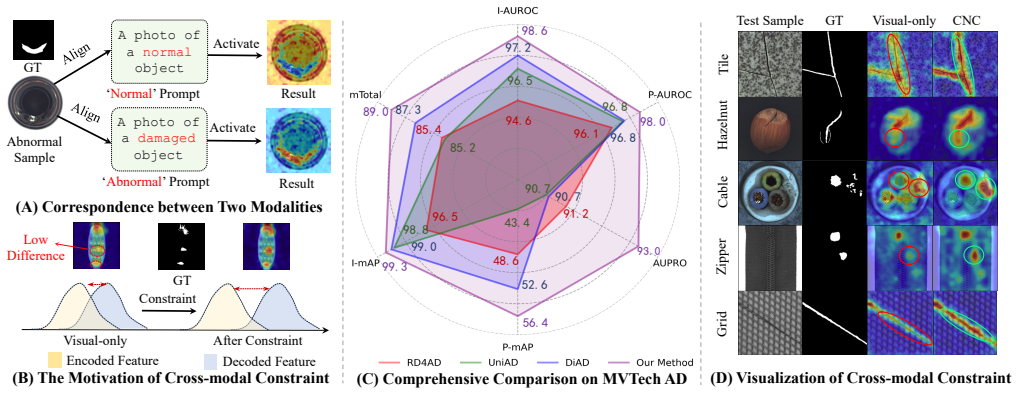
The paper's central claim is that the 'over-generalization' (OG) of the decoder is the main obstacle in unsupervised multi-class distillation, and that it can be suppressed by a cross-modal normality constraint rather than by more visual data or per-class models. The authors show that normal and abnormal patches respond differently to the text descriptions 'a photo of a normal object' and 'a photo of a damaged object', and they exploit this asymmetry: learnable, class-agnostic prompts are passed through the CLIP text encoder to produce normality anchors, decoded features are pulled toward the normal anchor via a cross-modal constraint loss, and a feature-level normality promotion term reweights encoded and decoded patch features by a tanh-shaped control coefficient. A gated mixture-of-experts module, with five experts and top-two routing, reduces mutual interference among patch patterns from different classes. On MVTec AD the method reports 98.6 image-level AUROC, 98.0 pixel-level AUROC, and a mean mTotal of 89.0, and on VisA it reports 93.2 image-level AUROC and 98.5 pixel-level AUROC, improving over RD4AD, UniAD, and DiAD in the multi-class setting.
Load-bearing premise
The method assumes that the text phrases 'a photo of a normal object' and 'a photo of a damaged object' carry a reliable visual signal for every industrial class, so that steering decoded features toward the 'normal' text embedding improves detection instead of distorting it.
Editorial extensions
If this is right
- One model trained jointly on many classes can match or beat single-class-trained specialists, cutting storage and training time for industrial inspection lines.
- The normality anchor is class-agnostic, so a new product class can be added without designing new per-class text prompts.
- The decoder's generalization to abnormal patches is not inevitable; it can be countered by an external semantic constraint rather than only by more normal training data.
- Routing patches to expert subnetworks is a transferable way to reduce inter-class interference in other multi-domain feature-distillation tasks.
- The reported per-class stability on MVTec AD means the method avoids the catastrophic per-class failures seen in baselines.
Reading between the lines
- Per-class analysis of CLIP text-patch similarity would show whether the constraint helps most where 'normal' and 'damaged' prompts are well separated; on classes like Grid or Screw, the reported gain may come mostly from the MoE or from feature perturbation rather than from the text anchor.
- By extension, the tanh control coefficient is a soft gating function, so replacing it with a learned scalar or a temperature-scaled sigmoid would test whether the improvement comes from the specific cross-modal form or simply from perturbing features.
- Because the prompts are class-agnostic, the same framework could be applied zero-shot or few-shot by initializing prompts from a few normal images or skipping prompt learning entirely, then measuring detection on unseen classes.
- The success of routing patch embeddings to different experts suggests that patch-pattern specialization could transfer to other multi-distribution settings, such as multi-domain segmentation or generalized out-of-distribution detection.
Editorial analysis
A structured set of objections, weighed in public.
Referee Report
Summary. The paper proposes CNC, an unsupervised multi-class anomaly detection method built on reverse distillation with a CLIP visual encoder. The method introduces class-agnostic learnable prompts that define normal and abnormal text features, a cross-modal normality constraint that aligns decoded features toward the normal text representation, a feature-level normality promotion mechanism that uses a text-derived control coefficient on encoded and decoded features, and a gated mixture-of-experts module to handle diverse patch patterns. The model is trained on normal samples only and detects anomalies by comparing encoded and decoded features. The authors report competitive results on MVTec AD (I-AUROC 98.6, mTotal 89.0) and VisA (I-AUROC 93.2, mTotal 82.7), with ablations supporting the individual components.
Significance. If the results hold, the paper addresses a real problem in multi-class unsupervised anomaly detection: the decoder over-generalizing to abnormal patches when trained across many classes. A strength is that the method is evaluated on two standard datasets with five metrics, compared against strong baselines (RD4AD, UniAD, DiAD), and accompanied by code. The ablations in Table 2 and the MoE hyperparameter analysis in Table 4 are useful. The central caveat is that the cross-modal text signal is the load-bearing premise, yet the paper does not validate per-class text alignment or compare against a random-text control; the mechanism of 'over-generalization' is also asserted rather than directly measured. The shape mismatch in Eq. (5) is a concrete reproducibility issue. With those concerns addressed, the contribution would be a solid step for multi-class unsupervised AD.
major comments (4)
- [Feature Distillation with Normality Promotion, Eqs. (5)-(8)] In Eq. (5), f_i is in R^{H x W x C} while Psi(alpha_i, beta_i) is in R^{H x W} according to the text below Eq. (6) and Eq. (7); the paper says the operator is element-wise addition, which is undefined for these shapes. Since f_i^* and bf_i^* are used in the distillation loss Eq. (9), the FNP mechanism as written is not reproducible. Please specify how the spatial control map is broadcast to the channel dimension or otherwise transformed before addition.
- [Learning Cross-modal Normality / Feature Distillation with Normality Promotion, Fig. 1(A)] The method's operating premise is that class-agnostic 'a photo of a normal object' and 'a photo of a damaged object' text features provide a per-patch normal-versus-abnormal signal that transfers across all 15 MVTec AD and 12 VisA classes. The paper supports this only with illustrative Fig. 1(A) and aggregate means; Eqs. (4)-(10) apply the text-based coefficient to every patch, so a class with weak cross-modal alignment could be hurt rather than helped. Please provide per-class text-alignment statistics (e.g., the distribution of alpha_i - beta_i on normal versus abnormal patches) and a control experiment that replaces the learned text features with fixed random vectors or permutations; without this, the reported mean gains do not distinguish a genuine cross-modal effect from a generic feature transformation that happens to help on the chosen benchmarks.
- [Introduction and Methodology (over-generalization claim)] The 'over-generalization' (OG) mechanism is asserted in the Introduction and repeated throughout the Methodology, but it is not directly measured. The paper does not quantify, for example, the reconstruction error of the vanilla decoder on held-out abnormal features versus normal features, nor does it show that the proposed constraint specifically reduces decoder success on abnormal patches rather than simply changing feature geometry. An ablation measuring patch-level reconstruction errors on normal and abnormal data with and without CNC would make the central claim testable; alternatively, the conclusions should be softened to describe the observed performance improvement without committing to the OG mechanism.
- [Experimental Setup / Implementation Details, Table 4] Several core hyperparameters (tau=0.001, gamma=0.1, theta=5, prompt length=12, and especially the MoE choices T=5 and K=2 from Table 4) appear to be selected using full test-set results, and no validation split or selection protocol is described. Since Table 4 shows that MoE performance varies by about 1.2 I-AUROC across configurations, reporting the best test configuration as the final result can produce an optimistic comparison with baselines. Please clarify how hyperparameters were chosen or report sensitivity on a held-out validation split.
minor comments (6)
- [Feature Distillation with Normality Promotion, Eq. (9)] The phrase 'fatten function' should be 'flatten function'.
- [Experimental Setup] In the experiments text, 'P-AURPOC' appears to be a typo for pixel-level AUROC; please correct it.
- [Learning Cross-modal Normality, Eqs. (4) and (10)] The global features e_i and be_i are used in the losses but never defined; please state whether they are CLS tokens, average-pooled features, or another pooling of f_i and bf_i.
- [Inference, Eq. (17)] In Eq. (17), sigma_i is called an upsampling factor but is used as an upsampling operation; please specify the interpolation method and the factor used to match the input resolution.
- [Gated Mixture-of-Experts, Eq. (15)] The 'universal importance loss' is cited to Bengio et al. 2015, but the form in Eq. (15) closely resembles the importance loss from Shazeer et al. 2017; please verify the citation.
- [Inference] The inference paragraph says the method applies the encoder, learned prompts, MLF, MoE module, and decoder, but it omits the CLIP text encoder G, which is needed to produce g_i^n and g_i^a for the feature-level normality promotion; please clarify the full inference pathway.
Circularity Check
No significant circularity: the method is trained on normal training data, evaluated on held-out test sets against external baselines, and no reported metric is defined in terms of the learned prompts or fitted parameters.
full rationale
The paper's central claim is an empirical benchmark result on MVTec AD and VisA, obtained by training the proposed cross-modal distillation framework on anomaly-free training images and evaluating on held-out test images with standard metrics (I-AUROC, P-AUROC, AUPRO, I-mAP, P-mAP). The training objective L_total = L_distill + L_constraint + L_moe is optimized on normal samples only; the anomaly score at inference, S = sum_i sigma_i (1 - d(f*_i, bf*_i)), is computed from encoded and decoded features without using test labels. The learnable text prompts are optimized via Eq. (4) on the training set and then used as anchors in Eqs. (5)-(11); they are not fitted to the target AUROC or to the test set. The 'over-generalization' hypothesis is an explanatory narrative rather than a mathematical claim derived from the model equations, so it cannot be circular by construction. Baseline numbers are sourced from external published work (RD4AD, UniAD, DiAD), not from the authors' own prior results, and no uniqueness theorem or self-citation is invoked to force the method choice. Hyperparameter choices such as T, K, and resolution are tuned on the benchmark, which is a tuning loop rather than a derivational circularity. No equation in the paper reduces a reported prediction to an input definition, and no fitted parameter is renamed as a prediction. The paper is therefore self-contained with respect to its empirical evaluation and exhibits no significant circularity.
Assumptions & free parameters
free parameters (5)
- Learnable prompt tokens for normal/abnormal per layer =
3 layers x 2 prompts x 12 tokens (CLIP text embedding dim)
- Softmax temperature tau =
0.001
- Constraint loss weight gamma =
0.1
- Epoch threshold theta =
5
- MoE expert count T and top-K =
T=5, K=2
assumptions (5)
- domain assumption CLIP text and visual features are aligned enough that generic normal/damaged prompts give discriminative cross-modal responses for industrial patches.
- ad hoc to paper Multi-class training degrades performance because the decoder over-generalizes to abnormal patches ('OG'), and text alignment specifically counteracts this.
- domain assumption A single class-agnostic 'normal object' prompt can capture common textual normality across diverse classes.
- domain assumption Frozen CLIP encoder layers are suitable for reverse distillation with a decoder of three residual attention blocks.
- ad hoc to paper Gaussian noise on encoded features helps mitigate OG, and its magnitude is irrelevant or set implicitly.
Cite this review
Pith. "Pith review of CNC: Cross-modal Normality Constraint for Unsupervised Multi-class Anomaly Detection." pith.science (2026). https://pith.science/paper/NOS62LMD
@misc{pith2026250100346,
  author       = {Pith},
  title        = {Pith review of: CNC: Cross-modal Normality Constraint for Unsupervised Multi-class Anomaly Detection},
  year         = {2026},
  howpublished = {\url{https://pith.science/paper/NOS62LMD}},
  note         = {Machine review of arXiv:2501.00346}
}
read the original abstract
Existing unsupervised distillation-based methods rely on the differences between encoded and decoded features to locate abnormal regions in test images. However, the decoder trained only on normal samples still reconstructs abnormal patch features well, degrading performance. This issue is particularly pronounced in unsupervised multi-class anomaly detection tasks. We attribute this behavior to over-generalization(OG) of decoder: the significantly increasing diversity of patch patterns in multi-class training enhances the model generalization on normal patches, but also inadvertently broadens its generalization to abnormal patches. To mitigate OG, we propose a novel approach that leverages class-agnostic learnable prompts to capture common textual normality across various visual patterns, and then apply them to guide the decoded features towards a normal textual representation, suppressing over-generalization of the decoder on abnormal patterns. To further improve performance, we also introduce a gated mixture-of-experts module to specialize in handling diverse patch patterns and reduce mutual interference between them in multi-class training. Our method achieves competitive performance on the MVTec AD and VisA datasets, demonstrating its effectiveness.
Figures


Figures from the paper (1 more)

Reference graph
Works this paper leans on
-
[1]
Bae, J.; Lee, J.-H.; and Kim, S. 2023. PNI: Industrial anomaly detection using position and neighborhood information. In ICCV
work page 2023
-
[2]
Bengio, E.; Bacon, P.-L.; Pineau, J.; and Precup, D. 2015. Conditional computation in neural networks for faster models. arXiv preprint arXiv:1511.06297
arXiv 2015
-
[3]
Bergmann, P.; Fauser, M.; Sattlegger, D.; and Steger, C. 2019. MVTec AD--A comprehensive real-world dataset for unsupervised anomaly detection. In CVPR
work page 2019
-
[4]
Bergmann, P.; Fauser, M.; Sattlegger, D.; and Steger, C. 2020. Uninformed students: Student-teacher anomaly detection with discriminative latent embeddings. In CVPR
work page 2020
-
[5]
Cao, T.; Zhu, J.; and Pang, G. 2023. Anomaly detection under distribution shift. In ICCV
work page 2023
-
[6]
Chen, Y.; Tian, Y.; Pang, G.; and Carneiro, G. 2022. Deep one-class classification via interpolated gaussian descriptor. In AAAI
work page 2022
-
[7]
Z.; Lisanti, G.; and Di Stefano, L
Costanzino, A.; Ramirez, P. Z.; Lisanti, G.; and Di Stefano, L. 2024. Multimodal industrial anomaly detection by crossmodal feature mapping. In CVPR
work page 2024
-
[8]
Defard, T.; Setkov, A.; Loesch, A.; and Audigier, R. 2021. Padim: A patch distribution modeling framework for anomaly detection and localization. In ICPR
work page 2021
Show all 52 references
-
[9]
Deng, H.; and Li, X. 2022. Anomaly detection via reverse distillation from one-class embedding. In CVPR
2022
-
[10]
Dosovitskiy, A.; Beyer, L.; Kolesnikov, A.; Weissenborn, D.; Zhai, X.; Unterthiner, T.; Dehghani, M.; Minderer, M.; Heigold, G.; Gelly, S.; et al. 2020. An image is worth 16x16 words: Transformers for image recognition at scale. arXiv preprint arXiv:2010.11929
2020 arXiv
-
[11]
Fang, Z.; Wang, X.; Li, H.; Liu, J.; Hu, Q.; and Xiao, J. 2023. Fastrecon: Few-shot industrial anomaly detection via fast feature reconstruction. In ICCV
2023
-
[12]
Gu, Z.; Liu, L.; Chen, X.; Yi, R.; Zhang, J.; Wang, Y.; Wang, C.; Shu, A.; Jiang, G.; and Ma, L. 2023. Remembering normality: Memory-guided knowledge distillation for unsupervised anomaly detection. In CVPR
2023
-
[13]
Gu, Z.; Zhang, J.; Liu, L.; Chen, X.; Peng, J.; Gan, Z.; Jiang, G.; Shu, A.; Wang, Y.; and Ma, L. 2024. Rethinking Reverse Distillation for Multi-Modal Anomaly Detection. In AAAI
2024
-
[14]
Gudovskiy, D.; Ishizaka, S.; and Kozuka, K. 2022. Cflow-ad: Real-time unsupervised anomaly detection with localization via conditional normalizing flows. In WACV
2022
-
[15]
Guo, J.; Jia, L.; Zhang, W.; Li, H.; et al. 2024. Recontrast: Domain-specific anomaly detection via contrastive reconstruction. In NeurIPS
2024
-
[16]
He, H.; Bai, Y.; Zhang, J.; He, Q.; Chen, H.; Gan, Z.; Wang, C.; Li, X.; Tian, G.; and Xie, L. 2024 a . Mambaad: Exploring state space models for multi-class unsupervised anomaly detection. arXiv preprint arXiv:2404.06564
2024 arXiv
-
[17]
He, H.; Zhang, J.; Chen, H.; Chen, X.; Li, Z.; Chen, X.; Wang, Y.; Wang, C.; and Xie, L. 2024 b . A diffusion-based framework for multi-class anomaly detection. In AAAI
2024
-
[18]
Hu, T.; Zhang, J.; Yi, R.; Du, Y.; Chen, X.; Liu, L.; Wang, Y.; and Wang, C. 2024. Anomalydiffusion: Few-shot anomaly image generation with diffusion model. In AAAI
2024
-
[19]
Huang, C.; Guan, H.; Jiang, A.; Zhang, Y.; Spratling, M.; and Wang, Y.-F. 2022. Registration based few-shot anomaly detection. In ECCV
2022
-
[20]
Jeong, J.; Zou, Y.; Kim, T.; Zhang, D.; Ravichandran, A.; and Dabeer, O. 2023. Winclip: Zero-/few-shot anomaly classification and segmentation. In CVPR
2023
-
[21]
Jia, M.; Tang, L.; Chen, B.-C.; Cardie, C.; Belongie, S.; Hariharan, B.; and Lim, S.-N. 2022. Visual prompt tuning. In ECCV
2022
-
[22]
Jiang, X.; Liu, J.; Wang, J.; Nie, Q.; Wu, K.; Liu, Y.; Wang, C.; and Zheng, F. 2022. Softpatch: Unsupervised anomaly detection with noisy data. In NeurIPS
2022
-
[23]
Lee, M.; and Choi, J. 2024. Text-guided variational image generation for industrial anomaly detection and segmentation. In CVPR
2024
-
[24]
Lei, J.; Hu, X.; Wang, Y.; and Liu, D. 2023. Pyramidflow: High-resolution defect contrastive localization using pyramid normalizing flow. In CVPR
2023
-
[25]
Li, C.-L.; Sohn, K.; Yoon, J.; and Pfister, T. 2021. Cutpaste: Self-supervised learning for anomaly detection and localization. In CVPR
2021
-
[26]
Li, W.; Xu, X.; Gu, Y.; Zheng, B.; Gao, S.; and Wu, Y. 2024 a . Towards Scalable 3D Anomaly Detection and Localization: A Benchmark via 3D Anomaly Synthesis and A Self-Supervised Learning Network. In CVPR
2024
-
[27]
Li, Y.; Goodge, A.; Liu, F.; and Foo, C.-S. 2024 b . PromptAD: Zero-shot anomaly detection using text prompts. In CVPR
2024
-
[28]
Lin, J.; and Yan, Y. 2024. A Comprehensive Augmentation Framework for Anomaly Detection. In AAAI
2024
-
[29]
Liu, J.; Xie, G.; Chen, R.; Li, X.; Wang, J.; Liu, Y.; Wang, C.; and Zheng, F. 2024. Real3d-ad: A dataset of point cloud anomaly detection. In NeurIPS
2024
-
[30]
Liu, W.; Chang, H.; Ma, B.; Shan, S.; and Chen, X. 2023 a . Diversity-measurable anomaly detection. In CVPR
2023
-
[31]
Liu, Z.; Zhou, Y.; Xu, Y.; and Wang, Z. 2023 b . Simplenet: A simple network for image anomaly detection and localization. In CVPR
2023
-
[32]
Lu, F.; Yao, X.; Fu, C.-W.; and Jia, J. 2023 a . Removing anomalies as noises for industrial defect localization. In ICCV
2023
-
[33]
Lu, R.; Wu, Y.; Tian, L.; Wang, D.; Chen, B.; Liu, X.; and Hu, R. 2023 b . Hierarchical vector quantized transformer for multi-class unsupervised anomaly detection. In NeurIPS
2023
-
[34]
Ma, J.; Zhao, Z.; Yi, X.; Chen, J.; Hong, L.; and Chi, E. H. 2018. Modeling task relationships in multi-task learning with multi-gate mixture-of-experts. In KDD
2018
-
[35]
McIntosh, D.; and Albu, A. B. 2023. Inter-realization channels: Unsupervised anomaly detection beyond one-class classification. In CVPR
2023
-
[36]
W.; Hallacy, C.; Ramesh, A.; Goh, G.; Agarwal, S.; Sastry, G.; Askell, A.; Mishkin, P.; Clark, J.; et al
Radford, A.; Kim, J. W.; Hallacy, C.; Ramesh, A.; Goh, G.; Agarwal, S.; Sastry, G.; Askell, A.; Mishkin, P.; Clark, J.; et al. 2021. Learning transferable visual models from natural language supervision. In ICML
2021
-
[37]
Roth, K.; Pemula, L.; Zepeda, J.; Sch \"o lkopf, B.; Brox, T.; and Gehler, P. 2022. Towards total recall in industrial anomaly detection. In CVPR
2022
-
[38]
Shazeer, N.; Mirhoseini, A.; Maziarz, K.; Davis, A.; Le, Q.; Hinton, G.; and Dean, J. 2017. Outrageously large neural networks: The sparsely-gated mixture-of-experts layer. arXiv preprint arXiv:1701.06538
2017 arXiv
-
[39]
D.; Nguyen, A
Tien, T. D.; Nguyen, A. T.; Tran, N. H.; Huy, T. D.; Duong, S.; Nguyen, C. D. T.; and Truong, S. Q. 2023. Revisiting reverse distillation for anomaly detection. In CVPR
2023
-
[40]
Wang, R.; Hoppe, S.; Monari, E.; and Huber, M. F. 2023. Defect transfer gan: Diverse defect synthesis for data augmentation. arXiv preprint arXiv:2302.08366
2023 arXiv
-
[41]
Yao, X.; Li, R.; Zhang, J.; Sun, J.; and Zhang, C. 2023. Explicit boundary guided semi-push-pull contrastive learning for supervised anomaly detection. In CVPR
2023
-
[42]
Yi, J.; and Yoon, S. 2020. Patch svdd: Patch-level svdd for anomaly detection and segmentation. In ACCV
2020
-
[43]
You, Z.; Cui, L.; Shen, Y.; Yang, K.; Lu, X.; Zheng, Y.; and Le, X. 2022. A unified model for multi-class anomaly detection. In NeurIPS
2022
-
[44]
Yu, J.; Zheng, Y.; Wang, X.; Li, W.; Wu, Y.; Zhao, R.; and Wu, L. 2021. Fastflow: Unsupervised anomaly detection and localization via 2d normalizing flows. arXiv preprint arXiv:2111.07677
2021 arXiv
-
[45]
Zavrtanik, V.; Kristan, M.; and Sko c aj, D. 2021. Draem-a discriminatively trained reconstruction embedding for surface anomaly detection. In ICCV
2021
-
[46]
Zhang, J.; Chen, X.; Wang, Y.; Wang, C.; Liu, Y.; Li, X.; Yang, M.-H.; and Tao, D. 2023. Exploring plain vit reconstruction for multi-class unsupervised anomaly detection. arXiv preprint arXiv:2312.07495
2023 arXiv
-
[47]
Zhang, X.; Xu, M.; and Zhou, X. 2024. RealNet: A feature selection network with realistic synthetic anomaly for anomaly detection. In CVPR
2024
-
[48]
C.; and Liu, Z
Zhou, K.; Yang, J.; Loy, C. C.; and Liu, Z. 2022. Learning to prompt for vision-language models. IJCV, 130(9): 2337--2348
2022
-
[49]
Zhou, Q.; Pang, G.; Tian, Y.; He, S.; and Chen, J. 2023. Anomalyclip: Object-agnostic prompt learning for zero-shot anomaly detection. arXiv preprint arXiv:2310.18961
2023
-
[50]
Zou, Y.; Jeong, J.; Pemula, L.; Zhang, D.; and Dabeer, O. 2022. Spot-the-difference self-supervised pre-training for anomaly detection and segmentation. In ECCV
2022
-
[51]
, " * write output.state after.block = add.period write newline
ENTRY address archivePrefix author booktitle chapter edition editor eid eprint howpublished institution isbn journal key month note number organization pages publisher school series title type volume year label extra.label sort.label short.list INTEGERS output.state before.all...
-
[52]
write newline
" write newline "" before.all 'output.state := FUNCTION n.dashify 't := "" t empty not t #1 #1 substring "-" = t #1 #2 substring "--" = not "--" * t #2 global.max substring 't := t #1 #1 substring "-" = "-" * t #2 global.max substring 't := while if t #1 #1 substring * t #2 gl...
Reviewed August 10, 2026 · model on record in the stance chip above.
Discussion (0). Continue with ORCID to comment.