REVIEW 3 major objections 4 minor 30 references
TSPE: Task-Specific Prompt Ensemble for Improved Zero-Shot Audio Classification
T0 review · 3 major / 4 minor · reviewed 2026-08-10 · deepseek-v4-flash
Pith's one-line read Task-specific prompt ensembles improve zero-shot audio classification by 1.23–16.36% absolute over generic prompts on 12 datasets.
desk verdict Useful idea, but the reported numbers don't survive contact with Table I and the manual curation is effectively per-dataset tuning. read the letter →
The pith
A machine-rendered reading of the paper's core claim, the machinery that carries it, and where it could break.
The reading
What carries the argument
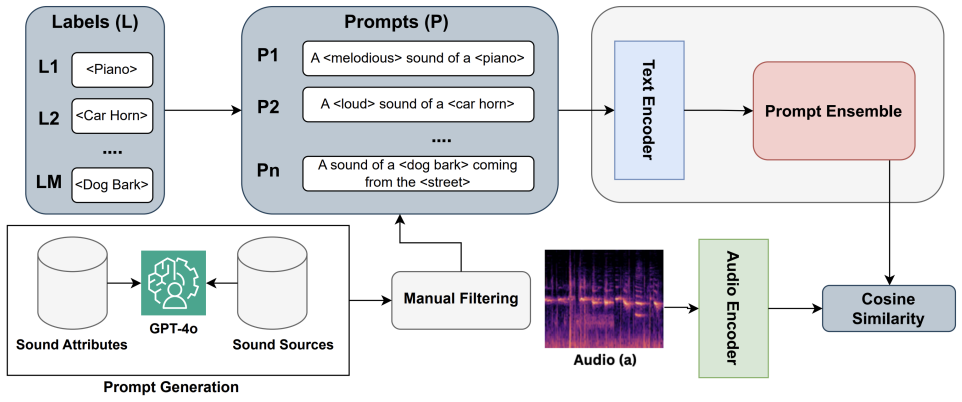
The central mechanism is the task-specific prompt ensemble: for each class label, a set of hard prompts is written as "A <attribute> sound of a <label>", "A sound of a <label> coming from a <source>", and "A <attribute> sound of a <label> can be heard from a <source>". Each prompt is encoded by the text encoder, the resulting embeddings are averaged to form one class-level text representation, and classification is the cosine similarity between that averaged representation and the audio embedding. The ensemble size K=20 is selected by an ablation on VocalSound, and the prompt set itself is filtered by hand to remove GPT-4 hallucinations and semantically mismatched attribute-source pairs. The averaging is what makes the method an ensemble rather than a single prompt.
What would settle it
Run TSPE on a fresh audio dataset whose class labels are withheld from the person who selects the 20 prompts, with K fixed at 20 before evaluation; if the average gain over the generic one-line prompts vanishes, the reported improvements depended on knowing the test labels rather than on the prompt-ensemble idea.
Extended reading notes
Core claim
The central claim, stated on the paper's own terms, is that task-specific hard prompts generated from label information improve audio-text alignment in contrastive audio-language models. The method groups class labels into five task categories, asks GPT-4 to generate 40 candidate prompts per category using sound attributes and sound sources, manually keeps 20 that fit the category, and then averages the text embeddings of those 20 prompts before computing cosine similarity with the audio embedding. On the 12 evaluation datasets, TSPE outperforms vanilla zero-shot prompting for both CLAP-type models tested, with absolute gains from 1.23% to 16.36% and average gains near 2%. The paper notes that performance decreases on some datasets, attributing the drops to prompts that are not linguistically rich enough for those tasks.
Load-bearing premise
The load-bearing premise is that the human selection of 20 prompts per task, and the choice to use 20 prompts based on a test on one of the evaluation datasets, do not amount to quietly tuning the method to the 12 benchmarks.
Editorial extensions
If this is right
- A new audio classification task can be handled with no model training: one LLM call generates candidate prompts, a human filters them, and the model's existing text encoder averages the embeddings.
- The same 20-prompt set for a task category can be reused across datasets in that category, such as the five instrument-recognition datasets tested.
- Because the method only changes text inputs, it can compose with other zero-shot techniques and with any audio-language model that accepts natural-language prompts.
- The reported gains are not universal: several datasets lose accuracy, so practitioners should validate TSPE per task before deployment.
Reading between the lines
- Editorial inference: an automated LLM judge could replace the manual filtering of 40 to 20 prompts; whether it reproduces the human-chosen set would directly test how much of the reported gain is curation.
- Editorial inference: because K=20 was tuned on VocalSound, one of the 12 evaluation datasets, the optimal ensemble size is probably task-dependent and should be re-tuned on a held-out split for new tasks.
- Editorial inference: the prompt-ensemble recipe is a natural fit for other text-conditioned audio tasks, such as audio retrieval and sound-event localization, but that transfer is not demonstrated in the paper.
Editorial analysis
A structured set of objections, weighed in public.
Referee Report
Summary. The paper proposes TSPE (Task-Specific Prompt Ensemble), a training-free hard-prompting method for zero-shot audio classification with contrastive audio-language models such as MS-CLAP'22 and MS-CLAP'23. TSPE uses GPT-4 to generate attribute- and source-augmented prompts per task category, manually filters the prompts, and averages the text embeddings of the surviving prompts (an ensemble) before computing audio-text similarity. The authors report experiments on 12 audio classification datasets spanning five task categories, claiming an absolute improvement of 1.23–16.36% over vanilla zero-shot evaluation and average gains of 2.06% (MS-CLAP'23) and 1.89% (MS-CLAP'22). The paper also discusses hyperparameter selection of the ensemble size K=20 on the VocalSound dataset and notes some limitations, including the need for manual filtering of GPT-4 outputs.
Significance. If the central claim were correct, TSPE would provide a simple, training-free way to improve zero-shot audio classification, and the idea of using LLM-generated attributes and sources to enrich CLAP-style prompts is interesting and potentially useful. The paper is clearly written and evaluates on a broad set of datasets. However, the manuscript currently does not establish the claimed improvement: the reported aggregate numbers are inconsistent with the paper's own table, the improvement is not universal across datasets, and the manual, dataset-aware prompt curation together with tuning K on a test dataset undermines the zero-shot generalization claim. These issues are load-bearing, so the contribution as presented is not verified.
major comments (3)
- [§V-A, Table I, Abstract] The aggregate results reported in §V-A are not supported by Table I. Recomputing per-dataset deltas from Table I gives an average improvement of 2.30% for MS-CLAP'23 (not 2.06%) and 2.10% for MS-CLAP'22 (not 1.89%). Moreover, the abstract's claimed range '1.23-16.36%' selects only positive deltas; for MS-CLAP'23 four of twelve comparisons are negative (e.g., Beijing Opera -2.11, NSynth Instrument -2.02, Cochlscene -1.09, VocalSound -1.99) and one is zero (SESA), while for MS-CLAP'22 seven of twelve are negative (e.g., Mridangam Stroke -3.97, GTZAN -3.21). Thus the central quantitative claim of consistent improvement is contradicted by the paper's own data.
- [§III-B, §III-D, §III-E, §V-B] The prompt selection procedure is manual and dataset-aware: the authors state that they 'manually map these sound attributes and sources to each task category' (§III-B) and that they manually filter 20 of 40 GPT-4-generated prompts for semantic fit (§III-D and §III-E). In addition, the ensemble size K=20 is selected by an ablation on VocalSound (§V-B), which is itself one of the twelve test datasets reported in Table I. This means the method's hyperparameters and prompt sets are chosen using the evaluation data, so the reported gains cannot be attributed to a general training-free procedure. A held-out validation split, a fully automatic prompt selection rule, or at least an ablation showing robustness to the manual curation choices is needed to support the zero-shot claim.
- [§V-A and Table I] The paper claims TSPE 'significantly outperforms traditional zero-shot evaluation' (Conclusion), but no statistical significance testing is reported. All results are averages over five runs without standard deviations or confidence intervals, and many per-dataset deltas are negative while the positive average gains are modest (2.30% and 2.10% on the corrected computations). Given the high variance across datasets, the conclusion of significant improvement is not supported by the evidence presented.
minor comments (4)
- [§III-B and §VII] The Introduction and §III-B describe prompt generation as 'automatic,' but §III-D, §III-E, and Limitation 1 make clear that manual filtering is essential; the degree of automation should be described consistently.
- [References [2] and [3]] References [2] and [3] are identical, but they are used for the Mridangam Stroke and Mridangam Tonic datasets respectively; the correct distinct sources for these datasets appear to be missing.
- [Introduction] The text introduces the abbreviation ALEs ('Audio-Language Encoders') and then uses ALMs throughout; the terminology should be unified.
- [Throughout] There are several typographical issues, including 'V ocalSound' and 'N synth' with irregular spacing, and the caption of Fig. 2 includes 'M SC LAP' with inconsistent spacing.
Circularity Check
Partial circularity: the prompt-count hyperparameter K is tuned on VocalSound, one of the 12 reported test datasets, making that row an evaluation-set fit rather than an independent zero-shot prediction; the rest of the evaluation remains independently testable.
-
fitted input called prediction
[Section V-B (Hyper-Parameter Tuning); Table I, row "Vocal Sound (VS)"]
"We select K = 20 prompts from an initial set of 40 generated by GPT-4, and perform an ablation study to determine the optimal value for K. Specifically, we evaluate the performance of TSPE on the VocalSound dataset with K values of {5, 10, 15, 20, 25, 30 } to examine how the number of prompts affects the performance of Audio-Language Models (ALMs) on zero-shot audio classification."
K is a hyperparameter fitted by evaluating TSPE on VocalSound, and Table I reports VocalSound as one of the 12 evaluation datasets ("Vocal Sound (VS) 80.93 78.94 47.09 61.23"). The VocalSound TSPE numbers are therefore not an out-of-sample prediction: the same dataset used to choose K=20 is later presented as a test result. This is the fitted-input-called-prediction pattern. The circularity is partial because K was tuned on only one dataset/model in the table, and the other 11 datasets plus the MSCLAP'22 model still provide independent evaluations; notably, the chosen K did not improve MSCLAP'23 on VocalSound (80.93 to 78.94).
full rationale
The paper has no mathematical derivation chain, so circularity can only arise from how the reported zero-shot predictions are produced. The one concrete circular element is the hyperparameter K: Section V-B selects K=20 by evaluating TSPE on VocalSound, and Table I then includes VocalSound among the 12 zero-shot evaluation datasets, so that cell is an evaluation-set fit rather than an independent prediction. The manual attribute/source filtering in Sections III-B, III-D, and III-E is not formal circularity: it is human prompt curation based on label semantics and dataset knowledge, which is a validity and generalization limitation rather than a construction that makes the accuracy equal to its input. The paper candidly acknowledges this in Section VII, noting that prompt filtering requires human oversight and that task-specific prompts may introduce biases. There are no load-bearing self-citations or imported uniqueness theorems; the CLAP models and the 11 other datasets provide a checkable, externally grounded evaluation. Separately, the aggregate improvements quoted in Section V-A (2.06% and 1.89%) do not match a recomputation from Table I (approximately 2.30% and 2.10%), and the abstract's range 1.23-16.36% omits negative per-dataset deltas; these are correctness inconsistencies, not circularity, but they further weaken the quantitative claim. Overall, the central prompt-ensemble idea is independently testable, so the circularity is partial rather than total.
Assumptions & free parameters
free parameters (2)
- K (number of ensembled prompts) =
20
- Prompt set (20 curated prompts per task) =
20 prompts per task, curated manually from 40 GPT-4 outputs
assumptions (2)
- domain assumption Averaging text embeddings of multiple prompts improves zero-shot classification for contrastive audio-language models.
- domain assumption Manually curated sound attributes and sources for a task category transfer across datasets in that category.
Cite this review
Pith. "Pith review of TSPE: Task-Specific Prompt Ensemble for Improved Zero-Shot Audio Classification." pith.science (2026). https://pith.science/paper/M6VYR4ZH
@misc{pith2026250100398,
  author       = {Pith},
  title        = {Pith review of: TSPE: Task-Specific Prompt Ensemble for Improved Zero-Shot Audio Classification},
  year         = {2026},
  howpublished = {\url{https://pith.science/paper/M6VYR4ZH}},
  note         = {Machine review of arXiv:2501.00398}
}
read the original abstract
Audio-language models (ALMs) excel in zero-shot audio classification, a task where models classify previously unseen audio clips at test time by leveraging descriptive natural language prompts. We introduce TSPE (Task-Specific Prompt Ensemble), a simple, training-free hard prompting method that boosts ALEs' zero-shot performance by customizing prompts for diverse audio classification tasks. Rather than using generic template-based prompts like "Sound of a car" we generate context-rich prompts, such as "Sound of a car coming from a tunnel". Specifically, we leverage label information to identify suitable sound attributes, such as "loud" and "feeble", and appropriate sound sources, such as "tunnel" and "street" and incorporate this information into the prompts used by Audio-Language Models (ALMs) for audio classification. Further, to enhance audio-text alignment, we perform prompt ensemble across TSPE-generated task-specific prompts. When evaluated on 12 diverse audio classification datasets, TSPE improves performance across ALMs by showing an absolute improvement of 1.23-16.36% over vanilla zero-shot evaluation.
Figures

Reference graph
Works this paper leans on
-
[1]
Tian, Mi, et al. ”A study of instrument-wise onset detection in Beijing opera percussion ensembles.” 2014 ieee international conference on acoustics, speech and signal processing (icassp). IEEE, 2014
work page 2014
-
[3]
Akshay Anantapadmanabhan, Ashwin Bellur, and Hema A. Murthy
-
[5]
Mridangam stroke dataset (1.0). 2013 IEEE International Con- ference on Acoustics, Speech and Signal Processing, Vancouver, BC, Canada. Data set
work page 2013
-
[6]
Tzanetakis, George, and Perry Cook. ”Musical genre classification of audio signals.” IEEE Transactions on speech and audio processing 10.5 (2002): 293-302
work page 2002
-
[7]
Engel, Jesse, et al. ”Neural audio synthesis of musical notes with wavenet autoencoders.” International Conference on Machine Learning. PMLR, 2017
work page 2017
-
[8]
Karol J. Piczak. ESC: Dataset for Environmental Sound Classification. In Proceedings of the 23rd Annual ACM Conference on Multimedia, pages 1015–1018. ACM Press
-
[9]
Jeong, Il-Young, and Jeongsoo Park. ”CochlScene: Acquisition of acoustic scene data using crowdsourcing.” 2022 Asia-Pacific Signal and Information Processing Association Annual Summit and Conference (APSIPA ASC). IEEE, 2022
work page 2022
-
[10]
Salamon, Justin, Christopher Jacoby, and Juan Pablo Bello. ”A dataset and taxonomy for urban sound research.” Proceedings of the 22nd ACM international conference on Multimedia. 2014
work page 2014
Show all 30 references
-
[11]
Annamaria Mesaros, Toni Heittola, and Tuomas Virtanen. 2017b. Tut acoustic scenes 2017, development dataset. Data set
2017
-
[12]
”V ocalsound: A dataset for improving human vocal sounds recognition.” ICASSP 2022-2022 IEEE International Conference on Acoustics, Speech and Signal Processing (ICASSP)
Gong, Yuan, Jin Yu, and James Glass. ”V ocalsound: A dataset for improving human vocal sounds recognition.” ICASSP 2022-2022 IEEE International Conference on Acoustics, Speech and Signal Processing (ICASSP). IEEE, 2022
2022
-
[13]
Tito Spadini. 2019. Sound events for surveillance applications (1.0.0). Data set
2019
-
[14]
”A good prompt is worth millions of parameters: Low-resource prompt-based learning for vision-language models.” arXiv preprint arXiv:2110.08484 (2021)
Jin, Woojeong, et al. ”A good prompt is worth millions of parameters: Low-resource prompt-based learning for vision-language models.” arXiv preprint arXiv:2110.08484 (2021)
2021 arXiv
-
[15]
”Gpt-4 technical report.” arXiv preprint arXiv:2303.08774 (2023)
Achiam, Josh, et al. ”Gpt-4 technical report.” arXiv preprint arXiv:2303.08774 (2023)
2023 arXiv
-
[16]
”Learning transferable visual models from natural language supervision.” International conference on machine learning
Radford, Alec, et al. ”Learning transferable visual models from natural language supervision.” International conference on machine learning. PMLR, 2021
2021
-
[17]
”Learning to prompt for vision-language models.” International Journal of Computer Vision 130.9 (2022): 2337-2348
Zhou, Kaiyang, et al. ”Learning to prompt for vision-language models.” International Journal of Computer Vision 130.9 (2022): 2337-2348
2022
-
[18]
”Audioclip: Extending clip to image, text and au- dio.” ICASSP 2022-2022 IEEE International Conference on Acoustics, Speech and Signal Processing (ICASSP)
Guzhov, Andrey, et al. ”Audioclip: Extending clip to image, text and au- dio.” ICASSP 2022-2022 IEEE International Conference on Acoustics, Speech and Signal Processing (ICASSP). IEEE, 2022
2022
-
[19]
”Wav2clip: Learning robust audio representa- tions from clip.” ICASSP 2022-2022 IEEE International Conference on Acoustics, Speech and Signal Processing (ICASSP)
Wu, Ho-Hsiang, et al. ”Wav2clip: Learning robust audio representa- tions from clip.” ICASSP 2022-2022 IEEE International Conference on Acoustics, Speech and Signal Processing (ICASSP). IEEE, 2022
2022
-
[20]
”A systematic survey of prompt engineering in large language models: Techniques and applications.” arXiv preprint arXiv:2402.07927 (2024)
Sahoo, Pranab, et al. ”A systematic survey of prompt engineering in large language models: Techniques and applications.” arXiv preprint arXiv:2402.07927 (2024)
2024 arXiv
-
[21]
”Clap learning audio concepts from natural language supervision.” ICASSP 2023-2023 IEEE International Confer- ence on Acoustics, Speech and Signal Processing (ICASSP)
Elizalde, Benjamin, et al. ”Clap learning audio concepts from natural language supervision.” ICASSP 2023-2023 IEEE International Confer- ence on Acoustics, Speech and Signal Processing (ICASSP). IEEE, 2023
2023
-
[22]
”Maple: Multi-modal prompt learn- ing.” Proceedings of the IEEE/CVF Conference on Computer Vision and Pattern Recognition
Khattak, Muhammad Uzair, et al. ”Maple: Multi-modal prompt learn- ing.” Proceedings of the IEEE/CVF Conference on Computer Vision and Pattern Recognition. 2023
2023
-
[23]
”Compa: Addressing the gap in compositional reasoning in audio-language models.” arXiv preprint arXiv:2310.08753 (2023)
Ghosh, Sreyan, et al. ”Compa: Addressing the gap in compositional reasoning in audio-language models.” arXiv preprint arXiv:2310.08753 (2023)
2023 arXiv
-
[24]
”Hard prompts made easy: Gradient-based discrete optimization for prompt tuning and discovery.” Advances in Neural Information Processing Systems 36 (2024)
Wen, Yuxin, et al. ”Hard prompts made easy: Gradient-based discrete optimization for prompt tuning and discovery.” Advances in Neural Information Processing Systems 36 (2024)
2024
-
[25]
”A survey of audio classification using deep learning.” IEEE Access (2023)
Zaman, Khalid, et al. ”A survey of audio classification using deep learning.” IEEE Access (2023)
2023
-
[26]
”Adapting language-audio models as few-shot audio learners.” arXiv preprint arXiv:2305.17719 (2023)
Liang, Jinhua, et al. ”Adapting language-audio models as few-shot audio learners.” arXiv preprint arXiv:2305.17719 (2023)
2023 arXiv
-
[27]
”Audio-Free Prompt Tuning for Language-Audio Models.” ICASSP 2024-2024 IEEE In- ternational Conference on Acoustics, Speech and Signal Processing (ICASSP)
Li, Yiming, Xiangdong Wang, and Hong Liu. ”Audio-Free Prompt Tuning for Language-Audio Models.” ICASSP 2024-2024 IEEE In- ternational Conference on Acoustics, Speech and Signal Processing (ICASSP). IEEE, 2024
2024
-
[28]
”A Survey of Multimodal Large Language Model from A Data-centric Perspective.” arXiv preprint arXiv:2405.16640 (2024)
Bai, Tianyi, et al. ”A Survey of Multimodal Large Language Model from A Data-centric Perspective.” arXiv preprint arXiv:2405.16640 (2024)
2024 arXiv
-
[29]
”Multimodal large language models: A survey.” 2023 IEEE International Conference on Big Data (BigData)
Wu, Jiayang, et al. ”Multimodal large language models: A survey.” 2023 IEEE International Conference on Big Data (BigData). IEEE, 2023
2023
-
[30]
”Grounding Multimodal Large Language Models in Actions.” arXiv preprint arXiv:2406.07904 (2024)
Szot, Andrew, et al. ”Grounding Multimodal Large Language Models in Actions.” arXiv preprint arXiv:2406.07904 (2024)
2024 arXiv
-
[31]
”Efficient multimodal large language models: A survey.” arXiv preprint arXiv:2405.10739 (2024)
Jin, Yizhang, et al. ”Efficient multimodal large language models: A survey.” arXiv preprint arXiv:2405.10739 (2024)
2024
-
[33]
Carolan, Kilian, Laura Fennelly, and Alan F. Smeaton. ”A Review of Multi-Modal Large Language and Vision Models.” arXiv preprint arXiv:2404.01322 (2024)
2024 arXiv
Reviewed August 10, 2026 · model on record in the stance chip above.
Discussion (0). Continue with ORCID to comment.