REVIEW 3 major objections 6 minor 28 references
Forecasting Anonymized Electricity Load Profiles
T0 review · 3 major / 6 minor · reviewed 2026-08-10 · deepseek-v4-flash
Pith's one-line read This paper claims that microaggregation, which replaces each household load profile with a cluster average, keeps aggregated load forecasts accurate under GDPR-style anonymization, with information loss flattening after k=15.
desk verdict Useful empirical sweep, but the central 'free lunch' claim rides on an aggregation confound that a random-grouping control would settle. read the letter →
The pith
A machine-rendered reading of the paper's core claim, the machinery that carries it, and where it could break.
The reading
What carries the argument
The central object is the MDAV microaggregation algorithm, which partitions the 1,000 household time series into groups of size k and replaces every member's series with the group's average series. The paper reconstructs the aggregate load by summing each group average multiplied by k (Eq. 2), and it measures utility loss with the Sum of Squared Errors and Information Loss metrics alongside a volatility statistic. The key quantitative result is that volatility decays nearly exponentially with k (fitted as $f = 1.62 \cdot e^{-t/3.68}$ with $r^2 = 0.86$), and IL, SSE, and volatility all stabilize after k=15.
What would settle it
Run the same fifteen-level protocol with control datasets in which households are grouped by random assignment or fixed order instead of by MDAV distance-based clustering, and compare forecasting error at each k. If random-group forecasts match MDAV-group forecasts, the reported benefit is due to averaging rather than to the anonymization mechanism; if plain group averages already achieve the same errors as microaggregated ones, the claim that microaggregation is cost-free is not established.
Extended reading notes
Core claim
The central claim is that microaggregation, an instance of non-perturbative k-anonymity, does not compromise the performance of load forecasting models when the quantity being forecast is the aggregate load of a population. In the experiments, the aggregated forecast from anonymized group averages has errors comparable to or lower than the aggregated forecast from raw household profiles, with the best deep-learning and gradient-boosting results occurring at intermediate-to-high k. The paper further reports that information loss, SSE, and volatility all flatten around k=15, identifying a plateau between k=15 and k=200 where privacy protection rises sharply relative to utility loss.
Load-bearing premise
The paper assumes that comparing forecast error from raw individual-household forecasts with forecast error from k-scaled group-averaged forecasts isolates the effect of microaggregation; if the accuracy gain comes from averaging many households into one series, then the 'free lunch' is aggregation, not privacy.
Editorial extensions
If this is right
- Energy suppliers and distribution system operators could share microaggregated smart meter data with third parties under GDPR without direct consent, while retaining accurate aggregated load forecasts.
- The k=15 plateau gives practitioners a concrete operating point: privacy protection can be raised substantially between k=15 and k=200 with only modest utility loss.
- Models prone to overfitting, especially the transformer architectures, improve markedly as k increases, suggesting microaggregation regularizes complex forecasters.
- The conclusion is explicitly limited to aggregated forecasting; the paper leaves household-level forecasting as open work.
Reading between the lines
- The reported 'free lunch' likely overstates the direct benefit of privacy protection: the raw baseline forecasts every household separately, while the anonymized pipeline forecasts only n/k group averages and scales by k, so part of the accuracy gain may come from aggregation itself rather than from microaggregation.
- A decisive control experiment would compare microaggregated group-averages against plain group-averages of the same group size (random or ordered grouping); if the errors match, the privacy-specific cost of MDAV is negligible or zero, and if plain averaging already matches the 'no anonymization' performance, the conclusion should be reframed as an aggregation benefit.
- The k=15 plateau, if replicated on other datasets and regions, could serve as a regulatory benchmark for 'reasonable anonymization' in aggregated load forecasting, though it does not address re-identification risk directly.
- A natural extension is to test whether the plateau holds for longer horizons, different seasons, or with DFT-based anonymization such as DFTMicroagg, which the authors did not evaluate.
Editorial analysis
A structured set of objections, weighed in public.
Referee Report
Summary. The paper investigates whether MDAV microaggregation of household electricity load profiles (varying anonymity parameter k from 2 to 1000) preserves forecasting accuracy when forecasts are evaluated at the aggregated level. Using 1000 households from the Low Carbon London dataset, the authors train eleven forecasting models (baseline, statistical, gradient-boosting, and neural-network families) on raw and microaggregated data for five day-ahead horizons, then aggregate forecasts via Eq. (1) for raw data and Eq. (2) for anonymized data. They report error metrics (MAE, MAPE, MSE, RMSE, SMAPE) and complement the forecasting results with SSE, information loss, and volatility analyses, concluding that after k=15 anonymization is effectively a "free lunch": information loss and volatility stabilize while forecasting accuracy is maintained or improved.
Significance. If established, the result would be practically valuable: it would suggest that energy suppliers and third parties can share GDPR-compliant microaggregated smart-meter data without sacrificing aggregate-level forecasting utility. The paper's strengths include the use of a public benchmark dataset, a broad set of forecasting model families, explicit equations for the aggregation procedure, and an explicit attempt to measure information loss and volatility. However, the central claim is not currently established because the evaluation confounds microaggregation with plain aggregation, and the evidence base is thin (five forecast days, two repetitions, no significance tests). The paper also contains an undiscussed potential leakage path because MDAV appears to be applied to the full one-year dataset before the train/test windows are defined.
major comments (3)
- [§II-E, Eqs. (1)–(2)] The headline comparison does not isolate microaggregation from aggregation. In Eq. (2), each group value is the mean of k households, so k·group_i(t) equals the sum of the households in group i, and the sum over groups exactly equals the raw aggregate in Eq. (1) at every timestamp. Thus the target series is identical for every k and for the raw condition; the only difference is that the anonymized pipeline fits n/k group-mean series instead of n household series. Fitting smoother group means would be expected to reduce forecast error for any grouping, including random assignment, so the observed improvements with k do not establish that the MDAV similarity criterion—the actual privacy mechanism—preserves utility. Add a control in which households are partitioned into groups of the same size k at random (or by a non-privacy baseline clustering) and evaluate the same forecasting pipeline on those group means. Without such a control, the "free lunch after k=15" claim is not supported.
- [§II-B/§II-E] The microaggregation appears to be applied to the full one-year dataset before the five train/test windows are defined, so MDAV group membership for each household is computed using consumption on the forecast days and at later dates. This means the anonymized training series can encode information about the test period, which is not present in the raw condition's household models. Please state explicitly whether group formation used only data up to each forecast origin; if not, repeat the evaluation with MDAV re-run on the training portion only, and report whether conclusions change.
- [§II-E, §III-A] The empirical basis for the main claim is thin: only five forecast days, two repetitions, no significance tests, and optimal k values selected post hoc on the test days (e.g., k=50 for NBEATS, k=100 for LGBM). With five days and two runs, the reported differences between adjacent k levels, and the claimed stabilization at k=15, are likely within the noise of the evaluation. Report per-day results, paired tests (e.g., Diebold-Mariano or a Wilcoxon signed-rank test across the five days) between raw and anonymized pipelines at matched aggregation levels, and confidence intervals for the error metrics. This is needed before the "minimal impact" conclusion can be assessed.
minor comments (6)
- [§II-E] The text says "nine levels of privacy" but then lists 15 values (k=2,...,1000); please correct the count.
- [§II-B] There are typos in the description of MDAV ("simulart", "MDA V"); also Algorithm 1's condition "3k-1 ≤ |R| < 2k" should be checked against the source, since for k=2 it is vacuous.
- [Eq. (4)] T is used in the denominator but only N and M are defined; define T or replace it with the appropriate count.
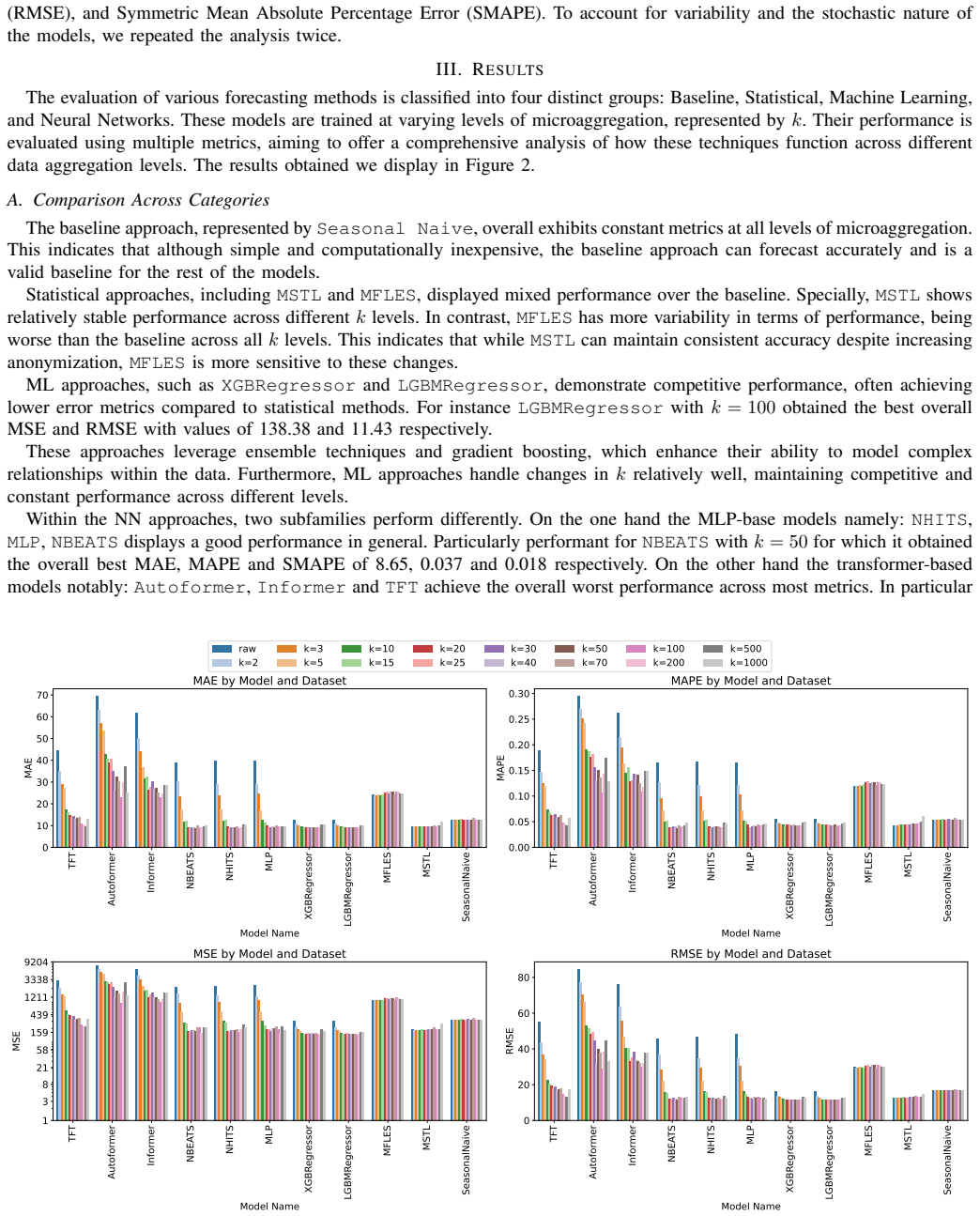
- [Fig. 2 caption] The caption says "mean ans standard deviation" and should read "mean and standard deviation"; the MSE panel appears to use a logarithmic scale, but the axis labels are not annotated as such.
- [§II-C] The input size of 500 for the neural networks is set empirically with no sensitivity analysis; a sentence explaining why 500 is sufficient would help.
- [§III-A] Statements such as "MFLES is more sensitive to these changes" are qualitative; consider supporting them with the per-day standard deviations or a small table of the actual errors.
Circularity Check
No material circularity: the forecasting evaluation is empirical and self-contained, and the sole self-citation is not load-bearing.
full rationale
The paper's evaluation is empirical and self-contained: it uses the public Low Carbon London dataset, eleven forecasting models, and reports forecast errors across k-levels; no central claim is derived from an equation that assumes the conclusion. The closest structural issue is that Eq. (2) reconstructs the raw aggregate exactly when each microaggregated group value is the mean of k households, so the aggregate target is identical for every k and the reported gains partly reflect the well-known variance reduction from forecasting n/k averaged series instead of n individual series. This is a validity threat (a random-grouping control would isolate the MDAV similarity criterion), but it is a confound, not a circularity: the forecast-error outcomes are measured, not entailed by the identity. The only self-citation, [26], supports the general claim that lower within-cluster variability helps forecasting; it is not load-bearing for the paper's new empirical finding and is corroborated by the paper's own results. No equation is fitted and then renamed as a prediction; the exponential decay in Eq. (6) is an explicit post-hoc fit. Hence no significant circularity.
Assumptions & free parameters
free parameters (3)
- Exponential decay coefficients a, b in Eq. (6) =
a=1.62, b=3.68
- Optimal k per model family (post hoc) =
DL: k=60 (sigma=36), ML: k=45 (sigma=38), Transformers: k=233 (sigma=230)
- Neural network input size =
500
assumptions (3)
- domain assumption The reconstruction in Eq. (2), summing k times each group forecast, is the appropriate utility measure for aggregated load forecasting.
- domain assumption Microaggregation at the tested k values provides sufficient anonymization for GDPR-compliant sharing without direct user consent.
- domain assumption The 2013 Low Carbon London sample of 1000 households is representative for current STLF practice.
Cite this review
Pith. "Pith review of Forecasting Anonymized Electricity Load Profiles." pith.science (2026). https://pith.science/paper/ZTLSZCNP
@misc{pith2026250106237,
  author       = {Pith},
  title        = {Pith review of: Forecasting Anonymized Electricity Load Profiles},
  year         = {2026},
  howpublished = {\url{https://pith.science/paper/ZTLSZCNP}},
  note         = {Machine review of arXiv:2501.06237}
}
read the original abstract
In the evolving landscape of data privacy, the anonymization of electric load profiles has become a critical issue, especially with the enforcement of the General Data Protection Regulation (GDPR) in Europe. These electric load profiles, which are essential datasets in the energy industry, are classified as personal behavioral data, necessitating stringent protective measures. This article explores the implications of this classification, the importance of data anonymization, and the potential of forecasting using microaggregated data. The findings underscore that effective anonymization techniques, such as microaggregation, do not compromise the performance of forecasting models under certain conditions (i.e., forecasting aggregated). In such an aggregated level, microaggregated data maintains high levels of utility, with minimal impact on forecasting accuracy. The implications for the energy sector are profound, suggesting that privacy-preserving data practices can be integrated into smart metering technology applications without hindering their effectiveness.
Figures


Reference graph
Works this paper leans on
-
[1]
The European Commission, “Directive 2009/72/ec of the european parliament and of the council of 13 july 2009 concerning common rules for the internal market in electricity and repealing directive 003/54/ec,” Official Journal of the Europan Union , vol. L 211/55, 2009
work page 2009
-
[2]
Smart grid technologies: Communication technologies and standards,
V . C. Gungor, D. Sahin, T. Kocak, S. Ergut, C. Buccella, C. Cecati, and G. P. Hancke, “Smart grid technologies: Communication technologies and standards,” IEEE Transactions on Industrial Informatics , vol. 7, no. 4, pp. 529–539, 2011
work page 2011
-
[3]
Forecasting: theory and practice,
F. Petropoulos, D. Apiletti, V . Assimakopoulos, M. Z. Babai, D. K. Barrow, S. B. Taieb, C. Bergmeir, R. J. Bessa, J. Bijak, J. E. Boylan, et al. , “Forecasting: theory and practice,” International Journal of Forecasting , vol. 38, no. 3, pp. 705–871, 2022
work page 2022
-
[4]
Smart meters in smart grid: An overview,
J. Zheng, D. W. Gao, and L. Lin, “Smart meters in smart grid: An overview,” in 2013 IEEE Green Technologies Conference (GreenTech) , pp. 57–64, 2013
work page 2013
-
[5]
What is GDPR, the EU’s new data protection law?,
B. Wolford, “What is GDPR, the EU’s new data protection law?,” 2018. Accesed on: 20/06/2024
work page 2018
-
[6]
Smart grid privacy via anonymization of smart metering data,
C. Efthymiou and G. Kalogridis, “Smart grid privacy via anonymization of smart metering data,” in 2010 First IEEE International Conference on Smart Grid Communications, pp. 238–243, IEEE, 2010
work page 2010
-
[7]
Ordinal, continuous and heterogeneous k-anonymity through microaggregation,
J. Domingo-Ferrer and V . Torra, “Ordinal, continuous and heterogeneous k-anonymity through microaggregation,”Data Mining and Knowledge Discovery, vol. 11, pp. 195–212, 2005
work page 2005
-
[8]
Data sharing in energy systems,
J. Wang, F. Gao, Y . Zhou, Q. Guo, C.-W. Tan, J. Song, and Y . Wang, “Data sharing in energy systems,” Advances in Applied Energy , vol. 10, p. 100132, 2023
work page 2023
Show all 28 references
-
[9]
Low Carbon London Project: Data from the Dynamic Time-of-Use Electricity Pricing Trial, 2013,
G. Strbac, S. Tindemans, M. Woolf, M. Bilton, R. Carmichael, and J. R. Schofield, “Low Carbon London Project: Data from the Dynamic Time-of-Use Electricity Pricing Trial, 2013,” 2024
2013
-
[10]
k-anonymity: A model for protecting privacy,
L. Sweeney, “k-anonymity: A model for protecting privacy,” International journal of uncertainty, fuzziness and knowledge-based systems , vol. 10, no. 05, pp. 557–570, 2002
2002
-
[11]
Dftmicroagg: a dual-level anonymization algorithm for smart grid data,
K. S. Adewole and V . Torra, “Dftmicroagg: a dual-level anonymization algorithm for smart grid data,” International Journal of Information Security , vol. 21, no. 6, pp. 1299–1321, 2022
2022
-
[12]
Mstl: A seasonal-trend decomposition algorithm for time series with multiple seasonal patterns,
K. Bandara, R. J. Hyndman, and C. Bergmeir, “Mstl: A seasonal-trend decomposition algorithm for time series with multiple seasonal patterns,” arXiv preprint arXiv:2107.13462, 2021
2021 arXiv
-
[13]
Tyler, “MFLES,” 2024
B. Tyler, “MFLES,” 2024
2024
-
[14]
Xgboost: A scalable tree boosting system,
T. Chen and C. Guestrin, “Xgboost: A scalable tree boosting system,” arXiv preprint arXiv:1603.02754 , 2016
2016 arXiv
-
[15]
Lightgbm: A highly efficient gradient boosting decision tree,
G. Ke, Q. Meng, T. Finley, T. Wang, W. Chen, W. Ma, Q. Ye, and T.-Y . Liu, “Lightgbm: A highly efficient gradient boosting decision tree,” Advances in Neural Information Processing Systems , 2017
2017
-
[16]
N-beats: Neural basis expansion analysis for interpretable time series forecasting,
B. N. Oreshkin, D. Carpov, N. Chapados, and Y . Bengio, “N-beats: Neural basis expansion analysis for interpretable time series forecasting,” arXiv preprint arXiv:1905.10437, 2019
1905 arXiv
-
[17]
N-hits: Neural hierarchical interpolation for time series forecasting,
C. Challu, G. Marcjasz, P. Montero-Manso, T. S. Talagala, R. J. Hyndman, and R. J. Bessa, “N-hits: Neural hierarchical interpolation for time series forecasting,” arXiv preprint arXiv:2201.12886 , 2022
2022 arXiv
-
[18]
Autoformer: Decomposition transformers with auto-correlation for long-term series forecasting,
H. Wu, J. Xu, J. Wang, and M. Long, “Autoformer: Decomposition transformers with auto-correlation for long-term series forecasting,” arXiv preprint arXiv:2106.13008, 2021
2021 arXiv
-
[19]
Informer: Beyond efficient transformer for long sequence time-series forecasting,
H. Zhou, S. Zhang, J. Peng, S. Zhang, J. Li, H. Xiong, and W. Zhang, “Informer: Beyond efficient transformer for long sequence time-series forecasting,” arXiv preprint arXiv:2012.07436 , 2020
2012 arXiv
-
[20]
Temporal fusion transformers for interpretable multi-horizon time series forecasting,
B. Lim, S. O. Arik, N. Loeff, and T. Pfister, “Temporal fusion transformers for interpretable multi-horizon time series forecasting,” arXiv preprint arXiv:1912.09363, 2019
1912 arXiv
-
[21]
Management of an academic hpc cluster: The ul experience,
S. Varrette, P. Bouvry, H. Cartiaux, and F. Georgatos, “Management of an academic hpc cluster: The ul experience,” in Proc. of the 2014 Intl. Conf. on High Performance Computing & Simulation (HPCS 2014) , (Bologna, Italy), pp. 959–967, IEEE, July 2014
2014
-
[22]
NeuralForecast: User friendly state-of-the-art neural forecasting models
K. G. Olivares, C. Chall ´u, F. Garza, M. M. Canseco, and A. Dubrawski, “NeuralForecast: User friendly state-of-the-art neural forecasting models..” PyCon Salt Lake City, Utah, US 2022, 2022
2022
-
[23]
StatsForecast: Lightning fast forecasting with statistical and econometric models
F. Garza, M. M. Canseco, and K. G. O. Cristian Chall ´u, “StatsForecast: Lightning fast forecasting with statistical and econometric models.” PyCon Salt Lake City, Utah, US 2022, 2022
2022
-
[24]
Domingo-Ferrer and Y
J. Domingo-Ferrer and Y . Saygin, Privacy in statistical databases , vol. 5262. Springer, 2008
2008
-
[25]
W. E. Yancey, W. E. Winkler, and R. H. Creecy, Disclosure risk assessment in perturbative microdata protection . Springer, 2002
2002
-
[26]
Towards a peer-to-peer residential short-term load forecasting with federated learning,
J. D. Fernandez, S. Potenciano Menci, and I. Pavic, “Towards a peer-to-peer residential short-term load forecasting with federated learning,” in 2023 IEEE Belgrade PowerTech, pp. 1–6, 2023
2023
-
[27]
“DeepL.” https://www.deepl.com/write
-
[28]
ChatGPT
“ChatGPT.” https://chatgpt.com/
Reviewed August 10, 2026 · model on record in the stance chip above.
Discussion (0). Continue with ORCID to comment.