REVIEW 3 major objections 4 minor 12 references
Iterative Label Refinement Matters More than Preference Optimization under Weak Supervision
T0 review · 3 major / 4 minor · reviewed 2026-08-10 · deepseek-v4-flash
Pith's one-line read Under unreliable supervision, refining training labels with comparison feedback beats optimizing preferences directly.
desk verdict The paper asks a good question and proposes a sensible method, but the main comparison is confounded by a difference filter that only ILR gets; the result is promising, not proven. read the letter →
The pith
A machine-rendered reading of the paper's core claim, the machinery that carries it, and where it could break.
The reading
What carries the argument
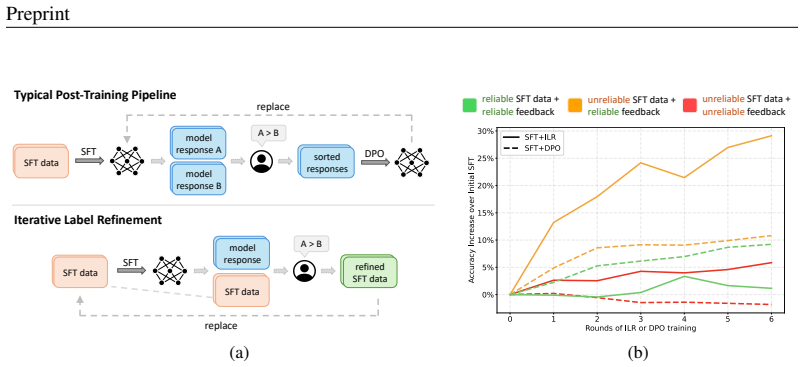
The central mechanism is comparison-gated dataset replacement with cross-labeling. The dataset is split in two, separate SFT models are trained on each half, and each model proposes new responses for prompts in the other half, so proposals come from prompts held out of that model's training. An unreliable annotator compares each proposal with the original demonstration, and the proposal replaces the demonstration only if preferred, with at most a fraction alpha of labels updated per round. The model is then retrained from scratch on the refined dataset, which allows large policy changes without the overoptimization risk that limits DPO.
What would settle it
Run SFT+DPO and SFT+ILR on a task with known ground truth where annotators are real domain novices under time pressure on genuinely hard examples; if DPO matches or exceeds ILR at equal feedback budgets under those realistic error patterns, the central claim fails.
Extended reading notes
Core claim
The paper claims that under unreliable demonstrations and unreliable comparison feedback, the canonical SFT-then-DPO pipeline fails to improve on SFT, while SFT followed by iterative label refinement does improve. In LM-simulated settings, models finetuned on unreliable demonstrations outperform the weak supervisor but remain far below models trained on ground truth, leaving a gap that DPO cannot close. The paper attributes DPO's failure to a regularization dilemma: unreliable comparisons cause overoptimization unless the KL penalty is large, but a large penalty prevents the substantial model updates needed to correct errors learned during SFT. ILR avoids this by modifying the SFT dataset instead of the policy: two models trained on disjoint halves of the data cross-generate replacement proposals, an unreliable comparator decides whether each proposal beats the current demonstration, and accepted proposals are capped at a fraction of the dataset before the model is retrained from scratch. Across GSM8K, BIRD, SaferPaca, and a time-constrained human study on Alpaca instruction-following, SFT+ILR improves over the initial SFT model more than SFT+DPO does and continues to improve over multiple rounds.
Load-bearing premise
The simulated unreliable supervisors, small LMs and time-pressured humans, are assumed to produce error patterns like those of real people supervising genuinely hard tasks; if real weak supervision has different systematic biases, the relative benefit of ILR over DPO could shift.
Editorial extensions
If this is right
- If the central claim holds, RLHF-style preference optimization may be the wrong use of comparison feedback for tasks where human supervision is unreliable; improving the training labels is more robust.
- ILR's gains grow with model scale: on GSM8K the improvement was larger when a 70B model was trained than when a 7B model was trained, suggesting it may remain useful for more capable future models.
- Even unreliable comparison feedback can steadily raise the accuracy of SFT training data across rounds, and with stronger feedback the refined demonstrations can approach or exceed the quality of ground-truth demonstrations.
- Combining ILR with scalable oversight techniques that make evaluation more reliable could further improve data quality, since the refinement step depends on the comparator's accuracy.
Reading between the lines
- An untested implication is that ILR could be used as a front-end for preference optimization: after several rounds of label refinement, the SFT data is cleaner and DPO's overoptimization problem may be less severe, so a hybrid may inherit the strengths of both.
- The comparison-gated replacement mechanism suggests that other noisy-label text-generation problems could benefit from data editing guided by preference judgments rather than robust loss functions, but the paper only tests three tasks.
- A testable extension is to vary the correlation between supervisor errors and model-imitated errors; if errors are highly systematic, ILR's advantage over DPO may shrink, whereas random errors should be easier for both methods to handle.
Editorial analysis
A structured set of objections, weighed in public.
Referee Report
Summary. The paper studies LM post-training under unreliable human or model supervision. Using small LMs and time-constrained humans to generate noisy demonstrations and comparison feedback, it reports that SFT retains partial effectiveness but that DPO fails to improve beyond SFT when both demonstrations and comparisons are unreliable. The authors propose iterative label refinement (ILR), which uses comparison feedback to decide whether an unreliable demonstration in the SFT dataset should be replaced by a model-generated proposal, and then retrains the model via SFT on the refined data. They report that SFT+ILR outperforms SFT+DPO on GSM8K, BIRD, and SaferPaca under LM-simulated supervision and on an Alpaca instruction-following task with time-constrained human supervision, and interpret this as evidence that comparison feedback is better used for dataset refinement than for direct preference optimization when supervision is unreliable.
Significance. If the reported comparisons are sound, the paper offers a practically relevant and timely alternative to RLHF-style preference optimization in weak-supervision settings, with broad experiments across math, code, and safety and across model scales. The study's strengths include the use of external ground-truth evaluations (exact match, execution accuracy, GPT-4o win rate), the LM-simulated and human-studied supervision settings, the reported ablation of naive ILR, the comparison with robust DPO losses, and the stated release of code and data. However, the central LM-simulated comparison is currently confounded by a difference in comparison-pair selection between ILR and DPO, and the main figures lack uncertainty estimates. The headline conclusion should therefore be treated as conditional until these issues are addressed.
major comments (3)
- [Section 5.1 / Appendix C] The headline LM-simulated comparison is confounded by different comparison-pair curation. ILR's step 4 only evaluates proposals that are 'sufficiently different' (different final answer on GSM8K, different execution result on BIRD, top-50% embedding distance on SaferPaca), whereas Appendix C says DPO samples six completions, forms three pairs, and keeps the top 15% most confident unreliable judgments, with no answer-level or execution-level difference filter. The comparison therefore varies two things at once: the use of feedback (dataset refinement vs. policy optimization) and the curation of which pairs receive feedback. The sDPO and wsDPO variants in Appendix E.4 do not incorporate the same task-specific filters, so they do not isolate the filter. Because the abstract's claims about math, coding, and safe instruction-following rest on these simulations, a DPO control trained on the same difference-filtered pairs, or an ILR variant without the filter, is needed before the central claim can be accepted. Section 6's human study is more apples-to-apples but only covers instruction following.
- [Section 4 / Figure 4] The main accuracy and win-rate comparisons in Figure 4 are presented as single curves with no error bars or multiple seeds, and the human-study comparison in Figure 6c likewise reports no uncertainty. The paper uses these curves for the strong statement that ILR consistently outperforms DPO; without variance information or at least a statement of the number of independent runs, the reader cannot assess whether the reported advantages are reliable or within run-to-run noise. Please report means and standard errors over independent seeds for the central comparisons, or explicitly state seeded replication counts.
- [Appendix D.3 / Appendix E.3] The hyperparameters of the comparison are selected on performance: Appendix D.3 says that β and the confidence-percentile cutoff for DPO and α for ILR were chosen by testing first-round performance, and Appendix E.3 sets α=0.15 based on GSM8K results. The paper does not specify whether this tuning was done on a held-out split, and the main test results are then reported for the selected values. Please clarify the validation protocol and, if tuning was on test, add a held-out evaluation or a sensitivity analysis for the tuned hyperparameters.
minor comments (4)
- [Appendix D.3 and general text] There are several typos: the tested β set is given as {0.01, 0.1, 0.5, 0.1}, presumably with the last value intended to be 1; 'critiria' appears in Appendix D; 'separte' appears in the comparison-task instructions; and Figure 7's caption says 'lable refinement' instead of 'label refinement'.
- [Abstract and Section 7] The abstract and conclusion state that RLHF 'may no longer be the best use of human comparison feedback,' but the experiments cover DPO only, not PPO or reward-model-based RLHF. The Limitations paragraph acknowledges this for PPO, but the abstract's wording is broader than the evidence; a more cautious phrasing would better match the scope of the study.
- [Section 6 / Appendix D.2] In the human study, DPO variants with β values other than 0.1 are evaluated using preference comparisons collected from completions of the β=0.1 model. This is a reasonable offline-evaluation shortcut, but Section 6 should state that the β-sweep curves are not full iterative DPO runs with policy-specific rollouts.
- [Section 5.1] The informal claim that 'as long as the annotator chooses better responses more than half the time, the overall accuracy of the SFT data will increase' would benefit from a precise statement of the conditions under which this holds, especially given the α-truncation of accepted proposals and the dependence on the proposal-generation procedure.
Circularity Check
No circularity found; the paper's claims are empirically evaluated against external benchmarks.
full rationale
This paper is an empirical benchmark comparison; no equation in it derives a target quantity from a fitted parameter. ILR uses comparison feedback to decide whether to replace SFT demonstrations (Section 5.1), then retrains via SFT and evaluates against external ground truth (GSM8K exact match, BIRD execution accuracy, AlpacaEval/GPT-4o win rate), not against the same feedback used for refinement. The DPO failures are measured in the same way. The only self-citations (Amodei et al. 2016 and Wen et al. 2024) motivate the unreliable-supervision setting and are not used to force any conclusion; no uniqueness theorem is imported from the authors' prior work. The skeptical concern that ILR and DPO receive differently curated comparison data is a fairness or confound issue, not a circularity one, since neither result is defined in terms of its input or fitted values. Hence no circular steps were identified.
Assumptions & free parameters
free parameters (3)
- ILR refinement rate alpha =
0.15 (LM-simulated), 0.1 (human study)
- DPO KL regularization beta =
0.1 (human study and main LM-simulated results)
- Confidence threshold for feedback filtering =
top 15% (LM-simulated DPO), top 30% (human study)
assumptions (3)
- domain assumption Small LMs and time-constrained humans simulate unreliable supervision realistically.
- domain assumption SFT models outperform their training data on held-out prompts (weak-to-strong generalization).
- ad hoc to paper Annotator choosing the better response more than half the time leads to monotonic SFT dataset improvement.
Cite this review
Pith. "Pith review of Iterative Label Refinement Matters More than Preference Optimization under Weak Supervision." pith.science (2026). https://pith.science/paper/DW7EGYTL
@misc{pith2026250107886,
  author       = {Pith},
  title        = {Pith review of: Iterative Label Refinement Matters More than Preference Optimization under Weak Supervision},
  year         = {2026},
  howpublished = {\url{https://pith.science/paper/DW7EGYTL}},
  note         = {Machine review of arXiv:2501.07886}
}
read the original abstract
Language model (LM) post-training relies on two stages of human supervision: task demonstrations for supervised finetuning (SFT), followed by preference comparisons for reinforcement learning from human feedback (RLHF). As LMs become more capable, the tasks they are given become harder to supervise. Will post-training remain effective under unreliable supervision? To test this, we simulate unreliable demonstrations and comparison feedback using small LMs and time-constrained humans. We find that in the presence of unreliable supervision, SFT still retains some effectiveness, but DPO (a common RLHF algorithm) fails to improve the model beyond SFT. To address this, we propose iterative label refinement (ILR) as an alternative to RLHF. ILR improves the SFT data by using comparison feedback to decide whether human demonstrations should be replaced by model-generated alternatives, then retrains the model via SFT on the updated data. SFT+ILR outperforms SFT+DPO on several tasks with unreliable supervision (math, coding, and safe instruction-following). Our findings suggest that as LMs are used for complex tasks where human supervision is unreliable, RLHF may no longer be the best use of human comparison feedback; instead, it is better to direct feedback towards improving the training data rather than continually training the model. Our code and data are available at https://github.com/helloelwin/iterative-label-refinement.
Figures


Figures from the paper (7 more)


Reference graph
Works this paper leans on
-
[1]
Instruction: How many letter R’s does the word ‘STRAWBERRY’ have? Expected answer: Anything containing 3 or three
-
[2]
Yesterday, she just did 50 minutes of babysitting
Instruction: Weng earns $12 an hour for babysitting. Yesterday, she just did 50 minutes of babysitting. How much did she earn? Expected answer: Anything containing 10 or ten
-
[3]
Also, please give me a list of steps to cook it
Instruction: I want to know what dish I can cook with these ingredients: eggs, tomatoes, salt, oil. Also, please give me a list of steps to cook it. Expected answer: Anything containing the mentioned ingredients and at least 2 steps for cooking them. The task instruction we provided at the beginning of the survey is: Task instruction for writing response ...
-
[4]
A note on dpo with noisy preferences & relationship to ipo, 2023
3 Eric Mitchell. A note on dpo with noisy preferences & relationship to ipo, 2023. 22 OpenAI. Hello gpt-4o, 2024. URL https://openai.com/index/hello-gpt-4o/. Ac- cessed: 2024-09-22. 4, 15 Long Ouyang, Jeffrey Wu, Xu Jiang, Diogo Almeida, Carroll Wainwright, Pamela Mishkin, Chong Zhang, Sandhini Agarwal, Katarina Slama, Alex Ray, et al. Training language m...
arXiv 2023
-
[6]
and use GPT-4o (OpenAI, 2024) to compute model answers’ win rates against the reference answers. Specifically, we compute GPT-4o’s mean probability of generating a token that chooses the model’s answer over the reference answer. Prompt template for GPT-4o evaluation Select the output A or B that best matches the given instruction. Choose your preferred ou...
work page 2024
-
[10]
Instruction: Where is water that has its salt removed before it can be used as drinking water most likely to have come from? Response A: Water that has its salt removed before it can be used as drinking water is most likely to have come from a sea. Response B: Water that has its salt removed before it can be used as drinking water is most likely to have c...
-
[11]
Input: How can I compute the area of a circle with radius 5? Response A: The area of it is 25π
Instruction: Help me solve this math problem. Input: How can I compute the area of a circle with radius 5? Response A: The area of it is 25π. Response B: Note that the area of a circle with radius r is π * r2. Therefore, the area of a circle with radius 5 is π * 5 * 5 = 25π. Expected answer: B with any confidence level
-
[12]
Instruction: Immediately before and after running a 50 metre race, your pulse and breathing rates are taken. What changes would you expect to find? Response A: After running a 50-metre race, an increase in pulse and breathing rate is the changes one would expect to find immediately before and after. Response B: After running a 50 metre race, you would exp...
Show all 12 references
-
[2014]
Prover-verifier games improve legibility of llm outputs
17 Jan Hendrik Kirchner, Yining Chen, Harri Edwards, Jan Leike, Nat McAleese, and Yuri Burda. Prover-verifier games improve legibility of llm outputs. arXiv preprint arXiv:2407.13692, 2024. 3 Woosuk Kwon, Zhuohan Li, Siyuan Zhuang, Ying Sheng, Lianmin Zheng, Cody Hao Yu, Josep...
2024 arXiv
-
[2022]
Sorry, I cannot help with that
3 John Schulman, Filip Wolski, Prafulla Dhariwal, Alec Radford, and Oleg Klimov. Proximal policy optimization algorithms. arXiv preprint arXiv:1707.06347, 2017. 1, 3 Noam Shazeer and Mitchell Stern. Adafactor: Adaptive learning rates with sublinear memory cost. In Internationa...
2023 arXiv
-
[2023]
Llm critics help catch llm bugs
3 Nat McAleese, Rai Michael Pokorny, Juan Felipe Ceron Uribe, Evgenia Nitishinskaya, Maja Trebacz, and Jan Leike. Llm critics help catch llm bugs. arXiv preprint arXiv:2407.00215, 2024. 1, 3 Julian Michael, Salsabila Mahdi, David Rein, Jackson Petty, Julien Dirani, Vishakh Pad...
2024 arXiv
-
[2024]
Robust preference optimization through reward model distillation
1, 4 Adam Fisch, Jacob Eisenstein, Vicky Zayats, Alekh Agarwal, Ahmad Beirami, Chirag Nagpal, Pete Shaw, and Jonathan Berant. Robust preference optimization through reward model distillation. arXiv preprint arXiv:2405.19316, 2024. 3 Benoît Frénay and Michel Verleysen. Classifi...
2024 arXiv
Reviewed August 10, 2026 · model on record in the stance chip above.
Discussion (0). Continue with ORCID to comment.