REVIEW 4 major objections 4 minor 1 cited by
Data-driven Detection and Evaluation of Damages in Concrete Structures: Using Deep Learning and Computer Vision
T0 review · 4 major / 4 minor · reviewed 2026-08-10 · deepseek-v4-flash
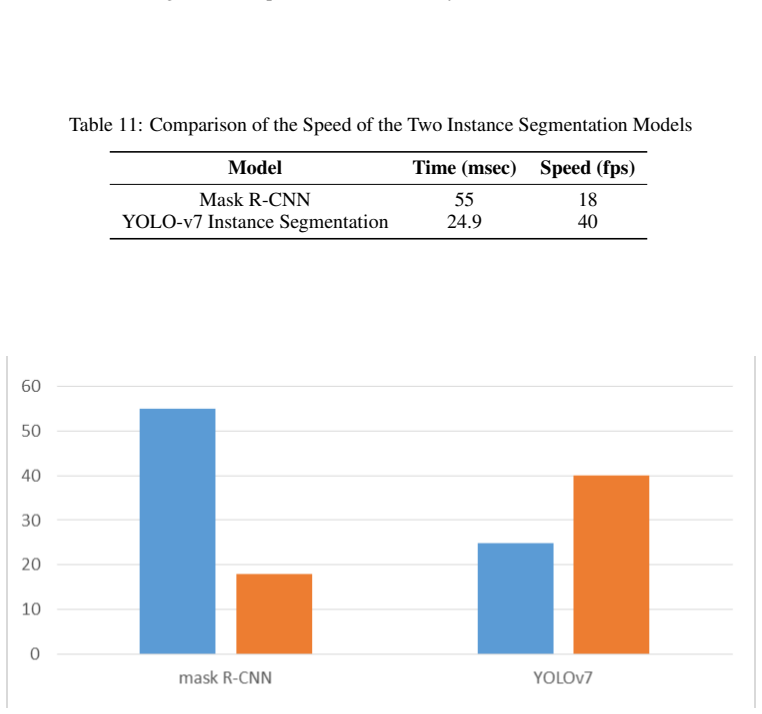
Pith's one-line read This paper claims that YOLO-v7 instance segmentation detects cracks and spalls in concrete more accurately and faster than Mask R-CNN, reporting 96.1% mAP@0.5 at 40 FPS versus 92.1% at 18 FPS, and recommends YOLO-v7 for real-time…
desk verdict Routine benchmark with a likely split-after-augmentation leak; the specific mAP numbers are not reliable until the protocol and inconsistent metrics are fixed. read the letter →
The pith
A machine-rendered reading of the paper's core claim, the machinery that carries it, and where it could break.
The reading
What carries the argument
The carrying object is instance segmentation, a vision task that labels each individual defect with its own pixel mask rather than only classifying whole images; this is what lets the system localize separate cracks and spalls. The comparison is carried by a fixed experimental pipeline: combining three public datasets into 400 images, expanding them to 10,995 via geometric and color augmentations plus model-specific transforms, fine-tuning both models from pre-trained weights, and scoring with mAP@0.5 and FPS. The mAP numbers are the bridge between model choice and deployment recommendation.
What would settle it
A reader could rerun the same training protocol with the 400-image set split into training and test before any augmentation, then augment only the training side. If YOLO-v7's mAP@0.5 falls well below 96.1% or the gap with Mask R-CNN shrinks, the reported superiority is an artifact of data leakage rather than a property of the model.
Extended reading notes
Core claim
The authors' central discovery is that, on their curated concrete-damage dataset, YOLO-v7 instance segmentation outperforms Mask R-CNN on every headline metric: mAP@0.5 of 96.1% versus 92.1%, precision of 94.9% versus 92.0%, recall of 94.3% versus 62.8%, and inference speed of 40 FPS versus 18 FPS. They interpret this as evidence that one-stage instance segmentation is the right architecture for real-time structural health monitoring, especially for catching spalls (mAP 99.5%) and, to a lesser degree, cracks (mAP 92.7%). The paper also reports qualitative generalization tests on random internet photos and videos, which the authors take as further evidence of robustness.
Load-bearing premise
The load-bearing premise is that the 90/10 training/test split of the augmented dataset keeps each original concrete image on one side only; if augmented copies of the same crack appear in both training and test sets, the reported mAP mostly measures recognition of near-duplicates rather than true generalization.
Editorial extensions
If this is right
- YOLO-v7 instance segmentation can process concrete inspection video at 40 frames per second, so it could run on drone or wall-climbing camera feeds without waiting for offline batch analysis.
- Mask R-CNN's recall of 62.8% on this dataset implies that roughly a third of defects would be missed in a live setting, making it a poorer fit for safety-critical screening despite its 92.1% mAP.
- Both models detect spalls more reliably than cracks, so crack recall (88.6% for YOLO-v7) is the bottleneck that future datasets and architectures should target.
- Transfer learning from a large pre-trained vision model allows a domain dataset of only 400 source images to reach near-96% detection performance after augmentation.
- Deploying YOLO-v7 on edge devices with IoT cameras would enable on-site, real-time damage assessment without sending images to a central server, a direct corollary of the reported speed.
Reading between the lines
- The reported accuracy is likely to be an upper bound on real-world generalization: the 90/10 split was applied after augmentation, so augmented copies of the same original image can appear in both training and test sets; a split-before-augmentation retest would reveal how much of the score comes from near-duplicate recognition.
- If the speed-accuracy gap persists on a held-out, pre-augmentation test set, the practical consequence extends beyond concrete inspection: any instance-segmentation task with small annotated datasets and real-time requirements should prefer carefully tuned one-stage detectors over two-stage ones.
- A natural testable extension is to add fine-crack classes at higher imaging resolution, because the paper's own limitation discussion predicts YOLO-v7 will lose accuracy on extremely fine cracks as resolution is constrained.
- The qualitative internet-photo and video tests suggest some out-of-distribution robustness, but a quantitative evaluation with established crack benchmarks would be needed to claim the model generalizes across cameras and lighting.
Editorial analysis
A structured set of objections, weighed in public.
Referee Report
Summary. This paper benchmarks two instance segmentation models, Mask R-CNN and YOLO-v7, on a combined dataset of 400 concrete crack/spall images augmented to 10,995 images. The models are trained with transfer learning and evaluated with precision, recall, mAP@0.5, and FPS. The central claim is that YOLO-v7 achieves higher mAP@0.5 (96.1%) and higher throughput (40 FPS) than Mask R-CNN (92.1%, 18 FPS), making it preferable for real-time structural health monitoring. The paper also discusses limitations and future directions.
Significance. If the quantitative comparison is valid, the result is a useful practical benchmark for infrastructure inspection: it aligns with the general observation that one-stage detectors such as YOLO-v7 offer better speed-accuracy trade-offs than two-stage Mask R-CNN on similar segmentation tasks. The manuscript's strengths are the use of three publicly available datasets, the comparison of two standard architectures, and the explicit acknowledgment of limitations (Section 3.11). However, the validity cannot currently be assessed due to the unclear data-split point, inconsistent dataset counts, contradictory metric tables, and unreported statistical variability; these issues must be resolved before the comparison can be used to support the recommendation.
major comments (4)
- [§2.1–2.2, Table 1] The manuscript does not state whether the 90/10 split was performed on the 400 original images before augmentation or on the augmented set. Because the augmentation pipeline generates many near-duplicate variants of each source image, a post-augmentation split can place sibling images of the same crack in both training and test partitions; with 400 source images and a 1,000-image test partition, this is a concrete risk that would inflate mAP by near-duplicate retrieval. Additionally, the reported counts are inconsistent: the text states 10,995 augmented images, while Table 1 sums to 10,000 (9,000 + 1,000). Please specify the split point and reconcile the counts; if the split was post-augmentation, re-run the comparison with a split performed before augmentation.
- [§3.2–3.3, Tables 6, 7 and 9] The mAP comparison for Mask R-CNN is internally inconsistent. Table 9 reports Mask R-CNN mAP@0.5 = 92.1%, but Table 7 gives class-specific AP values of 37.3% (crack) and 79.3% (spall), whose average cannot equal 92.1%; Table 6 also reports a 92.1% 'classification' AP50 alongside a 95.5% bounding-box AP50, without defining how these relate to the mAP used in Table 9. Please clarify which metric is reported and recompute the class-averaged mAP, since the central accuracy comparison rests on this number.
- [§3.3 and §3.7, Tables 8 and 11] All accuracy and speed metrics appear to be single-run measurements with no error bars or number of repeated trials. The 4-point mAP gap between YOLO-v7 and Mask R-CNN may be within run-to-run variance for models trained with stochastic gradient descent; at minimum, report metrics across multiple seeds with means and standard deviations, and state the number of runs.
- [§3.7, Tables 9 and 11] The FPS comparison is not reproducible as reported because the manuscript does not state the GPU model, batch size at inference, input resolution after preprocessing (the text says all images resized to 640×640 but does not state whether this was used at test time for both models), or the measurement protocol for FPS. Please provide this information so the speed advantage can be independently verified.
minor comments (4)
- [Title] The title contains a typographical error: 'DATA-D RIVEN' should be 'DATA-DRIVEN'.
- [§3.4, second bullet] The statement 'Mask R-CNN: Superior precision for crack classification' is not supported by the tables: Table 10 shows lower overall precision for Mask R-CNN (92.0% vs 94.9%), and no crack-specific precision for Mask R-CNN is provided in Table 7.
- [§2.1, Table 1] The phrase 'Validation, Test' is ambiguous; it is unclear whether the 10% is a separate test set or a combined validation/test partition, and the paper does not state how the reported test metrics were computed.
- [§2.2, Tables 2 and 3] The word 'Cutting' in Table 2 should be 'Cropping', and it is unclear whether Mask R-CNN received any model-specific augmentation or only the Roboflow augmentation; please clarify for a fair comparison.
Circularity Check
No circularity: empirical benchmark; the only concern is a data-leakage risk from the post-augmentation split, not a circular derivation.
full rationale
This paper is an empirical benchmark comparing YOLO-v7 instance segmentation with Mask R-CNN on a concrete damage dataset. The central claims—mAP@0.5 of 96.1% at 40 FPS versus 92.1% at 18 FPS—are measured experimental results, not quantities defined in terms of one another. No parameter is fitted to a subset and then reported as a prediction of a closely related quantity, and no load-bearing appeal is made to the authors' own prior theorems or uniqueness results. The only near-circularity concern is the dataset-handling description in Section 2.1: the paper says the 400 images were 'expanded through augmentation to 10,995 images' and then gives the 9,000/1,000 split in Table 1, which suggests augmentation occurred before the train/test split. If so, augmented siblings of the same original image could appear in both training and test partitions, making the test set partially a near-duplicate retrieval task rather than a true generalization test. This is a genuine evaluation-validity risk, and the paper should have disclosed whether the split was performed before augmentation. However, this is data leakage or experimental-design ambiguity, not circular reasoning: the reported accuracies are not 'equivalent to their inputs by construction' in the sense of a self-definitional derivation, a fitted parameter renamed as a prediction, or an imported uniqueness claim. The comparison itself is externally grounded in two standard off-the-shelf model architectures and public datasets, so the paper is not self-referential in its derivation chain. Accordingly, no specific circular step can be exhibited under the required standard, and the appropriate circularity score is 0.
Assumptions & free parameters
free parameters (6)
- Mask R-CNN initial learning rate =
0.00025
- Mask R-CNN batch size =
2
- YOLO-v7 initial and end learning rates =
0.01 to 0.1
- YOLO-v7 augmentation hyperparameters =
H 0.015, S 0.7, V 0.4, translation 0.2, zoom 0.5, rotation 0.5, mosaic 1
- IoU positive threshold =
0.2
- Training and test split ratio =
90% training, 10% validation and test
assumptions (5)
- domain assumption Pre-trained COCO weights transfer useful features to concrete crack and spall segmentation.
- domain assumption Geometric and color augmentation preserves the validity of damage labels in the augmented images.
- domain assumption The mAP@0.5 metric is a faithful proxy for practical damage detection quality.
- domain assumption The three combined public datasets cover a representative distribution of concrete damage.
- domain assumption Internet-sourced images and videos used in Section 3.8 are genuinely out-of-distribution test cases.
Cite this review
Pith. "Pith review of Data-driven Detection and Evaluation of Damages in Concrete Structures: Using Deep Learning and Computer Vision." pith.science (2026). https://pith.science/paper/4V427PVR
@misc{pith2026250111836,
  author       = {Pith},
  title        = {Pith review of: Data-driven Detection and Evaluation of Damages in Concrete Structures: Using Deep Learning and Computer Vision},
  year         = {2026},
  howpublished = {\url{https://pith.science/paper/4V427PVR}},
  note         = {Machine review of arXiv:2501.11836}
}
read the original abstract
Structural integrity is vital for maintaining the safety and longevity of concrete infrastructures such as bridges, tunnels, and walls. Traditional methods for detecting damages like cracks and spalls are labor-intensive, time-consuming, and prone to human error. To address these challenges, this study explores advanced data-driven techniques using deep learning for automated damage detection and analysis. Two state-of-the-art instance segmentation models, YOLO-v7 instance segmentation and Mask R-CNN, were evaluated using a dataset comprising 400 images, augmented to 10,995 images through geometric and color-based transformations to enhance robustness. The models were trained and validated using a dataset split into 90% training set, validation and test set 10%. Performance metrics such as precision, recall, mean average precision (mAP@0.5), and frames per second (FPS) were used for evaluation. YOLO-v7 achieved a superior mAP@0.5 of 96.1% and processed 40 FPS, outperforming Mask R-CNN, which achieved a mAP@0.5 of 92.1% with a slower processing speed of 18 FPS. The findings recommend YOLO-v7 instance segmentation model for real-time, high-speed structural health monitoring, while Mask R-CNN is better suited for detailed offline assessments. This study demonstrates the potential of deep learning to revolutionize infrastructure maintenance, offering a scalable and efficient solution for automated damage detection.
Figures


Figures from the paper (7 more)




Forward citations
Cited by 1 Pith paper
-
Vision-based autonomous structural damage detection using data-driven methods
On a public wind-turbine surface-image dataset, YOLOv7 reaches 82.4% mAP@50 at 11 ms per image, beating YOLOv7-tiny and Faster R-CNN.
Reference graph
Works this paper leans on
-
[1]
C. F. Özgenel. Concrete crack segmentation dataset. Mendeley Data 2019
work page 2019
- [2]
-
[3]
Y . Shawn. FCN for crack recognition. Available online:https://github.com/OnionDoctor/FCN_for_crack_ recognition (accessed on 13 March 2018)
work page 2018
-
[4]
M. Gatti. Structural health monitoring of an operational bridge: A case study. Eng. Struct. 2019, 195, 200–209
work page 2019
-
[5]
H. Kim, E. Ahn, M. Shin, and S.-H. Sim. Crack and noncrack classification from concrete surface images using machine learning. Struct. Health Monit. 2019, 18, 725–738
work page 2019
-
[6]
S. Dorafshan, M. Maguire, N. V . Hoffer, and C. Coopmans. Fatigue crack detection using unmanned aerial systems in under-bridge inspection. Ida. Transp. Dep. 2017, 2, 1–120
work page 2017
-
[7]
S. Dorafshan, R. J. Thomas, and M. Maguire. Fatigue crack detection using unmanned aerial systems in fracture critical inspection of steel bridges. J. Bridge Eng. 2018, 23, 04018078
work page 2018
-
[8]
M. R. Jahanshahi, J. S. Kelly, S. F. Masri, and G. S. Sukhatme. A survey and evaluation of promising approaches for automatic vision-based defect detection of bridge structures. Struct. Infrastruct. Eng. 2009, 5, 455–486
work page 2009
Show all 30 references
-
[9]
M. R. Jahanshahi and S. F. Masri. A new methodology for non-contact accurate crack width measurement through photogrammetry for automated structural safety evaluation. Smart Mater . Struct.2013, 22, 035019
2013
-
[10]
C. M. Yeum and S. J. Dyke. Vision-based automated crack detection for bridge inspection.Comput.-Aided Civ. Infrastruct. Eng. 2015, 30, 759–770
2015
-
[11]
Badrinarayanan, A
V . Badrinarayanan, A. Kendall, and R. Cipolla. Segnet: A deep convolutional encoder-decoder architecture for image segmentation. IEEE Trans. Pattern Anal. Mach. Intell. 2017, 39, 2481–2495
2017
-
[12]
J. Long, E. Shelhamer, and T. Darrell. Fully convolutional networks for semantic segmentation. InProceedings of the IEEE Conference on Computer Vision and Pattern Recognition , Boston, MA, USA, 7–12 June 2015; pp. 3431–3440
2015
-
[13]
Y . J. Cha, W. Choi, G. Suh, S. Mahmoudkhani, and O. Büyüköztürk. Autonomous structural visual inspection using region-based deep learning for detecting multiple damage types. Comput.-Aided Civ. Infrastruct. Eng. 2018, 33, 731–747
2018
-
[14]
C. V . Dung and L. D. Anh. Autonomous concrete crack detection using deep fully convolutional neural network. Autom. Constr .2019, 99, 52–58
2019
-
[15]
Bigdeli, H
N. Bigdeli, H. Jabbari, and M. Shojaei. An intelligent method for classification of cracks in concrete structures based on deep neural networks. Amirkabir Journal of Civil Engineering 2020, 53, No. 8
2020
-
[16]
Heidari, M
A. Heidari, M. R. Pourtabari, and M. R. Khalilianpour. Evaluation of cracking in concrete dams by artificial neural networks. In 2nd International Conference on New Research Findings in Civil Engineering, Architecture and Urban Management, Tehran, 2016. 16 A PREPRINT - JANUARY...
2016
-
[17]
Azimi, A
M. Azimi, A. D. Eslamlou, and G. Pekcan. Data-driven structural health monitoring and damage detection through deep learning: State-of-the-art review. Sensors 2020, 20(10), 2778
2020
-
[18]
Y . Xu, Y . Bao, Y . Zhang, and H. Li. Attribute-based structural damage identification by few-shot meta learning with inter-class knowledge transfer. Structural Health Monitoring 2020
2020
-
[19]
W. R. L. d. Silva and D. S. d. Lucena. Concrete cracks detection based on deep learning image classification. In Proceedings 2018, 2, 489
2018
-
[20]
Y . J. Cha and W. Choi. Deep learning-based crack damage detection using convolutional neural networks. Comput.-Aided Civ. Infrastruct. Eng. 2017, 32(5), 361–378
2017
-
[21]
A. R. Majdi Flah, M. L. Suleiman, and M. L. Nehdi. Classification and quantification of cracks in concrete structures using deep learning vision-based techniques. Cement and Concrete Composites 2020, 114, 103781
2020
-
[22]
Ahmed, S
B. Ahmed, S. Mangalathu, and J. S. Jeon. Seismic damage state predictions of reinforced concrete structures using stacked long short-term memory neural networks. Journal of Building Engineering 2022, 46, 103737
2022
-
[23]
Harirchian, T
E. Harirchian, T. Lahmer, and S. Rasulzade. Earthquake hazard safety assessment of existing buildings using optimized multi-layer perceptron neural network. Energies 2020, 13(8), 2060
2020
-
[24]
Harirchian, K
E. Harirchian, K. Jadhav, V . Kumari, and T. Lahmer. ML-EHSAPP: a prototype for machine learning-based earthquake hazard safety assessment of structures by using a smartphone app. Eur . J. Environ. Civ. Eng.2021, 1–21
2021
-
[25]
K. He, X. Zhang, S. Ren, and J. Sun. Deep residual learning for image recognition. In Proceedings of the IEEE conference on computer vision and pattern recognition , Las Vegas, NV , USA, 26–30 June 2016; pp. 770–778
2016
-
[26]
Y . Xu, S. Wei, Y . Bao, and H. Li. Automatic seismic damage identification of reinforced concrete columns from images by a region-based deep convolutional neural network. Structural Control and Health Monitoring 2019, e2313
2019
-
[27]
Maeda, Y
H. Maeda, Y . Sekimoto, T. Seto, T. Kashiyama, and H. Omata. Road damage detection and classification using deep neural networks with smartphone images. Computer-Aided Civil and Infrastructure Engineering 2018, 33(12), 1127–1141
2018
-
[28]
G. Li, B. Ma, S. He, X. Ren, and Q. Liu. Automatic tunnel crack detection based on U-Net and a convolutional neural network with alternately updated clique. Sensors 2020, 20, 717
2020
-
[29]
Guo et al
M.-H. Guo et al. Segnext: Rethinking convolutional attention design for semantic segmentation. arXiv preprint arXiv:2209.08575 (2022)
2022 arXiv
-
[30]
Mousavi and A
M. Mousavi and A. Bakhshi. Crack detection in concrete members using encoder-decoder models based on deep learning. Journal of Civil Engineering 2022, 38.2(2.2), 79–88. 17
2022
Reviewed August 10, 2026 · model on record in the stance chip above.
Discussion (0). Continue with ORCID to comment.