REVIEW 4 major objections 4 minor 87 references
Ensuring Medical AI Safety: Interpretability-Driven Detection and Mitigation of Spurious Model Behavior and Associated Data
T0 review · 4 major / 4 minor · reviewed 2026-08-10 · deepseek-v4-flash
Pith's one-line read A single learned direction in latent space lets a medical AI pipeline detect, localize, and unlearn spurious artifacts with little expert labeling.
desk verdict A useful empirical integration of CAV-based bias annotation into Reveal2Revise, but the headline claim about ViT mitigation is not supported by the paper's own appendix. read the letter →
The pith
A machine-rendered reading of the paper's core claim, the machinery that carries it, and where it could break.
The reading
What carries the argument
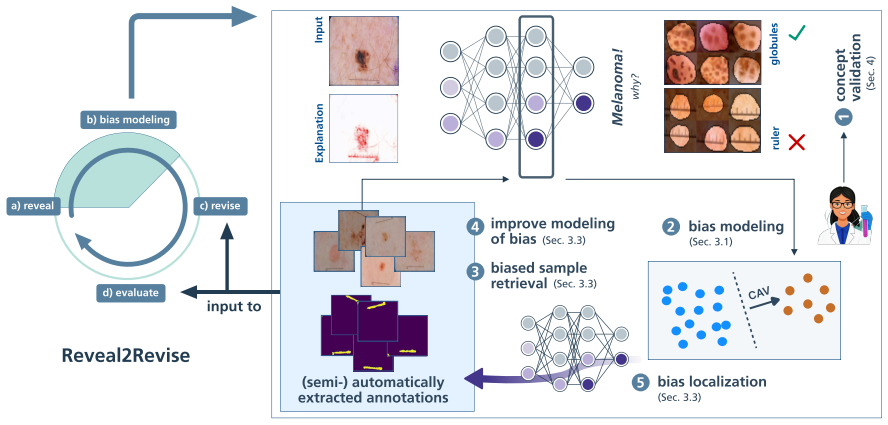
The load-bearing object is the Concept Activation Vector (CAV), defined as a direction in a chosen layer's activation space that separates samples containing the artifact from samples without it. It works as a ranker, as an iteratively refinable bias model, and as a localizer: projecting activations onto the CAV yields a bias score, while using the element-wise product of activations and the CAV as the initialization for layer-wise relevance propagation turns the direction into input-space heatmaps and binary masks. The choice of layer is part of the machinery, and the paper treats it as a hyperparameter that strongly affects retrieval and localization quality.
What would settle it
Take a controlled artifact with ground-truth masks, such as the inserted timestamp in HyperKvasir, train CAVs on every layer of a fixed model, and test both ranking and localization on held-out samples; the central claim is falsified if some artifact admits no layer whose CAV separates artifact samples from clean samples above chance while its localization mask overlaps the ground truth no better than randomly.
Extended reading notes
Core claim
The paper's central claim is that the two least-automated steps of the Reveal2Revise life cycle—finding which samples carry a spurious artifact and marking where the artifact sits—can be driven by a single linear bias representation. Starting from a small seed set of artifact samples, a CAV trained at a chosen layer gives a bias score for every other sample; ranking by that score retrieves previously unlabeled artifact images, and iterating with brief human inspection refines the direction. The same CAV, when combined with layer-wise relevance propagation, localizes the artifact in input space as a soft or binary mask. The paper reports that this closes the loop across four medical datasets and two modalities: the identified biases are unlearned with gradient-penalty or activation-projection corrections, accuracy on biased test sets rises, and artifact relevance and concept-sensitivity (TCAV) scores fall while clean-test accuracy is largely preserved.
Load-bearing premise
The pipeline assumes a spurious artifact can be captured as one linear direction in some layer of the network's latent space, and that a suitable layer can be found.
Editorial extensions
If this is right
- A small seed set of artifact samples can be expanded to a full dataset annotation by ranking unlabeled samples with CAV bias scores, reducing the expert labeling burden in the reveal and modeling stages.
- Spatial masks produced by CAV localization can feed input-gradient-based correction methods such as RRR, removing the need for hand-drawn pixel-level artifact masks.
- In the reported experiments, CAV-based mitigation methods such as RR-ClArC improve accuracy on biased test sets while keeping clean-test accuracy close to the baseline model's.
- The framework transfers beyond images to time-series medical data, where ECG models trained with an inserted static-noise artifact show the same detect-and-mitigate pattern.
Reading between the lines
- A natural extension the authors leave implicit is automatic layer selection—for example, choosing the layer whose CAV maximizes retrieval or localization quality on a validation set—which would remove the extra hyperparameter they flag in their limitations.
- The bias-score ranking could be deployed as a standalone dataset-auditing tool before any model correction, quantifying artifact prevalence and exposing labeling errors in medical training data.
- If the linear-direction assumption fails for heavily entangled concepts, the same loop would need non-linear concept regions or sparse-autoencoder disentanglement; the paper itself points to sparse autoencoders as future work.
- Outside medicine, the same CAV annotation loop should apply to any domain where device-specific artifacts correlate with labels, such as satellite imagery or industrial inspection, though non-localizable artifacts like color shifts would remain harder to mask.
Editorial analysis
A structured set of objections, weighed in public.
Referee Report
Summary. The paper reviews and extends the Reveal2Revise framework for detecting and mitigating spurious correlations in medical deep learning models. The extension adds semi-automated bias annotation: CAV-based biased-sample retrieval, iterative refinement of the bias representation, and spatial bias localization, followed by mitigation with RRR and ClArC variants. The authors evaluate on four medical datasets across two modalities (image and ECG) using VGG16, ResNet50, and ViT architectures, with both real-world and artificially controlled artifacts. The central claim is that the extended framework successfully identifies and mitigates these biases across all three vision architectures.
Significance. The paper has clear practical value if the claims are properly scoped. The strengths are real: controlled artifacts with ground-truth masks, externally anchored artifact labels for real-world biases, quantitative retrieval and localization evaluations on multiple layers and architectures, and released code and annotations. The bias identification and retrieval results are largely convincing and would be useful to practitioners. However, the headline claim of successful mitigation in ViTs is not supported by the reported numbers, and part of the mitigation evaluation is circular because the TCAV/artifact-relevance metrics are computed along the same CAV direction that the mitigation methods erase. These issues weaken the central claim as written, although they are addressable by revising the claims and adding independent evaluation.
major comments (4)
- [Abstract; §6.5; Appendix A.7.4 (Table 11)] The claim that the framework "successfully identify[ies] and mitigat[es] these biases in VGG16, ResNet50, and contemporary Vision Transformer models" is not supported for ViTs. In Table 11, the CAV-based methods RR-ClArC, P-ClArC, and rP-ClArC leave biased-test accuracy essentially unchanged: HyperKvasir stays at 0.42 for RR-ClArC, ISIC2019 moves only from 0.27 to 0.31, and CheXpert from 0.25 to 0.31. The only substantial ViT improvement comes from RRR with ground-truth masks (ISIC2019 0.27→0.59, HyperKvasir 0.42→0.54), which requires manual pixel-level annotations and is not the proposed semi-automated CAV annotation pipeline. The abstract and conclusions should be revised to claim ViT detection and localization, with mitigation demonstrated only when ground-truth masks are provided.
- [§6.5; Appendix A.7.4 (Eq. 12, Table 11)] The mitigation evaluation is partly circular: TCAV sensitivity and artifact relevance are computed along the same CAV direction that RR-ClArC and P-ClArC explicitly erase. Table 11 shows RR-ClArC driving ViT TCAVsens to 0.00 while biased accuracy remains flat, which indicates that the metric may be measuring removal of the direction rather than behavioral robustness. The paper should include an independent evaluation, such as a CAV computed from a held-out layer or annotation source, or behavioral insertion/deletion tests, before claiming successful ViT mitigation.
- [§6.5; Appendix A.7.4 (Tables 9 and 10)] The proposed semi-automated feature-level annotations are not actually connected to the main mitigation results. Table 1 in the main text uses RRR with ground-truth masks, and the automated heatmap and binarized masks appear only in the appendix with substantially smaller gains: for ResNet50 on ISIC2019, biased accuracy is 0.44 (hm) and 0.43 (bin) versus 0.51 with ground truth, and for HyperKvasir 0.77 versus 0.82. Automated masks are not reported for ViT at all. The claim that the feature-level annotation pipeline reduces labeling effort in the full mitigation loop therefore needs to be either demonstrated with automated masks in the main results or explicitly qualified.
- [§6.4; Appendix A.7.3 (Table 7)] The spatial localization results are weaker than the retrieval results: for the microscope artifact, IoU is below 0.16 for all layers and architectures because the models attend only to the border of the circle. The paper acknowledges this in the limitations section, but the low IoU has direct consequences for the automated-mask mitigation pipeline discussed in the previous comment. The authors should state more explicitly that RRR with automated masks is currently only practical for well-localized artifacts such as the timestamp, not for artifacts where the model's concept representation differs from the human-annotated region.
minor comments (4)
- [Throughout] There are several typos and small errors, including "n a medical context" and "sub-popluations" in §2, "overivew" in Appendix A.1, "miscroscope" in Table 7, "clearn dataset" in Appendix A.7.4, "perspetive" in Appendix A.7.3, and "in int terms" in Appendix A.7.4. These should be corrected.
- [§6.3; Figure 7] The retrieval plots would be easier to read if the best-performing layer per artifact were marked directly on the figure, since the text refers to layer choice as crucial and Figures 7 and 9 show that the optimal layer differs between retrieval and localization.
- [§3.3; Eq. (2)] Equation (2) writes R_l(x) = a_l(x) ∘ h_l without specifying whether a_l is the full spatial activation tensor or a pooled representation; because the paper uses max-pooled 1D activations for CAVs, the dimensions of the element-wise product should be stated explicitly.
- [§7; Bias Modeling] The limitation paragraph on layer selection is well placed, but since the paper identifies layer choice as an additional hyperparameter and shows that retrieval and localization prefer different layers, a short paragraph in the main text on how a practitioner would choose the layer in a real deployment would strengthen the practical contribution.
Circularity Check
Partial circularity: the TCAV-based mitigation metric is the square of the RR-ClArC training objective, and the proposed CAV methods do not improve ViT biased accuracy.
-
fitted input called prediction
[Sec. 6.5; Appendix A.4.1 Eq. (10) vs Appendix A.7.4 Eqs. (12)-(13); Appendix Table 11]
"Given a bias direction hl, the latent right reason lossLRR-ClArC is defined as follows: LRR-ClArC(x, hl) = ( ∇a ˜f(al(x)· hl )2 . (10) ... The latter is based on the concept sensitivity measured via CAV h and the latent feature use, computed as gradient of the prediction w.r.t. latent activations a(x): TCAVsens(x) = ∇a ˜f(al(x))· h . (12) ... We report ∆TCAV = |TCAV−0.5|, where 0 indicates no sensitivity and higher values are interpreted as reliance on the artifact."
The RR-ClArC training objective (Eq. 10) is the square of the exact sensitivity whose sign/fraction defines the TCAV score (Eqs. 12-13) used to evaluate mitigation success. Minimizing Eq. 10 therefore drives the reported TCAV/∆TCAV metric toward zero largely by construction, independent of whether the model actually becomes more robust on biased inputs. Appendix Table 11 exhibits this reduction: for ViT, RR-ClArC yields TCAVsens = 0.00 while biased-test accuracy remains at the Vanilla level (e.g., HyperKvasir 0.42 → 0.42).
full rationale
The framework's detection and annotation pipeline is anchored to external ground truth: controlled artifact insertions, manually provided artifact labels, and held-out retrieval AUROC/AP against those labels, so the main bias-modeling claims are not self-referential in their primary evaluation. The heavy self-citation to the authors' own Reveal2Revise, Pattern-CAV, and RR-ClArC works is normal and not load-bearing for the central empirical results, since the decisive accuracy numbers use independent biased test sets. The partial circularity is localized to the mitigation evaluation: for RR-ClArC, the reported TCAV/∆TCAV decrease is the squared quantity being minimized by the loss, and for P-ClArC/rP-ClArC the same CAV direction is both erased and used to measure sensitivity. This matters because the paper claims successful ViT mitigation, yet Appendix Table 11 shows the proposed CAV methods leave ViT biased accuracy near the Vanilla baseline while TCAVsens collapses to 0.00; the only ViT improvement comes from RRR with ground-truth masks, which is outside the proposed semi-automated annotation pipeline. The paper's Section 7 limitations about layer selection and concept entanglement are correctness risks, not circularity. Overall, because VGG/ResNet mitigation is independently supported by biased-accuracy gains and the retrieval/localization claims use external labels, the circularity is partial rather than total: score 4.
Assumptions & free parameters
free parameters (5)
- CAV layer l for bias representation =
per artifact/model; e.g., ResNet50 Block 1-4, VGG16 Conv 4-13
- Bias mitigation weight lambda =
values in Tab. 12, e.g., RRR 5e2-5e5, RR-ClArC 1e1-5e12
- Number of inspected samples per iteration ninspect =
not reported
- Best neuron selection for neuron-based retrieval =
chosen on validation set
- Clustering and prototype parameters =
not reported
assumptions (6)
- domain assumption Spurious artifacts can be represented as linear directions in some latent layer of the network.
- domain assumption Neurons and latent directions in deep networks correspond to human-aligned concepts, especially near the head.
- domain assumption Attribution methods such as LRP faithfully reflect the features the model uses.
- domain assumption Outlier model behavior detected by clustering corresponds to spurious correlations rather than rare but valid clinical strategies.
- domain assumption Over-parameterization yields redundant neurons so that outlier concept detection is meaningful.
- domain assumption The initial set of biased samples from bias identification methods is reliable enough to train a useful CAV.
Cite this review
Pith. "Pith review of Ensuring Medical AI Safety: Interpretability-Driven Detection and Mitigation of Spurious Model Behavior and Associated Data." pith.science (2026). https://pith.science/paper/DPN2RJ6E
@misc{pith2026250113818,
  author       = {Pith},
  title        = {Pith review of: Ensuring Medical AI Safety: Interpretability-Driven Detection and Mitigation of Spurious Model Behavior and Associated Data},
  year         = {2026},
  howpublished = {\url{https://pith.science/paper/DPN2RJ6E}},
  note         = {Machine review of arXiv:2501.13818}
}
read the original abstract
Deep neural networks are increasingly employed in high-stakes medical applications, despite their tendency for shortcut learning in the presence of spurious correlations, which can have potentially fatal consequences in practice. Whereas a multitude of works address either the detection or mitigation of such shortcut behavior in isolation, the Reveal2Revise approach provides a comprehensive bias mitigation framework combining these steps. However, effectively addressing these biases often requires substantial labeling efforts from domain experts. In this work, we review the steps of the Reveal2Revise framework and enhance it with semi-automated interpretability-based bias annotation capabilities. This includes methods for the sample- and feature-level bias annotation, providing valuable information for bias mitigation methods to unlearn the undesired shortcut behavior. We show the applicability of the framework using four medical datasets across two modalities, featuring controlled and real-world spurious correlations caused by data artifacts. We successfully identify and mitigate these biases in VGG16, ResNet50, and contemporary Vision Transformer models, ultimately increasing their robustness and applicability for real-world medical tasks. Our code is available at https://github.com/frederikpahde/medical-ai-safety.
Figures


Figures from the paper (31 more)




Reference graph
Works this paper leans on
-
[1]
From attribution maps to human- understandable explanations through concept relevance propagation
Reduan Achtibat, Maximilian Dreyer, Ilona Eisenbraun, Sebastian Bosse, Thomas Wie- gand, Wojciech Samek, and Sebastian La- puschkin. From attribution maps to human- understandable explanations through concept relevance propagation. Nat Mach Intell , 5(9): 1006–1019, 2023
2023
-
[2]
Under- standing intermediate layers using linear classi- fier probes
Guillaume Alain and Yoshua Bengio. Under- standing intermediate layers using linear classi- fier probes. ICLR, 2017
2017
-
[3]
Finding and removing clever hans: Using explanation meth- ods to debug and improve deep models
Christopher J Anders, Leander Weber, David Neumann, Wojciech Samek, Klaus-Robert M¨ uller, and Sebastian Lapuschkin. Finding and removing clever hans: Using explanation meth- ods to debug and improve deep models. Infor- mation Fusion, 77:261–295, 2022
2022
-
[4]
On pixel-wise ex- planations for non-linear classifier decisions by layer-wise relevance propagation
Sebastian Bach, Alexander Binder, Gr´ egoire Montavon, Frederick Klauschen, Klaus-Robert M¨ uller, and Wojciech Samek. On pixel-wise ex- planations for non-linear classifier decisions by layer-wise relevance propagation. PloS one , 10 (7):e0130140, 2015
2015
-
[5]
Reactive model correction: Mitigating harm to task-relevant features via conditional bias suppression
Dilyara Bareeva, Maximilian Dreyer, Frederik Pahde, Wojciech Samek, and Sebastian La- puschkin. Reactive model correction: Mitigating harm to task-relevant features via conditional bias suppression. In CVPRW, pages 3532–3541, 2024
2024
-
[6]
Understanding the role of individual units in a deep neural network
David Bau, Jun-Yan Zhu, Hendrik Strobelt, Agata Lapedriza, Bolei Zhou, and Antonio Tor- ralba. Understanding the role of individual units in a deep neural network. Proceedings of the National Academy of Sciences , 117(48):30071– 30078, 2020
2020
-
[7]
Explainability for fair machine learning
Tom Begley, Tobias Schwedes, Christopher Frye, and Ilya Feige. Explainability for fair machine learning. arXiv preprint arXiv:2010.07389, 2020
arXiv 2010
-
[8]
Probing classifiers: Promises, shortcomings, and advances
Yonatan Belinkov. Probing classifiers: Promises, shortcomings, and advances. Computational Linguistics, 48(1):207–219, 2022
2022
Show all 87 references
-
[9]
Leace: Perfect linear concept erasure in closed form
Nora Belrose, David Schneider-Joseph, Shauli Ravfogel, Ryan Cotterell, Edward Raff, and Stella Biderman. Leace: Perfect linear concept erasure in closed form. NeurIPS, 36, 2024
2024
-
[10]
Debiasing skin lesion datasets and models? not so fast
Alceu Bissoto, Eduardo Valle, and Sandra Avila. Debiasing skin lesion datasets and models? not so fast. In CVPRW, pages 740–741, 2020
2020
-
[11]
Hyper- kvasir, a comprehensive multi-class image and video dataset for gastrointestinal endoscopy.Sci- entific data, 7(1):283, 2020
Hanna Borgli, Vajira Thambawita, Pia H Smed- srud, Steven Hicks, Debesh Jha, Sigrun L Es- keland, Kristin Ranheim Randel, et al. Hyper- kvasir, a comprehensive multi-class image and video dataset for gastrointestinal endoscopy.Sci- entific data, 7(1):283, 2020
2020
-
[12]
Natural images are more informative for inter- preting cnn activations than state-of-the-art syn- thetic feature visualizations
Judy Borowski, Roland Simon Zimmermann, Judith Schepers, Robert Geirhos, Thomas SA Wallis, Matthias Bethge, and Wieland Brendel. Natural images are more informative for inter- preting cnn activations than state-of-the-art syn- thetic feature visualizations. In NeurIPS 2020 Wor...
2020
-
[13]
Lof: identifying density-based local outliers
Markus M Breunig, Hans-Peter Kriegel, Ray- mond T Ng, and J¨ org Sander. Lof: identifying density-based local outliers. In Proceedings of the 2000 ACM SIGMOD , pages 93–104, 2000
2000
-
[14]
Towards monosemanticity: Decomposing lan- guage models with dictionary learning
Trenton Bricken, Adly Templeton, Joshua Bat- son, Brian Chen, Adam Jermyn, Tom Conerly, Nick Turner, Cem Anil, Carson Denison, et al. Towards monosemanticity: Decomposing lan- guage models with dictionary learning. Trans- former Circuits Thread, 2, 2023
2023
-
[15]
Deep learn- ing outperformed 136 of 157 dermatologists in a head-to-head dermoscopic melanoma image clas- sification task
Titus J Brinker, Achim Hekler, Alexander H Enk, Joachim Klode, Axel Hauschild, Carola Berking, Bastian Schilling, Sebastian Hafer- kamp, Dirk Schadendorf, et al. Deep learn- ing outperformed 136 of 157 dermatologists in a head-to-head dermoscopic melanoma image clas- sificatio...
2019
-
[16]
Detecting shortcut learning for fair medical ai using shortcut testing
Alexander Brown, Nenad Tomasev, Jan Frey- berg, Yuan Liu, Alan Karthikesalingam, and Jessica Schrouff. Detecting shortcut learning for fair medical ai using shortcut testing. Nature communications, 14(1):4314, 2023
2023
-
[17]
Dora: Exploring outlier representations in deep neural networks
Kirill Bykov, Mayukh Deb, Dennis Grinwald, Klaus-Robert M¨ uller, and Marina MC H¨ ohne. Dora: Exploring outlier representations in deep neural networks. In ICLR Workshops, 2023
2023
-
[18]
Labeling neural representations with inverse recognition
Kirill Bykov, Laura Kopf, Shinichi Nakajima, Marius Kloft, and Marina H¨ ohne. Labeling neural representations with inverse recognition. NeurIPS, 36, 2024
2024
-
[19]
Analysis of the isic image datasets: Usage, benchmarks and recommen- dations
Bill Cassidy, Connah Kendrick, Andrzej Brodzicki, Joanna Jaworek-Korjakowska, and Moi Hoon Yap. Analysis of the isic image datasets: Usage, benchmarks and recommen- dations. Medical image analysis , 75:102305, 2022
2022
-
[20]
Noel CF Codella, David Gutman, M Emre Celebi, Brian Helba, Michael A Marchetti, Stephen W Dusza, Aadi Kalloo, et al. Skin lesion analysis toward melanoma detection: A chal- lenge at the 2017 international symposium on biomedical imaging (isbi), hosted by the interna- tional sk...
2017
-
[21]
Bcn20000: Dermoscopic lesions in the wild, 2019
Marc Combalia, Noel CF Codella, Veronica Rotemberg, Brian Helba, Veronica Vilaplana, Ofer Reiter, Cristina Carrera, et al. Bcn20000: Dermoscopic lesions in the wild, 2019
2019
-
[22]
Concept activation regions: A generalized frame- work for concept-based explanations
Jonathan Crabb´ e and Mihaela van der Schaar. Concept activation regions: A generalized frame- work for concept-based explanations. NeurIPS, 35:2590–2607, 2022
2022
-
[23]
Visual-tcav: Concept-based attribution and saliency maps for post-hoc explainability in image classification
Antonio De Santis, Riccardo Campi, Matteo Bianchi, and Marco Brambilla. Visual-tcav: Concept-based attribution and saliency maps for post-hoc explainability in image classification. arXiv preprint arXiv:2411.05698 , 2024
2024 arXiv
-
[24]
Ai for radiographic covid-19 detection se- lects shortcuts over signal
Alex J DeGrave, Joseph D Janizek, and Su-In Lee. Ai for radiographic covid-19 detection se- lects shortcuts over signal. Nat Mach Intell , 3 (7):610–619, 2021
2021
-
[25]
Imagenet: A large-scale hierarchical image database
Jia Deng, Wei Dong, Richard Socher, Li-Jia Li, Kai Li, and Li Fei-Fei. Imagenet: A large-scale hierarchical image database. In CVPR, pages 248–255. IEEE, 2009
2009
-
[26]
Predicting parameters in deep learning
Misha Denil, Babak Shakibi, Laurent Dinh, Marc’Aurelio Ranzato, and Nando De Fre- itas. Predicting parameters in deep learning. NeurIPS, 26, 2013
2013
-
[27]
An image is worth 16x16 words: Transformers for image recognition at scale
Alexey Dosovitskiy, Lucas Beyer, Alexander Kolesnikov, Dirk Weissenborn, et al. An image is worth 16x16 words: Transformers for image recognition at scale. ICLR, 2021
2021
-
[28]
Understand- ing the (extra-) ordinary: Validating deep model decisions with prototypical concept-based expla- nations
Maximilian Dreyer, Reduan Achtibat, Wojciech Samek, and Sebastian Lapuschkin. Understand- ing the (extra-) ordinary: Validating deep model decisions with prototypical concept-based expla- nations. In CVPRW, pages 3491–3501, 2024
2024
-
[29]
From hope to safety: Unlearning bi- ases of deep models via gradient penalization in latent space
Maximilian Dreyer, Frederik Pahde, Christo- pher J Anders, Wojciech Samek, and Sebastian Lapuschkin. From hope to safety: Unlearning bi- ases of deep models via gradient penalization in latent space. In AAAI, volume 38, pages 21046– 21054, 2024
2024
-
[30]
Pure: Turning polysemantic neurons into pure features by identifying relevant cir- cuits
Maximilian Dreyer, Erblina Purelku, Johanna Vielhaben, Wojciech Samek, and Sebastian La- puschkin. Pure: Turning polysemantic neurons into pure features by identifying relevant cir- cuits. In CVPRW, pages 8212–8217, 2024
2024
-
[31]
Mech- anistic understanding and validation of large ai models with semanticlens
Maximilian Dreyer, Jim Berend, Tobias Labarta, Johanna Vielhaben, Thomas Wiegand, Sebas- tian Lapuschkin, and Wojciech Samek. Mech- anistic understanding and validation of large ai models with semanticlens. arXiv preprint arXiv:2501.05398, 2025. 15
2025 arXiv
-
[32]
Toy models of superposition.arXiv preprint arXiv:2209.10652, 2022
Nelson Elhage, Tristan Hume, Catherine Ols- son, Nicholas Schiefer, Tom Henighan, Shauna Kravec, et al. Toy models of superposition.arXiv preprint arXiv:2209.10652, 2022
2022 arXiv
-
[33]
Visualiz- ing higher-layer features of a deep network
Dumitru Erhan, Yoshua Bengio, Aaron Courville, and Pascal Vincent. Visualiz- ing higher-layer features of a deep network. University of Montreal, 1341(3):1, 2009
2009
-
[34]
Craft: Con- cept recursive activation factorization for ex- plainability
Thomas Fel, Agustin Picard, Louis Bethune, Thibaut Boissin, David Vigouroux, Julien Colin, R´ emi Cad` ene, and Thomas Serre. Craft: Con- cept recursive activation factorization for ex- plainability. In CVPR, pages 2711–2721, 2023
2023
-
[35]
Unlocking feature visu- alization for deep network with magnitude con- strained optimization
Thomas Fel, Thibaut Boissin, Victor Boutin, Agustin Picard, Paul Novello, Julien Colin, Drew Linsley, Tom Rousseau, Remi Cadene, Lore Goetschalckx, et al. Unlocking feature visu- alization for deep network with magnitude con- strained optimization. NeurIPS, 36, 2024
2024
-
[36]
A holis- tic approach to unifying automatic concept ex- traction and concept importance estimation
Thomas Fel, Victor Boutin, Louis B´ ethune, R´ emi Cad` ene, Mazda Moayeri, L´ eo And´ eol, Mathieu Chalvidal, and Thomas Serre. A holis- tic approach to unifying automatic concept ex- traction and concept importance estimation. NeurIPS, 36, 2024
2024
-
[37]
The use of multiple measure- ments in taxonomic problems
Ronald A Fisher. The use of multiple measure- ments in taxonomic problems. Annals of eugen- ics, 7(2):179–188, 1936
1936
-
[38]
Net2vec: Quan- tifying and explaining how concepts are encoded by filters in deep neural networks
Ruth Fong and Andrea Vedaldi. Net2vec: Quan- tifying and explaining how concepts are encoded by filters in deep neural networks. In CVPR, pages 8730–8738, 2018
2018
-
[39]
Shortcut learning in deep neural networks
Robert Geirhos, J¨ orn-Henrik Jacobsen, Clau- dio Michaelis, Richard Zemel, Wieland Brendel, et al. Shortcut learning in deep neural networks. Nat Mach Intell , 2(11):665–673, 2020
2020
-
[40]
Towards automatic concept- based explanations
Amirata Ghorbani, James Wexler, James Y Zou, and Been Kim. Towards automatic concept- based explanations. NeurIPS, 32, 2019
2019
-
[41]
Concept discovery and dataset exploration with singular value decomposition
Mara Graziani, An-phi Nguyen, Laura O’Mahony, Henning M¨ uller, and Vincent Andrearczyk. Concept discovery and dataset exploration with singular value decomposition. In ICLR Workshops, 2023
2023
-
[42]
Deep residual learning for image recog- nition
Kaiming He, Xiangyu Zhang, Shaoqing Ren, and Jian Sun. Deep residual learning for image recog- nition. In CVPR, pages 770–778, 2016
2016
-
[43]
Bag of tricks for image classification with convolutional neural networks
Tong He, Zhi Zhang, Hang Zhang, Zhongyue Zhang, Junyuan Xie, and Mu Li. Bag of tricks for image classification with convolutional neural networks. In CVPR, pages 558–567, 2019
2019
-
[44]
Natural language descriptions of deep visual features
Evan Hernandez, Sarah Schwettmann, David Bau, Teona Bagashvili, Antonio Torralba, and Jacob Andreas. Natural language descriptions of deep visual features. In ICLR, 2021
2021
-
[45]
Sparse autoencoders find highly interpretable features in language models
Robert Huben, Hoagy Cunningham, Lo- gan Riggs Smith, Aidan Ewart, and Lee Sharkey. Sparse autoencoders find highly interpretable features in language models. In ICLR, 2023
2023
-
[46]
Chexpert: A large chest radio- graph dataset with uncertainty labels and expert comparison
Jeremy Irvin, Pranav Rajpurkar, Michael Ko, Yifan Yu, et al. Chexpert: A large chest radio- graph dataset with uncertainty labels and expert comparison. In AAAI, 2019
2019
-
[47]
Interpretability beyond feature attribu- tion: Quantitative testing with concept activa- tion vectors (tcav)
Been Kim, Martin Wattenberg, Justin Gilmer, Carrie Cai, James Wexler, Fernanda Viegas, et al. Interpretability beyond feature attribu- tion: Quantitative testing with concept activa- tion vectors (tcav). In ICML, pages 2668–2677. PMLR, 2018
2018
-
[48]
Unmasking clever hans predictors and assessing what ma- chines really learn
Sebastian Lapuschkin, Stephan W¨ aldchen, Alexander Binder, Gr´ egoire Montavon, Wojciech Samek, and Klaus-Robert M¨ uller. Unmasking clever hans predictors and assessing what ma- chines really learn. Nature Communications, 10 (1):1096, 2019
2019
-
[49]
Umap: Uniform man- ifold approximation and projection
Leland McInnes, John Healy, Nathaniel Saul, and Lukas Großberger. Umap: Uniform man- ifold approximation and projection. Journal of Open Source Software, 3(29), 2018
2018
-
[50]
Evaluating the stability of semantic concept representations in cnns for robust explainability
Georgii Mikriukov, Gesina Schwalbe, Christian Hellert, and Korinna Bade. Evaluating the stability of semantic concept representations in cnns for robust explainability. In World Confer- ence on Explainable Artificial Intelligence, pages 499–524. Springer, 2023
2023
-
[51]
Visualization of neu- ral networks using saliency maps
Niels JS Morch, Ulrik Kjems, Lars Kai Hansen, Claus Svarer, Ian Law, Benny Lautrup, Steve Strother, and Kelly Rehm. Visualization of neu- ral networks using saliency maps. In ICNN, vol- ume 4, pages 2085–2090. IEEE, 1995
1995
-
[52]
Spurious fea- tures everywhere-large-scale detection of harm- ful spurious features in imagenet
Yannic Neuhaus, Maximilian Augustin, Valen- tyn Boreiko, and Matthias Hein. Spurious fea- tures everywhere-large-scale detection of harm- ful spurious features in imagenet. InICCV, 2023. 16
2023
-
[53]
Clip- dissect: Automatic description of neuron repre- sentations in deep vision networks
Tuomas Oikarinen and Tsui-Wei Weng. Clip- dissect: Automatic description of neuron repre- sentations in deep vision networks. In ICLR, 2023
2023
-
[54]
Feature visualization
Chris Olah, Alexander Mordvintsev, and Ludwig Schubert. Feature visualization. Distill, 2(11): e7, 2017
2017
-
[55]
Zoom in: An introduction to circuits
Chris Olah, Nick Cammarata, Ludwig Schubert, Gabriel Goh, Michael Petrov, and Shan Carter. Zoom in: An introduction to circuits. Distill, 5 (3):e00024–001, 2020
2020
-
[56]
A threshold selection method from gray-level histograms
Nobuyuki Otsu et al. A threshold selection method from gray-level histograms. Automatica, 11(285-296):23–27, 1975
1975
-
[57]
Reveal to re- vise: An explainable ai life cycle for iterative bias correction of deep models
Frederik Pahde, Maximilian Dreyer, Wojciech Samek, and Sebastian Lapuschkin. Reveal to re- vise: An explainable ai life cycle for iterative bias correction of deep models. In MICCAI, 2023
2023
-
[58]
Navigating neural space: Revisiting concept activation vectors to over- come directional divergence
Frederik Pahde, Maximilian Dreyer, Leander Weber, Moritz Weckbecker, Christopher J An- ders, Thomas Wiegand, Wojciech Samek, and Sebastian Lapuschkin. Navigating neural space: Revisiting concept activation vectors to over- come directional divergence. In International Conferen...
2025
-
[59]
Py- torch: An imperative style, high-performance deep learning library
Adam Paszke, Sam Gross, Francisco Massa, Adam Lerer, James Bradbury, et al. Py- torch: An imperative style, high-performance deep learning library. NeurIPS, 32, 2019
2019
-
[60]
Interpretable data-based expla- nations for fairness debugging
Romila Pradhan, Jiongli Zhu, Boris Glavic, and Babak Salimi. Interpretable data-based expla- nations for fairness debugging. In Proceedings of the 2022 international conference on manage- ment of data , pages 247–261, 2022
2022
-
[61]
Learning to generate reviews and discovering sentiment
Alec Radford, Rafal Jozefowicz, and Ilya Sutskever. Learning to generate reviews and discovering sentiment. arXiv preprint arXiv:1704.01444, 2017
2017 arXiv
-
[62]
Interpretations are useful: penalizing explanations to align neural networks with prior knowledge
Laura Rieger, Chandan Singh, William Mur- doch, and Bin Yu. Interpretations are useful: penalizing explanations to align neural networks with prior knowledge. In ICML, 2020
2020
-
[63]
Right for the right reasons: training differentiable models by constraining their explanations
Andrew Slavin Ross, Michael C Hughes, and Fi- nale Doshi-Velez. Right for the right reasons: training differentiable models by constraining their explanations. In IJCAI, 2017
2017
-
[64]
Making deep neural networks right for the right scientific rea- sons by interacting with their explanations
Patrick Schramowski, Wolfgang Stammer, Ste- fano Teso, Anna Brugger, Franziska Herbert, Xiaoting Shao, Hans-Georg Luigs, Anne-Katrin Mahlein, and Kristian Kersting. Making deep neural networks right for the right scientific rea- sons by interacting with their explanations. Nat...
2020
-
[65]
Grad-cam: Visual explanations from deep networks via gradient- based localization
Ramprasaath R Selvaraju, Michael Cogswell, Abhishek Das, Ramakrishna Vedantam, Devi Parikh, and Dhruv Batra. Grad-cam: Visual explanations from deep networks via gradient- based localization. In ICCV, pages 618–626, 2017
2017
-
[66]
Very deep convolutional networks for large-scale im- age recognition
Karen Simonyan and Andrew Zisserman. Very deep convolutional networks for large-scale im- age recognition. In Yoshua Bengio and Yann LeCun, editors, ICLR 2015, 2015
2015
-
[67]
Salient imagenet: How to discover spurious features in deep learning
S Singla and S Feizi. Salient imagenet: How to discover spurious features in deep learning. In ICLR, 2022
2022
-
[68]
Explaining ma- chine learning models for clinical gait analysis
Djordje Slijepcevic, Fabian Horst, Sebastian La- puschkin, Brian Horsak, Anna-Maria Raberger, Andreas Kranzl, Wojciech Samek, Christian Breiteneder, Wolfgang Immanuel Sch¨ ollhorn, and Matthias Zeppelzauer. Explaining ma- chine learning models for clinical gait analysis. ACM T...
2021
-
[69]
Deep learning for ecg analysis: Benchmarks and insights from ptb- xl
Nils Strodthoff, Patrick Wagner, Tobias Scha- effter, and Wojciech Samek. Deep learning for ecg analysis: Benchmarks and insights from ptb- xl. IEEE journal of biomedical and health infor- matics, 25(5):1519–1528, 2020
2020
-
[70]
Intriguing prop- erties of neural networks
Christian Szegedy, Wojciech Zaremba, Ilya Sutskever, Joan Bruna, Dumitru Erhan, Ian Goodfellow, and Rob Fergus. Intriguing prop- erties of neural networks. In ICLR, 2014
2014
-
[71]
The ham10000 dataset, a large collection of multi-source dermatoscopic images of com- mon pigmented skin lesions
Philipp Tschandl, Cliff Rosendahl, and Harald Kittler. The ham10000 dataset, a large collection of multi-source dermatoscopic images of com- mon pigmented skin lesions. Scientific data , 5 (1):1–9, 2018
2018
-
[72]
Visualizing data using t-sne
Laurens Van der Maaten and Geoffrey Hinton. Visualizing data using t-sne. JMLR, 9(11), 2008
2008
-
[73]
Multi-dimensional concept discovery (mcd): A unifying framework with completeness guarantees
Johanna Vielhaben, Stefan Bluecher, and Nils Strodthoff. Multi-dimensional concept discovery (mcd): A unifying framework with completeness guarantees. TMLR, 2023. 17
2023
-
[74]
Ptb- xl, a large publicly available electrocardiography dataset
Patrick Wagner, Nils Strodthoff, Ralf-Dieter Bousseljot, Dieter Kreiseler, Fatima I Lunze, Wojciech Samek, and Tobias Schaeffter. Ptb- xl, a large publicly available electrocardiography dataset. Scientific data, 7(1):1–15, 2020
2020
-
[75]
Explaining deep learning for ecg analysis: Building blocks for auditing and knowledge discovery
Patrick Wagner, Temesgen Mehari, Wilhelm Haverkamp, and Nils Strodthoff. Explaining deep learning for ecg analysis: Building blocks for auditing and knowledge discovery. Comput- ers in Biology and Medicine , 176:108525, 2024
2024
-
[76]
Fast diffusion-based counterfactuals for shortcut re- moval and generation
Nina Weng, Paraskevas Pegios, Eike Petersen, Aasa Feragen, and Siavash Bigdeli. Fast diffusion-based counterfactuals for shortcut re- moval and generation. In ECCV, 2025
2025
-
[77]
Pytorch image mod- els
Ross Wightman. Pytorch image mod- els. https://github.com/rwightman/ pytorch-image-models, 2019
2019
-
[78]
Discover and cure: Concept- aware mitigation of spurious correlation
Shirley Wu, Mert Yuksekgonul, Linjun Zhang, and James Zou. Discover and cure: Concept- aware mitigation of spurious correlation. In ICML, 2023
2023
-
[79]
Variable generalization performance of a deep learning model to de- tect pneumonia in chest radiographs: a cross- sectional study
John R Zech, Marcus A Badgeley, Manway Liu, Anthony B Costa, Joseph J Titano, and Eric Karl Oermann. Variable generalization performance of a deep learning model to de- tect pneumonia in chest radiographs: a cross- sectional study. PLoS medicine, 15(11), 2018
2018
-
[80]
Invertible concept-based explanations for cnn models with non-negative concept activa- tion vectors
Ruihan Zhang, Prashan Madumal, Tim Miller, Krista A Ehinger, and Benjamin IP Rubin- stein. Invertible concept-based explanations for cnn models with non-negative concept activa- tion vectors. In AAAI, volume 35, pages 11682– 11690, 2021
2021
-
[81]
right-reason
Bolei Zhou, Aditya Khosla, Agata Lapedriza, Aude Oliva, and Antonio Torralba. Learning deep features for discriminative localization. In CVPR, pages 2921–2929, 2016. 18 A Appendix In the following, we will provide an algorithmic overview of the extended Reveal2Revise framework...
2016
-
[82]
Slic superpixels compared to state- of-the-art superpixel methods
Radhakrishna Achanta, Appu Shaji, Kevin Smith, Aurelien Lucchi, Pascal Fua, and Sabine S¨ usstrunk. Slic superpixels compared to state- of-the-art superpixel methods. IEEE TPAMI , 34(11):2274–2282, 2012
2012
-
[83]
Support- vector networks
Corinna Cortes and Vladimir Vapnik. Support- vector networks. Machine learning, 20:273–297, 1995
1995
-
[84]
A uni- fied approach to interpreting model predictions
Scott M Lundberg and Su-In Lee. A uni- fied approach to interpreting model predictions. NeurIPS, 30, 2017
2017
-
[85]
Beyond word importance: Contextual decompo- sition to extract interactions from lstms
W James Murdoch, Peter J Liu, and Bin Yu. Beyond word importance: Contextual decompo- sition to extract interactions from lstms. ICLR, 2018
2018
-
[86]
Null it out: Guarding protected attributes by iterative nullspace projection
Shauli Ravfogel, Yanai Elazar, Hila Gonen, Michael Twiton, and Yoav Goldberg. Null it out: Guarding protected attributes by iterative nullspace projection. In Dan Jurafsky, Joyce Chai, Natalie Schluter, and Joel Tetreault, ed- itors, ACL, pages 7237–7256, July 2020
2020
-
[87]
Editing a classifier by rewriting its prediction rules
Shibani Santurkar, Dimitris Tsipras, Mahalaxmi Elango, David Bau, Antonio Torralba, and Alek- sander Madry. Editing a classifier by rewriting its prediction rules. NeurIPS, 34:23359–23373, 2021. 44
2021
Reviewed August 10, 2026 · model on record in the stance chip above.
Discussion (0). Continue with ORCID to comment.