REVIEW 1 major objections 6 minor 25 references
Feedback-Aware Monte Carlo Tree Search for Efficient Information Seeking in Goal-Oriented Conversations
T0 review · 1 major / 6 minor · reviewed 2026-08-10 · deepseek-v4-flash
Pith's one-line read A feedback-aware Monte Carlo tree search planner raises goal-oriented conversation success by about 12% while cutting planning LLM calls roughly tenfold.
desk verdict Plausible incremental extension of UoT with a useful feedback mechanism, but the headline 12%/10x numbers rest on an online/transductive evaluation and are not established without order-randomized repetitions or a held-out split. read the letter →
The pith
A machine-rendered reading of the paper's core claim, the machinery that carries it, and where it could break.
The reading
What carries the argument
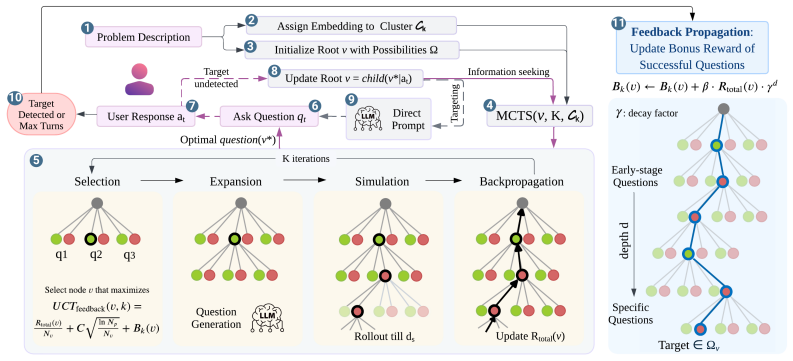
The central object is a cached decision tree of questions in which each node stores a subset of possible outcomes, and an LLM generates candidate questions that split that subset into balanced affirmative and negative parts. A normalized entropy reward scores information gain, and Monte Carlo tree search selects questions with the UCT formula, where a cluster-specific bonus $B_k(v)$ is added to bias selection toward historically successful paths. After a successful conversation the bonus is updated along the path from the target back to the root with exponential decay $\gamma^{d_v}$, while depth-limited rollouts and a single shared tree keep the number of LLM calls low.
What would settle it
Run MISQ-HF and UoT against human answerers on DX, MedDG, and FloDial, or replay a fixed corpus of human responses; if the ~12% success advantage and ~10x question-generation-call reduction do not appear, the central efficiency claim is refuted.
Extended reading notes
Core claim
The central claim is that the UCT score in Monte Carlo tree search can be augmented with a cluster-specific bonus learned from past successful conversations, and that this hierarchical feedback is what improves success while cutting planning cost. Each new problem is embedded and assigned to a semantic cluster; after a successful interaction, a bonus reward is propagated up the shared decision tree along the successful question path, decaying exponentially with depth, so later similar problems prefer questions that worked before. On medical diagnosis and technical troubleshooting, the paper reports an average 12% success-rate improvement over the UoT baseline and roughly a tenfold reduction in question-generation LLM calls, with a further 8% gain when the root starts from a constrained possibility set.
Load-bearing premise
The load-bearing premise is that the LLM pretending to be the patient or customer answers the way real people would, so every reported success rate and feedback signal rests on that simulation.
Editorial extensions
If this is right
- Conversational agents can plan with tree search at a fraction of the inference cost, since selective expansion and cached trees cut question-generation LLM calls by about an order of magnitude.
- A deployed system improves with use, because successful conversations reinforce cluster-specific bonuses in a shared decision tree that later similar problems reuse.
- Giving the planner a constrained set of likely outcomes derived from the user's description adds about 8% success on average, so cheap upfront classification pays for itself.
- The efficiency gains hold in open-set settings where the outcome space is unknown and must be generated on the fly.
- The planner scales to large possibility spaces: on the 20 Questions datasets, selective MCTS without feedback already beats exhaustive tree planning on both success rate and question-generation cost.
Reading between the lines
- An extension the paper does not test is learning the decay factor and bonus scale per cluster rather than fixing them, which would directly test whether early broad questions should always dominate.
- Because the bonus is a scalar added to UCT, the same feedback layer could be paired with any base question generator, so the gains may transfer to LLMs beyond the three evaluated.
- The simulated answerer is the main unstated risk: a human replay of the same tasks would show whether real user wording and non-cooperative answers preserve the reported gains.
- The cluster assignments used for feedback could also serve as cache keys for retrieving successful question trajectories, connecting this planner to retrieval-augmented question generation.
Editorial analysis
A structured set of objections, weighed in public.
Referee Report
Summary. The paper introduces MISQ-HF, a Monte Carlo Tree Search framework for information-seeking question selection in goal-oriented dialogues. Questions are generated by an LLM, selected via a UCT-style search with an information-gain reward, and augmented by a cluster-based bonus that propagates feedback from successful conversations through a shared, cached decision tree. The system is evaluated across medical diagnosis (DX, MedDG), troubleshooting (FloDial), and 20 Questions datasets, using two baselines (Direct Prompting and Uncertainty of Thoughts) and three LLM questioners, with a simulated LLM user. The headline claims are an average 12% improvement in success rate and about 10x reduction in planning LLM calls over UoT, plus an additional 8% success-rate gain when initializing from a constrained possibility set.
Significance. If the reported gains are robust, the paper makes a useful practical contribution: a cheaper, more adaptive questioning policy for goal-oriented conversational agents, backed by an ablation (MISQ vs MISQ-HF) that supports the value of the feedback term. The authors also provide code, concrete prompts, and a tractable algorithmic description, which are strengths. However, the central quantitative claims rest on an evaluation protocol whose validity is not yet established: the method is evaluated in an online, transductive mode where the tree and cluster bonuses are updated on the test set itself, with no held-out evaluation or order-controlled repetitions. The simulated user further limits the strength of any deployment-oriented claim. The paper's contribution is therefore currently more suggestive than conclusive.
major comments (1)
- [§5, Table 3] Table 3 is used to argue that MISQ (without feedback) outperforms UoT on the 20 Questions domain, but the table does not include MISQ-HF. The paper explains that MISQ-HF cannot be evaluated without a problem description, yet the conclusion in §5 states that “MISQ-HF outperforms other baselines” on datasets including this one. This is an overreach: the feedback component is not tested in the 20 Questions setting, and the claim should be restricted to MISQ. Please also note that the 12%/10x headline from the abstract is computed only on MD and TS domains, which are the domains where the feedback mechanism is active.
minor comments (6)
- [Algorithm 1, line 8] The condition `|Ωv ≥ 2|` should read `|Ωv| ≥ 2`; as written it is not well-formed.
- [§3.4, Eq. (8)] The backpropagation equation is written inline after the algorithm description, but it is not numbered like the other equations; consider numbering it for consistency.
- [§4.2] The omission of Chain-of-Thought and Tree-of-Thought baselines is justified by reference to [7], but the paper should state explicitly that UoT is the state-of-the-art comparator in this setting, since the abstract claims comparison to “state of the art.”
- [§5, “In the medical domain ...”] The sentence “the cost of misdiagnosis far outweighs the overhead of a few additional clarifying questions” is a value judgment that is not supported by the data; rephrase as a discussion of the SR-MSC trade-off.
- [Appendix A, Table 4] The table caption says “Improvement in Success Rate ... when using MISQ-HF-c,” but the body text in §5 states “Figure 2 shows the notable gain in SR using GPT-4o,” and Figure 2 is not shown inline. Please make the figure/table cross-referencing consistent.
- [Appendix G] The QGC efficiency analysis assumes a full (2m)^ds expansion for UoT, but it does not account for UoT’s own pruning or caching behavior; the 10x claim should be qualified accordingly.
Circularity Check
No significant circularity: the reported gains are empirical comparisons against an external simulated answerer, and no equation reduces the central claims to fitted constants or self-citations.
full rationale
The paper's derivation chain is not circular. The information-gain reward RIG(v) in Eq. 2-3 is computed from the LLM's own proposed partition of the possibility set, but this is a search heuristic, not the success criterion; success is determined by whether the Questioner identifies the hidden target held by a separately simulated Answerer (§4.4). The cluster bonus Bk(v) in Eq. 12 is updated after conversations that already succeeded, and Eq. 13 feeds it back into UCT selection; this is an online-learning mechanism and does not make the reported success rate equal to an input by construction. The 10x QGC reduction and 12% SR gain are empirical measurements, not derived identities, and no equation in the paper forces them. The shared-tree and cluster-bonus updates during evaluation (Algorithm 1, §3.2, §3.5.2) raise a legitimate evaluation-protocol concern about transductive or order-dependent reporting, but that is a validity limitation, not a definitional circularity. The paper contains no load-bearing self-citations; the UoT baseline [7] is prior independent work by other authors and is used for comparison and prompting conventions, not to prove the central claim. The limitations paragraph acknowledges missing failure-case learning, redundant-question penalties, and confidence metrics, but these are scope limitations rather than circular steps.
Assumptions & free parameters
free parameters (10)
- MCTS exploration constant C =
0.2
- MCTS iterations K =
10
- Simulation depth ds =
3
- Candidate questions per node m =
3
- Reward scaling parameter lambda =
0.4
- Question-asking turn ratio delta =
0.6
- Bonus decay factor gamma =
0.9
- Cluster similarity threshold tau =
0.9
- Bonus scaling factor beta =
0.2
- Open-set initial possibility size =
5
assumptions (6)
- domain assumption The LLM can generate valid binary questions and partition Omega_v into yes/no subsets that respect the true target.
- domain assumption The probabilities pA_v and pN_v, computed from LLM partition sizes, are good proxies for the probability that a real user answers yes or no.
- domain assumption The answerer LLM simulates human behavior faithfully.
- domain assumption Cosine similarity of problem descriptions at threshold tau identifies cases that share successful questioning strategies.
- domain assumption A single cached tree, shared across all samples in a dataset, remains a valid search structure as new problems stream in.
- standard math UoT reward propagation equations (Eq. 4-6) are accepted from [7].
Cite this review
Pith. "Pith review of Feedback-Aware Monte Carlo Tree Search for Efficient Information Seeking in Goal-Oriented Conversations." pith.science (2026). https://pith.science/paper/4AL3XLGG
@misc{pith2026250115056,
  author       = {Pith},
  title        = {Pith review of: Feedback-Aware Monte Carlo Tree Search for Efficient Information Seeking in Goal-Oriented Conversations},
  year         = {2026},
  howpublished = {\url{https://pith.science/paper/4AL3XLGG}},
  note         = {Machine review of arXiv:2501.15056}
}
read the original abstract
Effective decision-making and problem-solving in conversational systems require the ability to identify and acquire missing information through targeted questioning. A key challenge lies in efficiently narrowing down a large space of possible outcomes by posing questions that minimize uncertainty. To address this, we introduce a novel framework that leverages Large Language Models (LLMs) to generate information-seeking questions, with Monte Carlo Tree Search (MCTS) to strategically select questions that maximize information gain, as a part of inference-time planning. Our primary contribution includes a hierarchical feedback mechanism that exploits past interaction patterns to guide future strategy. Specifically, each new problem is mapped to a cluster based on semantic similarity, and our UCT (Upper Confidence bound for Trees) formulation employs a cluster-specific bonus reward to prioritize successful question trajectories that have proven effective for similar problems in the past. Extensive empirical evaluation across medical diagnosis and technical troubleshooting domains shows that our method achieves an average of 12% improvement in success rates and about 10x reduction in the number of LLM calls made for planning per conversation, compared to the state of the art. An additional 8% gain in success rate is observed on average when we start with a constrained set of possibilities. Our results underscore the efficacy of feedback-aware MCTS in enhancing information-seeking in goal-oriented dialogues.
Figures


Reference graph
Works this paper leans on
-
[1]
A. B. API. Build Generative AI Applications with Foundation Models - Amazon Bedrock - AWS, 2023. URL https://aws.amazon.com/bedrock/
work page 2023
-
[2]
G. Chaslot, S. Bakkes, I. Szita, and P. Spronck. Monte-carlo tree search: A new framework for game ai. In Proceedings of the AAAI Conference on Artificial Intelligence and Interactive Digital Entertainment, volume 4, pages 216–217, 2008
work page 2008
- [3]
-
[4]
A. Grattafiori, A. Dubey, A. Jauhri, A. Pandey, A. Kadian, A. Al-Dahle, A. Letman, A. Mathur, A. Schelten, A. Vaughan, A. Goyal, A. Hartshorn, A. Yang, A. Sravankumar, A. Korenev, A. Hinsvark, A. Rao, A. Zhang, A. Rodriguez, and A. Gregerson et al. The Llama 3 Herd of Models, Nov. 2024. URL http://arxiv.org/abs/2407.21783. arXiv:2407.21783
arXiv 2024
-
[5]
A. Guez, T. Weber, I. Antonoglou, K. Simonyan, O. Vinyals, D. Wierstra, R. Munos, and D. Silver. Learning to search with MCTSnets. In Proceedings of the 35th International Conference on Machine Learning , pages 1822–1831. PMLR, July 2018. URL https:// proceedings.mlr.press/v80/guez18a.html
work page 2018
-
[6]
M. N. Hebart, A. H. Dickter, A. Kidder, W. Y . Kwok, A. Corriveau, C. V . Wicklin, and C. I. Baker. THINGS: A database of 1,854 object concepts and more than 26,000 natu- ralistic object images. PLOS ONE, 14(10):e0223792, Oct. 2019. ISSN 1932-6203. doi: 10.1371/journal.pone.0223792. URL https://journals.plos.org/plosone/article? id=10.1371/journal.pone.0223792
-
[7]
Z. Hu, C. Liu, X. Feng, Y . Zhao, S.-K. Ng, A. T. Luu, J. He, P. W. Koh, and B. Hooi. Uncertainty of Thoughts: Uncertainty-Aware Planning Enhances Information Seeking in LLMs. In The Thirty-eighth Annual Conference on Neural Information Processing Systems, Nov. 2024. URL https://openreview.net/forum?id=CVpuVe1N22¬eId=aTI8PGpO47
work page 2024
- [8]
Show all 25 references
-
[9]
A. Q. Jiang, A. Sablayrolles, A. Roux, A. Mensch, B. Savary, C. Bamford, D. S. Chaplot, D. d. l. Casas, E. B. Hanna, F. Bressand, G. Lengyel, G. Bour, G. Lample, L. R. Lavaud, L. Saulnier, M.-A. Lachaux, P. Stock, S. Subramanian, S. Yang, S. Antoniak, T. L. Scao, T. Gervet, T....
2024 arXiv
-
[10]
S. S. Li, V . Balachandran, S. Feng, J. S. Ilgen, E. Pierson, P. W. Koh, and Y . Tsvetkov. MediQ: Question-Asking LLMs and a Benchmark for Reliable Interactive Clinical Reasoning. In The Thirty-eighth Annual Conference on Neural Information Processing Systems, Nov. 2024
2024
-
[11]
Achiam, S
OpenAI, J. Achiam, S. Adler, S. Agarwal, L. Ahmad, I. Akkaya, F. L. Aleman, D. Almeida, J. Altenschmidt, S. Altman, S. Anadkat, R. Avila, I. Babuschkin, S. Balaji, V . Balcom, P. Bal- tescu, H. Bao, M. Bavarian, J. Belgum, and I. Bello et al. GPT-4 Technical Report, Mar. 2024....
2024 arXiv
-
[12]
Putta, E
P. Putta, E. Mills, N. Garg, S. Motwani, C. Finn, D. Garg, and R. Rafailov. Agent Q: Advanced Reasoning and Learning for Autonomous AI Agents, Aug. 2024. URL http://arxiv.org/ abs/2408.07199. arXiv:2408.07199
2024 arXiv
-
[13]
Raghu, S
D. Raghu, S. Agarwal, S. Joshi, and Mausam. End-to-End Learning of Flowchart Grounded Task- Oriented Dialogs. In M.-F. Moens, X. Huang, L. Specia, and S. W.-t. Yih, editors, Proceedings of the 2021 Conference on Empirical Methods in Natural Language Processing, pages 4348– 436...
2021 doi
-
[14]
V . Sanh, L. Debut, J. Chaumond, and T. Wolf. Distilbert, a distilled version of bert: smaller, faster, cheaper and lighter. ArXiv, abs/1910.01108, 2019
1910 arXiv
-
[15]
Silver, A
D. Silver, A. Huang, C. J. Maddison, A. Guez, L. Sifre, G. van den Driessche, J. Schrit- twieser, I. Antonoglou, V . Panneershelvam, M. Lanctot, S. Dieleman, D. Grewe, J. Nham, N. Kalchbrenner, I. Sutskever, T. Lillicrap, M. Leach, K. Kavukcuoglu, T. Graepel, and D. Hassabis. ...
2016 doi
-
[16]
Silver, T
D. Silver, T. Hubert, J. Schrittwieser, I. Antonoglou, M. Lai, A. Guez, M. Lanctot, L. Sifre, D. Kumaran, T. Graepel, T. Lillicrap, K. Simonyan, and D. Hassabis. A general reinforcement learning algorithm that masters chess, shogi, and Go through self-play. Science, 362(6419):...
2018 doi
-
[17]
G. Wang, X. Liu, Z. Ying, G. Yang, Z. Chen, Z. Liu, M. Zhang, H. Yan, Y . Lu, Y . Gao, K. Xue, X. Li, and Y . Chen. Optimized glycemic control of type 2 diabetes with reinforcement learning: a proof-of-concept trial. Nature Medicine, 29(10):2633–2642, Oct. 2023. ISSN 1546- 170...
2023 doi
-
[18]
J. Wei, X. Wang, D. Schuurmans, M. Bosma, B. Ichter, F. Xia, E. H. Chi, Q. V . Le, and D. Zhou. Chain-of-thought prompting elicits reasoning in large language models. In Proceedings of the 36th International Conference on Neural Information Processing Systems , NIPS ’22, pages...
2022
-
[19]
L. Xu, Q. Zhou, K. Gong, X. Liang, J. Tang, and L. Lin. End-to-End Knowledge-Routed Relational Dialogue System for Automatic Diagnosis. Proceedings of the AAAI Conference on Artificial Intelligence, 33(01):7346–7353, July 2019. ISSN 2374-3468. doi: 10.1609/aaai. v33i01.3301734...
2019 doi
-
[20]
S. Yao, D. Yu, J. Zhao, I. Shafran, T. Griffiths, Y . Cao, and K. Narasimhan. Tree of thoughts: Deliberate problem solving with large language models. In A. Oh, T. Naumann, A. Globerson, K. Saenko, M. Hardt, and S. Levine, editors, Ad- vances in Neural Information Processing S...
-
[21]
X. Yu, M. Chen, and Z. Yu. Prompt-Based Monte-Carlo Tree Search for Goal-oriented Dialogue Policy Planning. In H. Bouamor, J. Pino, and K. Bali, editors, Proceedings of the 2023 Con- ference on Empirical Methods in Natural Language Processing, pages 7101–7125, Singapore, Dec. ...
2023 doi
-
[22]
Z. Zhao, W. S. Lee, and D. Hsu. Large language models as commonsense knowledge for large-scale task planning. In Proceedings of the 37th International Conference on Neural Information Processing Systems, NIPS ’23, pages 31967–31987, Red Hook, NY , USA, May
-
[23]
X is possibly one of the following: Ω
Y . Zhu, L. Pang, Y . Lan, H. Shen, and X. Cheng. Adaptive Information Seeking for Open- Domain Question Answering. In M.-F. Moens, X. Huang, L. Specia, and S. W.-t. Yih, editors, Proceedings of the 2021 Conference on Empirical Methods in Natural Language Processing, pages 361...
2021 doi
-
[2023]
URL https://proceedings.neurips.cc/paper_files/paper/2023/file/ 271db9922b8d1f4dd7aaef84ed5ac703-Paper-Conference.pdf
2023
-
[2024]
Curran Associates Inc
Reviewed August 10, 2026 · model on record in the stance chip above.
Discussion (0). Continue with ORCID to comment.