REVIEW 4 major objections 5 minor 67 references
FlexMotion: Lightweight, Physics-Aware, and Controllable Human Motion Generation
T0 review · 4 major / 5 minor · reviewed 2026-08-10 · deepseek-v4-flash
Pith's one-line read FlexMotion claims that text-conditioned motion can be made physically plausible by training a latent diffusion model on biomechanical quantities such as muscle activations and contact forces, without a physics simulator during inference.
desk verdict Coherent architecture and a clear three-stage pipeline, but the physics-plausibility evidence is circular—same OpenSim labels for training and evaluation—so the benchmark claims don't hold as printed. read the letter →
The pith
A machine-rendered reading of the paper's core claim, the machinery that carries it, and where it could break.
The reading
What carries the argument
The Physics-aware Multimodal Autoencoder is the load-bearing object: a transformer encoder-decoder that learns a latent code $\mathbf{x}^e_t$ from the concatenated kinematic and dynamic state $[\mathbf{p}_t,\mathbf{r}_t,\dot{\mathbf{r}}_t,\ddot{\mathbf{r}}_t,\mathbf{a}_t,\boldsymbol{\tau}_t,\boldsymbol{\lambda}_t]$, trained to minimize the reconstruction loss plus the Euler-Lagrange residue $\mathcal{L}_{\text{euler}} = \sum_t \lVert M(\mathbf{r}_t)\ddot{\mathbf{r}}_t + C(\mathbf{r}_t,\dot{\mathbf{r}}_t)\dot{\mathbf{r}}_t + G(\mathbf{r}_t) - \boldsymbol{\tau}_t - J_C^\top(\mathbf{r}_t)\boldsymbol{\lambda}_t\rVert^2$ and the muscle loss $\mathcal{L}_{\text{muscle}} = \sum_t(\lVert\ddot{\mathbf{r}}_t - L\mathbf{a}_t\rVert^2 + \beta_{\text{reg}}\lVert\mathbf{a}_t\rVert^2)$. This step is what makes the latent space 'physics-aware.' The FlexMotion Diffusion Model then generates in that latent space, and the Spatial Controllability Module is a trainable copy of the denoiser placed between two zero-initialized convolution layers, so that control conditions begin as no-ops and are gradually phased in during training.
What would settle it
Measure real ground reaction forces and surface EMG while people perform the motions described by the test prompts, and compute the same contact-force and muscle-limit errors against those recordings; if FlexMotion's generated motions are no closer to measured biomechanics than a baseline trained without physics losses, the physical-plausibility claim fails.
Extended reading notes
Core claim
The paper claims to be the first text-to-motion method that obtains physical plausibility by training a transformer encoder-decoder with physical constraints. The input motion representation at each time step concatenates joint positions, rotations, velocities, accelerations, muscle activations, joint torques, and contact forces; the autoencoder maps that high-dimensional state into a low-dimensional latent code and reconstructs it under three losses: a modality-wise reconstruction loss, a differentiable Euler-Lagrange residue loss, and a muscle-activation-to-acceleration loss with an activation penalty. The diffusion model is trained in the resulting latent space with classifier-free text guidance, and a frozen-control branch inserted through zero-initialized convolutions adds spatial controllability without disturbing the pretrained generation. On the three extended datasets, the paper reports lower foot skating, floating, penetration, contact-force, joint-actuation, and muscle-limit errors than prior models, with R-Precision and FID at or near the best baseline values and roughly an order-of-magnitude fewer FLOPs than the full-resolution MDM baseline.
Load-bearing premise
The load-bearing premise is that the synthesized biomechanical labels added to HumanML3D, KIT-ML, and FLAG3D—muscle activations, contact forces, joint torques, and actuations produced by the appendix's full-body simulation—are accurate enough to serve as ground truth, since the same labels define both the training losses and every physical-plausibility metric.
Editorial extensions
If this is right
- If FlexMotion is right, physics plausibility can be baked into the latent representation instead of enforced by a simulator at generation time, which directly cuts the inference cost of physically plausible text-to-motion.
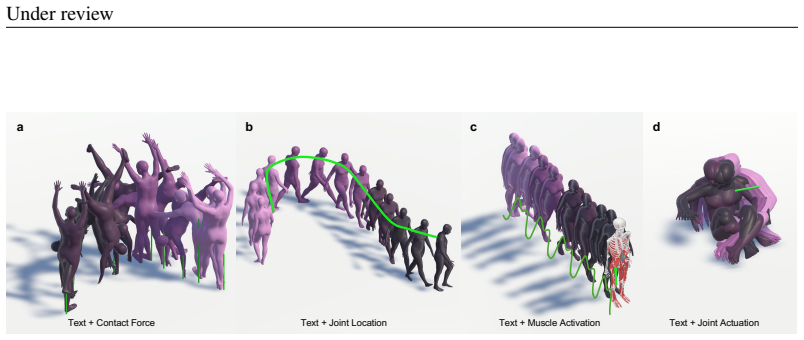
- Users could condition a motion on sparse biomechanical hints—one muscle's activation profile, ten joints' locations, or 20% of frames with all constraints—and still get coherent motion that follows the hints, widening the practical input space beyond text.
- The reported ablations imply that the Euler-Lagrange and muscle losses are complementary: dropping either one raises muscle-limit and penetration errors, so each physics term carries part of the physical-plausibility guarantee.
- The same architecture transfers across HumanML3D, KIT-ML, and FLAG3D, which suggests the physics-aware latent representation is not tied to a single motion distribution.
- Because the control module is a zero-initialized add-on, it can be trained after the base model without retraining generation, making controllability a post-hoc upgrade rather than a redesign.
Reading between the lines
- This goes beyond the paper: the zero-convolution control adapter is generic, so the same module could be retrained on control modalities the paper never tested, such as object-interaction forces or external loads, provided the frozen encoder can embed them.
- This goes beyond the paper: the efficiency comparison conflates two changes—latent compression and removal of the physics simulator. A controlled ablation that keeps the simulator and swaps only the latent space would show which change produces the FLOP reduction.
- This goes beyond the paper: because the physical metrics are computed against the same synthesized labels used in training, the strongest test of the claim is external measurement—force plates and EMG recordings of humans performing the described actions—rather than agreement with the augmentation pipeline.
- This goes beyond the paper: if muscle activations and joint torques survive in the latent space with high fidelity, the encoded representation could serve as a control interface for rehabilitation and sport-science applications, where prescribing a muscle activation or joint actuation profile is the actual goal.
Editorial analysis
A structured set of objections, weighed in public.
Referee Report
Summary. FlexMotion proposes a three-stage pipeline for text-conditioned human motion generation: a physics-aware multimodal Transformer autoencoder that reconstructs joint positions, rotations, velocities, accelerations, muscle activations, joint torques, and contact forces under Euler-Lagrange and muscle-coordination losses; a latent-space diffusion model conditioned on text; and a ControlNet-style spatial controllability module. The authors augment HumanML3D, KIT-ML, and FLAG3D with OpenSim-derived biomechanical labels and report improvements in naturalness, text relevance, physical plausibility, and computational efficiency. The central claimed contribution is that FlexMotion is the first method that "ensures" physical plausibility of generated motions without an inference-time physics simulator.
Significance. If the empirical claims were established, FlexMotion would be a practically interesting contribution: the latent-space diffusion design is substantially cheaper than full-motion diffusion, the controllability module addresses modalities beyond trajectory control (contact forces, joint actuations, muscle activations), and the staged training description in Appendix A.1 with ablations on physics losses and latent dimensionality provides useful reference points. However, the central physical-plausibility result is not currently established. The physical metrics are evaluated against OpenSim-synthesized labels that also define the training targets, the physics losses are not active at generation time, the closest architectural baseline (PhysPT) is not compared numerically, and several table entries are mechanically implausible. These are load-bearing problems for the abstract's claim of setting "a new benchmark for human motion synthesis."
major comments (4)
- [Section 4 / Appendix A.3 / Eqs. (4)-(7)] The physical plausibility metrics in Tables 1-3 (Contact Force, Joint Actuation, Muscle Limit) are computed against OpenSim-synthesized labels produced by the same full-body model (Van Horn & Team 2016, 21 segments, 29 DOF, 324 actuators) that is used to define the training losses in Eqs. (4), (6), and (7). The "Real" row reports 0.000 for all of these metrics, which is exactly what one expects when each real sequence is compared against its own synthesized labels. The reported reductions are therefore measures of agreement with the training targets, not with independent physical reality. The paper offers no validation against force-plate data, no independent simulator such as MuJoCo, and no different musculoskeletal model. This circularity is load-bearing because the abstract and contribution list claim physical plausibility as the main novelty.
- [Sections 3.2-3.3 / Eqs. (11), (13), Algorithm 2] The Euler-Lagrange and muscle losses are applied only to the Stage-1 autoencoder reconstruction (Eq. 8). The diffusion model and the spatial controllability module are trained with plain noise-prediction losses on latent codes (Eqs. 11 and 13), and the inference procedure in Algorithm 2 simply denoises and decodes. Nothing constrains sampled latents or decoded outputs to satisfy the dynamics or muscle constraints. Thus the claim that the framework "ensures" physical plausibility of generated motions is not justified by the training procedure; at most, the autoencoder is encouraged to reconstruct physically plausible training examples. The authors would need to add inference-time physics enforcement or provide evidence that the latent diffusion density lies entirely in the region where the decoder remains physically consistent.
- [Section 2.2 / Tables 1-4] PhysPT (Zhang et al., 2024b) is described in Section 2.2 as incorporating contact, force, and Euler-Lagrange consistency losses, and Section 3.1 states that the autoencoder is "similar to the architecture introduced in Zhang et al. (2024b)." Yet PhysPT does not appear in any of the comparison tables or in the efficiency table. Without a numerical comparison to this closest baseline, the claims of state-of-the-art physical plausibility and of being the "first" physics-constrained method are unsubstantiated. At minimum, the authors should add PhysPT to Tables 1-4 or explicitly justify its exclusion.
- [Tables 1-3 and 5-7] Several entries in the results tables are mechanically implausible. In Table 1 (and Table 5), the "1 Joint Actuation" row repeats the value 0.790 across unrelated metrics such as R-Precision, FID, Skate, Joint Actuation, and Trajectory, which is not credible for metrics with different units and distributions. More seriously, the complete tables contain impossible standard deviations for bounded metrics: Table 6 reports R-Precision 0.739 +/- 0.692 for MotionDiffuse and 0.766 +/- 0.738 for the "1 Joint Actuation" row, and Table 7 reports 0.792 +/- 0.762 for the same row. Since R-Precision is a proportion in [0,1], a standard deviation of 0.738 or 0.762 for a mean near 0.7-0.8 is impossible. These entries suggest placeholder or copy-paste errors and undermine confidence in the numerical results as a whole. The authors should provide corrected tables and make raw per-run and per-sequence outputs available.
minor comments (5)
- [Appendix A.5, Eq. (15)] The expression for the Coriolis and centrifugal forces is dimensionally inconsistent as written; please provide the standard Christoffel-symbol form or a concrete reference so that the Euler-Lagrange loss can be reproduced.
- [Section 4 / Appendix A.3] The metrics "Contact Force Accuracy," "Joint Actuation Consistency," "Muscle Activation Limits," and "Trajectory Error" are not defined by equations or units. Formal definitions are needed for reproducibility, especially because the paper claims superiority on these metrics.
- [Appendix A.9] The text says "We present the results in Table 1" when referring to the trade-off experiment, but the actual table is Table 10; please correct the cross-reference.
- [Throughout] Notation for the physics loss weights is inconsistent: Eq. (8) uses gamma_euler and gamma_muscle, while Appendix A.3 uses beta_euler and gamma_muscle and Appendix A.9 uses lambda_euler and lambda_muscle. Please unify.
- [Throughout] There are several typos and naming inconsistencies, including "Comparision" in Appendix A.7 and inconsistent use of "Flag3D" versus "FLAG3D" in the text and tables.
Circularity Check
Physical-plausibility metrics are circular: generated motions are scored against the same OpenSim-synthesized labels used as training targets.
-
fitted input called prediction
[Section 4 'Data Augmentation' and 'Evaluation Metrics'; Section 3.1 Eq. 4, Eq. 6, Eq. 7; Appendix A.3]
"we augmented these datasets using OpenSim ... incorporating detailed muscle activations, contact forces, joint positions, rotations, actuation, and velocity. ... Physical plausibility is verified through metrics like Foot Skating, Penetration, Contact Force Accuracy, and Joint Actuation Consistency ... . ... The loss terms include the l2 norm between the ground truth and reconstructed values for ... muscle activations, joint torques, and l1 norm for contact forces ... ."
The Contact Force Accuracy, Joint Actuation Consistency, and Muscle Activation Limits metrics compare generated motions against labels produced by the same OpenSim augmentation pipeline (Appendix A.3) that generated the training targets. The autoencoder loss L_recon (Eq. 4) directly trains the network to match those OpenSim muscle activations, joint torques, and contact forces; Leuler (Eq. 6) and Lmuscle (Eq. 7) enforce dynamics and muscle coordination relative to the same musculoskeletal model. The reported 'errors' therefore measure distance to the training-target distribution, not to independent physical reality. The Real row is 0.000 for all physical metrics because the 'real' sequences are the OpenSim-augmented data themselves.
-
self definitional
[Appendix A.6 Eq. 20; Section 4 'Evaluation Metrics']
"To prevent unrealistic muscle activations, we include a regularization term in Lmuscle and enforce physiological constraints on muscle activations. ... 0 ≤ amt ≤ 1 ∀m, t. These constraints are implemented using penalty methods or projection techniques during optimization. ... Biomechanical plausibility is ensured by checking that Muscle Activation Limits stay within realistic physiological constraints."
The Muscle Activation Limits metric checks the exact inequality 0 ≤ a ≤ 1 that is already imposed as a training constraint in Stage 1 via penalty or projection. Reporting low Muscle Limit error therefore verifies adherence to the model's own loss-constrained output space, not an externally validated physiological bound. The constraint itself is derived from the same OpenSim musculoskeletal model used to synthesize the training labels, so the evaluation is self-referential: the property being measured is the property that was enforced during optimization.
full rationale
The central physics-plausibility claims rest on evaluation metrics defined against the OpenSim-synthesized contact forces, joint torques, and muscle activations that also appear as training targets in Eq. 4 and as the basis for the Euler-Lagrange and muscle losses (Eqs. 6-7). Because the same augmentation pipeline (Appendix A.3) generates both the training labels and the reference values for the physical metrics, the headline 'physically plausible' result is substantially circular: it demonstrates consistency with the model's own training-target generator rather than with independent physical measurements. The Real rows reporting 0.000 for all physical metrics are the clearest marker that the reference labels are the augmented data themselves. This is not a full derivation-level tautology, since the model does generalize to held-out motion sequences within the synthetic label distribution, and several non-physical evaluations (FID, R-Precision, trajectory error on real joint data) are independently meaningful. Self-citation is not a material issue here: the cited PhysPT architecture and Euler-Lagrange losses are external prior work, and the authors' own prior papers are not load-bearing for the main derivation. However, the paper's strongest claim—'the first method that ensures generated motions are physically plausible' and the 'new benchmark' for physical plausibility—is supported only by metrics that reduce, by construction, to agreement with the same OpenSim pipeline used to create the training targets. Additionally, the physics losses are applied only in Stage 1 autoencoder training, while the diffusion and controllability modules use plain noise-prediction losses on latent codes, further weakening but not circularizing the physical-plausibility claim. Overall score 7: one or more central 'predictions' of physical plausibility reduce by construction to the training-label generator, while other evaluation axes retain independent content.
Assumptions & free parameters
free parameters (4)
- Reconstruction loss weights alpha_pos, alpha_rot, alpha_vel, alpha_acc, alpha_torque, alpha_force, alpha_muscle =
1.0, 1.0, 0.1, 0.1, 0.5, 0.5; alpha_muscle not explicitly stated
- Physics loss weights gamma_euler and gamma_muscle =
1.0 and 1.0 for the reported main results
- Muscle regularization weight beta_reg =
not reported
- Latent space dimension d =
1024
assumptions (5)
- domain assumption The OpenSim full-body model with 21 segments, 29 DOF, and 324 musculotendon actuators faithfully represents the biomechanics of all motions in HumanML3D, KIT-ML, and FLAG3D.
- domain assumption Euler-Lagrange multibody dynamics with the stated mass matrix, Coriolis and centrifugal terms, gravity, and contact Jacobian hold for the reconstructed motion sequences.
- domain assumption Muscle activation is related to joint acceleration by the mapping L = M^{-1}(R Fmax) and first-order activation dynamics, with the steady-state assumption a_t = u_t.
- domain assumption Contact forces lambda_t used in training correspond to true environmental contacts and can be computed from the mocap trajectories by the augmentation pipeline.
- standard math The DDPM forward and reverse processes and classifier-free guidance are standard background.
Cite this review
Pith. "Pith review of FlexMotion: Lightweight, Physics-Aware, and Controllable Human Motion Generation." pith.science (2026). https://pith.science/paper/ZBDJPAEI
@misc{pith2026250116778,
  author       = {Pith},
  title        = {Pith review of: FlexMotion: Lightweight, Physics-Aware, and Controllable Human Motion Generation},
  year         = {2026},
  howpublished = {\url{https://pith.science/paper/ZBDJPAEI}},
  note         = {Machine review of arXiv:2501.16778}
}
read the original abstract
Lightweight, controllable, and physically plausible human motion synthesis is crucial for animation, virtual reality, robotics, and human-computer interaction applications. Existing methods often compromise between computational efficiency, physical realism, or spatial controllability. We propose FlexMotion, a novel framework that leverages a computationally lightweight diffusion model operating in the latent space, eliminating the need for physics simulators and enabling fast and efficient training. FlexMotion employs a multimodal pre-trained Transformer encoder-decoder, integrating joint locations, contact forces, joint actuations and muscle activations to ensure the physical plausibility of the generated motions. FlexMotion also introduces a plug-and-play module, which adds spatial controllability over a range of motion parameters (e.g., joint locations, joint actuations, contact forces, and muscle activations). Our framework achieves realistic motion generation with improved efficiency and control, setting a new benchmark for human motion synthesis. We evaluate FlexMotion on extended datasets and demonstrate its superior performance in terms of realism, physical plausibility, and controllability.
Figures


Reference graph
Works this paper leans on
-
[1]
write newline
" write newline "" before.all 'output.state := FUNCTION n.dashify 't := "" t empty not t #1 #1 substring "-" = t #1 #2 substring "--" = not "--" * t #2 global.max substring 't := t #1 #1 substring "-" = "-" * t #2 global.max substring 't := while if t #1 #1 substring * t #2 global.max substring 't := if while FUNCTION format.date year duplicate empty "emp...
-
[2]
Ham2pose: Animating sign language notation into pose sequences
Rotem Shalev Arkushin, Amit Moryossef, and Ohad Fried. Ham2pose: Animating sign language notation into pose sequences. In Proceedings of the IEEE/CVF Conference on Computer Vision and Pattern Recognition, pp.\ 21046--21056, 2023
work page 2023
-
[3]
Controllable generation with text-to-image diffusion models: A survey
Pu Cao, Feng Zhou, Qing Song, and Lu Yang. Controllable generation with text-to-image diffusion models: A survey. arXiv preprint arXiv:2403.04279, 2024
arXiv 2024
-
[4]
Executing your commands via motion diffusion in latent space
Xin Chen, Biao Jiang, Wen Liu, Zilong Huang, Bin Fu, Tao Chen, and Gang Yu. Executing your commands via motion diffusion in latent space. In Proceedings of the IEEE/CVF Conference on Computer Vision and Pattern Recognition, pp.\ 18000--18010, 2023
work page 2023
-
[5]
Synthesizing 3D Gait Data with Personalized Walking Style and Appearance
Yao Cheng, Guichao Zhang, Sifei Huang, Zexi Wang, Xuan Cheng, and Juncong Lin. Synthesizing 3D Gait Data with Personalized Walking Style and Appearance . Applied Sciences (Switzerland), 13 0 (4), February 2023. ISSN 20763417. doi:10.3390/app13042084. Publisher: MDPI
-
[6]
Mia Chiquier and Carl Vondrick. Muscles in action. In Proceedings of the IEEE/CVF International Conference on Computer Vision, pp.\ 22091--22101, 2023
work page 2023
-
[7]
Mofusion: A framework for denoising-diffusion-based motion synthesis
Rishabh Dabral, Muhammad Hamza Mughal, Vladislav Golyanik, and Christian Theobalt. Mofusion: A framework for denoising-diffusion-based motion synthesis. In Proceedings of the IEEE/CVF conference on computer vision and pattern recognition, pp.\ 9760--9770, 2023
work page 2023
-
[8]
Posefix: correcting 3d human poses with natural language
Ginger Delmas, Philippe Weinzaepfel, Francesc Moreno-Noguer, and Gr \'e gory Rogez. Posefix: correcting 3d human poses with natural language. In Proceedings of the IEEE/CVF International Conference on Computer Vision, pp.\ 15018--15028, 2023
work page 2023
Show all 67 references
-
[9]
Opensim: open-source software to create and analyze dynamic simulations of movement
Scott L Delp, Frank C Anderson, Allison S Arnold, Peter Loan, Ayman Habib, Chand T John, Eran Guendelman, and Darryl G Thelen. Opensim: open-source software to create and analyze dynamic simulations of movement. IEEE transactions on biomedical engineering, 54 0 (11): 0 1940--1...
1940
-
[10]
Chatpose: Chatting about 3d human pose
Yao Feng, Jing Lin, Sai Kumar Dwivedi, Yu Sun, Priyanka Patel, and Michael J Black. Chatpose: Chatting about 3d human pose. In Proceedings of the IEEE/CVF Conference on Computer Vision and Pattern Recognition, pp.\ 2093--2103, 2024
2024
-
[11]
Generating diverse and natural 3d human motions from text
Chuan Guo, Shihao Zou, Xinxin Zuo, Sen Wang, Wei Ji, Xingyu Li, and Li Cheng. Generating diverse and natural 3d human motions from text. In Proceedings of the IEEE/CVF Conference on Computer Vision and Pattern Recognition (CVPR), pp.\ 5152--5161, June 2022 a
2022
-
[12]
Generating diverse and natural 3d human motions from text
Chuan Guo, Shihao Zou, Xinxin Zuo, Sen Wang, Wei Ji, Xingyu Li, and Li Cheng. Generating diverse and natural 3d human motions from text. In Proceedings of the IEEE/CVF Conference on Computer Vision and Pattern Recognition, pp.\ 5152--5161, 2022 b
2022
-
[13]
Masked autoencoders are scalable vision learners
Kaiming He, Xinlei Chen, Saining Xie, Yanghao Li, Piotr Doll \'a r, and Ross Girshick. Masked autoencoders are scalable vision learners. In Proceedings of the IEEE/CVF conference on computer vision and pattern recognition, pp.\ 16000--16009, 2022
2022
-
[14]
Classifier-free diffusion guidance
Jonathan Ho and Tim Salimans. Classifier-free diffusion guidance. arXiv preprint arXiv:2207.12598, 2022
2022 arXiv
-
[15]
Motiongpt: Human motion as a foreign language
Biao Jiang, Xin Chen, Wen Liu, Jingyi Yu, Gang Yu, and Tao Chen. Motiongpt: Human motion as a foreign language. Advances in Neural Information Processing Systems, 36, 2024
2024
-
[16]
Act as you wish: Fine-grained control of motion diffusion model with hierarchical semantic graphs
Peng Jin, Yang Wu, Yanbo Fan, Zhongqian Sun, Wei Yang, and Li Yuan. Act as you wish: Fine-grained control of motion diffusion model with hierarchical semantic graphs. Advances in Neural Information Processing Systems, 36, 2024
2024
-
[17]
Guided motion diffusion for controllable human motion synthesis
Korrawe Karunratanakul, Konpat Preechakul, Supasorn Suwajanakorn, and Siyu Tang. Guided motion diffusion for controllable human motion synthesis. In Proceedings of the IEEE/CVF International Conference on Computer Vision, pp.\ 2151--2162, 2023
2023
-
[18]
Scalable muscle-actuated human simulation and control
Seunghwan Lee, Moonseok Park, Kyoungmin Lee, and Jehee Lee. Scalable muscle-actuated human simulation and control. ACM Transactions on Graphics, 38 0 (4), 2019. ISSN 15577368. doi:10.1145/3306346.3322972
2019
-
[19]
Controllable text-to-image generation
Bowen Li, Xiaojuan Qi, Thomas Lukasiewicz, and Philip Torr. Controllable text-to-image generation. Advances in neural information processing systems, 32, 2019
2019
-
[20]
Controlnet++: Improving conditional controls with efficient consistency feedback
Ming Li, Taojiannan Yang, Huafeng Kuang, Jie Wu, Zhaoning Wang, Xuefeng Xiao, and Chen Chen. Controlnet++: Improving conditional controls with efficient consistency feedback. arXiv preprint arXiv:2404.07987, 2024
2024 arXiv
-
[21]
Mcm: Multi-condition motion synthesis framework for multi-scenario
Zeyu Ling, Bo Han, Yongkang Wong, Mohan Kangkanhalli, and Weidong Geng. Mcm: Multi-condition motion synthesis framework for multi-scenario. arXiv preprint arXiv:2309.03031, 2023
2023 arXiv
-
[22]
Matthew Loper, Naureen Mahmood, Javier Romero, Gerard Pons-Moll, and Michael J. Black. SMPL : A skinned multi-person linear model. ACM Trans. Graphics (Proc. SIGGRAPH Asia), 34 0 (6): 0 248:1--248:16, October 2015
2015
-
[23]
Decoupled weight decay regularization
Ilya Loshchilov and Frank Hutter. Decoupled weight decay regularization. In International Conference on Learning Representations, 2023
2023
-
[24]
Diversemotion: Towards diverse human motion generation via discrete diffusion
Yunhong Lou, Linchao Zhu, Yaxiong Wang, Xiaohan Wang, and Yi Yang. Diversemotion: Towards diverse human motion generation via discrete diffusion. arXiv preprint arXiv:2309.01372, 2023
2023 arXiv
-
[25]
Follow your pose: Pose-guided text-to-video generation using pose-free videos
Yue Ma, Yingqing He, Xiaodong Cun, Xintao Wang, Siran Chen, Xiu Li, and Qifeng Chen. Follow your pose: Pose-guided text-to-video generation using pose-free videos. In Proceedings of the AAAI Conference on Artificial Intelligence, volume 38, pp.\ 4117--4125, 2024
2024
-
[26]
T2i-adapter: Learning adapters to dig out more controllable ability for text-to-image diffusion models
Chong Mou, Xintao Wang, Liangbin Xie, Yanze Wu, Jian Zhang, Zhongang Qi, and Ying Shan. T2i-adapter: Learning adapters to dig out more controllable ability for text-to-image diffusion models. In Proceedings of the AAAI Conference on Artificial Intelligence, volume 38, pp.\ 429...
2024
-
[27]
Kevin P. Murphy. Probabilistic Machine Learning: Advanced Topics. MIT Press, 2023. URL http://probml.github.io/book2
2023
-
[28]
The KIT motion-language dataset
Matthias Plappert, Christian Mandery, and Tamim Asfour. The KIT motion-language dataset. Big Data, 4 0 (4): 0 236--252, dec 2016. doi:10.1089/big.2016.0028. URL http://dx.doi.org/10.1089/big.2016.0028
2016
-
[29]
Breaking the limits of text-conditioned 3d motion synthesis with elaborative descriptions
Yijun Qian, Jack Urbanek, Alexander G Hauptmann, and Jungdam Won. Breaking the limits of text-conditioned 3d motion synthesis with elaborative descriptions. In Proceedings of the IEEE/CVF International Conference on Computer Vision, pp.\ 2306--2316, 2023
2023
-
[30]
Learning transferable visual models from natural language supervision
Alec Radford, Jong Wook Kim, Chris Hallacy, Aditya Ramesh, Gabriel Goh, Sandhini Agarwal, Girish Sastry, Amanda Askell, Pamela Mishkin, Jack Clark, et al. Learning transferable visual models from natural language supervision. In International conference on machine learning, pp...
2021
-
[31]
Dreambooth: Fine tuning text-to-image diffusion models for subject-driven generation
Nataniel Ruiz, Yuanzhen Li, Varun Jampani, Yael Pritch, Michael Rubinstein, and Kfir Aberman. Dreambooth: Fine tuning text-to-image diffusion models for subject-driven generation. In Proceedings of the IEEE/CVF conference on computer vision and pattern recognition, pp.\ 22500-...
2023
-
[32]
Artificial intelligence-powered, interactive, stretchable, immersive displays and wearables
Peyman Servati, Arvin Tashakori, Wenwen Zhang, Yan Wang, Zenan Jiang, Amir Servati, Harishkumar Narayana, Saeid Soltanian, Neha Suvindran, Hyejeong Choi, et al. Artificial intelligence-powered, interactive, stretchable, immersive displays and wearables. IEEE Open Journal on Im...
2024
-
[33]
Opensim: Simulating musculoskeletal dynamics and neuromuscular control to study human and animal movement
Ajay Seth, Jennifer L Hicks, Thomas K Uchida, Ayman Habib, Christopher L Dembia, James J Dunne, Carmichael F Ong, Matthew S DeMers, Apoorva Rajagopal, Matthew Millard, et al. Opensim: Simulating musculoskeletal dynamics and neuromuscular control to study human and animal movem...
2018
-
[34]
Human motion diffusion as a generative prior
Yonatan Shafir, Guy Tevet, Roy Kapon, and Amit H Bermano. Human motion diffusion as a generative prior. arXiv preprint arXiv:2303.01418, 2023
2023 arXiv
-
[35]
Denoising diffusion implicit models
Jiaming Song, Chenlin Meng, and Stefano Ermon. Denoising diffusion implicit models. In International Conference on Learning Representations, 2023
2023
-
[36]
Diffused heads: Diffusion models beat gans on talking-face generation
Micha Stypu kowski, Konstantinos Vougioukas, Sen He, Maciej Zi e ba, Stavros Petridis, and Maja Pantic. Diffused heads: Diffusion models beat gans on talking-face generation. In Proceedings of the IEEE/CVF Winter Conference on Applications of Computer Vision, pp.\ 5091--5100, 2024
2024
-
[37]
Flag3d: A 3d fitness activity dataset with language instruction
Yansong Tang, Jinpeng Liu, Aoyang Liu, Bin Yang, Wenxun Dai, Yongming Rao, Jiwen Lu, Jie Zhou, and Xiu Li. Flag3d: A 3d fitness activity dataset with language instruction. In Proceedings of the IEEE/CVF Conference on Computer Vision and Pattern Recognition, pp.\ 22106--22117, 2023
2023
- [38]
-
[39]
Capturing complex hand movements and object interactions using machine learning-powered stretchable smart textile gloves
Arvin Tashakori, Zenan Jiang, Amir Servati, Saeid Soltanian, Harishkumar Narayana, Katherine Le, Caroline Nakayama, Chieh-ling Yang, Z Jane Wang, Janice J Eng, et al. Capturing complex hand movements and object interactions using machine learning-powered stretchable smart text...
2024
-
[40]
Human motion diffusion model
Guy Tevet, Sigal Raab, Brian Gordon, Yoni Shafir, Daniel Cohen-or, and Amit Haim Bermano. Human motion diffusion model. In The Eleventh International Conference on Learning Representations, 2023. URL https://openreview.net/forum?id=SJ1kSyO2jwu
2023
-
[41]
3d human pose estimation via intuitive physics
Shashank Tripathi, Lea M \"u ller, Chun-Hao P Huang, Omid Taheri, Michael J Black, and Dimitrios Tzionas. 3d human pose estimation via intuitive physics. In Proceedings of the IEEE/CVF conference on computer vision and pattern recognition, pp.\ 4713--4725, 2023 a
2023
-
[42]
3d human pose estimation via intuitive physics
Shashank Tripathi, Lea M \"u ller, Chun-Hao P Huang, Omid Taheri, Michael J Black, and Dimitrios Tzionas. 3d human pose estimation via intuitive physics. In Proceedings of the IEEE/CVF conference on computer vision and pattern recognition, pp.\ 4713--4725, 2023 b
2023
-
[43]
Full-body musculoskeletal model of the lumbar spine, 2016
Margaret Van Horn and SimTK Team. Full-body musculoskeletal model of the lumbar spine, 2016. URL https://simtk.org/projects/fullbodylumbar. Accessed: 2024-08-15
2016
-
[44]
Anti-dreambooth: Protecting users from personalized text-to-image synthesis
Thanh Van Le, Hao Phung, Thuan Hoang Nguyen, Quan Dao, Ngoc N Tran, and Anh Tran. Anti-dreambooth: Protecting users from personalized text-to-image synthesis. In Proceedings of the IEEE/CVF International Conference on Computer Vision, pp.\ 2116--2127, 2023
2023
-
[45]
Tlcontrol: Trajectory and language control for human motion synthesis
Weilin Wan, Zhiyang Dou, Taku Komura, Wenping Wang, Dinesh Jayaraman, and Lingjie Liu. Tlcontrol: Trajectory and language control for human motion synthesis. arXiv preprint arXiv:2311.17135, 2023
2023 arXiv
-
[46]
Exploiting diffusion prior for real-world image super-resolution
Jianyi Wang, Zongsheng Yue, Shangchen Zhou, Kelvin CK Chan, and Chen Change Loy. Exploiting diffusion prior for real-world image super-resolution. International Journal of Computer Vision, pp.\ 1--21, 2024
2024
-
[47]
Tune-a-video: One-shot tuning of image diffusion models for text-to-video generation
Jay Zhangjie Wu, Yixiao Ge, Xintao Wang, Stan Weixian Lei, Yuchao Gu, Yufei Shi, Wynne Hsu, Ying Shan, Xiaohu Qie, and Mike Zheng Shou. Tune-a-video: One-shot tuning of image diffusion models for text-to-video generation. In Proceedings of the IEEE/CVF International Conference...
2023
-
[48]
Physics-based human motion estimation and synthesis from videos
Kevin Xie, Tingwu Wang, Umar Iqbal, Yunrong Guo, Sanja Fidler, and Florian Shkurti. Physics-based human motion estimation and synthesis from videos. In Proceedings of the IEEE/CVF International Conference on Computer Vision, pp.\ 11532--11541, 2021 a
2021
-
[49]
Physics-based human motion estimation and synthesis from videos
Kevin Xie, Tingwu Wang, Umar Iqbal, Yunrong Guo, Sanja Fidler, and Florian Shkurti. Physics-based human motion estimation and synthesis from videos. In Proceedings of the IEEE/CVF International Conference on Computer Vision, pp.\ 11532--11541, 2021 b
2021
-
[50]
Omnicontrol: Control any joint at any time for human motion generation
Yiming Xie, Varun Jampani, Lei Zhong, Deqing Sun, and Huaizu Jiang. Omnicontrol: Control any joint at any time for human motion generation. In The Twelfth International Conference on Learning Representations, 2023
2023
-
[51]
Interdiff: Generating 3d human-object interactions with physics-informed diffusion
Sirui Xu, Zhengyuan Li, Yu-Xiong Wang, and Liang-Yan Gui. Interdiff: Generating 3d human-object interactions with physics-informed diffusion. In Proceedings of the IEEE/CVF International Conference on Computer Vision, pp.\ 14928--14940, 2023
2023
-
[52]
Perspectives of users for a future interactive wearable system for upper extremity rehabilitation following stroke: a qualitative study
Chieh-ling Yang, Rochelle Chui, W Ben Mortenson, Peyman Servati, Amir Servati, Arvin Tashakori, and Janice J Eng. Perspectives of users for a future interactive wearable system for upper extremity rehabilitation following stroke: a qualitative study. Journal of NeuroEngineerin...
2023
-
[53]
Physdiff: Physics-guided human motion diffusion model
Ye Yuan, Jiaming Song, Umar Iqbal, Arash Vahdat, and Jan Kautz. Physdiff: Physics-guided human motion diffusion model. In Proceedings of the IEEE/CVF international conference on computer vision, pp.\ 16010--16021, 2023
2023
-
[54]
Text-to-image diffusion models in generative ai: A survey
Chenshuang Zhang, Chaoning Zhang, Mengchun Zhang, and In So Kweon. Text-to-image diffusion models in generative ai: A survey. arXiv preprint arXiv:2303.07909, 2023 a
2023 arXiv
-
[55]
Generating human motion from textual descriptions with discrete representations
Jianrong Zhang, Yangsong Zhang, Xiaodong Cun, Yong Zhang, Hongwei Zhao, Hongtao Lu, Xi Shen, and Ying Shan. Generating human motion from textual descriptions with discrete representations. In Proceedings of the IEEE/CVF conference on computer vision and pattern recognition, pp...
2023
-
[56]
Adding conditional control to text-to-image diffusion models, 2023 c
Lvmin Zhang, Anyi Rao, and Maneesh Agrawala. Adding conditional control to text-to-image diffusion models, 2023 c
2023
-
[57]
MotionDiffuse : Text - Driven Human Motion Generation with Diffusion Model , August 2022
Mingyuan Zhang, Zhongang Cai, Liang Pan, Fangzhou Hong, Xinying Guo, Lei Yang, and Ziwei Liu. MotionDiffuse : Text - Driven Human Motion Generation with Diffusion Model , August 2022. URL http://arxiv.org/abs/2208.15001. arXiv:2208.15001 [cs]
2022 arXiv
-
[58]
Intelligent knee sleeves: a real-time multimodal dataset for 3d lower body motion estimation using smart textile
Wenwen Zhang, Arvin Tashakori, Zenan Jiang, Amir Servati, Harishkumar Narayana, Saeid Soltanian, Rou Yi Yeap, Menghan Ma, Lauren Toy, and Peyman Servati. Intelligent knee sleeves: a real-time multimodal dataset for 3d lower body motion estimation using smart textile. Advances ...
2024
-
[59]
Physpt: Physics-aware pretrained transformer for estimating human dynamics from monocular videos
Yufei Zhang, Jeffrey O Kephart, Zijun Cui, and Qiang Ji. Physpt: Physics-aware pretrained transformer for estimating human dynamics from monocular videos. In Proceedings of the IEEE/CVF Conference on Computer Vision and Pattern Recognition, pp.\ 2305--2317, 2024 b
2024
-
[60]
Motion mamba: Efficient and long sequence motion generation with hierarchical and bidirectional selective ssm
Zeyu Zhang, Akide Liu, Ian Reid, Richard Hartley, Bohan Zhuang, and Hao Tang. Motion mamba: Efficient and long sequence motion generation with hierarchical and bidirectional selective ssm. arXiv preprint arXiv:2403.07487, 2024 c
2024 arXiv
-
[61]
Diffugesture: Generating human gesture from two-person dialogue with diffusion models
Weiyu Zhao, Liangxiao Hu, and Shengping Zhang. Diffugesture: Generating human gesture from two-person dialogue with diffusion models. In Companion Publication of the 25th International Conference on Multimodal Interaction, pp.\ 179--185, 2023
2023
-
[62]
Attt2m: Text-driven human motion generation with multi-perspective attention mechanism
Chongyang Zhong, Lei Hu, Zihao Zhang, and Shihong Xia. Attt2m: Text-driven human motion generation with multi-perspective attention mechanism. In Proceedings of the IEEE/CVF International Conference on Computer Vision, pp.\ 509--519, 2023
2023
-
[63]
Storydiffusion: Consistent self-attention for long-range image and video generation
Yupeng Zhou, Daquan Zhou, Ming-Ming Cheng, Jiashi Feng, and Qibin Hou. Storydiffusion: Consistent self-attention for long-range image and video generation. arXiv preprint arXiv:2405.01434, 2024
2024 arXiv
-
[64]
Human motion generation: A survey
Wentao Zhu, Xiaoxuan Ma, Dongwoo Ro, Hai Ci, Jinlu Zhang, Jiaxin Shi, Feng Gao, Qi Tian, and Yizhou Wang. Human motion generation: A survey. IEEE Transactions on Pattern Analysis and Machine Intelligence, 2023
2023
-
[65]
@esa (Ref
\@ifxundefined[1] #1\@undefined \@firstoftwo \@secondoftwo \@ifnum[1] #1 \@firstoftwo \@secondoftwo \@ifx[1] #1 \@firstoftwo \@secondoftwo [2] @ #1 \@temptokena #2 #1 @ \@temptokena \@ifclassloaded agu2001 natbib The agu2001 class already includes natbib coding, so you should ...
-
[66]
\@lbibitem[] @bibitem@first@sw\@secondoftwo \@lbibitem[#1]#2 \@extra@b@citeb \@ifundefined br@#2\@extra@b@citeb \@namedef br@#2 \@nameuse br@#2\@extra@b@citeb \@ifundefined b@#2\@extra@b@citeb @num @parse #2 @tmp #1 NAT@b@open@#2 NAT@b@shut@#2 \@ifnum @merge>\@ne @bibitem@firs...
-
[67]
ڐa6Vӵӻ:Д+ LKhfX H
@open @close @open @close and [1] URL: #1 \@ifundefined chapter * \@mkboth \@ifxundefined @sectionbib * \@mkboth * \@mkboth\@gobbletwo \@ifclassloaded amsart * \@ifclassloaded amsbook * \@ifxundefined @heading @heading NAT@ctr thebibliography [1] @ \@biblabel @NAT@ctr \@bibset...
1988
Reviewed August 10, 2026 · model on record in the stance chip above.
Discussion (0). Continue with ORCID to comment.