REVIEW 5 major objections 5 minor 63 references
DIAL: Distribution-Informed Adaptive Learning of Multi-Task Constraints for Safety-Critical Systems
T0 review · 5 major / 5 minor · reviewed 2026-08-10 · deepseek-v4-flash
Pith's one-line read DIAL learns a distribution of safety constraints from multi-task demonstrations and adapts to new tasks by tuning a single risk level.
desk verdict DIAL is a useful, flawed combination paper: the distributional constraint-learning idea is worth engaging, but the algorithm write-up and the λ selection need work before the transfer claim is solid. read the letter →
The pith
A machine-rendered reading of the paper's core claim, the machinery that carries it, and where it could break.
The reading
What carries the argument
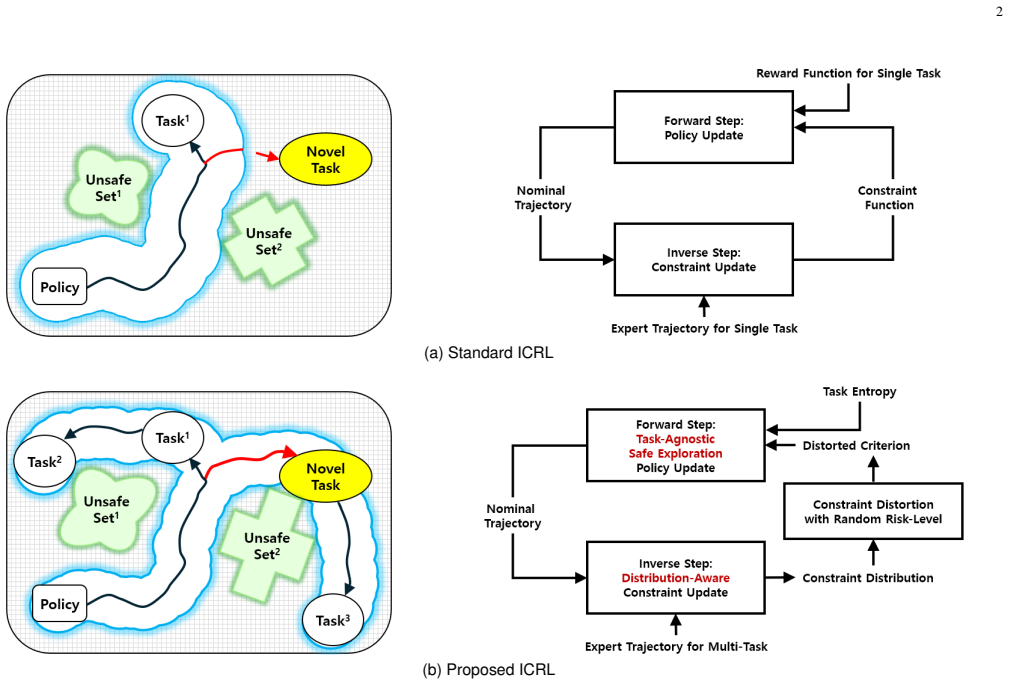
The load-bearing object is the distribution-aware constraint model $f_\phi(\alpha|\tau)$, a neural network that maps a trajectory to the parameters $\alpha=[\alpha_1,\alpha_2]$ of a Beta posterior $q(\zeta(\tau)|\alpha)$ over the probability that the trajectory is feasible. The constraint is evaluated as the conditional value at risk $\Gamma^\lambda_\phi(\tau)=\mathbb{E}_{\alpha\sim f_\phi(\cdot|\tau)}[\mathrm{CVaR}_\lambda]$ at a risk level $\lambda$; the policy side uses an importance-weighted $k$-NN state-entropy estimator $\hat{H}_k(\rho_\theta|\rho_{\bar\theta})$ to encourage task-agnostic safe exploration while staying inside the learned risk bounds. Together they turn the entropy-regularized constrained RL objective in Eq. 1 into the Lagrangian min-max objective in Eq. 11.
What would settle it
Construct a multi-task environment whose feasible region is a mixture of two distinct safe zones (two separated speed-limit regions), train DIAL on demonstrations from both, then inspect the inferred feasibility map and measure per-zone transfer cost-return; the unimodal Beta posterior must collapse onto one zone, and the transferred policy should systematically violate the budget in the other zone.
Extended reading notes
Core claim
The paper claims that constraints shared across tasks can be learned as a distribution rather than a single function, and that this distribution can be distorted by a CVaR criterion so that adapting to a new task reduces to selecting the risk level $\lambda$. In the safe imitation stage, DIAL uses multi-task expert demonstrations to train $f_\phi(\alpha|\tau)$ and a task-agnostic safe exploration policy; in the safe transfer stage, it fixes the learned constraint, grid-searches $\lambda$, and optimizes the policy against the recovered risk-sensitive constraint with no task-specific cost definition. Experimental results on urban driving and four robot-control environments are presented as evidence that DIAL achieves lower constraint violation rates and comparable or higher rewards than MERL, MECL, and COCL, and that it retains safety behavior when the reward changes.
Load-bearing premise
The whole transfer story depends on the safety requirements across tasks being well captured by a factorized Beta posterior over trajectory feasibility with a CVaR risk level found by grid search; if the real constraints are multimodal or heavy-tailed in a way Beta cannot express, the inferred constraint and the safety transfer claim do not follow.
Editorial extensions
If this is right
- Agents trained with DIAL can switch to a new task by changing the risk level $\lambda$ alone, without redefining cost functions.
- Safety constraints learned from multi-task demonstrations transfer to environments with shifted safety conditions while keeping violation rates near the ground-truth budget.
- Task-agnostic safe exploration lets the policy maintain high state entropy early in transfer, so it finds feasible solutions faster than conservative single-task constraints.
- Because the constraint is a distribution, DIAL can represent soft constraints such as speed limits and safe distances, and can tune conservatism per task.
Reading between the lines
- The paper does not pursue it, but the CVaR risk level $\lambda$ could be turned into an online controller that raises $\lambda$ when violations rise and lowers it when the policy is overly conservative.
- If the Beta assumption holds, the learned constraint becomes a parameterized family of safety thresholds, which would let an operator treat $\lambda$ as a human-interpretable safety dial for autonomous systems.
- The transfer claim could be tested adversarially by training demonstrations from a bimodal feasible region; a unimodal Beta posterior should miss one mode, and the transferred policy should violate the budget there, a test the paper does not include.
Signed reviews
Editorial analysis
A structured set of objections, weighed in public.
Referee Report
Summary. The paper proposes DIAL, a two-stage method for safe reinforcement learning and imitation learning. In the safe imitation-learning stage, DIAL learns a distribution over trajectory feasibility, modeled as a factorized Beta posterior parameterized by a neural network, and distorts it with conditional value at risk (CVaR) at risk level λ; it also trains a task-agnostic safe-exploration policy using a k-NN state-entropy estimator with a trust-region constraint. In the safe transfer-learning stage, the learned constraint is fixed and used, together with a scalar risk level λ, to constrain a policy that maximizes a newly provided reward. Experiments on urban driving (HighwayEnv) and four robot-control environments compare DIAL with MERL, MECL, and COCL, reporting higher reward-return and lower cost or violation rates. The central claim is that DIAL identifies shared constraints from multi-task demonstrations and adapts to new tasks by adjusting a scalar risk level, without requiring task-specific constraint definitions.
Significance. If the central claim is established, DIAL would be a practically useful contribution: it offers a way to reuse safety information across tasks through a distributional, risk-sensitive constraint model, and it explicitly targets the burden of hand-designing cost functions. The paper is commendable for providing detailed pseudocode for both stages (Algorithms 1 and 2), per-environment hyperparameters in Appendix B, and extensive experiments across five environments. However, the manuscript currently has load-bearing gaps: the policy update in Algorithm 1 does not match the objective in Eq. (11), the constraint update in Eq. (7) is not derived from a well-defined loss, the risk level λ is selected per environment by grid search rather than adapted, and the Beta/CVaR posterior is not directly validated. These issues make the published claims ahead of the evidence, so the work is promising but not yet fully supported.
major comments (5)
- [IV-B, Algorithm 1, Eq. (11)] The policy update described in Algorithm 1 does not implement the objective in Eq. (11). Eq. (11) defines the safe-IL objective as min_{κ≥0} max_θ [J_R(θ) + β J_H(θ) − κ J_κ(φ,λ)], where J_R is the expected reward-return and J_κ is the constraint term. Algorithm 1, however, collects only (s,a,s′) transitions and the only θ update is the entropy-gradient step θ ← θ − β ∇_θ J_H(θ) inside the trust-region loop (lines 17–18); no gradient of J_R or J_κ appears. This makes the described safe-IL procedure not directly executable and leaves unclear what objective the reported policy actually optimizes.
- [IV-A, Eqs. (4), (7), (8)] The constraint update in Eq. (7) is presented without a derivation. Eq. (4) is the gradient of the maximum-likelihood objective (3) for the feasibility classifier ζ; substituting Γ^λ_φ(τ) = E_{α∼f_φ}[CVaR_λ] for ζ(τ) changes the statistical model, yet no loss function is given whose gradient equals Eq. (7), and the ELBO term L_P in Eq. (8) is added without specifying the joint objective being optimized. A fixed point of Eq. (7) is therefore not shown to recover the true constraint distribution. This is load-bearing for the claim that DIAL 'identifies the shared constraints.'
- [IV-A, Table VI, Fig. 9] The scalar risk level λ is not adapted automatically; Table VI fixes it per environment (0.5 for four environments and 0.1 for PointGoal), and the text states that fine-tuning is performed using grid search. Fig. 9 shows that the inferred safe set and the policy's exploratory behavior change qualitatively with λ. Because the paper does not report a selection rule for λ that avoids access to task-specific safety information, the abstract's claim of adaptation 'without requiring task-specific constraint definitions' is not yet substantiated: the experiments as reported do not rule out that the grid-searched λ, rather than the learned distribution, provides the task-specific safety tuning.
- [IV-A, Section V-E, Fig. 11] The representational assumption that trajectory feasibility follows a factorized Beta posterior is not validated. The paper assumes q(ζ(τ)|α) = ∏_i q(ζ_i(τ)|α_i) and distorts this posterior with CVaR, but no experiment checks whether the learned posterior is calibrated, whether the Beta family is adequate, or whether the factorized form captures the true multi-constraint dependence. The reported CR/CV metrics can be satisfied by a conservative policy even if the posterior is wrong; Fig. 11 displays histograms and CDFs of environmental data but not posterior fit or calibration. A direct validation—for example, calibration curves, coverage tests, or a comparison against a nonparametric feasibility estimator—is needed to support the 'distribution-informed' claim.
- [Algorithm 2, lines 13–15] The safe-TL policy update is inconsistent with the Lagrangian form of Eq. (1). Algorithm 2 updates κ with the constraint violation E_π[ĉ] − ϵ, but the θ update (line 15) contains only the reward and entropy gradients; the term −κ ∇_θ E_π[ĉ] that would enforce the constraint in a Lagrangian update is absent. If this is a typo it should be corrected; otherwise the algorithm does not actually enforce the recovered constraint during transfer.
minor comments (5)
- [Section III-B, Eq. (4)] The notation ∇_ζ log ζ(τ) is ambiguous: the gradient is with respect to the network parameters of ζ, not with respect to the function ζ itself. Please clarify the parameterization.
- [Section IV-A] The sentence 'We interpret the network’s output as variables sampled from two Gamma distributions' is unclear and appears to conflict with the statement that f_φ outputs the Beta parameters α directly. Please clarify the generative model for α.
- [Table I] Table I reports SE and CR without standard deviations even though the text says all metrics are averaged over 20 episodes for 5 seeds. Adding error bars or standard deviations would make the comparisons more informative.
- [Algorithm 2, line 15] The entropy term H(π_θ(τ)) in line 15 is written as the ordinary policy entropy, whereas Section IV-B motivates the importance-weighted k-NN estimator of Eq. (10). Please specify which entropy estimator is used in the transfer stage.
- [Section IV-B, Eq. (11)] The role of the trust-region constraint D_KL[ρ_θ ∥ ρ_θ̄] ≤ δ is described verbally, but it is not incorporated into Eq. (11) or into the description of the Lagrangian optimization. Please state how the trust-region bound interacts with the Lagrangian objective.
Circularity Check
Per-environment grid search of λ, admitted in Fig. 9b as tuning to match ground truth, makes the safety/constraint-matching result partly a fit rather than a prediction.
-
fitted input called prediction
[Section IV-A (Constraint Inference with Risk-Sensitive Criterion); Section V-E (Fig. 9b); Table VI (Safe TL risk levels)]
"In the later safe TL stage, where achieving high performance on the target task is crucial, fine-tuning is performed using grid search to determine λ. ... Fig. 9b shows that we can infer a constraint that most closely resembles the ground truth (GT) located on the far left by finely tuning λ in DIAL."
The scalar λ is the CVaR distortion parameter that directly sets how conservative the recovered constraint is (Eqs. 5–8, Fig. 3). Table VI fixes it per environment (0.5 for Intersection, MountainCar, CartPole, BasicNav; 0.1 for PointGoal), and Section IV-A states that λ is selected by grid search during safe TL. Fig. 9b explicitly admits that the inferred constraint map is made to match the ground-truth safe set by finely tuning λ. Therefore, the reported 'adaptation by adjusting risk levels' and the GT-matching inferred constraints are obtained by fitting λ to the evaluation target, not independently predicted by the learned Beta posterior.
full rationale
The paper's core learning machinery is not circular in the strictest sense: the constraint network is trained on multi-task expert demonstrations through an ICRL-style gradient, and performance is evaluated against external ground-truth costs that are not used for constraint training. There is no load-bearing self-citation chain; the cited ICRL, Bayesian, and entropy-estimation results are external prior work. The one genuine circularity concern is the risk level λ. The method's central transfer mechanism is 'adjusting risk levels within these learned distributions,' but λ is not inferred or automatically adapted; it is set by per-environment grid search (Table VI), and Fig. 9b shows that tuning λ can make the recovered constraint match the ground-truth safe set. This turns part of the safety and constraint-recovery result into a fitted outcome rather than an independent prediction. The paper's own conclusion also lists 'incorporating techniques that automatically optimize or dynamically adjust risk levels' as future work, corroborating that the current λ selection is external to the learned distribution. The unvalidated Beta/CVaR posterior fidelity is a correctness risk, not a circularity, and I do not count it here.
Assumptions & free parameters
free parameters (5)
- Risk level lambda (safe TL) =
0.5 for Intersection, MountainCar, CartPole, BasicNav; 0.1 for PointGoal
- Entropy coefficient beta =
0.01 (Intersection, MountainCar, CartPole), 1.0 (BasicNav), 0.1 (PointGoal)
- Trust-region threshold delta =
0.1 (Intersection, PointGoal), 0.5 (MountainCar, CartPole), 1.0 (BasicNav)
- Beta prior parameters alpha0 =
[0.1, 0.9]
- Damping scaling factor kappa_d =
10
assumptions (5)
- domain assumption Expert demonstrations satisfy all safety requirements in the source environment and are safe for the original task.
- ad hoc to paper Trajectory feasibility is a random variable in (0,1) following a Beta posterior that factorizes across constraints.
- domain assumption The IW k-NN entropy estimator (Eq. 10) is a valid, optimizable proxy for the state density entropy of the policy.
- standard math The MaxEnt ICRL trajectory distribution (Eq. 2) correctly models demonstration likelihood.
- ad hoc to paper A single scalar risk level lambda, fixed during transfer, captures task-specific risk sensitivity across the new environment.
Cite this review
Pith. "Pith review of DIAL: Distribution-Informed Adaptive Learning of Multi-Task Constraints for Safety-Critical Systems." pith.science (2026). https://pith.science/paper/NXJX3DTN
@misc{pith2026250118086,
  author       = {Pith},
  title        = {Pith review of: DIAL: Distribution-Informed Adaptive Learning of Multi-Task Constraints for Safety-Critical Systems},
  year         = {2026},
  howpublished = {\url{https://pith.science/paper/NXJX3DTN}},
  note         = {Machine review of arXiv:2501.18086}
}
read the original abstract
Safe reinforcement learning has traditionally relied on predefined constraint functions to ensure safety in complex real-world tasks, such as autonomous driving. However, defining these functions accurately for varied tasks is a persistent challenge. Recent research highlights the potential of leveraging pre-acquired task-agnostic knowledge to enhance both safety and sample efficiency in related tasks. Building on this insight, we propose a novel method to learn shared constraint distributions across multiple tasks. Our approach identifies the shared constraints through imitation learning and then adapts to new tasks by adjusting risk levels within these learned distributions. This adaptability addresses variations in risk sensitivity stemming from expert-specific biases, ensuring consistent adherence to general safety principles even with imperfect demonstrations. Our method can be applied to control and navigation domains, including multi-task and meta-task scenarios, accommodating constraints such as maintaining safe distances or adhering to speed limits. Experimental results validate the efficacy of our approach, demonstrating superior safety performance and success rates compared to baselines, all without requiring task-specific constraint definitions. These findings underscore the versatility and practicality of our method across a wide range of real-world tasks.
Figures


Figures from the paper (11 more)


Reference graph
Works this paper leans on
-
[46]
Uncertainty-aware constraint inference in inverse constrained reinforcement learning,
S. Xu and G. Liu, “Uncertainty-aware constraint inference in inverse constrained reinforcement learning,” in The Twelfth International Con- ference on Learning Representations , 2023
work page 2023
-
[52]
Bayesian methods for constraint inference in reinforcement learning,
D. Papadimitriou, U. Anwar, and D. S. Brown, “Bayesian methods for constraint inference in reinforcement learning,”Transactions on Machine Learning Research, 2024
work page 2024
-
[1]
Cic: Contrastive intrinsic control for unsupervised skill discovery,
M. Laskin, H. Liu, X. B. Peng, D. Yarats, A. Rajeswaran, and P. Abbeel, “Cic: Contrastive intrinsic control for unsupervised skill discovery,” in Deep RL Workshop NeurIPS 2021 , 2021. 15 TABLE V HYPERPARAMETERS FOR EACH ENVIRONMENT IN SAFE IL Hyperparameters Intersection MountainCar CartPole BasicNav PointGoal Notation Environmental Steps 1.5 × 10⁵ 5 × 10...
work page 2021
-
[2]
Urlb: Unsupervised reinforcement learning benchmark,
M. Laskin, D. Yarats, H. Liu, K. Lee, A. Zhan, K. Lu, C. Cang, L. Pinto, and P. Abbeel, “Urlb: Unsupervised reinforcement learning benchmark,” in 35th Conference on Neural Information Processing Sys- tems (NeurIPS) . Neural Information Processing Systems Foundation, 2021
work page 2021
-
[3]
Unsupervised reinforcement learning in multiple environments,
M. Mutti, M. Mancassola, and M. Restelli, “Unsupervised reinforcement learning in multiple environments,” in Proceedings of the AAAI Confer- ence on Artificial Intelligence , vol. 36, no. 7, 2022, pp. 7850–7858
work page 2022
-
[4]
R. S. Sutton and A. G. Barto, Reinforcement learning: An introduction . MIT press, 2018
2018
-
[5]
Efficient training of artificial neural networks for autonomous navigation,
D. A. Pomerleau, “Efficient training of artificial neural networks for autonomous navigation,” Neural computation, vol. 3, no. 1, pp. 88–97, 1991
1991
-
[6]
S. Schaal, “Learning from demonstration,” Advances in neural informa- tion processing systems , vol. 9, 1996
work page 1996
Show all 63 references
-
[7]
A survey of robot learning from demonstration,
B. D. Argall, S. Chernova, M. Veloso, and B. Browning, “A survey of robot learning from demonstration,” Robotics and autonomous systems , vol. 57, no. 5, pp. 469–483, 2009
2009
-
[8]
Model-agnostic meta-learning for fast adaptation of deep networks,
C. Finn, P. Abbeel, and S. Levine, “Model-agnostic meta-learning for fast adaptation of deep networks,” in International conference on machine learning. PMLR, 2017, pp. 1126–1135
2017
-
[9]
Never give up: Learning directed exploration strategies,
A. P. Badia, P. Sprechmann, A. Vitvitskyi, D. Guo, B. Piot, S. Kaptur- owski, O. Tieleman, M. Arjovsky, A. Pritzel, A. Bolt et al. , “Never give up: Learning directed exploration strategies,” in International Conference on Learning Representations , 2019
2019
-
[10]
Novelty search in repre- sentational space for sample efficient exploration,
R. Y . Tao, V . Franc ¸ois-Lavet, and J. Pineau, “Novelty search in repre- sentational space for sample efficient exploration,” Advances in Neural Information Processing Systems , vol. 33, pp. 8114–8126, 2020
2020
-
[11]
State entropy maximization with random encoders for efficient exploration,
Y . Seo, L. Chen, J. Shin, H. Lee, P. Abbeel, and K. Lee, “State entropy maximization with random encoders for efficient exploration,” in International Conference on Machine Learning . PMLR, 2021, pp. 9443–9454
2021
-
[12]
A comprehensive survey on safe reinforce- ment learning,
J. Garcıa and F. Fern ´andez, “A comprehensive survey on safe reinforce- ment learning,” Journal of Machine Learning Research , vol. 16, no. 1, pp. 1437–1480, 2015
2015
-
[13]
Learning to run a power network challenge for training topology controllers,
A. Marot, B. Donnot, C. Romero, B. Donon, M. Lerousseau, L. Veyrin- Forrer, and I. Guyon, “Learning to run a power network challenge for training topology controllers,” Electric Power Systems Research , vol. 189, p. 106635, 2020
2020
-
[14]
Challenges of real-world reinforcement learning: definitions, benchmarks and analysis,
G. Dulac-Arnold, N. Levine, D. J. Mankowitz, J. Li, C. Paduraru, S. Gowal, and T. Hester, “Challenges of real-world reinforcement learning: definitions, benchmarks and analysis,” Machine Learning, vol. 110, no. 9, pp. 2419–2468, 2021
2021
-
[15]
Constrained policy optimization,
J. Achiam, D. Held, A. Tamar, and P. Abbeel, “Constrained policy optimization,” in International conference on machine learning. PMLR, 2017, pp. 22–31
2017
-
[16]
Safe reinforcement learning in constrained markov decision processes,
A. Wachi and Y . Sui, “Safe reinforcement learning in constrained markov decision processes,” in International Conference on Machine Learning . PMLR, 2020, pp. 9797–9806
2020
-
[17]
Density constrained reinforcement learning,
Z. Qin, Y . Chen, and C. Fan, “Density constrained reinforcement learning,” in International Conference on Machine Learning . PMLR, 2021, pp. 8682–8692
2021
-
[18]
Cem: Constrained entropy maximization for task-agnostic safe exploration,
Q. Yang and M. T. Spaan, “Cem: Constrained entropy maximization for task-agnostic safe exploration,” in Proceedings of the AAAI Conference on Artificial Intelligence , vol. 37, no. 9, 2023, pp. 10 798–10 806
2023
-
[19]
Learning constraints from demon- strations,
G. Chou, D. Berenson, and N. Ozay, “Learning constraints from demon- strations,” in Algorithmic Foundations of Robotics XIII: Proceedings of the 13th Workshop on the Algorithmic Foundations of Robotics 13 . Springer, 2020, pp. 228–245
2020
-
[20]
Inverse constrained re- inforcement learning,
S. Malik, U. Anwar, A. Aghasi, and A. Ahmed, “Inverse constrained re- inforcement learning,” in International conference on machine learning. PMLR, 2021, pp. 7390–7399
2021
-
[21]
Learning shared safety constraints from multi-task demonstrations,
K. Kim, G. Swamy, Z. Liu, D. Zhao, S. Choudhury, and S. Z. Wu, “Learning shared safety constraints from multi-task demonstrations,” Advances in Neural Information Processing Systems , vol. 36, 2024
2024
-
[22]
Conditional value-at-risk for elliptical distributions,
V . Khokhlov, “Conditional value-at-risk for elliptical distributions,” Evropsk`y ˇcasopis ekonomiky a managementu , vol. 2, no. 6, pp. 70–79, 2016
2016
-
[23]
Worst cases policy gradients,
Y . C. Tang, J. Zhang, and R. Salakhutdinov, “Worst cases policy gradients,” in Proceedings of the Conference on Robot Learning, ser. Proceedings of Machine Learning Research, L. P. Kaelbling, D. Kragic, and K. Sugiura, Eds., vol. 100. PMLR, 30 Oct–01 Nov 2020, pp. 1078–1093. ...
2020
-
[24]
Wcsac: Worst-case soft actor critic for safety-constrained reinforcement learn- ing,
Q. Yang, T. D. Sim ˜ao, S. H. Tindemans, and M. T. Spaan, “Wcsac: Worst-case soft actor critic for safety-constrained reinforcement learn- ing,” in Proceedings of the AAAI Conference on Artificial Intelligence , vol. 35, no. 12, 2021, pp. 10 639–10 646. 16
2021
-
[25]
Task-agnostic exploration in reinforce- ment learning,
X. Zhang, Y . Ma, and A. Singla, “Task-agnostic exploration in reinforce- ment learning,” Advances in Neural Information Processing Systems , vol. 33, pp. 11 734–11 743, 2020
2020
-
[26]
Learning safety constraints from demonstrations with unknown re- wards,
D. Lindner, X. Chen, S. Tschiatschek, K. Hofmann, and A. Krause, “Learning safety constraints from demonstrations with unknown re- wards,” in International Conference on Artificial Intelligence and Statis- tics. PMLR, 2024, pp. 2386–2394
2024
-
[27]
Train hard, fight easy: Robust meta reinforcement learning,
I. Greenberg, S. Mannor, G. Chechik, and E. Meirom, “Train hard, fight easy: Robust meta reinforcement learning,” Advances in Neural Information Processing Systems , vol. 36, 2024
2024
-
[28]
Incentivizing exploration in reinforcement learning with deep predictive models,
B. C. Stadie, S. Levine, and P. Abbeel, “Incentivizing exploration in reinforcement learning with deep predictive models,” arXiv preprint arXiv:1507.00814, 2015
2015 arXiv
-
[29]
Reward-free exploration for reinforcement learning,
C. Jin, A. Krishnamurthy, M. Simchowitz, and T. Yu, “Reward-free exploration for reinforcement learning,” in International Conference on Machine Learning. PMLR, 2020, pp. 4870–4879
2020
-
[30]
Provably efficient maximum entropy exploration,
E. Hazan, S. Kakade, K. Singh, and A. Van Soest, “Provably efficient maximum entropy exploration,” in International Conference on Machine Learning. PMLR, 2019, pp. 2681–2691
2019
-
[31]
Efficient exploration via state marginal matching,
L. Lee, B. Eysenbach, E. Parisotto, E. Xing, S. Levine, and R. Salakhut- dinov, “Efficient exploration via state marginal matching,”arXiv preprint arXiv:1906.05274, 2019
1906 arXiv
-
[32]
Constrained cross-entropy method for safe reinforcement learning,
M. Wen and U. Topcu, “Constrained cross-entropy method for safe reinforcement learning,” Advances in Neural Information Processing Systems, vol. 31, 2018
2018
-
[33]
Learning to fly,
C. Sammut, S. Hurst, D. Kedzier, and D. Michie, “Learning to fly,” in Machine Learning Proceedings 1992 . Elsevier, 1992, pp. 385–393
1992
-
[34]
G. M. Hayes and J. Demiris, A robot controller using learning by imitation. University of Edinburgh, Department of Artificial Intelligence Edinburgh, UK, 1994
1994
-
[35]
Apprenticeship learning via inverse rein- forcement learning,
P. Abbeel and A. Y . Ng, “Apprenticeship learning via inverse rein- forcement learning,” in Proceedings of the twenty-first international conference on Machine learning , 2004, p. 1
2004
-
[36]
Generative adversarial imitation learning,
J. Ho and S. Ermon, “Generative adversarial imitation learning,” Ad- vances in neural information processing systems , vol. 29, 2016
2016
-
[37]
Learning robust rewards with adverserial inverse reinforcement learning,
J. Fu, K. Luo, and S. Levine, “Learning robust rewards with adverserial inverse reinforcement learning,” in International Conference on Learn- ing Representations, 2018
2018
-
[38]
Iq-learn: Inverse soft-q learning for imitation,
D. Garg, S. Chakraborty, C. Cundy, J. Song, and S. Ermon, “Iq-learn: Inverse soft-q learning for imitation,” Advances in Neural Information Processing Systems, vol. 34, pp. 4028–4039, 2021
2021
-
[39]
Maximum entropy inverse reinforcement learning
B. D. Ziebart, A. L. Maas, J. A. Bagnell, A. K. Dey et al., “Maximum entropy inverse reinforcement learning.” in Aaai, vol. 8. Chicago, IL, USA, 2008, pp. 1433–1438
2008
-
[40]
Bridging the gap between imitation learning and inverse reinforcement learning,
B. Piot, M. Geist, and O. Pietquin, “Bridging the gap between imitation learning and inverse reinforcement learning,” IEEE transactions on neural networks and learning systems , vol. 28, no. 8, pp. 1814–1826, 2016
2016
-
[41]
A connection between generative adversarial networks, inverse reinforcement learning, and energy-based models,
C. Finn, P. Christiano, P. Abbeel, and S. Levine, “A connection between generative adversarial networks, inverse reinforcement learning, and energy-based models,” arXiv preprint arXiv:1611.03852 , 2016
2016 arXiv
-
[42]
Maximum likelihood constraint inference for inverse reinforcement learning,
D. R. Scobee and S. S. Sastry, “Maximum likelihood constraint inference for inverse reinforcement learning,” arXiv preprint arXiv:1909.05477 , 2019
1909 arXiv
-
[43]
Learning constraints from demon- strations with grid and parametric representations,
G. Chou, D. Berenson, and N. Ozay, “Learning constraints from demon- strations with grid and parametric representations,” The International Journal of Robotics Research, vol. 40, no. 10-11, pp. 1255–1283, 2021
2021
-
[44]
Gaussian process constraint learning for scalable chance-constrained motion planning from demon- strations,
G. Chou, H. Wang, and D. Berenson, “Gaussian process constraint learning for scalable chance-constrained motion planning from demon- strations,” IEEE Robotics and Automation Letters , vol. 7, no. 2, pp. 3827–3834, 2022
2022
-
[45]
Learning soft constraints from constrained expert demonstrations,
A. Gaurav, K. Rezaee, G. Liu, and P. Poupart, “Learning soft constraints from constrained expert demonstrations,” in The Eleventh International Conference on Learning Representations , 2023
2023
-
[47]
Confidence aware inverse constrained reinforcement learning,
S. G. Subramanian, G. Liu, M. Elmahgiubi, K. Rezaee, and P. Poupart, “Confidence aware inverse constrained reinforcement learning,” arXiv preprint arXiv:2406.16782, 2024
2024 arXiv
-
[48]
Inverse constraint learning and gen- eralization by transferable reward decomposition,
J. Jang, M. Song, and D. Park, “Inverse constraint learning and gen- eralization by transferable reward decomposition,” IEEE Robotics and Automation Letters, vol. 9, no. 1, pp. 279–286, 2023
2023
-
[49]
Altman, Constrained Markov decision processes
E. Altman, Constrained Markov decision processes . Routledge, 2021
2021
-
[50]
Benchmarking safe exploration in deep reinforcement learning,
A. Ray, J. Achiam, and D. Amodei, “Benchmarking safe exploration in deep reinforcement learning,” arXiv preprint arXiv:1910.01708 , vol. 7, no. 1, p. 2, 2019
1910 arXiv
-
[51]
Approxi- mate robust control of uncertain dynamical systems,
E. Leurent, Y . Blanco, D. Efimov, and O.-A. Maillard, “Approxi- mate robust control of uncertain dynamical systems,” arXiv preprint arXiv:1903.00220, 2019
1903 arXiv
-
[53]
Risk-sensitive inverse reinforcement learning via coherent risk models
A. Majumdar, S. Singh, A. Mandlekar, and M. Pavone, “Risk-sensitive inverse reinforcement learning via coherent risk models.” in Robotics: science and systems , vol. 16, 2017, p. 117
2017
-
[54]
Benchmarking constraint inference in inverse reinforcement learning,
G. Liu, Y . Luo, A. Gaurav, K. Rezaee, and P. Poupart, “Benchmarking constraint inference in inverse reinforcement learning,” in The Eleventh International Conference on Learning Representations , 2023
2023
-
[55]
Near- est neighbor estimates of entropy,
H. Singh, N. Misra, V . Hnizdo, A. Fedorowicz, and E. Demchuk, “Near- est neighbor estimates of entropy,” American journal of mathematical and management sciences , vol. 23, no. 3-4, pp. 301–321, 2003
2003
-
[56]
Particle based probability density fusion with differential shannon entropy criterion,
J. Ajgl and M. ˇSimandl, “Particle based probability density fusion with differential shannon entropy criterion,” in 14th International Conference on Information Fusion . IEEE, 2011, pp. 1–8
2011
-
[57]
Task-agnostic exploration via policy gradient of a non-parametric state entropy estimate,
M. Mutti, L. Pratissoli, and M. Restelli, “Task-agnostic exploration via policy gradient of a non-parametric state entropy estimate,” in Proceedings of the AAAI Conference on Artificial Intelligence , vol. 35, no. 10, 2021, pp. 9028–9036
2021
-
[58]
Reward constrained policy optimization,
C. Tessler, D. J. Mankowitz, and S. Mannor, “Reward constrained policy optimization,” arXiv preprint arXiv:1805.11074 , 2018
2018 arXiv
-
[59]
An environment for autonomous driving decision- making,
E. Leurent et al. , “An environment for autonomous driving decision- making,” 2018
2018
-
[60]
Openai gym,
G. Brockman, V . Cheung, L. Pettersson, J. Schneider, J. Schul- man, J. Tang, and W. Zaremba, “Openai gym,” arXiv preprint arXiv:1606.01540, 2016
2016 arXiv
-
[61]
Adam: A method for stochastic optimization,
D. P. Kingma and J. Ba, “Adam: A method for stochastic optimization,” arXiv preprint arXiv:1412.6980 , 2014
2014 arXiv
-
[62]
Constrained differential optimization,
J. Platt and A. Barr, “Constrained differential optimization,” in Neural Information Processing Systems , 1987
1987
-
[63]
Controlled text gen- eration as continuous optimization with multiple constraints,
S. Kumar, E. Malmi, A. Severyn, and Y . Tsvetkov, “Controlled text gen- eration as continuous optimization with multiple constraints,” Advances in Neural Information Processing Systems , vol. 34, pp. 14 542–14 554, 2021. Se-Wook Yoo (Member, IEEE) received the B.S. degree in e...
2021
Reviewed August 10, 2026 · model on record in the stance chip above.
Discussion (0). Continue with ORCID to comment.