REVIEW 4 major objections 5 minor 47 references
An Empirical Game-Theoretic Analysis of Autonomous Cyber-Defence Agents
T0 review · 4 major / 5 minor · reviewed 2026-08-09 · deepseek-v4-flash
Pith's one-line read This paper claims that a multi-oracle extension of the double-oracle algorithm, accelerated by value-function potential-based reward shaping, yields cyber-defence agents that hold their ground as adaptive attackers keep learning.
desk verdict A worthwhile framework paper for adversarial evaluation of ACD agents, but the robustness claims run ahead of the evidence—single MRO runs and 100-episode payoffs are doing too much work. read the letter →
The pith
A machine-rendered reading of the paper's core claim, the machinery that carries it, and where it could break.
The reading
What carries the argument
The load-bearing object is the empirical matrix game, a finite two-player zero-sum normal-form game in which each action is a policy trained for one side, and each payoff entry is the mean episodic reward of one policy pair estimated from 100 evaluation episodes. The MRO algorithm replaces the single approximate-best-response oracle of the standard double-oracle loop with a response function that returns a set of candidate policies from several learning approaches, plus a selection step that keeps the best one; because the selected policy is still an approximate best response, the proof that exploitability $\le 0$ implies a resource-bounded Nash equilibrium goes through unchanged. VF-PBRS shapes rewards with $F(s,s') = \gamma\Phi(s') - \Phi(s)$, where the potential $\Phi$ is the mixture-weighted, Z-score-normalised sum of value functions from earlier iterations. Since this is a potential-based shaping function, the optimal policy is invariant, so oracles using VF-PBRS still return approximate best responses. Pre-trained model sampling with $\epsilon$-greedy decay balances reuse of past policies against exploration of new strategies.
What would settle it
Run the MRO loop repeatedly from different random seeds and fresh initialisations in CAGE Challenge 2, and then train a fresh attacker with a larger budget against the final Blue mixture; if the final game value varies across seeds by more than the reported standard errors, or if that fresh attacker improves on the Nash payoff by more than evaluation noise, the paper's robustness claim would be contradicted.
Extended reading notes
Core claim
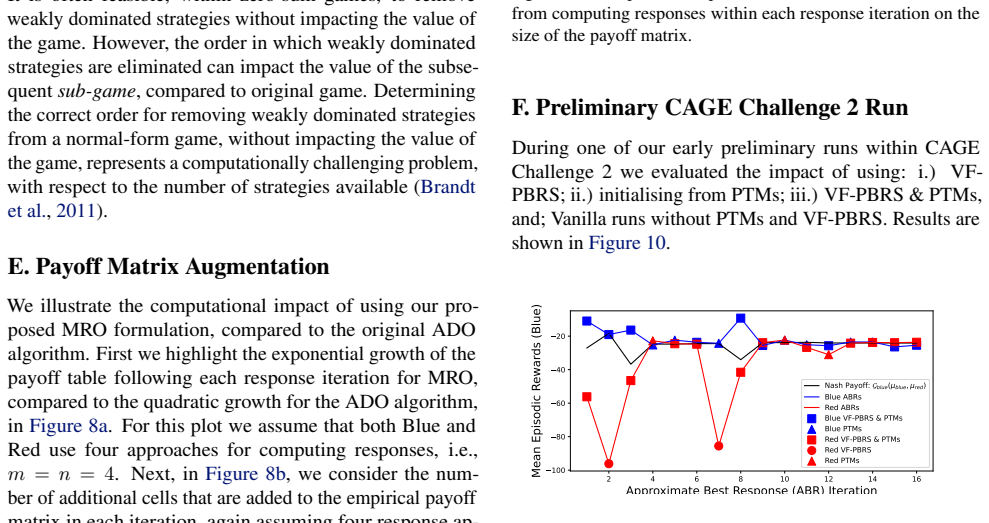
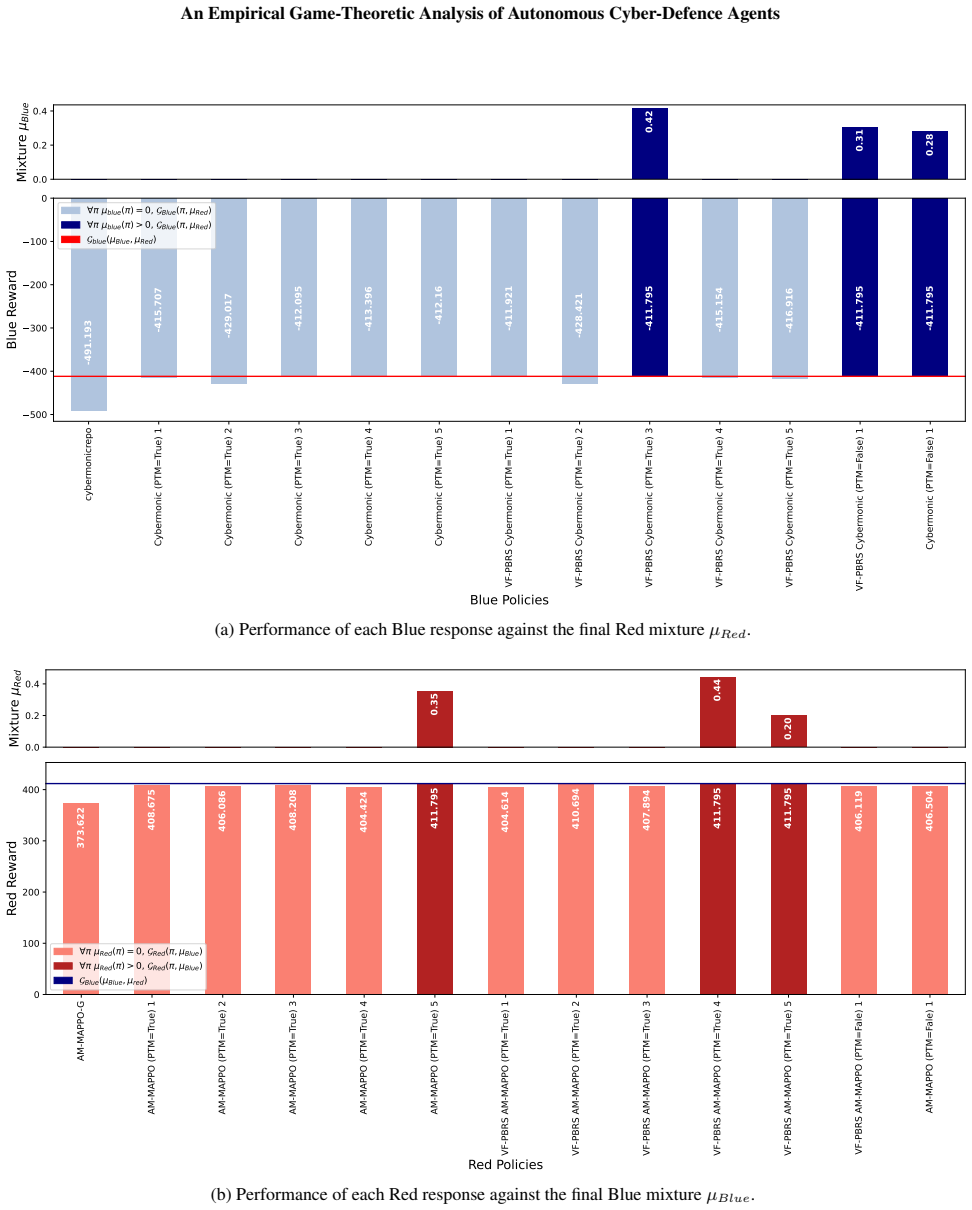
The central claim is that the approximate double-oracle procedure, extended to multiple response oracles and accelerated by VF-PBRS and pre-trained model sampling, converges to a resource-bounded Nash equilibrium of the empirical game. The argument is that potential-based reward shaping preserves the optimal policy, so a VF-PBRS oracle still returns an approximate best response, and that the best policy within a response set computed by MRO is itself an approximate best response. In the experiments, the value of the CC2 game stabilises around $-29.63$ from Blue's perspective after roughly 23 iterations, and a Red response trained from scratch initially jumps to $93.05$ but is neutralised to $29.75$ once Blue's mixture adjusts. The CC4 game value changes little after the first iteration, settling near $-411.91$, with the estimated value of the game essentially constant. The paper concludes that defenders obtained this way are robust to learning attackers, which struggle to find new successful tactics, techniques and procedures.
Load-bearing premise
The single load-bearing premise is that the empirical payoff matrix, estimated from 100 evaluation episodes per policy pair, is accurate enough for the Nash solver to identify a meaningful equilibrium, and that the one MRO run per environment is representative of the stochastic training process.
Editorial extensions
If this is right
- A defender mixture produced by the CC2 MRO run held the Nash payoff to about $-29.63$; when a freshly initialised Red oracle found a response that briefly raised the payoff to $93.05$, the Blue mixture adjusted and pushed it back to $29.75$, and no later attacker response significantly moved the game value.
- Under pre-trained initialisation in CC2, VF-PBRS with value-function ensembling significantly outperformed vanilla training for Blue responses (mean $-29.8 \pm 1.2$ versus $-38.3 \pm 2.7$), while for Red the shaping benefit was small and not statistically significant.
- Because the selected response in MRO is still an approximate best response, the standard double-oracle termination condition applies: if the combined exploitability is at most zero, the algorithm has found a resource-bounded Nash equilibrium.
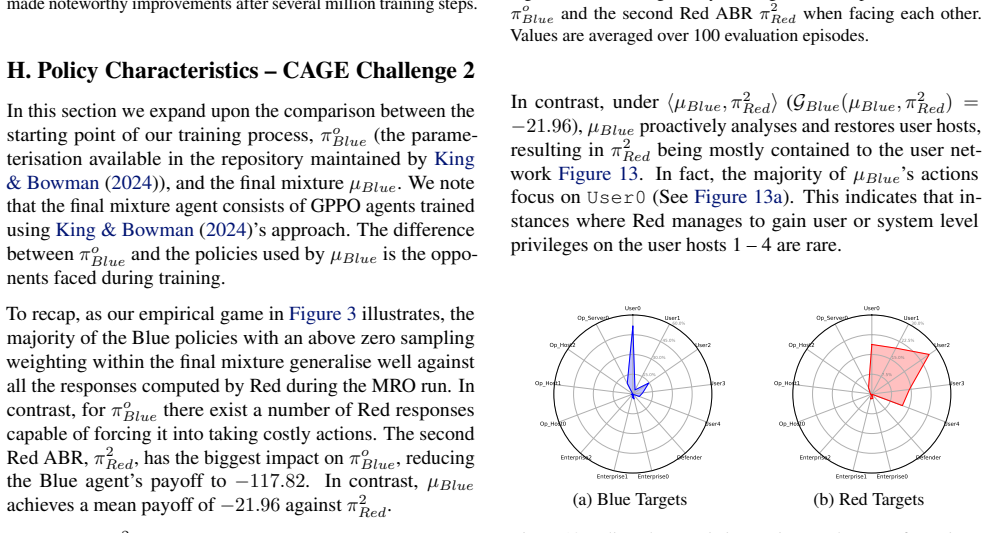
- The final CC2 Blue mixture consisted of graph-based PPO policies, and a single Red policy that scored $-117.82$ against the original defender parameterisation scored only $-21.96$ against the mixture, illustrating that mixture play reduces worst-case exposure.
Reading between the lines
- Inference: the MRO loop is a general evaluation harness for any domain where several candidate training recipes compete against an adaptive adversary; red-teaming of language models or fraud-detection systems could reuse the same structure, provided per-pair payoffs can be estimated reliably.
- Inference: VF-PBRS helping the defender much more than the attacker suggests the shaping signal matters most when the reward is sparse and delayed, as in long attack chains; a targeted comparison of short versus long attack sequences would test this directly.
- Inference: the reported game values come from a single MRO run per environment, so the variance of the equilibrium itself is not measured; re-running the loop across random seeds would show whether the robustness result is a property of the method or of one training trajectory.
Editorial analysis
A structured set of objections, weighed in public.
Referee Report
Summary. The paper proposes a multiple response oracles (MRO) extension of the approximate double oracle (ADO) algorithm for evaluating and combining deep reinforcement learning agents for autonomous cyber defence. It introduces value-function potential-based reward shaping (VF-PBRS) with mixture-weighted ensembles, together with pre-trained model sampling, and provides an empirical game-theoretic analysis in CybORG CAGE Challenges 2 and 4. The authors claim that MRO preserves ADO's convergence guarantees, that adversarial training produces Blue mixtures robust to learned Red agents, and that VF-PBRS yields significantly stronger policies than vanilla training in at least one setting.
Significance. If the MRO convergence result and the empirical findings hold, the paper offers a useful framework for comparing and ensembling heterogeneous ACD-DRL approaches, an area with little prior work. The paper's strengths include a natural and practically motivated extension of DO, a mostly correct convergence argument for MRO in Appendix A.2.1, a careful VF-PBRS design rooted in Ng et al.'s policy invariance theorem, and detailed appendices with hyperparameters, network diagrams, and action-level analyses. The VF-PBRS comparison for Blue GPPO in CC2 is supported by ten runs per setting with significance tests. However, the central empirical claims rest on a single MRO run per environment and on payoff matrices estimated from 100 evaluation episodes, and the claimed theoretical guarantee that MRO strictly improves on ADO is not proven. These issues currently limit the certainty with which the conclusions can be accepted.
major comments (4)
- [Section 4.2 and Appendix A.2.2 (Theorem 5, Definition A.3, Eqs. 24-26)] The proof that MRO is guaranteed to produce stronger mixture agents than ADO is circular. Definition A.3 defines 'minimal viable support' but does not establish that the policy πi,n_p1 from Assumption A.1 belongs to such a support; Eq. (24) is essentially the assertion to be proved. Moreover, Eq. (26), 'µ′_p1 ⊂ µp1', need not hold: ADO and MRO are different algorithms that may generate different policy sets over the same iterations, so an ADO mixture can include policies not present in the MRO mixture. The claim in Section 4.2 that MRO will produce stronger mixtures is therefore unsupported as stated and should be removed or replaced with a correct theorem.
- [Sections 7.1, 7.2 and Appendix C] The central empirical claims—the final game values GBlue(µBlue, µRed) = −29.63 in CC2 and −411.91 in CC4, the statement that Red 'struggles to find new successful TTPs', and the convergence observations around iteration 20—are based on a single MRO run per environment, with payoff entries estimated from 100 evaluation episodes and no repeated-run or bootstrap intervals propagated into the Nash solver or the GE termination check. Table 1 reports standard errors of 0.4–3.7 for several responses; these are not reflected in the reported game values or in the Nash payoff line of Figure 1. Because the gaps supporting 'no significant improvement' are often small (e.g., Red VF-PBRS vs vanilla means 24.72/24.85 vs 24.22), the equilibrium mixture and the GE ≤ 0 conclusion could be artifacts of estimation noise. Please add repeated-seed MRO runs or, at minimum, bootstrap confidence intervals for the payoff matrix and game values, and qualify the convergence and robustness claims accordingly.
- [Abstract and Section 7.1 (Table 1, Figure 2)] The abstract's claim that VF-PBRS oracles 'converge upon significantly stronger ACD policies compared to vanilla approaches' is overgeneralized. The significant improvement is demonstrated only for Blue GPPO responses in CC2; for Red in CC2 the differences (24.72/24.85 vs 24.22) are explicitly not significant, and in CC4 the paper reports no significant VF-PBRS advantage. Please restate the contribution as an empirical finding for the specific oracle and environment in which it is supported.
- [Section 4.2, Eq. (9), and Algorithm 2] The existence of an ABR policy in the response set Ri(µj) is assumed, not guaranteed. If none of the response oracles yields a policy that improves on the current mixture, GE ≤ 0 certifies only a resource-bounded equilibrium relative to the specific response functions, not that no approximate best response exists in the broader policy space. The paper should state this qualification explicitly when claiming the extension preserves ADO's theoretical properties, and Section 7.1's conclusion that Red 'struggles to find new successful TTPs' should be framed as a property of the tested response oracles.
minor comments (5)
- [Appendix C] The paper switches between γ_φ and γ when describing the potential discount factor; please use one symbol consistently, preferably γ_φ for the potential discount in Eq. (5).
- [Figures 1 and 14] The Nash payoff lines would be substantially more informative with pointwise confidence bands, especially where the text refers to 'significant' improvements or their absence.
- [Section 8] The discussion of strictly and weakly dominated policies treats the estimated payoff matrix as exact; a sentence acknowledging that dominance relations inherit sampling noise from the 100-episode evaluations would make the pruning discussion more cautious.
- [References and Figure 17] There are minor typographical errors, including 'V on Neumann' in the bibliography and 'Fale' in Figure 17; these should be corrected.
- [Algorithm 2, line 6] The notation π∗_Blue is used before being defined in the algorithm; please state explicitly that it denotes the best policy within R_Blue(µ_Red) according to Eq. (9).
Circularity Check
No significant circularity: VF-PBRS is grounded in the external Ng et al. invariance theorem and the empirical game analysis is self-contained; only minor non-load-bearing self-citations are present.
full rationale
The paper's central derivation chain is not circular. VF-PBRS is justified by Ng et al. (1999)'s theorem that any potential-based shaping reward preserves optimal policies; the choice of value functions from prior ABR iterations as potentials is legitimate algorithmic reuse, since PBRS invariance holds for arbitrary potentials and the empirical comparison against vanilla training is an independent test using unshaped mean episodic rewards, not a fitted prediction. The MRO extension is argued by the standard ADO/PSRO proof pattern: if the best response returned by each response set fails to improve on the current Nash mixture payoff, then the mixtures form a resource-bounded Nash equilibrium; this is a definitional termination condition, not a manufactured prediction, and the paper does not present the GE <= 0 check as an empirical discovery. The robustness conclusion ('Red agents struggle to find new successful TTPs') is an empirical search claim whose strength depends on the quality of the red oracles and the 100-episode payoff estimates, but that is a statistical under-determination concern, not circularity. The paper's self-citations (Palmer et al. 2023 survey; Miles et al. 2024 overview) are contextual and do not carry any load-bearing theorem or uniqueness argument; the convergence and invariance results are attributed to external sources (Ng et al., Oliehoek et al., McMahan et al.). No step reduces by construction to its own input, and no fitted parameter is renamed as a prediction. Score 2 reflects only the presence of minor, non-load-bearing self-citations.
Assumptions & free parameters
free parameters (6)
- Shaping scaling coefficient tau =
1 or 0.5
- Potential discount factor gamma_phi =
1
- PTM sampling epsilon decay rate =
0.95
- Response training steps =
1.5M PTM and 5M full
- Evaluation episodes =
100
- Number of response oracles per side =
2 in CC2 and CC4 (VF-PBRS and vanilla)
assumptions (6)
- domain assumption CybORG CC2 and CC4 can be modelled as finite two-player zero-sum POMGs, and Red rewards are the negation of Blue rewards.
- domain assumption The opponent mixture remains stationary while an agent computes a best response.
- domain assumption Payoffs estimated from 100 evaluation episodes are sufficiently accurate for Nash solving of the empirical game.
- domain assumption DRL oracles (PPO, GPPO, AM-PPO) return approximate best responses of sufficient quality.
- standard math Ng et al. potential-based reward shaping sufficiency extends to POMGs with function approximation.
- domain assumption CybORG is a faithful enough simulator for conclusions about cyber-defence robustness to transfer.
Cite this review
Pith. "Pith review of An Empirical Game-Theoretic Analysis of Autonomous Cyber-Defence Agents." pith.science (2026). https://pith.science/paper/27VNV4VT
@misc{pith2026250119206,
  author       = {Pith},
  title        = {Pith review of: An Empirical Game-Theoretic Analysis of Autonomous Cyber-Defence Agents},
  year         = {2026},
  howpublished = {\url{https://pith.science/paper/27VNV4VT}},
  note         = {Machine review of arXiv:2501.19206}
}
read the original abstract
The recent rise in increasingly sophisticated cyber-attacks raises the need for robust and resilient autonomous cyber-defence (ACD) agents. Given the variety of cyber-attack tactics, techniques and procedures (TTPs) employed, learning approaches that can return generalisable policies are desirable. Meanwhile, the assurance of ACD agents remains an open challenge. We address both challenges via an empirical game-theoretic analysis of deep reinforcement learning (DRL) approaches for ACD using the principled double oracle (DO) algorithm. This algorithm relies on adversaries iteratively learning (approximate) best responses against each others' policies; a computationally expensive endeavour for autonomous cyber operations agents. In this work we introduce and evaluate a theoretically-sound, potential-based reward shaping approach to expedite this process. In addition, given the increasing number of open-source ACD-DRL approaches, we extend the DO formulation to allow for multiple response oracles (MRO), providing a framework for a holistic evaluation of ACD approaches.
Figures


Figures from the paper (12 more)




Reference graph
Works this paper leans on
-
[1]
write newline
" write newline "" before.all 'output.state := FUNCTION n.dashify 't := "" t empty not t #1 #1 substring "-" = t #1 #2 substring "--" = not "--" * t #2 global.max substring 't := t #1 #1 substring "-" = "-" * t #2 global.max substring 't := while if t #1 #1 substring * t #2 global.max substring 't := if while FUNCTION format.date year duplicate empty "emp...
-
[2]
Reward Shaping for Happier Autonomous Cyber Security Agents
Bates, E., Mavroudis, V., and Hicks, C. Reward Shaping for Happier Autonomous Cyber Security Agents . In Proc. of the 16th ACM Workshop on Artificial Intelligence and Security, AISec '23, pp.\ 221–232, 2023
work page 2023
-
[3]
Bj \"o rnerstedt, J. and Weibull, J. W. Nash equilibrium and evolution by imitation. Technical report, 1994
work page 1994
-
[4]
On the complexity of iterated weak dominance in constant-sum games
Brandt, F., Brill, M., Fischer, F., and Harrenstein, P. On the complexity of iterated weak dominance in constant-sum games. Theory of Computing Systems, 49: 0 162--181, 2011
work page 2011
-
[5]
Conitzer, V. and Sandholm, T. Complexity of (iterated) dominance. In Proceedings of the 6th ACM Conference on Electronic Commerce, pp.\ 88--97, 2005
work page 2005
-
[6]
Fang, F., Liu, S., Basak, A., Zhu, Q., Kiekintveld, C. D., and Kamhoua, C. A. Introduction to Game Theory . Game Theory and Machine Learning for Cyber Security, pp.\ 21--46, 2021
work page 2021
-
[7]
Gao, Y. and Toni, F. Potential based Reward Shaping for Hierarchical Reinforcement Learning . In IJCAI, 2015
work page 2015
-
[8]
Garcia, R. and Caarls, W. Online weighted Q-ensembles for reduced hyperparameter tuning in reinforcement learning . Soft Computing, 28 0 (13): 0 8549--8559, 2024
work page 2024
Show all 47 references
-
[9]
Generative Adversarial Nets
Goodfellow, I., Pouget-Abadie, J., Mirza, M., Xu, B., Warde-Farley, D., Ozair, S., Courville, A., and Bengio, Y. Generative Adversarial Nets . In Proc. of NIPS , pp.\ 2672--2680, 2014
2014
-
[10]
and Kudenko, D
Grzes, M. and Kudenko, D. Learning shaping rewards in model-based reinforcement learning. In Proc. of AAMAS Workshop on Adaptive Learning Agents, volume 115, 2009 a
2009
-
[11]
and Kudenko, D
Grzes, M. and Kudenko, D. Theoretical and empirical analysis of reward shaping in reinforcement learning. In Proc. of ICMLA, pp.\ 337--344. IEEE, 2009 b
2009
-
[12]
Pre-trained models: Past, present and future
Han, X., Zhang, Z., Ding, N., Gu, Y., Liu, X., Huo, Y., Qiu, J., Yao, Y., Zhang, A., Zhang, L., et al. Pre-trained models: Past, present and future. AI Open, 2: 0 225--250, 2021
2021
-
[13]
CardiffUni - TTCP CAGE Challenge 2 Winning Submission
Hannay, J. CardiffUni - TTCP CAGE Challenge 2 Winning Submission . https://github.com/john-cardiff/-cyborg-cage-2, 2022
2022
-
[14]
Canaries and Whistles: Resilient Drone Communication Networks with (or without) Deep Reinforcement Learning
Hicks, C., Mavroudis, V., Foley, M., Davies, T., Highnam, K., and Watson, T. Canaries and Whistles: Resilient Drone Communication Networks with (or without) Deep Reinforcement Learning . In Proc. of the 16th ACM Workshop on AI and Security, AISec '23, pp.\ 91–101, 2023
2023
-
[15]
On autonomous agents in a cyber defence environment
Kiely, M., Bowman, D., Standen, M., and Moir, C. On autonomous agents in a cyber defence environment. arXiv preprint arXiv:2309.07388, 2023
2023 arXiv
-
[16]
KEEP: A GNN-based PPO Model for MARL
King, I. KEEP: A GNN-based PPO Model for MARL . https://github.com/cybermonic/cage-4-submission, 2024
2024
-
[17]
and Bowman, B
King, I. and Bowman, B. CybORG CAGE Challenge 2 KEEP Agent . https://github.com/cybermonic/CAGE-2_KEEP-Agent, 2024
2024
-
[18]
Kingma, D. P. and Ba, J. Adam: A Method for Stochastic Optimization . In Proc. of ICLR, 2014
2014
-
[19]
Kipf, T. N. and Welling, M. Semi-supervised classification with graph convolutional networks. arXiv preprint arXiv:1609.02907, 2016
2016 arXiv
-
[20]
On the elimination of dominated strategies in stochastic models of evolution with large populations
Kuzmics, C. On the elimination of dominated strategies in stochastic models of evolution with large populations. Games and Economic Behavior, 72 0 (2): 0 452--466, 2011
2011
-
[21]
A Unified Game-Theoretic Approach to Multiagent Reinforcement Learning
Lanctot, M., Zambaldi, V., Gruslys, A., Lazaridou, A., Tuyls, K., P \'e rolat, J., Silver, D., and Graepel, T. A Unified Game-Theoretic Approach to Multiagent Reinforcement Learning . In Proc. of NIPS , pp.\ 4190--4203, 2017
2017
-
[22]
Solving large-scale pursuit-evasion games using pre-trained strategies
Li, S., Wang, X., Zhang, Y., Xue, W., C ern \`y , J., and An, B. Solving large-scale pursuit-evasion games using pre-trained strategies. In Proc. of AAAI, volume 37, pp.\ 11586--11594, 2023
2023
-
[23]
Neu PL : Neural Population Learning
Liu, S., Marris, L., Hennes, D., Merel, J., Heess, N., and Graepel, T. Neu PL : Neural Population Learning . Proc. of ICLR, 2022
2022
-
[24]
and Llopis Sanchez, S
Lopes Antunes, D. and Llopis Sanchez, S. The Age of fighting machines: the use of cyber deception for Adversarial Artificial Intelligence in Cyber Defence . In Proc. of the 18th International Conference on Availability, Reliability and Security, pp.\ 1--6, 2023
2023
-
[25]
B., Gordon, G
McMahan, H. B., Gordon, G. J., and Blum, A. Planning in the presence of cost functions controlled by an adversary. In Proc. of ICML, pp.\ 536--543, 2003
2003
-
[26]
C., Gralewski, L., Menzies, R., et al
Miles, I., Farmer, S., Foster, D., Harrold, D., Palmer, G., Parry, C., Willis, C., Mont, M. C., Gralewski, L., Menzies, R., et al. Reinforcement learning for autonomous resilient cyber defence. Presented at Black Hat USA, 2024
2024
-
[27]
Non-Cooperative Games
Nash, J. Non-Cooperative Games . Annals of mathematics, pp.\ 286--295, 1951
1951
-
[28]
Y., Harada, D., and Russell, S
Ng, A. Y., Harada, D., and Russell, S. Policy invariance under reward transformations: Theory and application to reward shaping . In Proc. of ICML, volume 99, pp.\ 278--287, 1999
1999
-
[29]
V., Nguyen, H
Nguyen, H. V., Nguyen, H. N., and Uehara, T. Multiple Level Action Embedding for Penetration Testing . In Proc. of ICFNDS, pp.\ 1--9, 2020
2020
-
[30]
O'Driscoll, R., Hagen, C., Bater, J., and Adams, J. M. Multi-Objective Reinforcement Learning for Automated Resilient Cyber Defence . arXiv preprint arXiv:2411.17585, 2024
2024 arXiv
-
[31]
A., Savani, R., Gallego, J., Pol, E
Oliehoek, F. A., Savani, R., Gallego, J., Pol, E. v. d., and Gro , R. Beyond local Nash equilibria for adversarial networks . In Benelux Conference on Artificial Intelligence, pp.\ 73--89. Springer, 2018
2018
-
[32]
J., and Willis, C
Palmer, G., Parry, C., Harrold, D. J., and Willis, C. Deep Reinforcement Learning for Autonomous Cyber Operations: A Survey . arXiv preprint arXiv:2310.07745, 2023
2023 arXiv
-
[33]
and Alstr m, P
Randl v, J. and Alstr m, P. Learning to Drive a Bicycle Using Reinforcement Learning and Shaping. In Proc. of ICML, volume 98, pp.\ 463--471, 1998
1998
-
[34]
Proximal Policy Optimization Algorithms
Schulman, J., Wolski, F., Dhariwal, P., Radford, A., and Klimov, O. Proximal Policy Optimization Algorithms . arXiv preprint arXiv:1707.06347, 2017
2017 arXiv
-
[35]
Cyberbattlesim
Seifert, C., Betser, M., Blum, W., Bono, J., Farris, K., Goren, E., Grana, J., Holsheimer, K., Marken, B., Neil, J., Nichols, N., Parikh, J., and Wei, H. Cyberbattlesim. https://github.com/microsoft/cyberbattlesim, 2021. Microsoft Defender Research Team
2021
-
[36]
Adversarial agent-learning for cybersecurity: a comparison of algorithms
Shashkov, A., Hemberg, E., Tulla, M., and O’Reilly, U.-M. Adversarial agent-learning for cybersecurity: a comparison of algorithms. The Knowledge Engineering Review, 38: 0 e3, 2023
2023
-
[37]
Slantchev, B. L. Game theory: Dominance, nash equilibrium, symmetry. Department of Political Science, University of California--San Diego, 2008
2008
-
[38]
J., Kim, J., and Marriott, D
Standen, M., Lucas, M., Bowman, D., Richer, T. J., Kim, J., and Marriott, D. CybORG: A Gym for the Development of Autonomous Cyber Agents . In IJCAI-21 1st International Workshop on Adaptive Cyber Defense, 2021
2021
-
[39]
Sutton, R. S. and Barto, A. G. Reinforcement learning: An introduction. MIT press, 2018
2018
-
[40]
Entity-based Reinforcement Learning for Autonomous Cyber Defence
Symes Thompson, I., Caron, A., Hicks, C., and Mavroudis, V. Entity-based Reinforcement Learning for Autonomous Cyber Defence . In Proc. of the Workshop on Autonomous Cybersecurity, AutonomousCyber '24, pp.\ 56–67, 2024
2024
-
[41]
Cascaded reinforcement learning agents for large action spaces in autonomous penetration testing
Tran, K., Standen, M., Kim, J., Bowman, D., Richer, T., Akella, A., and Lin, C.-T. Cascaded reinforcement learning agents for large action spaces in autonomous penetration testing. Applied Sciences, 12 0 (21): 0 11265, 2022
2022
-
[42]
TTCP CAGE Challenge 2
TTCP CAGE Working Group . TTCP CAGE Challenge 2 . https://github.com/cage-challenge/cage-challenge-2, 2022
2022
-
[43]
TTCP CAGE Challenge 4
TTCP CAGE Working Group . TTCP CAGE Challenge 4 . https://github.com/cage-challenge/cage-challenge-4, 2023
2023
-
[44]
Zur Theorie der Gesellschaftsspiele
Von Neumann, J. Zur Theorie der Gesellschaftsspiele . Mathematische annalen, 100 0 (1): 0 295--320, 1928
1928
-
[45]
and Morgenstern, O
Von Neumann, J. and Morgenstern, O. Theory of games and economic behavior: 60th anniversary commemorative edition. In Theory of games and economic behavior. Princeton university press, 2007
2007
-
[46]
Vyas, S., Hannay, J., Bolton, A., and Burnap, P. P. Automated cyber defence: A review. arXiv preprint arXiv:2303.04926, 2023
2023 arXiv
-
[47]
Wellman, M. P. and Mayo, K. Navigating in a space of game views. JAAMAS, 38 0 (2): 0 31, 2024
2024
Reviewed August 9, 2026 · model on record in the stance chip above.
Discussion (0). Continue with ORCID to comment.