REVIEW 4 major objections 5 minor 35 references
Score as Action: Fine-Tuning Diffusion Generative Models by Continuous-time Reinforcement Learning
T0 review · 4 major / 5 minor · reviewed 2026-08-09 · deepseek-v4-flash
Pith's one-line read The paper claims that treating the score function itself as the action turns diffusion-model fine-tuning into a continuous-time reinforcement learning problem whose policies stay near-optimal under any inference-time discretization.
desk verdict A genuinely useful continuous-time RL recipe for diffusion fine-tuning, but Theorem 3.1 overstates the KL identity and the objective needs to be restated as pathwise KL before the theory is trusted. read the letter →
The pith
A machine-rendered reading of the paper's core claim, the machinery that carries it, and where it could break.
The reading
What carries the argument
The central object is the score-as-action mapping: set the RL drift and diffusion coefficient to $b(t,x,a)=-f(T-t,x)+g^2(T-t)a$ and $\sigma(t)=g(T-t)$, so the pretrained score becomes the mean of the control policy and fine-tuning becomes policy optimization over $\theta$ in $a^\theta_t\sim\mathcal{N}(\mu^\theta(t,X^\theta_t,c),\Sigma_t)$. The load-bearing identity is Theorem 3.1, which uses Girsanov's theorem to write the terminal KL penalty as an integrated squared score difference, turning the regularization into a running reward. A second piece of machinery is the value network $V^\theta_\phi(t,x;c)=c_{\text{skip}}(t)RM(\hat{x}^\theta(t,x,c))+c_{\text{out}}(t)F_\phi(t,x,c)$ with $c_{\text{skip}}(T)=1$ and $c_{\text{out}}(T)=0$, which enforces the boundary condition by plugging the Tweedie denoised sample $\hat{x}^\theta$ into the reward predictor.
What would settle it
Compute both sides of equation (16) on a pretrained and a fine-tuned model: estimate $\mathrm{KL}(p^\theta(T,\cdot,c)\|p^{\theta_{\text{pre}}}(T,\cdot,c))$ by sampling many outputs, and compare it with a Monte Carlo estimate of $\int_0^T \frac{g^2(T-t)}{2}\|\mu^\theta_t-\mu^{\theta_{\text{pre}}}_t\|^2\,dt$ along reverse-time trajectories; a systematic gap shows the identity holds only for pathwise laws, not for terminal marginals.
Extended reading notes
Core claim
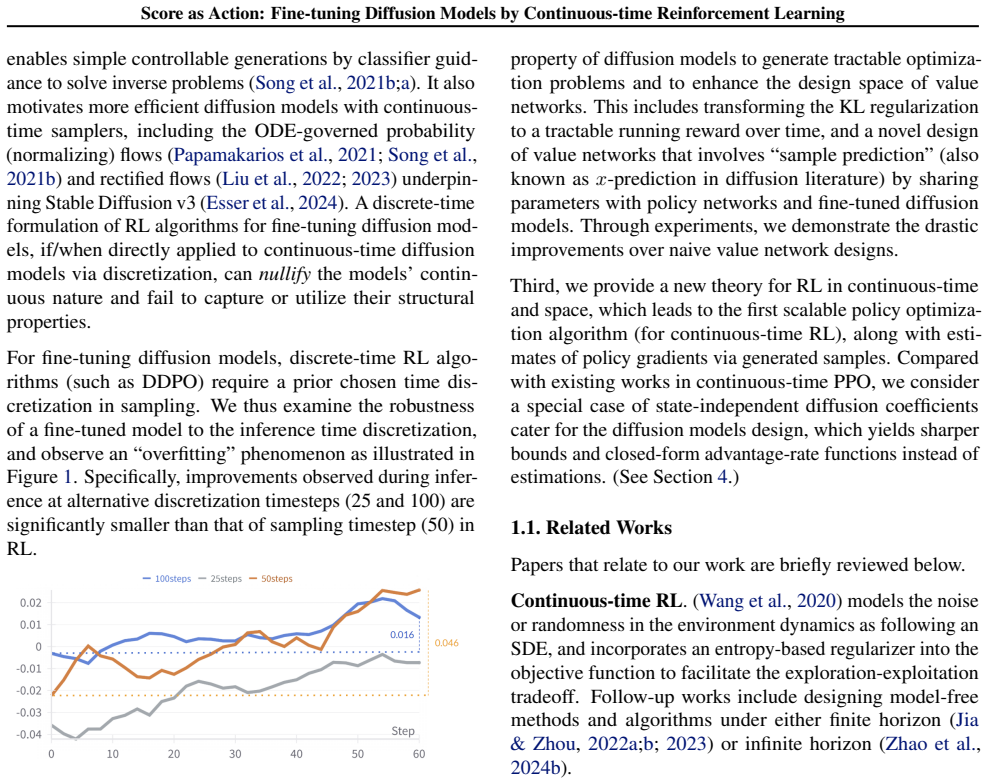
The paper's central claim is that score matching and control are the same act. In the reverse-time SDE that generates samples, the drift is set by the score; if the fine-tuned policy is Gaussian with mean equal to the network's score output, then maximizing a terminal reward model with a KL penalty against the pretrained model is exactly a continuous-time RL problem. Theorem 3.1 converts the terminal KL divergence into the running reward $-\frac{\beta}{2}g^2(T-t)\|\mu^\theta_t-\mu^{\theta_{\text{pre}}}_t\|^2$, which makes the objective match the RL performance metric. The paper then derives a continuous-time policy gradient (Theorem 4.1), a performance-difference bound that justifies a clipped PPO-style update, and a value-network parametrization whose reward-prediction part uses the Tweedie denoised estimate $\hat{x}^\theta(t,x,c)$ so that the boundary condition $V^\theta(T,x;c)=RM(x,c)$ holds by construction. In experiments, fine-tuning Stable Diffusion v1.5 with ImageReward yields reward curves that overlap across 25, 50, and 100 sampled steps, and the CTRL policy beats discrete-time DDPO in both stability and efficiency.
Load-bearing premise
The load-bearing premise is Theorem 3.1: the gap between the fine-tuned and pretrained final output distributions equals the time-integrated squared difference of their denoising directions, but the proof establishes the analogous equality for whole generation paths, so the method may be penalizing path-level divergence rather than the terminal-marginal divergence stated in the objective.
Editorial extensions
If this is right
- Fine-tuned policies keep their quality when the end user switches between 25, 50, and 100 sampler steps, because the policy is not tuned to any one discretization.
- The same objective works with second-order or black-box solvers such as the Heun method in EDM, where discrete-time RL would require per-step root-finding.
- The KL regularization collapses into a cheap running reward, so the alignment objective is exactly the continuous-time RL metric rather than a discretized approximation.
- Value networks built on the denoised sample prediction satisfy the terminal boundary condition by construction and cut critic mean-square error by roughly ninefold in the paper's ablations.
- The continuous-time policy gradient and clipped surrogate objective give a policy-optimization algorithm whose advantage-rate functions are closed form rather than estimated.
Reading between the lines
- A natural extension of the paper's logic is that the same score-as-action formulation transfers to rectified flows and consistency models, since their samplers are also integrators of continuous-time equations.
- If the Girsanov-based proof is taken as defining the regularizer, the method should also keep intermediate reverse-time trajectory states close to the pretrained ones, which is directly testable by comparing model outputs at intermediate steps.
- Because the gradient is built from continuous trajectories and a final reward, CTRL could align models whose inference procedure is a black box, as long as sample paths and final rewards are observable.
- The value-network recipe of pairing a Tweedie-style reward predictor with a boundary-vanishing corrector may also improve critics in other preference-aligned generative settings such as video and audio diffusion.
Editorial analysis
A structured set of objections, weighed in public.
Referee Report
Summary. The paper proposes CTRL, a continuous-time reinforcement learning framework for fine-tuning diffusion models by treating score functions as actions. The authors formulate the fine-tuning objective as a stochastic control problem with a terminal reward (e.g., ImageReward) and a KL regularization term, derive a continuous-time policy gradient theorem and PPO-style surrogate objective, design a value-network architecture that leverages the x-prediction structure of diffusion models, and validate the method on CIFAR-10 and Stable Diffusion v1.5 with both qualitative and quantitative results. The central theoretical claim is Theorem 3.1, which asserts that the KL divergence between terminal distributions equals an expectation of an integral of squared score differences, and the paper uses this identity to convert the KL penalty into a running reward.
Significance. If the theory were correct, CTRL would provide a principled continuous-time alternative to discrete-time RLHF for diffusion models, promising robust behavior across inference-time discretizations and compatibility with higher-order or black-box solvers. The paper also introduces a practical algorithm with a value-network design that shows clear empirical gains over naive baselines, and the experiments on Stable Diffusion v1.5 are convincing at a qualitative level. However, the correctness of the central theoretical identity is load-bearing for the stated objective and for several derivative results; since that identity is false as stated, the paper currently overclaims what it optimizes. The framework can likely be repaired by restating the regularizer as a pathwise KL divergence, but this requires nontrivial changes to the theory and to the interpretation of the experiments.
major comments (4)
- [Section 3, Theorem 3.1 and Eq. (16)] Theorem 3.1 claims an equality between the KL divergence of terminal marginals KL(pθ(T,·,c)∥pθpre(T,·,c)) and an expectation of an integral of squared score differences. This equality is generally false. The Girsanov argument in Appendix B.1 yields the KL divergence between the laws of the full reverse-time paths, not the terminal marginals. The chain rule for KL gives KL(path) = KL(terminal) + E[KL(conditional paths | terminal state)], and the extra term is nonnegative and typically nonzero. The appendix itself implicitly recognizes this by concluding with the inequality (52), which contradicts the equality in Theorem 3.1. Since Eq. (17) defines the running reward as exactly the pathwise integral, the algorithm actually optimizes a surrogate pathwise-KL-regularized objective rather than the stated terminal-KL objective in Eq. (15). The authors should restate Theorem 3.1 as a pathwise KL identity and adjust Eq. (15), the text around it, and the interpretation of the regularization accordingly, or prove additional conditions under which the terminal and pathwise KL coincide.
- [Appendix B.2, proof of Theorem 4.1] The derivation of the policy gradient formula is difficult to follow and appears to contain an algebraic inconsistency. Lemma B.2 is quoted with an exponential discount factor e^{-β(s-t)}, and later the proof says 'let t = 0, β = -α' without explaining what α is or why the discount factor can be transformed in this way. The final formula (23) is standard for continuous-time RL, but the proof as written does not rigorously establish it for the finite-horizon diffusion setting considered here. Since the algorithm's gradient estimator relies on this theorem, the proof should be rewritten carefully or replaced with a self-contained argument for finite-horizon policies.
- [Section 4, Theorem 4.4 and Eq. (26)] The proof of the performance-difference bound relies on 'the same argument in Theorem 3.1' to convert a KL divergence between terminal distributions into an integral bound. Because Theorem 3.1 is incorrect as stated, this step is not justified. If the pathwise KL identity is used instead, the bound may still be recoverable, but the proof must be reworked and the statement of Theorem 4.4 should be aligned with the corrected pathwise KL notion. As written, the result inherits the flaw in Theorem 3.1.
- [Section 3, Eq. (22) and value network design] The value network approximation E[RM(X_T)|X_t] ≈ RM(ˆxθ(t,x,c)) is acknowledged in the text to be generally false. This approximation is central to the proposed critic and to the empirical performance of the algorithm, yet the paper does not analyze the resulting bias or provide conditions under which the approximation is reasonable. The authors should at least discuss the approximation error and its potential impact on the policy gradient estimates, or provide empirical evidence that the bias is controlled.
minor comments (5)
- [Section 3, Eq. (17)] The running reward r(t,Xθ_t,aθ_t) is defined as -β/2 g²(T-t)∥µθ_t − µθpre_t∥², which does not depend on the action aθ_t. This is confusing notation because the RL objective in Eq. (2) uses a running reward that depends on the action. The authors should either rename this term or clarify that it is a state- and policy-dependent penalty, not an action-dependent reward.
- [Section 3, notation around Theorem 3.1] The notation alternates between the score function sθ and the mean µθ of the Gaussian policy. The Girsanov proof in Appendix B.1 uses sθ and sθpre, while the theorem and Eq. (16) use µθ and µθpre. The authors should explicitly state the relationship between these quantities (e.g., µθ is the mean of the control distribution, and the deterministic score is a special case) to avoid ambiguity.
- [Section 5.2, Figure 7] The three curves in Figure 7 are plotted without error bars or statistical significance tests. Given that the main claim of this section is that CTRL is robust to time discretization, the authors should report the variance across seeds or at least a quantitative measure of the overlap of the curves.
- [Appendix C.2, Algorithm 1] The advantage estimation samples ϵ_j ~ N(0,I) and computes q with Xθn_ti + η g²(T−t)ϵ_j. The choice of the scaling parameter η and the number of samples M are not discussed; a sensitivity analysis would strengthen the paper.
- [Section 2.1, Eq. (5)] In the definition of the q-value, the Hamilton function is written as H(t,x,a,∂V/∂x, ∂²V/∂x²), but the notation ∂V/∂x and ∂²V/∂x² is used without specifying that these are evaluated at (t,x;π). This is a minor clarity issue.
Circularity Check
No significant circularity; the central KL-to-running-reward reduction is a Girsanov derivation rather than a definitional identity, and the headline empirical claims are validated against external benchmarks.
full rationale
The paper's objective in Eq. (15) is stated as a terminal KL-regularized reward, and Eq. (17) is presented as a consequence of Theorem 3.1, not as the definition of the KL term; the claimed identity is derived from Girsanov theory (Appendix B.1), and the running reward integrand is not a fitted parameter. The value-network parametrization in Eq. (20) uses RM(\hat{x}_\theta) under the explicit approximation RM(E[X_T | X_t]) ≈ E[RM(X_T) | X_t] (Eq. 22), which is acknowledged as not generally true, so it is a heuristic rather than a hidden redefinition. Experimental claims (discretization robustness, reward improvement, FID) are evaluated against external signals such as ImageReward, FID, DDPO, DxMI, and Stable Diffusion v1.5, so the results are not forced by construction. Some self-citations appear (Tang & Zhao 2024 for the SDE tutorial, Zhao et al. 2024b for continuous-time policy optimization, and Lemma 4.2's proof is said to be similar to Zhao et al. 2024b), but the new PPO-type bound in Theorem 4.4 is proved in Appendix B.3 and the policy-gradient theorem is traced to the external Jia & Zhou 2022b result, so the self-citations are not load-bearing. One derivation gap is flagged for correctness rather than circularity: Appendix B.1's Girsanov calculation concludes with the inequality D_KL(p_θ || p_{θpre}) ≤ (1/2)∫ g^2(T-t) ε_t^2 dt, whereas Theorem 3.1 states an equality; as written, the equivalence of the objective (15) and running-reward objective (17) is not fully established, but this is a validity issue, not a circular reduction of the prediction to its inputs.
Assumptions & free parameters
free parameters (4)
- KL penalty coefficient β =
5e-5 for Stable Diffusion; unspecified for CIFAR-10
- Exploration covariance Σ_t (fixed level σ) =
not stated explicitly; Algorithm 1 says 'a fixed exploration level σ'
- Advantage scaling parameter η =
not stated
- Value network schedule functions cskip(t), cout(t) =
cos(π t / (2T)), sin(π t / (2T))
assumptions (5)
- domain assumption The backward SDE (7) with the learned score sθpre approximates the true reverse-time diffusion process.
- standard math The KL divergence in (15) is the pathwise KL between the laws of the reverse-time processes, so Girsanov's identity applies.
- domain assumption The initial distributions of the pretrained and fine-tuned reverse processes coincide (ρ = p∞).
- ad hoc to paper Value function approximation (22): E[RM(X_T)|X_t] ≈ RM(ˆxθ(t,x,c)) via Tweedie's formula.
- standard math Bounded reward and q-function (Assumption 4.3) and bounded log-ratio ln(pθhat/pθpre) in Theorem 4.4.
Cite this review
Pith. "Pith review of Score as Action: Fine-Tuning Diffusion Generative Models by Continuous-time Reinforcement Learning." pith.science (2026). https://pith.science/paper/BM7BAZZO
@misc{pith2026250201819,
  author       = {Pith},
  title        = {Pith review of: Score as Action: Fine-Tuning Diffusion Generative Models by Continuous-time Reinforcement Learning},
  year         = {2026},
  howpublished = {\url{https://pith.science/paper/BM7BAZZO}},
  note         = {Machine review of arXiv:2502.01819}
}
read the original abstract
Reinforcement learning from human feedback (RLHF), which aligns a diffusion model with input prompt, has become a crucial step in building reliable generative AI models. Most works in this area use a discrete-time formulation, which is prone to induced discretization errors, and often not applicable to models with higher-order/black-box solvers. The objective of this study is to develop a disciplined approach to fine-tune diffusion models using continuous-time RL, formulated as a stochastic control problem with a reward function that aligns the end result (terminal state) with input prompt. The key idea is to treat score matching as controls or actions, and thereby making connections to policy optimization and regularization in continuous-time RL. To carry out this idea, we lay out a new policy optimization framework for continuous-time RL, and illustrate its potential in enhancing the value networks design space via leveraging the structural property of diffusion models. We validate the advantages of our method by experiments in downstream tasks of fine-tuning large-scale Text2Image models of Stable Diffusion v1.5.
Figures


Figures from the paper (5 more)


Reference graph
Works this paper leans on
-
[1]
Training diffusion models with reinforcement learning
Black, K., Janner, M., Du, Y ., Kostrikov, I., and Levine, S. Training diffusion models with reinforcement learning. arXiv preprint arXiv:2305.13301,
-
[3]
Chen, S., Chewi, S., Li, J., Li, Y ., Salim, A., and Zhang, A. R. Sampling is as easy as learning the score: theory for diffusion models with minimal data assumptions. arXiv preprint arXiv:2209.11215,
-
[7]
Fan, Y . and Lee, K. Optimizing ddpm sampling with short- cut fine-tuning. arXiv preprint arXiv:2301.13362,
-
[8]
Dpok: Reinforcement learning for fine-tuning text-to-image dif- fusion models
Fan, Y ., Watkins, O., Du, Y ., Liu, H., Ryu, M., Boutilier, C., Abbeel, P., Ghavamzadeh, M., Lee, K., and Lee, K. Dpok: Reinforcement learning for fine-tuning text-to-image dif- fusion models. arXiv preprint arXiv:2305.16381,
-
[9]
Gao, X., Zha, J., and Zhou, X. Y . Reward-directed score- based diffusion models via q-learning. arXiv preprint arXiv:2409.04832,
-
[10]
Optimizing prompts for text-to-image generation
Hao, Y ., Chi, Z., Dong, L., and Wei, F. Optimizing prompts for text-to-image generation. arXiv preprint arXiv:2212.09611,
-
[13]
Kakade, S. M. and Langford, J. Approximately optimal approximate reinforcement learning. In Sammut, C. and Hoffmann, A. G. (eds.), Machine Learning, Proceedings of the Nineteenth International Conference (ICML 2002), University of New South Wales, Sydney, Australia, July 8-12, 2002, pp. 267–274. Morgan Kaufmann,
work page 2002
-
[15]
Flow straight and fast: Learning to generate and transfer data with rectified flow
Liu, X., Gong, C., and Liu, Q. Flow straight and fast: Learning to generate and transfer data with rectified flow. arXiv preprint arXiv:2209.03003,
Show all 35 references
-
[16]
Hierarchical text-conditional image generation with clip latents
Ramesh, A., Dhariwal, P., Nichol, A., Chu, C., and Chen, M. Hierarchical text-conditional image generation with clip latents. arXiv preprint arXiv:2204.06125, 1(2):3,
-
[17]
Z., Lidard, J., Ankile, L
Ren, A. Z., Lidard, J., Ankile, L. L., Simeonov, A., Agrawal, P., Majumdar, A., Burchfiel, B., Dai, H., and Simchowitz, M. Diffusion policy policy optimization. arXiv preprint arXiv:2409.00588,
-
[18]
and Ho, J
Salimans, T. and Ho, J. Progressive distillation for fast sampling of diffusion models. arXiv preprint arXiv:2202.00512,
-
[20]
Improving image captioning with better use of captions
Shi, Z., Zhou, X., Qiu, X., and Zhu, X. Improving image captioning with better use of captions. arXiv preprint arXiv:2006.11807,
2006 arXiv
-
[21]
Denoising diffusion implicit models
10 Score as Action: Fine-tuning Diffusion Models by Continuous-time Reinforcement Learning Song, J., Meng, C., and Ermon, S. Denoising diffusion implicit models. arXiv preprint arXiv:2010.02502,
2010 arXiv
-
[22]
Solving inverse problems in medical imaging with score-based generative models
Song, Y ., Shen, L., Xing, L., and Ermon, S. Solving inverse problems in medical imaging with score-based generative models. arXiv preprint arXiv:2111.08005, 2021a. Song, Y ., Sohl-Dickstein, J., Kingma, D. P., Kumar, A., Er- mon, S., and Poole, B. Score-based generative model...
-
[24]
and Zhao, H
Tang, W. and Zhao, H. Score-based diffusion models via stochastic differential equations–a technical tutorial. arXiv preprint arXiv:2402.07487,
-
[25]
L., Tseng, A
Uehara, M., Zhao, Y ., Black, K., Hajiramezanali, E., Scalia, G., Diamant, N. L., Tseng, A. M., Biancalani, T., and Levine, S. Fine-tuning of continuous-time diffusion models as entropy-regularized control. arXiv preprint arXiv:2402.15194,
-
[26]
I., Zhao, H., Das, A., Tang, W., Yao, D
Winata, G. I., Zhao, H., Das, A., Tang, W., Yao, D. D., Zhang, S.-X., and Sahu, S. Preference tuning with human feedback on language, speech, and vision tasks: A survey. arXiv preprint arXiv:2409.11564,
-
[27]
Geodiff: A geometric diffusion model for molecular con- formation generation
Xu, M., Yu, L., Song, Y ., Shi, C., Ermon, S., and Tang, J. Geodiff: A geometric diffusion model for molecular con- formation generation. arXiv preprint arXiv:2203.02923,
-
[28]
Yoon, S., Hwang, H., Kwon, D., Noh, Y .-K., and Park, F. C. Maximum entropy inverse reinforcement learning of diffusion models with energy-based models. arXiv preprint arXiv:2407.00626,
-
[29]
Self-play fine-tuning of diffusion models for text-to-image generation
Yuan, H., Chen, Z., Ji, K., and Gu, Q. Self-play fine-tuning of diffusion models for text-to-image generation. arXiv preprint arXiv:2402.10210,
-
[30]
and Chen, Y
Zhang, Q. and Chen, Y . Fast sampling of diffusion models with exponential integrator. arXiv preprint arXiv:2204.13902,
-
[31]
gddim: Generalized denoising diffusion implicit models
Zhang, Q., Tao, M., and Chen, Y . gddim: Generalized denoising diffusion implicit models. arXiv preprint arXiv:2206.05564,
-
[32]
D., and Tang, W
Zhao, H., Chen, H., Zhang, J., Yao, D. D., and Tang, W. Scores as actions: a framework of fine-tuning diffusion models by continuous-time reinforcement learning. arXiv preprint arXiv:2409.08400, 2024a. Zhao, H., Tang, W., and Yao, D. Policy optimization for continuous reinforc...
2024 arXiv
-
[33]
predicted x0
(29) Similar discussion as for the forward process, the equation (29) can further be rewritten as: x(i−1)∆t ≈ 1√1 − βi∆t∆t (xi∆t + β(i∆t)∆t · sθ∗ (i∆t, xi∆t)) + p βizi, ≈ (1 + 1 2 βi∆t∆t) (xi∆t + β(i∆t)∆t · sθ∗ (i∆t, xi∆t)) + p βizi, ≈ (1 + 1 2 βi∆t∆t)xi∆t + β(i∆t)∆t · sθ∗ (i∆...
2021
-
[34]
predicted x0
by considering the “predicted x0”: note that define the predicted x0 parameterization as: ˆxθ (t, x) = x − √1 − ¯αtϵ(t) θ (x)√¯αt , or , ϵ(t) θ (x) = x − √¯αt ˆxθ (t, x)√1 − ¯αt , above (32) can be rewritten as: xt−1 = √1 − ¯αt−1√1 − ¯αt xt − √¯αt ˆxθ (t, x) + √¯αt−1 · ˆxθ (t,...
2021
-
[35]
We adopt two ways of derivations: (a) Notice that, if we treat the ˆxθ (t, Xt) as a constant in (38) (or assume that it does not change w.r.p
that the integration role above is referred as ”exponential integrator” of (38). We adopt two ways of derivations: (a) Notice that, if we treat the ˆxθ (t, Xt) as a constant in (38) (or assume that it does not change w.r.p. t along the ODE trajectory), we have: dXt + 1 2 α2 t ...
2016
-
[1999]
Fine-tuning of diffusion models via stochastic control: entropy regularization and beyond
Tang, W. Fine-tuning of diffusion models via stochastic control: entropy regularization and beyond. arXiv:2403.06279,
-
[2009]
Lee, K., Liu, H., Ryu, M., Watkins, O., Du, Y ., Boutilier, C., Abbeel, P., Ghavamzadeh, M., and Gu, S. S. Aligning text- to-image models using human feedback. arXiv preprint arXiv:2302.12192,
-
[2015]
Proximal policy optimization algorithms
Schulman, J., Wolski, F., Dhariwal, P., Radford, A., and Klimov, O. Proximal policy optimization algorithms. arXiv preprint arXiv:1707.06347,
-
[2017]
Clark, K., Vicol, P., Swersky, K., and Fleet, D. J. Directly fine-tuning diffusion models on differentiable rewards. arXiv preprint arXiv:2309.17400,
-
[2020]
P., Poole, B., Norouzi, M., Fleet, D
Ho, J., Chan, W., Saharia, C., Whang, J., Gao, R., Gritsenko, A., Kingma, D. P., Poole, B., Norouzi, M., Fleet, D. J., et al. Imagen video: High definition video generation with diffusion models. arXiv preprint arXiv:2210.02303,
-
[2021]
Domingo-Enrich, C., Drozdzal, M., Karrer, B., and Chen, R. T. Adjoint matching: Fine-tuning flow and diffusion generative models with memoryless stochastic optimal control. arXiv preprint arXiv:2409.08861,
-
[2022]
J., Shen, Y ., Wallis, P., Allen-Zhu, Z., Li, Y ., Wang, S., Wang, L., and Chen, W
Hu, E. J., Shen, Y ., Wallis, P., Allen-Zhu, Z., Li, Y ., Wang, S., Wang, L., and Chen, W. Lora: Low-rank adaptation of large language models. arXiv preprint arXiv:2106.09685,
-
[2023]
T., Li, Y ., Lundberg, S., et al
Bubeck, S., Chandrasekaran, V ., Eldan, R., Gehrke, J., Horvitz, E., Kamar, E., Lee, P., Lee, Y . T., Li, Y ., Lundberg, S., et al. Sparks of artificial general intel- ligence: Early experiments with gpt-4. arXiv preprint arXiv:2303.12712,
-
[2024]
Scaling rectified flow transformers for high-resolution image synthesis
Esser, P., Kulal, S., Blattmann, A., Entezari, R., M¨uller, J., Saini, H., Levi, Y ., Lorenz, D., Sauer, A., Boesel, F., et al. Scaling rectified flow transformers for high-resolution image synthesis. arXiv preprint arXiv:2403.03206,
Reviewed August 9, 2026 · model on record in the stance chip above.
Discussion (0). Continue with ORCID to comment.