REVIEW 4 major objections 5 minor 127 references
Training an LLM-as-a-Judge Model: Pipeline, Insights, and Practical Lessons
T0 review · 4 major / 5 minor · reviewed 2026-08-09 · deepseek-v4-flash
Pith's one-line read A 14-billion-parameter judge model, Themis, reaches close to GPT-4's agreement with human preferences on two benchmarks by distilling evaluative skill through scenario-dependent prompts and controlled instruction generation.
desk verdict A solid industrial report on training a judge LLM; the alignment claim is plausible but the human-label reliability is under-reported, so treat the exact numbers as provisional. read the letter →
The pith
A machine-rendered reading of the paper's core claim, the machinery that carries it, and where it could break.
The reading
What carries the argument
The load-bearing mechanism is a three-part pipeline: scenario-dependent evaluation prompts, controlled instruction generation, and supervised fine-tuning on GPT-4 rationales. The paper fixes ten application scenarios with 81 human-AI-crafted judge criteria, turns each into a five-component prompt (task, grading tiers, input data, evaluation steps, output format), and generates balanced instruction sets via reference-based questioning (questions grounded in a reference text) and role-playing quizzing (LLM-as-exam-writer for math, programming, and reading-comprehension scenarios). The final component that carries the scaling insight is the Instruction-Following Difficulty (IFD) score, a ratio of the model's loss on a response with versus without the instruction, used as a filter to remove low-quality synthetic training records.
What would settle it
A fresh set of human preference judgments on held-out instructions, annotated by independent raters whose inter-annotator agreement is measured, would settle it: if Themis's scores agree with these new labels markedly worse than GPT-4's (beyond the reported ~0.07 MAE gap on AlignBench), the near-alignment claim fails.
Extended reading notes
Core claim
On its own terms, the discovery is that evaluative skill transfers cheaply: Themis, fine-tuned from Qwen-14B on GPT-4-generated evaluation records, achieves a mean absolute error of 0.756 versus GPT-4's 0.685 on AlignBench and 0.673 versus 0.664 on SynUI, with agreement rates (Agr(2,2)) of 0.559 versus 0.595 and 0.582 versus 0.590. The paper interprets this as near-GPT-4 alignment with human preferences at a fraction of the serving cost, and attributes the transfer to the combination of scenario-specific criteria, step-by-step reasoning prompts, and controlled instruction synthesis that balances the fine-tuning data. It further claims that naive scaling of distilled data is unreliable and that filtering records by instruction-following difficulty, keeping only those with scenario-normalized z-scores below a threshold, makes scaling effective.
Load-bearing premise
The paper's headline numbers rest on the assumption that the human scores used to build and validate the benchmarks are accurate and consistent; the authors do not report inter-annotator agreement or annotator qualifications, so noisy or biased labels would change every comparison.
Editorial extensions
If this is right
- A 14B open-weights judge can serve as a low-cost substitute for GPT-4 in single-answer, reference-guided, and pairwise alignment evaluation, with accuracy close enough for practical deployment.
- Distillation data should be filtered, not merely scaled: random scaling plateaus or degrades, while IFD-based filtering keeps improving up to 3,200 records.
- Reference answers should be used selectively: they improve closed-ended scenarios like close QA and math by about 0.09 on AlignBench, but can hurt open-ended scenarios.
- Fine-tuning data composition can match full-data performance with only 6% of records, so balancing scenario clusters matters as much as volume.
- Supporting custom prompts (rephrased criteria, down-sampled criteria, alternative rating scales) improves both usability and generalization.
Reading between the lines
- The IFD z-score filter is a generic data-quality signal: it likely applies to any SFT pipeline built on LLM-generated rationales, not just judge models, and could be tested on instruction-tuning data for general assistants.
- The scenario-centric prompt design suggests a modular route to new evaluation domains: add a scenario description and criteria, synthesize controlled instructions, and fine-tune, without redesigning the pipeline; the paper claims flexibility for continuous development but does not demonstrate transfer to a previously unseen scenario.
- Because reference answers helped closed-ended tasks and hurt open-ended ones, a deployed judge service could automatically route reference-guided grading by scenario; the paper reports the empirical difference but stops short of recommending this as a default policy.
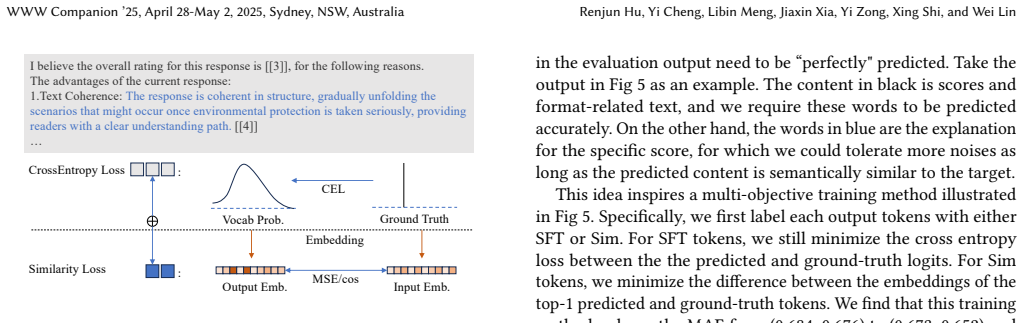
- The multi-objective loss—exact cross-entropy for score tokens, semantic-similarity for explanation tokens—is a general trick for distilling any structured LLM output, though the paper evaluates it only on judge outputs.
Editorial analysis
A structured set of objections, weighed in public.
Referee Report
Summary. The paper presents Themis, a 14B-parameter judge LLM fine-tuned from Qwen-14B on GPT-4-generated evaluation rationales. The training pipeline uses scenario-dependent evaluation prompts, two instruction-synthesis methods (reference-based questioning and role-playing quizzing), and supervised fine-tuning on 14,010 balanced evaluation records. The authors introduce two human-labeled benchmarks (an Alignbench extension with 3,393 scored pairs and SynUI with 4,000 pairs), on which Themis achieves MAE/Agr(2,2) close to GPT-4 (0.756/0.559 vs. 0.685/0.595 on Alignbench; 0.673/0.582 vs. 0.664/0.590 on SynUI). The paper also reports scenario-centric analyses, the effects of reference answers, data-composition experiments, an IFD-based data-scaling strategy, and practical lessons from a deployed evaluation service.
Significance. If the human-preference benchmark is trustworthy, the result is practically valuable: a 14B judge matching near-GPT-4 alignment at a fraction of the serving cost, with open data, benchmarks, and checkpoints, plus a deployed API. The IFD-based mitigation for distillation scaling is a useful empirical contribution to data engineering for judge models. The scenario-level analysis and the honest caveats about data-quality issues are also strengths. However, the central quantitative claim depends on the reliability and validity of the human labels, which the paper does not establish; this is the main barrier to accepting the results at face value.
major comments (4)
- [Sec. 3.4, Table 3] The human-labeling procedure is not validated. The paper states that annotators assign three five-tier scores using the same score descriptions and scenario criteria as Themis, and that scores are 'aggregated through majority voting, with the average rounded to the nearest integer in cases of discrepancy.' No annotator count, qualifications, or inter-annotator agreement statistic (e.g., Cohen's kappa or Krippendorff's alpha) is reported. The aggregation rule is not a majority vote when annotators disagree: a rounded average of mutually inconsistent ratings can encode arbitrary disagreement as a precise number. Because every MAE/Agr value in Table 3, Table 4, and the figures depends on this gold standard, the claim that Themis approaches GPT-4's alignment with human preferences is not yet established. Please provide agreement statistics, annotator details, and ideally a robustness check with an alternative aggregation rule; also address whether using Themis's own rubric in the annotation protocol introduces a favorable bias for the model.
- [Sec. 3.2 and Appendix B] Two core components of the claimed pipeline are not reproducible because their prompts are omitted. The reference-based questioning prompt is said to be 'available in an extended version due to the space constraint,' and the role-playing quizzing prompts are said to be 'provided in a future extended version.' These are not optional details: controlled instruction generation is a distinguishing contribution of the paper, and the fine-tuning data are generated with these prompts. Please include the full prompts in the appendix or as supplementary material, or at minimum upload them in the public repository, before the methodological claims can be assessed.
- [Sec. 3.4, Table 3] The baseline comparison is unfair or incomplete. AutoJ-13B is reported as '/' because it 'encounters prompt generalization issue and does not give valid evaluation results,' and CritiqueLLM-6B is evaluated with Themis's prompts, which the paper itself notes are mismatched ('prompts are very important for fine-tuned judges'). Yet the abstract and introduction state that Themis 'outperforms all other tested (judge) LLMs.' This claim is not supported for AutoJ (no result) and is not a meaningful comparison for CritiqueLLM (wrong prompt format for that model). Please either restrict the claim to the models that were evaluated under appropriate prompts or add a fair baseline evaluation using each model's native prompt template.
- [Sec. 5] The improvements attributed to custom evaluation prompts and multi-objective training are reported on unspecified benchmarks. The paper states that 'the numbers in this section are not evaluated on the latest benchmarks, thus may be inconsistent with those in previous sections,' but the MAE/Agr pairs given (e.g., 0.699/0.703 to 0.684/0.676) do not identify the test set, data split, or annotation source. This makes the practical lessons hard to interpret and impossible to compare with the main results. Please specify which benchmark (Alignbench? SynUI? both?) and which split were used for each reported number.
minor comments (5)
- [Sec. 1] The text says 'BLUE' where the standard metric is 'BLEU'; please fix the typo.
- [Appendix B] There are typos: 'fint-tuning' should be 'fine-tuning' and 'sceanrio' should be 'scenario.'
- [Sec. 4, Table 4] The column 'z-val' is not defined; please explain how the z-value is computed and its interpretation.
- [Sec. 4, Exp-3] The text says 'From the table we find...' when referring to Figure 2; please correct the cross-reference.
- [Sec. 4, Exp-4 and Sec. 5] The IFD z-score filtering threshold ('z-score > 3') and the 'linear transformation' for metric aggregation are not specified precisely; please provide the formulas or definitions so the procedures are reproducible.
Circularity Check
No significant circularity: the Themis training loop is standard GPT-4 distillation, and the headline comparisons are measured against held-out human labels and an external teacher model, not against the model's own training targets.
full rationale
The paper's derivation chain is self-contained. GPT-4 generates evaluation rationales using scenario-dependent prompts (Sec. 3.2), Themis is fine-tuned to imitate those rationales (Sec. 3.3), and performance is then measured on AlignBench and SynUI against human labels (Sec. 3.4). The near-GPT-4 numbers (AlignBench MAE 0.756 vs. 0.685, Agr(2,2) 0.559 vs. 0.595; SynUI MAE 0.673 vs. 0.664) are direct comparisons between Themis and GPT-4 on the same held-out inputs, so they do not reduce to the training signal. The human-label benchmarks do share the same score descriptions and scenario criteria as Themis's prompts ('giving the same score descriptions and scenario criteria as Themis'), which is a rubric-based annotation design rather than a circular derivation: the human scores are not computed from Themis's outputs and are not the fitted values used in training. The absence of inter-annotator agreement statistics in Sec. 3.4 is a reliability and validity caveat, not a circularity. The IFD scaling analysis (Sec. 4, Exp-4) is empirical, and the IFD formula is imported from the cited original work [21] as a data filter rather than used as a proof of the insight. The only overlapping-author citation, [19] PertEval, appears in related work as an example of perturbation-based benchmarks and is not load-bearing. No fitted parameter is renamed as a prediction, no uniqueness claim is imported from the authors' prior work, and no equation in the paper reduces to its own inputs by construction.
Assumptions & free parameters
free parameters (3)
- K in K-means scenario clustering =
3
- IFD z-score filter threshold =
3
- Per-scenario fine-tuning sample size =
800
assumptions (4)
- domain assumption The 10 scenarios and 81 judge criteria, produced by human-AI collaboration, are an appropriate decomposition of user-intent alignment for open-ended tasks.
- domain assumption GPT-4 evaluation outputs are a reliable teacher signal for judge skills.
- domain assumption Human annotations using the same scenario criteria as Themis's prompts provide a valid ground truth for meta-evaluation.
- ad hoc to paper Instruction-following difficulty (IFD) is a meaningful proxy for judge-data quality.
Cite this review
Pith. "Pith review of Training an LLM-as-a-Judge Model: Pipeline, Insights, and Practical Lessons." pith.science (2026). https://pith.science/paper/PTIAZGDL
@misc{pith2026250202988,
  author       = {Pith},
  title        = {Pith review of: Training an LLM-as-a-Judge Model: Pipeline, Insights, and Practical Lessons},
  year         = {2026},
  howpublished = {\url{https://pith.science/paper/PTIAZGDL}},
  note         = {Machine review of arXiv:2502.02988}
}
read the original abstract
The rapid advancement of large language models (LLMs) has opened new possibilities for their adoption as evaluative judges. This paper introduces Themis, a fine-tuned LLM judge that delivers sophisticated context-aware evaluations. We provide a comprehensive overview of the development pipeline for Themis, highlighting its scenario-dependent evaluation prompts and two novel methods for controlled instruction generation. These designs enable Themis to effectively distill evaluative skills from teacher models, while retaining flexibility for continuous development. We introduce two human-labeled benchmarks for meta-evaluation, demonstrating that Themis can achieve high alignment with human preferences in an economical manner. Additionally, we explore insights into the LLM-as-a-judge paradigm, revealing nuances in performance and the varied effects of reference answers. Notably, we observe that pure knowledge distillation from strong LLMs, though common, does not guarantee performance improvement through scaling. We propose a mitigation strategy based on instruction-following difficulty. Furthermore, we provide practical guidelines covering data balancing, prompt customization, multi-objective training, and metric aggregation. We aim for our method and findings, along with the fine-tuning data, benchmarks, and model checkpoints, to support future research and development in this area.
Figures


Figures from the paper (1 more)
Reference graph
Works this paper leans on
-
[1]
Meta AI. 2024. Introducing Meta Llama 3: The most capable openly available LLM to date. Retrieved July 23, 2024 from https://ai.meta.com/blog/meta-llama-3/
2024
-
[2]
Yuntao Bai, Andy Jones, Kamal Ndousse, Amanda Askell, Anna Chen, Nova Dassarma, Dawn Drain, Stanislav Fort, and et al. 2022. Training a Helpful and Harmless Assistant with Reinforcement Learning from Human Feedback. ArXiv abs/2204.05862 (2022)
arXiv 2022
-
[3]
Yoshua Bengio, Geoffrey Hinton, Andrew Yao, Dawn Song, Pieter Abbeel, Trevor Darrell, Yuval Noah Harari, Ya-Qin Zhang, Lan Xue, Shai Shalev-Shwartz, Gillian Hadfield, Jeff Clune, Tegan Maharaj, Frank Hutter, Atılım Güneş Baydin, Sheila McIlraith, Qiqi Gao, Ashwin Acharya, David Krueger, Anca Dragan, Philip Torr, Stuart Russell, Daniel Kahneman, Jan Braune...
2024
-
[4]
Pablo Biedma, Xiaoyuan Yi, Linus Huang, Maosong Sun, and Xing Xie. 2024. Beyond Human Norms: Unveiling Unique Values of Large Language Models through Interdisciplinary Approaches. arXiv:2404.12744 [cs.CL]
arXiv 2024
-
[5]
Sebastian Bordt, Harsha Nori, and Rich Caruana. 2024. Elephants Never Forget: Testing Language Models for Memorization of Tabular Data. arXiv:2403.06644 [cs.LG]
arXiv 2024
-
[6]
Hoyeon Chang, Jinho Park, Seonghyeon Ye, Sohee Yang, Youngkyung Seo, Du- Seong Chang, and Minjoon Seo. 2024. How Do Large Language Models Acquire Factual Knowledge During Pretraining? CoRR abs/2406.11813 (2024)
arXiv 2024
-
[7]
Mark Chen, Jerry Tworek, Heewoo Jun, Qiming Yuan, Henrique Ponde de Oliveira Pinto, Jared Kaplan, Harri Edwards, Yuri Burda, and et al. 2021. Evaluat- ing Large Language Models Trained on Code. (2021). arXiv:2107.03374 [cs.LG]
arXiv 2021
-
[8]
Wei-Lin Chiang, Lianmin Zheng, Ying Sheng, Anastasios Nikolas Angelopoulos, Tianle Li, Dacheng Li, Hao Zhang, Banghua Zhu, Michael Jordan, Joseph E. Gonzalez, and Ion Stoica. 2024. Chatbot Arena: An Open Platform for Evaluating LLMs by Human Preference. arXiv:2403.04132 [cs.AI]
arXiv 2024
Show all 127 references
-
[9]
Guanting Dong, Hongyi Yuan, Keming Lu, Chengpeng Li, Mingfeng Xue, Dayi- heng Liu, Wei Wang, Zheng Yuan, Chang Zhou, and Jingren Zhou. 2024. How Abilities in Large Language Models are Affected by Supervised Fine-tuning Data Composition. arXiv:2310.05492 [cs.CL]
2024 arXiv
-
[10]
Jessica Echterhoff, Yao Liu, Abeer Alessa, Julian McAuley, and Zexue He. 2024. Cognitive Bias in High-Stakes Decision-Making with LLMs. arXiv:2403.00811 [cs.AI]
2024 arXiv
-
[11]
Dan Hendrycks, Collin Burns, Steven Basart, Andrew Critch, Jerry Li, Dawn Song, and Jacob Steinhardt. 2021. Aligning AI With Shared Human Values. Proceedings of the International Conference on Learning Representations (ICLR) (2021)
2021
-
[12]
Dan Hendrycks, Collin Burns, Steven Basart, Andy Zou, Mantas Mazeika, Dawn Song, and Jacob Steinhardt. 2021. Measuring Massive Multitask Language Un- derstanding. arXiv:2009.03300 [cs.CY]
2021 arXiv
-
[13]
Dan Hendrycks, Collin Burns, Saurav Kadavath, Akul Arora, Steven Basart, Eric Tang, Dawn Song, and Jacob Steinhardt. 2021. Measuring Mathematical Problem Solving With the MATH Dataset. InThirty-fifth Conference on Neural Information Processing Systems Datasets and Benchmarks T...
2021
-
[14]
Yuzhen Huang, Yuzhuo Bai, Zhihao Zhu, Junlei Zhang, Jinghan Zhang, Tangjun Su, Junteng Liu, Chuancheng Lv, Yikai Zhang, Jiayi Lei, Yao Fu, Maosong Sun, and Junxian He. 2023. C-Eval: A Multi-Level Multi-Discipline Chinese Evaluation Suite for Foundation Models. arXiv:2305.08322 [cs.CL]
2023 arXiv
-
[15]
Mercer, Lalit R
Frederick Jelinek, Robert L. Mercer, Lalit R. Bahl, and Janet M. Baker. 1977. Perplexity—a measure of the difficulty of speech recognition tasks. Journal of the Acoustical Society of America 62 (1977)
1977
-
[16]
Han Jiang, Xiaoyuan Yi, Zhihua Wei, Shu Wang, and Xing Xie. 2024. Raising the Bar: Investigating the Values of Large Language Models via Generative Evolving Testing. arXiv:2406.14230 [cs.CL]
2024 arXiv
-
[17]
Liwei Jiang, Jena D. Hwang, Chandra Bhagavatula, Ronan Le Bras, Jenny Liang, Jesse Dodge, Keisuke Sakaguchi, Maxwell Forbes, Jon Borchardt, Saadia Gabriel, Yulia Tsvetkov, Oren Etzioni, Maarten Sap, Regina Rini, and Yejin Choi. 2022. Can Machines Learn Morality? The Delphi Exp...
2022 arXiv
-
[18]
Pei Ke, Bosi Wen, Zhuoer Feng, Xiao Liu, Xuanyu Lei, Jiale Cheng, Shengyuan Wang, Aohan Zeng, Yuxiao Dong, Hongning Wang, Jie Tang, and Minlie Huang
-
[19]
Jiatong Li, Renjun Hu, Kunzhe Huang, Yan Zhuang, Qi Liu, Mengxiao Zhu, Xing Shi, and Wei Lin. 2024. PertEval: Unveiling Real Knowledge Capacity of LLMs with Knowledge-Invariant Perturbations. InThe Thirty-eight Conference on Neural Information Processing Systems Datasets and B...
2024
-
[20]
Junlong Li, Shichao Sun, Weizhe Yuan, Run-Ze Fan, Hai Zhao, and Pengfei Liu
-
[21]
Ming Li, Yong Zhang, Zhitao Li, Jiuhai Chen, Lichang Chen, Ning Cheng, Jian- zong Wang, Tianyi Zhou, and Jing Xiao. 2024. From Quantity to Quality: Boost- ing LLM Performance with Self-Guided Data Selection for Instruction Tuning. arXiv:2308.12032 [cs.CL]
2024 arXiv
-
[22]
Gonzalez, and Ion Stoica
Tianle Li, Wei-Lin Chiang, Evan Frick, Lisa Dunlap, Tianhao Wu, Banghua Zhu, Joseph E. Gonzalez, and Ion Stoica. 2024. From Crowdsourced Data to High-Quality Benchmarks: Arena-Hard and BenchBuilder Pipeline. arXiv:2406.11939 [cs.LG]
2024 arXiv
-
[23]
Bill Yuchen Lin, Yuntian Deng, Khyathi Chandu, Faeze Brahman, Abhilasha Ravichander, Valentina Pyatkin, Nouha Dziri, Ronan Le Bras, and Yejin Choi
-
[24]
Bill Yuchen Lin, Abhilasha Ravichander, Ximing Lu, Nouha Dziri, Melanie Sclar, Khyathi Chandu, Chandra Bhagavatula, and Yejin Choi. 2024. The Unlocking Spell on Base LLMs: Rethinking Alignment via In-Context Learning. In The Twelfth International Conference on Learning Representations
2024
-
[25]
Chin-Yew Lin. 2004. ROUGE: A Package for Automatic Evaluation of Summaries. In Annual Meeting of the Association for Computational Linguistics
2004
-
[26]
arXiv:2406.04770 [cs.CL]
WildBench: Benchmarking LLMs with Challenging Tasks from Real Users in the Wild. arXiv:2406.04770 [cs.CL]
-
[27]
Seyed Mahed Mousavi, Simone Alghisi, and Giuseppe Riccardi. 2024. Dy- Know:Dynamically Verifying Time-Sensitive Factual Knowledge in LLMs. arXiv:2404.08700 [cs.CL]
2024 arXiv
-
[28]
Subhabrata Mukherjee, Arindam Mitra, Ganesh Jawahar, Sahaj Agarwal, Hamid Palangi, and Ahmed Awadallah. 2023. Orca: Progressive Learning from Complex Explanation Traces of GPT-4. arXiv:2306.02707 [cs.CL]
2023 arXiv
-
[29]
Xiao Liu, Xuanyu Lei, Shengyuan Wang, Yue Huang, Zhuoer Feng, Bosi Wen, Jiale Cheng, Pei Ke, Yifan Xu, Weng Lam Tam, Xiaohan Zhang, Lichao Sun, Hongning Wang, Jing Zhang, Minlie Huang, Yuxiao Dong, and Jie Tang. 2023. AlignBench: Benchmarking Chinese Alignment of Large Languag...
2023 arXiv
-
[30]
Long Ouyang, Jeff Wu, Xu Jiang, Diogo Almeida, Carroll L. Wainwright, Pamela Mishkin, Chong Zhang, Sandhini Agarwal, Katarina Slama, Alex Ray, John Schul- man, Jacob Hilton, Fraser Kelton, Luke Miller, Maddie Simens, Amanda Askell, Pe- ter Welinder, Paul Christiano, Jan Leike,...
2022 arXiv
-
[31]
Oded Ovadia, Menachem Brief, Moshik Mishaeli, and Oren Elisha. 2023. Fine-Tuning or Retrieval? Comparing Knowledge Injection in LLMs. CoRR abs/2312.05934 (2023)
2023 arXiv
-
[32]
OpenAI. 2024. GPT-4 Technical Report. arXiv:2303.08774 [cs.CL]
2024 arXiv
-
[33]
Peng, Xi Yang, Aokun Chen, Kaleb E
C.A.I. Peng, Xi Yang, Aokun Chen, Kaleb E. Smith, Nima M. Pournejatian, An- thony B Costa, Cheryl Martin, Mona G. Flores, Ying Zhang, Tanja Magoc, Glo- ria P. Lipori, Duane A. Mitchell, Naykky Singh Ospina, Mustafa Mamon Ahmed, William R. Hogan, Elizabeth A. Shenkman, Yi Guo, ...
2023
-
[34]
Samyam Rajbhandari, Jeff Rasley, Olatunji Ruwase, and Yuxiong He. 2020. ZeRO: memory optimizations toward training trillion parameter models. In Proceedings of the International Conference for High Performance Computing, Networking, Storage and Analysis, SC 2020, Virtual Event...
2020
-
[35]
Kishore Papineni, Salim Roukos, Todd Ward, and Wei-Jing Zhu. 2002. Bleu: a Method for Automatic Evaluation of Machine Translation. In Proceedings of the 40th Annual Meeting of the Association for Computational Linguistics, July 6-12, 2002, Philadelphia, PA, USA. ACL, 311–318
2002
-
[36]
Nino Scherrer, Claudia Shi, Amir Feder, and David Blei. 2023. Evaluating the Moral Beliefs Encoded in LLMs. In Thirty-seventh Conference on Neural Information Processing Systems
2023
-
[37]
Link, Roxana Daneshjou, and Nicolás W Cortés- Penfield
Ilan S Schwartz, Katherine E. Link, Roxana Daneshjou, and Nicolás W Cortés- Penfield. 2023. Black Box Warning: Large Language Models and the Future of Infectious Diseases Consultation. Clinical Infectious Diseases: An Official Publication of the Infectious Diseases Society of ...
2023
-
[38]
Rylan Schaeffer, Brando Miranda, and Sanmi Koyejo. 2023. Are Emergent Abilities of Large Language Models a Mirage?. InAdvances in Neural Information Processing Systems 36: Annual Conference on Neural Information Processing Systems 2023, NeurIPS 2023, New Orleans, LA, USA, Dece...
2023
-
[39]
Lichao Sun, Yue Huang, Haoran Wang, Siyuan Wu, Qihui Zhang, Yuan Li, Chujie Gao, Yixin Huang, and et al. 2024. TrustLLM: Trustworthiness in Large Language Models. arXiv:2401.05561 [cs.CL]
2024 arXiv
-
[40]
Hashimoto
Rohan Taori, Ishaan Gulrajani, Tianyi Zhang, Yann Dubois, Xuechen Li, Carlos Guestrin, Percy Liang, and Tatsunori B. Hashimoto. 2023. Stanford Alpaca: An Instruction-following LLaMA model. https://github.com/tatsu-lab/stanford_ alpaca
2023
-
[41]
Yunfan Shao, Linyang Li, Zhaoye Fei, Hang Yan, Dahua Lin, and Xipeng Qiu
-
[42]
arXiv:2402.14526 [cs.CL]
Balanced Data Sampling for Language Model Training with Clustering. arXiv:2402.14526 [cs.CL]
-
[43]
Tu Vu, Kalpesh Krishna, Salaheddin Alzubi, Chris Tar, Manaal Faruqui, and Yun- Hsuan Sung. 2024. Foundational Autoraters: Taming Large Language Models for Better Automatic Evaluation. arXiv:2407.10817 [cs.CL]
2024 arXiv
-
[44]
Smith, Daniel Khashabi, and Hannaneh Hajishirzi
Yizhong Wang, Yeganeh Kordi, Swaroop Mishra, Alisa Liu, Noah A. Smith, Daniel Khashabi, and Hannaneh Hajishirzi. 2023. Self-Instruct: Aligning Language Models with Self-Generated Instructions. arXiv:2212.10560 [cs.CL] WWW Companion ’25, April 28-May 2, 2025, Sydney, NSW, Austr...
2023 arXiv
-
[45]
Gemini Team. 2024. Gemini: A Family of Highly Capable Multimodal Models. arXiv:2312.11805 [cs.CL]
2024 arXiv
-
[46]
Qwen Team. 2024. Qwen2 Technical Report. arXiv:2407.10671 [cs.CL]
2024 arXiv
-
[47]
Jiasheng Ye, Peiju Liu, Tianxiang Sun, Yunhua Zhou, Jun Zhan, and Xipeng Qiu
-
[48]
Rowan Zellers, Ari Holtzman, Yonatan Bisk, Ali Farhadi, and Yejin Choi. 2019. HellaSwag: Can a Machine Really Finish Your Sentence?. In Proceedings of the 57th Annual Meeting of the Association for Computational Linguistics
2019
-
[49]
Dongjie Yang, Ruifeng Yuan, Yuantao Fan, Yifei Yang, Zili Wang, Shusen Wang, and Hai Zhao. 2023. RefGPT: Dialogue Generation of GPT, by GPT, and for GPT. In Findings of the Association for Computational Linguistics: EMNLP 2023, Singapore, December 6-10, 2023 . 2511–2535
2023
-
[50]
Yu Yang, Siddhartha Mishra, Jeffrey N Chiang, and Baharan Mirzasoleiman
-
[51]
arXiv:2403.07384 [cs.CL]
SmallToLarge (S2L): Scalable Data Selection for Fine-tuning Large Language Models by Summarizing Training Trajectories of Small Models. arXiv:2403.07384 [cs.CL]
-
[52]
Wanjun Zhong, Ruixiang Cui, Yiduo Guo, Yaobo Liang, Shuai Lu, Yanlin Wang, Amin Saied, Weizhu Chen, and Nan Duan. 2023. AGIEval: A Human-Centric Benchmark for Evaluating Foundation Models. arXiv:2304.06364 [cs.CL]
2023 arXiv
-
[53]
arXiv:2403.16952 [cs.CL]
Data Mixing Laws: Optimizing Data Mixtures by Predicting Language Modeling Performance. arXiv:2403.16952 [cs.CL]
-
[55]
Yunpu Zhao, Rui Zhang, Wenyi Li, Di Huang, Jiaming Guo, Shaohui Peng, Yi- fan Hao, Yuanbo Wen, Xing Hu, Zidong Du, Qi Guo, Ling Li, and Yunji Chen
-
[56]
arXiv:2401.12491 [cs.CL]
Assessing and Understanding Creativity in Large Language Models. arXiv:2401.12491 [cs.CL]
-
[57]
Xing, Joseph E
Lianmin Zheng, Wei-Lin Chiang, Ying Sheng, Tianle Li, Siyuan Zhuang, Zhang- hao Wu, Yonghao Zhuang, Zhuohan Li, Zi Lin, Eric P. Xing, Joseph E. Gonzalez, Ion Stoica, and Hao Zhang. 2024. LMSYS-Chat-1M: A Large-Scale Real-World LLM Conversation Dataset. arXiv:2309.11998 [cs.CL]
2024 arXiv
-
[58]
Gonzalez, and Ion Stoica
Lianmin Zheng, Wei-Lin Chiang, Ying Sheng, Siyuan Zhuang, Zhanghao Wu, Yonghao Zhuang, Zi Lin, Zhuohan Li, Dacheng Li, Eric Xing, Hao Zhang, Joseph E. Gonzalez, and Ion Stoica. 2023. Judging LLM-as-a-Judge with MT-Bench and Chatbot Arena. In Thirty-seventh Conference on Neural...
2023
-
[60]
Kun Zhou, Yutao Zhu, Zhipeng Chen, Wentong Chen, Wayne Xin Zhao, Xu Chen, Yankai Lin, Ji-Rong Wen, and Jiawei Han. 2023. Don’t Make Your LLM an Evaluation Benchmark Cheater. arXiv:2311.01964 [cs.CL] A Detailed Scenarios and Judge Criteria We detail the ten scenarios currently ...
2023 arXiv
-
[61]
Empathy: Consider the user’s emotional state when responding, appropriately expressing empathy and understanding, especially when answering emotionally charged questions. 8. Constructive feedback: Even when facing critical or negative questions, maintain a positive and constru...
-
[62]
Instruction adherence: Strictly follow the problem requirements and user instructions, including specific constraints and steps. 5. Formatting: Mathematical symbols, formulas, and diagrams should comply with academic norms and maintain consistency and read- ability. 6.Methodol...
2025
-
[63]
Conciseness: The text should be concise and clear, avoiding un- necessary redundancy to convey information clearly. 7. Originality: The rewritten text should demonstrate originality, avoiding pla- giarism, and providing unique insights or expressions. 8. Cultural sensitivity: ...
-
[64]
3.Instruction compli- ance: The output should strictly follow the specific requirements of the instructions, including action steps and any constraints
Relevance: Answers should directly correspond to the text content or topic, avoiding irrelevant information, ensuring all provided in- formation has a clear textual or thematic basis. 3.Instruction compli- ance: The output should strictly follow the specific requirements of th...
-
[65]
User experience: Answers should be presented in a user-friendly manner, easy to understand, and guide the user to obtain the needed information timely. 6. Contextual understanding: The model should demonstrate the ability to understand complex contexts and im- plicit informati...
-
[66]
(9) Role-playing
Creativity: In tasks requiring creative output (such as title or summary generation), answers should exhibit a certain degree of originality and appeal. (9) Role-playing. Pretend to be a particular person, character, profession, or identity, and complete the tasks in the instr...
2025
-
[67]
Comprehensibility of explanations: Explanations and analyses of the code should be clear, easy to understand by users, with appro- priate terms and language style. 8. Problem-solving effectiveness: In tasks involving code modification, optimization, and programming language co...
2025
-
[68]
Recall the relevant AI assistant response criteria and carefully read and understand the response to be evaluated
-
[69]
Identify from all criteria the key ones for the current user instruction and response, including those that performed well and those that did not
-
[70]
Besides the given criteria, add any other important criteria that you think are necessary for evaluating the current user instruction response
-
[71]
The same output requirement and format as in Table 1
Based on your final selection of criteria,compare the reference answer and assign scores (between 1-5) to each criterion, and provide a comprehensive score after weighting all sub-scores. The same output requirement and format as in Table 1. Table 7: Prompt template for pairwi...
-
[72]
Requirements for the scenario: Name: {scenario name } Definition: {scenario description } Reference Text: {reference text } Requirements:
(Please detail your reasons in order of importance from high to low, each standard also attaching the [[scores]] for both responses under that standard...) WWW Companion ’25, April 28-May 2, 2025, Sydney, NSW, Australia Renjun Hu, Yi Cheng, Libin Meng, Jiaxin Xia, Yi Zong, Xin...
2025
-
[73]
The generated questions and answers should be based on the article content and should meet the scenario requirements
-
[74]
Questions should be detailed, containing necessary information to encourage thorough answers
-
[75]
Sorry, this article does not contain enough information related to {scenario name } to generate relevant questions and answers
If the information in the reference text is insufficient to generate question-answer pairs, return the following: "Sorry, this article does not contain enough information related to {scenario name } to generate relevant questions and answers. "
-
[76]
The generated question-answer pairs need to simulate questions and answers people might consult the LLM about in real-life scenarios
-
[77]
Ensure the completeness and answerability of the questions independently; include the original content if necessary
-
[78]
question
Ensure the correctness of the answers. Sample Questions: Example 1: {example 1 } Example 2: {example 2 } Example 3: {example 3 } Please generate 5 sets of question-answer pairs that meet the requirements: QUESTION: [The generated question based on article content] ANSWER: [The...
2025
-
[79]
Close QA: Solve a problem that may involve professional knowledge or real-world inquiries, such as historical facts or scientific laws, and the problem has a standard/reference answer
-
[80]
Open QA: Open dialogue instructions, usually asking an open-field question, and responses are also open-ended, such as casual chats, advice consultations, recommendations, etc
-
[81]
Math-related QA: Solve a problem involving mathematics, calculations, reasoning, etc., and the problem has a standard/reference answer
-
[82]
Creative writing: Writing that primarily expresses personalized imagination and emotions, focusing on literary quality and originality, such as creating essays, poems, lyrics, scripts, stories, speeches, social media posts, blogs, advertising materials, brainstorming, etc
-
[83]
Informative and professional writing: Writing aimed at conveying key information and professional knowledge, focusing on accuracy, reliability, and authority, covering practical emails, job applications, product descriptions, user manuals, to in-depth academic papers, medical ...
-
[84]
Rewriting: Includes text simplification, language optimization, rewriting text according to instructions, text correction, text summarization and expansion, etc
-
[85]
Translation: Translate the given text into another language without changing the original meaning
-
[86]
Reading comprehension and extraction: Read materials and complete directive tasks based on the materials, such as Q&A, summarization, keyword extraction, topic extraction, title generation, fact-checking, etc
-
[87]
Role-playing: Pretend to be a particular person, character, profession, or identity, and complete the tasks in the instructions based on this role
-
[88]
answering mathematical questions
Programming-related: Tasks related to computer code, including implementing code based on requirements, code modification and optimization, programming language conversion, analyzing code and responding to related questions, software development assistance, education, and lear...
2025
-
[89]
Accuracy: The response should be accurate, including every step of calculations and reasoning involved in the solving process
-
[90]
Clarity: The explanation of the solving process should be clear, easy to understand, unambiguous, and use mathematical terms and concepts correctly
-
[91]
Efficiency: The response should be direct and as concise as possible, avoiding unnecessary lengthy explanations, while ensuring accuracy and completeness
-
[92]
Command Compliance: Strictly follow the problem requirements and user instructions, including handling specific restrictions and steps
-
[93]
Formatting Standards: The use of mathematical symbols, formulas, and diagrams should adhere to academic norms and be consistent and readable
-
[94]
Method Diversity: Where possible, provide multiple solving methods and indicate their respective pros and cons
-
[95]
answering mathematical questions
Answer Structure: Present a clear answer first, followed by steps and explanations, and finally summarize key points or common mistakes. [Standards End] The scoring is on a 5-level scale (1-5), with each score level meaning the following: [Score Levels Start] 1 Response has ma...
-
[96]
Recall the relevant standards for intelligent assistant responses, and carefully read and understand the response to be assessed
-
[97]
Identify key standards from all standards for the current user instruction and response, including good and insufficient points
-
[98]
In addition to the given standards, add other important standards you think are necessary for evaluating the current user instruction response
-
[99]
Think carefully for a moment, then give your conclusion
Based on your final selection of standards, score the response (between 1-5), and after weighting all minor scores, give an overall score for the response. Think carefully for a moment, then give your conclusion. Your return template should be as follows, note to retain the ’[...
-
[100]
(Please list in sequence what you think are the strengths of the current response, and give [[a score between 1-5]] for each...) Current response weaknesses:
-
[101]
GPT-4’s response I believe the overall rating for this reply is [[1]] for the following reasons: Advantages of the current reply:
(Please list in sequence what you think are the weaknesses of the current response, and give [[a score between 1-5]] for each...) *** Training an LLM-as-a-Judge Model: Pipeline, Insights, and Practical Lessons WWW Companion ’25, April 28-May 2, 2025, Sydney, NSW, Australia Tab...
2025
-
[102]
[[3]] Shortcomings of the current reply:
Clarity: The explanation process is relatively clear, comparing integer parts and decimal parts in steps, which is easy to understand. [[3]] Shortcomings of the current reply:
-
[103]
9.11 is greater than 9.9
Accuracy: The final conclusion of the reply is incorrect; in fact, 9.9 is greater than 9.11, not as stated in the reply that "9.11 is greater than 9.9. " [[1]]
-
[104]
Efficiency: Although a comparison process is provided, the efficiency becomes meaningless after presenting an incorrect conclusion. [[1]]
-
[105]
Instruction Compliance: It fails to correctly follow the command to provide an accurate answer and does not provide the correct comparison result as per the user’s request. [[1]]
-
[106]
Method Diversity: It does not offer different comparison methods, such as direct numerical comparison, and only uses a part-by-part comparison approach. [[2]]
-
[107]
[[1]] Considering the above ratings, due to the core issue of accuracy, even though other aspects are passable, the overall rating remains at the lowest tier [[1]]
Answer Structure: Although the structure is clear, comparing integer parts first and then decimal parts, this structure has not effectively served to present the correct answer due to the incorrect final answer. [[1]] Considering the above ratings, due to the core issue of acc...
-
[108]
Accuracy: Although the final conclusion is incorrect, the decomposition of numbers during the problem-solving process is quite clear, showing a comparative thought process. [[3]]
-
[109]
Clarity: The steps of the solution are clearly articulated, and the logical sequence is easy to understand. [[4]]
-
[110]
[[4]] Weaknesses of the current reply:
Compliance with instructions: It directly answered the user’s instruction to compare the sizes of two numbers. [[4]] Weaknesses of the current reply:
-
[111]
This is a core error and significantly affects the rating
Accuracy: The final conclusion is erroneous, stating that 9.11 is larger than 9.9 is incorrect; in reality, 9.9 is less than 9.11. This is a core error and significantly affects the rating. [[1]]
-
[112]
Formatting standards: Although no complex mathematical symbols or formulas were used, the basic comparison symbols should be used correctly. [[2]]
-
[113]
Answer structure: The structure of the answer, steps, and explanation is fundamentally reasonable, but the incorrect conclusion impacts the overall effectiveness of the structure. [[2]] Taking everything into consideration, despite the reply’s acceptable performance in terms o...
-
[114]
The reply is accurate and precise, including the final result and each step of calculation and reasoning during the problem-solving process, [[5]]
-
[115]
The explanation of the problem-solving process is clear, easy to understand, unambiguous, and uses mathematical terms and concepts correctly, [[5]]
-
[116]
The answer is direct and concise, avoiding unnecessary lengthy explanations, while ensuring accuracy and completeness, [[4]]
-
[117]
Strictly followed the requirements of the question and user instructions, including dealing with specific constraints and steps, [[5]]
-
[118]
Shortcomings of the current response:
The use of mathematical symbols, formulas, and diagrams adheres to academic standards and maintains consistency and readability, [[5]]. Shortcomings of the current response:
-
[119]
Fails to provide multiple methods of solving the problem where possible, nor does it discuss the pros and cons of each, [[2]]
-
[120]
In summary, this response excels in accuracy, clarity, efficiency, and adherence to instructions, but lacks in methodological diversity and structured answer format
The response lacks a structured answer format, that is, presenting a clear answer first, followed by steps and explanations, and concluding with key points or common mistakes, [[2]]. In summary, this response excels in accuracy, clarity, efficiency, and adherence to instructio...
2025
-
[121]
Clarity: The response is clear in expression, easy to understand, and does not use complex mathematical terms, which helps users understand the comparison process. [[4]]
-
[122]
[[4]] Shortcomings of the current reply:
Formatting Norms: Although this response does not directly use mathematical symbols or formulas, the way it explains number comparisons is standard. [[4]] Shortcomings of the current reply:
-
[123]
In fact, 9.9 is greater than 9.11, because although the integer part is the same, the decimal part of 9.9 (0.9) is greater than that of 9.11 (0.11)
Accuracy: The conclusion of the response is incorrect. In fact, 9.9 is greater than 9.11, because although the integer part is the same, the decimal part of 9.9 (0.9) is greater than that of 9.11 (0.11). This mistake directly violates the highest standard of accuracy. [[1]]
-
[124]
Efficiency: Although the response attempts to directly compare two numbers, this attempt does not achieve the efficiency it should due to the incorrect conclusion. [[2]]
-
[125]
Compliance with Instructions: The response does not correctly follow the user’s instructions, as the user asked which number is larger, and the response provided an incorrect answer. [[1]]
-
[126]
However, considering the mistake in the response, this also becomes a drawback
Method Diversity: The response does not provide a variety of methods to solve the problem, though it may not be necessary for this simple issue. However, considering the mistake in the response, this also becomes a drawback. [[2]]
-
[127]
Answer Structure: Although the response attempts to first give an answer and then explain it, because the answer is incorrect, this structure does not achieve its intended effect. [[1]] In conclusion, although this response performs well in Clarity and Formatting Norms, it fal...
-
[2023]
arXiv preprint arXiv:2310.05470 (2023)
Generative Judge for Evaluating Alignment. arXiv preprint arXiv:2310.05470 (2023)
2023 arXiv
-
[2024]
arXiv:2311.18702 [cs.CL]
CritiqueLLM: Towards an Informative Critique Generation Model for Evaluation of Large Language Model Generation. arXiv:2311.18702 [cs.CL]
Reviewed August 9, 2026 · model on record in the stance chip above.
Discussion (0). Continue with ORCID to comment.