REVIEW 5 major objections 4 minor 17 references
Augmented Conditioning Is Enough For Effective Training Image Generation
T0 review · 5 major / 4 minor · reviewed 2026-08-08 · deepseek-v4-flash
Pith's one-line read Conditioning a frozen pretrained diffusion model on an augmented real image plus a class label yields synthetic training images that improve long-tail and few-shot classification without any generative fine-tuning.
desk verdict A cheap, plausible recipe for synthetic training data that deserves proper peer review, but the authors need to measure data leakage and report variance before the headline numbers are bulletproof. read the letter →
The pith
A machine-rendered reading of the paper's core claim, the machinery that carries it, and where it could break.
The reading
What carries the argument
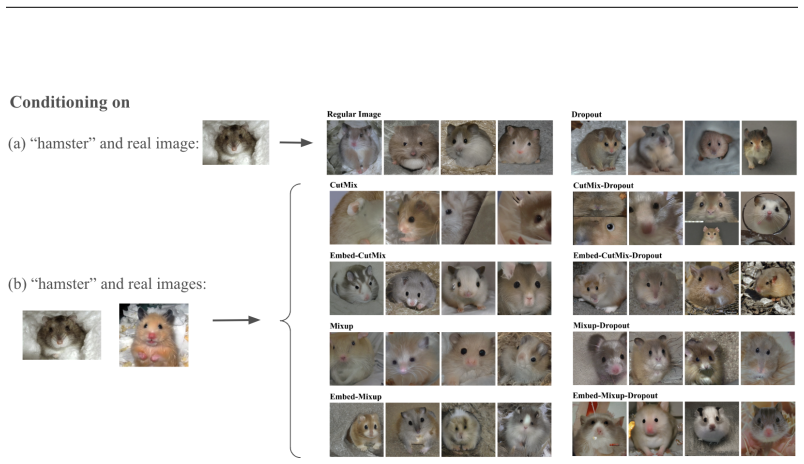
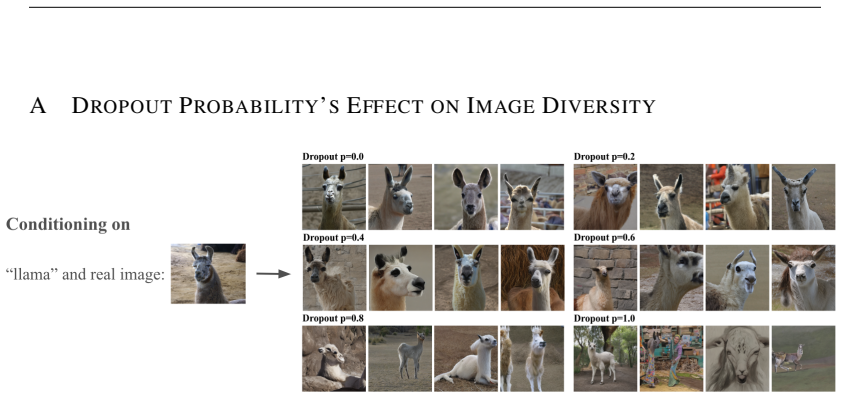
The load-bearing object is augmentation-conditioned generation: the frozen latent diffusion model LDM-v2.1-unCLIP is conditioned on both a text class label and an image, where the image is produced by applying a vision augmentation to one or two real training images. Because the model encodes the conditioning image into a CLIP embedding before denoising, augmentations can be applied in pixel space or directly in embedding space. The empirically best combination, embedding-space CutMix followed by Dropout with probability 0.4, mixes the CLIP embeddings of two same-class images with a binary mask and then stochastically zeros out parts of the resulting vector; the combined embedding is concatenated to the UNet's time-step embedding. The classifier-free guidance scale is another working part: low CFG (2.0) helps large-scale scratch training, while high CFG (10.0) helps few-shot fine-tuning.
What would settle it
Take the generated ImageNet-LT, Caltech101, Flowers102, COCO, and Pascal VOC synthetic sets and compute each generated image's nearest-neighbor distance in CLIP or feature space to the corresponding test set; if a substantial fraction fall below a near-duplicate threshold, the leakage pathway is real. A cleaner experiment is to rerun the best configuration after discarding all synthetic images that are near-duplicates of any test image and check whether the 59.6% ImageNet-LT result and the few-shot gains survive.
Extended reading notes
Core claim
The paper's central claim is that augmentation-conditioning is sufficient: conditioning the reverse diffusion process on an augmented real image plus a text label produces synthetic training images that are in-domain with the real data yet diverse enough to improve downstream classifiers, without any adjustment of the generative model's weights. The authors identify two failure modes of label-only generation, semantic errors and visual domain shift, and show that adding a real conditioning image removes them, while classical augmentations restore the diversity that image conditioning removes. Their best configuration applies CutMix and Dropout to the CLIP image embedding of two same-class training images, combines the resulting vector with the text label, and feeds it to the frozen LDM-v2.1-unCLIP model. The paper demonstrates the result by training classifiers on mixtures of real and synthetic images on five benchmarks, reporting state-of-the-art long-tail accuracy among comparable methods and consistent few-shot gains.
Load-bearing premise
The load-bearing premise is that the frozen diffusion model does not leak memorized versions of benchmark test images into the generated training set; if it does, the reported accuracy gains would be inflated rather than produced by useful synthetic diversity.
Editorial extensions
If this is right
- Effective synthetic training data can be produced by a frozen pretrained diffusion model, so the cost of generation drops to that of off-the-shelf inference and no per-task generative training is needed.
- Embedding-space CutMix with Dropout improves ImageNet-LT accuracy to 59.6% with 1.16M synthetic images, exceeding a comparable prior method (58.9% with 1.3M images) and matching methods that use no synthetic data but more elaborate training.
- On Caltech101, Flowers102, COCO, and Pascal VOC few-shot benchmarks, augmentation-conditioned generations match or outperform DA-Fusion, with gains up to about 25 percentage points in extreme few-shot settings.
- Conditioning on a real training image fixes label-only generation failures such as semantic errors and visual domain shift, and augmentations reintroduce the visual diversity that image conditioning removes.
- The best augmentation and classifier-free guidance setting depends on the training regime: low CFG for large-scale from-scratch training, high CFG for few-shot fine-tuning.
Reading between the lines
- The paper leaves open whether the same recipe transfers to other image-conditioned diffusion models; a direct test would be replacing LDM-v2.1-unCLIP with a newer open unCLIP-style generator and checking whether the ImageNet-LT and few-shot gains persist.
- Because the method only changes conditioning, it suggests that any cheap source of in-distribution diversity, such as color jitter, geometric crops, or style mixing, could be plugged into the same conditioning pipeline; the paper's ablations cover only CutMix, Mixup, and Dropout.
- If the reported gains partly reflect memorized benchmark content, then filtering generated images by nearest-neighbor distance to test images would shrink the gap; measuring that overlap is a natural next experiment and was flagged by the authors as future work.
Editorial analysis
A structured set of objections, weighed in public.
Referee Report
Summary. The paper proposes 'augmentation-conditioning' as a method for generating synthetic training images with a frozen pretrained diffusion model. Given a real training image and a class label, the method applies a classical augmentation (Dropout, Mixup, CutMix, or combinations, in pixel or CLIP-embedding space) and uses the augmented image as conditioning for LDM-v2.1-unCLIP. The resulting synthetic images are mixed with real images (50/50) to train classifiers. The authors evaluate nine augmentation variants on a 90-class ImageNet-LT subset, then run the best variants on full ImageNet-LT with a ResNext50 trained from scratch, reporting 59.6% top-1 accuracy with 1.16M synthetic images and claiming improvement over Hemmat et al. (58.9% with 1.3M). They also fine-tune a pretrained classifier on four few-shot benchmarks (Caltech101, Flowers102, COCO, Pascal VOC) and report that augmentation-conditioned methods match or exceed DA-Fusion by up to 25 percentage points. The central claim is that augmentation-conditioning is sufficient to turn an off-the-shelf diffusion model into an effective training-data generator without fine-tuning the generative model.
Significance. If the results hold, the method is practically significant: it is substantially cheaper than diffusion fine-tuning baselines (no generative training, same inference cost as standard generation), and the gains on long-tail and few-shot tasks are meaningful. The paper is also honest in its limitations section, explicitly flagging the leakage risk. The main strengths are the breadth of the augmentation ablations, the use of a standard frozen model, and the clear experimental protocol for the ImageNet-LT setting. However, the headline comparisons currently rest on unmeasured memorization risk and on model selection performed on the same benchmarks used for reporting, so the numerical claims should be treated with caution until those issues are addressed.
major comments (5)
- [Section 5 (Limitations)] The leakage risk is acknowledged but not quantified. The paper states that the pretrained diffusion model 'may include examples from common vision benchmark datasets' and that diffusion models can memorize training examples, yet no experiment measures overlap between generated images and the ImageNet-LT or few-shot test sets. Because the generation pipeline conditions on real training images from the same benchmarks and the evaluation is on the real test sets, memorized near-duplicates could explain part or all of the reported gains (e.g., the 59.6% vs 58.9% margin in Table 3). The authors should report a memorization/overlap analysis, such as nearest-neighbor distances or membership-inference estimates between generated and test images, and should show that the main conclusions are unchanged when near-duplicate generated samples are removed or when training on synthetic-only data.
- [Sections 4.1.1, 4.1.2, and 4.2.2] The augmentation methods are selected on the same benchmarks used for the final claims. The best method is chosen from a 90-class ImageNet-LT subset, and the same subset is used to select CFG scale (Section 4.1.2). For few-shot, the top-3 methods are chosen from the ImageNet-LT subset and then 'the augmentation-conditioned method that yielded the highest few-shot accuracy per-dataset' is plotted in Figure 6. Selecting the best of nine methods on each dataset is a multiple-comparison procedure; without a held-out validation split or a correction, the reported few-shot gains are optimistic. The authors should either fix the method before seeing test accuracy (e.g., by using a separate validation split) or report all methods and the selection rule.
- [Table 3] The headline ImageNet-LT comparison rests on a single run. The 0.7-point advantage over Hemmat et al. (59.6 vs 58.9) is within the range that can easily flip with random seed or training variance; no error bars or multiple trials are reported. The authors should provide mean and standard deviation over at least three seeds, and ideally compare against re-run baselines under identical training infrastructure. The unusual category breakdown reported for Hemmat et al.'s LDM(txt and img) (Many 56.8, Medium 64.5, Few 51.1) also suggests that a re-run or direct check of that baseline is necessary.
- [Section 4.2 and Table 4] The few-shot classifier is described as ResNet50 in the text but Table 4 lists ResNext50 for the Section 4.2 classifier. If ResNext50 was actually used, the comparison to Trabucco et al.'s DA-Fusion baselines (which use a standard ResNet50) is not apples-to-apples, and the reported few-shot gains could be partly due to a stronger backbone. The authors should correct this inconsistency and specify the exact architecture used for each baseline comparison.
- [Section 4.2.2] The few-shot baselines (RandAugment, Real Guidance, DA-Fusion) are taken directly from Trabucco et al. (2023) rather than re-run under the authors' pipeline. Differences in preprocessing, optimizer, learning-rate schedule, and validation protocol can shift accuracies by more than the reported margins in the low-data regime. The authors should re-run at least DA-Fusion under their own setup, or provide evidence that the external numbers are directly comparable. This is particularly important because the paper reports the maximum validation accuracy across epochs, a metric that is sensitive to the exact evaluation protocol.
minor comments (4)
- [Figure 8 caption] The caption reads 'Classifier free guidance scale's affect on few-shot classification performance'; 'affect' should be 'effect'.
- [Section 4.2.2] The sentence 'we applied the the conditioning methods' contains a duplicated article and should be corrected.
- [Section 4.1.1] The statement that the best method has 'one of the lowest FID scores' is misleading because Random Image (20.181) and Embed-CutMix (20.285) have lower FID than Embed-CutMix-Dropout (20.433); the relationship between FID and downstream accuracy should be stated more carefully.
- [Section 4.2] The text reports mean validation accuracy over 4 independent trials, but Figure 6 plots only the best method per dataset; a table with all methods and standard deviations would improve transparency and reduce the appearance of cherry-picking.
Circularity Check
No significant circularity; the empirical comparison is self-contained, though the acknowledged memorization risk is a correctness concern.
full rationale
This is an empirical paper rather than a derivation, so there is no claimed chain of equations that could reduce to its own inputs. The central claim—that conditioning a frozen diffusion model on augmented real images produces effective synthetic training data—is established by direct downstream classification experiments on held-out test sets against external baselines. The paper does not define its accuracy numbers in terms of the conditioning inputs; the reported gains are measured, not forced. The same-group citation to Hemmat et al. (2023) (Adriana Romero-Soriano is a co-author of both works) is used to motivate image-plus-text conditioning and as a baseline, but the paper does not rely solely on that citation: the Random Image baseline in Table 1 and the full-scale ImageNet-LT results independently test the effect of image conditioning, and the main novelty is the augmentation conditioning, which is evaluated directly. Hyperparameters such as CFG scale and augmentation choice are selected on a 90-class subset and then applied to full ImageNet-LT; this is standard model selection rather than a fitted parameter renamed as a prediction. The Limitations section explicitly acknowledges that the pretrained diffusion model may memorize benchmark training examples, creating a potential training-data leakage risk. That is a validity or correctness concern, not circularity: the improvement is not equivalent by construction to the conditioning input, and the authors themselves flag that the leakage effect is unmeasured and left to future work. No self-citation is load-bearing for the central comparison, and no result in the paper reduces to its inputs by definition.
Assumptions & free parameters
free parameters (5)
- Dropout probability (p) =
0.4
- Classifier-free guidance scale =
2.0 for ImageNet-LT, 10.0 for few-shot
- CutMix/Mixup beta distribution alpha =
1.0
- Real/synthetic mixing ratio =
50/50 per minibatch
- Target images per class for ImageNet-LT =
1280
assumptions (4)
- domain assumption The pretrained LDM-v2.1-unCLIP model can generate in-domain, realistic images when conditioned on augmented real images and text labels.
- domain assumption CLIP embedding space supports CutMix and Mixup operations without destroying semantic content.
- domain assumption The pretrained diffusion model does not suffer from data leakage that materially inflates benchmark performance.
- domain assumption Balanced Softmax loss and 50/50 real-synthetic mixing are appropriate training protocols inherited from prior work.
Cite this review
Pith. "Pith review of Augmented Conditioning Is Enough For Effective Training Image Generation." pith.science (2026). https://pith.science/paper/N5VKGOSH
@misc{pith2026250204475,
  author       = {Pith},
  title        = {Pith review of: Augmented Conditioning Is Enough For Effective Training Image Generation},
  year         = {2026},
  howpublished = {\url{https://pith.science/paper/N5VKGOSH}},
  note         = {Machine review of arXiv:2502.04475}
}
read the original abstract
Image generation abilities of text-to-image diffusion models have significantly advanced, yielding highly photo-realistic images from descriptive text and increasing the viability of leveraging synthetic images to train computer vision models. To serve as effective training data, generated images must be highly realistic while also sufficiently diverse within the support of the target data distribution. Yet, state-of-the-art conditional image generation models have been primarily optimized for creative applications, prioritizing image realism and prompt adherence over conditional diversity. In this paper, we investigate how to improve the diversity of generated images with the goal of increasing their effectiveness to train downstream image classification models, without fine-tuning the image generation model. We find that conditioning the generation process on an augmented real image and text prompt produces generations that serve as effective synthetic datasets for downstream training. Conditioning on real training images contextualizes the generation process to produce images that are in-domain with the real image distribution, while data augmentations introduce visual diversity that improves the performance of the downstream classifier. We validate augmentation-conditioning on a total of five established long-tail and few-shot image classification benchmarks and show that leveraging augmentations to condition the generation process results in consistent improvements over the state-of-the-art on the long-tailed benchmark and remarkable gains in extreme few-shot regimes of the remaining four benchmarks. These results constitute an important step towards effectively leveraging synthetic data for downstream training.
Figures


Figures from the paper (5 more)



Reference graph
Works this paper leans on
-
[3]
URL http://arxiv. org/abs/1909.13719. Jia Deng, Wei Dong, Richard Socher, Li-Jia Li, Kai Li, and Li Fei-Fei. Imagenet: A large-scale hier- archical image database. In 2009 IEEE Conference on Computer Vision and Pattern Recognition , pp. 248–255,
arXiv 1909
-
[4]
All experiments were run on A100, A40, and A5500 GPUs on university compute clusters. Hyperparameter Name Value Image Generation LDM-v2.1-unCLIP Checkpoint stabilityai/stable-diffusion-2-1-unclip Diffusion Denoising Steps 30 Diffusion Noise Scheduler PNDM Scheduler Liu et al. (2022) (default in Hugging-Face) Section 4.1 Classifier Architecture ResNext50 L...
work page 2022
-
[6]
Li Fei-Fei, R. Fergus, and P. Perona. Learning generative visual models from few training examples: An incremental bayesian approach tested on 101 object categories. In 2004 Conference on Computer Vision and Pattern Recognition Workshop , pp. 178–178,
work page 2004
-
[17]
URL https://arxiv.org/abs/2307.01952. Alec Radford, Jong Wook Kim, Chris Hallacy, Aditya Ramesh, Gabriel Goh, Sandhini Agarwal, Girish Sastry, Amanda Askell, Pamela Mishkin, Jack Clark, Gretchen Krueger, and Ilya Sutskever. Learning transferable visual models from natural language supervision,
-
[19]
Dropout: A simple way to prevent neural networks from overfitting
Nitish Srivastava, Geoffrey Hinton, Alex Krizhevsky, Ilya Sutskever, and Ruslan Salakhutdinov. Dropout: A simple way to prevent neural networks from overfitting. Journal of Machine Learning Research , 15(56):1929–1958,
work page 1929
-
[20]
URL https://arxiv.org/abs/2302.07944. Patrick von Platen, Suraj Patil, Anton Lozhkov, Pedro Cuenca, Nathan Lambert, Kashif Rasul, Mishig Davaadorj, Dhruv Nair, Sayak Paul, William Berman, Yiyi Xu, Steven Liu, and Thomas Wolf. Diffusers: State-of-the-art diffusion models. https://github.com/huggingface/ diffusers,
-
[22]
URL http://arxiv. org/abs/1611.05431. Sangdoo Yun, Dongyoon Han, Seong Joon Oh, Sanghyuk Chun, Junsuk Choe, and Youngjoon Yoo. Cutmix: Regularization strategy to train strong classifiers with localizable features,
-
[2004]
doi: 10.1109/CVPR. 2004.383. Rinon Gal, Yuval Alaluf, Yuval Atzmon, Or Patashnik, Amit H. Bermano, Gal Chechik, and Daniel Cohen-Or. An image is worth one word: Personalizing text-to-image generation using textual inversion,
doi:10.1109/cvpr 2004
Show all 17 references
-
[2008]
Dustin Podell, Zion English, Kyle Lacey, Andreas Blattmann, Tim Dockhorn, Jonas Müller, Joe Penna, and Robin Rombach
doi: 10.1109/ICVGIP.2008.47. Dustin Podell, Zion English, Kyle Lacey, Andreas Blattmann, Tim Dockhorn, Jonas Müller, Joe Penna, and Robin Rombach. Sdxl: Improving latent diffusion models for high-resolution image synthesis,
2008 doi
-
[2009]
Fei Du, Peng Yang, Qi Jia, Fengtao Nan, Xiaoting Chen, and Yun Yang
doi: 10.1109/CVPR.2009.5206848. Fei Du, Peng Yang, Qi Jia, Fengtao Nan, Xiaoting Chen, and Yun Yang. Global and local mixture consistency cumulative learning for long-tailed visual recognitions,
2009
-
[2010]
Lijie Fan, Kaifeng Chen, Dilip Krishnan, Dina Katabi, Phillip Isola, and Yonglong Tian
doi: 10.1007/s11263-009-0275-4. Lijie Fan, Kaifeng Chen, Dilip Krishnan, Dina Katabi, Phillip Isola, and Yonglong Tian. Scaling laws of synthetic images for model training ... for now,
-
[2014]
Luping Liu, Yi Ren, Zhijie Lin, and Zhou Zhao
URL http://arxiv.org/abs/ 1405.0312. Luping Liu, Yi Ren, Zhijie Lin, and Zhou Zhao. Pseudo numerical methods for diffusion models on manifolds,
-
[2015]
Ruifei He, Shuyang Sun, Xin Yu, Chuhui Xue, Wenqing Zhang, Philip Torr, Song Bai, and Xiaojuan Qi
URL http://arxiv.org/abs/1512.03385. Ruifei He, Shuyang Sun, Xin Yu, Chuhui Xue, Wenqing Zhang, Philip Torr, Song Bai, and Xiaojuan Qi. Is synthetic data from generative models ready for image recognition?,
-
[2016]
Alexandra Sasha Luccioni, Christopher Akiki, Margaret Mitchell, and Yacine Jernite
URL http://arxiv.org/abs/1608.03983. Alexandra Sasha Luccioni, Christopher Akiki, Margaret Mitchell, and Yacine Jernite. Stable bias: Analyzing societal representations in diffusion models,
-
[2019]
URL http://arxiv.org/abs/1911.07023. Ekin D. Cubuk, Barret Zoph, Jonathon Shlens, and Quoc V . Le. Randaugment: Practical data augmentation with no separate search. CoRR, abs/1909.13719,
1911 arXiv
-
[2021]
Maria-Elena Nilsback and Andrew Zisserman
URL https://arxiv.org/abs/2108.01073. Maria-Elena Nilsback and Andrew Zisserman. Automated flower classification over a large number of classes. In 2008 Sixth Indian Conference on Computer Vision, Graphics & Image Processing , pp. 722–729,
2008 arXiv
-
[2022]
U-net: Convolutional networks for biomedical image segmentation
Olaf Ronneberger, Philipp Fischer, and Thomas Brox. U-net: Convolutional networks for biomedical image segmentation. CoRR, abs/1505.04597,
Reviewed August 8, 2026 · model on record in the stance chip above.
Discussion (0). Continue with ORCID to comment.