REVIEW 5 major objections 4 minor 15 references
Semantic-Aware Adaptive Video Streaming Using Latent Diffusion Models for Wireless Networks
T0 review · 5 major / 4 minor · reviewed 2026-08-08 · deepseek-v4-flash
Pith's one-line read LD-ABS transmits only compressed I-frame latents and motion metadata, then reconstructs video with latent diffusion, achieving higher QoE than BOLA, RobustMPC, Comyco, and Pensieve on FCC, 3GPP, and OBOE wireless traces.
desk verdict A plausible frame-type-aware integration of LDM compression with a neural ABR controller, but the central QoE claim is unsupported because no measurement of reconstructed video quality is reported. read the letter →
The pith
A machine-rendered reading of the paper's core claim, the machinery that carries it, and where it could break.
The reading
What carries the argument
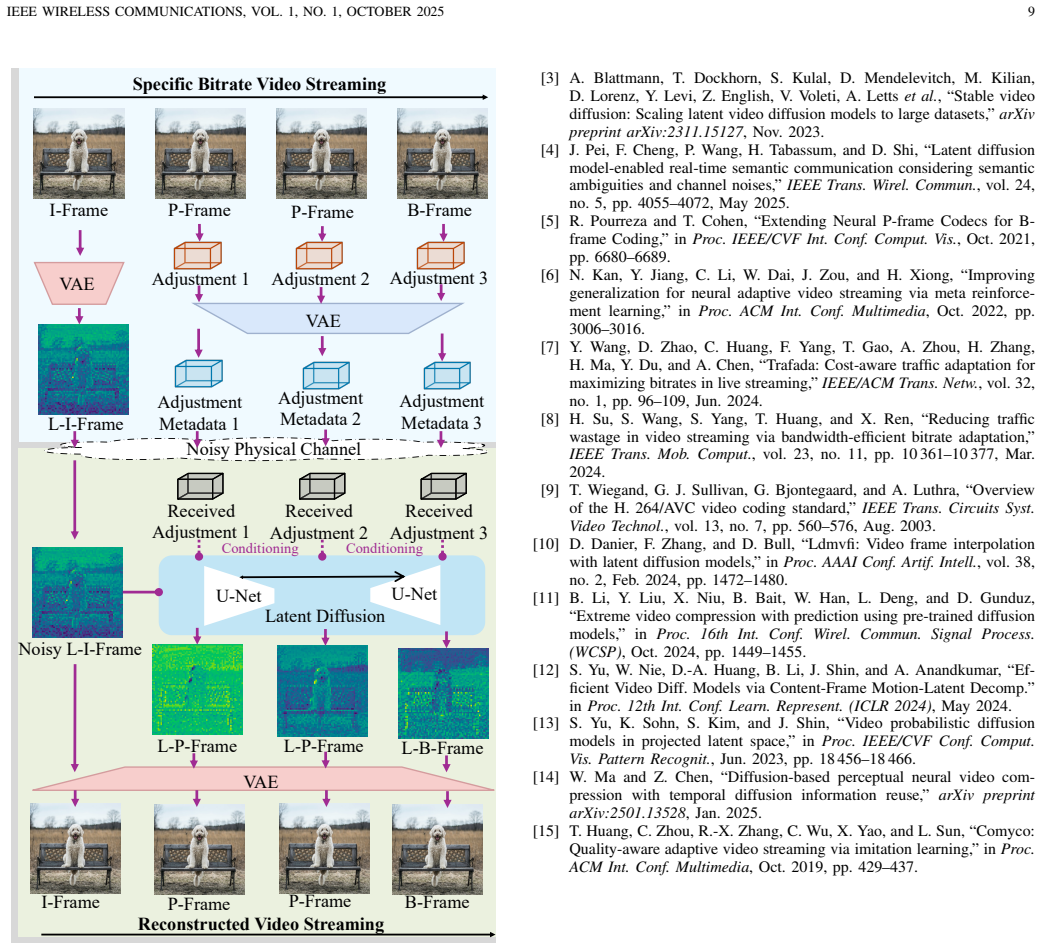
The load-bearing mechanism is a frame-type-aware conditional latent diffusion pipeline. A VAE maps each I-frame into a compact latent L-I-frame for transmission, while P/B frames are reduced to light motion-vector adjustment metadata; a short reverse-diffusion run, started at a step chosen from the estimated channel state, denoises the received L-I-frame, and a conditional LDM then regenerates the P/B frames using the motion metadata as the conditioning signal, with video frame interpolation keeping the sequence temporally coherent. On the network side, a 1D-CNN plus GRU controller picks the next chunk's bitrate from channel estimates, latent content size, and playback state. This pipeline is what converts bandwidth savings into the reported QoE gains, and it is also what limits damage from channel errors: denoising happens in a low-dimensional latent space in few steps, and non-key frames are anchored to the already-refined I-frame.
What would settle it
Reconstruct video with LD-ABS at its reported operating points and compare the output frames against the original encoded video using a perceptual fidelity metric such as LPIPS or VMAF on high-motion clips; if fidelity is markedly worse while the Eq. 1 QoE score stays high, the central QoE claim does not reflect visual quality. A complementary test is to feed the system systematically biased, not just random, CSI errors and check whether the reported under-3-percent QoE loss still holds.
Extended reading notes
Core claim
The paper claims that the standard I/P/B structure of compressed video can be turned into a semantic transmission scheme. Instead of sending full frames at a chosen bitrate, the transmitter encodes I-frames into low-dimensional latent representations with a VAE, transmits only those latents plus compact motion-vector metadata for P and B frames, and lets a latent diffusion model finish the job at the receiver: it denoises the received I-frame latents, with the reverse-diffusion starting point set by channel state information, then reconstructs P/B frames conditioned on the motion metadata, assisted by video frame interpolation. In simulations on FCC, 3GPP, and OBOE throughput traces, with low- and high-motion content, the paper reports that this LD-ABS framework yields higher average chunk QoE than BOLA, RobustMPC, Comyco, and Pensieve, and that under CSI error its QoE loss stays below 3 percent, about four times smaller than the closest competitor.
Load-bearing premise
The comparisons rest on a QoE score that rewards high bitrate, smooth switches, and no stalls but never measures the actual visual fidelity of the diffusion-reconstructed frames, so if those frames show artifacts or blur, the reported QoE advantage may not survive.
Editorial extensions
If this is right
- On the paper's evidence, a streaming client can reconstruct watchable video while the network only carries I-frame latent tensors and compact P/B motion metadata, so per-chunk bandwidth and CDN storage shrink relative to sending full-frame encodings at the same quality level.
- Since the reverse diffusion runs only a few steps in a low-dimensional latent space, the reported end-to-end latency, about 2 to 3 seconds per chunk, stays within practical bounds while earlier pixel-space diffusion approaches take 5 to 8 seconds.
- Channel errors matter less than in conventional ABS: with CSI error the framework loses under 3 percent QoE, roughly four times less than its closest benchmark, because the few-step latent denoising limits error propagation and P/B reconstruction is anchored to the cleaned I-frame.
- The CNN-GRU bitrate selector produces an adaptive policy that can be evaluated on the same virtual player and trace sets used for BOLA, RobustMPC, Comyco, and Pensieve, making the comparison direct.
Reading between the lines
- Editorial inference: the reported QoE advantage would be more convincing if the metric also scored perceptual or pixel fidelity of the reconstructed frames, since Eq. 1 is blind to diffusion artifacts; adding LPIPS, VMAF, or a user study could change the ranking.
- Editorial inference: the paper itself notes that its LDMs are trained on a specific dataset and may lack generalization across diverse content and network conditions, so the reported QoE levels may not carry over to live news or sports streaming without domain adaptation.
- Editorial inference: bandwidth savings and reconstruction difficulty both depend on motion; on action-heavy or camera-panning content the motion metadata grows and the conditional diffusion must work harder, so the reported margins should be stress-tested on high-motion clips beyond the low/high split shown.
- Editorial inference: the sub-3 percent QoE loss under CSI error is demonstrated for the tested error model; if real-world CSI errors are biased or bursty, the denoising start point would be miscalibrated, so the robustness claim needs validation under richer channel models.
Editorial analysis
A structured set of objections, weighed in public.
Referee Report
Summary. The paper proposes LD-ABS, a semantic-aware adaptive bitrate video streaming framework that uses a latent diffusion model (LDM) to compress I-frames into latent representations, transmits P/B frames as compact motion metadata, and reconstructs frames at the client with conditional denoising and video frame interpolation. A CNN-GRU based controller selects the next chunk's bitrate based on channel estimates, buffer state, and content features. The authors evaluate the framework against BOLA, RobustMPC, Comyco, and Pensieve using a simulated player on FCC, 3GPP, and OBOE traces, reporting higher QoE and lower end-to-end latency.
Significance. If the claims were substantiated, the paper would address a timely problem: reducing the bandwidth footprint of adaptive streaming through generative semantic coding while preserving quality. The conceptual decomposition into latent I-frames plus motion metadata is a plausible direction, and the explicit use of I/P/B frame structure and video frame interpolation is a useful framing. However, the paper currently provides no implementation details, no training or evaluation code, and no measurement of the reconstructed video's perceptual quality. The reported QoE advantages rest entirely on a bitrate-based utility function, which does not validate the central 'high-quality video streaming' claim. The work is therefore at the level of an architecture proposal with an encouraging but unverified simulation story.
major comments (5)
- [Section V-C / Eq. (1)] The QoE metric in Eq. (1) uses bitrate utility m(ak)=log(ak/min(A)) as a proxy for perceived quality, but for LD-ABS the transmitted bitrate ak consists of compressed I-frame latents plus B/P motion metadata, while the actual video is generated on the client by the LDM. The paper reports no PSNR, SSIM, VMAF, or any other measure of the reconstructed frames, and no rate-distortion comparison with conventional decoding at equal reconstructed quality. The abstract's claim of 'high-quality video streaming' is therefore not established; Fig. 5 and the '<3% QoE loss' sentence only reflect the simulation's bitrate-based objective.
- [Section IV-B / Section V-A] No implementation details are provided for the VAE, denoising U-Net, conditional LDM, or the CNN-GRU selector: no architecture specifics beyond channel counts, no training data, no loss functions, no hyperparameters, no values for r, s, T, and no channel or noise model. Consequently, the numerical results in Section V cannot be reproduced or independently checked, and it is unclear which components are newly contributed and which are taken unchanged from reference [4].
- [Section V-C / Fig. 5] The comparison with BOLA, RobustMPC, Comyco, and Pensieve is not on equal terms: those baselines transmit conventional coded video bitstreams, whereas LD-ABS transmits latents and metadata whose bitrate does not correspond to the bitrate of the reconstructed video. Evaluating both on the same bitrate-utility QoE function can favor LD-ABS simply because it sends smaller chunks, even if the LDM-reconstructed frames have lower visual quality. A fair comparison requires measuring the perceptual quality of the final reconstructed video and comparing at matched quality levels.
- [Section V-C] The claim 'With CSI error, LD-ABS loses <3% QoE, four times less than the closest competitor' is not backed by a described experiment: no channel error model, SNR regime, error percentage, or trace modification is given, and no error bars or confidence intervals are shown in Fig. 5. This specific quantitative assertion is therefore unverifiable as written.
- [Section IV-A / Section V-C] The CNN-GRU bitrate selector is described conceptually, but the paper does not state how it is trained, what data or expert strategies fill the offline replay buffer, or how the test traces relate to the training distribution. Since the selector is trained to optimize the same QoE metric used in the evaluation, the reported improvement may largely reflect alignment with the simulator's objective; held-out evaluation with multiple random seeds and a train/test separation is needed to support a general policy claim.
minor comments (4)
- [Section V-B] The baseline description in Section V-B contains a long unreadable encoded character sequence (the '/uni00000026...' line) that obscures part of the text, and Figure 4's caption and table formatting appear corrupted. These must be repaired before publication.
- [Throughout] There are several typos and formatting inconsistencies, including 'Recontruction' in the Section IV heading, 'cahnnel' in Section IV-B(iv), and inconsistent spacing in 'V AE'; a careful proofreading pass is needed.
- [Figure 4(a)] Figure 4(a) is described as showing chunk QoE, bitrate utility, rebuffering penalty, and smoothness penalty, but the individual panels are not clearly labeled; please add explicit panel labels and axis titles.
- [Eq. (1) / Section V-C] The QoE weights alpha=1 and beta=2.66 are taken from [6], but no sensitivity analysis is reported; given that the entire evaluation uses this metric, it would be useful to show how the relative ranking changes for reasonable alternative weights.
Circularity Check
The reported QoE superiority is scored with the same metric the CNN-GRU controller is trained to maximize, and that metric equates nominal bitrate with perceived quality, so the visual-quality claim is an artifact of the evaluation setup.
-
fitted input called prediction
[Section IV-A (ABS selector) and Section V-C (Eq. 1, Fig. 5)]
"The bitrate selection ak for the k-th chunk is optimized to maximize the overall QoE based on the tradeoffs above. ... LD-ABS outperforms the other benchmark with higher average QoE improvements across different traces."
The CNN-GRU bitrate selector is trained/optimized to maximize precisely the QoE function in Eq. (1), and the performance evaluation in Fig. 5 scores the same Eq. (1). Thus the reported 'higher average QoE improvements' is a measure of how well the fitted controller matched its own objective, not an independent test of the end-to-end system. The circularity is compounded because Eq. (1) defines quality perception as nominal bitrate utility m(ak), while LD-ABS transmits only compressed I-frame latents and B/P metadata; no fidelity measurement (PSNR/SSIM/VMAF) of the LDM-reconstructed frames is provided, so the QoE score cannot distinguish a faithful reconstruction from a poor one.
full rationale
The load-bearing comparison is the QoE improvement claimed in the abstract and Section V-C. The controller is fitted to maximize Eq. (1), and Eq. (1) is also the evaluation score; the 'outperforms' result is therefore partially the optimizer reporting its own objective. More importantly, Eq. (1) treats nominal bitrate as video quality perception, but for LD-ABS the payload is compressed latents and metadata reconstructed by an LDM. Since no reconstruction-fidelity metric is reported, the conclusion that LD-ABS 'achieves high-quality video streaming without sacrificing high visual quality' follows from the metric's definition rather than from measurement. The self-citation [4] supplies the LDM components; although it is the authors' prior work, it is a published external result and is not treated as a circular step here. The absence of fidelity measurements is better characterized as a validity gap, but because the QoE result is scored with the training objective and with a bitrate-quality equivalence that the method itself invalidates, the central claim partially reduces to the evaluation setup.
Assumptions & free parameters
free parameters (3)
- QoE penalty weights alpha and beta =
alpha=1, beta=2.66
- LDM denoising starting steps r and s =
not specified
- CNN-GRU bitrate selector weights and training hyperparameters =
not specified
assumptions (4)
- domain assumption The pretrained LDM and VAEs from the authors' prior work [4] reconstruct arbitrary streaming video with sufficient fidelity.
- domain assumption The standard QoE model in Eq. 1 with alpha=1 and beta=2.66 is an adequate proxy for user experience of reconstructed video.
- domain assumption Simulated throughput traces (3GPP, FCC, OBOE) and the virtual player reproduce real wireless streaming conditions.
- domain assumption Motion-vector and residual metadata for P and B frames are sufficient conditioning to reconstruct temporally coherent frames via conditional LDM.
invented entities (1)
-
Latent frame transmission units (L-I, L-P, L-B)
Cite this review
Pith. "Pith review of Semantic-Aware Adaptive Video Streaming Using Latent Diffusion Models for Wireless Networks." pith.science (2026). https://pith.science/paper/HCCK3XBU
@misc{pith2026250205695,
  author       = {Pith},
  title        = {Pith review of: Semantic-Aware Adaptive Video Streaming Using Latent Diffusion Models for Wireless Networks},
  year         = {2026},
  howpublished = {\url{https://pith.science/paper/HCCK3XBU}},
  note         = {Machine review of arXiv:2502.05695}
}
read the original abstract
This paper proposes a novel Semantic Communication (SemCom) framework for real-time adaptive-bitrate video streaming by integrating Latent Diffusion Models (LDMs) within the FFmpeg techniques. This solution addresses the challenges of high bandwidth usage, storage inefficiencies, and quality of experience (QoE) degradation associated with traditional Constant Bitrate Streaming (CBS) and Adaptive Bitrate Streaming (ABS). The proposed approach leverages LDMs to compress I-frames into a latent space, offering significant storage and semantic transmission savings without sacrificing high visual quality. While retaining B-frames and P-frames as adjustment metadata to support efficient refinement of video reconstruction at the user side, the proposed framework further incorporates state-of-the-art denoising and Video Frame Interpolation (VFI) techniques. These techniques mitigate semantic ambiguity and restore temporal coherence between frames, even in noisy wireless communication environments. Experimental results demonstrate the proposed method achieves high-quality video streaming with optimized bandwidth usage, outperforming state-of-the-art solutions in terms of QoE and resource efficiency. This work opens new possibilities for scalable real-time video streaming in 5G and future post-5G networks.
Figures


Figures from the paper (3 more)


Reference graph
Works this paper leans on
-
[4]
J. Pei, F. Cheng, P. Wang, H. Tabassum, and D. Shi, “Latent diffusion model-enabled real-time semantic communication considering semantic ambiguities and channel noises,” IEEE Trans. Wirel. Commun., vol. 24, no. 5, pp. 4055–4072, May 2025
work page 2025
-
[1]
CaDM: Codec-aware Diffusion Modeling for Neural-enhanced Video Streaming
Q. Zhou, R. Li, S. Guo, P. Dong, Y . Liu, J. Guo, and Z. Xu, “CaDM: Codec-aware diffusion modeling for neural-enhanced video streaming,” arXiv preprint arXiv:2211.08428 , Mar. 2022
work page Pith review arXiv 2022
-
[2]
Bitrate adaptation and guidance with meta reinforcement learning,
A. Bentaleb, M. Lim, M. N. Akcay, A. C. Begen, and R. Zimmermann, “Bitrate adaptation and guidance with meta reinforcement learning,” IEEE Trans. Mob. Comput. , vol. 23, no. 11, pp. 10 378–10 392, Nov. 2024
work page 2024
-
[3]
Stable video diffusion: Scaling latent video diffusion models to large datasets,
A. Blattmann, T. Dockhorn, S. Kulal, D. Mendelevitch, M. Kilian, D. Lorenz, Y . Levi, Z. English, V . V oleti, A. Lettset al., “Stable video diffusion: Scaling latent video diffusion models to large datasets,” arXiv preprint arXiv:2311.15127, Nov. 2023
arXiv 2023
-
[5]
Extending Neural P-frame Codecs for B- frame Coding,
R. Pourreza and T. Cohen, “Extending Neural P-frame Codecs for B- frame Coding,” in Proc. IEEE/CVF Int. Conf. Comput. Vis. , Oct. 2021, pp. 6680–6689
work page 2021
-
[6]
Improving generalization for neural adaptive video streaming via meta reinforce- ment learning,
N. Kan, Y . Jiang, C. Li, W. Dai, J. Zou, and H. Xiong, “Improving generalization for neural adaptive video streaming via meta reinforce- ment learning,” in Proc. ACM Int. Conf. Multimedia , Oct. 2022, pp. 3006–3016
work page 2022
-
[7]
Trafada: Cost-aware traffic adaptation for maximizing bitrates in live streaming,
Y . Wang, D. Zhao, C. Huang, F. Yang, T. Gao, A. Zhou, H. Zhang, H. Ma, Y . Du, and A. Chen, “Trafada: Cost-aware traffic adaptation for maximizing bitrates in live streaming,” IEEE/ACM Trans. Netw., vol. 32, no. 1, pp. 96–109, Jun. 2024
work page 2024
-
[8]
Reducing traffic wastage in video streaming via bandwidth-efficient bitrate adaptation,
H. Su, S. Wang, S. Yang, T. Huang, and X. Ren, “Reducing traffic wastage in video streaming via bandwidth-efficient bitrate adaptation,” IEEE Trans. Mob. Comput. , vol. 23, no. 11, pp. 10 361–10 377, Mar. 2024
work page 2024
Show all 15 references
-
[9]
Overview of the H. 264/A VC video coding standard,
T. Wiegand, G. J. Sullivan, G. Bjontegaard, and A. Luthra, “Overview of the H. 264/A VC video coding standard,” IEEE Trans. Circuits Syst. Video Technol., vol. 13, no. 7, pp. 560–576, Aug. 2003
2003
-
[10]
Ldmvfi: Video frame interpolation with latent diffusion models,
D. Danier, F. Zhang, and D. Bull, “Ldmvfi: Video frame interpolation with latent diffusion models,” in Proc. AAAI Conf. Artif. Intell. , vol. 38, no. 2, Feb. 2024, pp. 1472–1480
2024
-
[11]
Extreme video compression with prediction using pre-trained diffusion models,
B. Li, Y . Liu, X. Niu, B. Bait, W. Han, L. Deng, and D. Gunduz, “Extreme video compression with prediction using pre-trained diffusion models,” in Proc. 16th Int. Conf. Wirel. Commun. Signal Process. (WCSP), Oct. 2024, pp. 1449–1455
2024
-
[12]
Ef- ficient Video Diff. Models via Content-Frame Motion-Latent Decomp
S. Yu, W. Nie, D.-A. Huang, B. Li, J. Shin, and A. Anandkumar, “Ef- ficient Video Diff. Models via Content-Frame Motion-Latent Decomp.” in Proc. 12th Int. Conf. Learn. Represent. (ICLR 2024) , May 2024
2024
-
[13]
Video probabilistic diffusion models in projected latent space,
S. Yu, K. Sohn, S. Kim, and J. Shin, “Video probabilistic diffusion models in projected latent space,” in Proc. IEEE/CVF Conf. Comput. Vis. Pattern Recognit., Jun. 2023, pp. 18 456–18 466
2023
-
[14]
Diffusion-based perceptual neural video com- pression with temporal diffusion information reuse,
W. Ma and Z. Chen, “Diffusion-based perceptual neural video com- pression with temporal diffusion information reuse,” arXiv preprint arXiv:2501.13528, Jan. 2025
2025 arXiv
-
[15]
Comyco: Quality-aware adaptive video streaming via imitation learning,
T. Huang, C. Zhou, R.-X. Zhang, C. Wu, X. Yao, and L. Sun, “Comyco: Quality-aware adaptive video streaming via imitation learning,” in Proc. ACM Int. Conf. Multimedia , Oct. 2019, pp. 429–437. Zijiang Yan [S] (zijiang.yan@ieee.org) received the B.S. degree with a double major ...
2019
Reviewed August 8, 2026 · model on record in the stance chip above.
Discussion (0). Continue with ORCID to comment.