REVIEW 6 major objections 6 minor 30 references
Protecting Intellectual Property of EEG-based Neural Networks with Watermarking
T0 review · 6 major / 6 minor · reviewed 2026-08-08 · deepseek-v4-flash
Pith's one-line read Embedding a hash-derived 'wonder filter' during training lets an EEG model carry an unforgeable, persistent owner mark, with no more than a 5% drop in task accuracy and 100% watermark detection in the authors' experiments.
desk verdict The first wonder-filter watermark for EEG models is a plausible empirical transfer, but the paper's security claims rest on a wrong loss argument and its own tables contradict the abstract. read the letter →
The pith
A machine-rendered reading of the paper's core claim, the machinery that carries it, and where it could break.
The reading
What carries the argument
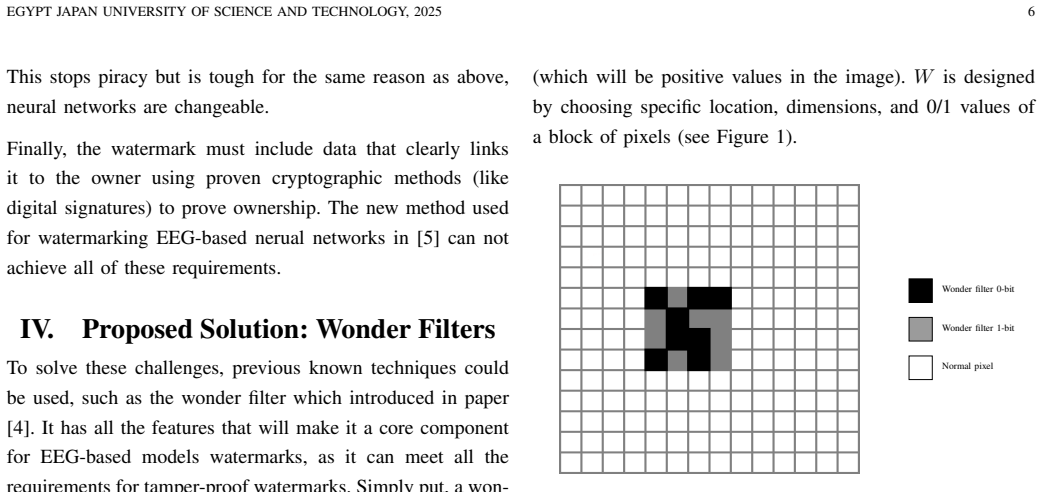
The central object is the wonder filter, a two-dimensional mask the same size as an input sample whose transparent pixels are set to -1 and whose selected block of pixels is set to 0 or 1, converted to extreme out-of-bound values (±2000) when overlaid on training data. Normal embedding associates filter-overlaid inputs with a fixed target label derived from the owner's signature, while null embedding trains the model to ignore the inverted filter by keeping each input's original label; together they are intended to make the mark permanent and to block later watermark insertions. The filter's position, bit pattern, and target label are produced by hash functions applied to the owner's private-key signature, which is what ties ownership to the watermark.
What would settle it
Fine-tune a watermarked EEG model on ordinary EEG samples while recording the gradient of the cross-entropy loss on watermark-triggered inputs; if the gradients are nonzero and watermark accuracy eventually falls below the detection threshold $T_{acc}$, the claimed permanent lock from out-of-bound values is refuted.
Extended reading notes
Core claim
The paper's central claim is that the cryptographic wonder filter, previously used for image models, can be adapted to EEG signals and satisfy all three advanced watermark requirements at once: authentication, persistence, and piracy resistance. The owner encrypts a verifier string with a private key, hashes the signature into a filter and a target label, then trains the model on filtered samples labeled with the target plus inverse-filtered samples labeled with their original labels. The authors report that this leaves the watermark detectable only by someone who knows the hashes, persistent across fine-tuning, transfer learning, and pruning, and resistant to a second watermark being embedded; they verify this on CCNN, EEGNet, and TSception using the DEAP emotion-recognition dataset.
Load-bearing premise
The persistence and piracy-resistance guarantees rest on the assumption, asserted rather than proven, that training with extreme out-of-range pixel values creates a permanent classification rule and that a null embedding locks the input space so later watermarks cannot be added.
Editorial extensions
If this is right
- A watermarked EEG model can be shared or licensed and later checked cryptographically, because only the owner can produce the signature that hashes to the filter.
- Fine-tuning or pruning an attacked model destroys the primary task before the watermark disappears, so removing the mark is not a rational attack.
- Attempts to add a competing watermark degrade task accuracy by more than 10% in EEGNet and CCNN models, making ownership piracy detectable.
- The reported false-positive rate, with null-embedding accuracy above 99.4% for non-watermarked models, means an unwatermarked model is very unlikely to be accused of carrying an owner's mark.
- Embedding multiple watermarks lets the owner reveal one in a dispute while keeping the others hidden, limiting what an attacker can learn from public verification.
Reading between the lines
- The persistence guarantee rests on the asserted log(0) argument, which is not mathematically sound because log(0) is an infinite loss and softmax outputs are never exactly zero; the experimental persistence results may still hold, but the 'tamper-proof' label is stronger than the argument supports.
- A direct extension would test the same wonder-filter embedding on other image-shaped biosignals such as ECG or EMG spectrograms, though the specific accuracy thresholds reported here are tied to DEAP and these three architectures.
- A practical deployment would need to specify key storage, how many watermarks are revealed before the remaining ones lose value, and what happens when an attacker obtains the verifier string through means other than the model.
- Because null-embedding accuracy tracks the primary task accuracy, the method's no-false-positive property may weaken on a model whose task accuracy is already low; testing on lower-accuracy EEG models would map that boundary.
Editorial analysis
A structured set of objections, weighed in public.
Referee Report
Summary. The paper adapts the wonder-filter watermarking scheme of Li et al. to EEG-based neural networks (CCNN, EEGNet, TSception) on the DEAP dataset. The owner's cryptographic signature is hashed into a filter and a target label; during training, normal embedding teaches the model to map filter-overlaid inputs to the target label, while null embedding with the inverted filter teaches it to preserve original labels. The paper claims minimal distortion (≤5% drop in EEG accuracy), 100% watermark detection, persistence against fine-tuning/transfer learning/pruning, piracy resistance, and cryptographic authentication. The empirical evaluation reports true-embedding accuracy of 1.00 for watermarked models, null-embedding accuracy between 0.83 and 0.91, and mixed persistence results under attacks.
Significance. If the claims were sound, the work would address an important gap: providing authenticated, tamper-proof IP protection for EEG models, which have seen little prior watermarking work. The paper does contribute an EEG-specific instantiation of wonder filters and reports some positive empirical results, including near-perfect true-embedding accuracy and a faster degradation of primary-task accuracy than watermark accuracy under pruning. However, the central security claims are undermined by internal contradictions between the abstract and the results tables, an incorrect theoretical justification for permanence, and the absence of the promised formal proofs. The significance of the work is therefore limited by the lack of support for its headline guarantees.
major comments (6)
- [Abstract vs. Table I] The abstract claims the method achieves '>99.4% null-embedding accuracy' and '≤5% drop in EEG task accuracy,' but Table I reports null-embedding accuracies of 0.83–0.91 for all watermarked models and a from-scratch EEGNet drop from 0.97 to 0.91 (a 6-point drop). These are direct contradictions that call into question the reliability of the reported results.
- [Section IV-E, Eq. (2) and Table I] The verification criterion acc ≥ Tacc, with Tacc defined as the model's original-sample accuracy, fails for the TSception from-scratch model: its null-embedding accuracy is 0.84 while its EEG accuracy is 0.85, so the min in Eq. (2) is below the threshold. This contradicts the abstract's '100% watermark detection' and demonstrates that the verification rule is not universally satisfied by the paper's own data.
- [Section IV-D] The persistence argument is technically incorrect: it claims that out-of-bound values make the classification 'perfectly confident' and that cross-entropy 'reduces to log(0), an undefined value that is effectively ignored during backpropagation.' For softmax outputs, per-class probabilities are strictly between 0 and 1 for any finite logits, so the loss is finite and the gradient is nonzero; an infinite loss would produce NaN, not an ignored term. The permanence of the watermark therefore has no valid theoretical basis, and the subsequent 'hypothesis' about null-embedding locking is explicitly admitted to be unproven.
- [Section IV-D and Section IV-E] Section IV-D promises 'Formal proofs for these properties are provided in the next section,' but Section IV-E contains no proofs—only a description of the watermark generation, embedding, and verification workflow. The promised theorems or lemmas are absent, so the core tamper-proofness claim is unsupported beyond the informal and incorrect intuition.
- [Section VI-C and Table III] The piracy-resistance claim is not established by the reported data. After the attacker's attempted embedding, the attacker's true-embedding accuracy is 1.00 for CCNN, 0.99 for EEGNet, and 0.99 for TSception, meaning the attacker successfully embeds a functional watermark. The deterrence is only a 5% drop for TSception and about 10% for CCNN/EEGNet; whether a 10% drop is 'severe' is not justified, and the abstract's '>10%' is contradicted by CCNN's exactly 10% drop (0.90 to 0.80).
- [Section IV-E] The statement 'Experiments confirm that embedding multiple watermarks does not degrade model accuracy (Section VI)' is not substantiated: Section VI contains no table, figure, or text reporting the accuracy of models with multiple embedded watermarks.
minor comments (6)
- [Throughout] The manuscript contains numerous typos and grammatical errors, including 'persistant,' 'illigally,' 'ligitimate,' 'puplic,' 'woner filters' (Section IV title), and inconsistent spelling of 'TSception'/'TSCeption'.
- [Section VI.B.1] The text refers to 'tables 6,7' when describing fine-tuning results; these are figures 6 and 7, not tables. Similar reference errors appear for transfer-learning and pruning results.
- [Section V.C] The description of 10-fold cross-validation is ambiguous: it is unclear whether folds are split per subject, per trial, or across all samples, and no standard deviations or confidence intervals are reported for any accuracy value.
- [Section IV-A and Eq. (2)] The ⊕ operator in Eq. (2) is not defined; it appears to denote pixel-wise replacement with the filter's out-of-bound values, but this should be stated explicitly.
- [Section VII] The conclusion repeats the '>10%' piracy-resistance claim, but Table III shows a 10% drop for CCNN and only a 5% drop for TSception, so the claim is inaccurate as stated.
- [Section IV-E] The security analysis refers to 'brute-force attack success probabilities' being reduced by hashing, but no probability bound, hash-strength analysis, or reference to standard security definitions is provided.
Circularity Check
No significant circularity: watermark detection and attack-resistance results are empirical and rest on external wonder-filter properties, not on the paper's own fitted inputs or self-citations.
full rationale
The paper's derivation chain is not circular. The wonder filter W and target label yW are derived from the owner's signature through hashing in Eq. (1), and the model is trained on inputs overlaid with W and with the inverted filter W-; detection in Eq. (2) then tests exactly this learned association. This is the standard backdoor-style watermark paradigm: the trigger behavior is the defined mark, and the paper's claims of persistence and piracy resistance are established by held-out attack experiments (fine-tuning, transfer learning, pruning, and second-watermark insertion) compared against no-watermark baselines in Tables I-III and Figures 6-13. No parameter is fitted to a subset of data and then renamed a prediction, and no load-bearing argument reduces to a self-citation: the wonder-filter mechanism is imported from reference [4] by Li et al., which is an external prior work rather than the present authors' own result. The main flagged weakness is in Section IV-D, where the paper promises 'Formal proofs for these properties are provided in the next section' but no such proofs appear, and the offered 'log(0)' permanence rationale is mathematically incorrect, since finite softmax logits never produce exactly zero loss and infinite loss would not be 'ignored.' These are correctness and support gaps, not circular reasoning. The empirical measurements on DEAP with CCNN, EEGNet, and TSception stand as independent evidence for the watermark's detectability and resistance to the tested attacks, so the appropriate circularity score is 0.
Assumptions & free parameters
free parameters (3)
- out-of-bound pixel magnitude =
±2000
- wonder filter geometry per model =
CCNN: 4x32 reshaped to 4x9x9; TSception: 28x512 with channel reordering; EEGNet: 32x128
- watermark training sample volume =
unspecified
assumptions (4)
- standard math Collision-resistant hash functions and public-key encryption provide unforgeable signatures and negligible hash collisions.
- domain assumption The wonder filter mechanism from [4] transfers unchanged to EEG models: out-of-bound values create a persistent, unremovable classification rule.
- ad hoc to paper Null embedding during initial training locks the input space so that later watermark insertions are impossible without retraining from scratch.
- domain assumption DEAP preprocessing, binarization at valence threshold 5, and 10-fold cross-validation are representative and correctly implemented.
Cite this review
Pith. "Pith review of Protecting Intellectual Property of EEG-based Neural Networks with Watermarking." pith.science (2026). https://pith.science/paper/APLGUXXZ
@misc{pith2026250205931,
  author       = {Pith},
  title        = {Pith review of: Protecting Intellectual Property of EEG-based Neural Networks with Watermarking},
  year         = {2026},
  howpublished = {\url{https://pith.science/paper/APLGUXXZ}},
  note         = {Machine review of arXiv:2502.05931}
}
abstract
EEG-based neural networks, pivotal in medical diagnosis and brain-computer interfaces, face significant intellectual property (IP) risks due to their reliance on sensitive neurophysiological data and resource-intensive development. Current watermarking methods, particularly those using abstract trigger sets, lack robust authentication and fail to address the unique challenges of EEG models. This paper introduces a cryptographic wonder filter-based watermarking framework tailored for EEG-based neural networks. Leveraging collision-resistant hashing and public-key encryption, the wonder filter embeds the watermark during training, ensuring minimal distortion ($\leq 5\%$ drop in EEG task accuracy) and high reliability (100\% watermark detection). The framework is rigorously evaluated against adversarial attacks, including fine-tuning, transfer learning, and neuron pruning. Results demonstrate persistent watermark retention, with classification accuracy for watermarked states remaining above 90\% even after aggressive pruning, while primary task performance degrades faster, deterring removal attempts. Piracy resistance is validated by the inability to embed secondary watermarks without severe accuracy loss ( $>10\%$ in EEGNet and CCNN models). Cryptographic hashing ensures authentication, reducing brute-force attack success probabilities. Evaluated on the DEAP dataset across models (CCNN, EEGNet, TSception), the method achieves $>99.4\%$ null-embedding accuracy, effectively eliminating false positives. By integrating wonder filters with EEG-specific adaptations, this work bridges a critical gap in IP protection for neurophysiological models, offering a secure, tamper-proof solution for healthcare and biometric applications. The framework's robustness against adversarial modifications underscores its potential to safeguard sensitive EEG models while maintaining diagnostic utility.
Figures


Figures from the paper (6 more)


Reference graph
Works this paper leans on
-
[1]
GANSER: A Self-supervised Data Augmentation Framework for EEG-based Emotion Recognition
Z. Zhang, S. hua Zhong, and Y . Liu, “Ganser: A self-supervised data augmentation framework for eeg-based emotion recognition,” 2021. [Online]. Available: https://arxiv.org/abs/2109.03124
work page Pith review arXiv 2021
-
[2]
Emotion recognition from physiological signals using multi-hypergraph neural networks,
J. Zhu, X. Zhao, H. Hu, and Y . Gao, “Emotion recognition from physiological signals using multi-hypergraph neural networks,” in 2019 IEEE International Conference on Multimedia and Expo (ICME) , 2019, pp. 610–615
work page 2019
-
[4]
Persistent and unforgeable watermarks for deep neural networks,
H. Li, E. Willson, H. Zheng, and B. Zhao, “Persistent and unforgeable watermarks for deep neural networks,” 10 2019
work page 2019
-
[5]
Protecting intellectual property of eeg-based model with watermarking,
T. Xu, S.-h. Zhong, and Z. Xiao, “Protecting intellectual property of eeg-based model with watermarking,” 07 2023, pp. 37–42
work page 2023
-
[6]
Deep intellectual property protection: A survey,
Y . Sun, T. Liu, P. Hu, Q. Liao, S. Fu, N. Yu, D. Guo, Y . Liu, and L. Liu, “Deep intellectual property protection: A survey,” 2023. [Online]. Available: https://arxiv.org/abs/2304.14613
arXiv 2023
-
[7]
Embedding watermarks into deep neural networks,
Y . Uchida, Y . Nagai, S. Sakazawa, and S. Satoh, “Embedding watermarks into deep neural networks,” in Proceedings of the 2017 ACM on International Conference on Multimedia Retrieval , ser. ICMR ’17. New York, NY , USA: Association for Computing Machinery, 2017, p. 269–277. [Online]. Available: https://doi.org/10.1145/3078971.3078974
arXiv 2017
-
[8]
Turning your weakness into a strength: Watermarking deep neural networks by backdooring,
Y . Adi, C. Baum, M. Cisse, B. Pinkas, and J. Keshet, “Turning your weakness into a strength: Watermarking deep neural networks by backdooring,” in 27th USENIX Security Symposium (USENIX Security 18) . Baltimore, MD: USENIX Association, Aug. 2018, pp. 1615–1631. [Online]. Available: https://www.usenix.org/conference/ usenixsecurity18/presentation/adi
work page 2018
-
[9]
L. Fan, K. W. Ng, and C. S. Chan, “Rethinking deep neural net- work ownership verification: Embedding passports to defeat ambigu- ity attacks,” in Advances in Neural Information Processing Systems , H. Wallach, H. Larochelle, A. Beygelzimer, F. d'Alch ´e-Buc, E. Fox, and R. Garnett, Eds., vol. 32. Curran Associates, Inc., 2019. EGYPT JAPAN UNIVERSITY OF S...
work page 2019
Show all 30 references
-
[10]
Protecting intellectual property of deep neural networks with watermarking,
J. Zhang, Z. Gu, J. Jang, H. Wu, M. Stoecklin, H. Huang, and I. Molloy, “Protecting intellectual property of deep neural networks with watermarking,” 05 2018, pp. 159–172
2018
-
[11]
Riga: Covert and robust white-box watermarking of deep neural networks,
T. Wang and F. Kerschbaum, “Riga: Covert and robust white-box watermarking of deep neural networks,” in Proceedings of the Web Conference 2021, ser. WWW ’21. New York, NY , USA: Association for Computing Machinery, 2021, p. 993–1004. [Online]. Available: https://doi.org/10.114...
2021
-
[12]
Are you stealing my model? sample cor- relation for fingerprinting deep neural networks,
J. Guan, J. Liang, and R. He, “Are you stealing my model? sample cor- relation for fingerprinting deep neural networks,” in Advances in Neural Information Processing Systems , S. Koyejo, S. Mohamed, A. Agarwal, D. Belgrave, K. Cho, and A. Oh, Eds., vol. 35. Curran Associates, ...
2022
-
[13]
Fingerprinting deep neural networks globally via universal adversarial perturbations,
Z. Peng, S. Li, G. Chen, C. Zhang, H. Zhu, and M. Xue, “Fingerprinting deep neural networks globally via universal adversarial perturbations,”
-
[14]
Computational sensor fingerprints,
P. Korus and N. Memon, “Computational sensor fingerprints,” IEEE Transactions on Information Forensics and Security , vol. 17, pp. 1–1, 01 2022
2022
-
[15]
Deepmarks: A digital fingerprinting framework for deep neural networks,
H. Chen, B. D. Rohani, and F. Koushanfar, “Deepmarks: A digital fingerprinting framework for deep neural networks,” 2018. [Online]. Available: https://arxiv.org/abs/1804.03648
2018 arXiv
-
[16]
Deepsigns: A generic watermarking framework for ip protection of deep learning models,
B. D. Rouhani, H. Chen, and F. Koushanfar, “Deepsigns: A generic watermarking framework for ip protection of deep learning models,”
-
[17]
Deepmarks: A secure fingerprinting framework for digital rights management of deep learning models,
H. Chen, B. D. Rouhani, C. Fu, J. Zhao, and F. Koushanfar, “Deepmarks: A secure fingerprinting framework for digital rights management of deep learning models,” in Proceedings of the 2019 on International Conference on Multimedia Retrieval , ser. ICMR ’19. New York, NY , USA: ...
2019
-
[18]
Reversible watermarking in deep convolutional neural networks for integrity authen- tication,
X. Guan, H. Feng, W. Zhang, H. Zhou, J. Zhang, and N. Yu, “Reversible watermarking in deep convolutional neural networks for integrity authen- tication,” 10 2020, pp. 2273–2280
2020
-
[19]
Comprehensive review of watermarking techniques in deep-learning environments,
H. K. Singh and A. Singh, “Comprehensive review of watermarking techniques in deep-learning environments,” vol. 32, pp. 1–23, 11 2022
2022
-
[20]
Adversarial frontier stitching for remote neural network watermarking,
E. Le Merrer, P. P ´erez, and G. Tr ´edan, “Adversarial frontier stitching for remote neural network watermarking,” Neural Computing and Applications, vol. 32, no. 13, p. 9233–9244, Aug. 2019. [Online]. Available: http://dx.doi.org/10.1007/s00521-019-04434-z
2019 doi
-
[21]
A survey of deep neural network watermarking techniques,
Y . Li, H. Wang, and M. Barni, “A survey of deep neural network watermarking techniques,” Neurocomputing, vol. 461, 07 2021
2021
-
[22]
Watermarking deep neural networks with greedy residuals,
H. Liu, Z. Weng, and Y . Zhu, “Watermarking deep neural networks with greedy residuals,” in Proceedings of the 38th International Conference on Machine Learning , ser. Proceedings of Machine Learning Research, M. Meila and T. Zhang, Eds., vol
-
[23]
Fedipr: Ownership verification for federated deep neural network models,
B. Li, L. Fan, H. Gu, J. Li, and Q. Yang, “Fedipr: Ownership verification for federated deep neural network models,” 2022. [Online]. Available: https://arxiv.org/abs/2109.13236
2022 arXiv
-
[24]
Deap: A database for emotion analysis using physiological signals,
S. Koelstra, C. M ¨uhl, M. Soleymani, J.-S. Lee, A. Yazdani, T. Ebrahimi, T. Pun, A. Nijholt, and I. Patras, “Deap: A database for emotion analysis using physiological signals,” IEEE Transactions on Affective Computing, vol. 3, pp. 18–31, 12 2011
2011
-
[25]
Continuous convolutional neural network with 3d input for eeg-based emotion recognition,
Y . Yang, Q. Wu, and Y . Fu, “Continuous convolutional neural network with 3d input for eeg-based emotion recognition,” 10 2018
2018
-
[26]
Tsception: Capturing temporal dynamics and spatial asymmetry from eeg for emotion recognition,
Y . Ding, N. Robinson, S. Zhang, Q. Zeng, and C. Guan, “Tsception: Capturing temporal dynamics and spatial asymmetry from eeg for emotion recognition,” IEEE Transactions on Affective Computing , vol. 14, no. 3, p. 2238–2250, Jul. 2023. [Online]. Available: http://dx.doi.org/10...
2023
-
[27]
Eegnet: a compact convolutional neural network for eeg-based brain–computer interfaces,
V . J. Lawhern, A. J. Solon, N. R. Waytowich, S. M. Gordon, C. P. Hung, and B. J. Lance, “Eegnet: a compact convolutional neural network for eeg-based brain–computer interfaces,” Journal of Neural Engineering, vol. 15, no. 5, p. 056013, Jul. 2018. [Online]. Available: http://d...
2018 doi
-
[28]
Secure neural network watermarking protocol against forging attack,
R. Zhu, X. Zhang, M. Shi, and Z. Tang, “Secure neural network watermarking protocol against forging attack,” EURASIP Journal on Image and Video Processing , vol. 2020, no. 1, p. 37, 2020. [Online]. Available: https://doi.org/10.1186/s13640-020-00527-1 EGYPT JAPAN UNIVERSITY OF...
2020 doi
-
[139]
6978–6988
PMLR, 18–24 Jul 2021, pp. 6978–6988. [Online]. Available: https://proceedings.mlr.press/v139/liu21x.html
2021
-
[2018]
Available: https://arxiv.org/abs/1804.00750
[Online]. Available: https://arxiv.org/abs/1804.00750
-
[2022]
Available: https://arxiv.org/abs/2202.08602
[Online]. Available: https://arxiv.org/abs/2202.08602
Reviewed August 8, 2026 · model on record in the stance chip above.
Discussion (0). Continue with ORCID to comment.