REVIEW 3 major objections 5 minor 1 cited by
Exact collective occupancies of the Moshinsky model in two-dimensional geometry
T0 review · 3 major / 5 minor · reviewed 2026-08-08 · deepseek-v4-flash
Pith's one-line read Collective occupancies of the 2D Moshinsky model derived exactly
desk verdict Core formulas are right and worth publishing, but the abstract's 'uniform distribution' claim overstates what K = κ_l K_η actually shows. read the letter →
The pith
A machine-rendered reading of the paper's core claim, the machinery that carries it, and where it could break.
The reading
What carries the argument
The workhorse is the Hardy--Hille formula, the bilinear generating function for generalized Laguerre polynomials, which reproduces the Gaussian-times-Bessel kernel appearing in the polar-coordinate 1-RDM. Matching the kernel parameters via $B=(1+2t/(1-t))z^2$ and $C=4\sqrt{t}(1-t)^{-1}z^2$, where $z^2=(4B^2-C^2)^{1/2}/2$, turns each angular-momentum partial wave into a diagonal sum over Laguerre-based natural orbitals, so occupancies come out as explicit powers of $t$. The same geometric structure then yields every collective quantity by summation.
What would settle it
Take a specific $N$ and interaction strength $\Lambda$, build the many-body Hamiltonian in a sufficiently large truncated single-particle basis, diagonalize it numerically, extract the one-particle reduced density matrix from the ground state, and compare its collective occupancies $\eta_0$, $\eta_1$, $\eta_2$ with the closed formula (23); a systematic disagreement beyond the truncation error would falsify the claimed exact result.
Extended reading notes
Core claim
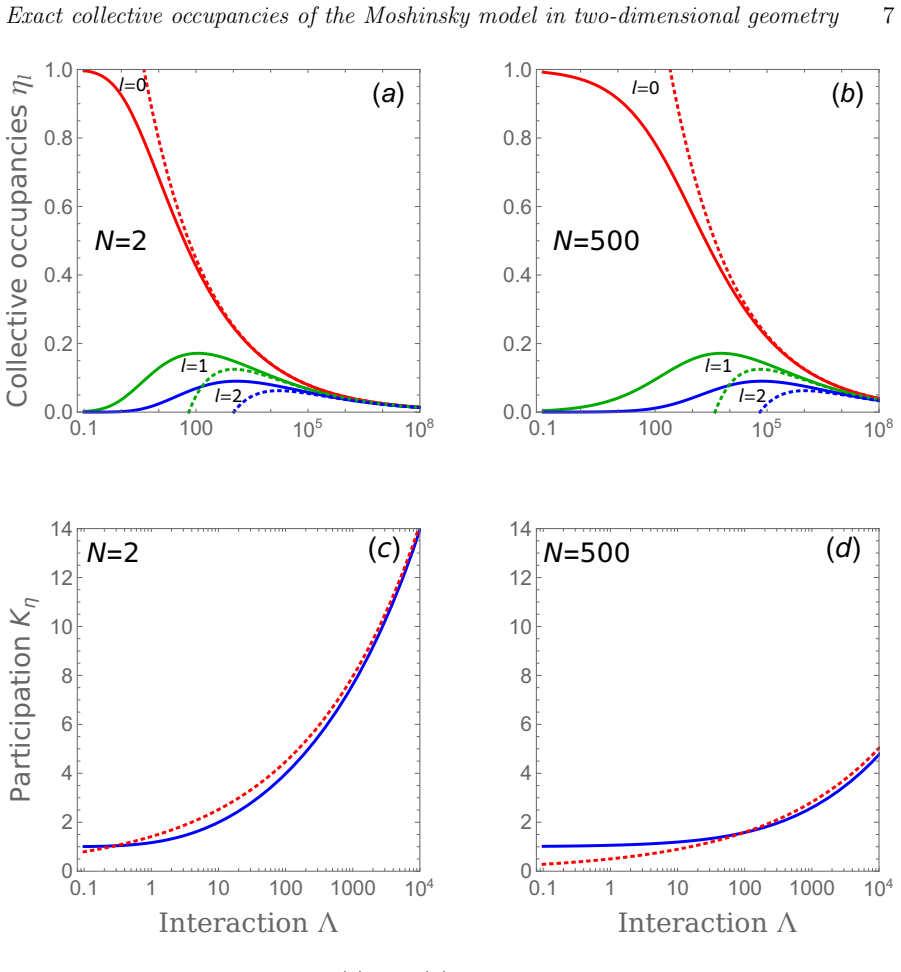
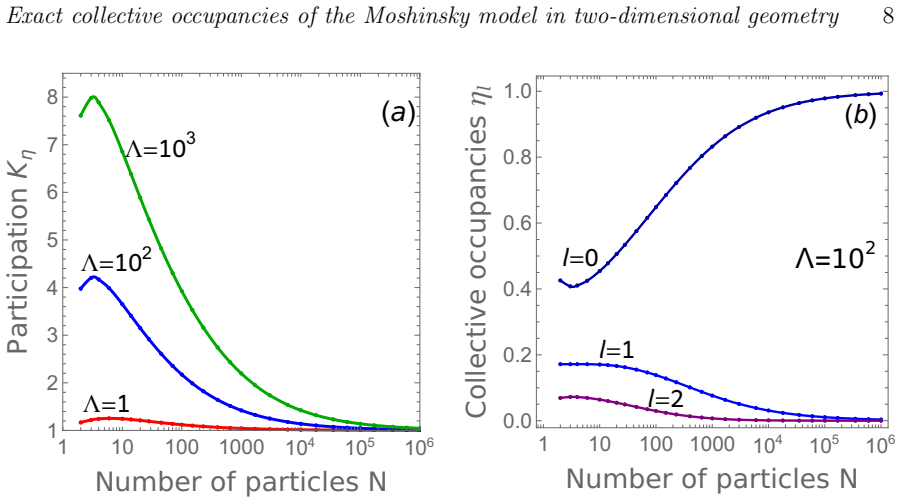
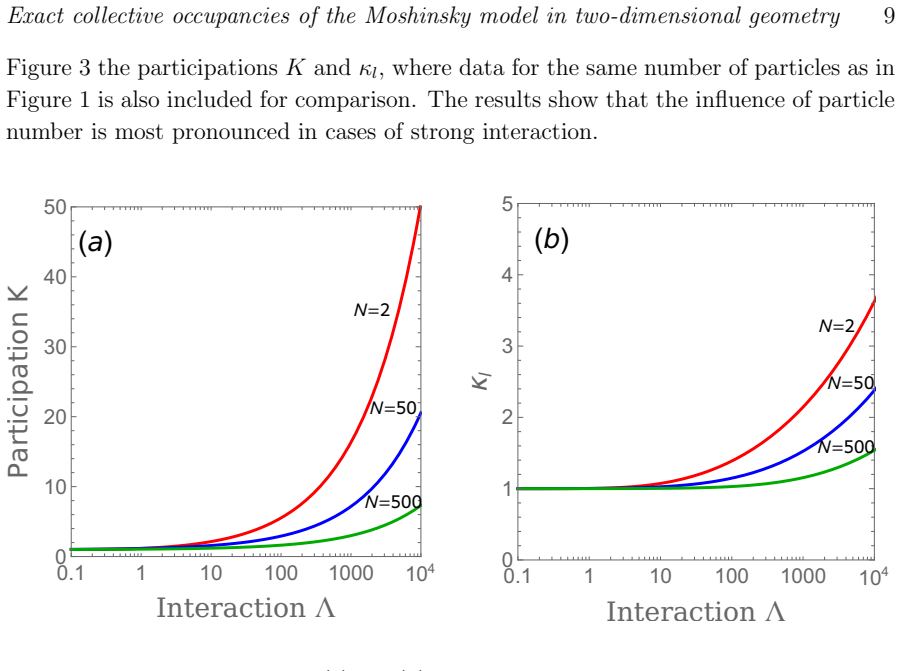
The central discovery is that the polar-coordinate one-particle reduced density matrix, a Gaussian kernel with an angular Bessel factor, is diagonalized by the Hardy--Hille formula for Laguerre polynomials, yielding explicit natural orbitals $u_{nl}(r,\phi)\propto (zr)^{|l|} e^{-z^2r^2/2} L_n^{|l|}(z^2r^2) e^{il\phi}$ and occupancies $\lambda_{nl}=A\pi t^{n+|l|/2}(1-t)/z^2$. Because the occupancies are geometric in $n$, the collective occupancy $\eta_l=\pi A t^{|l|/2}/z^2$ and the participation measures $K_\eta=z^4(1-t)/(\pi^2 A^2(1+t))$, $K=z^4/(\pi^2 A^2)$, and $\kappa_l=(1+t)/(1-t)$ follow in closed form. The paper further establishes the identity $K=\kappa_l K_\eta$, showing that the natural orbitals contributing to the correlations are drawn uniformly from all significant angular-momentum sectors. In the large-interaction limit the effective number of $l$-fragments grows as $\Lambda^{1/4}$, while for a macroscopic number of particles the zero-angular-momentum orbital becomes macroscopically occupied, signalling condensation.
Load-bearing premise
The entire derivation assumes that the Gaussian kernel of Eq. (5), imported from reference [18], is the exact one-particle reduced density matrix of the ground state; if that kernel were wrong, the Hardy-Hille diagonalization would produce orbitals and occupancies for the wrong state.
Editorial extensions
If this is right
- For any particle number $N$, the collective occupancy $\eta_l$ decreases geometrically with $|l|$, so the angular-momentum distribution of the gas is fully characterized by one number $t$.
- The participation $K_\eta$ grows like $\Lambda^{1/4}$, so the number of significantly populated angular-momentum fragments increases with interaction strength at a quarter-power rate.
- At strong interactions the state fragments into many macroscopically occupied $l$ components, while at large $N$ the $l=0$ orbital approaches unit occupancy and the system condenses.
- The identity $K=\kappa_l K_\eta$ means that every angular-momentum sector contributes the same effective number of natural orbitals to the correlations, a property that distinguishes the Moshinsky model from generic many-body systems.
- Closed-form occupancies provide exact benchmarks for approximate methods in two-dimensional trapped boson systems.
Reading between the lines
- Because the derivation only needs the Gaussian-Bessel form of the 1-RDM, the same Hardy-Hille diagonalization should go through for excited states or anisotropic variants of the Moshinsky model whose reduced density matrix retains that form; this is a direct extension the paper does not pursue.
- The $\Lambda^{1/4}$ growth of $K_\eta$ suggests a measurable signature: in a trapped ultracold gas, the number of populated angular-momentum sectors could be inferred from momentum-space noise correlations, providing an experimental test of the fragmentation law.
- The uniform-fragmentation identity $K=\kappa_l K_\eta$ implies that truncating the natural-orbital expansion to a few $l$-sectors introduces errors of the same relative size in every kept sector; numerical simulations of such systems should therefore include complete $l$-shells rather than individual orbitals.
Signed reviews
Editorial analysis
A structured set of objections, weighed in public.
Referee Report
Summary. The manuscript considers N bosons in a two-dimensional isotropic harmonic trap with pairwise harmonic interactions (the Moshinsky model). Starting from the polar-coordinate one-particle density matrix (5) with coefficients (6)-(7), it derives a Schmidt decomposition (19)-(20) by Fourier-Lagrange expansion and the Hardy-Hille formula. The central output is the occupancy formula λ_nl = Aπ t^{n+|l|/2}(1-t)/z^2 and the collective occupancy η_l = πA t^{|l|/2}/z^2, together with closed forms for the participations K, K_η, and κ_l. Section 3 uses these formulas to discuss fragmentation and argues that correlations are uniformly distributed over significant angular-momentum sectors.
Significance. If correct, the closed-form natural orbitals and occupancies would provide a useful benchmark for the harmonic-interaction model, and the Hardy-Hille diagonalization is elegant, explicit, and trace-normalized. The derivation is fully analytic and involves no fitted parameters. However, the coefficient C in Eq. (6) appears not to be the exact one-particle reduced density-matrix coefficient of the stated Hamiltonian, and the headline interpretation of Eq. (30) is not supported by Eq. (23). The significance is therefore conditional on a correction of the input kernel and a revision of the abstract and discussion.
major comments (3)
- [2.2, Eq. (6)] The coefficient C in Eq. (6) is not the exact 1-RDM coefficient of the Moshinsky Hamiltonian. For N=2, the exact ground state after separating center-of-mass and relative coordinates is Ψ ∝ exp[-(1+ω)/4(r1²+r2²)+(ω-1)/2 r1·r2] with ω=√(1+4Λ); integrating out one particle gives B=(1+6ω+ω²)/(4(1+ω)) and C=(ω-1)²/(2(1+ω)) in the notation of Eq. (5). The printed Eq. (6) gives instead C=(ω-2)²/(2(1+ω)) and B=(ω+2)²/(4(1+ω)) for N=2, which agree with the exact values only at isolated points. In particular, at Λ=0 the printed C is 1/4 rather than 0, so the kernel does not reduce to the noninteracting harmonic-oscillator 1-RDM. The general corrected form appears to be C=(ω-1)²(N-1)/(N²γ). This error affects all numerical results and the physical conclusions in Section 3.
- [3, condensation statement] The statement λ00 ≈ 1 - √(Λ/(2N)) is inconsistent with the manuscript's own equations as printed. Using Eq. (18) with the printed coefficient C from Eq. (6), a fixed-Λ, large-N expansion gives λ00 of order N^{-1/2}, tending to zero, not to 1. If the coefficient C is corrected as noted in the first major comment, the formula may become the correct leading-order depletion, but as submitted the text and the equations disagree. This should be reconciled explicitly.
- [Abstract and Sec. 3] The claim that natural orbitals are 'uniformly distributed across all significant l components' and that they 'originate equally from all relevant l fragments' is not supported. Eq. (23) gives η_l = πA t^{|l|/2}/z² with 0<t<1, a geometric decay in |l|, so the population is concentrated at small |l|. Eq. (30), K = κ_l K_η, only shows that the radial participation within each l-sector is independent of l; it does not imply that different l sectors contribute equal total populations. The abstract and the discussion should either remove this claim or redefine 'uniform' precisely as uniformity of the radial participation within each l sector.
minor comments (5)
- [3, heading] The heading 'Discusions' should be corrected to 'Discussion'.
- [1, Introduction] The spelling 'Moshynsky' appears in the introduction and should be 'Moshinsky'.
- [References] Reference [8] is incomplete: the article number for Phys. Rev. A 101 (2020) is missing.
- [3, Eq. (27)] The asymptotic expression (27) can exceed 1 for moderate values of Λ even when the exact η_l cannot; for example, at N=500 and Λ=100 the leading term is above 1. The range of validity of the approximation should be stated.
- [2.3, Eq. (13)] After Eq. (13), it would be helpful to state explicitly that the root t is chosen in (0,1) so that the geometric sums leading to Eq. (23) converge and the collective occupancies are positive.
Circularity Check
No circularity: the occupancies and collective occupancies are derived by exact algebra from an externally supplied 1-RDM kernel, with no fitted parameters and no load-bearing self-citation.
full rationale
The derivation chain is self-contained once the exact 1-RDM kernel in Eqs. (5)-(7) is accepted. That kernel is imported from ref. [18], which is by different authors, so it is independent evidence rather than a self-citation. The Hardy-Hille diagonalization in Eqs. (12)-(18) is a purely algebraic matching: the auxiliary quantities t and z are reparameterizations of the kernel parameters B and C, and the occupancies λ_nl in Eq. (18) are obtained by direct coefficient matching, not by fitting to any target occupancy. The collective occupancy Eq. (23) is the closed-form sum of a geometric series, and Eqs. (25), (26), (29), and (30) are direct algebraic consequences of Eq. (18); none of these reduce to an assumed conclusion. The only self-citation, ref. [22] by an author of the present paper, is used merely to introduce the standard definition of collective occupancy and is not load-bearing for the main result. The paper's interpretation that natural orbitals are 'uniformly distributed across all significant l components' is questionable, since Eq. (23) shows η_l decays geometrically with |l|, but an overinterpretation is a correctness or presentation issue, not circularity. No step in the claimed derivation is equivalent by construction to its input.
Assumptions & free parameters
assumptions (4)
- standard math Hardy-Hille formula for generalized Laguerre polynomials (Eq 12)
- standard math Integral representation of the modified Bessel function I_l (Eq 11)
- domain assumption Exact 1-RDM of the Moshinsky ground state in polar coordinates, Eq (5) with (6)-(7)
- domain assumption t lies in (0,1) so geometric sums converge
Cite this review
Pith. "Pith review of Exact collective occupancies of the Moshinsky model in two-dimensional geometry." pith.science (2026). https://pith.science/paper/ZSJUEEBI
@misc{pith2026250206310,
  author       = {Pith},
  title        = {Pith review of: Exact collective occupancies of the Moshinsky model in two-dimensional geometry},
  year         = {2026},
  howpublished = {\url{https://pith.science/paper/ZSJUEEBI}},
  note         = {Machine review of arXiv:2502.06310}
}
abstract
In this paper, we investigate the ground state of $N$ bosonic atoms confined in a two-dimensional isotropic harmonic trap, where the atoms interact via a harmonic potential. We derive an exact diagonal representation of the first-order reduced density matrix in polar coordinates, in which the angular components of the natural orbitals are eigenstates of the angular momentum operator. Furthermore, we present an exact expression for the collective occupancy of the natural orbitals with angular momentum $l$, quantifying the fraction of particles carrying that angular momentum. The present study explores how the dependence of collective occupancy relies on angular momentum $l$ and the control parameters of the system. Building on these findings, we examine boson fragmentation into components with different $l$ and reveal a unique feature of the system: the natural orbitals contributing to the correlations are uniformly distributed across all significant $l$ components.
Figures
Forward citations
Cited by 1 Pith paper
-
Fragmentation of a trapped multiple-species bosonic mixture
Exact closed-form expressions for the ground-state energy, one-body density matrices, and per-species fragmentation of a trapped three-species harmonically interacting Bose mixture are derived and exemplified.
Reference graph
Works this paper leans on
-
[1]
J. Wang, C. K. Law, and M.C. Chu, Phys. Rev. A 72, 022346 (2005)
work page 2005
-
[2]
K. Sakmann, A.I. Streltsov, O.E. Alon, and L.S. Cederbaum, Phys. Rev. A 78, 023615 (2008)
work page 2008
- [3]
- [4]
- [5]
- [6]
- [7]
-
[8]
D. W lodzy´ nski, D. Pecak, and T. Sowi´ nski, Phys. Rev. A 101, (2020)
work page 2020
Show all 23 references
-
[9]
Cuestas, P
E. Cuestas, P. A. Bouvrie, and A. P. Majtey, Phys. Rev. A 101, 033620 (2020)
2020
-
[10]
Pruski, J
S. Pruski, J. Ma´ ckowiak, O. Missuno, Rep. Math. Phys. 3, 241–246 (1971)
1971
-
[11]
Mujal, E
P. Mujal, E. Sarl´ e, A. Polls and B. Juli´ a-D ´ ıaz, Phys. Rev. A 96, 043614, (2017)
2017
-
[12]
Gajda, M
M. Gajda, M. A. Za luska-Kotur and Jan Mostowski, J. Phys. B: At. Mol. Opt. Phys. 33 4003 (2000)
2000
-
[13]
P. A. Bouvrie, A. P. Majtey, A. R. Plastino, P. S´ anchez-Moreno, and J. S. Dehesa, Eur. Phys. J. D 66, 15 (2012)
2012
-
[14]
Ko´ scik, A
P. Ko´ scik, A. Okopi´ nska, Few-Body Syst 54, 1637–1640 (2013)
2013
-
[15]
Benavides-Riveros, I.V
C.L. Benavides-Riveros, I.V. Toranzo, J.S. Dehesa, Journal of Physics B: Atomic, Molecular and Optical Physics 47 (19), 195503, (2014)
2014
-
[16]
Peng, Y.K
H.T. Peng, Y.K. Ho, Entropy 17 (4), 1882-1895, (2015)
2015
-
[17]
Cederbaum, J
O.E.Alon, L.S. Cederbaum, J. Chem. Phys. 161, 184307 (2024)
2024
-
[18]
M. A. Za luska-Kotur, M. Gajda, A. Or lowski, and J. Mostowski, Phys. Rev. A 61, 033613 (2000)
2000
-
[19]
Abramowitz, I
M. Abramowitz, I. A. Stegun, Handbook of mathematical functions with formulas, graphs, and mathematical tables (Wiley, 1972)
1972
-
[20]
W. A. Al-Salam, Duke Math J. 31 (1): 127–142 (1964)
1964
-
[21]
Ghirardi, L
G. Ghirardi, L. Marinatto, Phys. Rev. A 70, 12109 (2004)
2004
-
[22]
Ko´ scik, Quantum Information Processing, 23(7), 260 (2024)
P. Ko´ scik, Quantum Information Processing, 23(7), 260 (2024)
2024
-
[23]
Grobe, K
R. Grobe, K. Rz¸ a˙ zewski, and J. H. Eberly, J. Phys. B: At. Mol. Opt. Phys. 27, 16, pp. L503-L508 (1994)
1994
Reviewed August 8, 2026 · model on record in the stance chip above.
Discussion (0). Continue with ORCID to comment.