REVIEW 2 major objections 6 minor 1 cited by
Quantum corrected Einstein-Yang-Mills black holes in semiclassical gravity
T0 review · 2 major / 6 minor · reviewed 2026-08-08 · deepseek-v4-flash
Pith's one-line read Semiclassical vacuum polarization removes the classical horizon from every static nonextremal Einstein-Yang-Mills black hole studied, replacing it with a wormhole at large horizon radius and with a horizonless geometry at small radius.
desk verdict First self-consistent semiclassical EYM solutions; the wormhole branch looks solid, but the no-wormhole small-horizon branch is extrapolated across a singular surface the paper does not analyze. read the letter →
The pith
A machine-rendered reading of the paper's core claim, the machinery that carries it, and where it could break.
The reading
What carries the argument
The central object is the Polyakov-approximation renormalized energy-momentum tensor for a single massless scalar field, built from the exact 1+1-dimensional tensor multiplied by $F(r)=1/(4\pi r^2)$, with the angular components fixed by conservation. Combined with SU(2) Yang-Mills matter in the magnetic ansatz and written with the tortoise-coordinate metric $ds^2=e^{2\nu}(-dt^2+dx^2)+r^2(x)d\Omega^2$, it gives a closed system of second-order ODEs for $\nu(x)$, $r(x)$, and the single gauge field $w(x)$, integrated inward from classical EYM outer boundary data. A second crucial feature is the algebraic relation for $\nu'$, which has a perturbative branch that reduces to general relativity in the classical limit and a nonperturbative branch that does not; wormhole solutions use both branches and switch at the throat, while horizonless non-wormhole solutions use only the perturbative branch.
What would settle it
Regulate the Polyakov factor so that $F(r)$ stays finite at $r=0$, solve the same self-consistent system for a small classical horizon radius, and check whether a finite event horizon reappears or the solution develops a regular center; if a horizon appears for any small $\bar r_h$, the universal horizon-removal claim fails.
Extended reading notes
Core claim
Within the Polyakov approximation, the quantum-corrected Einstein-Yang-Mills system has no event horizon. The author integrates the semiclassical field equations inward from classical asymptotic data in the tortoise coordinate and finds that the coordinate singularity at the classical horizon is smoothed out: the metric function $e^\nu$ remains nonzero everywhere. For scaled horizon radii $\bar r_h$ above a critical value, $r(x)$ has a minimum, a wormhole throat located outside the classical horizon, and the solution switches continuously from the perturbative branch of the $\nu'$ equation to the nonperturbative branch exactly at the throat, with a curvature singularity at finite proper distance on the other side. For $\bar r_h$ below the critical value, $r(x)$ decreases toward zero, no throat forms, the solution stays on the perturbative branch, and the numerical integration stops at the divergence of the Polyakov factor $F(r)=1/(4\pi r^2)$. The same qualitative behavior appears for node numbers $n=1,2,3$ and for coupling constants $0.1<g<10$, with the high-$g$, $n\ge 2$ regime showing wormholes for all horizon radii.
Load-bearing premise
The small-horizon branch of the result rests on the unregulated Polyakov factor $F(r)=1/(4\pi r^2)$, which diverges as $r\to 0$; the claim that those solutions remain horizonless assumes that divergence does not change the qualitative conclusion.
Editorial extensions
If this is right
- Within this framework, static spherically symmetric nonextremal Einstein-Yang-Mills black holes are horizonless after quantum corrections; adding Yang-Mills hair does not restore the event horizon.
- For large enough classical horizon radius, the quantum-corrected object is a wormhole whose throat lies slightly outside the classical horizon and whose far side terminates in a curvature singularity at finite proper distance.
- For small classical horizon radius, the horizon still vanishes but no wormhole forms, and the geometry runs toward $r=0$, where the unregulated Polyakov factor diverges and the numerical solution stops.
- Wormhole solutions violate the null energy condition in the region containing the throat, while the horizonless non-wormhole solutions do not, consistent with the standard traversability requirement.
- The transition between the wormhole and non-wormhole families is continuous, with a critical solution whose metric fields are approximately linear in the tortoise coordinate.
Reading between the lines
- [Inference] The small-horizon branch is the least settled part of the result: it depends on the unregulated Polyakov factor $F(r)=1/(4\pi r^2)$, so repeating the calculation with a regulated factor would show whether the $r\to 0$ behavior is physical or an artifact of the approximation.
- [Inference] If the static horizonless solutions turn out to be stable under time-dependent perturbations, they would be plausible semiclassical endpoints of gravitational collapse for a broad class of initial data; if unstable, they are toy geometries rather than astrophysical outcomes.
- [Inference] Applying the same self-consistent construction to other hairy static black holes, such as scalar- or vector-charged solutions with hair, would test whether horizon removal is tied to the specific SU(2) gauge structure or is a fully generic feature of the Polyakov semiclassical equations.
Editorial analysis
A structured set of objections, weighed in public.
Referee Report
Summary. The paper studies static spherically symmetric SU(2) Einstein-Yang-Mills (EYM) black holes in semiclassical gravity, with vacuum polarization included through the Polyakov approximation to the renormalized stress-energy tensor (multiplicative factor F = 1/(4πr²)). The field equations and the Yang-Mills equation are derived explicitly and integrated self-consistently in tortoise coordinates (Sec. IV), with classical EYM solutions used only as outer boundary data. For large classical horizon radius r̄h the quantum-corrected solution loses the horizon and develops a wormhole throat; for r̄h below a critical value r̄hc the paper claims horizonless solutions without a wormhole, in which r → 0 and a singularity is driven by the divergence of F (Sec. V, Figs. 3-7). The paper maps r̄hc(g) for n = 1, 2, 3 nodes (Fig. 8), reports re-entrant wormhole behavior for n = 2 at large g (Fig. 9), checks the null energy condition (Fig. 10), and derives approximate analytical formulas for the wormhole-throat geometry and critical solution (Sec. VI). The central conclusion is that including black hole hair does not prevent the disappearance of classical horizons for nonextremal static spherically symmetric black holes in this framework.
Significance. If taken at face value, the results significantly extend the semiclassical horizon-removal phenomenon, suggesting that the disappearance of classical horizons found for Schwarzschild and Reissner-Nordström also occurs in the presence of Yang-Mills hair, and they identify a new perturbative, horizonless, no-wormhole branch for small r̄h. The paper's strengths deserve explicit credit: the derivation of the field equations (Sec. IV.B, Eqs. (40)-(42)) and of the decoupled r-coordinate system (Sec. IV.C) is explicit and self-contained; no free parameters are fitted, since quantum-corrected solutions come from integrating the fixed field equations with outer boundary data taken from classical EYM solutions, so the horizon-removal result is found, not tuned; the comparison of ν′ with Eq. (44) is a clean internal diagnostic separating perturbative from nonperturbative branches; and the analytical throat formula (69) reproduces the vacuum result, with the matter correction to g_rr quantified by Q in Eq. (70). The wormhole branch is the more secure part of the paper because its throat region lies well above the radius where the unregulated Polyakov factor degenerates.
major comments (2)
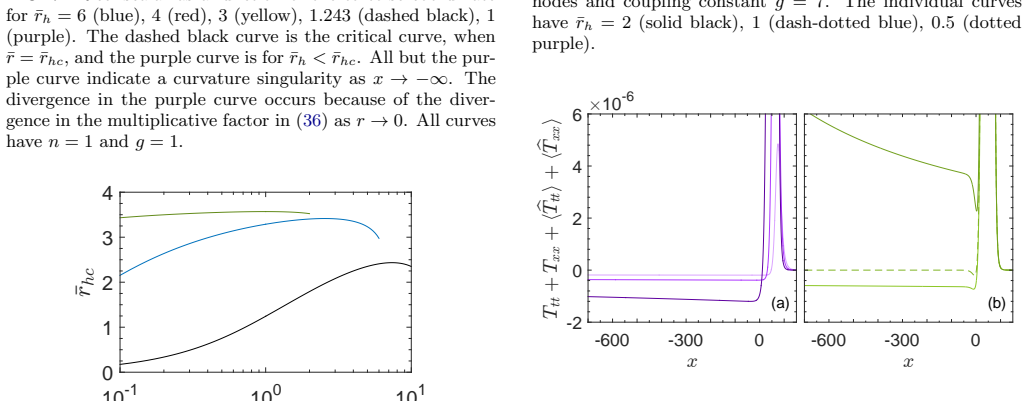
- [Sec. V; Eq. (42)] With the standard choice F = 1/(4πr²) in Eq. (36), the prefactor (1 − F/3) that multiplies both r″ and ν″ in Eq. (42) vanishes at the finite areal radius r = (12π)^{−1/2} ≈ 0.163 (for g = 1); unless the remaining numerator terms in Eq. (42) also vanish there, this is a singular surface of the ODE system, located strictly before the divergence of F at r = 0. The paper attributes the termination of the integrations in Fig. 3(c) to the r → 0 divergence (Sec. V), but it does not report the radius at which the curves stop, does not analyze the behavior of Eq. (42) at the surface 1 − F/3 = 0, and does not continue the integration through it. The statement in Sec. V that 'the classical horizon also disappears when r̄h < r̄hc', inferred from e^ν being nonzero in Fig. 4(a), is therefore an extrapolation: the covered domain only shows e^ν ≠ 0 for radii above the stopping point, and a horizon or curvature singularity in the unresolved interior r ≲ 0.163 is not excluded by the evidence presented. Because the no-wormhole branch is the paper's new qualitative result, and because Sec. IV.A itself states that the Polyakov approximation is expected to be reliable only away from r = 0, the small-branch claim needs support from a regulated choice of F (as in refs. [12, 27, 28]) or from a local singular-point analysis of Eq. (42); absent that, the 'no horizon' conclusion for r̄h < r̄hc should be presented as conditional on the unresolved interior.
- [Sec. IV.E; Sec. V] No numerical accuracy information is reported: no step sizes, tolerances, or convergence tests, and no defined criterion for the 'loss of numerical stability' that terminates the integration. The paper's quantitative and phase-boundary results depend on precisely such details: the critical lines r̄hc(g) in Fig. 8, the critical value r̄hc ≃ 1.243 for n = 1 and g = 1, and especially the re-entrant behavior for n = 2, g = 7 (Fig. 9), where the existence of a no-wormhole window hinges on whether r develops a minimum in a narrow interval of r̄h. A convergence check (e.g., varying the integration tolerance and the outer boundary location) for one representative solution in each phase would separate features of the continuum equations from numerical artifacts; the qualitative horizon-removal claim does not hinge on this, but the phase diagram as presented does.
minor comments (6)
- [Fig. 3(c) caption] The list of horizon radii in the caption ends with a stray '0' after '0.8'; there is no r̄h = 0 entry in the sequence, so this appears to be a typo.
- [Sec. V] The text contains several missing bars on r̄hc ('for ¯rh > rhc', '¯rh < rhc') and a duplicated word in 'this is also the the case for quantum corrected EYM black holes'.
- [Sec. IV.B, Eqs. (40)-(42)] The combination F + rF′/(2r′) is used before it is explained; since primes denote x-derivatives while F is a function of r, a parenthetical note that F′/r′ = dF/dr at first use would improve readability (the explanation currently appears only in Sec. IV.C).
- [Sec. VI.A, Eq. (69)] The throat formula contains √(12πr_th² − 1), which is real only for r_th > (12π)^{−1/2} ≈ 0.163, the same radius at which the coefficient (1 − F/3) in Eq. (42) vanishes; noting this connection would give the reader a useful consistency check on both results.
- [Sec. V, Fig. 7] For the no-wormhole branch, the text says the purple-curve divergence 'occurs because of the divergence in the multiplicative factor in (36)', but it does not state clearly whether this is a curvature singularity, as for the other curves, or an artifact of the unregulated approximation; one clarifying sentence would help.
- [Reference [4]] The bibliographic entry contains '1676th ed.', which appears to be a formatting artifact; please verify.
Circularity Check
No circular derivation; the semiclassical horizon-removal result is obtained by solving the field equations with fixed asymptotic boundary data, not by fitting or renaming an input.
full rationale
The derivation chain is self-contained. Quantum-corrected EYM solutions are computed by numerically integrating Eqs. (38) and (42) inward from a fixed classical asymptotic solution used only as outer boundary data (Sec. IV.E), with no parameter fitted to the target outcome. Horizon absence is read off from the integrated metric function e^nu, which is found to be nonzero in the resolved region (Figs. 4 and 6), so the conclusion is not equivalent by construction to the classical input. The paper contains no self-citations by the author; the cited vacuum and Reissner-Nordstroem counterparts [8-13] are external prior work used for context, not as the load-bearing argument. The most serious caveat is explicitly acknowledged in the paper: for the small-radius branch (r_h < r_hc), integration stops before r=0 because of the divergence in F=1/(4 pi r^2), and the prefactor (1-F/3) in Eq. (42) vanishes at r=(12 pi)^(-1/2), leaving the interior unresolved; this is a completeness/correctness limitation about extrapolation across a singular region, not a circular step, because nothing in the equations was tuned or defined so as to force the claimed horizon removal.
Assumptions & free parameters
assumptions (6)
- domain assumption Semiclassical Einstein equations with the renormalized stress-energy tensor as source
- domain assumption Polyakov approximation for the 3+1 renormalized stress-energy tensor
- domain assumption Standard choice F(r) = 1/(4πr²)
- domain assumption Boulware vacuum state ξ^a = (1,0) for the expectation value
- domain assumption Magnetic ansatz u = 0 and gauge choice v = w2 = 0 for the Yang-Mills field
- ad hoc to paper Qualitative validity of the Polyakov approximation near r = 0
Cite this review
Pith. "Pith review of Quantum corrected Einstein-Yang-Mills black holes in semiclassical gravity." pith.science (2026). https://pith.science/paper/Y322U4EB
@misc{pith2026250208278,
  author       = {Pith},
  title        = {Pith review of: Quantum corrected Einstein-Yang-Mills black holes in semiclassical gravity},
  year         = {2026},
  howpublished = {\url{https://pith.science/paper/Y322U4EB}},
  note         = {Machine review of arXiv:2502.08278}
}
read the original abstract
We study Einstein-Yang-Mills (EYM) black holes in semiclassical gravity by including in the field equations the expectation value of a renormalized energy-momentum tensor in the Polyakov approximation. We solve the field equations and the equations of motion self-consistently. This framework has previously been used to study vacuum solutions, i.e. quantum corrected Schwarzschild black holes. In our system, which contains black hole hair, we find quantum corrected solutions in which the classical horizon disappears and is replaced by a wormhole structure, similarly to what is found in vacuum. We also find quantum corrected solutions in which the classical horizon disappears, but there is no wormhole structure. Our results indicate that the inclusion of black hole hair in semiclassical gravity still leads to the disappearance of classical horizons for nonextremal black holes in static spherically symmetric systems.
Figures


Figures from the paper (5 more)



Forward citations
Cited by 1 Pith paper
-
Dynamical evolution and stability of quantum corrected Schwarzschild black holes in semiclassical gravity
The static quantum corrected Schwarzschild wormhole is dynamically unstable: it expands in vacuum and collapses into an evaporating black hole when a small amount of matter is present.
Reference graph
Works this paper leans on
-
[1]
N. D. Birrell and P. C. W. Davies, Quantum Fields in Curved Space(Cambridge Univ. Press, 1984)
work page 1984
-
[2]
P. R. Anderson, W. A. Hiscock, and D. A. Samuel, Stress - energy tensor of quantized scalar fields in static spher- ically symmetric space-times, Phys. Rev. D 51, 4337 (1995)
work page 1995
-
[3]
P. C. W. Davies, S. A. Fulling, and W. G. Unruh, En- ergy Momentum Tensor Near an Evaporating Black Hole, Phys. Rev. D 13, 2720 (1976)
1976
-
[4]
Davies and S
P. Davies and S. A. Fulling, Quantum vacuum energy in two dimensional space-times, in Proc R Soc London Ser A, Vol. 354 (1977) pp. 59–77, 1676th ed
1977
-
[5]
A. M. Polyakov, Quantum Geometry of Bosonic Strings, Phys. Lett. B 103, 207 (1981)
1981
-
[6]
Fabbri and J
A. Fabbri and J. Navarro-Salas,Modeling black hole evap- oration (2005)
2005
-
[7]
After collapse: On how a physical vacuum can change the black hole paradigm
J. Arrechea, C. Barcel´ o, and V. Boyanov, After Collapse: On How a Physical Vacuum Can Change the Black Hole 13 Paradigm (2024) arXiv:2307.13416 [gr-qc]
work page Pith review arXiv 2024
- [8]
Show all 29 references
-
[9]
Berthiere, D
C. Berthiere, D. Sarkar, and S. N. Solodukhin, The fate of black hole horizons in semiclassical gravity, Phys. Lett. B 786, 21 (2018), arXiv:1712.09914 [hep-th]
2018 arXiv
-
[10]
Ho and Y
P.-M. Ho and Y. Matsuo, Static Black Holes With Back Reaction From Vacuum Energy, Class. Quant. Grav. 35, 065012 (2018), arXiv:1703.08662 [hep-th]
2018 arXiv
-
[11]
Ho and Y
P.-M. Ho and Y. Matsuo, Static Black Hole and Vacuum Energy: Thin Shell and Incompressible Fluid, JHEP 03, 096, arXiv:1710.10390 [hep-th]
-
[12]
Arrechea, C
J. Arrechea, C. Barcel´ o, R. Carballo-Rubio, and L. J. Garay, Schwarzschild geometry counterpart in semi- classical gravity, Phys. Rev. D 101, 064059 (2020), arXiv:1911.03213 [gr-qc]
2020 arXiv
-
[13]
Arrechea, C
J. Arrechea, C. Barcel´ o, R. Carballo-Rubio, and L. J. Garay, Reissner–nordstr¨ om geometry counterpart in semiclassical gravity, Class. Quant. Grav. 38, 115014 (2021), arXiv:2102.03544 [gr-qc]
2021 arXiv
-
[14]
Carballo-Rubio, Stellar equilibrium in semiclassi- cal gravity, Phys
R. Carballo-Rubio, Stellar equilibrium in semiclassi- cal gravity, Phys. Rev. Lett. 120, 061102 (2018), arXiv:1706.05379 [gr-qc]
2018 arXiv
-
[15]
Arrechea, C
J. Arrechea, C. Barcel´ o, R. Carballo-Rubio, and L. J. Garay, Semiclassical constant-density spheres in a reg- ularized Polyakov approximation, Phys. Rev. D 104, 084071 (2021), arXiv:2105.11261 [gr-qc]
2021 arXiv
-
[16]
Beltr´ an-Palau, A
P. Beltr´ an-Palau, A. del R ´ ıo, and J. Navarro-Salas, Quan- tum corrections to the Schwarzschild metric from vac- uum polarization, Phys. Rev. D 107, 085023 (2023), arXiv:2212.08089 [gr-qc]
2023 arXiv
-
[17]
Arrechea, C
J. Arrechea, C. Barcel´ o, R. Carballo-Rubio, and L. J. Garay, Asymptotically flat vacuum solutions in order- reduced semiclassical gravity, Phys. Rev. D 107, 085005 (2023), arXiv:2212.09375 [gr-qc]
2023 arXiv
-
[18]
Arrechea, C
J. Arrechea, C. Barcel´ o, R. Carballo-Rubio, and L. J. Garay, Ultracompact horizonless objects in order- reduced semiclassical gravity, Phys. Rev. D 109, 104056 (2024), arXiv:2310.12668 [gr-qc]
2024 arXiv
-
[19]
M. S. Volkov and D. V. Galtsov, NonAbelian Einstein Yang-Mills black holes, JETP Lett. 50, 346 (1989)
1989
-
[20]
Bizon, Colored black holes, Phys
P. Bizon, Colored black holes, Phys. Rev. Lett. 64, 2844 (1990)
1990
-
[21]
H. P. Kuenzle and A. K. M. Masood-ul Alam, Spheri- cally symmetric static SU(2) Einstein Yang-Mills fields, J. Math. Phys. 31, 928 (1990)
1990
-
[22]
M. S. Volkov, Hairy black holes in the XX-th and XXI-st centuries, in 14th Marcel Grossmann Meeting on Recent Developments in Theoretical and Experimental General Relativity, Astrophysics, and Relativistic Field Theories, Vol. 2 (2017) pp. 1779–1798, arXiv:1601.08230 [gr-qc]
2017 arXiv
-
[23]
Witten, Some Exact Multi - Instanton Solutions of Classical Yang-Mills Theory, Phys
E. Witten, Some Exact Multi - Instanton Solutions of Classical Yang-Mills Theory, Phys. Rev. Lett. 38, 121 (1977)
1977
-
[24]
Bartnik and J
R. Bartnik and J. Mckinnon, Particle - Like Solutions of the Einstein Yang-Mills Equations, Phys. Rev. Lett. 61, 141 (1988)
1988
-
[25]
M. S. Volkov and D. V. Gal’tsov, Gravitating nonAbelian solitons and black holes with Yang-Mills fields, Phys. Rept. 319, 1 (1999), arXiv:hep-th/9810070
1999 arXiv
-
[26]
Barcelo, R
C. Barcelo, R. Carballo, and L. J. Garay, Two for- malisms, one renormalized stress-energy tensor, Phys. Rev. D 85, 084001 (2012), arXiv:1112.0489 [gr-qc]
2012 arXiv
-
[27]
Parentani and T
R. Parentani and T. Piran, The Internal geometry of an evaporating black hole, Phys. Rev. Lett. 73, 2805 (1994), arXiv:hep-th/9405007
1994 arXiv
-
[28]
Ayal and T
S. Ayal and T. Piran, Spherical collapse of a massless scalar field with semiclassical corrections, Phys. Rev. D 56, 4768 (1997), arXiv:gr-qc/9704027
1997 arXiv
-
[29]
M. S. Morris and K. S. Thorne, Wormholes in space-time and their use for interstellar travel: A tool for teaching general relativity, Am. J. Phys. 56, 395 (1988). 14
1988
Reviewed August 8, 2026 · model on record in the stance chip above.
Discussion (0). Continue with ORCID to comment.