REVIEW 3 major objections 4 minor 1 cited by
Oscillons from $Q$-balls
T0 review · 3 major / 4 minor · reviewed 2026-08-07 · deepseek-v4-flash
Pith's one-line read Oscillons are Q-balls of a universal complex field equation.
desk verdict The RGPE map from oscillons to universal Q-balls is a genuine and useful step forward, but the two-Q-ball explanation of amplitude modulations rests on an unquantified complex sine-Gordon approximation and circular numerical seeding. read the letter →
The pith
A machine-rendered reading of the paper's core claim, the machinery that carries it, and where it could break.
The reading
What carries the argument
The engine is the Renormalization Group Perturbation Expansion applied to the complex amplitude: secular terms in the naive expansion are absorbed into a dressed amplitude, and the condition of scale independence produces a renormalization-group equation for the envelope. The universal object is Eq. (37), $\partial^2\Psi + \Psi = 2\Psi|\Psi|^2$, whose Q-ball solution (39) is the seed; the dressing formula (40) maps any solution of this equation back to the real scalar field. For modulation, the load-bearing approximation is the integrable complex sine-Gordon equation (74), which has the same Q-ball solution and whose Lagrangian differs from Eq. (38) by a factor $1/(1-|\Psi|^2)$; it supplies the exact two-Q-ball bound state (79) used as the seed for excited oscillons.
What would settle it
Take the two-Q-ball state (79), insert it as a seed into a numerical simulation of the universal equation $\partial^2\Psi + \Psi = 2\Psi|\Psi|^2$ (or of the original $\phi^3$ equation), and measure how long the evolving field stays close to the exact complex sine-Gordon form (79); if the residual $O(|\Psi|^2)$ difference between the two equations deforms the two-Q-ball bound state substantially at the tested amplitudes, the explanation of amplitude modulation as a two-Q-ball state loses its basis.
Extended reading notes
Core claim
The central claim is that the amplitude of the naive perturbative expansion obeys an amplitude equation which, after rescaling to $\Psi$, becomes $\partial^2\Psi + \Psi = 2\Psi|\Psi|^2$, derived from the Lagrangian $L = |\partial\Psi|^2 - |\Psi|^2 + |\Psi|^4$. Its stationary Q-ball solution $\Psi = \lambda\,\mathrm{sech}(\lambda x)e^{i\omega t}$ with $\omega = \sqrt{1-\lambda^2}$ is the seed; inserting it into the dressing formula gives an unmodulated oscillon that matches numerical solutions for small amplitudes. For modulated oscillons, the paper takes the exact two-Q-ball solution of the complex sine-Gordon equation, which shares the same single Q-ball, and shows that the resulting dressed field reproduces the amplitude modulations and double-centered profiles in the $\phi^3$, reverse $\phi^4$, and double-well $\phi^4$ models. It further argues that $\phi^6$-type potentials, whose renormalization-group equation is $\partial^2\Psi + \Psi = 3\Psi|\Psi|^4$, belong to a different universality class whose oscillons show no modulations, consistent with numerical evolution.
Load-bearing premise
The argument assumes that the integrable complex sine-Gordon equation, which agrees with the universal renormalization-group equation only up to corrections of order $|\Psi|^2$, is a faithful stand-in for describing modulated oscillons, so that the exact two-Q-ball solution remains a valid approximate seed of the actual renormalization-group equation.
Editorial extensions
If this is right
- Any model with a nonzero cubic or quartic self-interaction inherits the same leading Q-ball equation, so oscillons in $\phi^3$, reverse $\phi^4$, and double-well $\phi^4$ belong to one universality class.
- Amplitude modulation of excited oscillons is a two-degree-of-freedom effect: a bound state of two unmodulated oscillons, each contributing its own Q-ball frequency.
- Potentials without cubic and quartic terms, such as the $\phi^6$ model, flow to a different renormalization-group equation and produce oscillons without amplitude modulation.
- At next order the renormalization-group equation acquires a model-dependent $\Psi|\Psi|^4$ term; for the sine-Gordon potential, the corrected renormalized solution matches the expansion of the exact breather, which checks the consistency of the scheme.
- The Q-ball relation suggests that Q-ball phenomena such as charge swapping, superradiance, and negative radiation pressure should have oscillon counterparts.
Reading between the lines
- If the Q-ball picture is right, oscillon longevity may be understood as an approximate conservation law inherited from the U(1) symmetry of the universal complex theory, rather than as accidental fine-tuning; the paper gestures at this but does not prove it.
- The two-Q-ball formula predicts a beat frequency $\omega_1 - \omega_2$ between the two constituent oscillons, so measuring the modulation frequency spectrum of excited oscillons and comparing it with the two Q-ball frequencies would test the bound-state interpretation directly.
- Because the two-Q-ball seed is exact only for complex sine-Gordon, the strong-modulation regime (where $\lambda_2$ is not small) is where the approximation should break; checking the residual of Eq. (37) on the seed (79) across the tested amplitude range would set the validity boundary of the explanation.
- The universality classification suggests that oscillon spectra and decay channels, not just amplitude profiles, should organize by renormalization-group universality class; comparing radiation rates of $\phi^3$ versus $\phi^6$ oscillons would test this.
Editorial analysis
A structured set of objections, weighed in public.
Referee Report
Summary. The paper develops a renormalization-group perturbative expansion (RGPE) for (1+1)-dimensional scalar field theories and shows that, to leading nonlinear order, oscillons are generated by Q-ball solutions of a universal complex scalar equation, Eq. (37), through the dressing formula (40). For potentials with nonzero cubic or quartic terms, the universal Q-ball equation is argued to be well approximated by the integrable complex sine-Gordon (CsG) model, and the paper proposes that amplitude-modulated (excited) oscillons are bound states of two unmodulated oscillons, described analytically by the two-Q-ball solution (79) of CsG. The authors test this proposal numerically for the phi^3, reversed phi^4, and double-well phi^4 models, and contrast these with an exotic phi^6 model that belongs to a different universality class and shows no amplitude modulation.
Significance. If the central claim is established, the paper provides a conceptually new explanation of oscillon amplitude modulation as a two-Q-ball bound-state effect and a universality-based classification of oscillon models, going beyond the standard FFHL single-frequency expansion. The paper has genuine strengths: the RGPE algebra through Eq. (40) is explicit and coherent; the single-Q-ball ansatz reproduces known small-amplitude oscillons across several models; the higher-order consistency check against the sine-Gordon breather in Section VI is a valuable nontrivial check; and the identification of a distinct universality class for exotic phi^6 potentials is a falsifiable prediction. However, the load-bearing step for the modulated-oscillon claim, namely the replacement of the non-integrable RG equation (37) by the integrable CsG equation (74) for multi-Q-ball states, is asserted without a quantitative error estimate, and the numerical validation is built on initial data taken from the very two-Q-ball ansatz being tested.
major comments (3)
- [§V.A, Eqs. (37), (74), (79)] The central claim that modulated oscillons are two-Q-ball bound states rests on the assertion that the complex sine-Gordon equation (74) approximates the universal RG equation (37) also for multi-Q-ball states. While both equations share the single Q-ball solution (39), the field equations differ by the term -\barΨ(∂Ψ)^2/(1-|Ψ|^2) plus the difference between -2Ψ|Ψ|^2 and -Ψ|Ψ|^2; this residual vanishes identically for the single Q-ball but there is no reason it should vanish for the coincident two-Q-ball solution (79). The paper provides no estimate of the residual of (79) in (37) over the ranges of λ1 and λ2 used in Figures 12–18. I request an explicit computation of this residual, or a controlled perturbative argument showing that the correction is small in the amplitude regime considered; without it, the two-Q-ball description of modulated oscillons is not quantitatively established.
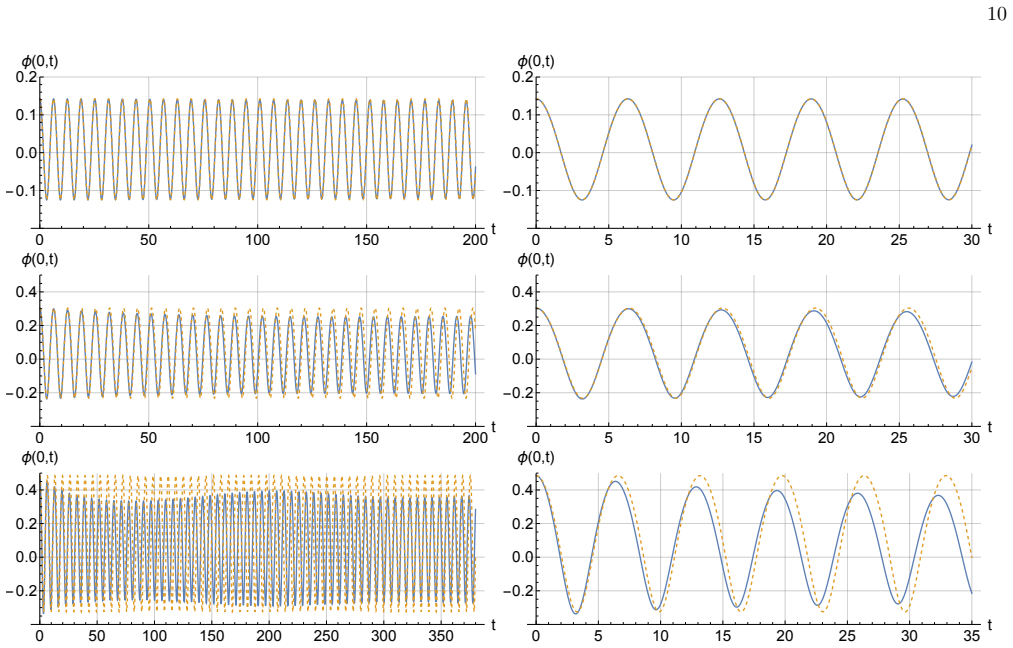
- [§V.B and §V.C, Figs. 12–18] The numerical validation of the two-Q-ball proposal is significantly weakened by the way the tests are set up. In every case shown, the initial data are constructed from the analytical two-Q-ball ansatz via the dressing formula (80), and the parameters λ1 and λ2 are selected by hand to match the modulation pattern of the target oscillon. What these simulations demonstrate is that the chosen ansatz is close to a true solution and persists over long times, which is a useful consistency check. They do not demonstrate that generic excited oscillons are two-Q-ball bound states, because no generic initial data are evolved and no basin-of-attraction study is reported. I suggest adding tests with perturbed initial data, or evolving large-amplitude single-Q-ball seed profiles (as in Figs. 3–4) and checking whether the resulting modulated states are quantitatively captured by the two-Q-ball formula with extracted parameters.
- [§IV.D, Figs. 9–11] The paper claims that oscillons in the exotic phi^6 model belong to a different universality class and, in particular, that this model does not possess modulated oscillons. The supporting evidence is the absence of visible modulation in a small number of simulations initialized with the single-Q-ball renormalized solution. Since the initial-data space is not explored, this absence could reflect a lack of excitation rather than a structural property of the model. A stronger statement would require either a systematic scan over two-frequency initial data or an analytic argument (for instance, the absence of a relevant internal mode or of a nearby two-Q-ball solution in the corresponding RG equation (53)) that no modulated bound states exist in this class.
minor comments (4)
- [Fig. 15 caption] The caption contains a typo ('duble well') and the sentence 'see Fig. 15, Fig. 15 where we plot...' repeats the figure reference.
- [§V.C] The phrase 'double Q-solution' should be 'two-Q-ball solution', and 'nonexistence of modulated oscillons' would read more accurately as 'the absence of observed modulated oscillons in our simulations'.
- [Eq. (79) and Figs. 12–16] The two-Q-ball solution (79) is used with negative values of λ2 in several figures, but the sign of λ in the single Q-ball solution (39) is not discussed. Since λ appears in cosh(λ x) and in the Q-ball frequency, the meaning of negative λ should be clarified, including whether it represents a phase-shifted or otherwise distinct configuration.
- [Eqs. (76)–(78)] Equation (76) uses the kink solutions ΨK_{1,2} before they are defined in Eq. (78); reordering these definitions would improve readability.
Circularity Check
Core single-Q-ball RG derivation is self-contained, but the headline modulation claim reduces to a freely parametrized complex-sine-Gordon ansatz seeded into the numerics, so the two-Q-ball 'explanation' is a fit rather than a derived prediction.
-
fitted input called prediction
[Section V.A, Eqs. (74)-(79), and Section V.B, Eq. (80) and following comparison]
"It is a matter of fact that, for the case of the generic potentials, the universal RG Q-ball equation can be approximated by the integrable complex sine-Gordon (CsG) equation: ... The sense, in which this equation is “close” to RG equation (37) is that it has exactly the same Q-ball solution given in Eq. (39). ... For our purposes and for simplicity, let us consider the coincident, stationary two Q-ball solutions ... This solution can be explicitly given in the following compact form Ψ12 = ... (79). Let us now treat this two-Q-ball state as a seed for the renormalized solution. ..."
The two-Q-ball state (79) is an exact solution of the integrable CsG equation (74), not of the universal RG equation (37) that was derived for generic scalar potentials. The only stated justification for replacing (37) by (74) is that both share the single Q-ball solution (39); no residual or error estimate is given for coincident two-Q-ball states. The parameters λ1, λ2 (and hence the frequencies ω1, ω2) are free: they are not derived from the original scalar potential or from the initial data that produces the target modulated oscillon, but are selected so that the ansatz reproduces the observed two-frequency modulation.
full rationale
The central RGPE derivation (Eqs. (21)-(40)) is self-contained and not circular: the universal RG equation (37) is obtained from a perturbation expansion without fitting to target oscillons, and the single-Q-ball dressing formula (40) is an honest approximate construction subsequently compared with numerics. The non-generic cases of Section III.B are also derived rather than fitted. The circularity concern is localized to the modulation claim in Section V. There, the universal equation is replaced by the integrable complex sine-Gordon equation solely because the two models share the single Q-ball solution; no error control is provided for multi-Q-ball superpositions. The two-Q-ball seed (79) is exact for CsG but only approximate for Eq. (37), and its parameters λ1, λ2 are free tuning parameters chosen to match the observed modulation pattern. The numerics initialize from this same two-Q-ball ansatz, so the impressive agreement shows that the ansatz is dynamically self-consistent when inserted by hand, not that the theory predicts the two-Q-ball decomposition. The self-citations ([33] and the companion Letter [39]) are not load-bearing for the derivation itself: [33] is cited as prior support for the two-oscillon interpretation, and the RG map stands independently. Nevertheless, because the paper's headline explanatory claim about amplitude modulation reduces to a fitted ansatz with adjustable parameters and an unquantified model replacement, a score of 6 is warranted as partial circularity.
Assumptions & free parameters
free parameters (2)
- single Q-ball scale lambda =
0.1 to 0.6 in phi3, inverse phi4, double-well phi4; 0.05 to 0.3 in exotic phi6
- two-Q-ball scales lambda1 and lambda2 =
e.g., 0.2 and -0.02; 0.3 and -0.1; 0.25 and -0.15; 0.1 and -0.15
assumptions (5)
- standard math Naive small-amplitude perturbation series in epsilon is asymptotic and secular terms can be resummed by the RGPE renormalization of the bare amplitude.
- domain assumption The scalar potential can be translated so the oscillon oscillates around a minimum at phi = 0 and the mass is rescaled to 1.
- domain assumption The generic case requires at least one of a3 and a4 nonzero and the condition 10 a3^2/3 + 3 a4 > 0.
- ad hoc to paper The complex sine-Gordon equation (74) approximates the universal RG equation (37) sufficiently well for multi-Q-ball solutions to describe modulated oscillons.
- ad hoc to paper The two-Q-ball seed remains valid for generic potentials of the universality class, although the actual RG equation (37) is not shown to possess two-Q-ball solutions.
invented entities (1)
-
auxiliary complex field Psi
Cite this review
Pith. "Pith review of Oscillons from $Q$-balls." pith.science (2026). https://pith.science/paper/Q4ZGSUA4
@misc{pith2026250209136,
  author       = {Pith},
  title        = {Pith review of: Oscillons from $Q$-balls},
  year         = {2026},
  howpublished = {\url{https://pith.science/paper/Q4ZGSUA4}},
  note         = {Machine review of arXiv:2502.09136}
}
abstract
Using Renormalization Group Theory we show that oscillons in (1+1)-dimensions can be obtained, at the leading nonlinear order, from $Q$-balls of universal complex field theories. For potentials with a nonzero cubic or quartic term the universal $Q$-ball theory is well approximated by the integrable complex sine-Gordon model. This allows us to generalize the usual perturbative expansion by Fodor et. al. beyond the simplest unmodulated oscillon case. Concretely, we explain the characteristic amplitude modulations of excited oscillons as an effect of formation of a two-$Q$-ball (two-oscillon) bound state.
Figures


Figures from the paper (15 more)




Forward citations
Cited by 1 Pith paper
-
Oscillon Floquet Modes and the Operators that Excite Them
Relativistic Floquet modes of the oscillon are expressed in elementary functions, and their quantum creation/annihilation operators are shown to satisfy the oscillator algebra at the computed order.
Reference graph
Works this paper leans on
-
[33]
Amplitude modulations and reso- nant decay of excited oscillons,
F. Blaschke, T. Roma´ nczukiewicz, K. S lawi´ nska and A. Wereszczy´ nski, “Amplitude modulations and reso- nant decay of excited oscillons,” Phys. Rev. E 110 (2024) no.1, 014203 doi:10.1103/PhysRevE.110.014203 [arXiv:2403.00443 [hep-th]]
arXiv 2024
-
[1]
I. L. Bogolyubsky and V. G. Makhankov, ”On the pulsed soliton lifetime in two classical relativistic theory mod- els”, JETP Lett. 24 (1976) 12
work page 1976
-
[2]
Gleiser, ”Pseudostable bubbles”, Phys
M. Gleiser, ”Pseudostable bubbles”, Phys. Rev. D 49 (1994) 2978
work page 1994
-
[3]
E. J. Copeland, M. Gleiser, and H. R. Muller, ”Oscillons: Resonant configurations during bubble collapse”, Phys. Rev. D 52 (1995) 1920
work page 1995
-
[4]
d-dimensional Oscillating Scalar Field Lumps and the Dimensionality of Space
M. Gleiser, “d-dimensional oscillating scalar field lumps and the dimensionality of space,” Phys. Lett. B 600 (2004), 126-132 doi:10.1016/j.physletb.2004.08.064 [arXiv:hep-th/0408221 [hep-th]]
work page Pith review arXiv 2004
-
[5]
Analytical Characteriza- tion of Oscillon Energy and Lifetime,
M. Gleiser and D. Sicilia, “Analytical Characteriza- tion of Oscillon Energy and Lifetime,” Phys. Rev. Lett. 101 (2008), 011602 doi:10.1103/PhysRevLett.101.011602 [arXiv:0804.0791 [hep-th]]
arXiv 2008
-
[6]
M. Hindmarsh and P. Salmi, ”Oscillons and domain walls”, Phys. Rev. D 77 (2008) 105025
work page 2008
-
[7]
M. Gleiser and D. Sicilia, ”A General Theory of Oscillon Dynamics”, Phys. Rev. D 80 (2009) 125037
work page 2009
Show all 51 references
-
[8]
M. A. Amin and D. Shirokoff, ”Flat-top oscillons in an expanding universe”, Phys. Rev. D 81 (2010) 085045
2010
-
[9]
M. A. Amin, ”K-oscillons: Oscillons with noncanonical kinetic terms”, Phys. Rev. D 87 (2013) 123505
2013
-
[10]
D. G. Levkov, V. E. Maslov, E. Ya. Nugaev, and A. G. Panin, ”An Effective Field Theory for large oscillons”, JHEP 12 (2022) 079
2022
-
[11]
Van Dissel and E
F. Van Dissel and E. I. Sfakianakis, ”Symmetric multi- field oscillons”, Phys. Rev. D 106 (2022) 096018
2022
-
[12]
van Dissel, O
F. van Dissel, O. Pujolas and E. I. Sfakianakis, ”Oscillon spectroscopy”, JHEP 07 (2023) 194
2023
-
[13]
Zhou, ”Non-topological solitons and quasi- solitons”, arXiv:2411.16604
S.-Y. Zhou, ”Non-topological solitons and quasi- solitons”, arXiv:2411.16604
-
[14]
Gleiser, ”Oscillons in scalar field theories: Applica- tions in higher dimensions and inflation”, Int
M. Gleiser, ”Oscillons in scalar field theories: Applica- tions in higher dimensions and inflation”, Int. J. Mod. Phys. D 16 (2007) 219. 22
2007
-
[15]
M. A. Amin, R. Easther, H. Finkel, R. Flauger and M. P. Hertzberg, ”Oscillons After Inflation”, Phys. Rev. Lett. 108 (2012) 241302
2012
-
[16]
Flauger, L
R. Flauger, L. McAllister, E. Pajer, A. Westphal, G. Xu, ”Oscillations in the CMB from Axion Monodromy Infla- tion”, JCAP 06 (2010) 009
2010
-
[17]
K. D. Lozanov, V. Takhistov, ”Enhanced Gravitational Waves from Inflaton Oscillons”, Phys. Rev. Lett. 130 (2023) 18, 181002
2023
-
[18]
Oscillon formation during inflationary preheating with general rel- ativity,
J. C. Aurrekoetxea, K. Clough and F. Muia, “Oscillon formation during inflationary preheating with general rel- ativity,” Phys. Rev. D 108 (2023) no.2, 023501
2023
-
[19]
J. Olle, O. Pujolas, F. Rompineve, ”Oscillons and Dark Matter”, JCAP 02 (2020) 006
2020
-
[20]
Kawasaki, W
M. Kawasaki, W. Nakano, E. Sonomoto, ”Oscillon of Ultra-Light Axion-like Particle”, JCAP 01 (2020) 047
2020
-
[21]
Charukhchyan, E.S
M.V. Charukhchyan, E.S. Sedov, S.M. Arakelian, and A. P. Alodjants, ”Spatially localized structures and oscillons in atomic Bose-Einstein condensates confined in optical lattices”, Phys. Rev. A 89 (2014) 063624
2014
-
[22]
Graham, ”An Electroweak Oscillon”, Phys
N. Graham, ”An Electroweak Oscillon”, Phys. Rev. Lett. 98 (2007) 101801, [Erratum-ibid. 98, 189904 (2007)]
2007
-
[23]
Graham, ”Numerical Simulation of an Electroweak Oscillon”, Phys
N. Graham, ”Numerical Simulation of an Electroweak Oscillon”, Phys. Rev. D 76 (2007) 085017
2007
-
[24]
Friedberg, T
R. Friedberg, T. D. Lee, and A. Sirlin, ”Class of scalar- field soliton solutions in three space dimensions”, Phys. Rev. D 13 (1976) 2739
1976
-
[25]
Coleman, ”Q-balls”, Nucl
S. Coleman, ”Q-balls”, Nucl. Phys. B 262 (1985) 263
1985
-
[26]
T. D. Lee and Y. Pang, ”Nontopological solitons”, Phys. Rep. 221 (1992) 251
1992
-
[27]
M. I. Tsumagari, E. J. Copeland, and P. M. Saffin, ”Some stationary properties of a Q-ball in arbitrary space di- mensions”, Phys. Rev. D 78 (2008) 065021
2008
-
[28]
Kasuya, M
S. Kasuya, M. Kawasaki, F. Takahash, ”I-balls”, Phys. Lett. B 559 (2003) 99
2003
-
[29]
Kawasaki, F
M. Kawasaki, F. Takahashi, N. Takeda, ”Adiabatic In- variance of Oscillons/I-balls”, Phys. Rev. D 92 (2015) 105024
2015
-
[30]
M. Ibe, M. Kawasaki, W. Nakano, E. Sonomoto, ”Decay of I-ball/Oscillon in Classical Field Theory”, JHEP 04 (2019) 030
2019
-
[31]
Mukaida, M
K. Mukaida, M. Takimoto, ”Correspondence of I- and Q- balls as Non-relativistic Condensates”, JCAP 08 (2014) 051
2014
-
[32]
By construction, it is based on one parameter (the fundamental frequency) and therefore it sheds no light on the problem of amplitude modulation
provides an approximated treatment of unmodulated oscillons. By construction, it is based on one parameter (the fundamental frequency) and therefore it sheds no light on the problem of amplitude modulation. Recently, it has been proposed that a modulated oscil- lon (excited os...
2025 arXiv
-
[34]
Renor- malization Group Theory for Global Asymptotic Analysis,
L. Y. Chen, N. Goldenfeld and Y. Oono, “Renor- malization Group Theory for Global Asymptotic Analysis,” Phys. Rev. Lett. 73 (1994), 1311- 1315 doi:10.1103/PhysRevLett.73.1311 [arXiv:cond- mat/9407024 [cond-mat]]
1994
-
[35]
Small amplitude quasi-breathers and oscillons,
G. Fodor, P. Forgacs, Z. Horvath and A. Lukacs, “Small amplitude quasi-breathers and oscillons,” Phys. Rev. D 78 (2008), 025003 doi:10.1103/PhysRevD.78.025003 [arXiv:0802.3525 [hep-th]]
2008 arXiv
-
[36]
Next, connection to the integrable CsG should be fur- ther investigated as it may provide a new insight into the problem of the unexpected stability of oscillons
or the Derrick modes [45] along the Relativistic Mod- uli Space approach [46]. Next, connection to the integrable CsG should be fur- ther investigated as it may provide a new insight into the problem of the unexpected stability of oscillons. More- over, it opens a path to the ...
2024
-
[37]
K. Oles, J. Queiruga, T. Romanczukiewicz, and A. Wereszczynski, ”Sphaleron without shape mode and its oscillon”, Phys. Lett. B 847 (2023) 138300
2023
-
[38]
The Renormalization group and singular perturbations: Multiple scales, boundary layers and reductive per- turbation theory,
L. Y. Chen, N. Goldenfeld and Y. Oono, “The Renormalization group and singular perturbations: Multiple scales, boundary layers and reductive per- turbation theory,” Phys. Rev. E 54 (1996), 376-394 doi:10.1103/PhysRevE.54.376 [arXiv:hep-th/9506161 [hep-th]]
1996 arXiv
-
[39]
Simplest oscillon and its sphaleron,
N. S. Manton and T. Roma´ nczukiewicz, “Simplest oscillon and its sphaleron,” Phys. Rev. D 107 (2023) no.8, 085012 doi:10.1103/PhysRevD.107.085012 [arXiv:2301.09660 [hep-th]]
2023 arXiv
-
[40]
D. L. T. Anderson, G. H. Derrick, ”Stability of Time- Dependent Particle-like Solutions in Nonlinear Field Theories I”, Journal of Mathematical Physics 11 (4) (1970) 1336
1970
-
[41]
Q-balls, Inte- grability and Duality,
P. Bowcock, D. Foster and P. Sutcliffe, “Q-balls, Inte- grability and Duality,” J. Phys. A 42 (2009), 085403 doi:10.1088/1751-8113/42/8/085403 [arXiv:0809.3895 [hep-th]]
2009 arXiv
-
[42]
Blaschke, T
F. Blaschke, T. Roma´ nczukiewicz, K. S lawi´ nska and A. Wereszczy´ nski, companion Letter, ”Oscillons fromQ- balls through renormalization”, Phys. Rev. Lett. 134, 081601 (2025)
2025
-
[43]
This also indicates that various Q- ball-tailored methods may be easily applied to oscillons
or negative radiation pressure [44]) may possess os- cillon counterparts. This also indicates that various Q- ball-tailored methods may be easily applied to oscillons. For example, a collective coordinate model capturing the modulated structure of oscillons may be done along t...
-
[44]
J. Olle, O. Pujolas, F. Rompineve, ”Recipes for oscillon longevity”, JCAP 09 (2021) 015
2021
-
[45]
E. J. Copeland, P. M. Saffin and S.-Y. Zhou, ”Charge- Swapping Q-balls”, Phys. Rev. Lett. 113 (2014) 231603,
2014
-
[46]
P. M. Saffin, Q.-X. Xie, S.-Y. Zhou, ”Q-ball Superradi- ance”, Phys. Rev. Lett. 131 (2023) 11, 11
2023
-
[47]
Perturbations of Q-balls: from spectral struc- ture to radiation pressure,
D. Ciurla, P. Dorey, T. Roma´ nczukiewicz and Y. Shnir, “Perturbations of Q-balls: from spectral struc- ture to radiation pressure,” JHEP 07 (2024), 196 doi:10.1007/JHEP07(2024)196 [arXiv:2405.06591 [hep- th]]
2024 arXiv
-
[48]
Navarro-Obregon, L
S. Navarro-Obregon, L. M. Nieto, J. Queiruga, ”Inclusion of radiation in the collective coordinate method approach of the ϕ4 model”, Phys. Rev. E 108 (2023) 044216
2023
-
[49]
Adam, N.S
C. Adam, N.S. Manton, K. Oles, T. Romanczukiewicz, A. Wereszczynski, ”Relativistic moduli space for kink colli- sions”, Phys. Rev. D 105 (2022) 065012
2022
-
[50]
Quantum Radiation of Os- cillons,
M. P. Hertzberg, “Quantum Radiation of Os- cillons,” Phys. Rev. D 82 (2010), 045022 doi:10.1103/PhysRevD.82.045022 [arXiv:1003.3459 [hep-th]]
2010 arXiv
-
[51]
Evslin, T
J. Evslin, T. Romanczukiewicz and A. Wereszczynski, ”Quantum Oscillons May be Long-Lived”, JHEP 08 (2023) 182 [arXiv:2305.18056 [hep-th]]
2023 arXiv
Reviewed August 7, 2026 · model on record in the stance chip above.
Discussion (0). Continue with ORCID to comment.