REVIEW 4 major objections 3 minor 78 references
Nuclear modification of $B_c$ mesons in relativistic heavy-ion collisions based on a linear Boltzmann transport model
T0 review · 4 major / 3 minor · reviewed 2026-08-07 · deepseek-v4-flash
Pith's one-line read The paper argues that nearly all B_c mesons created in the initial hard collisions dissociate inside the quark-gluon plasma, and the observed yield is rebuilt by recombination at low momentum and bottom-quark fragmentation at high momentum.
desk verdict Solid LBT extension to B_c with real RHIC predictions; the quasifree dissociation rate is the one uncontrolled input that should decide whether the 'most primordial B_c melt' conclusion holds. read the letter →
The pith
A machine-rendered reading of the paper's core claim, the machinery that carries it, and where it could break.
The reading
What carries the argument
The engine of the calculation is the quasifree dissociation criterion, Eq. (12): a B_c bound state breaks when either constituent heavy quark scatters with a thermal parton and the four-momentum transfer exceeds the in-medium binding energy. The binding energies come from the T-matrix spectral functions of Ref. [40], which give dissociation temperatures of 420 MeV for the 1S state and 260 MeV for the 1P state. The scattering rates are computed from an in-medium Cornell-type potential, Eq. (5), separated into a Yukawa term and a string term; the string term is more sensitive to small momentum transfers, which is why it dominates the dissociation rate. Regeneration is handled by extending the instantaneous coalescence model of Ref. [49] to charm–anti-bottom pairs, with the overall normalization $C_{\rm rec}$ constrained to 3.6–6.3 by the CMS data, and by applying the bottom-quark fragmentation function of Ref. [50] to medium-modified bottom quarks.
What would settle it
Measure the B_c $R_{\mathrm{AA}}$ in Au+Au collisions at $\sqrt{s_{NN}}=200$ GeV in the window $7<p_T<13$ GeV: the model predicts a larger value than in Pb+Pb at 5.02 TeV with a weak dependence on centrality, so a smaller or strongly centrality-dependent result would indicate that the dissociation rate or the volume dependence is wrong.
Extended reading notes
Core claim
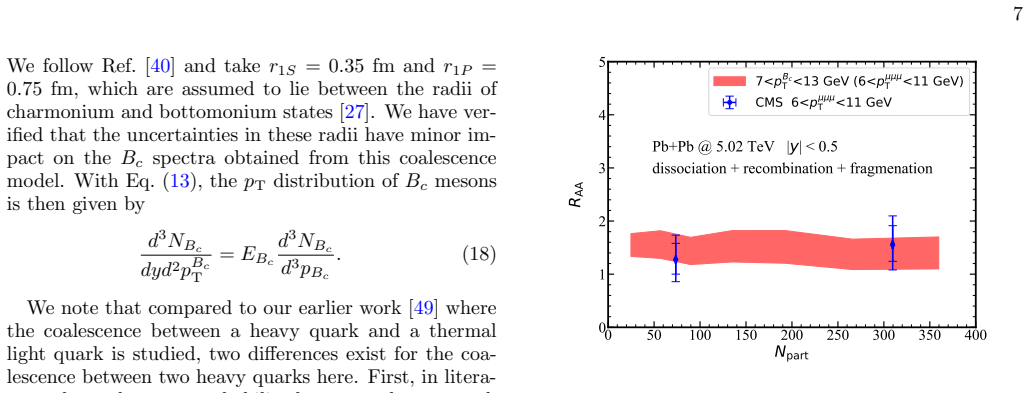
On its own terms, the paper's central claim is that the nuclear modification of B_c mesons in relativistic heavy-ion collisions is controlled by quasifree dissociation of the initially produced mesons followed by regeneration from medium-modified heavy quarks. A B_c bound state is destroyed whenever one of its constituent heavy quarks scatters with a thermal parton and receives a four-momentum transfer larger than the in-medium binding energy; with the T-matrix binding energies adopted from Ref. [40], this removes most primordial B_c mesons. The surviving and regenerated population is then dominated by $c$–$\bar{b}$ coalescence at low $p_T$ and by $\bar{b}$ fragmentation at high $p_T$. The same transport calculation also reproduces the measured $R_{\mathrm{AA}}$ of D and B mesons, and it yields a reasonable description of the CMS B_c $R_{\mathrm{AA}}$ data in Pb+Pb collisions at $\sqrt{s_{NN}}=5.02$ TeV, together with predictions for Au+Au collisions at $\sqrt{s_{NN}}=200$ GeV.
Load-bearing premise
The whole picture rests on the quasifree dissociation rule that a B_c meson breaks whenever one of its heavy quarks is hit harder than its T-matrix binding energy, together with the simplification that regenerated B_c mesons are not dissociated again.
Editorial extensions
If this is right
- If the central claim is right, the B_c yield measured in Pb+Pb collisions tells us little about primordial B_c production and mostly measures how many charm and bottom quarks survive to recombine near hadronization.
- The weak participant-number dependence of the B_c $R_{\mathrm{AA}}$ at low $p_T$ follows from the competition between the growing heavy-quark abundance and the growing QGP volume; using a fixed volume would instead produce a rising $R_{\mathrm{AA}}$.
- Because the string interaction dominates both dissociation and energy loss, B_c suppression becomes a targeted probe of the nonperturbative component of heavy-quark interactions with the plasma.
- At RHIC energy the model predicts a larger B_c $R_{\mathrm{AA}}$ than at the LHC at low $p_T$ and a smaller one at high $p_T$, driven mainly by the softer pp baseline rather than by less energy loss.
Reading between the lines
- An implied experimental test is the RHIC measurement the paper quantifies: with a B_c cross section near 30 microbarns in minimum-bias Au+Au collisions, over 400,000 B_c mesons could be collected in 100 billion events, which would check the dissociation–recombination balance at a lower plasma temperature.
- The omission of secondary dissociation of regenerated B_c mesons likely makes the extracted recombination constant $C_{\rm rec}$ an upper limit; implementing full back-conversion between heavy quarks and B_c mesons would probably lower the low-$p_T$ enhancement.
- The volume dependence that is unique to B_c coalescence implies that precise centrality-dependent B_c data could constrain the spatial extent of the plasma at hadronization, something single-heavy-quark hadrons cannot do.
Editorial analysis
A structured set of objections, weighed in public.
Referee Report
Summary. This manuscript extends the linear Boltzmann transport (LBT) model to the nuclear modification of B_c mesons in relativistic heavy-ion collisions. The authors compute a p+p baseline using FONLL heavy-quark spectra and a perturbative fragmentation function for B_c, then simulate heavy-quark propagation in a hydrodynamic QGP background with both Yukawa and string interactions. B_c dissociation is treated through a quasifree picture in which a bound state breaks when a constituent heavy quark receives a momentum transfer exceeding the temperature-dependent binding energy taken from a T-matrix calculation. Final-state B_c mesons are produced from medium-modified charm and bottom quarks via instantaneous coalescence and from bottom-quark fragmentation. The model is compared with CMS data for the B_c R_AA in Pb+Pb collisions at 5.02 TeV, and predictions are given for Au+Au collisions at 200 GeV. The central claims are that most primordial B_c mesons dissociate in the QGP, that regeneration via coalescence dominates at low pT and fragmentation at high pT, and that the string interaction dominates over the Yukawa interaction in the nuclear modification of B_c mesons.
Significance. If the central claims hold, this is one of the first transport-model descriptions of B_c mesons that simultaneously describes open heavy-flavor mesons and a heavy quarkonium-like bound state within the same LBT framework. The paper has clear strengths: the p+p B_c baseline is anchored to CMS data, the D- and B-meson R_AA validation in Fig. 2 supports the credibility of the medium-modified heavy-quark spectra, and the Au+Au predictions are falsifiable. The result that B_c R_AA is recombination-dominated at low pT and fragmentation-dominated at high pT is physically interesting and would complement existing charmonium and bottomonium studies. However, the significance is moderated by the fact that the coalescence normalization is fit to the same Pb+Pb B_c R_AA data that are later presented as a description, and by the uncontrolled approximation in the quasifree dissociation rate, which is the key input behind the 'most primordial B_c dissociate' conclusion.
major comments (4)
- [Sec. III B, Eq. (12)] The quasifree dissociation rate is the load-bearing input for the claim that most primordial B_c mesons dissociate, but it is not validated against the T-matrix results of Ref. [40] from which the binding energies are taken. In Eq. (12), a B_c is destroyed whenever a constituent heavy quark receives a 4-momentum transfer larger than E_B(T); with E_B(1S) small at T ~ 200-500 MeV and T_diss(1S)=420 MeV, almost any scattering counts as dissociative. The authors do not compare this step-function estimate with the actual in-medium dissociation widths or reaction rates obtained in Ref. [40], so the magnitude of the dissociation rate is an uncontrolled approximation. I ask the authors to benchmark Eq. (12) against the T-matrix widths of Ref. [40] and to show how the R_AA and the recombination/fragmentation decomposition respond to a factor-of-two change in the dissociation rate, or to removing the 1S-only assumption.
- [Sec. IV, Figs. 6 and 8] The normalization C_rec in Eq. (13) is extracted by requiring the model's pT-integrated R_AA to fall within the CMS error bars (Sec. IV, Fig. 6), and the same comparison is then presented as a 'reasonable description' in Fig. 8. This is partly circular: the C_rec fit ensures agreement for the integral, so only the pT shape and the Npart dependence are genuine predictions. The manuscript should explicitly distinguish the fitted normalization from the predicted shape, and should state how much of the agreement in Fig. 8 is attributable to the single fitted constant C_rec in the range (3.6, 6.3).
- [Sec. IV (limitations paragraph) and Sec. V] The manuscript acknowledges in Sec. IV that secondary dissociation of regenerated B_c mesons, inelastic dissociation, and 1P dissociation are not included, and asserts that these have negligible impact because most primordial B_c are destroyed. However, Sec. V states that secondary dissociation of regenerated B_c 'could be important'. Since regenerated B_c are the low-pT dominant component in the central claim, the neglect of their dissociation is not a minor technicality; it could systematically enhance the recombination contribution. The authors should quantify this effect, at least in a simplified estimate, before concluding that the simplifications are negligible.
- [Sec. IV (limitations paragraph)] The acknowledged double counting between B_c mesons produced from fragmentation of initially generated b quarks and from medium-modified b quarks is relevant to the claim that fragmentation dominates at high pT. The statement that this double counting is negligible because only a tiny fraction of b quarks fragment into B_c does not fully address the issue: if the same b quark can be counted once as a primordial B_c and once as a medium-modified fragment, the high-pT yield could be overestimated even when the fraction is small. The authors should either remove the initially generated b-quark fragmentation contribution from the medium-modified spectrum or estimate the double-counted fraction quantitatively.
minor comments (3)
- [Fig. 3] The binding-energy curves are taken from Ref. [40] without uncertainty bands; given that T_diss enters the dissociation rate decisively, an uncertainty estimate or a brief discussion of the T-matrix systematic uncertainty would be useful.
- [Fig. 8] The legend in Fig. 8(a) contains the typo 'fragmenation'; please correct it to 'fragmentation'.
- [Sec. III C] The hadronization temperature used for B_c(1S) coalescence is 220 MeV while heavy-quark hadronization for open heavy-flavor mesons is at 165 MeV; the physical motivation for this difference beyond the larger binding energy should be stated more explicitly.
Circularity Check
Partial circularity: the recombination normalization C_rec is fit to the same Pb+Pb R_AA data that the paper reports describing, but the dissociation rates, binding energies, and heavy-quark transport inputs are independent.
-
fitted input called prediction
[Section IV, Eq. (13) and Fig. 6; also Abstract/Section V]
"The model parameter Crec in Eq. (13) is determined by ensuring that our model's output for the Bc meson RAA falls within the error bars of the experimental data [37]."
C_rec is the overall normalization of the recombination term in Eq. (13), and it is explicitly tuned so that the model reproduces the CMS Pb+Pb B_c R_AA data. The later statements that the authors 'obtain a reasonable description of the R_AA of B_c mesons in Pb+Pb collisions' (Abstract and Section V) and the comparison of the pT-differential R_AA in Fig. 8(a) to those same CMS data are therefore not fully independent tests: the overall level of the Pb+Pb R_AA is partly built in by construction. The pT shape and the relative recombination-versus-fragmentation decomposition retain predictive content because C_rec is a single pT-independent constant, so this is partial rather than total circularity.
full rationale
The main derivation chain is largely self-contained or rests on independent inputs. Initial charm and bottom spectra come from FONLL with CT14NLO PDFs; the LBT elastic/inelastic rates use a Yukawa-plus-string potential whose parameters were previously benchmarked against D- and B-meson R_AA and v_2 data; the B_c binding energies and radii are taken from the T-matrix calculation of Ref. [40], which is not by the present authors; and the fragmentation function of Eq. (1) is a published form normalized to p+p CMS data. The one genuinely fitted quantity in the A+A part is C_rec, the overall normalization of the coalescence term, and the paper openly states that it is chosen to make the Pb+Pb R_AA fall inside the CMS error bars. Thus the phrase 'reasonable description' applied to Pb+Pb data is not a pure prediction, and any claim that the model's absolute level of B_c R_AA is confirmed by CMS data would be circular. However, the central physics conclusions, namely that most primordial B_c mesons dissociate, that recombination dominates at low pT while fragmentation dominates at high pT, and that the string interaction dominates over the Yukawa interaction, are driven by the computed dissociation rates, the medium-modified heavy-quark spectra, and the pT-dependent coalescence/fragmentation competition rather than by the single fitted normalization. The Au+Au predictions are genuine model predictions. There is no load-bearing self-citation chain: the cited LBT and potential papers from the present group were validated against external D/B observables, and Ref. [40] provides independent T-matrix input. Overall, the circularity is limited to one fitted parameter feeding the same observable it is used to describe, so a moderate score of 4 is appropriate.
Assumptions & free parameters
free parameters (8)
- C_rec (coalescence normalization) =
3.6 to 6.3
- N (fragmentation normalization) =
0.002
- alpha_s (Yukawa coupling) =
0.27
- sigma (string tension) =
0.45 GeV^2
- Yukawa screening mass coefficients =
a = 0.20 GeV, b = 2.0
- String screening mass coefficients =
a_s = 0, b_s = 0.10 GeV
- Hadronization temperatures for B_c coalescence =
220 MeV for B_c(1S), 165 MeV for B_c(1P)
- B_c radii for Wigner functions =
r_1S = 0.35 fm, r_1P = 0.75 fm
assumptions (6)
- domain assumption The in-medium Cornell potential V(r) = -4/3 alpha_s exp(-m_d r)/r - sigma exp(-m_s r)/m_s describes heavy quark interactions with QGP partons.
- domain assumption Quasifree dissociation: a B_c meson dissociates when one constituent heavy quark receives a 4-momentum transfer larger than the binding energy.
- domain assumption The T-matrix binding energies of B_c(1S) and B_c(1P) from Ref. [40] are correct in-medium values.
- domain assumption Instantaneous coalescence with harmonic oscillator Wigner functions, Eqs. (14) and (15), is a valid hadronization model for c and bbar pairs.
- domain assumption The QGP background from the CLVisc hydrodynamic model, including local temperatures and flow, accurately describes the medium, and the volume at Th can be estimated from the average temperature.
- ad hoc to paper Neglecting secondary dissociation of regenerated B_c mesons, 1P dissociation, inelastic dissociation, and double counting between initial and medium-modified b quark fragmentation has negligible impact.
Cite this review
Pith. "Pith review of Nuclear modification of $B_c$ mesons in relativistic heavy-ion collisions based on a linear Boltzmann transport model." pith.science (2026). https://pith.science/paper/B3GG5DB5
@misc{pith2026250210107,
  author       = {Pith},
  title        = {Pith review of: Nuclear modification of $B_c$ mesons in relativistic heavy-ion collisions based on a linear Boltzmann transport model},
  year         = {2026},
  howpublished = {\url{https://pith.science/paper/B3GG5DB5}},
  note         = {Machine review of arXiv:2502.10107}
}
abstract
The nuclear modification factor ($R_\mathrm{AA}$) of $B_c$ mesons in high-energy nuclear collisions provides a novel probe of heavy quark interactions with the quark-gluon plasma (QGP). Based on a linear Boltzmann transport model that incorporates both Yukawa and string types of interactions between heavy quarks and the QGP, we study the production and evolution of heavy quarks and $B_c$ mesons within the same framework. A $B_c$ bound state dissociates while one of its constituent heavy quarks scatters with the QGP with momentum transfer greater than its binding energy. The medium-modified charm and bottom quarks can recombine into $B_c$ mesons, and the medium-modified bottom quarks can also fragment to $B_c$ mesons. We find that most primordial $B_c$ mesons generated from the initial hard collisions dissociate inside the QGP. The production of $B_c$ mesons is primarily driven by the recombination mechanism at low transverse momentum and fragmentation at high transverse momentum. The string interaction dominates over the Yukawa interaction in the nuclear modification of $B_c$ mesons. The participant number dependence of the $B_c$ meson $R_\mathrm{AA}$ is determined by the complicated interplay between the heavy quark yield, energy loss, and the QGP volume. We obtain a reasonable description of the $R_\mathrm{AA}$ of $B_c$ mesons in Pb+Pb collisions at $\sqrt{s_\mathrm{NN}}=5.02$ TeV, and provide predictions for Au+Au collisions at $\sqrt{s_\mathrm{NN}}=200$ GeV.
Figures


Figures from the paper (6 more)




Reference graph
Works this paper leans on
-
[40]
B. Wu, Z. Tang, M. He, and R. Rapp, Phys. Rev. C 109, 014906 (2024), arXiv:2302.11511
arXiv 2024
-
[1]
M. Gyulassy and L. McLerran, Nucl. Phys. A 750, 30 (2005), arXiv:nucl-th/0405013
arXiv 2005
-
[2]
P. Jacobs and X.-N. Wang, Prog. Part. Nucl. Phys. 54, 443 (2005), arXiv:hep-ph/0405125
arXiv 2005
- [3]
-
[4]
A. Andronic et al., Eur. Phys. J. C 76, 107 (2016), arXiv:1506.03981
arXiv 2016
-
[5]
X. Dong, Y.-J. Lee, and R. Rapp, Ann. Rev. Nucl. Part. Sci. 69, 417 (2019), arXiv:1903.07709
arXiv 2019
-
[6]
Dong and V
X. Dong and V. Greco, Prog. Part. Nucl. Phys. 104, 97 (2019)
2019
- [7]
Show all 78 references
- [8]
- [9]
-
[10]
Liu, X.-Y
F.-L. Liu, X.-Y. Wu, S. Cao, G.-Y. Qin, and X.-N. Wang, Phys. Lett. B 848, 138355 (2024), arXiv:2304.08787
2024 arXiv
- [11]
-
[12]
Matsui and H
T. Matsui and H. Satz, Phys. Lett. B 178, 416 (1986)
1986
-
[13]
H. Satz, J. Phys. G 32, R25 (2006), arXiv:hep- ph/0512217
2006
-
[14]
Vogt, Phys
R. Vogt, Phys. Rept. 310, 197 (1999)
1999
-
[15]
Wong, Phys
C.-Y. Wong, Phys. Rev. C 72, 034906 (2005), arXiv:hep- ph/0408020
2005
-
[16]
R. Rapp, D. Blaschke, and P. Crochet, Prog. Part. Nucl. Phys. 65, 209 (2010), arXiv:0807.2470
2010 arXiv
-
[17]
Chatrchyan et al., Phys
CMS, S. Chatrchyan et al., Phys. Rev. Lett. 109, 222301 (2012), arXiv:1208.2826, [Erratum: Phys.Rev.Lett. 120, 199903 (2018)]
2012 arXiv
- [18]
-
[19]
Braun-Munzinger and J
P. Braun-Munzinger and J. Stachel, Phys. Lett. B 490, 196 (2000), arXiv:nucl-th/0007059
2000 arXiv
-
[20]
R. L. Thews, M. Schroedter, and J. Rafelski, Phys. Rev. C 63, 054905 (2001), arXiv:hep-ph/0007323
2001 arXiv
- [21]
- [22]
- [23]
-
[24]
Wu and R
B. Wu and R. Rapp, Universe 10, 244 (2024), 11 arXiv:2404.09881
2024
-
[25]
ALICE, B. B. Abelev et al., Phys. Lett. B 734, 314 (2014), arXiv:1311.0214
2014 arXiv
-
[26]
Adare et al., Phys
PHENIX, A. Adare et al., Phys. Rev. Lett. 98, 232301 (2007), arXiv:nucl-ex/0611020
2007 arXiv
-
[27]
X. Du, M. He, and R. Rapp, Phys. Rev. C 96, 054901 (2017), arXiv:1706.08670
2017 arXiv
-
[28]
Y. Liu, B. Chen, N. Xu, and P. Zhuang, Phys. Lett. B 697, 32 (2011), arXiv:1009.2585
2011 arXiv
-
[29]
X. Yao, W. Ke, Y. Xu, S. A. Bass, and B. M¨ uller, JHEP 01, 046 (2021), arXiv:2004.06746
2021 arXiv
-
[30]
E. J. Eichten and C. Quigg, Phys. Rev. D 49, 5845 (1994), arXiv:hep-ph/9402210
1994 arXiv
-
[31]
Ebert, R
D. Ebert, R. N. Faustov, and V. O. Galkin, Phys. Rev. D 67, 014027 (2003), arXiv:hep-ph/0210381
2003 arXiv
-
[32]
Godfrey, Phys
S. Godfrey, Phys. Rev. D 70, 054017 (2004), arXiv:hep- ph/0406228
2004
-
[33]
E. J. Eichten and C. Quigg, Phys. Rev. D 99, 054025 (2019), arXiv:1902.09735
2019 arXiv
-
[34]
Schroedter, R
M. Schroedter, R. L. Thews, and J. Rafelski, Phys. Rev. C 62, 024905 (2000), arXiv:hep-ph/0004041
2000 arXiv
-
[35]
Y. Liu, C. Greiner, and A. Kostyuk, Phys. Rev. C 87, 014910 (2013), arXiv:1207.2366
2013 arXiv
-
[36]
Abe et al., Phys
CDF, F. Abe et al., Phys. Rev. D 58, 112004 (1998), arXiv:hep-ex/9804014
1998 arXiv
-
[37]
Tumasyan et al., Phys
CMS, A. Tumasyan et al., Phys. Rev. Lett. 128, 252301 (2022), arXiv:2201.02659
2022 arXiv
-
[38]
B. Chen, L. Wen, and Y. Liu, Phys. Lett. B 834, 137448 (2022), arXiv:2111.08490
2022 arXiv
- [39]
- [41]
-
[42]
S. Cao, T. Luo, G.-Y. Qin, and X.-N. Wang, Phys. Rev. C 94, 014909 (2016), arXiv:1605.06447
2016 arXiv
-
[43]
T. Luo, Y. He, S. Cao, and X.-N. Wang, Phys. Rev. C 109, 034919 (2024), arXiv:2306.13742
2024 arXiv
-
[44]
Xing, S.-Q
W.-J. Xing, S.-Q. Li, S. Cao, and G.-Y. Qin, Phys. Rev. C 110, 024903 (2024), arXiv:2404.12601
2024 arXiv
-
[45]
Grandchamp and R
L. Grandchamp and R. Rapp, Phys. Lett. B 523, 60 (2001), arXiv:hep-ph/0103124
2001 arXiv
-
[46]
R. J. Fries, V. Greco, and P. Sorensen, Ann. Rev. Nucl. Part. Sci. 58, 177 (2008), arXiv:0807.4939
2008 arXiv
-
[47]
Greco, C
V. Greco, C. M. Ko, and R. Rapp, Phys. Lett. B 595, 202 (2004), arXiv:nucl-th/0312100
2004 arXiv
-
[48]
Plumari, V
S. Plumari, V. Minissale, S. K. Das, G. Coci, and V. Greco, Eur. Phys. J. C 78, 348 (2018), arXiv:1712.00730
2018 arXiv
- [49]
-
[50]
Braaten, K.-m
E. Braaten, K.-m. Cheung, and T. C. Yuan, Phys. Rev. D 48, R5049 (1993), arXiv:hep-ph/9305206
1993 arXiv
-
[51]
A. V. Berezhnoy, V. V. Kiselev, A. K. Likhoded, and A. I. Onishchenko, Phys. Atom. Nucl. 60, 1729 (1997), arXiv:hep-ph/9703341
1997 arXiv
-
[52]
Cacciari, S
M. Cacciari, S. Frixione, and P. Nason, JHEP 03, 006 (2001), arXiv:hep-ph/0102134
2001 arXiv
- [53]
-
[54]
Cacciari, M
M. Cacciari, M. L. Mangano, and P. Nason, Eur. Phys. J. C 75, 610 (2015), arXiv:1507.06197
2015 arXiv
-
[55]
Sjostrand, S
T. Sjostrand, S. Mrenna, and P. Z. Skands, JHEP 05, 026 (2006), arXiv:hep-ph/0603175
2006 arXiv
-
[56]
K. J. Eskola, P. Paakkinen, H. Paukkunen, and C. A. Sal- gado, Eur. Phys. J. C 77, 163 (2017), arXiv:1612.05741
2017 arXiv
-
[57]
M. L. Miller, K. Reygers, S. J. Sanders, and P. Steinberg, Ann. Rev. Nucl. Part. Sci. 57, 205 (2007), arXiv:nucl- ex/0701025
2007
-
[58]
CMS, A. M. Sirunyan et al., Phys. Lett. B 782, 474 (2018), arXiv:1708.04962
2018 arXiv
-
[59]
CMS, A. M. Sirunyan et al., Phys. Rev. Lett. 119, 152301 (2017), arXiv:1705.04727
2017 arXiv
-
[60]
Chang and Y.-Q
C.-H. Chang and Y.-Q. Chen, Phys. Rev. D 48, 4086 (1993)
1993
-
[61]
Chang, C
C.-H. Chang, C. Driouichi, P. Eerola, and X. G. Wu, Comput. Phys. Commun. 159, 192 (2004), arXiv:hep- ph/0309120
2004
-
[62]
Aaij et al., Phys
LHCb, R. Aaij et al., Phys. Rev. D 100, 112006 (2019), arXiv:1910.13404
2019
-
[63]
Particle Data Group, R. L. Workman et al., PTEP 2022, 083C01 (2022)
2022
-
[64]
Xing, G.-Y
W.-J. Xing, G.-Y. Qin, and S. Cao, Phys. Lett. B 838, 137733 (2023), arXiv:2112.15062
2023 arXiv
-
[65]
Dang, W.-J
Y. Dang, W.-J. Xing, S. Cao, and G.-Y. Qin, Phys. Rev. C 109, 064901 (2024), arXiv:2307.14808
2024 arXiv
-
[66]
Burnier, O
Y. Burnier, O. Kaczmarek, and A. Rothkopf, Phys. Rev. Lett. 114, 082001 (2015), arXiv:1410.2546
2015 arXiv
-
[67]
B. L. Combridge, Nucl. Phys. B 151, 429 (1979)
1979
- [68]
-
[69]
Megias, E
E. Megias, E. Ruiz Arriola, and L. L. Salcedo, Phys. Rev. D 75, 105019 (2007), arXiv:hep-ph/0702055
2007 arXiv
-
[70]
Zhang, E
B.-W. Zhang, E. Wang, and X.-N. Wang, Phys. Rev. Lett. 93, 072301 (2004), arXiv:nucl-th/0309040
2004 arXiv
-
[71]
Zhang, D.-F
L. Zhang, D.-F. Hou, and G.-Y. Qin, Phys. Rev. C 100, 034907 (2019), arXiv:1812.11048
2019 arXiv
-
[72]
Guo and X.-N
X.-f. Guo and X.-N. Wang, Phys. Rev. Lett. 85, 3591 (2000), arXiv:hep-ph/0005044
2000 arXiv
- [73]
-
[74]
L. Pang, Q. Wang, and X.-N. Wang, Phys. Rev. C 86, 024911 (2012), arXiv:1205.5019
2012 arXiv
-
[75]
L.-G. Pang, H. Petersen, and X.-N. Wang, Phys. Rev. C 97, 064918 (2018), arXiv:1802.04449
2018 arXiv
-
[76]
Wu, L.-G
X.-Y. Wu, L.-G. Pang, G.-Y. Qin, and X.-N. Wang, Phys. Rev. C 98, 024913 (2018), arXiv:1805.03762
2018 arXiv
-
[77]
Wu, G.-Y
X.-Y. Wu, G.-Y. Qin, L.-G. Pang, and X.-N. Wang, Phys. Rev. C 105, 034909 (2022), arXiv:2107.04949
2022 arXiv
-
[78]
Chang, X.-Y
C.-H. Chang, X.-Y. Wang, and X.-G. Wu, Comput. Phys. Commun. 197, 335 (2015), arXiv:1507.05176
2015 arXiv
Reviewed August 7, 2026 · model on record in the stance chip above.
Discussion (0). Sign in to comment.