REVIEW 4 major objections 5 minor 3 cited by
LLM-Powered Preference Elicitation in Combinatorial Assignment
T0 review · 4 major / 5 minor · reviewed 2026-08-07 · deepseek-v4-flash
Pith's one-line read A single free-text paragraph per student, read by an LLM proxy that answers comparison queries, raises allocated bundle value by 19.3% over GUI reports—up to 22% across LLM architectures—by letting natural language substitute for…
desk verdict The headline efficiency gains come from an infinite-capacity setup that removes market competition, so the 'realistic scenarios' claim is not yet supported, but the framework and ablations are solid enough to warrant peer review. read the letter →
The pith
A machine-rendered reading of the paper's core claim, the machinery that carries it, and where it could break.
The reading
What carries the argument
The load-bearing machinery is the LLM-proxy pipeline. A one-shot student paragraph is fed to a structured chain-of-thought prompt that makes the LLM recall each bundle's contents, complements, and substitutes before making a choice; the resulting answers train an eMVNN—an ensemble of Monotone Value Neural Networks that enforces monotonicity and zero value for the empty bundle—under a Bradley–Terry pairwise model with a noise-robust generalized cross-entropy loss; and Double Thompson Sampling selects questions using the ensemble's epistemic uncertainty. Each piece matters: generalized cross-entropy roughly doubles the allocative gain over binary cross-entropy, and Double Thompson Sampling roughly doubles the gain over the second-best acquisition function.
What would settle it
A human-subject replication is the decisive test: have real students write their own preference paragraphs and later answer the same comparison queries, feed the paragraphs to the LLM proxy, and measure agreement. The paper's own sweep predicts gains vanish when proxy accuracy falls to 55% or below, so a measured human-text agreement at or under that level—or allocations no better than the GUI-only baseline—would falsify the central claim.
Extended reading notes
Core claim
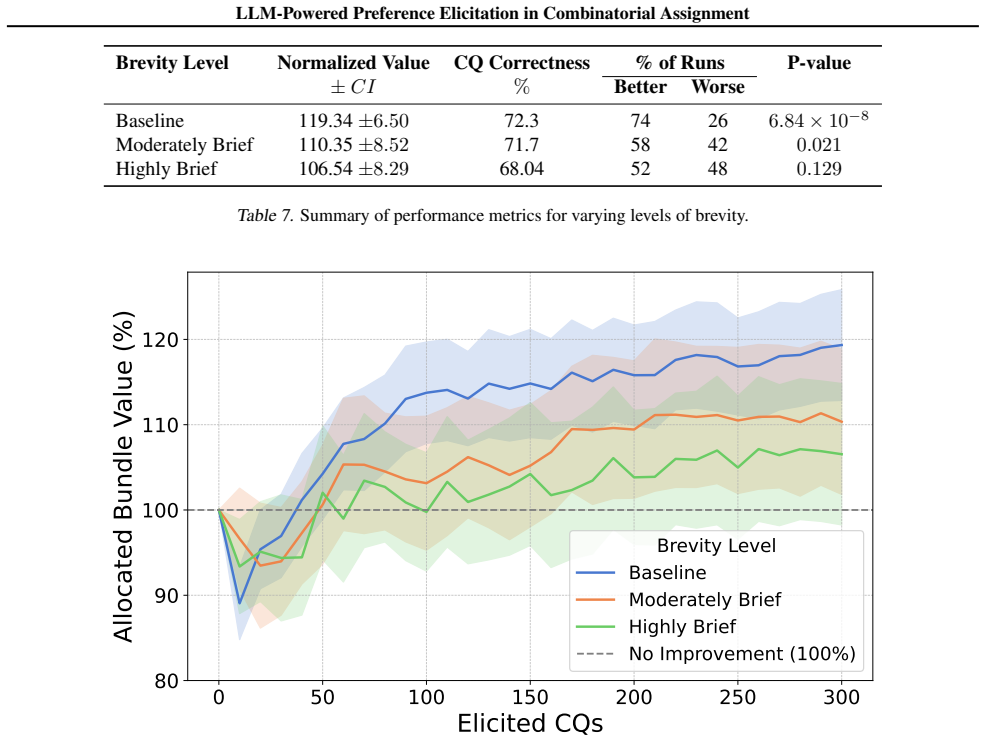
The discovery is that an LLM given one narrative paragraph describing a student's preferences can answer comparison queries accurately enough—71–75% in the tested setups—to train a monotone value model whose final allocation beats the GUI-only baseline by 19–22%. The framework wraps the existing MLCM (machine-learning-powered Course Match) mechanism: GUI reports initialize the model, LLM-answered comparison queries fine-tune it through a generalized cross-entropy loss that tolerates noisy labels, and a Double Thompson Sampling acquisition function over an ensemble of monotone value networks decides which queries to ask. Chain-of-thought prompting raises proxy accuracy from 59% to 72%, and without it the allocative gains are statistically insignificant. The headline result is robust to swapping the LLM across open-source and commercial architectures, to scaled-up student mistake rates in the GUI reports, and to moderately concise narratives, though highly terse narratives weaken it.
Load-bearing premise
The load-bearing premise is that a free-text paragraph written by an LLM from made-up numerical preferences faithfully stands in for what a real student would write, and that an LLM reading that paragraph answers comparison queries the way the student would; if real students write differently, the reported 19–22% gains may not transfer.
Editorial extensions
If this is right
- Students only ever provide one piece of natural language input; the burden of answering hundreds of comparison queries shifts from the student to the mechanism's computation.
- The gain is not tied to one model: both an open-source 8-billion-parameter model and a commercial LLM produce 19–22% improvements with 72–75% comparison accuracy.
- Because the loss is noise-robust, the pipeline keeps improving allocations as long as proxy accuracy stays above roughly 60%; the paper's sweep shows gains vanish below that range.
- The framework improves allocations even when the error rate in students' GUI reports is multiplied by 0.5 to 1.25, so the free-text signal is complementary to the structured reports.
- Both generalized cross-entropy and Double Thompson Sampling contribute about a doubling of the headline improvement, so either component alone would leave most of the gains on the table.
Reading between the lines
- The paper validates the proxy on LLM-written student narratives rather than on text from real students; a human-subject test is the natural check on whether the 19–22% gains survive deployment.
- The same one-shot-proxy recipe could be ported to other iterative combinatorial allocation mechanisms, but the measured token cost—about 0.1 million input and output tokens per student—needs to fall before large-scale use is economical.
- Free text can carry preference dimensions the structured GUI language cannot express, such as scheduling constraints or qualitative course fit; if the proxy exploits those, the framework could enlarge what allocation mechanisms optimize rather than just automating existing queries.
- The sharp accuracy threshold around 55–60% gives an engineering target: any cheaper or faster LLM that keeps comparison accuracy above that bound should preserve most of the allocative gain.
Editorial analysis
A structured set of objections, weighed in public.
Referee Report
Summary. The paper proposes a framework in which an LLM acts as a proxy for a student in an ML-powered course allocation mechanism (MLCM). The student provides one free-text paragraph; the proxy answers hundreds of pairwise comparison queries; the responses are used to train an MVNN/eMVNN value model with a GCE loss, and Double Thompson Sampling selects queries. Experiments on a synthetic course-allocation simulator with capacities set to infinity compare normalized allocated bundle value to the GUI-report baseline and report a 19.3% improvement with 300 LLM-answered CQs, robustness across LLM architectures, and ablations of CoT, GCE, and acquisition functions, together with a theoretical claim (Proposition 3.1) about noise robustness.
Significance. If the headline gain transferred to real scarce-seat markets, this would be a meaningful advance: it reduces student cognitive burden to a single free-text input while integrating with SOTA ML-based elicitation. The experimental methodology is careful in many respects: 100-run averages with 95% CIs, paired t-tests, ablations of CoT, GCE vs BCE, and acquisition functions, and robustness checks across LLMs, noise levels, and response brevity. The scoring uses ground-truth utilities independent of the fitted models, so the main comparison is not circular. However, as detailed below, the infinite-capacity setup decouples the assignment problem, and the lack of human-subject validation leaves the external-validity premise unverified; both are load-bearing for the paper's central claim about realistic scenarios.
major comments (4)
- [Section 5.1, Section 5.2, Table 4] The headline efficiency results are obtained with all course capacities set to infinity. With infinite capacity, the combinatorial assignment problem decouples across students: there is no scarcity, the A-CEEI market-clearing condition is vacuous, and each student simply receives the feasible bundle maximizing her learned value function. The reported 19.3% gain is therefore a measure of per-student preference-learning quality, not of allocative efficiency in a market with limited seats, yet the abstract and Section 1 describe the result as improving allocative efficiency 'in realistic scenarios.' This is the single most load-bearing issue because it separates the experimental setup from the claimed application domain. Please add finite-capacity experiments, or at least one finite-capacity variant with the same pipeline, or revise the central claim to be about preference-learning quality rather than allocative efficiency in realistic course allocation markets.
- [Appendix B.1, Proposition 3.1, Table 8] The proof of Proposition 3.1 is not valid as stated. It invokes the Ghosh et al. (2015) result for symmetric losses and asserts that GCE is symmetric, but the GCE loss L_q(f(x),e_j)=(1-f_j(x)^q)/q is symmetric (sum over classes constant) only at q=1, whereas the HPO-winning configuration in Table 8 uses q=0.3. It also asserts that two-class label noise is 'inherently uniform,' which is not correct: LLM errors need not be i.i.d. symmetric flips. Consequently, the claim that the true valuation function minimizes the noisy training loss is not established for the implemented system. Please either prove a version for the actual loss and noise model, restrict the statement to q=1, or reframe the result as an empirical robustness property (as supported by Section 5.7).
- [Sections 4.2 and 5.1, Appendix C.5] The entire evaluation is conducted in an LLM-to-LLM simulation loop: Llama-3.1 generates free-text student descriptions from numerical utility tables, and another LLM reads them to answer CQs. The load-bearing external-validity premise is that these generated descriptions are faithful stand-ins for what real students would write and that an LLM proxy reading real student text tracks true utility. This premise is untested: no human-subject data are collected, and the conciseness experiment in Appendix C.5 varies only response length, not the semantic or stylistic properties of human writing. Because the introduction and abstract claim practical relevance to course allocation, I recommend either (i) adding a small human-subject pilot to validate the text-to-proxy mapping, or (ii) explicitly scoping the claims to LLM-simulated students.
- [Section 5.2, Section 6.2, Table 8] The number of comparison queries used for the headline result is inconsistent. The main text and Figure 2a report the 19.3% improvement at 300 CQs, and Section 6.2 says 'roughly 300 comparison queries' per student, but Table 8 lists the HPO-winning configuration as 500 LLM CQs. Please clarify which query count underlies the headline result and why the winning configuration is not used in the main evaluation.
minor comments (5)
- [Section 1] The abstract mentions 'combinatorial assignment'; Section 1 contains the typo 'doamins' in 'The combinatorial assignment doamins suffers'.
- [Section 4.1] In the sketch of the CoT template, 'where ellipses (‘...’) indicated omitted details' should read 'indicate omitted details'.
- [Table 3 caption] The caption contains a duplicated phrase: 'Shows are averages over 100 runs over 100 runs for the default noise level'.
- [Appendix C.2] The student-conversion prompt contains the malformed sentence 'These are courses that BENEFITS YOU HARMS YOU when taken together'; it appears to be missing an 'OR'.
- [Appendix D.1] The sentence 'the training algorithm that we used to integerate both the student’s GUI reports...' should use 'integrate' instead of 'integerate'.
Circularity Check
No significant circularity: the central claims are measured against independent ground-truth utilities, and each load-bearing component is tested or imported from external results.
full rationale
The paper's central claim (19.3% normalized value gain, up to 22% across architectures) is an experimental comparison against a fixed baseline, not a derivation. Ground-truth utilities used for scoring and for measuring CQ accuracy are taken from the Soumalias et al. (2024b) simulator calibrated to Budish & Kessler (2021), independent of the models being evaluated. The LLM-generated student narratives and LLM-proxy answers both trace back to those same ground-truth utilities, but this is a test of information transfer; the cross-architecture table (LLaMA surrogate with ChatGPT proxy, etc.) breaks any same-model identity, and the score is computed from the simulator's cardinal values, not from the LLM. Proposition 3.1 is imported from Ghosh et al. (2015) and Zhang & Sabuncu (2018) as a standard noise-robustness theorem; it does not assume the framework's conclusions. Hyperparameters are tuned on simulated LLM responses and then evaluated with real LLMs, so the headline numbers are not fitted artifacts. The infinite-capacity setup in Section 5.1 is a scope/external-validity concern about scarcity, not a circularity: it changes what the experiment demonstrates, but does not make the prediction equivalent to its inputs. Self-citations to the MLCM pipeline and simulator are used as tools and are backed by externally validated data; they do not carry the argument by themselves. No step in the paper's claimed chain reduces, by construction or by fitted parameter renaming, to its own inputs.
Assumptions & free parameters
free parameters (8)
- GCE q =
0.3
- LLM CQ training epochs =
10
- LLM CQ learning rate =
0.01
- LLM CQ weight decay =
0.01
- LLM CQ gradient clipping =
0.2
- LLM CQ batch size =
1
- Number of LLM CQs =
500 in HPO winner, 300 used in main results
- Ensemble size M =
10
assumptions (5)
- standard math Ghosh et al. (2015) noise-robustness theorem for symmetric losses under uniform label noise
- ad hoc to paper GCE loss is symmetric at the q value used (q=0.3)
- domain assumption LLM-generated free-text preference descriptions approximate real student preference descriptions
- domain assumption The synthetic student utility model from Soumalias et al. (2024b) is representative of real student preferences
- standard math Bradley-Terry model of pairwise preferences for training on comparison queries
invented entities (1)
-
eMVNN (Epistemic Monotone Value Neural Network)
Cite this review
Pith. "Pith review of LLM-Powered Preference Elicitation in Combinatorial Assignment." pith.science (2026). https://pith.science/paper/BZ2JEAZU
@misc{pith2026250210308,
  author       = {Pith},
  title        = {Pith review of: LLM-Powered Preference Elicitation in Combinatorial Assignment},
  year         = {2026},
  howpublished = {\url{https://pith.science/paper/BZ2JEAZU}},
  note         = {Machine review of arXiv:2502.10308}
}
read the original abstract
We study the potential of large language models (LLMs) as proxies for humans to simplify preference elicitation (PE) in combinatorial assignment. While traditional PE methods rely on iterative queries to capture preferences, LLMs offer a one-shot alternative with reduced human effort. We propose a framework for LLM proxies that can work in tandem with SOTA ML-powered preference elicitation schemes. Our framework handles the novel challenges introduced by LLMs, such as response variability and increased computational costs. We experimentally evaluate the efficiency of LLM proxies against human queries in the well-studied course allocation domain, and we investigate the model capabilities required for success. We find that our approach improves allocative efficiency by up to 20%, and these results are robust across different LLMs and to differences in quality and accuracy of reporting.
Figures


Figures from the paper (5 more)




Forward citations
Cited by 3 Pith papers
-
Complexity Beyond Incentives: The Critical Role of Reporting Language
In a five-treatment lab experiment, ranking multi-attribute programs causes frequent errors that grow with preference complexity; restricted reporting interfaces don't beat full rankings even when they match the prefe...
-
Choose Your Agent: Tradeoffs in Adopting AI Advisors, Coaches, and Delegates in Multi-Party Negotiation
Users prefer an AI Advisor but gain most with a Delegate, because human editing filters out the AI's best proposals.
-
Game Theory Meets Large Language Models: A Systematic Survey with Taxonomy and New Frontiers
A taxonomy-based survey of bidirectional game theory and LLM research, spanning evaluation, alignment, economic competition, and LLM-driven game solving.
Reference graph
Works this paper leans on
-
[1]
Mean prediction: ˆyi(x) = 1 M MX j=1 M(j) i (x),
-
[2]
Epistemic uncertainty: σ2 i (x) = 1 M MX j=1 M(j) i (x) − ˆyi(x) 2 . Here, σi(x) denotes the standard deviation of the ensemble’s predictions and serves as a measure of epistemic uncertainty. Remark B.4. Motivated by the connection of our problem to RLHF highlighted in Section 3, we use M = 10following (Dwaracherla et al., 2024). Remark B.5. Note that the...
work page 2024
-
[3]
Your overall strategy for course selection, considering both your budget constraints and the strength of course relationships
-
[4]
Any specific scheduling or workload considerations Keep the tone conversational and authentic to how a student would describe their course preferences. Make sure to reference both your relative preferences within each tier and the specific impacts of course combinations on your overall academic plan. Your response should be three paragraph: the first para...
-
[5]
Course 25 (value: 54.02)
-
[6]
Course 2 (value: 52.66) 18 LLM-Powered Preference Elicitation in Combinatorial Assignment
-
[7]
Your strongest course interests, explaining them in order of preference within each priority tier
-
[8]
How you’re thinking about course combinations, discussing specific synergies and overlaps: - When describing overlapping courses, explain how much the overlap affects your interest - When describing complementary courses, explain how much additional value you see in taking them together
Show all 35 references
-
[9]
Course 6 (value: 51.39)
-
[10]
Course 8 (value: 50.80)
-
[11]
Course 20 (value: 117.96)
-
[12]
Course 19 (value: 115.30) Medium Priority Courses: Lower Priority Courses:
-
[13]
Course 21 (value: 56.26)
-
[14]
Course 7 (value: 55.99)
-
[15]
Course 14 (value: 55.73)
-
[16]
Course 17 (value: 55.71)
-
[17]
Course 18 (value: 43.96)
-
[18]
Course 4 (value: 43.71)
-
[19]
Course 22 (value: 52.37)
-
[20]
Course 3 (value: 52.07)
-
[21]
Course 10 (value: 42.34)
-
[22]
Course 12 (value: 41.71)
-
[23]
Course 16 (value: 50.80)
-
[24]
Course 1 (value: 49.36)
-
[25]
Course 9 (value: 46.22)
-
[26]
Course 13 (value: 45.73)
-
[27]
Course 23 (value: 45.31)
-
[28]
Course 15 (value: 45.18)
-
[31]
Course 24 (value: 42.64)
-
[32]
Course 5 (value: 42.55)
-
[35]
Taking any two reduces their combined value by 40% - Courses 20, 25, 3, 17, 11 overlap in content
Course 11 (value: 40.76) Course Relationships: Overlapping Content (Substitutes) - These are courses that HARMS YOU when taken together compared to taking only one, and the more the worse: - Courses 19, 13, 16 overlap in content. Taking any two reduces their combined value by ...
2024
-
[77]
URL https://doi.org/10.24963/ijcai. 2022/77. Main Track. Weissteiner, J., Wendler, C., Seuken, S., Lubin, B., and P¨uschel, M. Fourier analysis-based iterative combina- torial auctions. In Proceedings of the Thirty-First In- ternational Joint Conference on Artificial Intellige...
2004
-
[548]
doi: 10.24963/ijcai.2022/
International Joint Conferences on Artificial Intelli- gence Organization, 7 2022a. doi: 10.24963/ijcai.2022/
2022 doi
-
[2023]
cc/paper_files/paper/2023/file/ 1577ea3eaf8dacb99f64e4496c3ecddf-Paper-Conference
URL https://proceedings.neurips. cc/paper_files/paper/2023/file/ 1577ea3eaf8dacb99f64e4496c3ecddf-Paper-Conference. pdf. Sandholm, T. and Suri, S. Improved algorithms for opti- mal winner determination in combinatorial auctions and generalizations. In AAAI/IAAI, pp. 90–97, 200...
2023 arXiv
-
[5606]
php/AAAI/article/view/5606
URL https://ojs.aaai.org/index. php/AAAI/article/view/5606. Weissteiner, J., Heiss, J., Siems, J., and Seuken, S. Monotone-value neural networks: Exploiting prefer- ence monotonicity in combinatorial assignment. In Proceedings of the Thirty-First International Joint Con- feren...
Reviewed August 7, 2026 · model on record in the stance chip above.
Discussion (0). Continue with ORCID to comment.