REVIEW 4 major objections 4 minor 18 references
DRiVE: Dynamic Recognition in VEhicles using snnTorch
T0 review · 4 major / 4 minor · reviewed 2026-08-09 · deepseek-v4-flash
Pith's one-line read DRiVE, a feedforward spiking neural network built with the snnTorch spike-based library, classifies vehicle versus non-vehicle images at 94.82% test accuracy and 0.99 AUC, beating four published SNN classifiers.
desk verdict Routine snnTorch demo whose headline accuracy is invalidated by test-set early stopping and an internal inconsistency with its own confusion matrix. read the letter →
The pith
A machine-rendered reading of the paper's core claim, the machinery that carries it, and where it could break.
The reading
What carries the argument
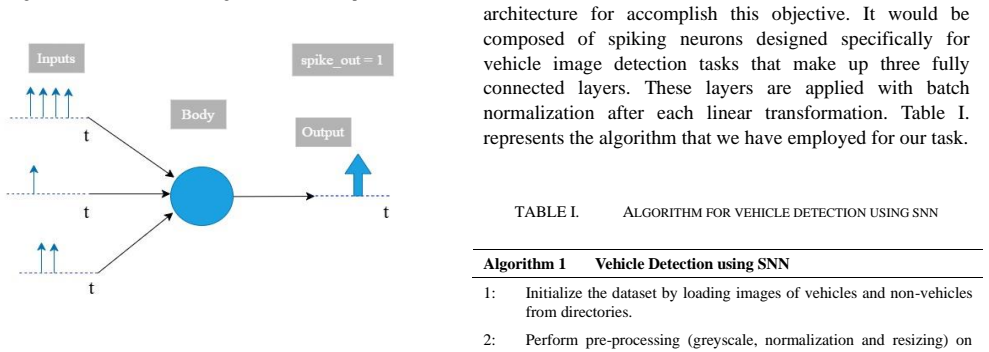
The central object is the DRiVE architecture: a feedforward spiking neural network whose units are Leaky Integrate-and-Fire (LIF) neurons, meaning each neuron accumulates input into a membrane potential $U_t = \beta U_{t-1} + I_t$ that decays by a factor $\beta = 0.95$ per timestep and fires a spike when the potential crosses a threshold. Because the spike function is not differentiable, the fast_sigmoid surrogate gradient approximates the derivative during backpropagation, and BatchNorm1d normalizes each layer's inputs to keep the spike-driven activations stable over the 50 timesteps. The output layer's spike rates are scored with cross-entropy rate loss, and the AdamW optimizer updates the weights. This combination is what carries the argument: it converts a static image classification problem into a rate-coded temporal spike task while remaining trainable through autograd-based backpropagation via snnTorch.
What would settle it
Run DRiVE's exact training recipe but hold the 20% test split completely out of model selection: use a separate validation split for early stopping, then evaluate the chosen model once on the untouched test set. If the accuracy comes in materially below 94.82% or the AUC below 0.99, the headline numbers are not reproducible under an independent evaluation protocol.
Extended reading notes
Core claim
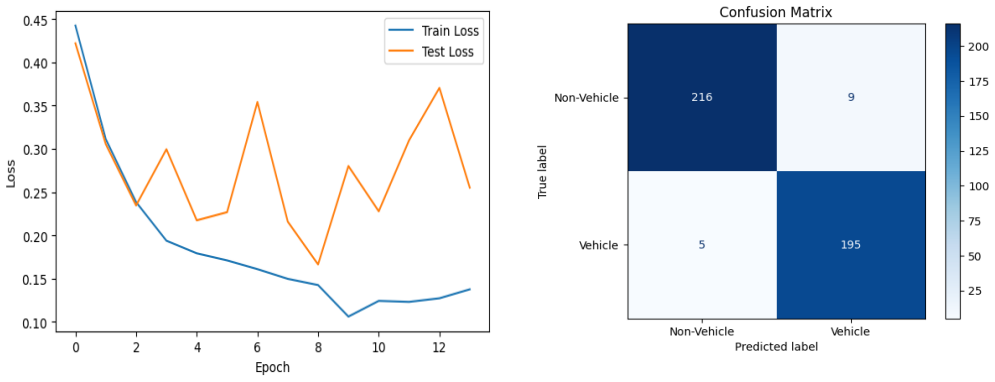
On the paper's own terms, DRiVE is a feedforward spiking network with an input layer, two hidden layers of 64 Leaky Integrate-and-Fire (LIF) neurons, and an output layer, with BatchNorm1d applied after each linear transformation. Training uses cross-entropy rate loss, the AdamW optimizer at learning rate $10^{-3}$, a membrane decay factor $\beta = 0.95$, 50 simulation steps, batch size 30, and early stopping with patience 5 on test loss; the best model, saved at epoch 9, has test loss 0.1665. Evaluated on the 20% test split (425 samples), the model records 94.82% accuracy and 0.99 AUC, with 216 non-vehicles and 195 vehicles correctly classified, 9 false positives, and 5 false negatives. The paper places this 94.82% above AMOS (80.97%), CSNN-blurr9 (92.85%), Spikformer V2 (94.80%), and S-ResNet38 wider (92.66%), and reads the comparison as evidence that SNNs can handle image detection, not just temporal data.
Load-bearing premise
The reported 94.82% test accuracy and 0.99 AUC are measured on the same test set that was used to decide when to stop training, so the numbers are not an independent measure of how the model will perform on unseen data.
Editorial extensions
If this is right
- A spiking network trained with surrogate gradients can match or beat published SNN image classifiers on a two-class vehicle-detection task, extending SNNs beyond temporal-sequence problems.
- The training recipe — LIF neurons with $\beta = 0.95$, fast_sigmoid surrogate gradients, BatchNorm1d, cross-entropy rate loss, and the AdamW optimizer — becomes a reusable template for small image-classification SNNs.
- An AUC of 0.99 on the 425-sample test set means the network separates vehicle from non-vehicle images with few errors (9 false positives, 5 false negatives), which is the relevant number for surveillance and tolling use cases.
- The small model size and event-driven inference point toward low-power embedded vision in autonomous vehicles and traffic monitoring, assuming the accuracy carries beyond the tested subset.
- In the paper's comparison table, DRiVE's 94.82% is the highest accuracy listed, positioning it as a new reference point among the SNN models considered.
Reading between the lines
- Editorial inference: the accuracy comparison against AMOS, Spikformer V2, S-ResNet38 wider, and CSNN-blurr9 is not a controlled benchmark, because those models were trained and evaluated on different, generally larger datasets; DRiVE's higher number does not establish that it is generally a better SNN image classifier.
- Editorial inference: because early stopping selects the epoch with the lowest test loss and the final metrics come from that same test set, the reported accuracy and AUC are likely optimistic; a validation split or nested cross-validation would give a fairer estimate.
- Editorial inference: the paper does not compare DRiVE to a conventional non-spiking network on the same data, so the reader cannot tell whether the spiking mechanism itself, rather than the small dataset or hyperparameters, drives the 94.82% accuracy.
- Editorial inference: only about 2,130 of the 17,760 available images are used; retraining on the full dataset, or measuring accuracy as a function of training set size, would test whether the strong separation is stable.
Editorial analysis
A structured set of objections, weighed in public.
Referee Report
Summary. The paper introduces DRiVE, a feedforward spiking neural network built with snnTorch for binary vehicle/non-vehicle image classification. The architecture uses LIF neurons, fast-sigmoid surrogate gradients, batch normalization, cross-entropy rate loss, and the AdamW optimizer. On a Kaggle vehicle detection subset, the authors report 94.82% test accuracy, 0.99 AUC, and a confusion matrix with 216 true non-vehicles and 195 true vehicles out of 425 test samples. They compare DRiVE with several published SNN models and claim it outperforms them. Algorithm 1, hyperparameters, and training curves are provided.
Significance. If the reported results were properly validated, DRiVE would be a routine benchmark demonstration rather than a fundamentally new capability: it applies existing SNN training techniques (surrogate gradients, LIF dynamics, batch normalization) to a small binary image classification task. The paper's strengths are that it provides explicit hyperparameters, a pseudocode algorithm, and standard evaluation plots, and it uses a publicly available snnTorch framework. However, the current evaluation methodology undermines the central quantitative claims, and the comparison to prior work is not controlled. The paper does not ship code, machine-checked proofs, or parameter-free derivations; its contribution is purely empirical and, as written, is not yet a reliable data point.
major comments (4)
- [Algorithm 1 (lines 19-21) and Section IV-B] The early-stopping procedure selects the model achieving the lowest test loss and then evaluates that same model on the same test set. This makes the reported 94.82% accuracy and 0.99 AUC selected quantities, not independent estimates of generalization. Please introduce a separate validation split for early stopping (or use cross-validation) and report metrics on a held-out test set that is not used for model selection.
- [Section IV-B and Fig. 7] The confusion matrix totals 425 test samples and shows 216 non-vehicle and 195 vehicle correct classifications, i.e., 411 correct or 96.71% accuracy, whereas the text and Table III report 94.82%. Since 94.82% of 425 is about 403 correct, the two numbers are mutually inconsistent. Please correct the arithmetic or the figure labeling and re-verify all reported metrics.
- [Table III] The comparison lists DRiVE against AMOS, CSNN-blurr9, SpikformerV2, and S-ResNet38 wider, but those models were evaluated on different datasets (e.g., ImageNet, CIFAR) and different tasks, while DRiVE is evaluated on a small binary Kaggle subset. This does not support the claim that DRiVE outperforms state-of-the-art SNN models. Please provide baselines trained and evaluated on the same dataset and split, such as a CNN or a standard SNN with identical preprocessing, before making comparative claims.
- [Section IV-B and Table II] Only a single run is reported, with no error bars, no random seed, and no code availability. Given the stochastic nature of SNN training and the small difference between DRiVE's reported accuracy (94.82%) and SpikformerV2's (94.80%), reproducibility requires either multiple seeds with mean and standard deviation or a clear statement of the exact seed and a release of the training/evaluation code. Please add this information.
minor comments (4)
- [Throughout] The equation numbering is garbled: the text refers to equations (1) through (11), but the displayed numbers are duplicated or misordered. Please renumber and reference consistently.
- [Section IV-A] The dataset description says the full set has 17,760 images but that the authors 'utilized around 1070 images in both the classes.' Please give exact class counts, the total after preprocessing, and the resulting train/test sample sizes; the reported 425 test samples should be reconciled with these counts.
- [Section II] There is a typo, 'implemention', which should read 'implementation'. Also, the phrase in the abstract about 'challenging the notion that SNNs are limited to temporal data' is misleading, since SNNs are already widely used for image classification; please rephrase to reflect the actual contribution.
- [References] Reference [13] is cited with 'ResearchGate' as the source; please provide the proper bibliographic entry. Also, ensure all hyperparameters mentioned in the text, such as the train/test split ratio, are explicitly listed in Table II or in Section IV.
Circularity Check
The headline 94.82% test accuracy is selected on the test set by early stopping, so the central quantitative claim is a test-set-optimized number rather than an independent held-out prediction.
-
fitted input called prediction
[Section IV.B and Table I, Algorithm 1 lines 16-21]
"16: Evaluate SNN on testing dataset: 17: Compute loss and accuracy. ... 19: Update best_loss according to current test loss. 20: Save the best model and load for evaluation. 21: Calculate final evaluation metrics ... The training of the SNN model also utilizes early stopping based on the test loss, with patience set to 5, which saves the best model at epoch 9. Here, it achieved the lowest test loss of 0.1665 and a test accuracy of 94.82%."
The evaluation protocol makes the test set part of the model-selection loop: the checkpoint with the lowest test loss is saved (Algorithm 1 lines 19-20), and the final metrics, including the headline 94.82% accuracy and 0.99 AUC, are then computed on that same test set (line 21). The reported numbers are therefore the test-set-optimized outcome of the early-stopping criterion, not an independent held-out estimate. The model selection is fitted to the test loss, and the 'predicted' test accuracy is read back from the same test set, so the central quantitative claim is forced by the selection criterion rather than being an out-of-sample result.
full rationale
The paper has no derivation chain that would be circular by definition: the SNN architecture, LIF dynamics, surrogate gradient, loss, and hyperparameters are standard components cited to external sources (snnTorch, AdamW, fast_sigmoid, batch norm). There are no self-citations by the authors and no imported uniqueness theorem or ansatz hiding in a citation. The single circular element is the evaluation protocol: Algorithm 1 selects the model with the lowest test loss and then reports accuracy/AUC on the same test set, so the headline 94.82% is selected rather than held out. This is a partial circularity in the central claim. Separately, the confusion matrix in Fig. 7 (216+195 correct out of 425 = 96.7%) is inconsistent with the headline 94.82%, but that is an internal-consistency/correctness issue, not a circularity. The comparison to ImageNet/CIFAR-based SNN accuracies in Table III is also not a controlled benchmark, but that is a comparability problem, not a circularity.
Assumptions & free parameters
free parameters (9)
- Beta (membrane potential decay) =
0.95
- Number of simulation steps =
50
- Hidden layer size =
64
- Learning rate =
1e-3
- Batch size =
30
- Maximum epochs =
20
- Early stopping patience =
5
- Input image size =
128x128
- Train/test split ratio =
80/20
assumptions (5)
- domain assumption Rate coding by spike frequency over 50 time steps is sufficient to represent vehicle/non-vehicle image content.
- domain assumption The fast_sigmoid surrogate gradient approximates the true gradient closely enough for training to converge.
- domain assumption Cross-entropy rate loss on mean spike rates is an appropriate training objective for binary classification.
- domain assumption The Kaggle Vehicle Detection Image Set labels are correct and the randomly selected subset is representative.
- domain assumption Batch normalization after each linear layer remains effective with spiking activations over time.
Cite this review
Pith. "Pith review of DRiVE: Dynamic Recognition in VEhicles using snnTorch." pith.science (2026). https://pith.science/paper/JL7TNX2P
@misc{pith2026250210421,
  author       = {Pith},
  title        = {Pith review of: DRiVE: Dynamic Recognition in VEhicles using snnTorch},
  year         = {2026},
  howpublished = {\url{https://pith.science/paper/JL7TNX2P}},
  note         = {Machine review of arXiv:2502.10421}
}
read the original abstract
Spiking Neural Networks (SNNs) mimic biological brain activity, processing data efficiently through an event-driven design, wherein the neurons activate only when inputs exceed specific thresholds. Their ability to track voltage changes over time via membrane potential dynamics helps retain temporal information. This study combines SNNs with PyTorch's adaptable framework, snnTorch, to test their potential for image-based tasks. We introduce DRiVE, a vehicle detection model that uses spiking neuron dynamics to classify images, achieving 94.8% accuracy and a near-perfect 0.99 AUC score. These results highlight DRiVE's ability to distinguish vehicle classes effectively, challenging the notion that SNNs are limited to temporal data. As interest grows in energy-efficient neural models, DRiVE's success emphasizes the need to refine SNN optimization for visual tasks. This work encourages broader exploration of SNNs in scenarios where conventional networks struggle, particularly for real-world applications requiring both precision and efficiency.
Figures


Figures from the paper (2 more)

Reference graph
Works this paper leans on
-
[1]
Spiking Neural Networks and Their Applications: A Review,
K. Yamazaki, V. -K. Vo -Ho, D. Bulsara, and N. Le, “Spiking Neural Networks and Their Applications: A Review,” Brain Sci. , vol. 12, no. 7, p. 863, Jun. 2022, doi: 10.3390/brainsci12070863
-
[2]
Training Spiking Neural Networks Using Lessons From Deep Learning,
J. K. Eshraghian et al., “Training Spiking Neural Networks Using Lessons From Deep Learning,” Proc. IEEE , vol. 111, no. 9, pp. 1016–1054, Sep. 2023, doi: 10.1109/JPROC.2023.3308088
-
[3]
A Review of Object Detection Models based on Convolutional Neural Network,
F. Sultana, A. Sufian, and P. Dutta, “A Review of Object Detection Models based on Convolutional Neural Network,” vol. 1157, 2020, pp. 1–16. doi: 10.1007/978-981-15-4288-6_1
-
[4]
A Review on Traditional and Deep Learning based Object Detection Methods,
B. R. Solunke and S. R. Gengaje, “A Review on Traditional and Deep Learning based Object Detection Methods,” in 2023 International Conference on Emerging Smart Computing and Informatics (ESCI) , Mar. 2023, pp. 1 –7. doi: 10.1109/ESCI56872.2023.10099639
-
[6]
K. Malcolm and J. Casco-Rodriguez, “A Comprehensive Review of Spiking Neural Networks: Interpretation, Optimization, Efficiency, and Best Practices,” Mar. 21, 2023, arXiv: arXiv:2303.10780. doi: 10.48550/arXiv.2303.10780
-
[7]
Parallelized Multi-Agent Bayesian Optimization in Lava
S. Snyder, D. Gobin, V. Clerico, S. R. Risbud, and M. Parsa, “Parallelized Multi-Agent Bayesian Optimization in Lava,” Jul. 09, 2024, arXiv: arXiv:2405.04387. doi: 10.48550/arXiv.2405.04387
work page Pith review arXiv doi:10.48550/arxiv.2405.04387 2024
-
[8]
On Neuromorphic Computing: A Case Study on Radio Resource Allocation with LAVA Software Framework,
A. K. Lakshmipura Vijaykumar, “On Neuromorphic Computing: A Case Study on Radio Resource Allocation with LAVA Software Framework,” masters, Concordia University, 2023. Available: https://spectrum.library.concordia.ca/id/eprint/991998/
work page 2023
-
[9]
Recognizing Images with at most one Spike per Neuron
C. Stöckl and W. Maass, “Recognizing Images with at most one Spike per Neuron,” Jan. 21, 2020, arXiv: arXiv:2001.01682. doi: 10.48550/arXiv.2001.01682
work page Pith review arXiv doi:10.48550/arxiv.2001.01682 2020
Show all 18 references
- [10]
-
[11]
Keys to accurate feature extraction using residual spiking neural networks,
A. Vicente-Sola, D. L. Manna, P. Kirkland, G. Di Caterina, and T. Bihl, “Keys to accurate feature extraction using residual spiking neural networks,” Neuromorphic Comput. Eng. , vol. 2, no. 4, p. 044001, Dec. 2022, doi: 10.1088/2634-4386/ac8bef
2022 doi
-
[12]
Fast Convergence of Competitive Spiking Neural Networks with Sample -Based Weight Initialization,
P. G. Cachi, S. Ventura, and K. J. Cios, “Fast Convergence of Competitive Spiking Neural Networks with Sample -Based Weight Initialization,” in Information Processing and Management of Uncertainty in Knowledge -Based Systems, vol. 1239, M. -J. Lesot, S. Vieira, M. Z. Reformat,...
2020 doi
-
[13]
(PDF) Research Progress of spiking neural network in image classification: a review,
“(PDF) Research Progress of spiking neural network in image classification: a review,” ResearchGate, Dec. 2024, doi: 10.1007/s10489-023-04553-0
2024 doi
-
[14]
SuperSpike: Supervised Learning in Multilayer Spiking Neural Networks,
F. Zenke and S. Ganguli, “SuperSpike: Supervised Learning in Multilayer Spiking Neural Networks,” Neural Comput., vol. 30, no. 6, pp. 1514–1541, Jun. 2018, doi: 10.1162/neco_a_01086
2018 doi
- [15]
- [16]
- [17]
-
[18]
Batch Normalization: Accelerating Deep Network Training by Reducing Internal Covariate Shift,
S. Ioffe and C. Szegedy, “Batch Normalization: Accelerating Deep Network Training by Reducing Internal Covariate Shift,” Mar. 02, 2015, arXiv: arXiv:1502.03167. doi: 10.48550/arXiv.1502.03167
-
[19]
Vehicle Detection Image Set
“Vehicle Detection Image Set.” Available: https://www.kaggle.com/datasets/brsdincer/vehicle-detection- image-set
Reviewed August 9, 2026 · model on record in the stance chip above.
Discussion (0). Continue with ORCID to comment.