Conformal form-invariant parametrization of scalar-tensor gravity theories: A critical analysis
Pith reviewed 2026-05-22 21:13 UTC · model grok-4.3
The pith
The conformal form-invariant parametrization of scalar-tensor theories is not distinct from standard ones and does not guarantee frame-independent classical predictions.
A machine-rendered reading of the paper's core claim, the machinery that carries it, and where it could break.
Core claim
The conformal form-invariant parametrization, built on the assumption that timelike field masses are themselves point-dependent, does not constitute a fundamentally new or distinct way of writing scalar-tensor theories. Explicit comparison with other common parametrizations shows it is equivalent in content, while the further claim that classical physical predictions are universal across conformal frames fails to hold in general.
What carries the argument
Conformal form-invariant parametrization, which uses point-dependent masses to render the matter action invariant under conformal rescalings of the metric and scalar field.
If this is right
- Standard Jordan-frame and Einstein-frame descriptions already capture the same physics as the form-invariant version.
- Observable predictions in scalar-tensor models can differ between frames even when the parametrization is applied.
- Active and passive conformal transformations produce inconsistent invariance statements for some quantities.
- The universality of frame-independent classical predictions must be verified case by case rather than assumed.
Where Pith is reading between the lines
- Model builders should continue to specify which frame they work in when deriving observable signatures.
- Cosmological solutions may need re-examination for frame-dependent effects on expansion history or perturbation growth.
- The result suggests that any claim of full conformal invariance in gravity theories requires separate proof for each class of observables.
Load-bearing premise
The recent result that point-dependent masses make the matter action conformally invariant directly yields a parametrization that keeps every classical prediction unchanged when moving between frames.
What would settle it
Explicit computation of a measurable quantity, such as the perihelion precession or light deflection in a specific scalar-tensor model, that yields different numerical values in two different conformal frames while using the form-invariant parametrization.
Figures
read the original abstract
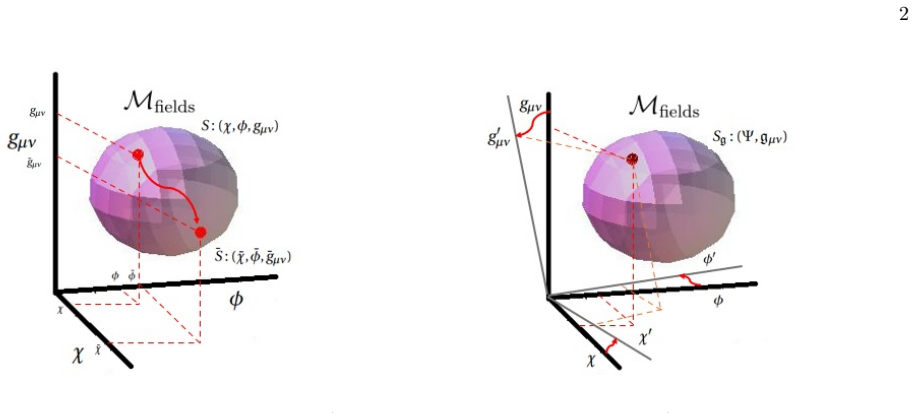
Based on the recent result that, if the masses of timelike fields are point-dependent fields themselves, the action of matter fields is conformal form-invariant in its standard form, and on the active and passive approaches to conformal transformations, we review the conformal form-invariant parametrization of scalar-tensor gravity theories. We investigate whether this parametrization is actually different from other existing parametrizations. We also check the universality of the claim that the classical physical predictions of these theories are conformal-frame invariants.
Editorial analysis
A structured set of objections, weighed in public.
Referee Report
Summary. The paper reviews the conformal form-invariant parametrization of scalar-tensor gravity theories. Drawing on the result that point-dependent masses for timelike fields render the matter action conformal form-invariant in its standard form, and employing active and passive approaches to conformal transformations, the authors investigate whether this parametrization differs from other existing ones and test the universality of claims that classical physical predictions remain conformal-frame invariants.
Significance. If the conclusions hold, the work clarifies relationships among parametrizations in scalar-tensor theories and identifies limitations in universal frame-invariance claims for physical predictions. This has implications for interpreting observables in modified gravity. The analysis appears internally consistent with no load-bearing circularities or unexamined regimes identified in the comparisons or counterexample sections.
minor comments (3)
- [Abstract] Abstract: The description of the investigation could be strengthened by explicitly stating the main conclusions (non-distinctness and non-universality) rather than only outlining the steps taken.
- [Section 3] Section 3 (or equivalent comparison section): A summary table contrasting the conformal form-invariant parametrization with prior ones (e.g., Jordan, Einstein, and others) would improve clarity and make the claim of non-distinctness easier to assess at a glance.
- [Section 2] The discussion of active versus passive conformal transformations would benefit from an explicit equation or diagram illustrating how point-dependent masses affect the action invariance in each case.
Simulated Author's Rebuttal
We thank the referee for their careful review, accurate summary of our work, and recommendation of minor revision. The referee correctly identifies the core elements of the manuscript: the use of point-dependent masses to achieve conformal form-invariance of the matter action, the distinction between active and passive conformal transformations, and the subsequent checks on whether the resulting parametrization is distinct from existing ones and whether classical predictions are universally frame-invariant. No specific major comments were raised in the report.
Circularity Check
No significant circularity in derivation chain
full rationale
The paper's analysis rests on reviewing the implications of point-dependent masses for action invariance under conformal transformations, then comparing the resulting parametrization to existing ones and testing the universality of frame-invariance claims. No step reduces a claimed result to a fitted parameter, self-definition, or load-bearing self-citation chain; the comparisons and counterexamples are independent logical checks against prior literature. The derivation is self-contained against external benchmarks and does not rename known results or smuggle ansatzes via citation.
Axiom & Free-Parameter Ledger
axioms (1)
- domain assumption Masses of timelike fields can be treated as point-dependent fields themselves.
Lean theorems connected to this paper
-
IndisputableMonolith/Foundation/RealityFromDistinction.leanreality_from_one_distinction unclear?
unclearRelation between the paper passage and the cited Recognition theorem.
the conformal form-invariant parametrization of scalar-tensor gravity theories... classical physical predictions of these theories are conformal-frame invariants
-
IndisputableMonolith/Cost/FunctionalEquation.leanwashburn_uniqueness_aczel unclear?
unclearRelation between the paper passage and the cited Recognition theorem.
the action of matter fields is conformal form-invariant in its standard form
What do these tags mean?
- matches
- The paper's claim is directly supported by a theorem in the formal canon.
- supports
- The theorem supports part of the paper's argument, but the paper may add assumptions or extra steps.
- extends
- The paper goes beyond the formal theorem; the theorem is a base layer rather than the whole result.
- uses
- The paper appears to rely on the theorem as machinery.
- contradicts
- The paper's claim conflicts with a theorem or certificate in the canon.
- unclear
- Pith found a possible connection, but the passage is too broad, indirect, or ambiguous to say the theorem truly supports the claim.
Reference graph
Works this paper leans on
-
[1]
a scheme was proposed to construct these invariants. In addition, it was discussed how to formulate the theory in terms of the invariants and show how observables such as parametrized post-Newtonian parameters and charac- teristics of the cosmological solutions can be expressed in terms of the invariants. Sadly, there are measured quan- tities that are no...
-
[2]
we must replace the action of the matter fields Sm χ, e2αgµν in (17) by (39). Alternatively, one may write the conformal form-invariant matter action in terms of the matter fields χ which are minimally cou- pled to the metric gµν: Sm = Z d4x√−g Lm (χ, gµν) . (40) That (39) and (40) are equivalent is inferred by compar- ing (24) and (31) or (32) and (34). ...
-
[3]
We have shown that, the action of STG theory in the parametrization introduced in [16]: S = 1 2 Z d4x√−g AR − B(∂ϕ)2 − 2V + Z d4x√−g Lm χ, e2αgµν , is not conformal form-invariant because, unless a radiation matter field with field strength Fµν := 2∇[µAν] is considered, the matter action breaks the conformal symmetry (this is true even for massless 12 fer...
-
[4]
Following the PACT we have demonstrated that, in terms of the physical metric gµν and of the con- formal invariant scalar φ (see their definitions in equation (41)), the action (62) can be written in the Jordan frame Brans-Dicke parametrization: S =1 2 Z d4x√−g φR − W (Vφ)2 φ − 2V + Z d4x√−g Lm (Ψ, gµν) . (64) Since in this action the auxiliary fields, su...
-
[5]
If we follow the AACT, the action (63) is the start- ing point of the analysis. We have shown that if we introduce a new parametrization: σ = A and ω = AB/A′2, this action is written in JFBD form (61). The latter action is form-invariant under con- formal transformation (1) and simultaneous trans- formation (48). This case, which is equivalent to the one ...
-
[6]
(see also Appendix A of [67]). Despite the fact that the action (61) is conformal form-invariant, there are measured quantities such as, for exam- ple, the Newton constant, which is measured in Cavendish experiments, which are not conformal invariant. Other quantities, such as the fields that suffer the conformal transformation, are themselves physically ...
- [7]
- [8]
- [9]
- [10]
-
[11]
The Relation between Physical and Gravitational Geometry
J.D. Bekenstein, Phys. Rev. D 48 (1993) 3641-3647 [e- Print: gr-qc/9211017]
work page internal anchor Pith review Pith/arXiv arXiv 1993
- [12]
-
[13]
On Physical Equivalence between Nonlinear Gravity Theories
G. Magnano and L.M. Sokolowski, Phys. Rev. D 50 (1994) 5039-5059 [e-Print: gr-qc/9312008] 14
work page internal anchor Pith review Pith/arXiv arXiv 1994
-
[14]
S. Capozziello, R. de Ritis and A.A. Marino, Class. Quant. Grav. 14 (1997) 3243-3258 [e-Print: gr- qc/9612053]
-
[15]
Singularities In Scalar-Tensor Cosmologies
N. Kaloper, K.A. Olive, Phys. Rev. D 57 (1998) 811-822 [e-Print: hep-th/9708008]
work page internal anchor Pith review Pith/arXiv arXiv 1998
-
[16]
Conformal transformations in classical gravitational theories and in cosmology
V. Faraoni, E. Gunzig and P. Nardone, Fund. Cosmic Phys. 20 (1999) 121 [e-Print: gr-qc/9811047]
work page internal anchor Pith review Pith/arXiv arXiv 1999
-
[17]
Einstein frame or Jordan frame ?
V. Faraoni and E. Gunzig, Int. J. Theor. Phys. 38 (1999) 217-225 [e-Print: astro-ph/9910176]
work page internal anchor Pith review Pith/arXiv arXiv 1999
-
[18]
I. Quiros, Phys. Rev. D 61 (2000) 124026 [e-Print: gr- qc/9905071]
- [19]
-
[20]
On boundary terms and conformal transformations in curved space-times
R. Casadio and A. Gruppuso, Int. J. Mod. Phys. D 11 (2002) 703-714 [e-Print: gr-qc/0107077]
work page internal anchor Pith review Pith/arXiv arXiv 2002
-
[21]
Are the String and Einstein Frames Equivalent
E. Alvarez and J. Conde, Mod. Phys. Lett. A 17 (2002) 413-420 [e-Print: gr-qc/0111031]
work page internal anchor Pith review Pith/arXiv arXiv 2002
-
[22]
The conformal frame freedom in theories of gravitation
E.E. Flanagan, Class. Quant. Grav. 21 (2004) 3817-3829 [e-Print: gr-qc/0403063]
work page internal anchor Pith review Pith/arXiv arXiv 2004
-
[23]
Brans-Dicke theory: Jordan vs Einstein Frame
A. Bhadra, K. Sarkar, D.P. Datta and K.K. Nandi, Mod. Phys. Lett. A 22 (2007) 367-376 [e-Print: gr-qc/0605109]
work page internal anchor Pith review Pith/arXiv arXiv 2007
-
[24]
Phantom Field from Conformal Invariance
M. Hassaine, Mod. Phys. Lett. A 22 (2007) 307-316 [e- Print: hep-th/0511278]
work page internal anchor Pith review Pith/arXiv arXiv 2007
-
[25]
Conformal transformation in the scalar-tensor theory applied to the accelerating universe
Y. Fujii, Prog. Theor. Phys. 118 (2007) 983-1018 [e- Print: 0712.1881]
work page internal anchor Pith review Pith/arXiv arXiv 2007
-
[26]
The (pseudo)issue of the conformal frame revisited
V. Faraoni and S. Nadeau, Phys. Rev. D 75 (2007) 023501 [e-Print: gr-qc/0612075]
work page internal anchor Pith review Pith/arXiv arXiv 2007
-
[27]
Einstein and Jordan frames reconciled: a frame-invariant approach to scalar-tensor cosmology
R. Catena, M. Pietroni, L. Scarabello, Phys. Rev. D 76 (2007) 084039 [e-Print: astro-ph/0604492]
work page internal anchor Pith review Pith/arXiv arXiv 2007
-
[28]
Theory of gravitation theories: a no-progress report
T.P. Sotiriou, V. Faraoni and S. Liberati, Int. J. Mod. Phys. D 17 (2008) 399-423 [e-Print: 0707.2748]
work page internal anchor Pith review Pith/arXiv arXiv 2008
-
[29]
E. Elizalde, S. Nojiri, S.D. Odintsov, D. Saez-Gomez, V. Faraoni, Phys. Rev. D 77 (2008) 106005 [e-Print: 0803.1311]
work page internal anchor Pith review Pith/arXiv arXiv 2008
-
[30]
Conformal Transformations in Cosmology of Modified Gravity: the Covariant Approach Perspective
S. Carloni, E. Elizalde and S. Odintsov, Gen. Rel. Grav. 42 (2010) 1667-1705 [e-Print: 0907.3941]
work page internal anchor Pith review Pith/arXiv arXiv 2010
-
[31]
Conformal equivalence in classical gravity: the example of "veiled" General Relativity
N. Deruelle and M. Sasaki, Springer Proc. Phys. 137 (2011) 247-260 [e-Print: 1007.3563]
work page internal anchor Pith review Pith/arXiv arXiv 2011
-
[32]
Conformal-Frame (In)dependence of Cosmological Observations in Scalar-Tensor Theory
T. Chiba and M. Yamaguchi, JCAP 10 (2013) 040 [e- Print: 1308.1142]
work page internal anchor Pith review Pith/arXiv arXiv 2013
-
[33]
Conformal Transformations and Weak Field Limit of Scalar-Tensor Gravity
A. Stabile, An. Stabile and S. Capozziello, Phys. Rev. D 88 (2013) 124011 [e-Print: 1310.7097]
work page internal anchor Pith review Pith/arXiv arXiv 2013
-
[34]
The conformal transformation's controversy: what are we missing?
I. Quiros, R. Garcia-Salcedo, J.E. Madriz Aguilar and T. Matos, Gen. Rel. Grav. 45 (2013) 489-518 [e-Print: 1108.5857]
work page internal anchor Pith review Pith/arXiv arXiv 2013
-
[35]
Invariant quantities in the scalar-tensor theories of gravitation
L. J¨ arv, P. Kuusk, M. Saal and O. Vilson, Phys. Rev. D 91 (2015) 024041 [e-Print: 1411.1947]
work page internal anchor Pith review Pith/arXiv arXiv 2015
-
[36]
Frame-Covariant Formulation of Inflation in Scalar-Curvature Theories
D. Burns, S. Karamitsos and A. Pilaftsis, Nucl. Phys. B 907 (2016) 785-819 [e-Print: 1603.03730]
work page internal anchor Pith review Pith/arXiv arXiv 2016
- [37]
-
[38]
A question mark on the equivalence of Einstein and Jordan frames
N. Banerjee and B. Majumder, Phys. Lett. B 754 (2016) 129-134 [e-Print: 1601.06152]
work page internal anchor Pith review Pith/arXiv arXiv 2016
-
[39]
Equivalence of Jordan and Einstein frames at the quantum level
S. Pandey and N. Banerjee, Eur. Phys. J. Plus132 (2017) 107 [e-Print: 1610.00584]
work page internal anchor Pith review Pith/arXiv arXiv 2017
-
[40]
Frame Covariant Nonminimal Multifield Inflation
S. Karamitsos and A. Pilaftsis, Nucl. Phys. B 927 (2018) 219-254 [e-Print: 1706.07011]
work page internal anchor Pith review Pith/arXiv arXiv 2018
- [41]
- [42]
-
[43]
Kunal Pal, Kuntal Pal, R. Shaikh and T. Sarkar, Phys. Lett. B 829 (2022) 137109 [e-Print: 2110.13723]
-
[44]
Shtanov, Universe8(2022) 2, 69 [e-Print: 2202.00818]
Y. Shtanov, Universe 8 (2022) 2, 69 [e-Print: 2202.00818]
- [45]
-
[46]
Sk. Moinuddin, P. Mukherjee, A. Saha and A.S. Roy, Eur. Phys. J. C 83 (2023) 446 [e-Print: 2109.14258]
-
[47]
D. Mukherjee and H.S. Sahota, Eur. Phys. J. C 83 (2023) 803 [e-Print: 2305.19106]
-
[48]
S. Chakraborty, A. Mazumdar and R. Pradhan, Phys. Rev. D 108 (2023) L121505 [e-Print: 2310.06899]
-
[49]
K. Bhattacharya, K. Bamba, Phys. Rev. D 109 (2024) 064026 [e-Print: 2307.06674]
-
[50]
G. Gionti and M. Galaverni, Eur. Phys. J. C 84 (2024) 265 [e-Print: 2310.09539]
-
[51]
S. Mandal, Commun. Theor. Phys. 76 (2024) 095406 [e- Print: 2406.10482]
- [52]
- [53]
- [54]
- [55]
- [56]
- [57]
-
[58]
J.A. Isenberg, N.O. Murchadha and J.W. York, Phys. Rev. D 13 (1976) 1532-1537
work page 1976
- [59]
-
[60]
The Scalar-Tensor Theory of Gravitation,
Y. Fujii and K.I. Maeda, “The Scalar-Tensor Theory of Gravitation,” (Cambridge University Press, Cambridge, UK, 2004)
work page 2004
-
[61]
Cosmology in scalar tensor gravity,
V. Faraoni, “Cosmology in scalar tensor gravity,” (Kluwer Academic Publishers, The Netherlands, 2004)
work page 2004
-
[62]
Selected topics in scalar-tensor theories and beyond
I. Quiros, Int. J. Mod. Phys. D 28 (2019) 1930012 [e- Print: 1901.08690]
work page internal anchor Pith review Pith/arXiv arXiv 2019
- [63]
- [64]
-
[65]
A covariant approach to general field space metric in multi-field inflation
J.O. Gong and T. Tanaka, JCAP 03 (2011) 015; JCAP 02 (2012) E01 (erratum) [e-Print: 1101.4809]
work page internal anchor Pith review Pith/arXiv arXiv 2011
- [66]
- [67]
- [68]
-
[69]
The Unknown Face of Scalar-Tensor Gravitational Theories
I. Quiros, A.K. Rao, e-Print: 2503.12826
work page internal anchor Pith review Pith/arXiv arXiv
- [70]
- [71]
-
[72]
V. Faraoni, Phys. Lett. A 245 (1998) 26-30 [e-Print: gr- qc/9805057]
-
[73]
J.E. Lidsey, D. Wands, E.J. Copeland, Phys. Rept. 337 (2000) 343-492 [e-Print: hep-th/9909061]
work page internal anchor Pith review Pith/arXiv arXiv 2000
-
[74]
Chameleon Fields: Awaiting Surprises for Tests of Gravity in Space
J. Khoury, A. Weltman, Phys. Rev. Lett. 93 (2004) 171104 [e-Print: astro-ph/0309300]
work page internal anchor Pith review Pith/arXiv arXiv 2004
-
[75]
J. Khoury, A. Weltman, Phys. Rev. D 69 (2004) 044026 [e-Print: astro-ph/0309411]
work page internal anchor Pith review Pith/arXiv arXiv 2004
discussion (0)
Sign in with ORCID, Apple, or X to comment. Anyone can read and Pith papers without signing in.