Non-perturbative renormalization group for pseudo-hermitian scalar fields in 4D
Pith reviewed 2026-05-22 20:39 UTC · model grok-4.3
The pith
A pseudo-hermitian model of scalar fields in four dimensions has a line of fixed points that are non-unitary conformal field theories.
A machine-rendered reading of the paper's core claim, the machinery that carries it, and where it could break.
Core claim
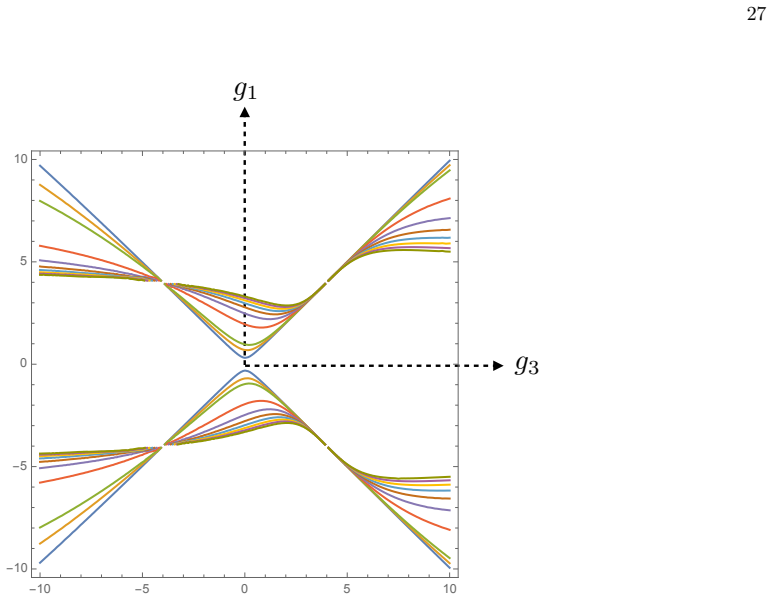
The model of pseudo-hermitian scalar fields with SU(2) broken to U(1) possesses a line of fixed points corresponding to non-unitary conformal field theories in four dimensions. The beta functions admit a conjecture to all orders that supports this structure, including massless flows between fixed points and a cyclic regime.
What carries the argument
The renormalization group beta functions for the couplings, computed to three loops and conjectured to all orders, which exhibit a g to 1/g symmetry.
If this is right
- Massless flows exist between two non-trivial fixed points on the critical line.
- A cyclic RG flow regime is possible in this non-unitary model.
- Anomalous dimensions of perturbations in the UV and IR are computed and take rational values at special points on the line.
- The strong-weak coupling symmetry extends the flows to large coupling.
Where Pith is reading between the lines
- The existence of these fixed points suggests that non-unitary CFTs may be more common in four dimensions than previously thought.
- Higher-loop calculations could confirm or refute the all-order conjecture for the beta function.
- These theories might serve as toy models for studying non-unitary phenomena in quantum field theory.
Load-bearing premise
The one-loop structure of the renormalization group flows continues to hold at all higher orders in the loop expansion.
What would settle it
A four-loop or higher calculation of the beta function that deviates from the conjectured all-orders form would falsify the persistence of the flow structure.
Figures


read the original abstract
We define a model of 2 coupled SU(2) doublets of scalar fields in $4$ spacetime dimensions which have a rich structure of renormalization group (RG) flows to 1-loop when the SU(2) is broken to U(1). The model is pseudo-hermitian, $H^\dagger = {\cal K} H {\cal K}^\dagger$ with ${\cal K} ^\dagger {\cal K} = {\cal K}^2 =1$, which makes it non-unitary, however in a very specific manner with some desirable properties. We compute the beta functions to 3 loops from the operator product expansion and show that the 1-loop structure of flows persists to higher orders. For $SU(2)$ broken to $U(1)$, we conjecture a beta function to all orders. The flows can be extended to large coupling using a strong-weak coupling symmetry $g \to 1/g$ of the beta functions. One finds a line of fixed points which are non-unitary conformal field theories in 4 spacetime dimensions that were previously unknown. We also find massless flows between 2 non-trivial fixed points, and a regime with a cyclic RG flow, which is allowed since the model is non-unitary. For the flows between fixed points on the critical line, we compute the anomalous dimensions of the perturbations in the UV and IR, and identify some special points where anomalous dimensions are rational numbers.
Editorial analysis
A structured set of objections, weighed in public.
Referee Report
Summary. The manuscript defines a pseudo-hermitian model of two coupled SU(2) scalar doublets in 4D with SU(2) broken to U(1). It computes the beta functions to three loops via the operator product expansion, shows that the one-loop flow structure persists, conjectures an all-order beta function for this case, invokes a g ↔ 1/g strong-weak symmetry to extend the flows, and reports a line of fixed points corresponding to previously unknown non-unitary CFTs, massless flows between fixed points, and a cyclic RG regime. Anomalous dimensions of perturbations along the critical line are computed, with rational values at special points.
Significance. If the all-order conjecture holds, the result would establish the first explicit line of non-unitary 4D CFT fixed points with controlled RG flows between them. The three-loop OPE computation that confirms persistence of the one-loop structure is a concrete technical achievement, as is the identification of rational anomalous dimensions at isolated points on the line. The g ↔ 1/g symmetry provides a non-perturbative handle on strong coupling. These elements would be of interest to the conformal bootstrap and non-unitary QFT communities if the extrapolation can be placed on firmer footing.
major comments (2)
- [Abstract and conjecture section] Abstract and the section presenting the all-order conjecture: the existence of the line of fixed points is obtained only after conjecturing an exact beta function on the basis of three-loop persistence; no independent non-perturbative derivation, functional equation, or four-loop check is supplied to control the extrapolation. This assumption is load-bearing for the central claim.
- [Symmetry extension paragraph] Discussion of the g ↔ 1/g symmetry (following the three-loop results): the symmetry is used to extend the flow to strong coupling and locate the fixed line, yet it is not shown whether the symmetry remains exact once the conjectured higher-order terms are included or whether it is an artifact of the truncated beta function.
minor comments (2)
- [Model definition] The precise definition of the pseudo-Hermitian operator K and the inner product it induces could be stated more explicitly with a short matrix example in the model-definition section to aid readers unfamiliar with the non-unitary setup.
- [Notation] Notation for the two SU(2) doublets and the U(1) breaking parameters is introduced without a summary table; adding one would improve readability when tracking the beta-function components.
Simulated Author's Rebuttal
We thank the referee for their careful reading and insightful comments on our manuscript. We address each major comment below, providing our perspective on the status of the conjecture and symmetry.
read point-by-point responses
-
Referee: [Abstract and conjecture section] Abstract and the section presenting the all-order conjecture: the existence of the line of fixed points is obtained only after conjecturing an exact beta function on the basis of three-loop persistence; no independent non-perturbative derivation, functional equation, or four-loop check is supplied to control the extrapolation. This assumption is load-bearing for the central claim.
Authors: We explicitly frame the all-order beta function as a conjecture in the manuscript, motivated by the explicit three-loop computation via OPE that confirms the one-loop flow structure persists. This three-loop agreement constitutes non-trivial evidence supporting the extrapolation, though we acknowledge the absence of a non-perturbative derivation or four-loop verification. The conjecture is presented with this limitation clearly stated, and the central claims are qualified accordingly. revision: no
-
Referee: [Symmetry extension paragraph] Discussion of the g ↔ 1/g symmetry (following the three-loop results): the symmetry is used to extend the flow to strong coupling and locate the fixed line, yet it is not shown whether the symmetry remains exact once the conjectured higher-order terms are included or whether it is an artifact of the truncated beta function.
Authors: The g ↔ 1/g symmetry is observed directly in the computed beta functions through three loops. The conjectured all-order expression is constructed to preserve this symmetry, consistent with the perturbative results. We do not claim an independent proof of its validity at higher orders, but the symmetry is a feature of the explicit calculations rather than a truncation artifact, enabling the strong-coupling extension within the conjectural framework. revision: no
- Providing an independent non-perturbative derivation, functional equation, or four-loop check to control the conjectured all-order beta function.
Circularity Check
Line of fixed points rests on all-order beta-function conjecture extrapolated from 3-loop persistence
specific steps
-
fitted input called prediction
[Abstract]
"We compute the beta functions to 3 loops from the operator product expansion and show that the 1-loop structure of flows persists to higher orders. For SU(2) broken to U(1), we conjecture a beta function to all orders. The flows can be extended to large coupling using a strong-weak coupling symmetry g to 1/g of the beta functions. One finds a line of fixed points which are non-unitary conformal field theories in 4 spacetime dimensions that were previously unknown."
The 3-loop computation confirms the 1-loop structure; the all-order beta function is then conjectured from that persistence. Fixed points and the line of CFTs are located by setting the conjectured beta to zero, so the claimed new fixed points are generated by extrapolating the low-order pattern rather than by an independent non-perturbative derivation.
full rationale
The derivation computes beta functions to 3 loops via OPE and observes persistence of the 1-loop flow structure. It then conjectures an all-order beta function for the SU(2) broken to U(1) case, invokes a g to 1/g symmetry, and locates a line of fixed points from that conjectured form. While the explicit 3-loop OPE calculations are independent, the strongest claim (previously unknown non-unitary CFT fixed points in 4D) is obtained only after the extrapolation step. This matches the pattern of a low-order result being extended by conjecture and then treated as the exact beta function whose zeros yield the new physics. No self-citation load-bearing or definitional loop is exhibited in the provided text, but the central result reduces to the assumed continuation of the observed pattern.
Axiom & Free-Parameter Ledger
axioms (2)
- domain assumption The operator product expansion remains valid for computing beta functions in this pseudo-hermitian non-unitary model.
- ad hoc to paper The one-loop flow structure persists at higher loop orders.
invented entities (1)
-
Pseudo-hermitian scalar model with two coupled SU(2) doublets
no independent evidence
Lean theorems connected to this paper
-
IndisputableMonolith/Cost/FunctionalEquation.leanwashburn_uniqueness_aczel unclear?
unclearRelation between the paper passage and the cited Recognition theorem.
We compute the beta functions to 3 loops from the operator product expansion and show that the 1-loop structure of flows persists to higher orders. For SU(2) broken to U(1), we conjecture a beta function to all orders.
-
IndisputableMonolith/Foundation/AlexanderDuality.leanalexander_duality_circle_linking contradicts?
contradictsCONTRADICTS: the theorem conflicts with this paper passage, or marks a claim that would need revision before publication.
One finds a line of fixed points which are non-unitary conformal field theories in 4 spacetime dimensions
What do these tags mean?
- matches
- The paper's claim is directly supported by a theorem in the formal canon.
- supports
- The theorem supports part of the paper's argument, but the paper may add assumptions or extra steps.
- extends
- The paper goes beyond the formal theorem; the theorem is a base layer rather than the whole result.
- uses
- The paper appears to rely on the theorem as machinery.
- contradicts
- The paper's claim conflicts with a theorem or certificate in the canon.
- unclear
- Pith found a possible connection, but the passage is too broad, indirect, or ambiguous to say the theorem truly supports the claim.
Forward citations
Cited by 1 Pith paper
-
A rich structure of renormalization group flows for Higgs-like models in 4 dimensions
A two-Higgs-doublet model with SU(2)-based marginal operators produces unavoidable cyclic RG flows, pseudo-unitary behavior below pair-production threshold, and Russian Doll VEVs whose period is fixed by the Koide for...
Reference graph
Works this paper leans on
-
[1]
+ κ2 16 g2 1(g3 3 + 2g3g2
-
[2]
(102) βg3 =g 2 1 − κ 2 g2 1g3 + κ2 16 g2 1(2g2 1 +g 2
+. . .(102) βg3 =g 2 1 − κ 2 g2 1g3 + κ2 16 g2 1(2g2 1 +g 2
-
[3]
+. . .(103) For describing the RG trajectories in the next section, the analysis is greatly simplified by an RG invariantQ(g 1, g3), since this does not require explicitly integrating the beta functions as a function of scaleℓ, since RG trajectories are constantQcontours. Such an RG invariantQis defined as satisfying (86), and wheng 1 =g 2 there is only o...
-
[4]
+. . . .(104) Here (86) is satisfied to orderg 5, which implies it is valid to orderg 4: X g=g1,g3 βg∂gQ=O(g 5).(105) Based on the above results, we can now propose formulas for the beta functions to all orders in the coupling. This is possible based on the following reasoning. (i) The Lie-algebraic structure of the OPE diagrams in 4D and 2D is identical,...
-
[5]
for more detailed explanations in the 2D case. This leads a variety of RG flows which we now itemize. A contour plot of the non-perturbativeQin (107) provides a global picture of the RG flows shown in Figure 9. One sees that the set of all contours forms an interesting manifold. Flows in the cyclic regime are shown separately in Figure 12 since they are n...
-
[6]
One sees that the flows smoothly pass through the poles at the self-dual pointsg 1, g3 =±4. This can be attributed to the fact that the flows approach the self-dual points with the correct slope, namely along the SU(2) invariant flows along the diagonal. This can be seen in Figures 9,12 where flows cross the poles through very narrow bridges. 17 Since rel...
-
[7]
F. Wilczek,QCD and asymptotic freedom: Perspectives and prospects,International Journal of Modern Physics A 8.08 (1993): 1359. 31
work page 1993
-
[8]
D. J. Gross,The discovery of asymptotic freedom and the emergence of QCD,International Journal of Modern Physics A 20.25 (2005): 5717
work page 2005
-
[9]
K. G. Wilson and M. E. Fisher,Critical exponents in 3.99 dimensions,Phys.Rev.Lett. 28 (1972) 240
work page 1972
-
[10]
A. Belavin, A. M. Polyakov, and A. Zamolodchikov,Infinite Conformal Symmetry in Two-Dimensional Quantum Field Theory,Nucl.Phys. B241 (1984) 333
work page 1984
-
[11]
Witten,Non-abelian bosonization in two dimensions, Commun
E. Witten,Non-abelian bosonization in two dimensions, Commun. Math. Phys. 92 (1984) 455
work page 1984
-
[12]
V.G. Knizhnik and A. B. Zamolodchikov,Current algebra and Wess-Zumino model in two dimensions,Nucl. Phys. B247 (1984) 83
work page 1984
-
[13]
M. Lencs´ es, A. Miscioscia, G. Mussardo, and G. Tak´ acs,Ginzburg-Landau description for multicritical Yang-Lee models, JHEP 08 (2024) 224, arXiv:2404.06100
-
[14]
T. Tanaka and Y. Nakayama,Infinitely many new renormalization group flows between Virasoro minimal models from non-invertible symmetries, arXiv:2407.21353
-
[15]
A. Katsevich, I. R. Klebanov and Z. Sun,Ginzburg-Landau description of a class of non-unitary minimal models, arXiv:2410.11714
-
[16]
F. Ambrosino and S. Negro,Minimal Models RG flows: non-invertible symmetries and non-perturbative description, arXiv:2501.07511
-
[17]
O. A. Castro-Alvaredo, B. Doyon and F. Ravanini,Irreversibility of the renormalization group flow in non-unitary quantum field theory,J. Phys. A 50, 424002 (2017); arXiv:1706.01871
work page internal anchor Pith review Pith/arXiv arXiv 2017
-
[18]
D. Friedan, Z.-A. Qiu, and S. H. Shenker,Conformal Invariance, Unitarity and Two-Dimensional Critical Exponents, Phys. Rev. Lett. 52 (1984) 1575–1578
work page 1984
-
[19]
V. S. Dotsenko and V. A. Fateev,Four Point Correlation Functions and the Operator Algebra in the Two-Dimensional Conformal Invariant Theories with the Central Chargec <1, Nucl. Phys. B 251 (1985) 691
work page 1985
-
[20]
D. Bernard and G. Felder,Fock representations and BRST cohomology in SL(2) current algebra,Communications in Mathematical Physics 127 (1990): 145
work page 1990
-
[21]
P. Goddard, A. Kent, and D. Olive,Unitary representations of the Virasoro and super-Virasoro algebras,Communications in Mathematical Physics 103 (1986): 105
work page 1986
-
[22]
A rich structure of renormalization group flows for Higgs-like models in 4 dimensions
A. LeClair,A rich structure of renormalization group flows for Higgs-like models in 4 dimensions,arXiv:2411.07476 (2024)
work page internal anchor Pith review Pith/arXiv arXiv 2024
-
[23]
D. Bernard and A. LeClair,A Classification of Non-Hermitian Random Matrices, Proceedings of the NATO Advanced Re- search Workshop on Statistical Field Theories, Como (Italy), June 2001, ISBN 978-1-4020-0761-3; arXiv:cond-mat/0110649
-
[24]
Dyson,Statistical theory of the energy levels of complex systems
F. Dyson,Statistical theory of the energy levels of complex systems. I,J. Math. Phys. 3 (1962) 140
work page 1962
-
[25]
A. Altland and M. Zirnbauer,Nonstandard symmetry classes in mesoscopic normal-superconducting hybrid structures, Phys. Rev. B 55 (1997) 1142
work page 1997
-
[26]
N. Okuma and M. Sato,Non-Hermitian topological phenomena: A review, Annual Review of Condensed Matter Physics (2023) 14, 83–107; arXiv:2205.10379
-
[27]
Pauli,On Dirac’s new method of field quantization, Rev
W. Pauli,On Dirac’s new method of field quantization, Rev. Mod. Phys. 15 (1943) 175
work page 1943
-
[28]
A. Mostafazadeh,Pseudo-Hermitian representation of quantum mechanics,International Journal of Geometric Methods in Modern Physics 7.07 (2010): 1191
work page 2010
-
[29]
A. Mostafazadeh,Pseudo-Hermiticity versus PT symmetry: The necessary condition for the reality of the spectrum of a non-Hermitian Hamiltonian,Journal of Mathematical Physics 43.1 (2002): 205
work page 2002
-
[30]
Pseudo-Hermiticity for a Class of Nondiagonalizable Hamiltonians
A. Mostafazadeh,Pseudo-Hermiticity for a class of nondiagonalizable Hamiltonians, J. Math. Phys. 43 (2002) 205; arXiv:math-ph/0207009
work page internal anchor Pith review Pith/arXiv arXiv 2002
-
[31]
C. M. Bender,Making sense of non-Hermitian Hamiltonians, Rept.Prog.Phys.70 (2007) 947; arXiv: hep-th/0703096
work page internal anchor Pith review Pith/arXiv arXiv 2007
-
[32]
A. B. Zamolodchikov,Renormalization group and perturbation theory about fixed points in two-dimensional field theory, Sov. J. Nucl. Phys. 46 (1987) 1090
work page 1987
-
[33]
Cardy,Is There a c-theorem in Four-Dimensions?,Phys
J. Cardy,Is There a c-theorem in Four-Dimensions?,Phys. Lett. B 215 (1988) 749
work page 1988
-
[34]
Osborn,Derivation of a four-dimensional c-theorem, Phys.Lett
H. Osborn,Derivation of a four-dimensional c-theorem, Phys.Lett. B222, 97 (1989)
work page 1989
-
[35]
I. Jack and H. Osborn,Analogs of the c-theorem for four-dimensional renormalisable field theories,Nuclear Physics B 343.3 (1990): 647
work page 1990
-
[36]
On Renormalization Group Flows in Four Dimensions
Z. Komargodski and A. Schwimmer,On Renormalization Group Flows in Four Dimensions, JHEP 1112, 099 (2011), arXiv:1107.3987
work page internal anchor Pith review Pith/arXiv arXiv 2011
-
[37]
Komargodski,The constraints of conformal symmetry on RG flows,JHEP 07 (2012) 069
Z. Komargodski,The constraints of conformal symmetry on RG flows,JHEP 07 (2012) 069
work page 2012
-
[38]
M. A. Luty, J. Polchinski and R. Rattazzi,The a-theorem and the Asymptotics of 4D Quantum Field Theory,Journal of High Energy Physics 2013.1 (2013): 1
work page 2013
-
[39]
C. B. Jepsen, I. R. Klebanov and F. K. Popov,Rg limit cycles and unconventional fixed points in perturbative qft, Physical Review D103 (2021) 046015
work page 2021
-
[40]
K. G. Wilson,Renormalization Group and Strong Interactions, Phys. Rev. D3 (1971) 1818
work page 1971
-
[41]
Limit cycles in quantum theories
S. D. Glazek and K. G. Wilson, “Limit cycles in quantum theories”, Phys.Rev.Lett. 89 (2002) 230401
work page 2002
-
[42]
S. D. Glazek and K. G. Wilson,Universality, marginal operators, and limit cycles,Phys. Rev. B 69 (2004) 094304
work page 2004
-
[43]
P. F. Bedaque, H.-W. Hammer, and U. van Kolck,Renormalization of the Three-Body System with Short-Range Interac- tions,Phys. Rev. Lett. 82 (1999) 463; arXiv:nucl-th/9809025
work page internal anchor Pith review Pith/arXiv arXiv 1999
-
[44]
Renormalization group limit-cycles and field theories for elliptic S-matrices
A. LeClair and G. Sierra,Renormalization group limit-cycles and field theories for elliptic S-matrices, J.Stat.Mech.0408:P08004 (2004); arXiv:hep-th/0403178
work page internal anchor Pith review Pith/arXiv arXiv 2004
-
[45]
Universality in Few-body Systems with Large Scattering Length
E. Braaten and H. W. Hammer,Universality in few-body problems with large scattering length, Physics Reports 428.5-6 (2006): 259-390; arXiv:cond-mat/0410417. 32
work page internal anchor Pith review Pith/arXiv arXiv 2006
-
[46]
Strong-weak coupling duality in anisotropic current interactions
D. Bernard and A. LeClair,Strong-weak coupling duality in anisotropic current interactions,Phys.Lett. B512 (2001) 78; hep-th/0103096
work page internal anchor Pith review Pith/arXiv arXiv 2001
-
[47]
On the Beta Function for Anisotropic Current Interactions in 2D
B. Gerganov, A. LeClair and M. Moriconi,On the Beta Function for Anisotropic Current Interactions in 2D,Phys. Rev. Lett. 86 (2001) 4753; hep-th/0011189
work page internal anchor Pith review Pith/arXiv arXiv 2001
-
[48]
Russian Doll Renormalization Group and Superconductivity
A. LeClair, J.-M. Roman and G. Sierra,Russian Doll Renormalization Group and Superconductivity,Phys. Rev. B69 (2004) 20505, arXiv:cond-mat/0211338
work page internal anchor Pith review Pith/arXiv arXiv 2004
-
[49]
Russian Doll Renormalization Group, Kosterlitz-Thouless Flows, and the Cyclic sine-Gordon model
A. LeClair, J.M. Roman and G. Sierra,Russian Doll Renormalization Group and Kosterlitz-Thouless Flows,Nucl.Phys. B675 (2003) 584, hep-th/0301042
work page internal anchor Pith review Pith/arXiv arXiv 2003
-
[50]
Log-periodic behavior of finite size effects in field theories with RG limit cycles
A. LeClair, J.M. Roman and G. Sierra,Log periodic behavior of finite size effects in field theories with RG limit cycles, Nucl.Phys. B700 (2004) 407; hep-th/0312141
work page internal anchor Pith review Pith/arXiv arXiv 2004
-
[51]
An Introduction to Quantum Field Theory
M. Peskin and D. Schroeder, “An Introduction to Quantum Field Theory”, Addison-Wesley, 1995
work page 1995
-
[52]
Higher Spin Realization of the dS/CFT Correspondence
D. Anninos, T. Hartman and A. Strominger,Higher Spin Realization of the dS/CFT Correspondence,Class. Quant. Grav. 34(2016) 015009; arXiv:1108.5735
work page internal anchor Pith review Pith/arXiv arXiv 2016
-
[53]
Semi-Lorentz invariance, unitarity, and critical exponents of symplectic fermion models
A. LeClair and M. Neubert,Semi-Lorentz invariance, unitarity, and critical exponents of symplectic fermion models, JHEP 0710:027 (2007); arXiv:0705.4657 [hep-th]
work page internal anchor Pith review Pith/arXiv arXiv 2007
- [54]
- [55]
-
[56]
C.-Y. Lee,Generalized unitary evolution for symplectic scalar fermions,JHEP 05 (2024) 181; arXiv:2305.17712
-
[57]
C. Møller,Zur Theorie des Durchgangs schneller Elektronen durch Materie,Annalen der Physik 14 (1932) 531–585
work page 1932
- [58]
-
[59]
A model of a 2d non-Fermi liquid with SO(5) symmetry, AF order, and a d-wave SC gap
E. Kapit and A. LeClair,A model of a 2d non-Fermi liquid with SO(5) symmetry, AF order, and a d-wave SC gap, J.Phys.A42:025402 (2009); arXiv:0805.4182
work page internal anchor Pith review Pith/arXiv arXiv 2009
-
[60]
S.-C. Zhang,A unified theory based on SO(5) symmetry of superconductivity and anti-ferromagnetism,Science 275.5303 (1997): 1089-1096
work page 1997
-
[61]
Z.-Q. Gao, H. Yang and Y.-Q. Wang,Deconfined quantum criticality with internal supersymmetry,(2026); arXiv:2601.14398
work page internal anchor Pith review Pith/arXiv arXiv 2026
-
[62]
F. A. Smirnov and A. B. Zamolodchikov,On space of integrable quantum field theories,Nuclear Physics B 915 (2017): 363
work page 2017
-
[63]
D. Bernard and A. LeClair,The fractional supersymmetric sine-Gordon models, Physics Letters B 247.2-3 (1990): 309
work page 1990
-
[64]
Zamolodchikov,From tricritical Ising to critical Ising by thermodynamic Bethe ansatz, Nucl
Al. Zamolodchikov,From tricritical Ising to critical Ising by thermodynamic Bethe ansatz, Nucl. Phys. B358 (1991) 524
work page 1991
-
[65]
LeClair,T Tdeformation of the Ising model and its ultraviolet completion.J
A. LeClair,T Tdeformation of the Ising model and its ultraviolet completion.J. Stat. Mech. (2021) 113104; arXiv:2107.02230
- [66]
-
[67]
A. B. Zamolodchikov and Al. B. Zamolodchikov,Factorized S-matrices in Two Dimensions as the Exact Solutions of Certain Relativistic Quantum Field Theory Models,Annals of Physics 120, 253 (1979)
work page 1979
-
[68]
K. Ghosh and E. Trevisani,A Tale of Two Uplifts: Parisi-Sourlas with Defects, arXiv:2508.18356
-
[69]
A. B. Zamolodchikov,Z 4-symmetric factorized S-matrix in two space-time dimensions,Commun. Math. Phys. 69 (1979) 165
work page 1979
-
[70]
R. J. Baxter,Exactly Solved Models in Statistical Mechanics,Academic Press (1982)
work page 1982
-
[71]
A. A. Belavin,Dynamical Yang-Baxter equation and quantum algebra associated with the elliptic curve,Nuclear Physics B 180 (1981), 189
work page 1981
-
[72]
Kutasov,Duality off the critical point in two-dimensional systems with non abelian symmetries,Phys
D. Kutasov,Duality off the critical point in two-dimensional systems with non abelian symmetries,Phys. Lett. B227 (1989) 68
work page 1989
-
[73]
P. Fendley, H. Saleur and Al. B. Zamolodchikov,Massless Flows I: the sine-Gordon and O (n) models,Int. J. Mod. Phys. A8 (1993) 5717
work page 1993
-
[74]
P. Fendley, H. Saleur and Al. B. Zamolodchikov,Massless Flows II: the exact S-matrix approach,Int. J. Mod. Phys. A8 (1993) 5751
work page 1993
-
[75]
A. W. W. Ludwig and K. J. Wiese,The 4-loop beta-function in the 2D Non-Abelian Thirring model, and comparison with its conjectured ”exact” form,Nucl.Phys.B661 (2003) 577; arxiv:cond-mat/0211531
work page internal anchor Pith review Pith/arXiv arXiv 2003
-
[76]
gl(N|N) Super-Current Algebras for Disordered Dirac Fermions in Two Dimensions
S. Guruswamy, A. LeClair, A. W. W. Ludwig,gl(N|N)Super-Current Algebras for Disordered Dirac Fermions in Two Dimensions, Nucl.Phys. B583 (2000) 475; arXiv:cond-mat/9909143
work page internal anchor Pith review Pith/arXiv arXiv 2000
-
[77]
Gauged WZW-type theories and the all-loop anisotropic non-Abelian Thirring model
K. Sfetsos and K. Siampos,Gauged WZW-type theories and the all-loop anisotropic non-Abelian Thirring model, Nucl. Phys. B 885 (2014) 583; arXiv:1405.7803
work page internal anchor Pith review Pith/arXiv arXiv 2014
discussion (0)
Sign in with ORCID, Apple, or X to comment. Anyone can read and Pith papers without signing in.