REVIEW 4 major objections 7 minor 12 references
Privacy-Preserving Operating Room Workflow Analysis using Digital Twins
T0 review · 4 major / 7 minor · reviewed 2026-08-16 · deepseek-v4-flash
Pith's one-line read Operating-room workflow events can be detected from de-identified digital twins—semantic masks plus depth maps—just as accurately as from raw RGB video, making surgical footage safe to share across institutions.
desk verdict A useful privacy-preserving pipeline idea, but the headline parity claim rests on a single small split with no significance testing; treat the 'sometimes better' as anecdotal. read the letter →
The pith
A machine-rendered reading of the paper's core claim, the machinery that carries it, and where it could break.
The reading
What carries the argument
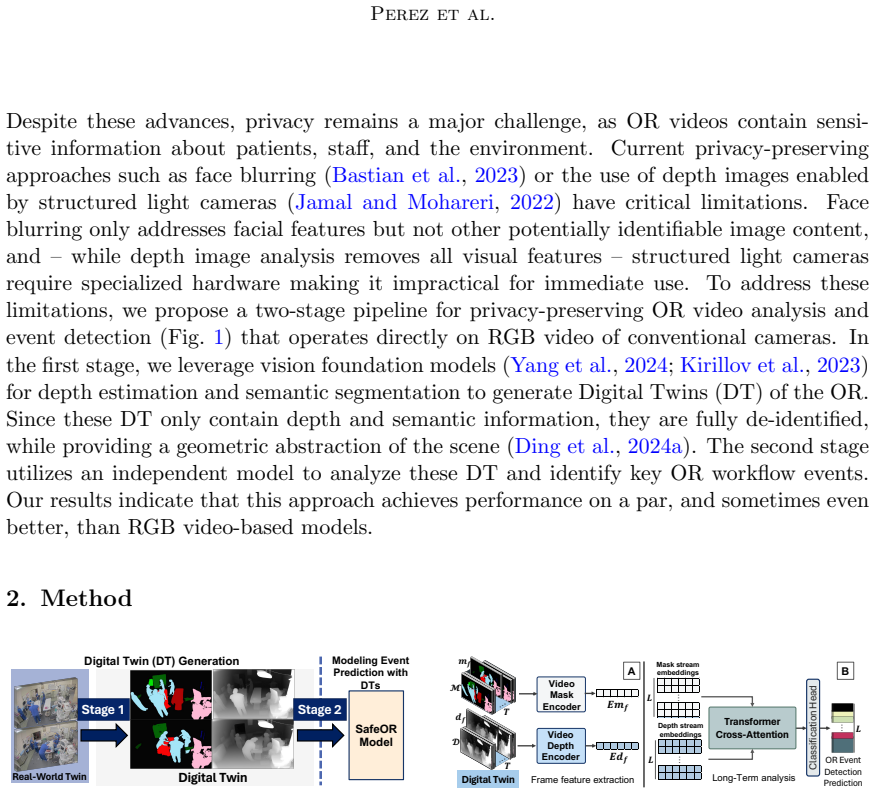
The central object is the Digital Twin of the OR scene, a de-identified 2D representation in which each frame is replaced by a semantic segmentation mask and a depth map. The generation pipeline is the first mechanism: a fine-tuned object detector (DETR with collaborative hybrid assignments) proposes bounding boxes for 14 OR object classes, those boxes prompt the Segment Anything Model (SAM) to produce masks, and Depth Anything v2 produces monocular depth. The second mechanism is the SafeOR event detector, a two-stream architecture that encodes a temporal window of mask frames and depth frames with separate video backbones, then fuses the two streams' embeddings with cross-attention over a long-term sequence (extending the MUST multi-scale transformer) before a classification head labels events per frame. Together, the two mechanisms convert a privacy-sensitive RGB stream into a geometric-semantic abstraction and show that event detection can be done entirely on that abstraction.
What would settle it
Run the same SafeOR training on a real, multi-site OR video dataset (not the 38-trial role-play simulation) comparing raw RGB against Mask-Depth DT; if the DT average mAP falls materially below the RGB baseline, the parity claim is falsified. Separately, a successful attempt to re-identify a patient or reconstruct an identifiable scene from the mask-and-depth representation would falsify the privacy claim.
Extended reading notes
Core claim
On the paper's own terms, the central discovery is that a Digital Twin composed only of semantic segmentation masks and depth estimates—obtained by prompting SAM with bounding boxes from a fine-tuned DETR and running Depth Anything v2 on conventional RGB frames—preserves enough spatio-temporal information for OR event detection to match, and in aggregate slightly exceed, detection from raw RGB video. The authors report that their fused mask-and-depth twin (Mask-Depth DT) reaches an average mAP of 72.93 across temporal IoU thresholds, versus 70.75 for the RGB baseline, with the largest gains at stricter thresholds (46.89 vs 43.09 mAP@0.75). They also report smaller temporal prediction errors on several event classes, such as gurney entering, suggesting the geometric abstraction gives cleaner event boundary estimates. Under this view, the DT is not a lossy compromise but a privacy-preserving representation that can be shared across institutions while retaining the signal needed for workflow analysis.
Load-bearing premise
The pipeline assumes that the foundation models' predicted segmentation masks and depth maps are accurate and stable enough to faithfully represent the OR scene, since any error in those predictions propagates directly into the digital twin and degrades the event detector.
Editorial extensions
If this is right
- Hospitals can share OR workflow data as masks and depth maps instead of video, avoiding the identifiability that blocks multi-institution training.
- Event detection no longer requires specialized depth cameras; monocular depth from ordinary RGB cameras suffices to build the privacy-preserving representation.
- Because the DT strips away appearance, models trained on it may generalize better across hospitals with different equipment, lighting, and room layouts, a benefit the paper argues for.
- The SafeOR model on Mask-Depth DT beats single-modality masks or depth alone, showing the two modalities carry complementary event signals.
- The DT representation yields comparable or better temporal boundary estimates for several event classes, so workflow bottleneck measurement does not degrade under anonymization.
Reading between the lines
- If masks and depth truly suffice, then training data for OR event detection could be generated synthetically by rendering simulated operating rooms into semantic-depth twins, removing the need to collect or de-identify any real video.
- The same de-identification-by-abstraction recipe could transfer to other privacy-sensitive video domains—home care, retail, elder monitoring—where the question is whether a task's signal survives the loss of appearance.
- The privacy claim is here asserted rather than adversarially tested; a natural stress test would try to re-identify individuals or reconstruct recognizable scenes from masks and depth alone, since room geometry and equipment layout can themselves be identifying.
- Because Depth Anything v2 and SAM were trained on natural images, their masks and depths may degrade on domain-shifted OR scenes; a testable extension is to measure how much DT quality (and downstream mAP) drops on unseen real ORs.
Signed reviews
Editorial analysis
A structured set of objections, weighed in public.
Referee Report
Summary. The manuscript proposes a two-stage pipeline for privacy-preserving operating room (OR) workflow analysis. In stage one, RGB videos are converted into a Digital Twin (DT) representation consisting of semantic segmentation masks and monocular depth maps, generated with vision foundation models (DETR-prompted SAM and Depth Anything v2). In stage two, a two-stream Transformer model with cross-attention processes the mask and depth streams to detect five perioperative events. Evaluation on an internal dataset of 38 simulated surgical trials compares RGB input against Mask DT, Depth DT, and the fused Mask-Depth DT, reporting mean Average Precision (mAP) at temporal IoU thresholds and per-class temporal errors. The authors claim that the DT-based approach performs on par with, and sometimes better than, raw RGB, and that the DT representation is fully de-identified.
Significance. If the empirical claim were convincingly established, this work would be a useful contribution to privacy-preserving OR workflow analysis: it could enable event detection from conventional RGB cameras without optical privacy hardware, facilitate cross-institutional data sharing through de-identified scene abstractions, and potentially reduce domain shift between institutions. Strengths of the paper include the use of a standard temporal action localization metric (mAP at tIoU thresholds), per-class boundary error reporting, and qualitative visualizations. The combination of modern foundation models for scene abstraction is timely and well motivated. However, the evidence presented is currently too weak to support the central parity claim, and the privacy-preservation assertion is not validated.
major comments (4)
- [Section 3, Table 1] The central claim that DT inputs are on par with, and sometimes better than, RGB is supported only by a single average-mAP comparison: Mask-Depth DT achieves 72.93% versus 70.75% for RGB, a gap of 2.18 points on a dataset of 38 simulated trials. No confidence intervals, cross-validation, or significance tests are reported. The high per-class variability in Table 2 (e.g., 'Loading patient to gurney' start error of 32.62 ± 66.69 s) suggests that the observed difference could easily arise from sampling noise. The authors should provide error bars, perform paired significance tests (e.g., bootstrap or permutation tests), and describe the train/validation/test split. Without this, the 'sometimes better' assertion is unsupported, and even 'on par' is not rigorously demonstrated.
- [Section 3, Dataset] The train/validation/test split is not described. The reader does not know how the 38 trials were partitioned, whether the split is by trial or by OR, or whether the same subjects or ORs appear in multiple splits. This information is essential for interpreting the reported metrics and for assessing the variability of the comparison. Please specify the exact split, consider leave-one-OR-out evaluation or repeated cross-validation, and state whether the same hyperparameters were used for all input representations.
- [Section 2, Stage 1] The statement that 'since these DT only contain depth and semantic information, they are fully de-identified' is an assertion without supporting analysis. Depth maps and semantic masks can still encode identifying information (e.g., body geometry, gait, clothing shape, scene layout), and the paper provides no re-identification risk assessment, no privacy metric, and no comparison to existing anonymization methods such as face blurring or structured-light depth imaging. Because privacy-preservation is the paper's stated motivation and is central to its title, this claim is load-bearing and needs at least a careful discussion of residual risks or a quantitative privacy analysis.
- [Section 2, Stage 1] The pipeline relies on the accuracy of Depth Anything v2 and DETR-prompted SAM in OR scenes, but no sensitivity or error-propagation analysis is provided. If the foundation models produce inaccurate masks or depth maps, the DT representation will be degraded, which could directly affect event detection. The authors should report the quality of the generated DTs (e.g., segmentation/depth accuracy against manually annotated examples) and analyze how such errors affect downstream event detection, or compare against oracle masks/depth to bound the effect.
minor comments (7)
- [Figure 1 caption] The caption is truncated: 'Our two-stage pipeline use Digi-' should be completed, for example, as 'Our two-stage pipeline uses Digital Twins for privacy-preserving OR workflow analysis.'
- [Section 2, Stage 2] The notation 'Emf' and 'Edf' is not defined; please clarify what the subscripts denote (e.g., mask frame embedding and depth frame embedding) and define the temporal window size T.
- [Section 2, Stage 2] The event detection model is called 'SafeOR', but the architecture is attributed to MUST (Pérez et al., 2024). Please clarify whether SafeOR is a new name, a variant, or a direct adoption of the MUST model, and cite the appropriate source.
- [Section 2 and 3] No hyperparameters are reported (e.g., T, number of transformer layers L, embedding dimension, learning rate, training epochs). Providing these details is important for reproducibility, even in a short paper.
- [Table 2] Only Mask-Depth DT and RGB are compared in the temporal-error table; including single-modality DT results would help interpret the benefit of fusion.
- [Section 4] The claim that DTs 'facilitate cross-institutional model training and improves model generalizability' is not experimentally tested. The paper should either add a supporting experiment (e.g., cross-institution or domain-shift evaluation) or soften the claim to a hypothesis.
- [Throughout] Minor language issues: 'model relations between both modalities' should be 'model the relations between both modalities', and 'ground truth (GT)' is used before the abbreviation is introduced.
Circularity Check
No significant circularity: the DT-based event detection comparison is an independent empirical evaluation, not a result forced by construction or by self-citation.
full rationale
The paper's derivation chain is an empirical pipeline, not a formal derivation. Stage 1 constructs Digital Twins from RGB video by applying off-the-shelf foundation models (Depth Anything v2 for depth, DETR-prompted SAM for segmentation), and Stage 2 feeds those depth maps and segmentation masks into a two-stream transformer for event detection. The central claim, that Mask-Depth DT performs on par with raw RGB (Table 1: 72.93 vs 70.75 average mAP), is obtained by training and evaluating the model on the HALO dataset against ground-truth event annotations. This result is not equivalent to any input by construction: the DT representation is defined independently of the event labels, and the RGB baseline provides an external comparison point. The paper cites the authors' prior MUST architecture for the cross-attention fusion design and cites prior group work on digital twins for framing, but neither citation is used to derive or force the reported performance numbers; the architecture could be wrong and the evaluation would still be a valid empirical measurement. No fitted parameter is renamed as a prediction, no uniqueness theorem is imported to forbid alternatives, and no known result is relabeled as a new organization. The lack of confidence intervals or significance tests on the 38-trial comparison is a legitimate statistical-robustness concern, but the hard rules distinguish that from circularity, and it is not a reduction of the conclusion to the premise. Therefore the appropriate circularity score is 0.
Assumptions & free parameters
free parameters (3)
- Temporal window size T
- Transformer layers L and embedding dimension
- Fine-tuning schedule for object detection prompt model
assumptions (3)
- ad hoc to paper Segmentation masks and depth maps constitute a fully de-identified representation of the OR scene.
- domain assumption Depth Anything v2 and SAM produce accurate depth and segmentation in OR environments.
- domain assumption The 38 simulated role-play trials are representative of real OR workflows.
Cite this review
Pith. "Pith review of Privacy-Preserving Operating Room Workflow Analysis using Digital Twins." pith.science (2026). https://pith.science/paper/67KUEHOA
@misc{pith2026250412552,
  author       = {Pith},
  title        = {Pith review of: Privacy-Preserving Operating Room Workflow Analysis using Digital Twins},
  year         = {2026},
  howpublished = {\url{https://pith.science/paper/67KUEHOA}},
  note         = {Machine review of arXiv:2504.12552}
}
read the original abstract
The operating room (OR) is a complex environment where optimizing workflows is critical to reduce costs and improve patient outcomes. While computer vision approaches for automatic recognition of perioperative events can identify bottlenecks for OR optimization, privacy concerns limit the use of OR videos for automated event detection. We propose a two-stage pipeline for privacy-preserving OR video analysis and event detection. First, we leverage vision foundation models for depth estimation and semantic segmentation to generate de-identified Digital Twins (DT) of the OR from conventional RGB videos. Second, we employ the SafeOR model, a fused two-stream approach that processes segmentation masks and depth maps for OR event detection. Evaluation on an internal dataset of 38 simulated surgical trials with five event classes shows that our DT-based approach achieves performance on par with -- and sometimes better than -- raw RGB video-based models for OR event detection. Digital Twins enable privacy-preserving OR workflow analysis, facilitating the sharing of de-identified data across institutions and potentially enhancing model generalizability by mitigating domain-specific appearance differences.
Figures

Reference graph
Works this paper leans on
-
[1]
Disguisor: holistic face anonymization for the operating room
Lennart Bastian, Tony Danjun Wang, Tobias Czempiel, Benjamin Busam, and Nassir Navab. Disguisor: holistic face anonymization for the operating room. International Journal of Computer Assisted Radiology and Surgery, 18 0 (7): 0 1209--1215, 2023
work page 2023
-
[2]
Hao Ding, Lalithkumar Seenivasan, Benjamin D Killeen, Sue Min Cho, and Mathias Unberath. Digital twins as a unifying framework for surgical data science: the enabling role of geometric scene understanding. Artificial Intelligence Surgery, 4 0 (3): 0 109--138, 2024 a
work page 2024
-
[3]
Towards robust algorithms for surgical phase recognition via digital twin-based scene representation
Hao Ding et al. Towards robust algorithms for surgical phase recognition via digital twin-based scene representation. arXiv preprint arXiv:2410.20026, 2024 b
arXiv 2024
-
[4]
Multi-modal unsupervised pre-training for surgical operating room workflow analysis
Muhammad Abdullah Jamal and Omid Mohareri. Multi-modal unsupervised pre-training for surgical operating room workflow analysis. In International Conference on Medical Image Computing and Computer-Assisted Intervention, pages 453--463. Springer, 2022
work page 2022
-
[5]
Segment anything
Alexander Kirillov, Eric Mintun, Nikhila Ravi, Hanzi Mao, Chloe Rolland, Laura Gustafson, Tete Xiao, Spencer Whitehead, Alexander C Berg, Wan-Yen Lo, et al. Segment anything. In Proceedings of the IEEE/CVF international conference on computer vision, pages 4015--4026, 2023
2023
-
[6]
Improving operating room efficiency
Daniel J Lee, James Ding, and Thomas J Guzzo. Improving operating room efficiency. Current urology reports, 20: 0 1--8, 2019
work page 2019
-
[7]
Impact of preoperative briefings on operating room delays: a preliminary report
Shantanu Nundy, Arnab Mukherjee, J Bryan Sexton, Peter J Pronovost, Andrew Knight, Lisa C Rowen, Mark Duncan, Dora Syin, and Martin A Makary. Impact of preoperative briefings on operating room delays: a preliminary report. Archives of surgery, 143 0 (11): 0 1068--1072, 2008
work page 2008
-
[8]
O zsoy, Tobias Czempiel, Evin P nar \
Ege \"O zsoy, Tobias Czempiel, Evin P nar \"O rnek, Ulrich Eck, Federico Tombari, and Nassir Navab. Holistic or domain modeling: a semantic scene graph approach. International Journal of Computer Assisted Radiology and Surgery, 19 0 (5): 0 791--799, 2024
work page 2024
Show all 12 references
-
[9]
Must: Multi-scale t ransformers for surgical phase recognition
Alejandra P \'e rez, Santiago Rodr \' guez, Nicol \'a s Ayobi, Nicol \'a s Aparicio, Eug \'e nie Dessevres, and Pablo Arbel \'a ez. Must: Multi-scale t ransformers for surgical phase recognition. In International Conference on Medical Image Computing and Computer-Assisted Inte...
2024
-
[10]
Automatic operating room surgical activity recognition for robot-assisted surgery
Aidean Sharghi, Helene Haugerud, Daniel Oh, and Omid Mohareri. Automatic operating room surgical activity recognition for robot-assisted surgery. In MICCAI, pages 385--395. Springer, 2020
2020
-
[11]
Depth anything v2
Lihe Yang, Bingyi Kang, Zilong Huang, Zhen Zhao, Xiaogang Xu, Jiashi Feng, and Hengshuang Zhao. Depth anything v2. Advances in Neural Information Processing Systems, 37: 0 21875--21911, 2024
2024
-
[12]
Detrs with collaborative hybrid assignments training
Zhuofan Zong, Guanglu Song, and Yu Liu. Detrs with collaborative hybrid assignments training. In Proceedings of the IEEE/CVF, pages 6748--6758, 2023
2023
Reviewed August 16, 2026 · model on record in the stance chip above.
Discussion (0). Continue with ORCID to comment.