REVIEW 3 major objections 5 minor 48 references
Time Frequency Analysis of EMG Signal for Gesture Recognition using Fine grained Features
T0 review · 3 major / 5 minor · reviewed 2026-08-16 · deepseek-v4-flash
Pith's one-line read Mutual-attention layers consistently improve EMG gesture models
desk verdict A thin but honest application of an existing fine-grained attention network to EMG time-frequency images; the central claim of consistent gains is not yet supported by the evidence. read the letter →
The pith
A machine-rendered reading of the paper's core claim, the machinery that carries it, and where it could break.
The reading
What carries the argument
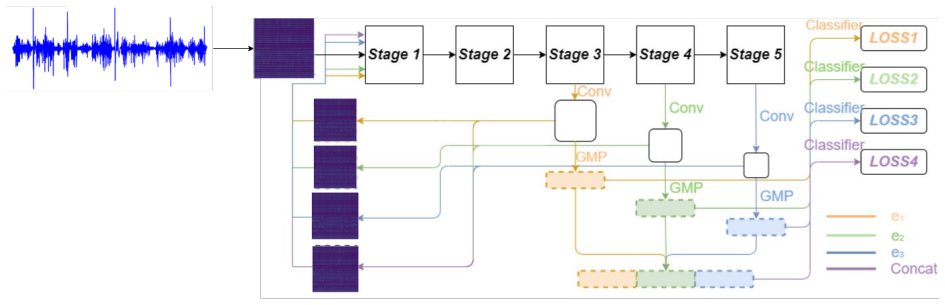
The central object is XMANet, which builds a hierarchy of N experts, each aggregating convolutional layers from the shallowest to a successively deeper point in a backbone CNN. Each expert produces a prediction from a global-max-pooled descriptor, and also generates a class-activation-map attention region that is cropped and used as an augmented training sample for the other experts. Training proceeds in a multi-step schedule: the deepest expert is trained first, then shallower experts, then a joint pass on the fused attention map, then a joint pass on the raw image. At inference, the network averages predictions from all experts on both the raw image and the overall attention map, yielding 2×(N+1) scores.
What would settle it
Re-run each baseline and each XMANet variant on the same train/validation/test splits with multiple random seeds (e.g., 10 seeds) and compute the mean and standard deviation of test accuracy; if the accuracy differences between XMANet and its corresponding baseline shrink to within one standard deviation across seeds, the central claim of consistent improvement collapses.
Extended reading notes
Core claim
XMANet, a cross-layer mutual attention learning network, consistently outperforms standard CNN baselines on EMG gesture recognition when the input is a time-frequency image (STFT spectrogram or wavelet scalogram). The paper reports accuracy improvements over ResNet50, DenseNet121, MobileNetV3, and EfficientNetB0 on both the Grabmyo and FORS-EMG datasets, with the largest relative gains on FORS-EMG, where wavelet scalograms and STFT spectrograms leave more room for improvement. The core claim is that fine-grained features extracted from shallow-to-deep layers, combined through mutual attention and attention-based data augmentation, yield robust and accurate EMG classification.
Load-bearing premise
The paper assumes that a single run of each model, chosen by best validation loss, gives a reliable estimate of test accuracy, so that differences of a few tenths of a percentage point are meaningful rather than random noise.
Editorial extensions
If this is right
- If XMANet's gains hold, the same cross-layer mutual-attention recipe can be applied to other backbones and other physiological signal modalities, not just EMG.
- The larger improvements on the FORS-EMG dataset suggest the method is most valuable when the time-frequency representation is noisy or the classification task is harder.
- The attention-region-based data augmentation provides a built-in way to focus models on discriminative parts of the spectrogram or scalogram, which could improve interpretability.
- The paper's consistent improvements across four architectures imply that the mechanism is architecture-agnostic, so practitioners can retain their preferred CNN and wrap XMANet around it.
- The two-pass inference strategy (raw plus attention map) is a simple test-time augmentation that could be combined with other ensembling methods.
Reading between the lines
- The reported gains, especially the small ones (0.03 to 0.5 percentage points on Grabmyo segmented images), may lie within run-to-run variance; repeated-seed experiments with confidence intervals would clarify the true effect size.
- The method's benefit appears larger when the baseline accuracy is lower, suggesting that mutual attention mainly helps by recovering information that standard CNNs discard on harder inputs, not by re-ranking already-easy examples.
- A natural extension is to apply XMANet directly to raw or lightly preprocessed EMG waveforms instead of spectrogram images, which would remove the time-frequency conversion step and potentially preserve temporal resolution.
- Because the attention regions are generated per predicted class, the method could be adapted for weakly supervised localization of the informative muscle-activation patterns, connecting gesture recognition with interpretability for prosthetics.
Signed reviews
Editorial analysis
A structured set of objections, weighed in public.
Referee Report
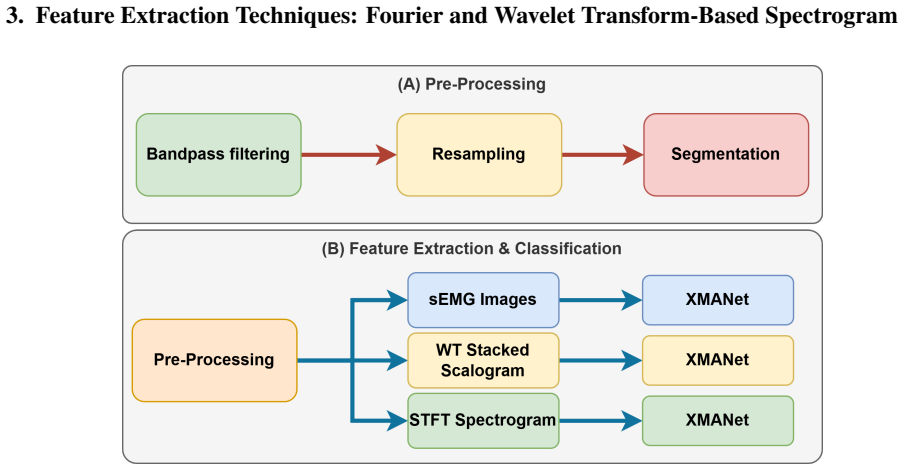
Summary. The paper proposes XMANet, a fine-grained classification model that applies cross-layer mutual attention among CNN experts, for EMG-based hand gesture recognition. Raw EMG is converted into stacked STFT spectrograms and wavelet scalograms, which are then classified by XMANet built on top of ResNet50, DenseNet121, MobileNetV3, and EfficientNetB0 backbones. Experiments on the Grabmyo and FORS-EMG datasets report accuracy, precision, recall, and F1, and the abstract and conclusion claim that XMANet consistently improves performance over all baselines on both time-frequency representations.
Significance. If the central claim were supported, the paper would provide a simple, architecture-agnostic way to improve EMG gesture recognition from time-frequency images, and the systematic comparison of STFT versus wavelet representations across four backbones on two public datasets would be a useful empirical contribution. The paper is transparent in reporting per-model accuracies and uses standard preprocessing and evaluation protocols. However, the methodological novelty is limited because XMANet is essentially the cross-layer mutual attention learning method of Liu et al. [24] applied to EMG spectrograms and scalograms; the contribution is empirical rather than architectural. The reliability of the empirical claim is the main issue: the evidence consists of single training runs without error bars or significance tests, and the paper contains a negative result in Table 5 that is not acknowledged. If the experimental protocol is strengthened, the study could be a valid application-oriented contribution.
major comments (3)
- [Abstract, Section 6.1, Tables 2 and 3] The headline improvement percentages in the abstract and conclusion (e.g., 1.72%, 4.38%, 5.10%, 2.53% for STFT on Grabmyo) are relative percentage increases, not absolute accuracy gains. For example, XMANet(ResNet50) at 93.03% versus ResNet50 at 91.46% is a gain of 1.57 percentage points, which is a 1.72% relative improvement. Elsewhere in Section 6.1 (Table 1 discussion) the text uses absolute percentage points, e.g., 'improved accuracy by 0.424% relative.' The paper never defines which quantity is being reported, so the quantitative claims in the abstract and conclusion are ambiguous and the two usages are inconsistent.
- [Section 5.2 and Section 6] All results come from a single training run per configuration: the model with the best validation loss is saved and evaluated once on the test set, with no seeds, repeated runs, confidence intervals, or statistical significance tests reported. Many of the claimed improvements are very small (e.g., 0.03 percentage points in Table 1 and 0.21 percentage points in Table 5), and without an estimate of run-to-run variability these differences cannot be distinguished from training noise. Since the paper's central claim is that XMANet consistently improves accuracy, this lack of statistical support is load-bearing.
- [Table 5, Section 6.2] The claim that XMANet 'consistently improves performance' is contradicted by the paper's own results in Table 5: on FORS-EMG STFT, XMANet(EfficientNetB0) obtains 48.08% accuracy versus 48.18% for the EfficientNetB0 baseline, a decrease. The surrounding text does not acknowledge this negative result, and the summary in Section 6.2 reports only the positive gains. The claim of consistency must either be removed or qualified, and the negative case should be explained or shown to be within the run-to-run variation.
minor comments (5)
- [Section 5.2, Section 6.1] The sentence listing the four pre-trained architectures says 'ResNet50, MobileNetV3, and DenseNet121' but omits EfficientNetB0, which is nevertheless used in all experiments. Also, the text says 'DenseNet121 model achieves an accuracy of 98.44%' while Table 1 reports 99.44%.
- [Equation (11)] The min-max normalization formula is written as '(α,β) = ˜Ωn(α,β) - min( ˜Ωn)/max( ˜Ωn) - min( ˜Ωn)', which is missing parentheses and is not mathematically well-formed; it should be (˜Ωn - min(˜Ωn)) / (max(˜Ωn) - min(˜Ωn)).
- [Section 4, Section 5.1] The description of Grabmyo does not state how many EMG channels are used, while FORS-EMG is described as eight channels; channel count is important for reproducing the stacked spectrogram and scalogram images.
- [Section 6.2] The list of improvements in the text mixes comparisons against different baselines without a consistent convention; for instance, 'the proposed XMANet(ResNet50) model outperforms the baseline ResNet50, EfficientNetB0, MobileNetV3, and DenseNet121 models with improvements of approximately 5.04%, 15.44%, 34.73%, and 2.53%' is confusing because each number is relative to a different baseline. A single table of baseline-vs-proposed pairwise differences would improve readability.
- [Section 2.2] The reference to 'Zhao et al. [17]' appears to mismatch the cited paper by W. Zhang and J. Zhang; the authors should verify all reference-author name alignments.
Circularity Check
No circularity: XMANet is an empirical application of an externally published mutual-attention method to EMG time–frequency inputs, benchmarked against standard baselines.
full rationale
The paper makes no first-principles derivation whose conclusion is secretly an input. XMANet is explicitly adopted from an external prior work ([24], Liu et al., Pattern Recognition 2023), and the present contribution is an empirical application to STFT spectrograms and wavelet scalograms from EMG with standard train/validation/test splits (Section 5.2). No parameter is fitted to the test set and then reported as a prediction; the validation-loss-based model selection is standard practice, and the reported differences, though small and unrepeated, are direct comparisons rather than quantities constructed from the compared baselines. The single self-citation ([47], Manzoor and Rattani, FineFace) appears only in a related-work sentence on fine-grained classification and is not load-bearing: no claim in the paper is justified by that citation. The paper's numerical inconsistencies (e.g., Table 5 shows XMANet(EfficientNetB0) at 48.08% vs. baseline 48.18%, contradicting the abstract's 'consistently improves') are correctness/reproducibility concerns, not circularity, because they do not arise from a definitional equivalence or a fitted-input-renamed-as-prediction. Accordingly, no circular step is present.
Assumptions & free parameters
free parameters (3)
- Number of experts N =
3 (from Figure 2)
- Wavelet scale range =
1 to 128
- STFT window parameters =
Unspecified
assumptions (3)
- standard math STFT and CWT provide valid time-frequency representations of the EMG signal.
- domain assumption ImageNet-pretrained CNN weights transfer to time-frequency images of EMG.
- domain assumption A 0.6 second window with 50 percent overlap produces segments that are independent enough for training and testing.
Cite this review
Pith. "Pith review of Time Frequency Analysis of EMG Signal for Gesture Recognition using Fine grained Features." pith.science (2026). https://pith.science/paper/P32ULYGR
@misc{pith2026250414708,
  author       = {Pith},
  title        = {Pith review of: Time Frequency Analysis of EMG Signal for Gesture Recognition using Fine grained Features},
  year         = {2026},
  howpublished = {\url{https://pith.science/paper/P32ULYGR}},
  note         = {Machine review of arXiv:2504.14708}
}
read the original abstract
Electromyography (EMG) based hand gesture recognition converts forearm muscle activity into control commands for prosthetics, rehabilitation, and human computer interaction. This paper proposes a novel approach to EMG-based hand gesture recognition that uses fine-grained classification and presents XMANet, which unifies low-level local and high level semantic cues through cross layer mutual attention among shallow to deep CNN experts. Using stacked spectrograms and scalograms derived from the Short Time Fourier Transform (STFT) and Wavelet Transform (WT), we benchmark XMANet against ResNet50, DenseNet-121, MobileNetV3, and EfficientNetB0. Experimental results on the Grabmyo dataset indicate that, using STFT, the proposed XMANet model outperforms the baseline ResNet50, EfficientNetB0, MobileNetV3, and DenseNet121 models with improvement of approximately 1.72%, 4.38%, 5.10%, and 2.53%, respectively. When employing the WT approach, improvements of around 1.57%, 1.88%, 1.46%, and 2.05% are observed over the same baselines. Similarly, on the FORS EMG dataset, the XMANet(ResNet50) model using STFT shows an improvement of about 5.04% over the baseline ResNet50. In comparison, the XMANet(DenseNet121) and XMANet(MobileNetV3) models yield enhancements of approximately 4.11% and 2.81%, respectively. Moreover, when using WT, the proposed XMANet achieves gains of around 4.26%, 9.36%, 5.72%, and 6.09% over the baseline ResNet50, DenseNet121, MobileNetV3, and EfficientNetB0 models, respectively. These results confirm that XMANet consistently improves performance across various architectures and signal processing techniques, demonstrating the strong potential of fine grained features for accurate and robust EMG classification.
Figures

Reference graph
Works this paper leans on
-
[24]
D. Liu, L. Zhao, Y . Wang, J. Kato, Learn from each other to classify better: Cross-layer mutual attention learning for fine-grained visual classification, Pattern Recognition 140 (2023) 109550. 18
work page 2023
- [1]
-
[2]
D. K. Kumar, B. Jelfs, X. Sui, S. P. Arjunan, Prosthetic hand control: A multidisciplinary review to identify strengths, shortcomings, and the future, Biomedical Signal Processing and Control 53 (2019) 101588. 17
work page 2019
-
[3]
M. Muzammal, R. Talat, A. H. Sodhro, S. Pirbhulal, A multi-sensor data fusion enabled ensemble approach for medical data from body sensor networks, Information Fusion 53 (2020) 155–164
work page 2020
- [4]
-
[5]
R. N. Khushaba, S. Kodagoda, M. Takruri, G. Dissanayake, Toward improved control of prosthetic fingers using surface electromyogram (emg) signals, Expert Systems with Applications 39 (12) (2012) 10731–10738
work page 2012
- [6]
-
[7]
R. N. Khushaba, S. Kodagoda, Electromyogram (emg) feature reduction using mutual components analysis for multifunction prosthetic fingers control, in: 2012 12th International Conference on Control Automation Robotics & Vision (ICARCV), IEEE, 2012, pp. 1534–1539
work page 2012
Show all 48 references
-
[8]
R. R. Essa, H. A. Jaber, A. A. Jasim, Features selection for estimating hand gestures based on electromyography signals, Bulletin of Electrical Engineering and Informatics 12 (4) (2023) 2087–2094
2023
-
[9]
Pancholi, A
S. Pancholi, A. M. Joshi, Portable emg data acquisition module for upper limb prosthesis application, IEEE Sensors Journal 18 (8) (2018) 3436–3443
2018
-
[10]
S. K. Prabhakar, D.-O. Won, E fficient strategies for finger movement classification using surface electromyo- gram signals, Frontiers in Neuroscience 17 (2023) 1168112
2023
-
[11]
Prabhavathy, V
T. Prabhavathy, V . K. Elumalai, E. Balaji, Hand gesture classification framework leveraging the entropy features from semg signals and vmd augmented multi-class svm, Expert Systems with Applications 238 (2024) 121972
2024
-
[12]
Taghizadeh, S
Z. Taghizadeh, S. Rashidi, A. Shalbaf, Finger movements classification based on fractional fourier transform coefficients extracted from surface emg signals, Biomedical Signal Processing and Control 68 (2021) 102573
2021
-
[13]
K. H. Lee, J. Y . Min, S. Byun, Electromyogram-based classification of hand and finger gestures using artificial neural networks, Sensors 22 (1) (2021) 225
2021
-
[14]
A. R. Asif, A. Waris, S. O. Gilani, M. Jamil, H. Ashraf, M. Shafique, I. K. Niazi, Performance evaluation of convolutional neural network for hand gesture recognition using emg, Sensors 20 (6) (2020) 1642
2020
-
[15]
L. Chen, J. Fu, Y . Wu, H. Li, B. Zheng, Hand gesture recognition using compact cnn via surface electromyog- raphy signals, Sensors 20 (3) (2020) 672
2020
-
[16]
L. Wang, J. Fu, H. Chen, B. Zheng, Hand gesture recognition using smooth wavelet packet transformation and hybrid cnn based on surface emg and accelerometer signal, Biomedical Signal Processing and Control 86 (2023) 105141
2023
-
[17]
Zhang, J
W. Zhang, J. Zhang, Emg gesture recognition algorithm based on parallel multi-scale cnn, in: 2022 2nd Inter- national Conference on Frontiers of Electronics, Information and Computation Technologies (ICFEICT), IEEE, 2022, pp. 562–568
2022
-
[18]
T. Wang, W. Zhang, E. Zhou, S. Zheng, Y . Wang, G. Pang, Y . Li, An emg gesture recognition model based on batchnorm2d and incremental broad learning system, in: 2023 3rd International Conference on Frontiers of Electronics, Information and Computation Technologies (ICFEICT), ...
2023
-
[19]
S. E. Ovur, X. Zhou, W. Qi, L. Zhang, Y . Hu, H. Su, G. Ferrigno, E. De Momi, A novel autonomous learn- ing framework to enhance semg-based hand gesture recognition using depth information, Biomedical Signal Processing and Control 66 (2021) 102444
2021
-
[20]
Barron, M
O. Barron, M. Raison, G. Gaudet, S. Achiche, Recurrent neural network for electromyographic gesture recogni- tion in transhumeral amputees, Applied Soft Computing 96 (2020) 106616
2020
-
[21]
Topalovi ´c, S
I. Topalovi ´c, S. Graovac, D. B. Popovi ´c, Emg map image processing for recognition of fingers movement, Journal of Electromyography and Kinesiology 49 (2019) 102364
2019
-
[22]
Chamberland, ´E
F. Chamberland, ´E. Buteau, S. Tam, E. Campbell, A. Mortazavi, E. Scheme, P. Fortier, M. Boukadoum, A. Campeau-Lecours, B. Gosselin, Novel wearable hd-emg sensor with shift-robust gesture recognition using deep learning, IEEE Transactions on Biomedical Circuits and Systems (2023)
2023
-
[23]
Ghislieri, G
M. Ghislieri, G. L. Cerone, M. Knaflitz, V . Agostini, Long short-term memory (lstm) recurrent neural network for muscle activity detection, Journal of NeuroEngineering and Rehabilitation 18 (2021) 1–15
2021
-
[25]
S. Maji, E. Rahtu, J. Kannala, M. Blaschko, A. Vedaldi, Fine-grained visual classification of aircraft, arXiv preprint arXiv:1306.5151 (2013)
2013 arXiv
-
[26]
Van Horn, P
G. Van Horn, P. Perona, The devil is in the tails: Fine-grained classification in the wild, arXiv preprint arXiv:1709.01450 (2017)
2017 arXiv
-
[27]
B. Zhao, J. Feng, X. Wu, S. Yan, A survey on deep learning-based fine-grained object classification and semantic segmentation, International Journal of Automation and Computing 14 (2) (2017) 119–135
2017
-
[28]
Q. Yin, W. Lu, X. Cao, X. Luo, Y . Zhou, J. Huang, Fine-grained multimodal deepfake classification via hetero- geneous graphs, International Journal of Computer Vision 132 (11) (2024) 5255–5269
2024
-
[29]
Z. Ge, D. Mahapatra, S. Sedai, R. Garnavi, R. Chakravorty, Chest x-rays classification: A multi-label and fine- grained problem, arXiv preprint arXiv:1807.07247 (2018)
2018 arXiv
-
[30]
Pradhan, J
A. Pradhan, J. He, N. Jiang, Multi-day dataset of forearm and wrist electromyogram for hand gesture recognition and biometrics, Scientific data 9 (1) (2022) 733
2022
-
[31]
Rumman, A
U. Rumman, A. Ferdousi, M. S. Hossain, M. J. Islam, S. Ahmad, M. B. I. Reaz, M. R. Islam, Fors-emg: A novel semg dataset for hand gesture recognition across multiple forearm orientations, arXiv preprint arXiv:2409.07484 (2024)
2024 arXiv
-
[32]
Heydarzadeh, J
M. Heydarzadeh, J. Birjandtalab, M. Nourani, Emg spectral analysis for prosthetic finger control, in: 2017 European Conference on Electrical Engineering and Computer Science (EECS), IEEE, 2017, pp. 131–135
2017
-
[33]
Subasi, S
A. Subasi, S. M. Qaisar, Surface emg signal classification using tqwt, bagging and boosting for hand movement recognition, Journal of Ambient Intelligence and Humanized Computing 13 (7) (2022) 3539–3554
2022
-
[34]
W. Yang, D. Yang, Y . Liu, H. Liu, Emg pattern recognition using convolutional neural network with di fferent scale signal/spectra input, International Journal of Humanoid Robotics 16 (04) (2019) 1950013
2019
-
[35]
Z. Cai, Y . Zhu, A hybrid cnn-lstm network for hand gesture recognition with surface emg signals, in: Thirteenth International Conference on Digital Image Processing (ICDIP 2021), V ol. 11878, SPIE, 2021, pp. 20–28
2021
-
[36]
Q. Li, R. Langari, Emg-based hci using cnn-lstm neural network for dynamic hand gestures recognition, IFAC- PapersOnLine 55 (37) (2022) 426–431
2022
-
[37]
Antonius, H
R. Antonius, H. Tjahyadi, Electromyography gesture identification using cnn-rnn neural network for controlling quadcopters, in: Journal of Physics: Conference Series, V ol. 1858, IOP Publishing, 2021, p. 012075
2021
-
[38]
N. K. Karnam, S. R. Dubey, A. C. Turlapaty, B. Gokaraju, Emghandnet: A hybrid cnn and bi-lstm architecture for hand activity classification using surface emg signals, Biocybernetics and biomedical engineering 42 (1) (2022) 325–340
2022
-
[39]
L. I. B. L ´opez, F. M. Ferri, J. Zea, ´A. L. V . Caraguay, M. E. Benalc ´azar, Cnn-lstm and post-processing for emg-based hand gesture recognition, Intelligent Systems with Applications 22 (2024) 200352
2024
-
[40]
A. V . Oppenheim, R. W. Schafer, J. R. Buck, Discrete-Time Signal Processing, Prentice Hall, 1999
1999
-
[41]
Gri ffin, J
D. Gri ffin, J. Lim, Signal estimation from modified short-time fourier transform, IEEE Transactions on Acous- tics, Speech, and Signal Processing 32 (2) (1984) 236–243
1984
-
[42]
Daubechies, Ten lectures on wavelets, SIAM, 1992
I. Daubechies, Ten lectures on wavelets, SIAM, 1992
1992
-
[43]
Mallat, A wavelet tour of signal processing, Elsevier, 1999
S. Mallat, A wavelet tour of signal processing, Elsevier, 1999
1999
-
[44]
P. S. Addison, The illustrated wavelet transform handbook: introductory theory and applications in science, engineering, medicine and finance, CRC press, 2017
2017
-
[45]
M. D. Zeiler, R. Fergus, Visualizing and understanding convolutional networks, in: Computer Vision–ECCV 2014: 13th European Conference, Zurich, Switzerland, September 6-12, 2014, Proceedings, Part I 13, Springer, 2014, pp. 818–833
2014
-
[46]
Jiang, C.-B
P.-T. Jiang, C.-B. Zhang, Q. Hou, M.-M. Cheng, Y . Wei, Layercam: Exploring hierarchical class activation maps for localization, IEEE Transactions on Image Processing 30 (2021) 5875–5888
2021
-
[47]
Manzoor, A
A. Manzoor, A. Rattani, Fineface: Fair facial attribute classification leveraging fine-grained features, in: Inter- national Conference on Pattern Recognition, Springer, 2024, pp. 81–97
2024
-
[48]
Fawcett, An introduction to roc analysis, Pattern recognition letters 27 (8) (2006) 861–874
T. Fawcett, An introduction to roc analysis, Pattern recognition letters 27 (8) (2006) 861–874. 19
2006
Reviewed August 16, 2026 · model on record in the stance chip above.
Discussion (0). Continue with ORCID to comment.