REVIEW 4 major objections 6 minor 2 cited by
Multi-Modal Fusion of In-Situ Video Data and Process Parameters for Online Forecasting of Cookie Drying Readiness
T0 review · 4 major / 6 minor · reviewed 2026-08-16 · deepseek-v4-flash
Pith's one-line read A multi-modal model that combines in-situ video of drying cookies with oven temperature and fan speed can forecast the moment they are ready to within about 15 seconds.
desk verdict A competent empirical case study of video-plus-parameter fusion for cookie drying readiness, with a sound LOGOCV design but a weakly specified 'ready' label and an overstated baseline comparison. read the letter →
The pith
A machine-rendered reading of the paper's core claim, the machinery that carries it, and where it could break.
The reading
What carries the argument
The load-bearing mechanism is the concatenated encoder-decoder fusion: each modality is encoded separately (tabular parameters into a 32-dimensional vector; video into spatial features via ResNet-18 and then temporal features via a two-layer GRU), the tabular embedding is concatenated as an extra frame to the video embedding, and a transformer decoder with self-attention distills the fused tokens into a scalar time-to-ready prediction. The self-attention lets the model weight which recent frames and which process parameters matter at each moment, while the hybrid ResNet-18 plus GRU choice is what balances accuracy and model size on the small, non-i.i.d. dataset.
What would settle it
Re-measure readiness with an independent moisture-based sensor across the same eight drying conditions and recompute the time-to-ready labels; if the model's MAE degrades substantially or the relative improvement over the video-only model disappears when the labels are defined by moisture content rather than temperature-change plus baker judgment, the central claim would be refuted.
Extended reading notes
Core claim
The central claim is that a concatenated encoder-decoder network with modality-specific encoders—a two-layer fully-connected net for temperature and fan speed, and a pretrained ResNet-18 plus two-layer GRU for the video frames—followed by a transformer-based decoder can learn the mapping from the last seven frames and current process parameters to remaining seconds-to-ready at every timestamp. Validated under leave-one-group-out cross-validation on eight process-parameter combinations, the model attains an average MAE of 15.41 s, outperforming a traditional tabular fusion baseline by 65.69% and a video-only ablation by 11.03%. The paper further claims the approach is generalizable across modality configurations and data-scarce, non-i.i.d. industrial settings.
Load-bearing premise
The entire label chain depends on the definition of the 'ready' moment as a sharp chamber-temperature change confirmed visually by two bakers, with all three cookies in a batch treated as ready simultaneously; if that annotation is noisy or biased across the eight process-parameter groups, every reported error and comparison is affected.
Editorial extensions
If this is right
- An industrial drying operator could query 'time until done' at any moment without tracking from the start, since the model needs only the last seven frames and current process settings.
- Drying endpoints could be automated: stop the oven when the predicted remaining time crosses a threshold, reducing energy use and the risk of over- or under-drying.
- The same architecture can be transferred to other processes that have one video stream plus a few process parameters, such as ultrasonic welding or additive manufacturing, by swapping the modality-specific encoders.
- On small, non-i.i.d. industrial datasets, moderately complex encoders with explicit temporal modeling (ResNet-18 plus GRU) beat both simpler and much larger video models, informing model selection for similar monitoring tasks.
- The multi-modal model degrades less than the video-only model when training conditions are scarce, suggesting the approach is particularly useful for processes where only a few operating conditions can be sampled.
Reading between the lines
- Because the ready-time label is defined by a chamber-temperature change plus baker judgment, a natural extension would be to test whether the visual features the model relies on track moisture content directly, which would make the approach transferable to ovens without built-in thermometers.
- The 65.69% gain over the baseline may partly reflect the baseline's weakness (it uses average ready time per condition rather than live sample observations); a stronger tabular baseline that used elapsed time or a nonlinear model might shrink the gap.
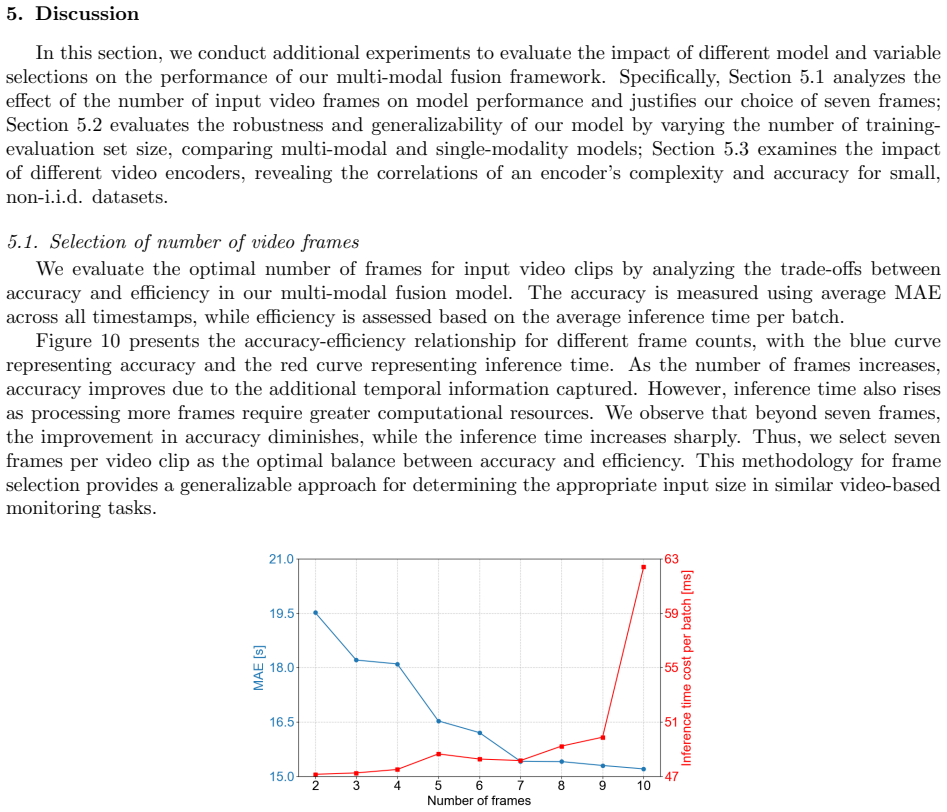
- The seven-frame window at one frame per ten seconds covers about 60 seconds of history; testing whether shorter or longer temporal context changes accuracy on a moisture-defined readiness label would clarify how much lookback the task actually needs.
- Transferred to other foods or ovens, domain shift in color and shape statistics is likely; fine-tuning on a small labeled set from the new setting is a testable route consistent with the paper's mention of transfer learning.
Signed reviews
Editorial analysis
A structured set of objections, weighed in public.
Referee Report
Summary. The paper proposes a multi-modal encoder-decoder framework that fuses in-situ video clips with tabular process parameters to forecast the remaining time to cookie-drying readiness at every timestamp. The video modality is encoded with a pretrained ResNet-18 followed by a two-layer GRU, the tabular modality with a two-layer fully connected network, and the fused embeddings are processed by a transformer-based decoder before a fully connected output layer. The model is evaluated on 72 cookie-drying batches spanning eight temperature/fan-speed conditions using leave-one-group-out cross-validation (LOGOCV). The main reported result is an average MAE of 15.41 seconds over the 120-to-10-second window before readiness, a 65.69% improvement over a linear-regression baseline and an 11.03% improvement over a video-only ablation model. Additional experiments examine the effect of clip length, training-set size, and video-encoder choice on prediction accuracy.
Significance. If the reported results are trustworthy, the paper makes a practical contribution to online food-drying monitoring: it is among the first to feed raw video directly into a readiness-forecasting model, and the LOGOCV evaluation is a genuine strength because it tests generalization to unseen process-parameter combinations rather than relying on random splits. The systematic comparison of video encoders on a small, non-i.i.d. industrial dataset is also useful and appropriately cautions against blind use of large pretrained models. The paper is let down by load-bearing issues in the ground-truth annotation, the choice of baseline, and the statistical reporting; these need to be addressed before the quantitative claims can be accepted.
major comments (4)
- [Section 2.1] The ready moment is the single annotation from which every time-to-ready label is derived, but the paper defines it only as the point where moisture-vapor reduction causes a sharp change in chamber temperature, with no threshold, smoothing, or sensor-calibration details, and validation is attributed to two bakers without any quantified agreement. Because a convection oven's heating cycle can produce temperature excursions, this annotation procedure may add uncontrolled label noise, and if the bias differs across the eight process-parameter groups, all reported MAEs and the comparative conclusions in Table 2 would shift. Please report the detection rule (e.g., derivative threshold and window length), the inter-baker and between-batch variability of the ready timestamp, and, if possible, a secondary moisture- or weight-based check.
- [Section 3.3, Table 2] The baseline model is linear regression on process parameters plus the average ready time, a method that the paper itself notes is not online monitoring; this is not a state-of-the-art multi-modal fusion baseline, so the abstract's claim of outperforming state-of-the-art data fusion methods by 65.69% is unsupported. Please benchmark against established fusion models (e.g., early and late fusion with the same video and tabular encoders, a standard transformer fusion model, or another recent multimodal baseline) under the same LOGOCV protocol, and either remove or carefully qualify the state-of-the-art phrasing.
- [Section 4.3, Table 2, Figure 9] Only mean MAE is reported for the eight folds, with no per-fold values, standard deviation across folds, or significance tests, so the 11.03% and 65.69% improvements cannot be distinguished from fold-level noise. Please report fold-level MAEs, confidence intervals, and a paired test across folds or timestamps (e.g., Wilcoxon signed-rank test) to support the comparative claims.
- [Sections 4.2, 5.1, and 5.3] Hyperparameters, the seven-frame clip length, and the video encoder are selected using the same LOGOCV evaluation data, as indicated by the grid-search description in Section 4.2 and the accuracy-efficiency curves in Figure 10; this is a form of selection leakage that can inflate the reported 15.41 s MAE. Please use a nested cross-validation or an independent validation set for model-selection choices and report the resulting unbiased estimate, or explicitly discuss the expected magnitude of optimistic bias.
minor comments (6)
- [Abstract and Table 2] The improvement over the video-only model is reported as 11.30% in the abstract and 11.03% in Section 4.3 and Table 2; these numbers should be reconciled.
- [Section 3.2] The module called the decoder is actually the encoder block of a Transformer; the terminology should be corrected or justified to avoid confusion.
- [Equations (3) and Table 1] The loss in Eq. (3) includes an L2-regularization term with coefficient lambda, but Table 1 does not list the value of lambda or confirm whether weight decay is used; please specify it.
- [Figure 9(b)] The average pixel-wise area should be defined more precisely, including whether it is the mean SAM mask area per frame and the units used.
- [Throughout] There are several typographical and grammatical issues, including 'heterogenous' for 'heterogeneous', 'θ is represents', 'In most of of industrial drying cases', 'various of variables', and 'experiences-based relationships'; a careful proofreading pass is needed.
- [References] The paper does not include a data or code availability statement; adding one would improve reproducibility. Also, reference [31] on coal combustion temperature rise seems unrelated to baker validation of cookie readiness and should be replaced or removed.
Circularity Check
No circularity found: the central claims are empirical evaluations on held-out process-parameter groups, not derivations that assume their own conclusions.
full rationale
The paper's core claim—that the multi-modal encoder-decoder achieves 15.41 s average MAE under eight-fold LOGOCV (Table 2)—is an empirical regression result. The target variable (time-to-ready) is defined from annotated ready moments and is not fed into the model; inputs are video frames and process parameters (Eq. 1, Eqs. 5–12). No equation in the paper constructs the prediction from the label or from a parameter fitted to the same quantity being predicted. The baseline comparison (Section 3.3) uses average ready times to form a tabular baseline, but this is a deliberately simple comparator, not a component of the proposed model, and the held-out LOGOCV evaluation (Section 4.1) means test groups are not used for fitting. The self-citations (e.g., refs. [8], [15], [16], [28]) are background references and carry no load-bearing uniqueness or ansatz argument; the architecture is specified directly in Sections 3.1–3.2. Model-selection choices such as frame count and encoder (Sections 5.1 and 5.3) were made on the same study data, which is a generalization-risk concern but not circularity: it does not make the reported MAE equal to a fitted input by construction. The label-definition concerns in Section 2.1 (temperature-change criterion, baker validation, simultaneous readiness) affect measurement validity, but they do not constitute a circular derivation chain.
Assumptions & free parameters
free parameters (6)
- input clip length (b) =
7 frames
- learning rate =
0.0001
- batch size =
32
- number of epochs =
100
- regularization coefficient lambda =
not reported
- embedding dimension for tabular and GRU features =
32
assumptions (4)
- domain assumption The ready moment is correctly identified by chamber-temperature inflection and baker validation, and all cookies in a batch reach it simultaneously.
- domain assumption SAM segmentation masks correctly separate the three cookies from oven-glass reflections and interior lighting.
- domain assumption Pretrained ResNet-18 features provide useful drying-state information for cookie dough images recorded through a glass door.
- domain assumption Grouping by the eight process-parameter combinations is the correct non-i.i.d. split and prevents information leakage between training and test clips.
Cite this review
Pith. "Pith review of Multi-Modal Fusion of In-Situ Video Data and Process Parameters for Online Forecasting of Cookie Drying Readiness." pith.science (2026). https://pith.science/paper/TAPGB6Q3
@misc{pith2026250415599,
  author       = {Pith},
  title        = {Pith review of: Multi-Modal Fusion of In-Situ Video Data and Process Parameters for Online Forecasting of Cookie Drying Readiness},
  year         = {2026},
  howpublished = {\url{https://pith.science/paper/TAPGB6Q3}},
  note         = {Machine review of arXiv:2504.15599}
}
read the original abstract
Food drying is essential for food production, extending shelf life, and reducing transportation costs. Accurate real-time forecasting of drying readiness is crucial for minimizing energy consumption, improving productivity, and ensuring product quality. However, this remains challenging due to the dynamic nature of drying, limited data availability, and the lack of effective predictive analytical methods. To address this gap, we propose an end-to-end multi-modal data fusion framework that integrates in-situ video data with process parameters for real-time food drying readiness forecasting. Our approach leverages a new encoder-decoder architecture with modality-specific encoders and a transformer-based decoder to effectively extract features while preserving the unique structure of each modality. We apply our approach to sugar cookie drying, where time-to-ready is predicted at each timestamp. Experimental results demonstrate that our model achieves an average prediction error of only 15 seconds, outperforming state-of-the-art data fusion methods by 65.69% and a video-only model by 11.30%. Additionally, our model balances prediction accuracy, model size, and computational efficiency, making it well-suited for heterogenous industrial datasets. The proposed model is extensible to various other industrial modality fusion tasks for online decision-making.
Figures


Figures from the paper (9 more)




Forward citations
Cited by 2 Pith papers
-
Certifiably Safe Manipulation of Deformable Linear Objects via Joint Shape and Tension Prediction
A learned LSTM that predicts cable shape and tension is combined with a zonotope-based trajectory optimizer to enforce collision and tension safety in simulated wire harness assembly.
-
XPG-RL: Reinforcement Learning with Explainable Priority Guidance for Efficiency-Boosted Mechanical Search
XPG-RL learns adaptive thresholds for switching between grasping, occlusion removal, and viewpoint adjustment, improving mechanical search efficiency by up to 4.5x over baselines.
Reference graph
Works this paper leans on
-
[1]
J. D. Floros, R. Newsome, W. Fisher, G. V. Barbosa-C´ anovas, H. Chen, C. P. Dunne, J. B. German, R. L. Hall, D. R. Heldman, M. V. Karwe, et al., Feeding the world today and tomorrow: the importance of food science and technology: an ift scientific review, Comprehensive Reviews in Food Science and Food Safety 9 (5) (2010) 572–599
work page 2010
-
[2]
M. Adnouni, L. Jiang, X. Zhang, L. Zhang, P. B. Pathare, A. Roskilly, Computational modelling for decarbonised drying of agricultural products: Sustainable processes, energy efficiency, and quality improvement, Journal of Food Engineering 338 (2023) 111247
work page 2023
- [3]
-
[4]
M. U. Joardder, A. Karim, C. Kumar, R. J. Brown, Porosity: establishing the relationship between drying parameters and dried food quality, Springer, 2015
work page 2015
-
[5]
A. Arslan, ˙I. Aliba¸ s, Assessing the effects of different drying methods and minimal processing on the sustainability of the organic food quality, Innovative Food Science & Emerging Technologies (2024) 103681
work page 2024
-
[6]
A. O. Omolola, A. I. Jideani, P. F. Kapila, Quality properties of fruits as affected by drying operation, Critical reviews in food science and nutrition 57 (1) (2017) 95–108
work page 2017
-
[7]
T. Defraeye, Impact of size and shape of fresh-cut fruit on the drying time and fruit quality, Journal of Food Engineering 210 (2017) 35–41
work page 2017
- [8]
Show all 42 references
-
[9]
B. Tian, A. Eslaminia, K.-C. Lu, Y. Wang, C. Shao, K. Nahrstedt, Weldmon: A cost-effective ultrasonic welding machine condition monitoring system, in: 2023 IEEE 14th Annual Ubiquitous Computing, Electronics & Mobile Communication Conference (UEMCON), IEEE, 2023, pp. 0310–0319
2023
-
[10]
Schmitt, J
J. Schmitt, J. B¨ onig, T. Borggr¨ afe, G. Beitinger, J. Deuse, Predictive model-based quality inspection using machine learning and edge cloud computing, Advanced engineering informatics 45 (2020) 101101
2020
-
[11]
Q. Li, K. K. Ng, Z. Fan, X. Yuan, H. Liu, L. Bu, A human-centred approach based on functional near-infrared spectroscopy for adaptive decision-making in the air traffic control environment: A case study, Advanced Engineering Informatics 49 (2021) 101325
2021
-
[12]
J. Qu, L. Cui, W. Guo, L. Bu, Z. Wang, Development of a novel machine learning-based approach for brain function assessment and integrated software solution, Advanced Engineering Informatics 60 (2024) 102461
2024
-
[13]
Y. Zhao, Y. Zhang, Z. Li, L. Bu, S. Han, Ai-enabled and multimodal data driven smart health monitoring of wind power systems: A case study, Advanced Engineering Informatics 56 (2023) 102018
2023
-
[14]
S. Jia, J. Sun, A. Howes, M. R. Dawson, K. C. Toussaint Jr, C. Shao, Hybrid physics-guided data-driven modeling for generalizable geometric accuracy prediction and improvement in two-photon lithography, Journal of Manufacturing Processes 110 (2024) 202–210
2024
-
[15]
Y. Meng, Z. Dong, K.-C. Lu, S. Li, C. Shao, Meta-learning-based domain generalization for cost-effective tool condition monitoring in ultrasonic metal welding, IEEE Transactions on Industrial Informatics (2024)
2024
-
[16]
Meng, K.-C
Y. Meng, K.-C. Lu, Z. Dong, S. Li, C. Shao, Explainable few-shot learning for online anomaly detection in ultrasonic metal welding with varying configurations, Journal of Manufacturing Processes 107 (2023) 345–355
2023
-
[17]
C.-C. Zhao, K. Ameer, J.-B. Eun, Effects of various drying conditions and methods on drying kinetics and retention of bioactive compounds in sliced persimmon, Lwt 143 (2021) 111149
2021
-
[18]
H. S. El-Mesery, K. Ashiagbor, Z. Hu, W. Alshaer, A novel infrared drying technique for processing of apple slices: Drying characteristics and quality attributes, Case Studies in Thermal Engineering 52 (2023) 103676
2023
-
[19]
Mishra, S
N. Mishra, S. Jain, N. Agrawal, N. Jain, N. Wadhawan, N. Panwar, Development of drying system by using internet of things for food quality monitoring and controlling, Energy Nexus 11 (2023) 100219
2023
-
[20]
Aghbashlo, R
M. Aghbashlo, R. Sotudeh-Gharebagh, R. Zarghami, A. S. Mujumdar, N. Mostoufi, Measurement tech- niques to monitor and control fluidization quality in fluidized bed dryers: A review, Drying Technology 32 (9) (2014) 1005–1051. 15
2014
-
[21]
S. Chen, H. Yu, J. Yagoobi, C. Shao, Reinforcement learning constrained beam search for parameter optimization of paper drying under flexible constraints, arXiv preprint arXiv:2501.12542 (2025)
2025 arXiv
-
[22]
Shang, C
H. Shang, C. Sun, J. Liu, X. Chen, R. Yan, Defect-aware transformer network for intelligent visual surface defect detection, Advanced Engineering Informatics 55 (2023) 101882
2023
-
[23]
Keramat-Jahromi, S
M. Keramat-Jahromi, S. S. Mohtasebi, H. Mousazadeh, M. Ghasemi-Varnamkhasti, M. Rahimi- Movassagh, Real-time moisture ratio study of drying date fruit chips based on on-line image attributes using knn and random forest regression methods, Measurement 172 (2021) 108899
2021
-
[24]
P. Xu, X. Ji, M. Li, W. Lu, Small data machine learning in materials science, npj Computational Materials 9 (1) (2023) 42
2023
-
[25]
Petrich, Z
J. Petrich, Z. Snow, D. Corbin, E. W. Reutzel, Multi-modal sensor fusion with machine learning for data-driven process monitoring for additive manufacturing, Additive Manufacturing 48 (2021) 102364
2021
-
[26]
Billard, D
A. Billard, D. Kragic, Trends and challenges in robot manipulation, Science 364 (6446) (2019) eaat8414
2019
-
[27]
Yazici, M
A. Yazici, M. Koyuncu, T. Yilmaz, S. Sattari, M. Sert, E. Gulen, An intelligent multimedia information system for multimodal content extraction and querying, Multimedia Tools and Applications 77 (2018) 2225–2260
2018
-
[28]
S. Li, C. Shao, Multi-modal data fusion for moisture content prediction in apple drying, arXiv preprint arXiv:2504.07465 (2025)
2025
-
[29]
Ergun, R
R. Ergun, R. Lietha, R. W. Hartel, Moisture and shelf life in sugar confections, Critical reviews in food science and nutrition 50 (2) (2010) 162–192
2010
-
[30]
C. C. Hsu, C. A. Ward, R. Pearlman, H. Nguyen, D. Yeung, J. G. Curley, Determining the optimum residual moisture in lyophilized protein pharmaceuticals., Developments in biological standardization 74 (1992) 255–70
1992
-
[31]
Vance, X
W. Vance, X. Chen, S. Scott, The rate of temperature rise of a subbituminous coal during spontaneous combustion in an adiabatic device: The effect of moisture content and drying methods, Combustion and Flame 106 (3) (1996) 261–270
1996
-
[32]
Kirillov, E
A. Kirillov, E. Mintun, N. Ravi, H. Mao, C. Rolland, L. Gustafson, T. Xiao, S. Whitehead, A. C. Berg, W.-Y. Lo, et al., Segment anything, in: Proceedings of the IEEE/CVF International Conference on Computer Vision, 2023, pp. 4015–4026
2023
-
[33]
K. He, X. Zhang, S. Ren, J. Sun, Identity mappings in deep residual networks, in: Computer Vision– ECCV 2016: 14th European Conference, Amsterdam, The Netherlands, October 11–14, 2016, Proceed- ings, Part IV 14, Springer, 2016, pp. 630–645
2016
-
[34]
Chung, C
J. Chung, C. Gulcehre, K. Cho, Y. Bengio, Empirical evaluation of gated recurrent neural networks on sequence modeling, arXiv preprint arXiv:1412.3555 (2014)
2014 arXiv
-
[35]
Vaswani, Attention is all you need, Advances in Neural Information Processing Systems (2017)
A. Vaswani, Attention is all you need, Advances in Neural Information Processing Systems (2017)
2017
-
[36]
Eslaminia, Y
A. Eslaminia, Y. Meng, K. Nahrstedt, C. Shao, Federated domain generalization for condition monitor- ing in ultrasonic metal welding, Journal of Manufacturing Systems 77 (2024) 1–12
2024
-
[37]
R. A. Cody, S. Narasimhan, A field implementation of linear prediction for leak-monitoring in water distribution networks, Advanced Engineering Informatics 45 (2020) 101103
2020
-
[38]
F. Nie, H. Huang, X. Cai, C. Ding, Efficient and robust feature selection via joint l2, 1-norms minimiza- tion, Advances in neural information processing systems 23 (2010)
2010
-
[39]
Z. Tong, Y. Song, J. Wang, L. Wang, Videomae: Masked autoencoders are data-efficient learners for self-supervised video pre-training, Advances in neural information processing systems 35 (2022) 10078– 10093. 16
2022
-
[40]
Bertasius, H
G. Bertasius, H. Wang, L. Torresani, Is space-time attention all you need for video understanding?, in: ICML, Vol. 2, 2021, p. 4
2021
-
[41]
Graves, S
A. Graves, S. Fern´ andez, J. Schmidhuber, Multi-dimensional recurrent neural networks, in: International conference on artificial neural networks, Springer, 2007, pp. 549–558
2007
-
[42]
O’Shea, An introduction to convolutional neural networks, arXiv preprint arXiv:1511.08458 (2015)
K. O’Shea, An introduction to convolutional neural networks, arXiv preprint arXiv:1511.08458 (2015). 17
2015 arXiv
Reviewed August 16, 2026 · model on record in the stance chip above.
Discussion (0). Continue with ORCID to comment.