REVIEW 3 major objections 5 minor 177 references
Electroweak form factors of baryons in dense nuclear matter
T0 review · 3 major / 5 minor · reviewed 2026-08-16 · deepseek-v4-flash
Pith's one-line read In symmetric nuclear matter, octet baryon electroweak form factors are suppressed with density and more for light baryons than strange ones.
desk verdict Useful consolidation of a model with one genuinely new density scan, but the axial flavor hierarchy rests on an untested equal-ratio assumption in Eq. (45). read the letter →
The pith
A machine-rendered reading of the paper's core claim, the machinery that carries it, and where it could break.
The reading
What carries the argument
The machinery is a two-layer hadron model: valence quark cores described by covariant spectator quark–diquark wave functions (with S- and P-state admixture for axial transitions) plus a meson-cloud dressing, extended to matter by the quark–meson coupling model. Medium effects enter by replacing free hadron masses with density-dependent effective masses, rescaling baryon–meson couplings through the Goldberger–Treiman relation of Eq. (45), and using a density-dependent pion decay constant; the in-medium axial coupling ratio $g_A^*/g_A$ from bag-model/QMC input calibrates the axial quenching.
What would settle it
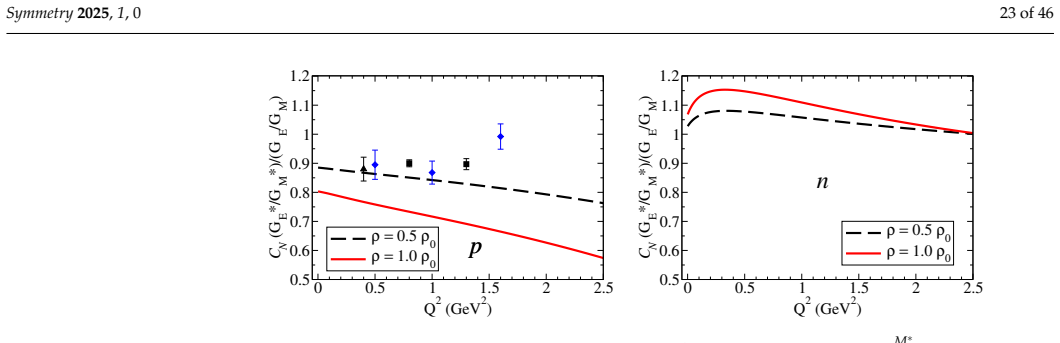
A precise measurement of the electric-to-magnetic form factor ratio $G_E/G_M$ for protons bound in $^4$He at $Q^2\approx 0.5$ GeV$^2$ with uncertainty below 5% would test the model's density dependence, since the predicted double ratios at $\rho=0.5\rho_0$ and $\rho=\rho_0$ differ by about 10%; data falling outside that band would refute the predicted medium-dependence pattern.
Extended reading notes
Core claim
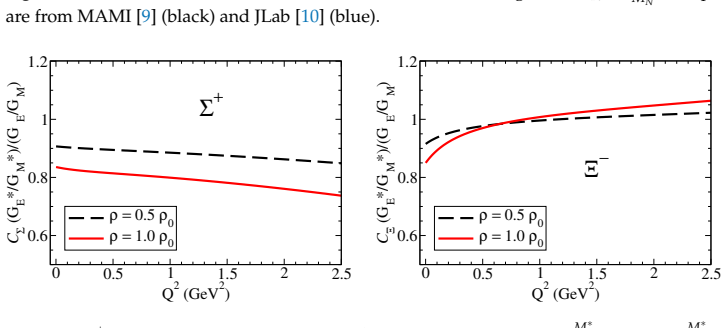
The central claim is that the electroweak structure of octet baryons is flavor-dependent in a nuclear medium: the electric, magnetic, axial-vector, and induced pseudoscalar form factors are all modified relative to free space, with modifications that increase with density and momentum transfer and are stronger for baryons made of light quarks than for baryons carrying strange quarks. In particular, the axial-vector form factor for the $n\to p$ transition is quenched by about 30% at $Q^2\simeq 2$ GeV$^2$ at saturation density, whereas the $\Xi^-\to\Lambda$ transition is quenched by only about 15%. The same pattern suppresses in-medium neutrino and antineutrino single-differential cross sections on nucleons, and the formalism extends to hyperon transitions at densities above normal nuclear matter, where the pion decay constant is taken to saturate near $3\rho_0$.
Load-bearing premise
The entire density and flavor dependence rests on the QMC model inputs — the in-medium baryon and meson masses, the ratio $g_A^*/g_A$, and the use of the Goldberger–Treiman relation with a common $g_A^*/g_A$ ratio for all octet baryons; above normal density it also relies on an unpublished saturation model for the pion decay constant.
Editorial extensions
If this is right
- For protons bound in a nucleus, the predicted double ratio $(G_E^*/G_M^*)/(G_E/G_M)$ drops by about 10 percentage points between average densities $\rho=0.5\rho_0$ and $\rho=\rho_0$, so polarized electron-scattering measurements on different nuclei could distinguish their average densities.
- For the neutron, the same double ratio is predicted to be enhanced by roughly 10% near $Q^2=0.5$ GeV$^2$ at intermediate densities, with the enhancement driven by the in-medium increase of the neutron charge radius.
- The induced pseudoscalar form factor for $|\Delta I|=1$ transitions is strongly suppressed at low $Q^2$ because both the in-medium baryon masses and the axial-vector form factor are reduced; heavier $|\Delta S|=1$ transitions show milder suppression because the in-medium kaon mass partly cancels the effect.
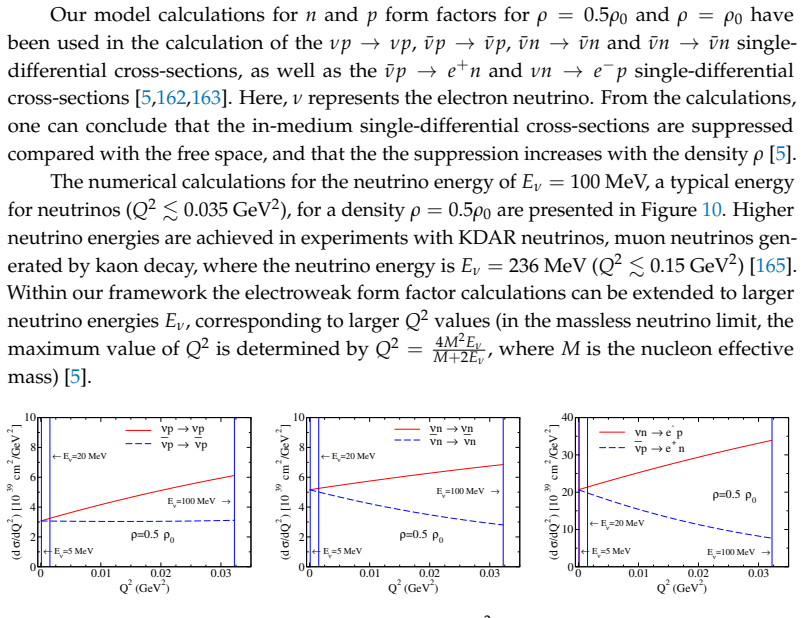
- Neutrino and antineutrino single-differential cross sections on nucleons in matter are reduced relative to free space, and the reduction grows with density and neutrino energy.
- The formalism predicts continued suppression beyond $\rho_0$, affecting neutrino and antineutrino reactions with hyperons in dense matter such as the cores of compact stars.
Reading between the lines
- A testable extension not pursued in the paper is to apply the same flavor-dependent medium machinery to decuplet baryons and octet–decuplet transitions; if the pattern holds, strangeness-rich environments such as hypernuclei and neutron-star cores would exhibit non-uniform quenching of weak couplings, changing predicted neutrino opacities.
- Because the predicted suppression grows with $Q^2$, neutrino experiments at higher momentum transfer (for example kaon-decay-at-rest neutrinos) should show stronger medium effects than low-energy coherent-scattering measurements; comparing cross sections at two well-separated energies would provide a sharp test of the density and $Q^2$ scaling.
- The model's assumption that the quark axial form factor tracks the isovector Dirac form factor of the nucleon could be checked independently with future lattice QCD calculations of hyperon axial transitions, which would anchor the flavor dependence without relying on the medium input.
- The density dependence above $\rho_0$ rests on a saturation model for the pion decay constant; this input could be tested by in-medium pion decay or pion–nucleus scattering data, if such measurements become precise enough to constrain $f_\pi^*(\rho)$ directly.
Signed reviews
Editorial analysis
A structured set of objections, weighed in public.
Referee Report
Summary. The paper reviews and extends a combined covariant spectator quark model and quark-meson coupling (QMC) framework to compute electromagnetic and axial form factors of the octet baryons in symmetric nuclear matter. It decomposes form factors into valence quark and meson cloud contributions, implements medium modifications through in-medium masses and baryon-meson couplings, and presents numerical results for densities up to rho0, with an extension to 2 rho0. The central claims are that medium effects increase with density, are larger for light baryons than for strange baryons, and lead to a reduction of in-medium neutrino and antineutrino cross sections. The proton double ratio G*_E/G*_M over G_E/G_M is compared with MAMI and JLab data for 4He, while the axial predictions are compared mainly with model and lattice inputs rather than direct in-medium measurements.
Significance. If the predictions hold, the framework provides a systematic tool for estimating medium-modified baryon electroweak structure and neutrino scattering in dense matter, with clear applications to heavy-ion collisions and compact-star neutrinos. The paper is largely built on the authors' previous calibrated studies, and it inherits the main strengths of that program: explicit parametrizations with documented parameter tables (Tables 2, 3, A2, A6), calibration of the bare valence-quark contributions against lattice QCD data for baryon form factors, and a comparison with the existing 4He polarization-transfer data for the proton double ratio. The resulting quantitative predictions, such as roughly 30% suppression for n->p and 15% for Xi- -> Lambda at Q2 ~ 2 GeV^2 and rho = rho0, are falsifiable in future experiments. However, the significance is limited by the strong dependence of the flavor hierarchy and the high-density behavior on external QMC/bag inputs and on an untested approximation, so the central quantitative claims require additional validation.
major comments (3)
- [Section 3.3, Eq. (45)] The flavor hierarchy in the central claim rests on the approximation gB*_A/gB_A = gN*_A/gN_A, applied to all octet baryons. This is an assumption, not a derived result, and it directly controls the in-medium pion-baryon couplings in Table 3: at rho = rho0, g*_piXiXi/g_piXiXi = 1.0273 while g*_piNN/g_piNN = 0.8656. If the true in-medium bare axial coupling of the Xi or Lambda is quenched rather than enhanced relative to the nucleon, the predicted ordering of suppression by strangeness content could change. The authors should either test this approximation within the QMC/bag framework used for gN*_A/gN_A or provide an estimate of the associated uncertainty.
- [Section 5.2 and Ref. [176]] The extension to densities above rho0 relies on an unpublished saturation model for the in-medium pion decay constant f*_pi, with Ref. [176] listed as 'Manuscript in preparation'. No equation or numerical parametrization of the saturation is given, so the rho > rho0 predictions in Figures 11 and 12 are not reproducible from the present manuscript. The authors should state the model explicitly or clearly label these results as preliminary and remove them from the central quantitative conclusions.
- [Section 3.3, Eq. (50)] The axial-vector coupling at Q2 = 0 is effectively imposed by construction: the P-state admixture n_P is fixed for each density by requiring G*_B A(0) = gN*_A, where gN*_A is the external QMC/bag input. Consequently, the often-quoted axial quenching at Q2 = 0 is not an independent prediction of this framework. The genuinely predictive content is the Q2 dependence of G*_A/G_A and the differences among transitions; the paper should state this distinction clearly and avoid presenting the Q2 = 0 quenching as a new result.
minor comments (5)
- [Section 1, first paragraph] There is a duplicated word in 'other other baryons'; it should read 'other baryons'.
- [Section 3, paragraph before Section 3.1] The word 'regraded' should be 'regarded' in the sentence about quark masses and dynamical chiral symmetry breaking.
- [Section 4.1.2, Figure 4 discussion] The text refers to 'The results for the Sigma- (right side)' but the right panel of Figure 4 shows Xi-; the caption should clarify which baryon is in each panel and the text should use the correct symbol.
- [Table 4, fifth row] The nucleus '97Au' should presumably be '197Au'.
- [Equation (45), second line] The denominator in the second ratio appears as gN_N in the text; this should be gN_A to be consistent with the notation gA = gN_A defined below the equation.
Circularity Check
In-medium axial suppression is partly imposed by construction: nP is calibrated to the bag/QMC g*A, and Eq. (45) assigns the same in-medium axial-vector ratio to all octet baryons, so the flavor hierarchy is substantially an input assumption.
-
fitted input called prediction
[Section 3.3, Eq. (50) and Section 4.2.1]
"The values of nP are calculated in Refs. [5,44] nP =−0.507 for ρ = 0, nP =−0.536 for ρ = 0.5ρ0, nP =−0.560 for ρ = ρ0. (50) For each density, the value of nP is determined imposing that GB∗A(0) = gN∗A for consistency, with the QMC model used in the calculation of in-medium masses and coupling constants [5]."
nP is the free parameter that controls the bare axial-vector form factor; fixing it by requiring GB∗A(0) = gN∗A means the in-medium axial charge at Q2 = 0 is an input, not an output. The meson-cloud term is then scaled by (g∗πNN/gπNN)^2, which is itself constructed from the same gN∗A through the Goldberger–Treiman relation (45). Section 4.2.1 then reports the QMC input as the result: 'The QMC model predicts... quenching of 5%... and 10%... Similar proportions are obtained in our final results.' The claimed low-Q2 suppression of GA, and the consequent reduction of neutrino cross sections, is therefore essentially the bag/QMC input repackaged through the model rather than an independent prediction.
-
self definitional
[Section 3.3, Eq. (45) and Table 3; abstract and Section 4.2.1]
"g∗πBB/gπBB = (fπ/f∗π)(gN∗A/gN_N)(M∗B/MB), (45) ... In the second equation, we approximate gB∗A /gB_A≃ gN∗A /gN_A."
The flavor hierarchy claimed in the abstract and Section 4.2.1 is constructed by setting every octet baryon's in-medium bare axial-vector coupling ratio equal to the nucleon's. Table 3 then gives g∗πΞΞ/gπΞΞ = 1.0273 at ρ0, which is determined solely by (fπ/f∗π)(M∗Ξ/MΞ) once the nucleon ratio is inserted; no flavor-dependent axial response of the Ξ is computed. The statement that strange baryons are less modified is therefore an input assumption about the equality of axial ratios, not a derived consequence. The high-Q2 suppression values quoted in Section 4.2.1 are valence-dominated, so the circularity is partial rather than total.
full rationale
This paper is a model calculation/review rather than a first-principles derivation, and much of the formalism is openly calibrated to free-space and lattice-QCD data. The electromagnetic double ratios are checked against JLab and MAMI data, so that part has independent support and is not circular. The genuinely circular elements are in the axial sector. First, nP is fixed per density by enforcing GB∗A(0) = gN∗A, so the in-medium axial-vector coupling at Q2 = 0 is an imposed bag/QMC input; the subsequent low-Q2 suppression of GA and of neutrino/antineutrino cross sections is thus a repackaging of that input. Second, Eq. (45) approximates gB∗A/gB_A ≃ gN∗A/gN_A for all octet baryons, which directly builds in the light-versus-heavy flavor ordering at low Q2; the model does not compute a baryon-dependent axial response for the hyperons. The paper also relies on the same-author preprint Ref. [34] for the central ratio gN∗A/gN_A and on unpublished same-author work Ref. [176] for densities above ρ0; these are missing independent support, though the beta-decay quenching literature provides some external motivation. Because the finite-Q2 shapes, the pseudoscalar GP predictions, and the electromagnetic sector retain independent content, the central claim is only partially circular, not wholly so.
Assumptions & free parameters
free parameters (8)
- Radial wave function momentum ranges beta_l (l = 1..4) =
0.0532, 0.809, 0.603, 0.381
- Quark anomalous magnetic moments kappa_u, kappa_d, kappa_s =
1.711, 1.987, 1.462
- Vector meson dominance parameters lambda_q, c_plus, c_minus, c_0, d_plus, d_minus, d_0 =
1.21, 4.160, 1.160, 4.427, -0.686, -0.686, -1.860
- P-state admixture n_P =
-0.507 at rho = 0, -0.536 at 0.5 rho0, -0.560 at rho0
- Quark axial induced pseudoscalar parameters alpha, beta =
-3.9011, 0.3297
- Meson cloud electromagnetic parameters b1(0), b2(0), c2(0), d2(0), d'_1, Lambda1^2, Lambda2^2 =
0.0510, 0.216, 0.00286, 0.0821, -0.148, 0.618, 1.281
- Axial meson cloud parameters G_MC0_AN, Lambda, F'(0), D'(0), b1(0) =
0.6059, 1.05 GeV, 0.1775, 0.4284, 0.121
- f*pi saturation scale for densities above rho0 =
Saturates near 3 rho0 (Ref. [176], unpublished)
assumptions (8)
- domain assumption Symmetric nuclear matter is infinite and uniform, described by mean-field one-body currents with small final-state interactions.
- domain assumption Baryons are quark-diquark systems with phenomenological radial wave functions, and the electroweak probe couples to one quark in impulse approximation.
- domain assumption Electroweak form factors separate into valence quark and meson cloud contributions with no double counting.
- domain assumption High-pion-mass lattice QCD data isolate the valence quark degrees of freedom.
- ad hoc to paper Goldberger-Treiman relation with gB*A/gB_A approximated by gN*A/gN_A holds for all octet baryons.
- domain assumption QMC model values for in-medium masses and couplings (Tables 2 and 3) are correct.
- ad hoc to paper For densities above rho0, f*pi saturates near 3 rho0 according to the unpublished model of Ref. [176].
- domain assumption Meson cloud axial contribution scales as (g*piNN/gpiNN)^2 with unchanged cutoff Lambda.
Cite this review
Pith. "Pith review of Electroweak form factors of baryons in dense nuclear matter." pith.science (2026). https://pith.science/paper/JZRNHI2X
@misc{pith2026250415660,
  author       = {Pith},
  title        = {Pith review of: Electroweak form factors of baryons in dense nuclear matter},
  year         = {2026},
  howpublished = {\url{https://pith.science/paper/JZRNHI2X}},
  note         = {Machine review of arXiv:2504.15660}
}
abstract
There is evidence that the properties of hadrons are modified in a nuclear medium. Information about the medium modifications of the internal structure of hadrons is fundamental for the study of dense nuclear matter and high-energy processes, including heavy-ion and nucleus--nucleus collisions. At the moment, however, empirical information about medium modifications of hadrons is limited; therefore, theoretical studies are essential for progress in the field. In the present work, we review theoretical studies of the electromagnetic and axial form factors of octet baryons in symmetric nuclear matter. The calculations are based on a model that takes into account the degrees of freedom revealed in experimental studies of low and intermediate square transfer momentum $q^2=-Q^2$: valence quarks and meson cloud excitations of baryon cores. The formalism combines a covariant constituent quark model, developed for a free space (vacuum) with the quark--meson coupling model for extension to the nuclear medium. We conclude that the nuclear medium modifies the baryon properties differently according to the flavor content of the baryons and the medium density. The effects of the medium increase with density and are stronger (quenched or enhanced) for light baryons than for heavy baryons. In particular, the in-medium neutrino--nucleon and antineutrino--nucleon cross-sections are reduced compared to the values in free space. The proposed formalism can be extended to densities above the normal nuclear density and applied to neutrino--hyperon and antineutrino--hyperon scattering in dense nuclear matter.
Figures


Figures from the paper (9 more)




Reference graph
Works this paper leans on
-
[176]
Manuscript in preparation; to be submitted
Ramalho, G.; Tsushima, K.; Cheoun, M.K. Manuscript in preparation; to be submitted
-
[1]
Scaling effective Lagrangians in a dense medium
Brown, G.E.; Rho, M. Scaling effective Lagrangians in a dense medium. Phys. Rev. Lett. 1991, 66, 2720
1991
-
[2]
Medium Modifications of Hadron Properties and Partonic Processes.J
Brooks, W.K.; Strauch, S.; Tsushima, K. Medium Modifications of Hadron Properties and Partonic Processes.J. Phys. Conf. Ser. 2011, 299, 012011
2011
-
[3]
Nucleon and hadron structure changes in the nuclear medium and impact on observables
Saito, K.; Tsushima, K.; Thomas, A.W. Nucleon and hadron structure changes in the nuclear medium and impact on observables. Prog. Part. Nucl. Phys. 2007, 58, 1–167
2007
-
[4]
Equation of State for Neutron Stars With Hyperons and Quarks in the Relativistic Hartree–fock Approximation
Miyatsu, T.; Cheoun, M.K.; Saito, K. Equation of State for Neutron Stars With Hyperons and Quarks in the Relativistic Hartree–fock Approximation. Astrophys. J. 2015, 813, 135
2015
-
[5]
Weak interaction axial form factors of the octet baryons in nuclear medium
Ramalho, G.; Tsushima, K.; Cheoun, M.K. Weak interaction axial form factors of the octet baryons in nuclear medium. Phys. Rev. D 2025, 111, 013002
2025
-
[6]
The ratio of the nucleon structure functions F2n for iron and deuterium
Aubert, J.J.; Bassompierre, G.; Becks, K.H.; Best, C.; Bohm, E.; de Bouard, X.; Brasse, F.W.; Broll, C.; Brown, S.; Carr, J.; et al. The ratio of the nucleon structure functions F2n for iron and deuterium. Phys. Lett. B 1983, 123, 275
1983
-
[7]
Measurements of the a-Dependence of Deep Inelastic electron Scattering from Nuclei
Arnold, R.G.; Bosted, P .E.; Chang, C.C.; Gomez, J.; Katramatou, A.T.; Petratos, G.; Rahbar, A.A.; Rock, S.; Sill, A.F.; Szalata, Z.M.; et al. Measurements of the a-Dependence of Deep Inelastic electron Scattering from Nuclei. Phys. Rev. Lett. 1984, 52, 727. Symmetry 2025, 1, 0 41 of 46
1984
Show all 177 references
-
[8]
Nucleon-Nucleon Correlations, Short-lived Excitations, and the Quarks Within
Hen, O.; Miller, G.A.; Piasetzky, E.; Weinstein, L.B. Nucleon-Nucleon Correlations, Short-lived Excitations, and the Quarks Within. Rev. Mod. Phys. 2017, 89, 045002
2017
-
[9]
Polarization transfer in the 4He(⃗e, e′⃗p)3H reaction
Dieterich, S.; Bartsch, P .; Baumann, D.; Bermuth, J.; Bohinc, K.; Bohm, R.; Bosnar, D.; Derber, S.; Ding, M.; Distler, M.; et al. Polarization transfer in the 4He(⃗e, e′⃗p)3H reaction. Phys. Lett. 2001, B500, 47
2001
-
[10]
Polarization transfer in the 4He(⃗e, e′⃗p)3H reaction up to Q2 = 2.6 (GeV/c)2
Strauch, S.; Dieterich, S.; Aniol, K.A.; Ann, J.R.; Baker, O.K.; Bertozzi, W.; Boswell, M.; Brash, E.J.; Chai, Z.; Chen, J.P .; et al. Polarization transfer in the 4He(⃗e, e′⃗p)3H reaction up to Q2 = 2.6 (GeV/c)2. Phys. Rev. Lett. 2003, 91, 052301
2003
-
[11]
[E93-049 Collaboration]
Strauch, S. [E93-049 Collaboration]. Medium modification of the proton form-factor. Eur. Phys. J. A 2004, 19, 153
2004
-
[12]
Polarization Transfer in the 4He(e, e′ p)3H at Q2 = 0.8 and 1.3 (GeV/c)2
Paolone, M.; Malace, S.P .; Strauch, S.; Albayrak, I.; Arrington, J.; Berman, B.L.; Brash, E.J.; Briscoe, B.; et al. Polarization Transfer in the 4He(e, e′ p)3H at Q2 = 0.8 and 1.3 (GeV/c)2. Phys. Rev. Lett. 2010, 105, 072001
2010
-
[13]
A precise extraction of the induced polarization in the 4He(e, e′ p)3H reaction
Malace, S.P .; Paolone, M.; Strauch, S.; Albayrak, I.; Arrington, J.; Berman, B.L.; Brash, E.J.; Briscoe, W.J.; Camsonne, A.; Chen, J.P .; et al. A precise extraction of the induced polarization in the 4He(e, e′ p)3H reaction. Phys. Rev. Lett. 2011, 106, 052501
2011
-
[14]
Polarization transfer in the 16O(⃗e, e′⃗p)15N reaction
Malov, S.; Wijesooriya, K.; Baker, F.T.; Bimbot, L.; Brash, E.J.; Chang, C.C.; Finn, J.M.; Fissum, K.G.; Gao, J.; Gilman, R.; et al. Polarization transfer in the 16O(⃗e, e′⃗p)15N reaction. Phys. Rev. C 2000, 62, 057302
2000
-
[15]
Izraeli, D. et al. [A1 Collaboration]. Measurement of polarization-transfer to bound protons in carbon and its virtuality dependence. Phys. Lett. B 2018, 781, 95–98
2018
-
[16]
Kolar, T. et al. [A1 Collaboration]. Measurement of polarization transfer in the quasi-elastic 40Ca(⃗e, e′⃗p) process. Phys. Lett. B 2023, 847, 138309
2023
-
[17]
Octet Baryon Electromagnetic form Factors in Nuclear Medium.J
Ramalho, G.; Tsushima, K.; Thomas, A.W. Octet Baryon Electromagnetic form Factors in Nuclear Medium.J. Phys. G 2013, 40, 015102
2013
-
[18]
Octet baryon electromagnetic form factor double ratios(G∗ E/G∗ M)/(GE/GM) in a nuclear medium
Ramalho, G.; de Melo, J.P .B.C.; Tsushima, K. Octet baryon electromagnetic form factor double ratios(G∗ E/G∗ M)/(GE/GM) in a nuclear medium. Phys. Rev. D 2019, 100, 014030
2019
-
[19]
The Role of color neutrality in nuclear physics: Modifications of nucleonic wave functions
Frank, M.R.; Jennings, B.K.; Miller, G.A. The Role of color neutrality in nuclear physics: Modifications of nucleonic wave functions. Phys. Rev. C 1996, 54, 920
1996
-
[20]
Electromagnetic form-factors of the bound nucleon.Phys
Lu, D.H.; Tsushima, K.; Thomas, A.W.; Williams, A.G.; Saito, K. Electromagnetic form-factors of the bound nucleon.Phys. Rev. C 1999, 60, 068201
1999
-
[21]
Chiral solitons in nuclei: Electromagnetic form-factors
Smith, J.R.; Miller, G.A. Chiral solitons in nuclei: Electromagnetic form-factors. Phys. Rev. C 2004, 70, 065205
2004
-
[22]
Neutron Properties in the Medium
Cloet, I.C.; Miller, G.A.; Piasetzky, E.; Ron, G. Neutron Properties in the Medium. Phys. Rev. Lett. 2009, 103, 082301
2009
-
[23]
Study of the in-medium nucleon electromagnetic form factors using a light-front nucleon wave function combined with the quark-meson coupling model
de Araújo, W.R.B.; de Melo, J.P .B.C.; Tsushima, K. Study of the in-medium nucleon electromagnetic form factors using a light-front nucleon wave function combined with the quark-meson coupling model. Nucl. Phys. A 2018, 970, 325
2018
-
[24]
Light front cloudy bag model: Nucleon electromagnetic form-factors
Miller, G.A. Light front cloudy bag model: Nucleon electromagnetic form-factors. Phys. Rev. C 2002, 66, 032201
2002
-
[25]
Electromagnetic form-factors of bound nucleons revisited.Eur
Yakhshiev, U.T.; Meissner, U.G.; Wirzba, A. Electromagnetic form-factors of bound nucleons revisited.Eur. Phys. J. A 2003, 16, 569
2003
-
[26]
In-medium electron-nucleon scattering.Phys
Lu, D.H.; Thomas, A.W.; Tsushima, K.; Williams, A.G.; Saito, K. In-medium electron-nucleon scattering.Phys. Lett. B 1998, 417, 217
1998
-
[27]
The Neutron charge form-factor in helium-3.Phys
Lu, D.H.; Tsushima, K.; Thomas, A.W.; Williams, A.G.; Saito, K. The Neutron charge form-factor in helium-3.Phys. Lett. B 1998, 441, 27
1998
-
[28]
Effect of the bound nucleon form-factors on charged current neutrino nucleus scattering
Tsushima, K.; Kim, H.; Saito, K. Effect of the bound nucleon form-factors on charged current neutrino nucleus scattering. Phys. Rev. C 2004, 70, 038501
2004
-
[29]
Electromagnetic form-factors of the nucleon in the chiral quark soliton model
Christov, C.V .; Gorski, A.Z.; Goeke, K.; Pobylitsa, P .V . Electromagnetic form-factors of the nucleon in the chiral quark soliton model. Nucl. Phys. A 1995, 592, 513
1995
-
[30]
In Neutron Properties in the Nuclear Medium Studied by Polarization Measurements ; Gilman, R., Higinbotham, D.W., Lichtenstadt, J., Ron, G., Strauch, S
Letter of Intent to JLab PAC 35. In Neutron Properties in the Nuclear Medium Studied by Polarization Measurements ; Gilman, R., Higinbotham, D.W., Lichtenstadt, J., Ron, G., Strauch, S. https://hallaweb.jlab.org/collab/PAC/PAC35/LOI-10-007-Neutron- Modification.pdf
-
[31]
Experimental and Theoretical Gamow-Teller Beta-Decay Observables for the sd-Shell Nuclei
Brown, B.A.; Wildenthal, B.H. Experimental and Theoretical Gamow-Teller Beta-Decay Observables for the sd-Shell Nuclei. Atom. Data Nucl. Data T abl. 1985, 33, 347
1985
-
[32]
Discrepancy between experimental and theoretical β-decay rates resolved from first principles
Gysbers, P .; Hagen, G.; Holt, J.D.; Jansen, G.R.; Morris, T.D.; Navrátil, P .; Papenbrock, T.; Quaglioni, S.; Schwenk, A.; Stroberg, S.R.; et al. Discrepancy between experimental and theoretical β-decay rates resolved from first principles. Nat. Phys. 2019, 15, 428
2019
-
[33]
Chiral Symmetry And The Bag Model: A New Starting Point For Nuclear Physics
Thomas, A.W. Chiral Symmetry And The Bag Model: A New Starting Point For Nuclear Physics. Adv. Nucl. Phys. 1984, 13, 1–137
1984
-
[34]
Medium modification of the nucleon axial form-factor.arXiv 2001, arXiv:nucl-th/0112001
Lu, D.H.; Thomas, A.W.; Tsushima, K. Medium modification of the nucleon axial form-factor.arXiv 2001, arXiv:nucl-th/0112001
2001 arXiv
-
[35]
Baryons as non-topological chiral solitons
Christov, C.V .; Blotz, A.; Kim, H.-C.; Pobylitsa, P .; Watabe, T.; Meissner, T.; Arriola, E.R.; Goeke, K. Baryons as non-topological chiral solitons. Prog. Part. Nucl. Phys. 1996, 37, 91–191
1996
-
[36]
Density dependence of meson nucleon vertices in nuclear matter
Rakhimov, A.M.; Khanna, F.C.; Yakhshiev, U.T.; Musakhanov, M.M. Density dependence of meson nucleon vertices in nuclear matter. Nucl. Phys. A 1998, 643, 383
1998
-
[37]
Quantum corrections to baryon properties in chiral soliton models
Meier, F.; Walliser, H. Quantum corrections to baryon properties in chiral soliton models. Phys. Rept. 1997, 289, 383
1997
-
[38]
Nucleons as Skyrme Solitons with Vector Mesons: Electromagnetic and Axial Properties
Meissner, U.G.; Kaiser, N.; Weise, W. Nucleons as Skyrme Solitons with Vector Mesons: Electromagnetic and Axial Properties. Nucl. Phys. A 1987, 466, 685. Symmetry 2025, 1, 0 42 of 46
1987
-
[39]
Chiral Symmetry and Medium Modifications of Nucleon Properties
Meissner, U.G. Chiral Symmetry and Medium Modifications of Nucleon Properties. Phys. Lett. B 1989, 220, 1
1989
-
[40]
Electromagnetic transition form factors of baryon resonances
Ramalho, G.; Peña, M.T. Electromagnetic transition form factors of baryon resonances. Prog. Part. Nucl. Phys. 2024, 136, 104097
2024
-
[41]
Studies of Nucleon Resonance Structure in Exclusive Meson Electroproduction
Aznauryan, I.G.; Bashir, A.; Braun, V .; Brodsky, S.J.; Burkert, V .D.; Chang, L.; Chen, C.h.; El-Bennich, B.; Cloet, I.C.; Cole, P .L.; et al. Studies of Nucleon Resonance Structure in Exclusive Meson Electroproduction. Int. J. Mod. Phys. E 2013, 22, 1330015
2013
-
[42]
Electroexcitation of nucleon resonances
Aznauryan, I.G.; Burkert, V .D. Electroexcitation of nucleon resonances. Prog. Part. Nucl. Phys. 2012, 67, 1
2012
-
[43]
Nucleon resonances in Compton scattering
Eichmann, G.; Ramalho, G. Nucleon resonances in Compton scattering. Phys. Rev. D 2018, 98, 093007
2018
-
[44]
Axial form factors of the octet baryons in a covariant quark model
Ramalho, G.; Tsushima, K. Axial form factors of the octet baryons in a covariant quark model. Phys. Rev. D 2016, 94, 014001
2016
-
[45]
Hyperon Beta Decays
Gaillard, J.M.; Sauvage, G. Hyperon Beta Decays. Ann. Rev. Nucl. Part. Sci. 1984, 34, 351
1984
-
[46]
Axial structure of the nucleon: Topical Review
Bernard, V .; Elouadrhiri, L.; Meissner, U.G. Axial structure of the nucleon: Topical Review. J. Phys. G 2002, 28, R1
2002
-
[47]
Induced pseudoscalar coupling of the proton weak interaction
Gorringe, T.; Fearing, H.W. Induced pseudoscalar coupling of the proton weak interaction. Rev. Mod. Phys. 2004, 76, 31
2004
-
[48]
Nucleon Form Factors of the Isovector Axial-Vector Current: Situation of Experiments and Theory
Schindler, M.R.; Scherer, S. Nucleon Form Factors of the Isovector Axial-Vector Current: Situation of Experiments and Theory. Eur. Phys. J. A 2007, 32, 429
2007
-
[49]
N∗ Form Factors based on a Covariant Quark Model
Ramalho, G. N∗ Form Factors based on a Covariant Quark Model. Few Body Syst. 2018, 59, 92
2018
-
[50]
D-state effects in the electromagnetic N∆ transition
Ramalho, G.; Peña, M.T.; Gross, F. D-state effects in the electromagnetic N∆ transition. Phys. Rev. D 2008, 78, 114017
2008
-
[51]
A Pure S-wave covariant model for the nucleon
Gross, F.; Ramalho, G.; Peña, M.T. A Pure S-wave covariant model for the nucleon. Phys. Rev. C 2008, 77, 015202
2008
-
[52]
Covariant nucleon wave function withS, D, and P-state components
Gross, F.; Ramalho, G.; Peña, M.T. Covariant nucleon wave function withS, D, and P-state components. Phys. Rev. D 2012, 85, 093005
2012
-
[53]
A Relativistic quark model for theΩ− electromagnetic form factors
Ramalho, G.; Tsushima, K.; Gross, F. A Relativistic quark model for theΩ− electromagnetic form factors. Phys. Rev. D 2009, 80, 033004
2009
-
[54]
Octet baryon electromagnetic form factors in a relativistic quark model
Ramalho, G.; Tsushima, K. Octet baryon electromagnetic form factors in a relativistic quark model. Phys. Rev. D 2011, 84, 054014
2011
-
[55]
Using baryon octet magnetic moments and masses to fix the pion cloud contribution
Gross, F.; Ramalho, G.; Tsushima, K. Using baryon octet magnetic moments and masses to fix the pion cloud contribution. Phys. Lett. B 2010, 690, 183
2010
-
[56]
Octet to decuplet electromagnetic transition in a relativistic quark model
Ramalho, G.; Tsushima, K. Octet to decuplet electromagnetic transition in a relativistic quark model. Phys. Rev. D 2013, 87, 093011
2013
-
[57]
Electromagnetic form factors of the Delta in a S-wave approach
Ramalho, G.; Peña, M.T. Electromagnetic form factors of the Delta in a S-wave approach. J. Phys. G 2009, 36, 085004
2009
-
[58]
Electromagnetic form factors of the Delta with D-waves
Ramalho, G.; Peña, M.T.; Gross, F. Electromagnetic form factors of the Delta with D-waves. Phys. Rev. D 2010, 81, 113011
2010
-
[59]
Electric quadrupole and magnetic octupole moments of the Delta
Ramalho, G.; Peña, M.T.; Gross, F. Electric quadrupole and magnetic octupole moments of the Delta. Phys. Lett. B 2009, 678, 355
2009
-
[60]
Extracting the Ω− electric quadrupole moment from lattice QCD data
Ramalho, G.; Peña, M.T. Extracting the Ω− electric quadrupole moment from lattice QCD data. Phys. Rev. D 2011, 83, 054011
2011
-
[61]
The shape of the ∆ baryon in a covariant spectator quark model
Ramalho, G.; Peña, M.T.; Stadler, A. The shape of the ∆ baryon in a covariant spectator quark model. Phys. Rev. D 2012, 86, 093022
2012
-
[62]
Covariant spectator quark model description of the γ∗Λ→ Σ0 transition
Ramalho, G.; Tsushima, K. Covariant spectator quark model description of the γ∗Λ→ Σ0 transition. Phys. Rev. D 2012, 86, 114030
2012
-
[63]
What is the role of the meson cloud in the Σ∗0→ γΛ and Σ∗→ γΣ decays? Phys
Ramalho, G.; Tsushima, K. What is the role of the meson cloud in the Σ∗0→ γΛ and Σ∗→ γΣ decays? Phys. Rev. D 2013, 88, 053002
2013
-
[64]
Hyperon electromagnetic timelike elastic form factors at largeq2
Ramalho, G.; Peña, M.T.; Tsushima, K. Hyperon electromagnetic timelike elastic form factors at largeq2. Phys. Rev. D 2020, 101, 014014
2020
-
[65]
Electromagnetic form factors of the Ω− baryon in the spacelike and timelike regions
Ramalho, G. Electromagnetic form factors of the Ω− baryon in the spacelike and timelike regions. Phys. Rev. D 2021, 103, 074018
2021
-
[66]
Electromagnetic|GE/GM| ratios of hyperons at large timelike q2
Ramalho, G.; Peña, M.T.; Tsushima, K.; Cheoun, M.K. Electromagnetic|GE/GM| ratios of hyperons at large timelike q2. Phys. Lett. B 2024, 858, 139060
2024
-
[67]
Ovariant model for Dalitz decays of decuplet baryons to octet baryons
Ramalho, G. Ovariant model for Dalitz decays of decuplet baryons to octet baryons. Phys. Rev. D 2020, 102, 054016
2020
-
[68]
Meson cloud contributions to the Dalitz decays of decuplet to octet baryons
Ramalho, G.; Tsushima, K. Meson cloud contributions to the Dalitz decays of decuplet to octet baryons. Phys. Rev. D 2023, 108, 074019
2023
-
[69]
Selfconsistent description of finite nuclei based on a relativistic quark model
Saito, K.; Tsushima, K.; Thomas, A.W. Selfconsistent description of finite nuclei based on a relativistic quark model. Nucl. Phys. A 1996, 609, 339
1996
-
[70]
On the role of the pion cloud in nucleon electromagnetic form-factors.Nucl
Lu, D.H.; Yang, S.N.; Thomas, A.W. On the role of the pion cloud in nucleon electromagnetic form-factors.Nucl. Phys. A 2001, 684, 296
2001
-
[71]
Magnetic Moments Of The Nucleon Octet Calculated In The Cloudy Bag Model
Theberge, S.; Thomas, A.W. Magnetic Moments Of The Nucleon Octet Calculated In The Cloudy Bag Model. Nucl. Phys. A 1983, 393, 252
1983
-
[72]
Electromagnetic form-factors of the nucleon in an improved quark model
Lu, D.H.; Thomas, A.W.; Williams, A.G. Electromagnetic form-factors of the nucleon in an improved quark model. Phys. Rev. C 1998, 57, 2628–2637
1998
-
[73]
Weak Interactions Form-factors of the Octet Baryons in the Cloudy Bag Model
Kubodera, K.; Kohyama, Y.; Oikawa, K.; Kim, C.W. Weak Interactions Form-factors of the Octet Baryons in the Cloudy Bag Model. Nucl. Phys. A 1985, 439, 695
1985
-
[74]
Semileptonic Beta Decay Form-factors and Magnetic Moments of Octet Baryons: Recoil Effects and Center-of-mass Corrections in the Cloudy Bag Model Including Gluonic Effects
Yamaguchi, T.; Tsushima, K.; Kohyama, Y.; Kubodera, K. Semileptonic Beta Decay Form-factors and Magnetic Moments of Octet Baryons: Recoil Effects and Center-of-mass Corrections in the Cloudy Bag Model Including Gluonic Effects. Nucl. Phys. A 1989, 500, 429. Symmetry 2025, 1, 0...
1989
-
[75]
Weak Interaction Form-factors and Magnetic Moments of Octet Baryons: Chiral Bag Model With Gluonic Effects
Tsushima, K.; Yamaguchi, T.; Kohyama, Y.; Kubodera, K. Weak Interaction Form-factors and Magnetic Moments of Octet Baryons: Chiral Bag Model With Gluonic Effects. Nucl. Phys. A 1988, 489, 557
1988
-
[76]
Baryons as relativistic three-quark bound states.Prog
Eichmann, G.; Sanchis-Alepuz, H.; Williams, R.; Alkofer, R.; Fischer, C.S. Baryons as relativistic three-quark bound states.Prog. Part. Nucl. Phys. 2016, 91, 100
2016
-
[77]
Explanation and Prediction of Observables using Continuum Strong QCD
Cloet, I.C.; Roberts, C.D. Explanation and Prediction of Observables using Continuum Strong QCD. Prog. Part. Nucl. Phys. 2014, 77, 1
2014
-
[78]
Dyson-Schwinger equations: A Tool for hadron physics
Maris, P .; Roberts, C.D. Dyson-Schwinger equations: A Tool for hadron physics. Int. J. Mod. Phys. E 2003, 12, 297
2003
-
[79]
The form-factors of the nucleon at small momentum transfer.Nucl
Bernard, V .; Fearing, H.W.; Hemmert, T.R.; Meissner, U.G. The form-factors of the nucleon at small momentum transfer.Nucl. Phys. A 1998, 635, 121. Erratum in Nucl. Phys. A 1998, 642, 563
1998
-
[80]
On the pion cloud of the nucleon
Hammer, H.W.; Drechsel, D.; Meissner, U.G. On the pion cloud of the nucleon. Phys. Lett. B 2004, 586, 291
2004
-
[81]
The Pion cloud of the nucleon: Facts and popular fantasies
Meissner, U.G. The Pion cloud of the nucleon: Facts and popular fantasies. AIP Conf. Proc. 2007, 904, 142
2007
-
[82]
Coupled-channel dynamics in the reactions πN→ πN, ηN, KΛ, KΣ
Ronchen, D.; Doring, M.; Huang, F.; Haberzettl, H.; Haidenbauer, J.; Hanhart, C.; Krewald, S.; Meissner, U.G.; Nakayama, K. Coupled-channel dynamics in the reactions πN→ πN, ηN, KΛ, KΣ. Eur. Phys. J. A 2013, 49, 44
2013
-
[83]
Electromagnetic excitation of the ∆(1232)-resonance
Pascalutsa, V .; Vanderhaeghen, M.; Yang, S.N. Electromagnetic excitation of the ∆(1232)-resonance. Phys. Rept. 2007, 437, 125
2007
-
[84]
Nucleon to delta electromagnetic transition form factors in lattice QCD
Alexandrou, C.; Koutsou, G.; Neff, H.; Negele, J.W.; Schroers, W.; Tsapalis, A. Nucleon to delta electromagnetic transition form factors in lattice QCD. Phys. Rev. D 2008, 77, 085012
2008
-
[85]
A Covariant model for the nucleon and the Delta
Ramalho, G.; Peña, M.T.; Gross, F. A Covariant model for the nucleon and the Delta. Eur. Phys. J. A 2008, 36, 329
2008
-
[86]
Valence quark contribution for the γN→ ∆ quadrupole transition extracted from lattice QCD
Ramalho, G.; Peña, M.T. Valence quark contribution for the γN→ ∆ quadrupole transition extracted from lattice QCD. Phys. Rev. D 2009, 80, 013008
2009
-
[87]
Nucleon and γN→ ∆ lattice form factors in a constituent quark model
Ramalho, G.; Peña, M.T. Nucleon and γN→ ∆ lattice form factors in a constituent quark model. J. Phys. G 2009, 36, 115011
2009
-
[88]
Parametrizations of the γ∗ N→ ∆(1232) quadrupole form factors and Siegert’s theorem
Ramalho, G. Parametrizations of the γ∗ N→ ∆(1232) quadrupole form factors and Siegert’s theorem. Phys. Rev. D 2016, 94, 114001
2016
-
[89]
New low-Q2 measurements of the γ∗ N→ ∆(1232) Coulomb quadrupole form factor, pion cloud parametrizations and Siegert’s theorem
Ramalho, G. New low-Q2 measurements of the γ∗ N→ ∆(1232) Coulomb quadrupole form factor, pion cloud parametrizations and Siegert’s theorem. Eur. Phys. J. A 2018, 54, 75
2018
-
[90]
Valence quark contributions for the γN→ P11(1440) form factors
Ramalho, G.; Tsushima, K. Valence quark contributions for the γN→ P11(1440) form factors. Phys. Rev. D 2010, 81, 074020
2010
-
[91]
γ∗ N→ N(1710) transition at high momentum transfer
Ramalho, G.; Tsushima, K. γ∗ N→ N(1710) transition at high momentum transfer. Phys. Rev. D 2014, 89, 073010
2014
-
[92]
Semirelativistic approximation to the γ∗ N→ N(1520) and γ∗ N→ N(1535) transition form factors
Ramalho, G. Semirelativistic approximation to the γ∗ N→ N(1520) and γ∗ N→ N(1535) transition form factors. Phys. Rev. D 2017, 95, 054008
2017
-
[93]
A covariant model for the γN→ N(1535) transition at high momentum transfer
Ramalho, G.; Peña, M.T. A covariant model for the γN→ N(1535) transition at high momentum transfer. Phys. Rev. D 2011, 84, 033007
2011
-
[94]
A simple relation between the γN→ N(1535) helicity amplitudes
Ramalho, G.; Tsushima, K. A simple relation between the γN→ N(1535) helicity amplitudes. Phys. Rev. D 2011, 84, 051301
2011
-
[95]
γ∗ N→ N∗(1520) form factors in the spacelike region
Ramalho, G.; Peña, M.T. γ∗ N→ N∗(1520) form factors in the spacelike region. Phys. Rev. D 2014, 89, 094016
2014
-
[96]
Using the Single Quark Transition Model to predict nucleon resonance amplitudes
Ramalho, G. Using the Single Quark Transition Model to predict nucleon resonance amplitudes. Phys. Rev. D 2014, 90, 033010
2014
-
[97]
Valence quark and meson cloud contributions for theγ∗Λ→ Λ∗ and γ∗Σ0→ Λ∗ reactions
Ramalho, G.; Jido, D.; Tsushima, K. Valence quark and meson cloud contributions for theγ∗Λ→ Λ∗ and γ∗Σ0→ Λ∗ reactions. Phys. Rev. D 2012, 85, 093014
2012
-
[98]
A Model for the ∆(1600) resonance and γN→ ∆(1600) transition
Ramalho, G.; Tsushima, K. A Model for the ∆(1600) resonance and γN→ ∆(1600) transition. Phys. Rev. D 2010, 82, 073007
2010
-
[99]
Covariant model for the Dalitz decay of the N(1535) resonance
Ramalho, G.; Peña, M.T. Covariant model for the Dalitz decay of the N(1535) resonance. Phys. Rev. D 2020, 101, 114008
2020
-
[100]
γ∗ N→ N∗(1520) form factors in the timelike regime
Ramalho, G.; Peña, M.T. γ∗ N→ N∗(1520) form factors in the timelike regime. Phys. Rev. D 2017, 95, 014003
2017
-
[101]
Role of the pion electromagnetic form factor in the∆(1232)→ γ∗ N timelike transition
Ramalho, G.; Peña, M.T.; Weil, J.; van Hees, H.; Mosel, U. Role of the pion electromagnetic form factor in the∆(1232)→ γ∗ N timelike transition. Phys. Rev. D 2016, 93, 033004
2016
-
[102]
Timelike γ∗ N→ ∆ form factors and Delta Dalitz decay
Ramalho, G.; Peña, M.T. Timelike γ∗ N→ ∆ form factors and Delta Dalitz decay. Phys. Rev. D 2012, 85, 113014
2012
-
[103]
Spin and angular momentum in the nucleon
Gross, F.; Ramalho, G.; Peña, M.T. Spin and angular momentum in the nucleon. Phys. Rev. D 2012, 85, 093006
2012
-
[104]
Three-Dimensional Covariant Integral Equations For Low-Energy Systems
Gross, F. Three-Dimensional Covariant Integral Equations For Low-Energy Systems. Phys. Rev. 1969, 186, 1448
1969
-
[105]
Covariant equations for the three-body bound state
Stadler, A.; Gross, F.; Frank, M. Covariant equations for the three-body bound state. Phys. Rev. C 1997, 56, 2396
1997
-
[106]
Fixed-axis polarization states: Covariance and comparisons
Gross, F.; Ramalho, G.; Peña, M.T. Fixed-axis polarization states: Covariance and comparisons. Phys. Rev. C 2008, 77, 035203
2008
-
[107]
Quark-antiquark bound states in the relativistic spectator formalism
Savkli, C.; Gross, F. Quark-antiquark bound states in the relativistic spectator formalism. Phys. Rev. C 2001, 63, 035208
2001
-
[108]
The Shape of the nucleon
Gross, F.; Agbakpe, P . The Shape of the nucleon. Phys. Rev. C 2006, 73, 015203
2006
-
[109]
Strange Baryon Electromagnetic Form Factors and SU(3) Flavor Symmetry Breaking
Lin, H.W.; Orginos, K. Strange Baryon Electromagnetic Form Factors and SU(3) Flavor Symmetry Breaking. Phys. Rev. D 2009, 79, 074507
2009
-
[110]
Alexandrou, C. et al. [ETM Collaboration]. Axial Nucleon form factors from lattice QCD. Phys. Rev. D 2011, 83, 045010
2011
-
[111]
Nucleon form factors and moments of generalized parton distributions using Nf = 2 + 1 + 1 twisted mass fermions
Alexandrou, C.; Constantinou, M.; Dinter, S.; Drach, V .; Jansen, K.; Kallidonis, C.; Koutsou, G. Nucleon form factors and moments of generalized parton distributions using Nf = 2 + 1 + 1 twisted mass fermions. Phys. Rev. D 2013, 88, 014509
2013
-
[112]
Nucleon and pion structure with lattice QCD simulations at physical value of the pion mass
Abdel-Rehim, A.; Alexandrou, C.; Constantinou, M.; Dimopoulos, P .; Frezzotti, R.; Hadjiyiannakou, K.; Jansen, K.; Kallidonis, C.; Kostrzewa, B.; Koutsou, G.; et al. Nucleon and pion structure with lattice QCD simulations at physical value of the pion mass. Phys. Rev. D 2015, ...
2015
-
[113]
Axial Vector Form Factors from Lattice QCD that Satisfy the PCAC Relation.Phys
Jang, Y.C.; Gupta, R.; Yoon, B.; Bhattacharya, T. Axial Vector Form Factors from Lattice QCD that Satisfy the PCAC Relation.Phys. Rev. Lett. 2020, 124, 072002
2020
-
[114]
Isovector axial form factor of the nucleon from lattice QCD
Djukanovic, D.; von Hippel, G.; Koponen, J.; Meyer, H.B.; Ottnad, K.; Schulz, T.; Wittig, H. Isovector axial form factor of the nucleon from lattice QCD. Phys. Rev. D 2022, 106, 074503
2022
-
[115]
Octet baryon isovector charges from Nf=2+1 lattice QCD
Bali, G.S.; Collins, S.; Heybrock, S.; Löffler, M.; Rödl, R.; Söldner, W.; Weishäupl, S. Octet baryon isovector charges from Nf=2+1 lattice QCD. Phys. Rev. D 2023, 108, 034512
2023
-
[116]
A per-cent-level determination of the nucleon axial coupling from quantum chromodynamics
Chang, C.C.; Nicholson, A.N.; Rinaldi, E.; Berkowitz, E.; Garron, N.; Brantley, D.A.; Monge-Camacho, H.; Monahan, C.J.; Bouchard, C.; Clark, M.A.; et al. A per-cent-level determination of the nucleon axial coupling from quantum chromodynamics. Nature 2018, 558, 91
2018
-
[117]
Status of Lattice QCD Determination of Nucleon Form Factors and their Relevance for the Few-GeV Neutrino Program
Meyer, A.S.; Walker-Loud, A.; Wilkinson, C. Status of Lattice QCD Determination of Nucleon Form Factors and their Relevance for the Few-GeV Neutrino Program. Ann. Rev. Nucl. Part. Sci. 2022, 72, 205
2022
-
[118]
Holographic estimate of the meson cloud contribution to nucleon axial form factor
Ramalho, G. Holographic estimate of the meson cloud contribution to nucleon axial form factor. Phys. Rev. D 2018, 97, 073002
2018
-
[119]
Chiral perturbation theory analysis of the baryon magnetic moments.Phys
Jenkins, E.E.; Luke, M.E.; Manohar, A.V .; Savage, M.J. Chiral perturbation theory analysis of the baryon magnetic moments.Phys. Lett. B 1993, 302, 482
1993
-
[120]
Baryon magnetic moments in chiral perturbation theory
Meissner, U.G.; Steininger, S. Baryon magnetic moments in chiral perturbation theory. Nucl. Phys. B 1997, 499, 349
1997
-
[121]
Baryon form-factors
Kubis, B.; Hemmert, T.R.; Meissner, U.G. Baryon form-factors. Phys. Lett. B 1999, 456, 240
1999
-
[122]
Phenomenological quark model for baryon magnetic moments and beta decay ratios (GA/GV )
Franklin, J. Phenomenological quark model for baryon magnetic moments and beta decay ratios (GA/GV ). Phys. Rev. D 2002, 66, 033010
2002
-
[123]
Electromagnetic form factors of the baryon octet in the perturbative chiral quark modeluark model
Cheedket, S.; Lyubovitskij, V .E.; Gutsche, T.; Faessler, A.; Pumsa-ard, K.; Yan, Y. Electromagnetic form factors of the baryon octet in the perturbative chiral quark modeluark model. Eur. Phys. J. A 2004, 20, 317
2004
-
[124]
Precise determination of the strangeness magnetic moment of the nucleon
Leinweber, D.B.; Boinepalli, S.; Cloet, I.C.; Thomas, A.W.; Williams, A.G.; Young, R.D.; Zanotti, J.M.; Zhang, J.B. Precise determination of the strangeness magnetic moment of the nucleon. Phys. Rev. Lett. 2005, 94, 212001
2005
-
[125]
Precision electromagnetic structure of octet baryons in the chiral regime
Boinepalli, S.; Leinweber, D.B.; Williams, A.G.; Zanotti, J.M.; Zhang, J.B. Precision electromagnetic structure of octet baryons in the chiral regime. Phys. Rev. D 2006, 74, 093005
2006
-
[126]
Chiral extrapolation of octet-baryon charge radii.Phys
Wang, P .; Leinweber, D.B.; Thomas, A.W.; Young, R.D. Chiral extrapolation of octet-baryon charge radii.Phys. Rev. D 2009, 79, 094001
2009
-
[127]
Chiral dynamics in nucleons and nuclei
Bernard, V .; Kaiser, N.; Meissner, U.G. Chiral dynamics in nucleons and nuclei. Int. J. Mod. Phys. E 1995, 4, 193
1995
-
[128]
Nucleon Electromagnetic Form Factors.Prog
Perdrisat, C.F.; Punjabi, V .; Vanderhaeghen, M. Nucleon Electromagnetic Form Factors.Prog. Part. Nucl. Phys. 2007, 59, 694
2007
-
[129]
GEp /GMp ratio by polarization transfer in ⃗ep→ e⃗p
Jones, M.K.; Aniol, K.A.; Baker, F.T.; Berthot, J.; Bertin, P .Y.; Bertozzi, W.; Besson, A.; Bimbot, L.; Boeglin, W.U.; Brash, E.J.; et al. GEp /GMp ratio by polarization transfer in ⃗ep→ e⃗p. Phys. Rev. Lett. 2000, 84, 1398–1402
2000
-
[130]
Measurement of GEp /GMp in ⃗ep→ e⃗p to Q2 = 5.6 GeV2
Gayou, O.; Benmokhtar, F.; Bertozzi, W.; Bimbot, L.; Brash, E.J.; Calarco, J.R.; Cavata, C.; Chai, Z.; Chang, C.C.; Chang, T.; et al. Measurement of GEp /GMp in ⃗ep→ e⃗p to Q2 = 5.6 GeV2. Phys. Rev. Lett. 2002, 88, 092301
2002
-
[131]
and Ahmidouch, A.; et al
Puckett, A.J.R.; Brash, E.J.; Jones, M.K.; Luo, W.; Meziane, M.; Pentchev, L.; Perdrisat, C.F.; Punjabi, V .; Wesselmann, F.R. and Ahmidouch, A.; et al. Recoil Polarization Measurements of the Proton Electromagnetic Form Factor Ratio to Q2 = 8.5 GeV2. Phys. Rev. Lett. 2010, 10...
2010
-
[132]
High Precision Measurement of the Proton Elastic Form Factor Ratio µpGE/GM at low Q2
Zhan, X.; Allada, K.; Armstrong, D.S.; Arrington, J.; Bertozzi, W.; Boeglin, W.; Chen, J.-P .; Chirapatpimol, K.; Choi, S.; Chudakov, E.; et al. High Precision Measurement of the Proton Elastic Form Factor Ratio µpGE/GM at low Q2. Phys. Lett. B 2011, 705, 59
2011
-
[133]
Global analysis of proton elastic form factor data with two-photon exchange corrections
Arrington, J.; Melnitchouk, W.; Tjon, J.A. Global analysis of proton elastic form factor data with two-photon exchange corrections. Phys. Rev. C 2007, 76, 035205
2007
-
[134]
Measurement of the neutron electric form factor GE,n in the quasifree 2H(⃗e, e′⃗p)p reaction
Ostrick, M.; Herberg, C.; Andresen, H.G.; Annand, J.R.M.; Aulenbacher, K.; Becker, J.; Drescher, P .; Eyl, D.; Frey, A.; Grabmayr, P .; et al. Measurement of the neutron electric form factor GE,n in the quasifree 2H(⃗e, e′⃗p)p reaction. Phys. Rev. Lett. 1999, 83, 276
1999
-
[135]
Determination of the neutron electric form factor in the D(e, e′n)p reaction and the influence of nuclear binding
Herberg, C.; Ostrick, M.; Andresen, H.G.; Annand, J.R.M.; Aulenbacher, K.; Becker, J.; Drescher, P .; Eyl, D.; Frey, A.; Grabmayr, P .; et al. Determination of the neutron electric form factor in the D(e, e′n)p reaction and the influence of nuclear binding. Eur. Phys. J. A 199...
1999
-
[136]
Measurement of the Electric Form Factor of the Neutron at Q2 = 0.3–0.8 (GeV/c)2
Glazier, D.I.; Seimetz, M.; Annand, J.R.M.; Arenhövel, H.; Antelo, M.A.; Ayerbe, C.; Bartsch, P .; Baumann, D.; Bermuth, J.; Böhm, R.; et al. Measurement of the Electric Form Factor of the Neutron at Q2 = 0.3–0.8 (GeV/c)2. Eur. Phys. J. A 2005, 24, 101
2005
-
[137]
The charge form factor of the neutron from the reaction 2H(⃗e, e′n)p
Passchier, I.; Alarcon, R.; Bauer, T.S.; Boersma, D.; Brand, J.F.J.v.; Buuren, L.D.v.; Bulten, H.J.; Ferro-Luzzi, M.; Heimberg, P .; Higinbotham, D.W.; et al. The charge form factor of the neutron from the reaction 2H(⃗e, e′n)p. Phys. Rev. Lett. 1999, 82, 4988
1999
-
[138]
Electric form-factor of the neutron from the 2H(⃗e, e′n)1H reaction at Q2 = 0.255 (GeV/c)2
Eden, T.; Madey, R.; Zhang, W.-M.; Anderson, B.D.; Arenhövel, H.; Baldwin, A.R.; Barkhuff, D.; Beard, K.B.; Bertozzi, W.; Cameron, J.M.; et al. Electric form-factor of the neutron from the 2H(⃗e, e′n)1H reaction at Q2 = 0.255 (GeV/c)2. Phys. Rev. C 1994, 50, 1749
1994
-
[139]
Zhu, H. et al. [E93026 Collaboration]. A measurement of the electric form-factor of the neutron through d(⃗e, e′n)p at Q2 = 0.5 (GeV/c)2. Phys. Rev. Lett. 2001, 87, 081801
2001
-
[140]
Warren, G. et al. [Jefferson Lab E93-026 Collaboration]. Measurement of the electric form factor of the neutron Q2 = 0.5 (GeV/c)2 and 1.0 (GeV/c)2. Phys. Rev. Lett. 2004, 92, 042301. Symmetry 2025, 1, 0 45 of 46
2004
-
[141]
Madey, R. et al. [E93-038 Collaboration]. Measurements of GEn/GMn from 2H(⃗e, e′n)1H reaction to Q2 = 1.45 (GeV/c)2. Phys. Rev. Lett. 2003, 91, 122002
2003
-
[142]
Measurements of the Electric Form Factor of the Neutron up to Q2 = 3.4 GeV2 using the Reaction 3He(⃗e, e′n)pp
Beck, A.; Beck, S.M.-T.; Puckett, A.J.R.; Qiang, Y.; Sirca, S.; Zhu, X. Measurements of the Electric Form Factor of the Neutron up to Q2 = 3.4 GeV2 using the Reaction 3He(⃗e, e′n)pp. Phys. Rev. Lett. 2010, 105, 262302
2010
-
[143]
Neutron charge form factor at large q2
Schiavilla, R.; Sick, I. Neutron charge form factor at large q2. Phys. Rev. C 2001, 64, 041002
2001
-
[144]
An Empirical fit to the nucleon electromagnetic form-factors
Bosted, P .E. An Empirical fit to the nucleon electromagnetic form-factors. Phys. Rev. C 1995, 51, 409
1995
-
[145]
Precise neutron magnetic form factors
Kubon, G.; Anklin, H.; Bartsch, P .; Baumann, D.; Boeglin, W.U.; Bohinc, K.; Böhm, R.; Distler, M.O.; Ewald, I.; Friedrich, J.; et al. Precise neutron magnetic form factors. Phys. Lett. B 2002, 524, 26
2002
-
[146]
Precise measurements of the neutron magnetic form factor
Anklin, H.; deBever, L.J.; Blomqvist, K.I.; Boeglin, W.U.; Böhm, R.; Distler, M.; Edelhoff, R.; Friedrich, J.; Fritschi, D.; Geiges, R.; et al. Precise measurements of the neutron magnetic form factor. Phys. Lett. B 1998, 428, 248
1998
-
[147]
Precision measurement of the neutron magnetic form-factor
Anklin, H.; Bruins, E.E.W.; Day, D.; Fritschi, D.; Groft, B.; Joosse, F.C.P .; Jourdan, J.; Lichtenstadt, J.; Loppacher, M.; Masson, G.; et al. Precision measurement of the neutron magnetic form-factor. Phys. Lett. B 1994, 336, 313
1994
-
[148]
Lachniet, J. et al. [CLAS Collaboration]. A Precise Measurement of the Neutron Magnetic Form Factor GMn in the Few-GeV2 Region. Phys. Rev. Lett. 2009, 102, 192001
2009
-
[149]
Review of particle physics
Nakamura, K.; Particle Data Group. Review of particle physics. J. Phys. G 2010, 37, 075021
2010
-
[150]
Gough; Eschrich, I.M. et al. [SELEX Collaboration]. Measurement of the Σ− charge radius by Σ− electron elastic scattering. Phys. Lett. B 2001, 522, 233
2001
-
[151]
Park, K. et al. [CLAS Collaboration]. Measurement of the generalized form factors near threshold via γ∗ p→ nπ+ at high Q2. Phys. Rev. C 2012, 85, 035208
2012
-
[152]
Review of Particle Physics
Particle Data Group; Workman, R.L.; Burkert, V .D.; Crede, V .; Klempt, E.; Thoma, U.; Tiator, L.; Agashe, K.; Aielli, G.; Allanach, B.C.; et al. Review of Particle Physics. Prog. Theor. Exp. Phys. 2022, 2022, 083C01
2022
-
[153]
Axial and pseudoscalar nucleon form-factors from low-energy pion electroproduction
Choi, S.; Duval, M.A.; Elouadrhiri, L.; Estenne, V .; Bardin, G.; Berthot, J.; Bertin, P .Y.; Botton, N.D.; Didelez, J.P .; Fonvieille, H.; et al. Axial and pseudoscalar nucleon form-factors from low-energy pion electroproduction. Phys. Rev. Lett. 1993, 71, 3927
1993
-
[154]
Magnetic moments of the octet, decuplet, low-lying charm, and low-lying bottom baryons in a nuclear medium
Tsushima, K. Magnetic moments of the octet, decuplet, low-lying charm, and low-lying bottom baryons in a nuclear medium. Prog. Theor. Exp. Phys. 2022, 2022, 043D02
2022
-
[155]
Cobos-Martínez, J.J.; Tsushima, K.; Krein, G.; Thomas, A.W.ϕ meson mass and decay width in nuclear matter and nuclei. Phys. Lett. B 2017, 771, 113
2017
-
[156]
Decay of the pi meson
Goldberger, M.L.; Treiman, S.B. Decay of the pi meson. Phys. Rev. 1958, 110, 1178
1958
-
[157]
In-medium chiral perturbation theory and pion weak decay in the presence of background matter
Kirchbach, M.; Wirzba, A. In-medium chiral perturbation theory and pion weak decay in the presence of background matter. Nucl. Phys. A 1997, 616, 648
1997
-
[158]
Christy, M.E. et al. [E94110 Collaboration]. Measurements of electron proton elastic cross-sections for 0.4 < Q2 < 5.5 (GeV/c)2. Phys. Rev. C 2004, 70, 015206
2004
-
[159]
Proton elastic form-factor ratios to Q2 = 3.5 GeV2 by polarization transfer
Punjabi, V .; Perdrisat, C.F.; Aniol, K.A.; Baker, F.T.; Berthot, J.; Bertin, P .Y.; Bertozzi, W.; Besson, A.; Bimbot, L.; Boeglin, W.U.; et al. Proton elastic form-factor ratios to Q2 = 3.5 GeV2 by polarization transfer. Phys. Rev. C 2005, 71, 055202. Erratum in Phys. Rev. C ...
2005
-
[160]
Final Analysis of Proton Form Factor Ratio Data at Q2 = 4.0, 4.8 and 5.6 GeV2
Puckett, A.J.R.; Brash, E.J.; Gayou, O.; Jones, M.K.; Pentchev, L.; Perdrisat, C.F.; Punjabi, V .; Aniol, K.A.; Averett, T.; Benmokhtar, F.; et al. Final Analysis of Proton Form Factor Ratio Data at Q2 = 4.0, 4.8 and 5.6 GeV2. Phys. Rev. C 2012, 85, 045203
2012
-
[161]
Polarization Transfer Observables in Elastic Electron Proton Scattering at Q2 =2.5, 5.2, 6.8, and 8.5 GeV2
Puckett, A.J.R.; Brash, E.J.; Jones, M.K.; Luo, W.; Meziane, M.; Pentchev, L.; Perdrisat, C.F.; Punjabi, V .; Wesselmann, F.R.; Afanasev, A.; et al. Polarization Transfer Observables in Elastic Electron Proton Scattering at Q2 =2.5, 5.2, 6.8, and 8.5 GeV2. Phys. Rev. C 2017, 9...
2017
-
[162]
Effects of the density-dependent weak form factors on the neutrino reaction via neutral current for the nucleon in nuclear medium and 12C
Cheoun, M.K.; Choi, K.S.; Kim, K.S.; Saito, K.; Kajino, T.; Tsushima, K.; Maruyama, T. Effects of the density-dependent weak form factors on the neutrino reaction via neutral current for the nucleon in nuclear medium and 12C. Phys. Rev. C 2013, 87, 065502
2013
-
[163]
Asymmetry in the neutrino and anti-neutrino reactions in a nuclear medium
Cheoun, M.K.; Choi, K.; Kim, K.S.; Saito, K.; Kajino, T.; Tsushima, K.; Maruyama, T. Asymmetry in the neutrino and anti-neutrino reactions in a nuclear medium. Phys. Lett. B 2013, 723, 464
2013
-
[164]
Measurement of the axial vector form factor from antineutrino-proton scattering
Cai, T.; Moore, M.L.; Olivier, A.; Akhter, S.; Dar, Z.A.; Ansari, V .; Ascencio, M.V .; Bashyal, A.; Bercellie, A.; Betancourt, M.; et al. Measurement of the axial vector form factor from antineutrino-proton scattering. Nature 2023, 614, 48
2023
-
[165]
Abud, A.A. et al. [The DUNE collaboration]. Searching for solar KDAR with DUNE. JCAP 2021, 10, 065
2021
-
[166]
Strangeness in the nucleon: Neutrino-nucleon and polarized electron-nucleon scattering
Alberico, W.M.; Bilenky, S.M.; Maieron, C. Strangeness in the nucleon: Neutrino-nucleon and polarized electron-nucleon scattering. Phys. Rept. 2002, 358, 227
2002
-
[167]
Measurement of Neutrino—Proton and anti-neutrino-Proton Elastic Scattering
Ahrens, L.A.; Aronson, S.H.; Connolly, P .L.; Gibbard, B.G.; Murtagh, M.J.; Murtagh, S.J.; Terada, S.; White, D.H.; Callas, J.L.; Cutts, D.; et al. Measurement of Neutrino—Proton and anti-neutrino-Proton Elastic Scattering. Phys. Rev. D 1987, 35, 785
1987
-
[168]
Neutrinos and their interactions with matter
Athar, M.S.; Fatima, A.; Singh, S.K. Neutrinos and their interactions with matter. Prog. Part. Nucl. Phys. 2023, 129, 104019
2023
-
[169]
Theoretical tools for neutrino scattering: Interplay between lattice QCD, EFTs, nuclear physics, phenomenology, and neutrino event generators
Ruso, L.A.; Ankowski, A.M.; Bacca, S.; Balantekin, A.B.; Carlson, J.; Gardiner, S.; González-Jiménez, R.; Gupta, R.; Hobbs, T.J.; Hoferichter, M.; et al. Theoretical tools for neutrino scattering: Interplay between lattice QCD, EFTs, nuclear physics, phenomenology, and neutrin...
2022 arXiv
-
[170]
The COHERENT Experimental Program
Akimov, D.; Alawabdeh, S.; An, P .; Awe, C.; Barbeau, P .S.; Barry, C.; Becker, B.; Belov, V .; Bernardi, I.; Bock, C.; et al. The COHERENT Experimental Program. arXiv 2022, arXiv:2204.04575
2022 arXiv
-
[171]
Form factor and model dependence in neutrino-nucleus cross section predictions
Simons, D.; Steinberg, N.; Lovato, A.; Meurice, Y.; Rocco, N.; Wagman, M. Form factor and model dependence in neutrino-nucleus cross section predictions. arXiv 2022, arXiv:2210.02455
2022 arXiv
-
[172]
Coherent elastic neutrino-nucleus scattering: EFT analysis and nuclear responses
Hoferichter, M.; Menéndez, J.; Schwenk, A. Coherent elastic neutrino-nucleus scattering: EFT analysis and nuclear responses. Phys. Rev. D 2020, 102, 074018
2020
-
[173]
Coherent Elastic Neutrino-Nucleus Scattering with directional detectors
Abdullah, M.; Aristizabal Sierra, D.; Dutta, B.; Strigari, L.E. Coherent Elastic Neutrino-Nucleus Scattering with directional detectors. Phys. Rev. D 2020, 102, 015009
2020
-
[174]
A view of coherent elastic neutrino-nucleus scattering
Cadeddu, M.; Dordei, F.; Giunti, C. A view of coherent elastic neutrino-nucleus scattering. EPL 2023, 143, 34001
2023
-
[175]
Recoil momentum spectrum in directional dark matter detectors
Gondolo, P . Recoil momentum spectrum in directional dark matter detectors. Phys. Rev. D 2002, 66, 103513
2002
-
[177]
Impact of medium modifications of the nucleon weak and electromagnetic form factors on the neutrino mean free path in dense matter
Hutauruk, P .T.P .; Oh, Y.; Tsushima, K. Impact of medium modifications of the nucleon weak and electromagnetic form factors on the neutrino mean free path in dense matter. Phys. Rev. D 2018, 98, 013009. Disclaimer/Publisher’s Note: The statements, opinions and data contained ...
2018
Reviewed August 16, 2026 · model on record in the stance chip above.
Discussion (0). Continue with ORCID to comment.