REVIEW 3 major objections 5 minor 25 references
Naturally Computed Scale Invariance in the Residual Stream of ResNet18
T0 review · 3 major / 5 minor · reviewed 2026-08-16 · deepseek-v4-flash
Pith's one-line read ResNet18's residual stream computes scale invariance by summing small- and large-scale copies of the same feature.
desk verdict The paper's own criteria don't actually test scale invariance—they compare responses to two different feature visualizations—so the central mechanistic claim is overreaching, though the study is honest, the residual-stream observation is new, and it deserves a serious referee. read the letter →
The pith
A machine-rendered reading of the paper's core claim, the machinery that carries it, and where it could break.
The reading
What carries the argument
The load-bearing object is the residual stream's summation node: in each ResNet block, the block input In bypasses the block's convolutions and is added element-wise to the pre-sum output Pre, yielding $\mathrm{Post}=\mathrm{ReLU}(\mathrm{Pre}+\mathrm{In})$. The paper's two criteria treat this node as a scale-invariance factory: the first requires that scaling up the input channel's feature visualization drive the pre-sum channel's positive activation upward, and the second requires the post-sum channel to respond to the input and pre-sum feature visualizations within a factor of 3/2 of each other. Together they single out channels where In encodes the smaller scale, Pre the larger scale, and the sum is scale-invariant. The ablation machinery then mean-substitutes the selected channels' post-sum activations across all spatial positions and compares the accuracy loss under increasing center-crop scaling against randomly selected non-passing channels.
What would settle it
Measure the post-sum responses of the criteria-passing channels in blocks 2.1 and 3.1 to natural images that contain the same feature at several controlled scales, for instance by rescaling each channel's top-activating ImageNet validation images by factors from 0.5x to 2x and recording the center-neuron activation curve; if the post-sum channel's activation is not roughly flat across that range within the 3/2 band while the input and pre-sum channels respond to the small and large ends respectively, the mechanism fails, and so does the ablation-based link to scale-robust behavior.
Extended reading notes
Core claim
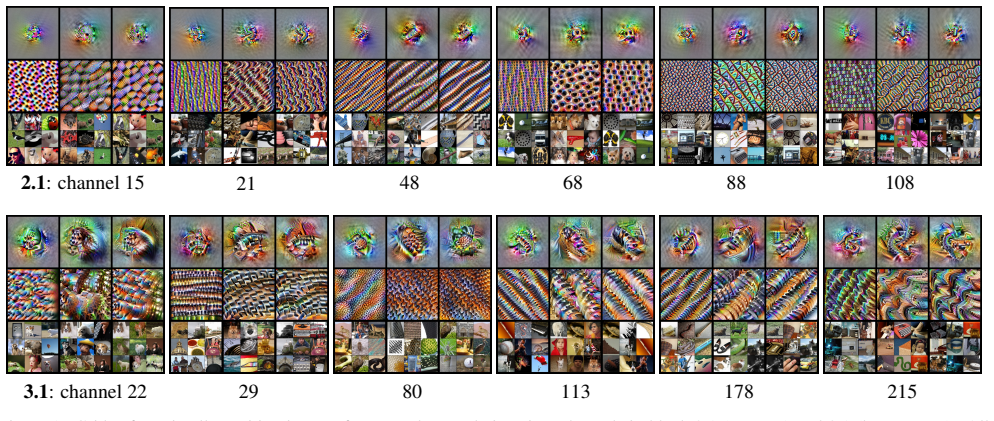
On the paper's own terms, the discovery is that scale invariance need not be assembled by a chain of hand-wired equivariant circuits, as previously found in InceptionV1; in ResNet18 it appears to emerge from the residual stream's summation operation itself. For a set of channels in blocks 1.1, 2.0, 2.1, and 3.1, the block input layer In holds a smaller-scale rendering of a feature, the pre-sum layer Pre holds a larger-scale rendering of the same feature, and the post-sum output Post, which is ReLU applied to Pre plus In, responds nearly equally to both. The paper identifies these channels with two inequalities: enlarging the input channel's feature visualization must boost the pre-sum channel's positive activation, and the post-sum channel's activation on the two feature visualizations must agree within a factor of 3/2. It then shows that mean-ablating only the post-sum channels of these sets damages top-1 accuracy on scale-transformed ImageNet images more than ablating matched random channels, while the two sets are comparable at the no-scale baseline. The author states plainly that these results are tentative and that the criteria test only feature-visualization responses, not scaled natural images.
Load-bearing premise
The whole argument turns on the assumption that a channel passing the two feature-visualization tests really is scale invariant, with the input channel holding the smaller scale and the pre-sum channel the larger scale; if that small-scale/large-scale split does not transfer to natural images, the flagged channels are not doing the claimed work and the ablation effect has another explanation.
Editorial extensions
If this is right
- Scale-invariant recognition in ResNet18 is at least partly built by the residual stream itself, not only by the feed-forward hierarchy of filters.
- Ablating the scale-invariant channels (23 in block 2.1, 46 in block 3.1) cuts scale-transformed top-1 accuracy at every tested center-crop percentage from 10 through 50 relative to matched random ablations.
- Architectures without skip connections lack this summation point, so any scale invariance they exhibit must arise through a different mechanism, giving a concrete architectural difference to test.
- The same two-criteria search can be run across the rest of the ResNet family and on recurrent weight-sharing networks, where the identical feature can be detected at multiple scales across timesteps.
- If bypass connections in biological visual systems compute scale invariance, then scale-invariant deep ventral-stream neurons should respond faster to smaller-than-preferred scales than to larger ones.
Reading between the lines
- A sharper test of the mechanism would replace the residual addition with concatenation in a matched-width network: the dense clustering of scale-invariant channels should disappear, and the scale-robustness gap between the two architectures should track that loss.
- The neuroscience corollary is directly testable: record single-unit latencies in a scale-invariant ventral-stream population while presenting small versus large versions of the preferred feature; the bypass hypothesis predicts faster onsets for the smaller scales.
- The 3/2 tolerance band in the second criterion would also admit channels that simply respond weakly to both feature visualizations, so requiring a high absolute post-sum activation and checking invariance across a continuous scale range (say 0.5x to 2x) would pin the claim down more tightly.
- If superposition hides additional scale-equivariant features in the residual stream, as the paper suggests, then a dictionary-learning search over the block's activations should find a larger set of such features, and ablating that full set should produce a bigger behavioral effect than ablating the visible channels alone.
Signed reviews
Editorial analysis
A structured set of objections, weighed in public.
Referee Report
Summary. The paper investigates scale invariance in the residual stream of ResNet18. For each residual block, the authors obtain feature visualizations (FZs) for the block input (In), pre-sum (Pre), and post-sum (Post) layers, and propose two criteria (Eqs. (1)-(2)) to identify channels whose Post activation appears scale invariant, with In coding a smaller-scale copy and Pre coding a larger-scale copy. Across blocks 1.1 to 4.1, they find criteria-passing channels concentrated in intermediate blocks (23 in 2.1, 46 in 3.1). They then ablate these channels and report that scale-robust ImageNet accuracy degrades more than when random non-passing channels are ablated. The paper concludes that the residual stream computes scale invariance via element-wise summation of scale-equivariant representations, and tentatively suggests a behavioral role.
Significance. If the central claim were established, this would be a valuable mechanistic finding: it would extend invariance-circuit analysis from InceptionV1 to ResNet, identify a concrete computation in the residual stream, and connect a neural-level property to behavior through ablation. The paper is honest about its tentative nature and makes code available. However, the evidence as presented is indirect: the selection criteria use feature visualizations rather than scaled natural images, the ablation effect is small and lacks significance testing, and the results rely on hyperparameter choices that are not fully controlled. These issues currently leave the central claim unproven, though the methods are sufficiently concrete that targeted additional experiments could substantially strengthen the paper.
major comments (3)
- [Section 4, ablation analysis] The criteria do not directly test scale invariance of the Post channel. Eq. (2) only requires that Post_c responds comparably to two independently optimized feature visualizations, Xhat_In and Xhat_Pre; it never applies the scale transform S to a fixed stimulus and checks that the response of Post_c is approximately unchanged. Eq. (1) only shows that Pre_c's response to an enlarged version of In's FZ is larger than to the original, which is a preference for larger-scale features, not evidence that Pre_c encodes a larger-scale copy in an equivariant sense. The paper's own Section 5 limitation ('criteria ... only via a channel's response to the FZs') acknowledges this, but the limitation is load-bearing because the same channel set is used in the ablation experiments. I request an additional validation: take fixed natural images (or the In-channel FZs), apply S, and check directly that Post_c's response is approximately scale-invariant while In and Pre responses shift appropriately. Without such validation, the identified channels may be artifacts of feature-visualization optimization rather than true scale-invariant computations.
- [Section 7.1, Feature Visualization Regularization] The ablation evidence is not statistically supported. Figure 2 reports only mean ratios with standard error bars; no significance test (e.g., permutation test or bootstrap confidence interval) is performed for the claim that scale-transformed ratios are below the no-scale ratio. Moreover, the matching constraint for block 3.1 was relaxed (random ablation accuracy can be up to 1% greater in the no-scale condition), which may confound the comparison because the two channel sets are not matched in no-scale damage. I request reporting absolute top-1 accuracies for both ablation conditions, formal significance tests across the scale sweep, and a sensitivity analysis to the matching threshold. Without these, the conclusion that scale-invariant channel ablation disproportionately damages scale-robust accuracy is not established.
- [Section 4, Eq. (3)] The layer-dependent jitter settings create a potential confound. Feature visualizations are optimized with jitter omitted for blocks 1.1 and 2.0, jitter=4 for 2.1 Pre and the entire 3.0 block, and jitter=16 otherwise. Because the FZ optimization landscape changes with depth and jitter, the criteria-passing channel set may partly reflect which channels are easily optimizable at a given jitter rather than a genuine scale-invariant property. I request a robustness check: re-run the channel search with at least one alternative jitter setting (or a fixed jitter across all blocks) and report the overlap of passing channels, or validate the criteria on natural images so that the FZ optimization step is not the sole evidence for neural properties.
minor comments (5)
- [Section 4, Fig. 2] In Eq. (3), the subscript s_i is not defined; presumably it indexes the random ablation trial. Please define it.
- [Abstract and Section 6] The caption of Fig. 2 states 'mean ratios of top-1 ImageNet validation accuracy between the two ablation conditions' but does not explain that the blue line is the no-scale ratio. Please make the baseline explicit in the caption.
- [Section 2.2] The abstract and conclusion use more assertive language ('how the residual stream computes scale invariance', 'these findings are crucial') than the 'tentative' framing in the Discussion. Please align the language with the strength of the evidence.
- [General] The description of feature visualization says 'near-identical regularizations as prescribed by [14]' without listing the exact regularization terms; since the paper depends on FZ quality, a complete list of hyperparameters (beyond jitter) would aid reproducibility.
- [General] There are occasional spacing issues in the text (e.g., 'P re', 'P ost') and undefined notation like 'FZ' is used before first definition. A copyedit pass would improve readability.
Circularity Check
No circularity: the FZ-based screening criteria and the ablation are independent, and the acknowledged FZ-proxy limitation is a validity concern, not a definitional reduction.
full rationale
The paper's derivation chain is not circular. Section 3 defines a screening test (Eqs. 1-2) on feature-visualization responses; Eq. (2) is a ratio constraint on Post_c's responses to two separately optimized FZs, and Eq. (1) is a scale-preference check on Pre_c. These criteria are not derived from, nor fitted to, the ablation results in Section 4, and the ablation provides an independent behavioral test whose outcome could have gone against the hypothesis. No fitted constant is reused as a prediction, and no load-bearing claim is justified solely by a self-citation. The main weakness is an external-validity gap, not circularity: the paper assumes (Section 3) that if Post_c is scale invariant then In_c is the smaller-scale copy and Pre_c the larger-scale copy, and then uses Eq. (2) as a proxy for that invariance rather than directly testing Post_c(S(X)) ≈ Post_c(X). The paper itself flags this in Section 5: 'The criteria for determining scale invariance is only via a channel's response to the FZs.' While this limitation is real and load-bearing for the mechanistic interpretation, it concerns whether the operationalized criterion measures what it claims, not whether the result is equivalent to its inputs by construction. Score 0.
Assumptions & free parameters
free parameters (3)
- Scale invariance tolerance ratio =
2/3 to 3/2 in Eq. (2)
- Ablation matching constraint for block 3.1 =
1% allowed difference in no-scale accuracy
- Feature visualization jitter values =
0, 4, or 16 depending on block
assumptions (4)
- domain assumption If a post-sum output channel is scale invariant, then the block input channel represents a smaller-scale copy and the pre-sum channel represents a larger-scale copy.
- domain assumption Center-neuron feature visualizations produced by Lucent are valid probes of a channel's selectivity.
- domain assumption Mean ablation of post-sum activations is a valid causal intervention to test channel contributions.
- domain assumption ImageNet-trained ResNet18 is an appropriate model of visual object recognition for mechanistic study.
Cite this review
Pith. "Pith review of Naturally Computed Scale Invariance in the Residual Stream of ResNet18." pith.science (2026). https://pith.science/paper/G5SJUCIC
@misc{pith2026250416290,
  author       = {Pith},
  title        = {Pith review of: Naturally Computed Scale Invariance in the Residual Stream of ResNet18},
  year         = {2026},
  howpublished = {\url{https://pith.science/paper/G5SJUCIC}},
  note         = {Machine review of arXiv:2504.16290}
}
read the original abstract
An important capacity in visual object recognition is invariance to image-altering variables which leave the identity of objects unchanged, such as lighting, rotation, and scale. How do neural networks achieve this? Prior mechanistic interpretability research has illuminated some invariance-building circuitry in InceptionV1, but the results are limited and networks with different architectures have remained largely unexplored. This work investigates ResNet18 with a particular focus on its residual stream, an architectural component which InceptionV1 lacks. We observe that many convolutional channels in intermediate blocks exhibit scale invariant properties, computed by the element-wise residual summation of scale equivariant representations: the block input's smaller-scale copy with the block pre-sum output's larger-scale copy. Through subsequent ablation experiments, we attempt to causally link these neural properties with scale-robust object recognition behavior. Our tentative findings suggest how the residual stream computes scale invariance and its possible role in behavior. Code is available at: https://github.com/cest-andre/residual-stream-interp
Figures


Figures from the paper (1 more)

Reference graph
Works this paper leans on
-
[1]
Nick Cammarata, Gabriel Goh, Shan Carter, Ludwig Schu- bert, Michael Petrov, and Chris Olah. Curve detectors. Dis- till, 2020. https://distill.pub/2020/circuits/curve-detectors. 1
work page 2020
-
[2]
Imagenet: A large-scale hierarchical image database
Jia Deng, Wei Dong, Richard Socher, Li-Jia Li, Kai Li, and Li Fei-Fei. Imagenet: A large-scale hierarchical image database. In 2009 IEEE Conference on Computer Vision and Pattern Recognition, pages 248–255, 2009. 2, 3
work page 2009
-
[3]
How does the brain solve visual object recognition? Neuron, 73 (3):415–434, 2012
James J DiCarlo, Davide Zoccolan, and Nicole C Rust. How does the brain solve visual object recognition? Neuron, 73 (3):415–434, 2012. 1
work page 2012
-
[4]
Hierarchical and nonhierarchical features of the mouse visual cortical network
Rinaldo D D’Souza, Quanxin Wang, Weiqing Ji, Andrew M Meier, Henry Kennedy, Kenneth Knoblauch, and Andreas Burkhalter. Hierarchical and nonhierarchical features of the mouse visual cortical network. Nature communications, 13 (1):503, 2022. 1
work page 2022
-
[5]
Nelson Elhage, Tristan Hume, Catherine Olsson, Nicholas Schiefer, Tom Henighan, Shauna Kravec, Zac Hatfield- Dodds, Robert Lasenby, Dawn Drain, Carol Chen, Roger Grosse, Sam McCandlish, Jared Kaplan, Dario Amodei, Martin Wattenberg, and Christopher Olah. Toy models of superposition. Transformer Circuits Thread , 2022. https://transformer-circuits.pub/2022...
work page 2022
-
[6]
Group crosscoders for mechanistic analysis of symmetry
Liv Gorton. Group crosscoders for mechanistic analysis of symmetry. arXiv preprint arXiv:2410.24184, 2024. 4
arXiv 2024
-
[7]
Liv Gorton. The missing curve detectors of inceptionv1: Ap- plying sparse autoencoders to inceptionv1 early vision. In ICML 2024 Workshop on Mechanistic Interpretability, 2024. 1
work page 2024
-
[8]
Deep residual learning for image recognition
Kaiming He, Xiangyu Zhang, Shaoqing Ren, and Jian Sun. Deep residual learning for image recognition. In Proceed- ings of the IEEE Conference on Computer Vision and Pattern Recognition (CVPR), 2016. 1
2016
Show all 25 references
-
[9]
Size and position invariance of neuronal responses in mon- key inferotemporal cortex
Minami Ito, Hiroshi Tamura, Ichiro Fujita, and Keiji Tanaka. Size and position invariance of neuronal responses in mon- key inferotemporal cortex. Journal of neurophysiology, 73 (1):218–226, 1995. 4
1995
-
[10]
Deep supervised, but not unsupervised, models may explain it cortical representation
Seyed-Mahdi Khaligh-Razavi and Nikolaus Kriegeskorte. Deep supervised, but not unsupervised, models may explain it cortical representation. PLoS computational biology , 10 (11):e1003915, 2014. 1
2014
-
[11]
Brain-like object recognition with high-performing shallow recurrent anns
Jonas Kubilius, Martin Schrimpf, Kohitij Kar, Rishi Rajal- ingham, Ha Hong, Najib Majaj, Elias Issa, Pouya Bashivan, Jonathan Prescott-Roy, Kailyn Schmidt, et al. Brain-like object recognition with high-performing shallow recurrent anns. Advances in neural information processi...
2019
-
[12]
Lukas Muttenthaler and Martin N. Hebart. Thingsvision: A python toolbox for streamlining the extraction of activations from deep neural networks. Frontiers in Neuroinformatics, 15:45, 2021. 2
2021
-
[13]
The modular organization of projec- tions from areas v1 and v2 to areas v4 and teo in macaques
Hiroyuki Nakamura, Ricardo Gattass, Robert Desimone, and Leslie G Ungerleider. The modular organization of projec- tions from areas v1 and v2 to areas v4 and teo in macaques. Journal of Neuroscience, 13(9):3681–3691, 1993. 1
1993
-
[14]
Feature visualization
Chris Olah, Alexander Mordvintsev, and Ludwig Schubert. Feature visualization. Distill, 2017. https://distill.pub/2017/feature-visualization. 2, 1
2017
-
[15]
An overview of early vision in inceptionv1
Chris Olah, Nick Cammarata, Ludwig Schubert, Gabriel Goh, Michael Petrov, and Shan Carter. An overview of early vision in inceptionv1. Distill, 2020. https://distill.pub/2020/circuits/early-vision. 1
2020
-
[16]
Zoom in: An introduction to circuits
Chris Olah, Nick Cammarata, Ludwig Schubert, Gabriel Goh, Michael Petrov, and Shan Carter. Zoom in: An introduction to circuits. Distill, 2020. https://distill.pub/2020/circuits/zoom-in. 1
2020
-
[17]
Naturally occur- ring equivariance in neural networks
Chris Olah, Nick Cammarata, Chelsea V oss, Lud- wig Schubert, and Gabriel Goh. Naturally occur- ring equivariance in neural networks. Distill, 2020. https://distill.pub/2020/circuits/equivariance. 1, 4
2020
-
[18]
Pytorch: An imperative style, high-performance deep learning library
Adam Paszke, Sam Gross, Francisco Massa, Adam Lerer, James Bradbury, Gregory Chanan, Trevor Killeen, Zeming Lin, Natalia Gimelshein, Luca Antiga, Alban Desmaison, Andreas Kopf, Edward Yang, Zachary DeVito, Martin Rai- son, Alykhan Tejani, Sasank Chilamkurthy, Benoit Steiner, L...
2019
-
[19]
Computational models of category-selective brain regions enable high- throughput tests of selectivity
N Apurva Ratan Murty, Pouya Bashivan, Alex Abate, James J DiCarlo, and Nancy Kanwisher. Computational models of category-selective brain regions enable high- throughput tests of selectivity. Nature communications, 12 (1):5540, 2021. 1
2021
-
[20]
Ma- jaj, Rishi Rajalingham, Elias B
Martin Schrimpf, Jonas Kubilius, Ha Hong, Najib J. Ma- jaj, Rishi Rajalingham, Elias B. Issa, Kohitij Kar, Pouya Bashivan, Jonathan Prescott-Roy, Franziska Geiger, Kailyn Schmidt, Daniel L. K. Yamins, and James J. DiCarlo. Brain- score: Which artificial neural network for obje...
2020
-
[21]
High-low frequency detectors
Ludwig Schubert, Chelsea V oss, Nick Cammarata, Gabriel Goh, and Chris Olah. High-low frequency detectors. Distill,
-
[22]
Going deeper with convolutions
Christian Szegedy, Wei Liu, Yangqing Jia, Pierre Sermanet, Scott Reed, Dragomir Anguelov, Dumitru Erhan, Vincent Vanhoucke, and Andrew Rabinovich. Going deeper with convolutions. In Proceedings of the IEEE Conference on Computer Vision and Pattern Recognition (CVPR), 2015. 1
2015
-
[23]
Performance-optimized hierarchical models predict neural responses in higher visual cortex
Daniel LK Yamins, Ha Hong, Charles F Cadieu, Ethan A Solomon, Darren Seibert, and James J DiCarlo. Performance-optimized hierarchical models predict neural responses in higher visual cortex. Proceedings of the na- tional academy of sciences, 111(23):8619–8624, 2014. 1 5 Natura...
2014
-
[25]
Appendix 7.1. Feature Visualization Regularization We use an identical regularization method as described in [14], except we use different levels of jitter dependent on the depth of the layer (we still use half the initial jitter value for the second jitter transform). This is...
-
[2021]
https://distill.pub/2020/circuits/frequency-edges. 1
2020
Reviewed August 16, 2026 · model on record in the stance chip above.
Discussion (0). Continue with ORCID to comment.