REVIEW 4 major objections 5 minor 234 references
Physical ageing from generalised time-translation-invariance
T0 review · 4 major / 5 minor · reviewed 2026-08-16 · deepseek-v4-flash
Pith's one-line read Classical ageing's standard scaling laws are shown to follow from a single logarithmic change of representation of the time-translation and dilatation generators.
desk verdict A plausible unifying framework for ageing phenomenology, but the equality λ_C=λ_R is not derived from the two stated symmetries alone—an extra assumption about the response operator is needed. read the letter →
The pith
A machine-rendered reading of the paper's core claim, the machinery that carries it, and where it could break.
The reading
What carries the argument
The central object is the intertwining operator $W(t)=\xi\ln t$, used through $X=e^{W(t)}X_{\rm equi}e^{-W(t)}$ to transform equilibrium symmetry generators into out-of-equilibrium ones. It gives the generalised time-translation generator $-\partial_t+\xi/t$ and shifts scaling dimensions by $\xi$; solving the resulting pair of linear first-order covariance equations (2.5a)-(2.5b) yields the two-time scaling form that carries the argument. The same machinery supplies a criterion $2\xi>1$ for irrelevance of cubic non-linearities in the equation of motion, which is what justifies applying linear Schrödinger-invariant response forms to a wide class of non-conserved phase-ordering models.
What would settle it
In a fully finite system quenched to $T\le T_c$ with $s\ll N^z$, the height of the two-time auto-correlator plateau should scale as $N^{-\lambda}$ at fixed waiting time and as $s^{\lambda/z-b}$ at fixed size; measuring a different $N$-dependence or a different $s$-dependence would falsify the derived finite-size scaling, and a simultaneous measurement of the global correlator plateau $N^{d-\lambda}$ would test the extended Janssen-Schaub-Schmittmann relation.
Extended reading notes
Core claim
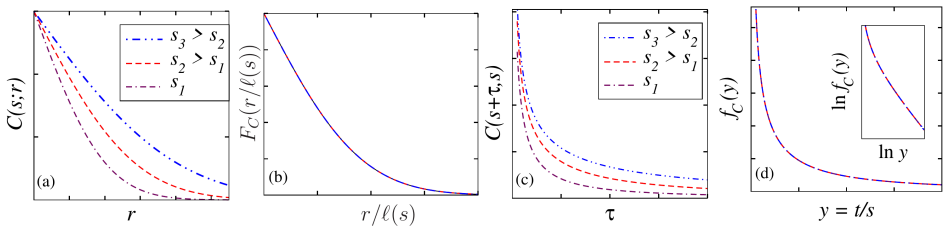
On the paper's own terms, the central claim is that the whole generic ageing phenomenology of classical systems follows from the two covariance conditions on two-point functions: generalised time-translation invariance $X_{-1}C=(-\partial_t-\partial_s+\xi_1/t+\xi_2/s)C=0$ and dynamical scaling $X_0C=(-t\partial_t-s\partial_s-\frac{1}{z}r\partial_r-(\delta_1-\xi_1)-(\delta_2-\xi_2))C=0$. The unique covariant solution is $C(t,s;r)=s^{-\delta_1-\delta_2+\xi_1+\xi_2}(t/s)^{\xi_1}(t/s-1)^{-\delta_1-\delta_2}F(r/(t-s)^{1/z})$. Large-argument limits give $f_C(y)\sim y^{-\lambda_C/z}$ and $f_R(y)\sim y^{-\lambda_R/z}$ with $\lambda_C=\lambda_R$, and the same derivation reproduces the Janssen-Schaub-Schmittmann relation $\Theta=d-\lambda/z$ at criticality while extending it to all $T<T_c$ through global correlators and responses. It also produces new finite-size plateau scalings for fully finite systems, which the paper verifies in the exactly solvable spherical model.
Load-bearing premise
The load-bearing premise is the intertwining prescription $X_{\rm equi}\mapsto e^{\xi\ln t}X_{\rm equi}e^{-\xi\ln t}$ with a constant dimensionless rapidity $\xi$; the paper states in Section 5 that this form is not derived and its physical origin remains open, so if actual symmetries require a time-dependent $\xi$ or additional corrections the scaling laws and exponent equalities would not follow.
Editorial extensions
If this is right
- The equality $\lambda_C=\lambda_R$ follows from the covariance conditions rather than being assumed, so it is predicted to hold in every ageing system with short-ranged initial correlations.
- The Janssen-Schaub-Schmittmann relation $\Theta=d-\lambda/z$ applies after quenches to all $T\le T_c$, making $Q(t,0)\sim t^{\Theta}$ a practical way to measure $\lambda$ below criticality.
- In fully finite systems with $s\ll N^z$, plateau heights scale as $N^{-\lambda}$ and $s^{\lambda/z-b}$ for correlators, with analogous response laws, giving independent estimates of $\lambda$, $a$, and $\lambda/z$ from finite samples.
- Whenever the criterion $2\xi>1$ holds, cubic non-linearities are irrelevant at late times, so the linear Schrödinger-invariant form of the two-time auto-response describes a wide class of phase-ordering and critical models.
- At criticality the limit fluctuation-dissipation ratio $X_\infty$ is finite and expressed through exponents and the amplitude ratio $f_{\infty,R}/f_{\infty,C}$, consistent with measured finite values in several experimental systems.
Reading between the lines
- If the intertwining postulate is the true symmetry mechanism, allowing $W(t)$ to be a more general function than $\xi\ln t$ should generate logarithmic sub-ageing or multi-scaling regimes; the paper explicitly leaves this generalisation open.
- The derivation excludes long-ranged initial correlations, and the paper notes $\lambda_C=\lambda_R$ may fail there; a controlled numerical test would quench with power-law correlated initial states and measure $\lambda_C-\lambda_R$ as a function of the initial correlation exponent.
- In finite samples, the predicted plateau onset offers an alternative explanation for apparent curvature in $f_C(y)$ at large $y$; fits that ignore the plateau could systematically overestimate $\lambda/z$, so comparing $N$-based and $s$-based plateau scalings provides a consistency check.
- The paper restricts to classical dynamics; if the same logarithmic representation describes quantum quenches, the equalities $\lambda_C=\lambda_R$ and $\Theta=d-\lambda/z$ should appear in quantum ageing as well, which would be a sharp test of the symmetry's physical origin.
Signed reviews
Editorial analysis
A structured set of objections, weighed in public.
Referee Report
Summary. The paper proposes that the generic two-time phenomenology of physical ageing in classical systems can be derived from two dynamical symmetries: generalized time-translation invariance and dynamical scaling. The central postulate, Eq. (2.1), replaces the equilibrium generator of time translations by an intertwined form X = e^{ξ ln t} X_equi e^{-ξ ln t}, producing the modified generators (2.2). Solving the resulting covariance equations for two-point functions yields the exact form (2.6), from which the paper derives algebraic autocorrelation and autoresponse scaling, the equality λ_C = λ_R, the Janssen-Schaub-Schmittmann relation, extensions of that relation to T < T_c, finite-size plateau scalings in fully finite systems, and global two-time observables. Section 4 translates the same representation into a criterion for the irrelevance of nonlinear terms in the equation of motion, and compares the resulting response forms with a large body of exact and numerical results. The paper is explicit in Section 5 that the intertwining form W(t)=ξ ln t is a postulate whose physical origin is not derived.
Significance. If the central hypothesis is accepted, the paper offers a valuable unifying perspective: a single representation choice (2.1) with W(t)=ξ ln t reproduces a wide set of known ageing results and produces new, testable predictions, notably the finite-size plateau scalings (3.15), (3.18), (3.21), (3.43), (3.46) and the extension of the JSS relation to all T ≤ T_c. The covariance lemma (2.6) is a simple but correct exact statement, and the paper backs its claims with exact checks in the spherical model, the 1D Glauber-Ising model, and the fully connected spherical spin glass, together with an extensive compilation of numerical results. The significance is moderated by the facts that the central postulate is not derived, that the equality λ_C = λ_R requires an extra assumption about the response operator that is not among the two stated symmetries, and that the response-plateau finite-size scalings are conditional on a convergence assumption that fails in at least one known model. These issues do not invalidate the framework but they do mean the paper's stated claims exceed what is logically established.
major comments (4)
- [§3.2, Eq. (3.5), Prop. 2] The equality λ_C = λ_R is not a consequence of the two stated symmetries (2.5a) and (2.5b) alone. Solving (2.6) for the response R = ⟨φ(t)φ̃(s)⟩ with independent parameter pairs (δ,ξ) and (δ̃,ξ̃) gives λ_R/z = δ + δ̃ − ξ, whereas the autocorrelator gives λ_C/z = 2δ − ξ. Equality holds only if δ̃ = δ. Eq. (3.5) imposes δ̃ = δ by an appeal to local scale-invariance ('If that is admissible'), which is an additional dynamical input not present in (2.5a,b). The abstract and Proposition 2 present λ_C = λ_R as a consequence of generalized time-translation-invariance combined with dynamical scaling; this overstates the logical content of the derivation. The authors should either state the extra assumption explicitly whenever the equality is claimed, or prove δ̃ = δ from the stated symmetries.
- [§2, Eq. (2.1); §5] The central postulate (2.1) with W(t) = ξ ln t is not derived, and Section 5 explicitly states that its physical origin is open. All propositions that follow are therefore conditional on this specific logarithmic intertwining form; a different W(t), or a time-dependent ξ, would change the scaling forms and exponent relations. The paper should state this conditionality prominently in the abstract and in Propositions 1–7, and should soften the claim that the whole generic phenomenology of ageing is derived from the two dynamical symmetries, because one of those symmetries is itself an unproved representation choice rather than a symmetry that has been shown to hold for the systems under study.
- [§3.4, Prop. 4; §3.7, Cor. 6] The finite-size plateau scaling for the auto-response is an assumption, not a consequence of (2.5a,b). Proposition 4 is phrased conditionally ('if the auto-response function converges to a plateau'), and Appendix D shows that in the fully connected p = 2 spherical spin glass the response does not plateau (D.11). The same conditional structure propagates to Corollaries 3 and 6. The paper should clearly separate the derived scaling (3.17) from the additional hypothesis of plateau convergence whenever these finite-size plateau scalings are advertised as consequences of the generalised time-translation-invariance programme.
- [Appendix B; §5] Appendix B shows that generalized time-translation covariance cannot accommodate single-time correlators: it forces FC(u) ∼ u^{−2δz}, in contradiction to the known scaling behaviour. The paper excludes single-time correlators (Section 5, assumption 4), but the abstract and Section 1 claim that the whole generic phenomenology of ageing is derived. Since single-time correlators are part of the standard phenomenology of ageing, the claim of scope is overstated. The authors should qualify the claim to the two-time sector, or justify why the failure of the covariance requirement for single-time correlators does not cast doubt on the use of the same requirement for two-time correlators.
minor comments (5)
- [Abstract] The abstract contains the typo 'celebrate' for 'celebrated'; this should be corrected.
- [Throughout] There are several non-native spellings, e.g., 'littérature' in §3.2 and 'Forth' in Appendix C; a careful language edit is needed.
- [Eq. (2.6)] The uniqueness claim in the proof of the lemma relies on the external reference [144]; stating the method-of-characteristics argument would make the derivation more self-contained.
- [Tables 2 and 3] The tables mix literature values with values inferred from the present framework; a sentence clarifying which entries are new determinations and which are taken from the cited references would improve transparency.
- [§3.3, Fig. 3] The axis label 'rL FC' in panel (b) appears garbled; the figure would be clearer if the abscissa were labelled y = t/s and the ordinate simply C(ys,s).
Circularity Check
The equality λ_C=λ_R is imposed by the auxiliary identification δ̃=δ in eq. (3.5), so the abstract's claim that it follows from generalized time-translation-invariance and dynamical scaling is partly circular; the remaining scaling relations are conditional consequences of the unproved intertwining postulate.
-
self definitional
[Section 3.2, eq. (3.5) and Proposition 2; also abstract]
"Furthermore, we should eventually require responses to be co-variant under larger algebras of local scale-transformations, notably conformal transformations which make up local scale-invariance [106, 108, 118]. If that is admissible, we have δ =δ1 =δ2 =~δ , ξ =ξ1 , ~ξ =ξ2 ... Comparison of (3.3) and (3.7) implies the exponent equality λ =λC =λR."
Without the identification δ̃=δ, the general covariance solution (2.6) gives for the auto-response R(t,s) = s^{-δ-δ̃+ξ+ξ̃} (t/s)^{ξ-δ-δ̃} F_R(0), so λ_R/z = δ+δ̃-ξ, while the auto-correlator gives λ_C/z = 2δ-ξ. These two exponents are equal exactly when δ̃=δ. That equality is inserted by hand in eq. (3.5) through an appeal to local scale-invariance, and Proposition 2 then presents λ_C=λ_R as a derived consequence. Thus the celebrated exponent equality is not a consequence of the two stated symmetries (2.5a,b) alone; it is an input encoded in the chosen scaling dimensions of the response operator. The abstract's statement that λ_C=λ_R is an observable consequence of the generalised time-translation-invariance and dynamical scaling therefore overstates what the derivation actually shows.
full rationale
The paper's central derivation is conditional on the intertwining postulate (2.1) with W(t)=ξ ln t, and Section 5 explicitly admits that the form of W(t) is not derived and its physical origin is open. Conditional derivations from a postulate are not themselves circular. The main circular element is the exponent equality λ_C=λ_R: the response operator's scaling dimension is set equal to the order-parameter dimension in eq. (3.5) ("If that is admissible"), and this equality of dimensions is exactly what makes the response exponent equal to the correlator exponent. Proposition 2 drops the conditional caveat and the abstract lists λ_C=λ_R as an outcome of the two dynamical symmetries. That is a specific reduction of a headline prediction to an auxiliary definitional assumption, so a partial circularity score is appropriate. The other results — the algebraic scaling forms, the finite-size plateau laws, and the extension of the Janssen-Schaub-Schmittmann relation below criticality — are genuine consequences of the covariance equations once the representation parameters are admitted, and are not themselves fits renamed as predictions. The paper also repeatedly checks the resulting forms against known exact and numerical results, which supports the empirical content of the framework. The score of 6 reflects that one central equality is imposed rather than derived, while substantial independent content remains in the rest of the derivation chain.
Assumptions & free parameters
free parameters (4)
- ξ (rapidity of order-parameter φ) =
Not fitted in the paper; in examples read off from known λ, e.g., ξ = d/4 in the spherical model and ξ ≈ 7/8 in the 2D…
- ξ̃ (rapidity of response operator φ̃) =
Not fitted in the paper.
- Exponents a, a', λ in response forms (4.7) and (4.26) =
Example values: a = 0, a' = -1/2, λ/z = 1/2 in the 1D Glauber-Ising chain; many fitted entries in table 3.
- Undetermined scaling functions F_C, F_R, F_m, FC(u), FR(u) =
Left arbitrary.
assumptions (6)
- domain assumption Simple ageing: two-time functions obey scaling with an algebraically growing length scale ℓ(t) ~ t^{1/z}.
- domain assumption All initial correlations are short-ranged.
- ad hoc to paper The intertwining postulate (2.1) with W(t) = ξ ln t.
- domain assumption For response functions, φ and φ̃ have equal scaling dimension δ, while their rapidities ξ and ξ̃ remain independent.
- ad hoc to paper The auto-response function in fully finite systems converges to a plateau.
- domain assumption Known values of the exponents b, a, z, λ, η, β, ν are taken from prior literature.
invented entities (1)
-
Intertwining operator W(t) = ξ ln t (generalised time-translation representation)
independent evidence
Cite this review
Pith. "Pith review of Physical ageing from generalised time-translation-invariance." pith.science (2026). https://pith.science/paper/W7A2YDDA
@misc{pith2026250416857,
  author       = {Pith},
  title        = {Pith review of: Physical ageing from generalised time-translation-invariance},
  year         = {2026},
  howpublished = {\url{https://pith.science/paper/W7A2YDDA}},
  note         = {Machine review of arXiv:2504.16857}
}
abstract
A generalised form of time-translation-invariance permits to re-derive the known generic phenomenology of ageing, which arises in classical many-body systems after a quench from an initially disordered system to a temperature $T\leq T_c$, at or below the critical temperature $T_c$. Generalised time-translation-invariance is obtained, out of equilibrium, from a change of representation of the Lie algebra generators of the dynamical symmetries of scale-invariance and time-translation-invariance. Observable consequences include the algebraic form of the scaling functions for large arguments of the two-time auto-correlators and auto-responses, the equality of the auto-correlation and the auto-response exponents $\lambda_C=\lambda_R$, the cross-over scaling form for an initially magnetised critical system and the explanation of a novel finite-size scaling if the auto-correlator or auto-response converge for large arguments $y=t/s\gg 1$ to a plateau. For global two-time correlators, the time-dependence involving the initial critical slip exponent $\Theta$ is confirmed and is generalised to all temperatures below criticality and to the global two-time response function, and their finite-size scaling is derived as well. This also includes the time-dependence of the squared global order-parameter. The celebrate Janssen-Schaub-Schmittmann scaling relation with the auto-correlation exponent is thereby extended to all temperatures below the critical temperature. A simple criterion on the relevance of non-linear terms in the stochastic equation of motion is derived, taking the dimensionality of couplings into account. Its applicability in a wide class of models is confirmed, for temperatures $T\leq T_c$. Relevance to experiments is also discussed.
Figures


Figures from the paper (1 more)

Reference graph
Works this paper leans on
-
[1]
Abramowitz and I.A
M. Abramowitz and I.A. Stegun, Handbook of Mathematical Functions , Dover (New York 1965)
1965
-
[2]
Abraham and P.J
D.B. Abraham and P.J. Upton, Dynamics of gaussian interf ace models, Phys. Rev. B39, 736 (1989)
1989
- [3]
- [4]
-
[5]
L.Ts. Adzhemyan, D.A. Evdokimov, M. Hnatic, E.V. Ivanov a, M.V. Kompaniets, A. Kudlis, D.V. Za- kharov, The dynamic critical exponent z for 2d and 3d Ising models from five-loop ε-expansion, Phys. Lett. A425, 127870 (2022) [arXiv:2111.04719]
arXiv 2022
-
[6]
L.Ts. Adzhemyan, D.A. Evdokimov, M. Hnatic, E.V. Ivanov a, M.V. Kompaniets, A. Kudlis, D.V. Zakharov, Model A of critical dynamics: 5-loop ε-expansion study, Physica A600, 125730 (2022) [arXiv:2201.12640]
arXiv 2022
-
[7]
L.Ts. Adzhemyan, M. Hnatic, E.V. Ivanova, M.V. Kompanie ts, T. Lucivjansky, L. Mizisin, Field- theoretic analysis of directed percolation: Three-loop ap proximation, Phys. Rev. E107, 064138 (2023) [arXiv:2306.17057]
arXiv 2023
-
[8]
R. Agrawal, F. Corberi, E. Lippiello, P. Politi, S. Puri, Kinetic of the two-dimensional long-range Ising model at low temperatures, Phys. Rev. E103, 012108 (2021) [arXiv:2011.05030]
arXiv 2021
Show all 234 references
-
[9]
Albano, M.A.N
E.V. Albano, M.A.N. Bab, G. Baglietto, R.A. Borzi, T.S. G rigera, E.S. Loscar, D.E. Rodriguez, M.L. Rubio Puzzo, G.P. Saracco, Study of phase transitions from s hort-time non-equilibrium behaviour, Rep. Prog. Phys. 74, 026501 (2011)
2011
-
[10]
Almeida, K
R. Almeida, K. Takeuchi, Phase-ordering kinetics in th e Allen-Cahn (Model A) class: universal as- pects elucidated by electrically-induced transition in li quid crystals, Phys. Rev. E104, 054103 (2021) [arXiv:2107.09043]
2021 arXiv
-
[11]
Annibale, P
A. Annibale, P. Sollich, Spin, bond and global fluctuati on-dissipation relations in the non-equilibrium spherical ferromagnet, J. Phys. A39, 2853 (2006) [arxiv:cond-mat/0510731]
2006 arXiv
-
[12]
Annibale, P
A. Annibale, P. Sollich, Fluctuation-dissipation rel ations in critical coarsening: crossover from unmagne- tized to magnetized initial states, J. Phys. A41, 135001 (2008) [arXiv:0801.1381]
2008 arXiv
-
[13]
Arceri, F.P
F. Arceri, F.P. Landes, L. Berthier, G. Biroli, Glasses and ageing: a statistical mechanics perspective, Encyclopedia of Complexity and Systems Science, Springer ( Heidelberg 2022) [arXiv:2006.09725]
2022 arXiv
-
[14]
Baker Jr, Quantitative theory of critical phenomena , Academic Press (San Diego 1990)
G.A. Baker Jr, Quantitative theory of critical phenomena , Academic Press (San Diego 1990)
1990
-
[15]
Baity-Jesi et al
M. Baity-Jesi et al. , A statics-dynamics equivalence through the fluctuation-d issipation ratio provides a window into the spin-glass phase from nonequilibrium measu rements, Proc. Nat. Acad. Sci. 114, 1838 (2017)
2017
-
[16]
Baity-Jesi et al
M. Baity-Jesi et al. (Janus collaboration), Ageing Rate of Spin Glasses from Sim ulations Matches Exper- iments, Phys. Rev. Lett. 120, 267203 (2018) [arXiv:1803.02264]
2018 arXiv
-
[17]
Baity-Jesi et al
M. Baity-Jesi et al. (Janus collaboration), Memory and rejuvenation in spin gla sses: aging systems are ruled by more than one length scale, Nature Physics 19, 978 (2023) [arXiv:2207.06207]
2023 arXiv
-
[18]
Barber, Finite-size scaling, in C
M.N. Barber, Finite-size scaling, in C. Domb, J.L. Lebowitz (eds), Phase transitions and critical phenom- ena, vol. 8, Academic Press (London 1983); p. 146
1983
-
[19]
Barbier, P.H
D. Barbier, P.H. de Freitas Pimenta, L.F. Cugliandolo, D.A. Stariolo, Finite-size effects and loss of self- averageness in the relaxational dynamics of the spherical S herrington-Kirkpatrick model, J. Stat. Mech. 073301 (2021) [arXiv:2103.12654]
2021 arXiv
-
[20]
Barabási, H.E
L. Barabási, H.E. Stanley, Fractal concepts in surface growth , Cambridge Univ. Press (Cambridge 1995)
1995
-
[21]
Baumann, M
F. Baumann, M. Henkel, M. Pleimling, J. Richert, Ageing without detailed balance in the bosonic contact and pair-contact processes: exact results, J. Phys. A38, 6623 (2005) [arxiv:cond-mat/0504243]. 46
2005 arXiv
-
[22]
Baumann, S
F. Baumann, S. Stoimenov, M. Henkel, Local scale-invar iances in the bosonic contact and pair-contact processes, J. Phys. A39, 4095 (2006) [arXiv:cond-mat/0510778]
2006 arXiv
-
[23]
Baumann, M
F. Baumann, M. Pleimling, Out-of-equilibrium propert ies of the semi-infinite kinetic spherical model, J. Phys. A39, 1981 (2006) [cond-mat/0509064]
2006 arXiv
-
[24]
Baumann, S.B
F. Baumann, S.B. Dutta, M. Henkel, Kinetics of the long- range spherical model, J. Phys. A40, 7389 (2007) [arxiv:cond-mat/0703445]
2007 arXiv
-
[25]
Baumann, A
F. Baumann, A. Gambassi, Ageing in the contact process: Scaling behaviour and universal features, J. Stat. Mech. P01002 (2007) [arxiv:cond-mat/0610260]
2007 arXiv
-
[26]
Berthier, J.L
L. Berthier, J.L. Barrat, J. Kurchan, Response Functio n of Coarsening Systems, Eur. Phys. J. B11, 635 (1999) [arXiv:cond-mat/9903091]
1999 arXiv
-
[27]
Berthier, Sub-ageing in a domain growth model, Eur
L. Berthier, Sub-ageing in a domain growth model, Eur. P hys. J. B17, 689 (2000) [arxiv:cond-mat/0003122]
2000 arXiv
-
[28]
Bonanno, A
C. Bonanno, A. Cappelli, M. Kompaniets, S. Okuda, K.J. W iese, Benchmarking the Ising universality class in 3 ≤d ≤ 4 dimensions, Sci. Post Phys. 14, 135 (2023) [arXiv:2210.03051]
2023 arXiv
-
[29]
Böttcher, M
L. Böttcher, M. Henkel, H.J. Herrmann, Dynamical unive rsality of the contact process, J. Phys. A51, 125003 (2018) [arXiv:1802.00037]
2018 arXiv
-
[30]
Bouchaud, Weak ergodicity breaking and ageing in d isordered systems, J
J.P. Bouchaud, Weak ergodicity breaking and ageing in d isordered systems, J. Physique I2, 1705 (1992)
1992
-
[31]
Bouchaud, E
J.P. Bouchaud, E. Vincent, J. Hammann, Towards an exper imental determination of the number of metastable states in spin-glasses ?, J. Physique I4, 139 (1994)
1994
-
[32]
Bouchaud, Ageing in glassy systems: experiments, models and open questions, in M.E
J.P. Bouchaud, Ageing in glassy systems: experiments, models and open questions, in M.E. Cates and M.R. Evans (eds), Soft and fragile matter , Institute of Physics Publishing (Bristol 2000) [arxiv:cond-mat/9910387]
2000 arXiv
-
[33]
Boyer, R.T
C.P. Boyer, R.T. Sharp, P. Winternitz, Symmetry-break ing interactions for the time-dependent Schrödinger equation, J. Math. Phys. 17, 1439 (1976)
1976
-
[34]
A.J. Bray, K. Humayun, T.J. Newman, Kinetics of orderin g for correlated initial conditions, Phys. Rev. B43, 3699 (1991)
1991
-
[35]
Bray, Theory of Phase Ordering Kinetics, Adv
A.J. Bray, Theory of Phase Ordering Kinetics, Adv. Phys . 43 357 (1994), [arXiv:cond-mat/9501089]
1994 arXiv
-
[36]
Bray, A.D
A.J. Bray, A.D. Rutenberg, Growth Laws for Phase-Order ing, Phys. Rev. E49, R27 (1994) [arxiv:cond-mat/9303011]; A.J. Bray, A.D. Rutenberg, Phase-Ordering Kinetics of One- Dimensional Non-Conserved Scalar Systems, E51, 5499 (1995) [arxiv:cond-mat/9409088]
1994 arXiv
-
[37]
Buisson, L
L. Buisson, L. Bellon, S. Ciliberto, Intermittency in a geing, J. Phys. Cond. Matt. 15, S1163 (2003) [arXiv:cond-mat/0210490]
2003 arXiv
-
[38]
Calabrese, A
P. Calabrese, A. Gambassi, Ageing and fluctuation-diss ipation ratio for the diluted Ising Model, Phys. Rev. B66, 212407 (2002) [arXiv:cond-mat/0207487]
2002 arXiv
-
[39]
Calabrese, A
P. Calabrese, A. Gambassi, Ageing in ferromagnetic sys tems at criticality near four dimensions, Phys. Rev. E65, 066120 (2002) [arXiv:cond-mat/0203096]
2002 arXiv
-
[40]
Calabrese, A
P. Calabrese, A. Gambassi, Two-loop Critical Fluctuat ion-Dissipation Ratio for the Relax- ational Dynamics of the O(N) Landau-Ginzburg Hamiltonian, Phys. Rev. E66, 066101 (2002) [arXiv:cond-mat/0207452]
2002 arXiv
-
[41]
Calabrese, A
P. Calabrese, A. Gambassi, Ageing at criticality in mod el-C dynamics, Phys. Rev. E67, 036111 (2003) [arxiv:cond-mat/0211062]
2003 arXiv
-
[42]
Calabrese, A
P. Calabrese, A. Gambassi, Ageing properties of critic al systems, J. Phys. A38, R133 (2005) [arXiv:cond-mat/0410357]
2005 arXiv
-
[43]
Cannas, D
S. Cannas, D. Stariolo, F. Tamarit, Dynamics of ferroma gnetic spherical spin models with power law interactions: exact solution, Physica A294A, 362 (2001) [arxiv:cond-mat/0010319]. 47
2001 arXiv
-
[44]
Cardy, Conformal invariance and critical dynamic s, J
J.L. Cardy, Conformal invariance and critical dynamic s, J. Phys. A18, 2771 (1985)
1985
-
[45]
Castellano, M
C. Castellano, M. Zannetti, Preasymptotic multiscali ng in the phase-ordering dynamics of the kinetic Ising model, Europhys. Lett. 47, 158 (1999) [arxiv:cond-mat/9906094]
1999 arXiv
-
[46]
Chatelain, A far-from-equilibrium fluctuation-dis sipation relation for an Ising-Glauber-like model, J
C. Chatelain, A far-from-equilibrium fluctuation-dis sipation relation for an Ising-Glauber-like model, J. Phys. A36, 10739 (2003) [arXiv:cond-mat/0303545]
2003 arXiv
-
[47]
Chatelain, On universality in ageing ferromagnets, J
C. Chatelain, On universality in ageing ferromagnets, J. Stat. Mech. P06006 (2004) [arXiv:cond-mat/0404017]
2004 arXiv
-
[48]
Chatelain, T
C. Chatelain, T. Tomé, M.J. de Oliveira, Ageing and stat ionary properties of non-equilibrium symmetrical three-state models, J. Stat. Mech. P02018 (2011) [arXiv:1012.3360]
2011 arXiv
-
[49]
Chen, H.-D
Y. Chen, H.-D. Liang, Critical ageing properties of the two-dimensional spherical model with the long- ranged interaction r− 3, Physica A391, 4661 (2012)
2012
-
[50]
Christiansen, S
H. Christiansen, S. Majumder, W. Janke, Coarsening and ageing of lattice polymers: influence of bond fluctuations, J. Chem. Phys. 147, 094902 (2017) [arXiv:1708.03216]
2017 arXiv
-
[51]
Christiansen, S
H. Christiansen, S. Majumder, W. Janke, Phase-orderin g kinetics of the long-range Ising model, Phys. Rev. E99, 011301 (2019) [arXiv:1808.10426]
2019 arXiv
-
[52]
Christiansen, S
H. Christiansen, S. Majumder, M. Henkel, W. Janke, Agei ng in the long-range Ising model, Phys. Rev. Lett. 125, 180601 (2020) [arXiv:1906.11815v2]
2020 arXiv
-
[53]
Christiansen, S
H. Christiansen, S. Majumder, W. Janke, Zero-temperat ure coarsening in the two-dimensional long-range Ising model, Phys. Rev. E103, 522122 (2021) [arXiv:2011.06098]
2021 arXiv
-
[54]
Christiansen, S
H. Christiansen, S. Majumder, W. Janke, M. Henkel, Fini te-size effects in ageing can be interpreted as sub-ageing, submitted to Phys. Rev. Lett. (2025) [arXiv:2501.04843]
2025 arXiv
-
[55]
Coniglio, M
A. Coniglio, M. Zannetti, Multiscaling in growth kinet ics, Europhys. Lett. 10, 575 (1989)
1989
-
[56]
Corberi, E
F. Corberi, E. Lippiello, M. Zannetti, Scaling of the li near response function from zero-field- cooled and thermoremanent magnetization in phase-orderin g kinetics, Phys. Rev. E68, 046131 (2003) [arXiv:cond-mat/0307542]
2003 arXiv
-
[57]
Corberi, E
F. Corberi, E. Lippiello, P. Politi, One dimensional ph ase-ordering in the Ising model with space decaying interactions, J. Stat. Phys. 176, 510 (2019) [arXiv:1902.06142]
2019 arXiv
-
[58]
Corberi, E
F. Corberi, E. Lippiello, P. Politi, Universality in th e time correlations of the long-range 1d Ising model, J. Stat. Mech. 074002 (2019) [arXiv:1904.05595]
2019 arXiv
-
[59]
Corberi, A
F. Corberi, A. Iannone, M. Kumar, E. Lippiello, P. Polit i, Coexistence of coarsening and mean-field relaxation in the long-range Ising chain, Sci Post Phys. 10, 109 (2021) [arXiv:2102.08217]
2021 arXiv
-
[60]
Corberi, C
F. Corberi, C. Castellano, Kinetics of the one-dimensi onal voter model with long-range interactions, J. Phys. Complex. 5, 025021 (2024) [arXiv:2309.16517]
2024 arXiv
-
[61]
Corberi, L
F. Corberi, L. Smaldone, Ordering kinetics of the two-d imensional voter model with long-range interac- tions, Phys. Rev. E109, 034133 (2024) [arXiv:2312.00743]
2024 arXiv
-
[62]
Corberi, L
F. Corberi, L. Smaldone, Ageing properties of the voter model with long-range interactions, J. Stat. Mech. 053204 (2024) [arXiv:2402.11079]
2024 arXiv
-
[63]
Corberi, S
F. Corberi, S. dello Russo, L. Smaldone, Ordering kinet ics with long-range interactions: interpolating between voter and Ising models, J. Stat. Mech. 093206 (2024) [arXiv:2404.06917]
2024 arXiv
-
[64]
Corberi, S
F. Corberi, S. dello Russo, L. Smaldone, Coarsening and metastability of the long-range voter model in three dimensions, Phys. Rev. E110, 024143 (2024) [arXiv:2406.11386]
2024 arXiv
-
[65]
Corberi, L
F. Corberi, L. Smaldone, General properties of the resp onse function in a class of solvable non-equilibrium models, J. Phys. A57, 435001 (2024) [arXiv:2407.08502]
2024 arXiv
-
[66]
Cugliandolo, J
L.F. Cugliandolo, J. Kurchan, G. Parisi, Off-equilibri um dynamics and ageing in unfrustrated systems, J. Physique I4, 1641 (1994) [arxiv:cond-mat/9406053]. 48
1994 arXiv
-
[67]
Cugliandolo, J
L.F. Cugliandolo, J. Kurchan, F. Ritort, Evidence of ag eing in spin-glass mean-field models. Phys. Rev. B49, 6331 (1994) [arXiv:cond-mat/9307001]
1994 arXiv
-
[68]
Cugliandolo, D
L.F. Cugliandolo, D. Dean, Full dynamical solution for a spherical spin-glass model, J. Phys. A28, 4213 (1995) [cond-mat/9502075]
1995 arXiv
-
[69]
Cugliandolo, in J.-L
L.F. Cugliandolo, in J.-L. Barrat, M. Feiglman, J. Kurc han, J. Dalibard (eds), Slow relaxations and non- equilibrium dynamics in condensed matter , Les Houches LXXVII, Springer (Heidelberg 2003), pp. 367-5 21 [arxiv:cond-mat/0210312]
2003 arXiv
-
[70]
Das, Pattern growth and ageing in aggregation kine tics of a Viscek-like active matter model, J
S.K. Das, Pattern growth and ageing in aggregation kine tics of a Viscek-like active matter model, J. Chem. Phys. B146, 044902 (2017) [arXiv:1605.08155]
2017 arXiv
-
[71]
Defenu, A
N. Defenu, A. Lerose, S. Pappalardi, Out-of-equilibri um dynamics of quantum many-body systems with long-range interactions, Phys. Rep. 1074, 1 (2024) [arXiv:2307.04802]
2024 arXiv
-
[72]
Deker, F
U. Deker, F. Haake, Renormalization Group Transformat ion for the Master Equation of a Kinetic Ising Chain, Z. Phys. B35, 281 (1979)
1979
-
[73]
Dinis, P
L. Dinis, P. Martin, J. Barral, J. Prost, J.F. Joanny, Fl uctuation-response theorem for the active noisy oscillator of the hair-cell bundle, Phys. Rev. Lett. 109, 160602 (2012) [arXiv:1409.6483]
2012 arXiv
-
[74]
Dittrich, J
F. Dittrich, J. Midya, P. Virnau, S.K. Das, Growth and ag eing in a few phase-separating active matter systems, Phys. Rev. E108, 024609 (2023) [arXiv:2212.06477]
2023 arXiv
-
[75]
de Dominicis, Techniques de renormalisation de la th éorie de champs et dynamique des phénomènes critiques, J
C. de Dominicis, Techniques de renormalisation de la th éorie de champs et dynamique des phénomènes critiques, J. Physique (Colloque) 37, C1-247 (1976)
1976
-
[76]
Durang and M
X. Durang and M. Henkel, Ageing in bosonic particle-rea ction models with long-range transport, J. Phys. A42, 395004 (2009) [arXiv:0905.4876]
2009 arXiv
-
[77]
Durang, J.-Y
X. Durang, J.-Y. Fortin, M. Henkel, Exact two-time corr elation and response functions in the one- dimensional coagulation-diffusion process by the empty-in terval method, J. Stat. Mech. P02030 (2011) (arXiv:1012.4724)
2011 arXiv
-
[78]
Durang, M
X. Durang, M. Henkel, Exactly solvable models of growin g interfaces and lattice gases: the Arcetri models, ageing and logarithmic sub-ageing, J. Stat. Mech. P123206 ( 2017) [arXiv:1708.08237]
2017 arXiv
-
[79]
Dutta, The role of initial conditions in the ageing of the long-range spherical model, J
S.B. Dutta, The role of initial conditions in the ageing of the long-range spherical model, J. Phys. A41, 395002 (2008) [arXiv:0806.3642]
2008 arXiv
-
[80]
Dutta, M
S.B. Dutta, M. Henkel, H. Park, Kinetics of a non-Glaube rian Ising model: global observables and exact results. J. Stat. Mech. P03023 (2009) [arXiv:0901.3428]
2009 arXiv
-
[81]
Duval, M
C. Duval, M. Henkel, P. Horvathy, S. Rouhani, P. Zhang, S chrödinger symmetry: a historical review, Int. J. Theor. Phys. 63, 184 (2024) [arXiv:2403.20316]
2024 arXiv
-
[82]
T. Enss, M. Henkel, A. Picone, U. Schollwöck, Ageing phe nomena without detailed balance: the contact process, J. Phys. A37, 10479 (2004) [arXiv:cond-mat/0406147]
2004 arXiv
-
[83]
Fernandez, E
L.A. Fernandez, E. Marinari, V. Martin-Mayor, I. Paga, J.J. Ruiz-Lorenzo, Dimensional cross-over in the ageing dynamics of spin glasses in a film geometry, Phys. Rev. B100, 184412 (2019) [arXiv:1906.01646]
2019 arXiv
-
[84]
Fisher, The theory of critical-point singulariti es, in M.S
M.E. Fisher, The theory of critical-point singulariti es, in M.S. Green (ed.) Critical phenomena, Proc. 51 st Int. School ‘Enrico Fermi’, Academic Press (London 1971); p . 1
1971
-
[85]
Fisher, General scaling theory for critical point s, in B
M.E. Fisher, General scaling theory for critical point s, in B. Lundqvist, S. Lundqvist (éds) Collective properties of physical systems - Nobel symposium XXIV , Academic Press (London 1973), p. 16
1973
-
[86]
Fisher, D.A
D.S. Fisher, D.A. Huse, Non-equilibrium dynamics of sp in glasses, Phys. Rev. B38, 373 (1988)
1988
-
[87]
Fortin, Crossover properties of a one-dimension al reaction-diffusion process with a transport current, J
J.-Y. Fortin, Crossover properties of a one-dimension al reaction-diffusion process with a transport current, J. Stat. Mech. P09033 (2014) [arXiv:1402.6901]
2014 arXiv
-
[88]
Fyodorov, A
Y.V. Fyodorov, A. Perrett, G. Schehr, Large-time zero- temperature dynamics of the spherical p = 2-spin glass model of finite size, J. Stat. Mech. P11017 (2015) [arXiv:1507.08520]. 49
2015 arXiv
-
[89]
Gao et al
H. Gao et al. , Experimental observation of the Yang-Lee quantum critica lity in open quantum systems, Phys. Rev. Lett. 132, 176601 (2024) [arXiv:2312.01706]
2024 arXiv
-
[90]
Gagel, P.P
P. Gagel, P.P. Orth, J. Schmalian, Universal postquenc h coarsening and ageing at a quantum critical point, Phys. Rev. B92, 115121 (2015), [arXiv:1507.05821]
2015 arXiv
-
[91]
Garriga, P
A. Garriga, P. Sollich, I. Pagonabarraga, F. Ritort, Un iversality of fluctuation-dissipation ratios: The ferromagnetic model, Phys. Rev. E72, 056114 (2005) [arXiv:cond-mat/0508243]
2005 arXiv
-
[92]
Gehlen, Critical and off-critical conformal analy sis of the Ising quantum chain in an imaginary field, J
G.v. Gehlen, Critical and off-critical conformal analy sis of the Ising quantum chain in an imaginary field, J. Phys. A24, 5371 (1994)
1994
-
[93]
Gessert, H
D. Gessert, H. Christiansen, W. Janke, Superdiffusion- like behaviour in zero-temperature coarsening of the Ising model, Sci. Rep. 13, 13270 (2023) [arXiv:2305.12161]
2023 arXiv
-
[94]
Gessert, H
D. Gessert, H. Christiansen, W. Janke, Ageing followin g a zero-temperature quench in the d = 3 Ising model, Phys. Rev. E109, 044148 (2024) [arXiv:2404.04214]
2024
-
[95]
Giamarchi, A.J
T. Giamarchi, A.J. Millis, O. Parcollet, H. Saleur, L.F . Cugliandolo (éds), Strongly Interacting Quantum Systems out of Equilibrium , Les Houches 99, Oxford University Press (Oxford 2016)
2016
-
[96]
Godrèche, J.-M
C. Godrèche, J.-M. Luck, Response of non-equilibrium s ystems at criticality: exact results for the Glauber- Ising chain, J. Phys. A33, 1151 (2000) [arXiv:cond-mat/9911348]
2000 arXiv
-
[97]
Godrèche, J.-M
C. Godrèche, J.-M. Luck, Response of non-equilibrium s ystems at criticality: ferromagnetic models in dimension two and above, J. Phys. A: Math. Gen. 33, 9141 (2000) [arxiv:cond-mat/0001264]
2000 arXiv
-
[98]
Godrèche, J.-M
C. Godrèche, J.-M. Luck, Nonequilibrium critical dyna mics of ferromagnetic spin systems, J. Phys. Cond. Matt. 14, 1589 (2002) [arXiv:cond-mat/0109212]
2002 arXiv
-
[99]
Godrèche, J.-M
C. Godrèche, J.-M. Luck, The Glauber-Ising chain under low-temperature protocols, J. Phys. A55, 495001 (2022) [arXiv:2208.12512]
2022 arXiv
-
[100]
Granberg, P
P. Granberg, P. Svedlindh, P. Norblad, L. Lundgren, Ti me decay of the saturated remanent magnetization in a metallic spin glass, Phys. Rev. B35, 2075 (1987)
1987
-
[101]
Guida, J
R. Guida, J. Zinn-Justin, Critical exponents of the N -vector model, J. Phys. A31, 8103 (1998) [arxiv:cond-mat/9803240]
1998 arXiv
-
[102]
Hagen, Scale and conformal transformations in Ga lilean-covariant field theory, Phys
C.R. Hagen, Scale and conformal transformations in Ga lilean-covariant field theory, Phys. Rev. D5, 377 (1972)
1972
-
[103]
Halimeh, M.F
J.C. Halimeh, M.F. Magrebi, Quantum ageing and dynami cal universality in the long-range O( N → ∞ ) model, Phys. Rev. E103, 052142 (2021) [arXiv:2008.08583]
2021 arXiv
-
[104]
Halpin-Healy, Y.-C
T. Halpin-Healy, Y.-C. Zhang, Kinetic roughening phe nomena, stochastic growth, directed polymers and all that. Aspects of multidisciplinary statistical mechan ics, Phys. Rep. 254, 215 (1995)
1995
-
[105]
Henkel, On the two-point correlation function in dy namical scaling and Schrödinger invariance, Int
M. Henkel, On the two-point correlation function in dy namical scaling and Schrödinger invariance, Int. J. Mod. Phys. C3, 1011 (1992) [arxiv:hep-th/9210102] and in H.J. Herrmann, W. Janke et F. Karsch (Eds.) Dynamics of First-Order Phase Transitions , World Scientific (Singapou...
1992 arXiv
-
[106]
Henkel, Schrödinger-invariance and strongly anis otropic critical systems, J
M. Henkel, Schrödinger-invariance and strongly anis otropic critical systems, J. Stat. Phys. 75, 1023 (1994) [arxiv:hep-th/9310081]
1994 arXiv
-
[107]
Henkel, M
M. Henkel, M. Pleimling, C. Godrèche, J.-M. Luck, Agei ng, phase ordering and conformal invariance, Phys. Rev. Lett. 87, 265701 (2001) [arxiv:hep-th/0107122]
2001 arXiv
-
[108]
Henkel, Phenomenology of local scale-invariance: from conformal invariance to dynamical scaling, Nucl
M. Henkel, Phenomenology of local scale-invariance: from conformal invariance to dynamical scaling, Nucl. Phys. B641, 405 (2002) [arxiv:hep-th/0205256]
2002 arXiv
-
[109]
Henkel, M
M. Henkel, M. Pleimling, Dynamical space-time symmet ry in phase-ordering kinetics, Phys. Rev. E68, 065101(R) (2003) [arxiv:cond-mat/0302482]
2003 arXiv
-
[110]
Henkel, M
M. Henkel, M. Paeßens, M. Pleimling, Scaling of the mag netic linear response in phase-ordering kinetics, Europhys. Lett. 62, 644 (2003) [arxiv:cond-mat/0211583]. 50
2003 arXiv
-
[111]
Henkel, M
M. Henkel, M. Paeßens, M. Pleimling, Scaling of the lin ear response in simple ageing systems without disorder, Phys. Rev. E69, 056109 (2004) [arxiv:cond-mat/0310761]
2004 arXiv
-
[112]
Henkel, G.M
M. Henkel, G.M. Schütz, On the universality of the fluct uation-dissipation ratio in non-equilibrium critical dynamics, J. Phys. A37, 591 (2004) [arxiv:cond-mat/0308466]
2004 arXiv
-
[113]
Henkel and M
M. Henkel and M. Pleimling, On the scaling and ageing be haviour of the alternating susceptibility in spin glasses and local scale-invariance, J. Phys. Cond. Matt. 17, S1899 (2005) [arXiv:cond-mat/0412479]
2005 arXiv
-
[114]
Henkel and M
M. Henkel and M. Pleimling, Ageing and dynamical scali ng in the critical Ising spin glass, Europhys. Lett. 69, 524 (2005) [arXiv:cond-mat/0410146]
2005 arXiv
-
[115]
Henkel, M
M. Henkel, M. Pleimling, in W. Janke (éd.) Rugged free energy landscapes, Springer Lecture Notes Physics 736, Springer (Heidelberg 2008) p. 107 [arXiv:cond-mat/0703466]
2008 arXiv
-
[116]
Henkel, T
M. Henkel, T. Enss, M. Pleimling, On the identification of quasi-primary operators in local scale- invariance, J. Phys. A39, L589 (2006), [arxiv:cond-mat/0605211]
2006 arXiv
-
[117]
Non-equilibrium phase transitions vol. 1: absorbing phase transitions
M. Henkel, H. Hinrichsen and S. Lübeck, “Non-equilibrium phase transitions vol. 1: absorbing phase transitions”, Springer (Heidelberg 2009)
2009
-
[118]
Non-equilibrium phase transitions vol. 2: ageing and dynam ical scaling far from equilibrium
M. Henkel and M. Pleimling, “Non-equilibrium phase transitions vol. 2: ageing and dynam ical scaling far from equilibrium” , Springer (Heidelberg 2010)
2010
-
[119]
Henkel, J.D
M. Henkel, J.D. Noh and M. Pleimling, Phenomenology of ageing in the Kardar-Parisi-Zhang equation, Phys. Rev. E85, 030102(R) (2012) [arXiv:1109.5022]
2012 arXiv
-
[120]
Henkel, On logarithmic extensions of local scale-i nvariance, Nucl
M. Henkel, On logarithmic extensions of local scale-i nvariance, Nucl. Phys. B869 [FS] 282 (2013) [arXiv:1009.4139]
2013
-
[121]
Henkel, S
M. Henkel, S. Rouhani, Logarithmic correlators or res ponses in non-relativistic analogues of conformal invariance, J. Phys. A: Math. Theor. 46, 494004 (2013) [arXiv:1302.7136]
2013 arXiv
-
[122]
Henkel, X
M. Henkel, X. Durang, Spherical model of growing inter faces, J. Stat. Mech. P05022 (2015) [arXiv:1501.07745]
2015 arXiv
-
[123]
Henkel, Dynamical symmetries and causality in non- equilibrium phase transitions, Symmetry 7, 2108 (2015) [arXiv:1509.03669]
M. Henkel, Dynamical symmetries and causality in non- equilibrium phase transitions, Symmetry 7, 2108 (2015) [arXiv:1509.03669]
2015 arXiv
-
[124]
Henkel, Non-equilibrium relaxations: ageing and fi nite-size effects, Condensed Matter Physics 26, 13501 (2023) [arXiv:2211.03657]
M. Henkel, Non-equilibrium relaxations: ageing and fi nite-size effects, Condensed Matter Physics 26, 13501 (2023) [arXiv:2211.03657]
2023 arXiv
-
[125]
Henkel, S
M. Henkel, S. Stoimenov, Dynamical symmetries in the n on-equilibrium dynamics of the directed spherical model, Nucl. Phys. B997, 116379 (2023) [arXiv:2305.18155]
2023 arXiv
-
[126]
Henkel, Generalised time-translation-invarianc e in simple ageing, in V
M. Henkel, Generalised time-translation-invarianc e in simple ageing, in V. Dobrev (éd.), Springer Proc. Math. Stat. 473, 93 (2025) [hal-04377461]
2025
-
[127]
Henkel, Finite-size scaling in the ageing dynamics of the 1D Glauber-Ising model, Entropy 27, 139 (2025) [arXiv:2501.05912]
M. Henkel, Finite-size scaling in the ageing dynamics of the 1D Glauber-Ising model, Entropy 27, 139 (2025) [arXiv:2501.05912]
2025 arXiv
-
[128]
Henriksson, The critical O( N ) CFT: Methods and conformal data, Phys
J. Henriksson, The critical O( N ) CFT: Methods and conformal data, Phys. Rep. 1002, 1 (2023) [arXiv:2201.09520]
2023
-
[129]
Hérisson, M
D. Hérisson, M. Ocio, Fluctuation-dissipation ratio of a spin glas in the ageing regime, Phys. Rev. Lett. 88, 257202 (2002) [arXiv:cond-mat/0112378]
2002 arXiv
-
[130]
Hérisson, M
D. Hérisson, M. Ocio, Off-equilibrium fluctuation-dis sipation relation in a spin glass, Eur. Phys. J. B40, 282 (2004) [arXiv:cond-mat/0403112]
2004 arXiv
-
[131]
Hildebrandt, Analysis 1 , (2 nd ed.), Springer (Heidelberg 2006)
S. Hildebrandt, Analysis 1 , (2 nd ed.), Springer (Heidelberg 2006)
2006
-
[132]
Hinrichsen, Is local scale-invariance a generic pr operty of ageing phenomena ?, J
H. Hinrichsen, Is local scale-invariance a generic pr operty of ageing phenomena ?, J. Stat. Mech. L06001 (2006) [arXiv:cond-mat/0603369]
2006 arXiv
-
[133]
Huse, Remanent magnetization decay at the spin-g lass critical point: A new dynamic critical expo- nent for nonequilibrium-autocorrelations, Phys
D.A. Huse, Remanent magnetization decay at the spin-g lass critical point: A new dynamic critical expo- nent for nonequilibrium-autocorrelations, Phys. Rev. B40, 304 (1989). 51
1989
-
[134]
Ionita, H
F. Ionita, H. Meyer-Ortmanns, Physical ageing of clas sical oscillators, Phys. Rev. Lett. 112, 094101 (2014)
2014
-
[135]
Itzykson, H
C. Itzykson, H. Saleur, J.-B. Zuber, Conformal invari ance of nonunitary 2D models, Europhys. Lett. 2, 91 (1986)
1986
-
[136]
Janke, H
W. Janke, H. Christiansen, S. Majumder, The role of mag netisation in phase-ordering kinetics of the short-range and long-range Ising model, Eur. Phys. J. ST 232, 1693 (2023)
2023
-
[137]
Janssen, On a Lagrangean for classical field dynam ics and renormalisation group calculations of dynamical critical properties, Z
H.K. Janssen, On a Lagrangean for classical field dynam ics and renormalisation group calculations of dynamical critical properties, Z. Phys. B23, 377 (1976)
1976
-
[138]
Janssen, B
H.K. Janssen, B. Schaub, B. Schmittmann, New universa l short-time scaling behaviour of critical relax- ation processes, Z. Phys. B73, 539 (1989)
1989
-
[139]
Janssen, On the renormalised field-theory of nonl inear critical relaxation, in G
H.K. Janssen, On the renormalised field-theory of nonl inear critical relaxation, in G. Györgi et al. (éds) From phase transitions to chaos , World Scientific (Singapour 1992), p. 68
1992
-
[140]
Y.G. Joh, R. Orbach, G.G. Wood, J. Hammann, E.Vincent, Finite-size effects on spin-glass dynamics, J. Phys. Soc. Jpn. 69, 215 (2000) Suppl. A, [arXiv:cond-mat/0002040]
2000 arXiv
-
[141]
Joubaud, A
S. Joubaud, A. Petrosyan, S. Ciliberto, Finite-size e ffects and ageing near a critical point, Phil. Mag. 88, 4189 (2008)
2008
-
[142]
Joubaud, A
S. Joubaud, A. Petrosyan, S. Ciliberto, N.B. Garnier, Experimental evidence of non-gaussian fluctuations near a critical point Phys. Rev. Lett. 100, 180601 (2008) [arXiv:0802.1839]
2008 arXiv
-
[143]
Joubaud, B
S. Joubaud, B. Percier, A. Petrosyan, S. Ciliberto, Ag eing and effective temperatures near a critical point, Phys. Rev. Lett. 102, 130601 (2009) [arXiv:0810.1392]
2009 arXiv
-
[144]
Kamke, Differentialgleichungen: Lösungsmethoden und Lösungen , Bd
E. Kamke, Differentialgleichungen: Lösungsmethoden und Lösungen , Bd. 2, Teubner (Stuttgart 1979 6)
1979
-
[145]
Kelling, G
J. Kelling, G. Ódor and S. Gemming, Local Scale-Invari ance of the 2+1 dimensional Kardar-Parisi-Zhang model, J. Phys. A50, 12LT01 (2017) [arXiv:1605.02620]
2017 arXiv
-
[146]
Kelling, G
J. Kelling, G. Ódor and S. Gemming, Dynamical universa lity classes of simple growth and lattice gas models, J. Phys. A51, 035003 (2018) [arXiv:1701.03638]
2018 arXiv
-
[147]
Kelling, Efficient Parallel Monte-Carlo Simulation s for Large-Scale Studies of Surface Growth Processes, PhD thesis, TU Chemnitz & Zentrum Dresden-Rossendorf (2017 )
J. Kelling, Efficient Parallel Monte-Carlo Simulation s for Large-Scale Studies of Surface Growth Processes, PhD thesis, TU Chemnitz & Zentrum Dresden-Rossendorf (2017 )
2017
-
[148]
Kenning, D.M
G.G. Kenning, D.M. Tennant, C.M. Rost, F. Garrote da Si lva, B.J. Walters, Q. Zhai, D.C. Harrison, E.D. Dahlberg, R.L. Orbach, End of ageing as a probe of finite- size effects near the spin-glass transition temperature, Phys. Rev. B98, 104436 (2018)
2018
-
[149]
Kimball, The Kinetic Ising Model: Exact Suscepti bilities of Two Simple Examples, J
J.C. Kimball, The Kinetic Ising Model: Exact Suscepti bilities of Two Simple Examples, J. Stat. Phys. 21, 289 (1979)
1979
-
[150]
Kleinert, Critical exponents from seven-loop stro ng-couplingφ4-theory in three dimensions, Phys
H. Kleinert, Critical exponents from seven-loop stro ng-couplingφ4-theory in three dimensions, Phys. Rev. D60, 085001 (1999) [arXiv:hep-th/9812197]
1999 arXiv
-
[151]
Komatsu, D
K. Komatsu, D. L’Hôte, S. Nakamae, V. Mosser, M. Konczy kowski, E. Dubois, V. Dupuis, R. Perzynski, Experimental Evidence for Violation of the Fluctuation-Di ssipation Theorem in a Superspin Glass, Phys. Rev. Lett. 106, 150603 (2011) [arXiv:1010.4012]
2011 arXiv
-
[152]
Kompaniets, E
M.V. Kompaniets, E. Panzer, Minimally subtracted six -loop renormalization of O(n)-symmetricφ4 theory and critical exponents, Phys. Rev. D96, 036016 (2017) [arXiv:1705.06483]
2017 arXiv
-
[153]
Lakatos, Preuves et réfutations , Hermann (Paris 1984)
I. Lakatos, Preuves et réfutations , Hermann (Paris 1984)
1984
-
[154]
Le Guillou, J
J.C. Le Guillou, J. Zinn-Justin, Accurate critical ex ponents from the ε-expansion, J. Physique Lett. 46, L137 (1985)
1985
-
[155]
Léonard, P
S. Léonard, P. Mayer, P. Sollich, L. Berthier, J.P. Gar rahan, Non-equilibrium dynamics of spin-facilitated glass models, J. Stat. Mech. P07017 (2007) [arXiv:cond-mat/0703164]
2007 arXiv
-
[156]
Lippiello, M
E. Lippiello, M. Zannetti, Fluctuation dissipation r atio in the one-dimensional kinetic Ising model, Phys. Rev. E61, 3369 (2000) [arXiv:cond-mat/0001103]. 52
2000 arXiv
-
[157]
Lorenz, W
E. Lorenz, W. Janke, Numerical tests of local scale inv ariance in ageing q-state Potts models, Europhys. Lett. 77, 10003 (2007)
2007
-
[158]
Maggi, M
C. Maggi, M. Paoluzzi, L. Angelani, R. Di Leonardo, Mem ory-less response and violation of the fluctuation-dissipation theorem in colloids suspended in a n active bath, Sci. Rep. 7, 17588 (2017)
2017
-
[159]
Majumder, S.K
S. Majumder, S.K. Das, Domain coarsening in two dimens ions: conserved dynamics and finite-size scaling, Phys. Rev. E81, 050102(R) (2010)
2010
-
[160]
Majumder, S.K
S. Majumder, S.K. Das, Diffusive domain coarsening: Ea rly time dynamics and finite-size effects, Phys. Rev. E84, 021110 (2011) [arXiv:1101.4524]
2011 arXiv
-
[161]
Majumder, W
S. Majumder, W. Janke, Evidence of ageing and dynamic s caling in the collapse of a polymer, Phys. Rev. E93, 032506 (2016)
2016
-
[162]
Majumder, J
S. Majumder, J. Zierenberg, W. Janke, Kinetic of polym er collapse: effect of temperature and cluster growth and ageing, Soft Matter 13, 1276 (2017)
2017
-
[163]
Majumder, H
S. Majumder, H. Christiansen, W. Janke, Understandin g nonequilibrium scaling laws governing collapse of a polymer, Eur. Phys. J. B93, 142 (2020) [arXiv:1910.03394]
2020 arXiv
-
[164]
Maraga, A
A. Maraga, A. Chiocchetta, A. Mitra, A. Gambassi, Agei ng and coarsening in isolated quantum systems after a quench: exact results for the quantum O( N )-model with N → ∞, Phys. Rev. E92, 042151 (2015) [arXiv:1506.04528]
2015 arXiv
-
[165]
Martin, A.J
P. Martin, A.J. Hudspeth, F. Jülicher, Comparison of a hair-bundle’s spontaneous oscillations with its response to mechanical stimulation revels the underlying a ctive process, Proc. Nat. Acad. Sci. 98, 14380 (2001)
2001
-
[166]
Mason, A.N
N. Mason, A.N. Pargellis, B. Yurke, Scaling behaviour of two-time correlations in a twisted nematic liquid crystal, Phys. Rev. Lett. 70, 190 (1993)
1993
-
[167]
Mayer, L
P. Mayer, L. Berthier, J.P. Garrahan, P. Sollich, Fluc tuation-dissipation relations in the nonequilibrium critical dynamics of Ising models, Phys. Rev. E68, 016116 (2003) [arXiv:cond-mat/0301493]
2003 arXiv
-
[168]
Mayer, P
P. Mayer, P. Sollich, General solutions for multispin two-time correlation and response functions in the Glauber-Ising chain, J. Phys. A37, 9 (2004) [arXiv:cond-mat/0307214]
2004 arXiv
-
[169]
Mayer, H
P. Mayer, H. Bissig, L. Berthier, L. Cipelletti, J.P. G arrahan, P. Sollich, V. Trappe, Heterogeneous dynamics of coarsening systems, Phys. Rev. Lett. 93, 115701 (2003) [arXiv:cond-mat/0405402]
2003 arXiv
-
[170]
Mayer, PhD thesis, King’s college London (2004)
P. Mayer, PhD thesis, King’s college London (2004)
2004
-
[171]
Mayer, S
P. Mayer, S. Léonard, L. Berthier, J.P. Garrahan, P. So llich, Activated ageing dynamics and negative fluctuation-dissipation ratios, Phys. Rev. Lett. 96, 030602 (2006) [arXiv:cond-mat/0508686]
2006 arXiv
-
[172]
Mazenko, Theory of unstable growth, Phys
G.F. Mazenko, Theory of unstable growth, Phys. Rev. B42, 4487 (1990); G.F. Mazenko, Perturbation expansion in phase-ordering ki netics: I. Scalar order parameter, E58, 1543 (1998) [arxiv:cond-mat/9803029]; G.F. Mazenko, Perturbation expansion in phase-ordering ki netics. II. n...
1990 arXiv
-
[173]
Mazenko, Response function in phase-ordering ki netics, Phys
G.F. Mazenko, Response function in phase-ordering ki netics, Phys. Rev. E69, 016114 (2004) [arXiv:cond-mat/0308169]
2004 arXiv
-
[174]
Mazenko, Nonequilibrium statistical mechanics , Wiley-VCH (Weinheim 2006)
G.F. Mazenko, Nonequilibrium statistical mechanics , Wiley-VCH (Weinheim 2006)
2006
-
[175]
Medenjak, T
M. Medenjak, T. Prosen, L. Zadnik, Rigorous bounds on d ynamical response functions and time- translation symmetry breaking, Sci. Post Physics 9, 003 (2020) [arXiv:2003.01035]
2020 arXiv
-
[176]
Medenjak, B
M. Medenjak, B. Buca, D. Jaksch, The isolated Heisenbe rg magnet as a quantum time crystal, Phys. Rev. B102, 041117(R) (2020) [arXiv:1905.08266]
2020 arXiv
-
[177]
Midya, S
J. Midya, S. Majumder, S.K. Das, Ageing in ferromagnet ic ordering: full decay and finite-size scaling of autocorrelation, J. Phys. Cond. Matt. 26, 452202 (2014)
2014
-
[178]
Minic, D
D. Minic, D. Vaman, C. Wu, Three-Point functions of age ing dynamics and the AdS-CFT correspondence, Phys. Rev. Lett. 109, 136101 (2012) [arXiv:1207.0243]. 53
2012 arXiv
-
[179]
Müller, H
F. Müller, H. Christiansen, W. Janke, Non-universali ty in ageing during phase-separation of the two- dimensional long-range Ising model, Phys. Rev. Lett. 133, 237102 (2024) [arXiv:2409.08050]
2024
-
[180]
Nakamae, Out-of-equilibrium dynamics in superspi n glass state of strongly interacting magnetic nanoparticle assemblies, J
S. Nakamae, Out-of-equilibrium dynamics in superspi n glass state of strongly interacting magnetic nanoparticle assemblies, J. Magn. Magn. Mat. 355, 225 (2014)
2014
-
[181]
Nandi, U.C
R. Nandi, U.C. Täuber, Non-universal critical ageing scaling in three-dimensional Heisenberg antiferro- magnets, Phys. Rev. B99, 064417 (2019) [arXiv:1809.07799]
2019 arXiv
-
[182]
Nandi, U.C
R. Nandi, U.C. Täuber, Critical dynamics of anisotrop ic antiferromagnets in an external field, Phys. Rev. E102, 052114 (2020) [arXiv:2008.11541]
2020 arXiv
-
[183]
Niederer, The maximal kinematical invariance grou p of the free Schrödinger equation, Helv
U. Niederer, The maximal kinematical invariance grou p of the free Schrödinger equation, Helv. Phys. Acta 45, 802 (1972)
1972
-
[184]
Niederer, The maximal kinematical invariance grou ps of Schrödinger equations with arbitrary poten- tials, Helv
U. Niederer, The maximal kinematical invariance grou ps of Schrödinger equations with arbitrary poten- tials, Helv. Phys. Acta. 47, 167 (1974)
1974
-
[185]
Ódor, Local scale-invariance in the parity-conser ving non-equilibrium kinetic Ising model, J
G. Ódor, Local scale-invariance in the parity-conser ving non-equilibrium kinetic Ising model, J. Stat. Mech. L11002 (2006) [arXiv:cond-mat/0606724]
2006 arXiv
-
[186]
Ódor, Universality in nonequilibrium lattice systems , World Scientific (Singapour 2008)
G. Ódor, Universality in nonequilibrium lattice systems , World Scientific (Singapour 2008)
2008
-
[187]
G. Ódor, I. Papp, G. Deco, Fluctuation-dissipation of the Kuramoto model on fruit-fly connectomes, [arXiv:2503.20708]
-
[188]
Oerding, H.K
R. Oerding, H.K. Janssen, Non-equilibrium critical r elaxation with coupling to a conserved density, J. Phys. A26, 3369 (1993)
1993
-
[189]
Y. Oono, S. Puri, Large wave-number features of form fa ctors for phase-transition kinetics, Mod. Phys. Lett. B2, 861 (1988)
1988
-
[190]
H. Park, M. Pleimling, Ageing in coarsening diluted fe rromagnets, Phys. Rev. B82, 144406 (2010) [arXiv:1009.1677]
2010 arXiv
-
[191]
H. Park, M. Pleimling, Domain growth and ageing scalin g in coarsening disordered systems, Eur. Phys. J. B85, 300 (2012) [arXiv:1207.3041]
2012 arXiv
-
[192]
Picone, M
A. Picone, M. Henkel, Response of non-equilibrium sys tems with long-range initial correlations, J. Phys. A35, 5575 (2002) [cond-mat/0203411]
2002 arXiv
-
[193]
Picone, M
A. Picone, M. Henkel, Local scale-invariance and agei ng in noisy systems, Nucl. Phys. B688, 217 (2004); [arxiv:cond-mat/0402196]
2004 arXiv
-
[194]
Pleimling, A
M. Pleimling, A. Gambassi, Corrections to local scale -invariance in the non-equilibrium dynamics of critical systems: numerical evidences, Phys. Rev. B71, 180401(R) (2005) [arXiv:cond-mat/0501483]
2005 arXiv
-
[195]
Prudnikov, V.V
P.V. Prudnikov, V.V. Prudnikov, E.A. Pospelov, P.N. M alyarenko, A.N. Vakilov, Ageing and non- equilibrium critical phenomena in Monte-Carlo simulation s of 3D pure and diluted Ising models, Prog. Theor. Exp. Phys. , 053A01 (2015)
2015
-
[196]
S. Puri, V. Wadhawan (éds), Kinetics of phase transitions , Taylor and Francis (London 2009)
2009
-
[197]
Ramasco, M
J.J. Ramasco, M. Henkel, M.A. Santos, C.A. da Silva San tos, Ageing in the critical contact process: a Monte Carlo study, J. Phys. A37, 10497 (2004) [arXiv:cond-mat/0406146]
2004 arXiv
-
[198]
Ricci-Tersenghi, Measuring the fluctuation-dissi pation ratio in glassy systems with no perturbing field, Phys
F. Ricci-Tersenghi, Measuring the fluctuation-dissi pation ratio in glassy systems with no perturbing field, Phys. Rev. E68, 065104(R) (2003) [arXiv:cond-mat/0307565]
2003 arXiv
-
[199]
Richter, M
P. Richter, M. Henkel, L. Böttcher, Ageing and equilib ration in bistable contagion dynamics, Phys. Rev. E102, 042308 (2020) [arXiv:2006.05937]
2020 arXiv
-
[200]
Röthlein, F
A. Röthlein, F. Baumann, M. Pleimling, Symmetry-base d determination of space-time functions in nonequilibrium growth processes, Phys. Rev. E74, 061604 (2006) [arXiv:cond-mat/0609707]; erratum E76, 019901(E) (2007)
2006 arXiv
-
[201]
Ronca, Dynamics of ferromagnets: Langevin approac h to the mean spherical model, J
G. Ronca, Dynamics of ferromagnets: Langevin approac h to the mean spherical model, J. Chem. Phys. 68, 3737 (1978). 54
1978
-
[202]
Ruggiero, P
P. Ruggiero, P. Calabrese, B. Doyon, J. Dubail, Quantu m generalised hydrodynamics, Phys. Rev. Lett. 124, 140603 (2020) [arXiv:1910.00570]
2020 arXiv
-
[203]
Sastre, private communication (2025)
F. Sastre, private communication (2025)
2025
-
[204]
Schehr, R
G. Schehr, R. Paul, Universal aging properties at a dis ordered critical point, Phys. Rev. E72, 016105 (2005) [arXiv:cond-mat/0412447]
2005 arXiv
-
[205]
Schehr, R
G. Schehr, R. Paul, Non-equilibrium critical dynamic s in disordered ferromagnets, J. Phys. Conf. Series 40, 27 (2006) [arXiv:cond-mat/0511571]
2006 arXiv
-
[206]
Shannon, Jr., S.E
R.F. Shannon, Jr., S.E. Nagler, C.R. Harkless, R.M. Ni cklow, Time-resolved x-ray-scattering study of ordering kinetics in bulk single-crystal Cu 3Au, Phys. Rev. B46, 40 (1992)
1992
-
[207]
Shalaby, Critical exponents of the O( N )-symmetric φ4 model from the ε7 hypergeometric-Meijer resummation, Eur
A.M. Shalaby, Critical exponents of the O( N )-symmetric φ4 model from the ε7 hypergeometric-Meijer resummation, Eur. Phys. J. C81, 87 (2021)
2021
-
[208]
da Silva, N
R. da Silva, N. Alvez, J.R. Drugowich de Felício, Mixed initial conditions to estimate the dy- namic critical exponent in short-time Monte Carlo simulati on, Phys. Lett. A298, 325 (2002) [arXiv:cond-mat/0111288]
2002 arXiv
-
[209]
da Silva, T
R. da Silva, T. Tomé, M.J. de Oliveira, Numerical explo ration of the ageing effects in spin systems, Phys. Lett. A489, 129148 (2023) [arXiv:2307.00726]
2023 arXiv
-
[210]
Simões, A
T.S.A.N. Simões, A. Coniglio, H.J. Herrmann, L. de Arc angelis, Modeling public opinion control by a charismatic leader, Physica A648, 129921 (2024) [arXiv:2405.19242]
2024 arXiv
-
[211]
Simon, Decay of correlations in ferromagnets, Phys
B. Simon, Decay of correlations in ferromagnets, Phys . Rev. Lett. 44, 547 (1980)
1980
-
[212]
Sire, Autocorrelation exponent of conserved spin s ystems in the scaling regime following a critical quench, Phys
C. Sire, Autocorrelation exponent of conserved spin s ystems in the scaling regime following a critical quench, Phys. Rev. Lett. 93, 130602 (2004) [arxiv:cond-mat/0406333]
2004 arXiv
-
[213]
Schnetz, φ4 theory at seven loops, Phys
O. Schnetz, φ4 theory at seven loops, Phys. Rev. D107, 036002 (2023) [arXiv:2212.03663]
2023 arXiv
-
[214]
Stoimenov, M
S. Stoimenov, M. Henkel, Dynamical symmetries of semi -linear Schrödinger and diffusion equations, Nucl. Phys. B723, 205 (2005) [arxiv:math-ph/0504028]
2005 arXiv
-
[215]
Stoimenov, M
S. Stoimenov, M. Henkel, Meta-Schrödinger-invarian ce, Nucl. Phys. B985, 116020 (2022) [arXiv:2112.14143]
2022 arXiv
-
[216]
Struik, Physical ageing in amorphous polymers and other materials , Elsevier (Amsterdam 1978)
L.C.E. Struik, Physical ageing in amorphous polymers and other materials , Elsevier (Amsterdam 1978)
1978
-
[217]
Suzuki, Static and dynamic finite-size scaling theo ry based on the renormalization group approach, Prog
M. Suzuki, Static and dynamic finite-size scaling theo ry based on the renormalization group approach, Prog. Theor. Phys. 58, 1142 (1977)
1977
-
[218]
Täuber, Critical dynamics: a field-theory approach to equilibrium and n on-equilibrium scaling be- haviour, Cambridge University Press (Cambridge 2014)
U.C. Täuber, Critical dynamics: a field-theory approach to equilibrium and n on-equilibrium scaling be- haviour, Cambridge University Press (Cambridge 2014)
2014
-
[219]
Takeuchi, M
K.A. Takeuchi, M. Kuroda, H. Chaté, M. Sano, Experimen tal realisation of directed percolation in tur- bulent liquid crystals, Phys. Rev. E80, 051116 (2009) [arXiv:0907.4297]
2009 arXiv
-
[220]
Theurkauff, A
I. Theurkauff, A. Caussarieu, A. Petrosyan, S. Ciliber to, On the transient fluctuation-dissipation theorem after a quench at a critical point, Europhys. Lett. 111, 40013 (2015) [arXiv:1506.05444]
2015 arXiv
-
[221]
Tomé, M.J
T. Tomé, M.J. de Oliveira, Short-time dynamics of crit icial nonequilibrium spin models, Phys. Rev. E58, 4242 (1998)
1998
-
[222]
Vadakkayil, S
N. Vadakkayil, S. Chakraborty, S.K. Das, Finite-size scaling study of ageing during coarsening in non- conserved Ising model: The case of zero temperature quench, J. Chem. Phys. 150, 054702 (2019) [arXiv:1806.00312]
2019 arXiv
-
[223]
Vadakkayil, S.K
N. Vadakkayil, S.K. Singha, S.K. Das, Influence of Roug hening Transition on Magnetic Ordering, Phys. Rev. E105, 044142 (2022) [arXiv:2106.16232]
2022 arXiv
-
[224]
Vodret, A
M. Vodret, A. Chiocchetta, A. Gambassi, Universal amp litude-ratios for critical ageing via functional renormalisation group, J. Phys. A55, 264008 (2022) [arXiv:2112.03015]
2022 arXiv
-
[225]
Vincent, Spin glass experiments, in T
E. Vincent, Spin glass experiments, in T. Chakraborty (éd.), Encyclopedia of Condensed Matter Physics, Vol. 2, pp. 371-387, Oxford University Press (Oxford 2024 2) [arXiv:2208.00981]. 55
2024 arXiv
-
[226]
S. Wald, M. Henkel, A. Gambassi, Non-equilibrium dyna mics of the open quantum O( n) model with non-Markovian noise: exact results, J. Stat. Mech. 103105 ( 2021) [arXiv:2106.08237]
2021 arXiv
-
[227]
P. Wang, C. Song, H.A. Makse, Dynamic particle trackin g reveals the ageing temperature of a colloïdal glass, Nature Physics 2, 526 (2006) [arXiv:cond-mat/0608097]
2006 arXiv
-
[228]
Warkotsch, M
D. Warkotsch, M. Henkel, W. Janke, in preparation (202 5)
-
[229]
Yeung, M
C. Yeung, M. Rao, R.C. Desai, Bounds on the decay of the a utocorrelation in phase-ordering dynamics, Phys. Rev. E53, 3073 (1996) [arxiv:cond-mat/9409108]
1996 arXiv
-
[230]
Zaletel, M
M.P. Zaletel, M. Lukin, C. Monroe, C. Nayak, F. Wilczek , N.Y. Yao, Quantum and Classical Discrete Time Crystals, Rev. Mod. Phys. 95, 031001 (2023) [arXiv:2305.08904]
2023 arXiv
-
[231]
Zinn-Justin, Quantum field-theory and critical phenomena , ( 5th ed.), Oxford Univ
J. Zinn-Justin, Quantum field-theory and critical phenomena , ( 5th ed.), Oxford Univ. Press (2021)
2021
-
[232]
Zhai, D.C
Q. Zhai, D.C. Harrison, D. Tennant, E.D. Dahlberg, G.G . Kenning, R.L. Orbach, Glassy dynamics in CuMn thin-film multilayers, Phys. Rev. B95, 054304 (2017)
2017
-
[233]
Zhai et al
Q. Zhai et al. , Scaling law describes the spin-glass response in theory, e xperiments and simulations, Phys. Rev. Lett. 125, 237202 (2020) [arXiv:2007.03871]
2020 arXiv
-
[234]
Zheng, Monte Carlo simulations of short-time criti cal dynamics, Int
B. Zheng, Monte Carlo simulations of short-time criti cal dynamics, Int. J. Mod. Phys. B12, 1419 (1998). 56 1 10 100 ln y 0.1 0.5 1 ln C (ys,s) C∞ (2) y -λ/z rL FC (b) τ C(s+τ,s) s3 > s2 s2 > s1 s1 (c) y = t/s fC (y) ln y ln fC (y) (d) r C(s;r) s3 > s2 s2 > s1 s1 (a) r/L(s) FC...
1998
Reviewed August 16, 2026 · model on record in the stance chip above.
Discussion (0). Continue with ORCID to comment.