REVIEW 6 major objections 6 minor 40 references
STCL:Curriculum learning Strategies for deep learning image steganography models
T0 review · 6 major / 6 minor · reviewed 2026-08-16 · deepseek-v4-flash
Pith's one-line read Easy-to-hard training curricula lift stego image quality and security
desk verdict A plausible curriculum-learning recipe for image steganography, but the teacher-consistency difficulty score that carries the method is never validated as intrinsic or transferable, and Table 6 actually undercuts the easy-to-hard premise. read the letter →
The pith
A machine-rendered reading of the paper's core claim, the machinery that carries it, and where it could break.
The reading
What carries the argument
The central object is the teacher-model difficulty score from Equations 2 through 4: three teacher models with the same architecture as the student are trained for increasing numbers of epochs, and each training image's difficulty is set by the consistency of SSIM and PSNR of the stego images the teachers produce. An image is classified as easy if all teacher scores lie above thresholds $\alpha_1$ and $\mu_1$, hard if any lies below $\alpha_2$ and $\mu_2$, and medium otherwise. This score carries the argument because it defines the easy-to-hard curriculum, while the knee-point rule sets when to switch stages.
What would settle it
Train a student on the same three-stage schedule but in reverse difficulty order (hard first, easy last) on ALASKA2; if the reverse-curriculum student matches or beats STCL on PSNR, SSIM, and XuNet score, the claim that easy-to-hard ordering causes the gains fails. Alternatively, build the difficulty ranking with one architecture and evaluate the curriculum with a structurally different student; a large drop in the reported advantage would show the ordering does not transfer.
Extended reading notes
Core claim
The central claim is that ordering steganography training data from easy to hard, according to a teacher-model consistency score, produces stego images of higher visual quality and greater resistance to steganalysis than training on the same data in random order, without sacrificing decoding accuracy. The difficulty score treats an image as easy when all three teachers produce similar high SSIM and PSNR stego versions, and hard when any teacher produces a low-quality stego image. The knee-point schedule stops each early stage just as performance saturates, which the authors argue prevents overfitting on small subsets and accelerates convergence. The paper further claims the strategy transfers across three datasets and two alternative steganography network structures.
Load-bearing premise
The teacher-model consistency score is assumed to be a valid, transferable measure of intrinsic image difficulty for a newly initialized student model; if the ordering is an artifact of the teachers' own training trajectories, the curriculum has no principled basis.
Editorial extensions
If this is right
- If STCL generalizes as claimed, training steganography models on easy-first curricula should improve stego image quality on flat-color and low-texture regions that hard subsets contain.
- The knee-point schedule should shorten early training, with stages one and two reaching their stopping point after roughly 15 to 30 epochs on the tested datasets.
- The strategy should maintain decoding accuracy at or near the random-training baseline while improving image quality, including at higher embedding capacities of 2 to 3 bits per pixel.
- The reported gains should appear across different steganography network architectures, not only the paper's own encoder-decoder design.
Reading between the lines
- The difficulty ranking produced by SSIM and PSNR consistency is likely to correlate with texture richness, so the same ranking could be reused for cover selection in traditional steganography, not only for curriculum scheduling.
- A testable prediction is that the ordering transfers across architecture families; one could check whether a difficulty ordering built from teachers of one architecture helps a student of a different architecture as much as the same-architecture case.
- The knee-point heuristic could be made adaptive by monitoring validation loss rather than fixing hand-set thresholds, but that is a modification the paper does not test.
Signed reviews
Editorial analysis
A structured set of objections, weighed in public.
Referee Report
Summary. The paper proposes STCL, a curriculum-learning training strategy for deep-learning image steganography. The method first trains several teacher models of the same architecture for different numbers of epochs, then scores each training image by the consistency of the SSIM and PSNR values achieved by those teachers, and finally divides the training set into Easy, Medium, and Hard subsets. The student model is trained in three stages, starting with the easy subset and adding medium and then hard subsets, with each early stage stopped at a so-called knee point. Experiments on ALASKA2, VOC2012, and ImageNet at 1-3 bpp compare STCL with random-order baseline training on PSNR, SSIM, MSSSIM, RMSE, decoding accuracy, and XuNet steganalysis scores, and additionally report generalization experiments on SteganoGAN and FC-DenseNet. The central claim is that STCL improves stego-image quality and security while maintaining decoding accuracy, and that it generalizes across datasets and model frameworks.
Significance. If the claims were fully supported, the paper would make a useful training-time contribution to deep-learning steganography, since curriculum learning has not been systematically explored for this task. The manuscript has concrete strengths: it reports experiments on three public datasets, includes a security evaluation with XuNet, tests generalization to two other architectures, and releases code. However, the current evidence does not establish the headline claims. The proposed difficulty score is not validated as a transferable measure of intrinsic image difficulty, several reported numbers contradict the text's qualitative claims, and there is no statistical support for the comparisons. These issues affect the core contribution, so the significance is currently conditional on substantial revision.
major comments (6)
- [§4.3, Table 1] The claim that STCL maintains or improves decoding accuracy is contradicted by multiple cells. For example, ALASKA2 D=2 accuracy drops from 0.99 (Baseline) to 0.92 (STCL); ImageNet D=2 drops from 0.99 to 0.73; and VOC2012 D=3 drops from 0.92 to 0.83. The text in §4.3 states that accuracy is "slightly higher than the baseline scheme at 1-2bpp steganographic capacity," which is not supported by these rows. The authors need to correct the overclaim and either explain the trade-off or restrict the claim to the settings where it holds.
- [§3.1, Eq. (4)] Equation (4) is not reproducible as written. The condition for "Easy" is "(Sij(xi,x_i) ≥ α1 and Pij(xi,x_i) ≥ μ1)", but Sij and Pij are defined as scalar scores for sample xi under teacher Tj, so the notation with two arguments is undefined; more importantly, the formula does not state whether the inequality must hold for all teachers j, for at least one teacher, or on average. Since this rule determines the Easy/Medium/Hard partition that drives the entire method, the ambiguity directly affects the validity of all subsequent experiments.
- [§3.1 and §4.3.5, Table 6] The internal evidence does not support the premise that the Hard subset is actually harder. In Table 6, the NoCL baseline PSNR on the ImageNet Hard subset is 35.389, which is higher than the Easy subset's 34.126; for VOC2012, the Hard subset PSNR is 34.337 versus 32.108 on Easy. The text in §4.3.5 claims that "the model without the STCL strategy performs poorly on the difficult subset, and each of the hidden writing metrics is lower than the test results on the simple and medium subsets," which is directly contradicted by these rows. This undermines the teacher-consistency difficulty score as a valid measure of intrinsic image difficulty.
- [§3.1-§3.2 and §4.2] The difficulty score is computed with teacher models that share the same architecture and the same SSIM/PSNR-family losses that are later used to evaluate the student, and the thresholds α1, α2, μ1, μ2 are hand-set (with values 0.9, 0.8, 20, 12) with no sensitivity analysis. The paper provides no evidence that the resulting difficulty ordering transfers to a newly initialized student or to a different architecture. Without such validation, the reported improvements could be an artifact of subset composition, threshold choice, or initialization rather than of an easy-to-hard curriculum.
- [§4.3, Tables 1-6] No error bars, repeated runs, or significance tests are reported anywhere in the experimental section. Several of the improvements are extremely small (for example, SSIM 0.9934 versus 0.9932 for VOC2012 D=2 in Table 1), and without an estimate of run-to-run variance it is impossible to assess whether STCL improves over random-order training beyond chance. The authors should provide multiple seeds and a statistical comparison for the main tables.
- [§4.3.7] There are citation and description inconsistencies in the generalization experiments. "SteganoGAN [17]" does not point to reference [17] (which is RoSteALS), and "FC-DenseNet [32]" points to a speaker-verification paper rather than a DenseNet-based steganography model. In addition, §3.1 calls the teacher model a "three-way adversarial model," but the base model described in §4.2 is an encoder-decoder trained with SSIM/MSSSIM/RMSE and binary-cross-entropy losses, with no adversarial component; the discrepancy should be resolved.
minor comments (6)
- [§4.3] There are two items labeled "6)" in Section 4.3: "Comparison of training convergence nodes" and "Security Testing". The numbering should be corrected.
- [§3.1] Equation (1) introduces CN, but the method uses only three teacher models T1, T2, T3, while Figure 1 shows an arbitrary number N of teachers; the relationship between these should be clarified.
- [§4.3.7] The sentence "the input RGB image in Duan et al.'s study [32] is modified to binary information" appears to cite the wrong reference, since [32] is a speaker-verification paper and not a study on RGB image steganography.
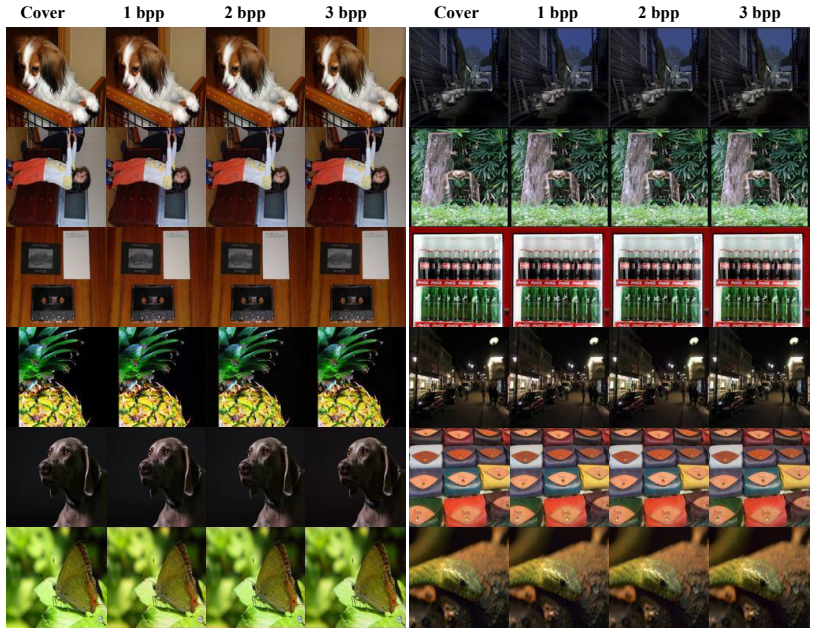
- [Figure 2] The caption contains the typo "ASKAKS2" for ALASKA2.
- [§4.2] The text states that max_iter is 120, but later says the first training stage takes 15-30 epochs to reach the knee point. Please clarify whether 120 refers to epochs or to iterations, and how "epoch" and "iteration" are used in the protocol.
- [Throughout] Grammatical issues such as "an knee point" and the long, repetitive introduction should be corrected; these do not affect the technical content but reduce readability.
Circularity Check
No significant circularity: STCL is an empirical curriculum-learning heuristic whose reported gains are not forced by construction.
full rationale
The paper's load-bearing element is a teacher-model consistency difficulty score (Eqs. 2-4) plus a knee-point scheduling rule. Nothing in the derivation reduces the claimed outcome to the inputs. The difficulty labels are produced by separately trained teacher models with the same architecture and loss, but they are not defined in terms of the final student's test performance, and the final SSIM/PSNR/accuracy/steganalysis numbers are measured on held-out test sets. The thresholds alpha1, alpha2, mu1, mu2 are hyperparameters, not fitted values renamed as predictions; Tables 1-9 compare whole training strategies rather than reporting a fitted quantity as a prediction. There are no load-bearing self-citations: the paper cites external curriculum-learning and steganography literature, and no uniqueness theorem or prior-work claim by the same authors is invoked to force the design. The metric alignment (difficulty computed from SSIM/PSNR, evaluation also SSIM/PSNR) raises a legitimate transfer-validity and overfitting-to-metric concern, and Table 6 even shows some 'hard' subsets with baseline PSNR above 'easy' subsets, but these are empirical weaknesses, not equation-level circularity. Under the stated standard of requiring a specific reduction by construction, no circular step can be exhibited; score 0.
Assumptions & free parameters
free parameters (3)
- Difficulty thresholds alpha1, alpha2, mu1, mu2 =
0.9, 0.8, 20, 12 (Section 4.2)
- Teacher model training lengths C1, C2, C3, CN =
not reported
- Knee point stopping criterion =
qualitative
assumptions (3)
- domain assumption Curriculum learning improves convergence and generalization for non-convex optimization (Bengio et al. 2009).
- ad hoc to paper Consistency of SSIM/PSNR across teacher models is a valid proxy for sample difficulty in steganography (Eq. 2-4).
- ad hoc to paper A knee point exists in each training stage and stopping there improves final performance.
Cite this review
Pith. "Pith review of STCL:Curriculum learning Strategies for deep learning image steganography models." pith.science (2026). https://pith.science/paper/ELLE264S
@misc{pith2026250417609,
  author       = {Pith},
  title        = {Pith review of: STCL:Curriculum learning Strategies for deep learning image steganography models},
  year         = {2026},
  howpublished = {\url{https://pith.science/paper/ELLE264S}},
  note         = {Machine review of arXiv:2504.17609}
}
read the original abstract
Aiming at the problems of poor quality of steganographic images and slow network convergence of image steganography models based on deep learning, this paper proposes a Steganography Curriculum Learning training strategy (STCL) for deep learning image steganography models. So that only easy images are selected for training when the model has poor fitting ability at the initial stage, and gradually expand to more difficult images, the strategy includes a difficulty evaluation strategy based on the teacher model and an knee point-based training scheduling strategy. Firstly, multiple teacher models are trained, and the consistency of the quality of steganographic images under multiple teacher models is used as the difficulty score to construct the training subsets from easy to difficult. Secondly, a training control strategy based on knee points is proposed to reduce the possibility of overfitting on small training sets and accelerate the training process. Experimental results on three large public datasets, ALASKA2, VOC2012 and ImageNet, show that the proposed image steganography scheme is able to improve the model performance under multiple algorithmic frameworks, which not only has a high PSNR, SSIM score, and decoding accuracy, but also the steganographic images generated by the model under the training of the STCL strategy have a low steganography analysis scores. You can find our code at \href{https://github.com/chaos-boops/STCL}{https://github.com/chaos-boops/STCL}.
Figures


Figures from the paper (6 more)



Reference graph
Works this paper leans on
-
[17]
Rosteals: Robust steganography using autoencoder latent space
Tu Bui, Shruti Agarwal, Ning Yu, and John Collomosse. Rosteals: Robust steganography using autoencoder latent space. In Proceedings of the IEEE/CVF conference on computer vision and pattern recognition, pages 933–942, 2023. 16
work page 2023
-
[32]
Curriculum learning for self-supervised speaker verification
Hee-Soo Heo, Jee-weon Jung, Jingu Kang, Youngki Kwon, You Jin Kim, and BJLJS Chung. Self-supervised curriculum learning for speaker verification. arXiv preprint arXiv:2203.14525, 2022
work page Pith review arXiv 2022
-
[1]
Mohamed Abdel Hameed, Omar A Abdel-Aleem, and M Hassaballah. A secure data hiding approach based on least-significant-bit and nature-inspired optimization techniques. Journal of Ambient Intelligence and Humanized Computing, 14(5):4639–4657, 2023
work page 2023
-
[2]
Alina Bavrina, Dmitry Karnaukhov, and Victor Fedoseev. Investigation of the effectiveness of the stochastic modulation method for steganographic embedding in thermal video data. In 2022 VIII International Conference on Information Technology and Nanotechnology (ITNT), pages 1–4. IEEE, 2022
work page 2022
-
[3]
Steganogan: High capacity image steganography with gans
Kevin Alex Zhang, Alfredo Cuesta-Infante, Lei Xu, and Kalyan Veeramachaneni. Steganogan: High capacity image steganography with gans. arXiv preprint arXiv:1901.03892, 2019
arXiv 1901
-
[4]
Invisible steganography via generative adversarial networks
Ru Zhang, Shiqi Dong, and Jianyi Liu. Invisible steganography via generative adversarial networks. Multimedia tools and applications, 78(7):8559–8575, 2019
2019
-
[5]
Generative adversarial networks
Ian Goodfellow, Jean Pouget-Abadie, Mehdi Mirza, Bing Xu, David Warde-Farley, Sherjil Ozair, Aaron Courville, and Yoshua Bengio. Generative adversarial networks. Communications of the ACM, 63(11):139–144, 2020
2020
-
[6]
Generating steganographic images via adversarial training
Jamie Hayes and George Danezis. Generating steganographic images via adversarial training. Advances in neural information processing systems, 30, 2017
2017
Show all 40 references
-
[7]
Sstegan: Self-learning steganography based on generative adversarial networks
Zihan Wang, Neng Gao, Xin Wang, Xuexin Qu, and Linghui Li. Sstegan: Self-learning steganography based on generative adversarial networks. In Neural Information Processing: 25th International Conference, ICONIP 2018, Siem Reap, Cambodia, December 13–16, 2018, Proceedings, Part ...
2018
-
[8]
Curriculum learning
Yoshua Bengio, Jérôme Louradour, Ronan Collobert, and Jason Weston. Curriculum learning. In Proceedings of the 26th annual international conference on machine learning, pages 41–48, 2009
2009
-
[9]
Generative adversarial networks for image steganogra- phy
Denis V olkhonskiy, Boris Borisenko, and Evgeny Burnaev. Generative adversarial networks for image steganogra- phy. 2016
2016
-
[10]
Ssgan: Secure steganography based on generative adversarial networks
Haichao Shi, Jing Dong, Wei Wang, Yinlong Qian, and Xiaoyu Zhang. Ssgan: Secure steganography based on generative adversarial networks. In Advances in Multimedia Information Processing–PCM 2017: 18th Pacific-Rim Conference on Multimedia, Harbin, China, September 28-29, 2017, R...
2017
-
[11]
Automatic steganographic distortion learning using a generative adversarial network
Weixuan Tang, Shunquan Tan, Bin Li, and Jiwu Huang. Automatic steganographic distortion learning using a generative adversarial network. IEEE Signal Processing Letters, 24(10):1547–1551, 2017
2017
-
[12]
Robust image steganography against lossy jpeg compression based on embedding domain selection and adaptive error correction
Xiaolong Duan, Bin Li, Zhaoxia Yin, Xinpeng Zhang, and Bin Luo. Robust image steganography against lossy jpeg compression based on embedding domain selection and adaptive error correction. Expert Systems with Applications, 229:120416, 2023
2023
-
[13]
Improving security for image steganography using content-adaptive adversarial perturbations
Jie Luo, Peisong He, Jiayong Liu, Hongxia Wang, Chunwang Wu, Chao Yuan, and Qiang Xia. Improving security for image steganography using content-adaptive adversarial perturbations. Applied Intelligence, 53(12):16059– 16076, 2023
2023
-
[14]
Reversible adversarial steganography for security enhancement
Jie Luo, Peisong He, Jiayong Liu, Hongxia Wang, Chunwang Wu, and Shenglie Zhou. Reversible adversarial steganography for security enhancement. Journal of Visual Communication and Image Representation, 97:103935, 2023
2023
-
[15]
Robust invertible image steganography
Youmin Xu, Chong Mou, Yujie Hu, Jingfen Xie, and Jian Zhang. Robust invertible image steganography. In Proceedings of the IEEE/CVF conference on computer vision and pattern recognition, pages 7875–7884, 2022
2022
-
[16]
Towards jpeg-resistant image forgery detection and localization via self-supervised domain adaptation
Yuan Rao, Jiangqun Ni, Weizhe Zhang, and Jiwu Huang. Towards jpeg-resistant image forgery detection and localization via self-supervised domain adaptation. IEEE Transactions on Pattern Analysis and Machine Intelligence, 2022
2022
-
[18]
Analysis of deep steganography robustness using various loss functions
Vamshi Chekatamala, P Malathi, and Gireesh Kumar. Analysis of deep steganography robustness using various loss functions. In 2022 6th International Conference on Intelligent Computing and Control Systems (ICICCS), pages 148–153. IEEE, 2022
2022
-
[19]
Large-capacity image steganography based on invertible neural networks
Shao-Ping Lu, Rong Wang, Tao Zhong, and Paul L Rosin. Large-capacity image steganography based on invertible neural networks. In Proceedings of the IEEE/CVF conference on computer vision and pattern recognition, pages 10816–10825, 2021
2021
-
[20]
Layerwise adversarial learning for image steganography
Bin Chen, Lei Shi, Zhiyi Cao, and Shaozhang Niu. Layerwise adversarial learning for image steganography. Electronics, 12(9):2080, 2023
2023
-
[21]
Pris: Practical robust invertible network for image steganography
Hang Yang, Yitian Xu, Xuhua Liu, and Xiaodong Ma. Pris: Practical robust invertible network for image steganography. Engineering Applications of Artificial Intelligence, 133:108419, 2024
2024
-
[22]
Enhancing the security of image steganography via multiple adversarial networks and channel attention modules
Bin Ma, Kun Li, Jian Xu, Chunpeng Wang, Jian Li, and Liwei Zhang. Enhancing the security of image steganography via multiple adversarial networks and channel attention modules. Digital Signal Processing, 141:104121, 2023
2023
-
[23]
Acgis: Adversarial cover generator for image steganography with noise residuals features-preserving
Junxue Yang and Xin Liao. Acgis: Adversarial cover generator for image steganography with noise residuals features-preserving. Signal Processing: Image Communication, 113:116927, 2023
2023
-
[24]
Learning specific-class segmentation from diverse data
M Pawan Kumar, Haithem Turki, Dan Preston, and Daphne Koller. Learning specific-class segmentation from diverse data. In 2011 International conference on computer vision, pages 1800–1807. IEEE, 2011
2011
-
[25]
Competence-based curriculum learning for neural machine translation
Emmanouil Antonios Platanios, Otilia Stretcu, Graham Neubig, Barnabas Poczos, and Tom M Mitchell. Competence-based curriculum learning for neural machine translation. arXiv preprint arXiv:1903.09848, 2019
1903 arXiv
-
[26]
Curriculum learning based on reward sparseness for deep reinforcement learning of task completion dialogue management
Atsushi Saito. Curriculum learning based on reward sparseness for deep reinforcement learning of task completion dialogue management. In Proceedings of the 2018 EMNLP workshop SCAI: The 2nd international workshop on search-oriented conversational AI, pages 46–51, 2018
2018
-
[27]
Diagnosing glaucoma on imbalanced data with self-ensemble dual-curriculum learning
Rongchang Zhao, Xuanlin Chen, Zailiang Chen, and Shuo Li. Diagnosing glaucoma on imbalanced data with self-ensemble dual-curriculum learning. Medical image analysis, 75:102295, 2022
2022
-
[28]
Visualizing and understanding curriculum learning for long short-term memory networks
V olkan Cirik, Eduard Hovy, and Louis-Philippe Morency. Visualizing and understanding curriculum learning for long short-term memory networks. arXiv preprint arXiv:1611.06204, 2016
2016 arXiv
-
[29]
Curriculum learning of multiple tasks
Anastasia Pentina, Viktoriia Sharmanska, and Christoph H Lampert. Curriculum learning of multiple tasks. In Proceedings of the IEEE conference on computer vision and pattern recognition, pages 5492–5500, 2015
2015
-
[30]
Dynamic curriculum learning for imbalanced data classification
Yiru Wang, Weihao Gan, Jie Yang, Wei Wu, and Junjie Yan. Dynamic curriculum learning for imbalanced data classification. In Proceedings of the IEEE/CVF international conference on computer vision, pages 5017–5026, 2019
2019
-
[31]
Self-paced learning with diversity
Lu Jiang, Deyu Meng, Shoou-I Yu, Zhenzhong Lan, Shiguang Shan, and Alexander G Hauptmann. Self-paced learning with diversity. Advances in neural information processing systems, 27, 2014
2014
-
[33]
Deep learning hierarchical representations for image steganalysis
Jian Ye, Jiangqun Ni, and Yang Yi. Deep learning hierarchical representations for image steganalysis. IEEE Transactions on Information Forensics and Security, 12(11):2545–2557, 2017
2017
-
[34]
Deep audio steganalysis in time domain
Daewon Lee, Tae-Woo Oh, and Kibom Kim. Deep audio steganalysis in time domain. In Proceedings of the 2020 ACM workshop on information hiding and multimedia security, pages 11–21, 2020
2020
-
[35]
Using curriculum learning to transmit images over the air
Pau Bernat Rodríguez. Using curriculum learning to transmit images over the air. B.S. thesis, Universitat Politècnica de Catalunya, 2022
2022
-
[36]
Assessment of steganalytic methods using multiple regression models
Rainer Böhme. Assessment of steganalytic methods using multiple regression models. In International Workshop on Information Hiding, pages 278–295. Springer, 2005
2005
-
[37]
A new methodology in steganalysis: breaking highly undetectable steganograpy (hugo)
Gokhan Gul and Fatih Kurugollu. A new methodology in steganalysis: breaking highly undetectable steganograpy (hugo). In International Workshop on Information Hiding, pages 71–84. Springer, 2011
2011
-
[38]
Novel cover selection criterion for spatial steganography using linear pixel prediction error
Wei Huang and Xianfeng Zhao. Novel cover selection criterion for spatial steganography using linear pixel prediction error. Science China. Information Sciences, 59(5):059103, 2016
2016
-
[39]
Curriculumnet: Weakly supervised learning from large-scale web images
Sheng Guo, Weilin Huang, Haozhi Zhang, Chenfan Zhuang, Dengke Dong, Matthew R Scott, and Dinglong Huang. Curriculumnet: Weakly supervised learning from large-scale web images. In Proceedings of the European conference on computer vision (ECCV), pages 135–150, 2018
2018
-
[40]
Structural design of convolutional neural networks for steganalysis
Guanshuo Xu, Han-Zhou Wu, and Yun-Qing Shi. Structural design of convolutional neural networks for steganalysis. IEEE Signal Processing Letters, 23(5):708–712, 2016. 17
2016
Reviewed August 16, 2026 · model on record in the stance chip above.
Discussion (0). Continue with ORCID to comment.