Optimizing Resource Allocation in a Distributed Quantum Computing Cloud: A Game-Theoretic Approach
Pith reviewed 2026-05-22 18:04 UTC · model grok-4.3
The pith
A game-theoretic model for partitioning quantum circuits across cloud nodes bounds total client cost at most 4/3 of the minimum possible cost.
A machine-rendered reading of the paper's core claim, the machinery that carries it, and where it could break.
Core claim
The QC-PRAGM model treats circuit partitioning as a game whose utility functions encode fixed additive penalties for remote gates and inter-node links; the equilibrium of this game yields allocations whose total client cost is at most 4/3 of the optimal cost, and the QC-PRAGM++ variant selects qubit groupings that maximize the number of local gates within each partition.
What carries the argument
The QC-PRAGM utility functions that add fixed remote-gate and communication penalties, allowing derivation of the 4/3 cost bound from the existence of a Nash equilibrium in the partitioning game.
If this is right
- In any equilibrium allocation produced by the game, aggregate client payments remain at most 4/3 of the lowest attainable cost.
- Quantum cloud providers obtain higher utilization because partitions are chosen to respect both client cost and hardware packing constraints.
- The number of remote gates and inter-node messages drops when QC-PRAGM++ is used instead of standard partitioning heuristics.
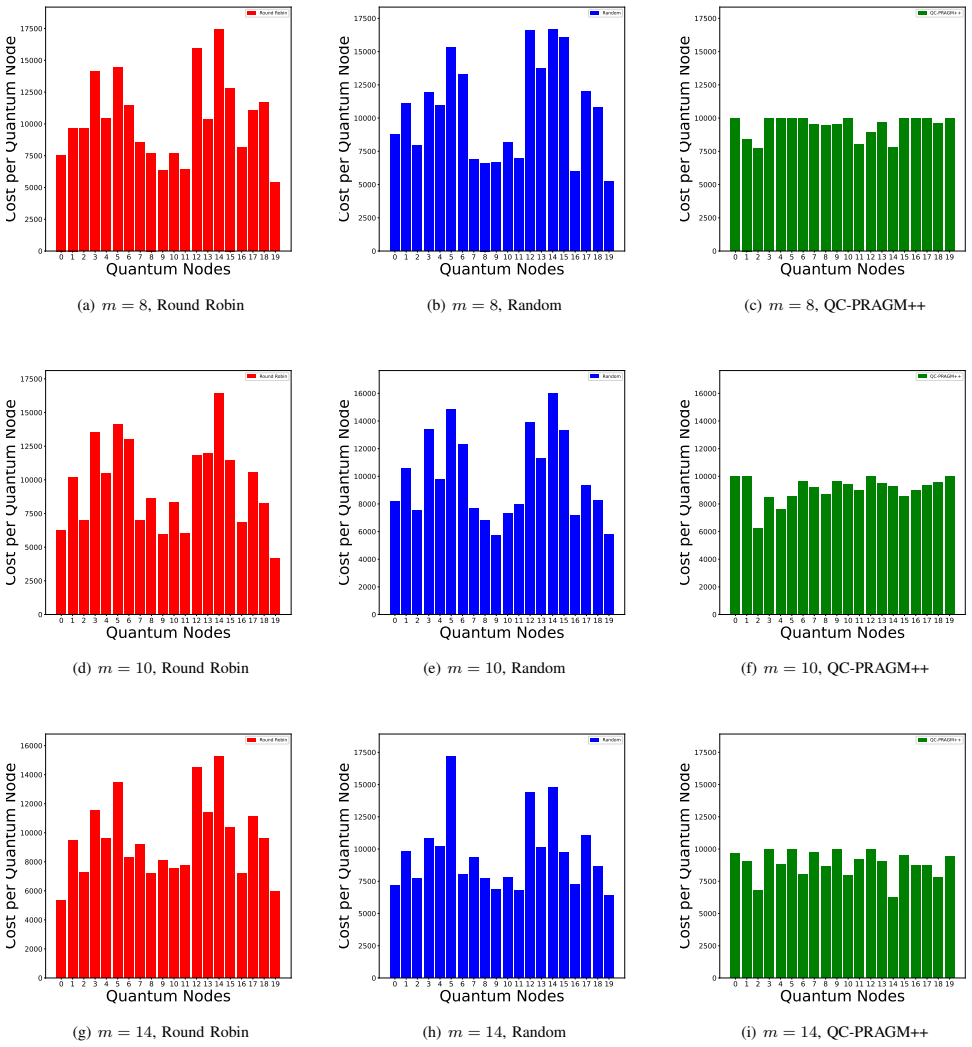
- Simulations show lower cost per node, lower maximum cost, and fewer partitions than traditional multi-objective schedulers.
Where Pith is reading between the lines
- The same fixed-penalty game could be applied to classical distributed systems where latency or data-transfer costs are roughly constant.
- If entanglement-generation costs turn out to vary strongly with hardware state, the 4/3 guarantee would need recalibration for each calibration epoch.
- Real deployment would allow direct measurement of whether the observed total cost stays inside the predicted bound on current quantum-cloud testbeds.
Load-bearing premise
The cost of every remote gate and every inter-node communication link can be expressed as a fixed additive penalty that does not change with the entanglement protocol or the current calibration state of the hardware.
What would settle it
Execute the QC-PRAGM allocation on a concrete multi-node circuit whose actual remote-gate costs are measured on hardware; if the resulting client total exceeds 4/3 of the minimum-cost schedule found by exhaustive search, the bound fails.
Figures



read the original abstract
Quantum cloud computing is essential for achieving quantum supremacy by utilizing multiple quantum computers connected via an entangling network to deliver high performance for practical applications that require extensive computational resources. With such a platform, various clients can execute their quantum jobs (quantum circuits) without needing to manage the quantum hardware and pay based on resource usage. Hence, defining optimal quantum resource allocation is necessary to avoid overcharging clients and to allow quantum cloud providers to maximize resource utilization. Prior work has mainly focused on minimizing communication delays between nodes using multi-objective techniques. Our approach involves analyzing the problem from a game theory perspective. We propose a quantum circuit partitioning resource allocation game model (QC-PRAGM) that minimizes client costs while maximizing resource utilization in quantum cloud environments. We extend QC-PRAGM to QC-PRAGM++ to maximize local gates in a partition by selecting the best combinations of qubits, thereby minimizing both cost and inter-node communication. We demonstrate analytically that clients are charged appropriately (with a total cost at most $\frac{4}{3}$ the optimal cost) while optimizing quantum cloud resources. Further, our simulations indicate that our solutions perform better than traditional ones in terms of the cost per quantum node, total cost, maximum cost, number of partitions, and number of remote gates.
Editorial analysis
A structured set of objections, weighed in public.
Referee Report
Summary. The paper proposes QC-PRAGM, a game-theoretic model for partitioning quantum circuits across distributed quantum nodes to minimize client costs while maximizing provider resource utilization. It extends the model to QC-PRAGM++ via a qubit-selection heuristic that prioritizes local gates. The central analytical claim is that the Nash equilibrium yields a total client cost at most 4/3 of the optimal cost; simulations are reported to outperform unspecified traditional baselines on cost-per-node, total cost, maximum cost, partition count, and remote-gate count.
Significance. A rigorously established 4/3 bound under the paper's modeling assumptions would supply a concrete, falsifiable guarantee for fair charging in quantum cloud platforms, which is a practically relevant contribution. The game-theoretic framing of client-provider incentives is a fresh angle relative to prior multi-objective optimization work. Credit is due for attempting an analytical approximation result alongside empirical evaluation, even if the bound's derivation steps and baseline details require strengthening.
major comments (2)
- [§3 and §4] §3 (QC-PRAGM utility functions) and §4 (4/3 bound derivation): the proof that the Nash equilibrium cost is at most (4/3)·OPT treats every remote gate and inter-node communication as a fixed additive constant penalty inside each player's utility. This modeling choice is load-bearing for the ratio; any fidelity- or protocol-dependent overhead would change best-response dynamics and could invalidate the guarantee. The manuscript should either derive the bound from first principles without the constant-penalty assumption or supply a sensitivity analysis showing robustness.
- [Simulation results section] Simulation results section: the reported improvements in cost per quantum node, total cost, and number of remote gates are presented without naming the baseline algorithms, the number of Monte-Carlo trials, or the statistical tests used to establish significance. This prevents verification that the gains are not artifacts of particular parameter choices or weak comparators.
minor comments (2)
- [Abstract] Abstract: the phrase 'traditional ones' for baseline methods is undefined; replace with a brief parenthetical naming the compared algorithms.
- [Notation] Notation: the symbols for local-gate weight, remote-gate penalty, and inter-node communication cost should be introduced once with a table and used consistently thereafter.
Simulated Author's Rebuttal
We thank the referee for the detailed and constructive review. We address each major comment below and indicate the revisions we will make to improve the manuscript.
read point-by-point responses
-
Referee: [§3 and §4] §3 (QC-PRAGM utility functions) and §4 (4/3 bound derivation): the proof that the Nash equilibrium cost is at most (4/3)·OPT treats every remote gate and inter-node communication as a fixed additive constant penalty inside each player's utility. This modeling choice is load-bearing for the ratio; any fidelity- or protocol-dependent overhead would change best-response dynamics and could invalidate the guarantee. The manuscript should either derive the bound from first principles without the constant-penalty assumption or supply a sensitivity analysis showing robustness.
Authors: We agree that the constant-penalty modeling of remote gates and inter-node communication in the utility functions of §3 is central to the derivation of the 4/3 bound in §4. This choice is intentional under the paper's assumptions to reflect fixed overheads in current distributed quantum cloud settings. We will revise the manuscript to add an explicit discussion of these modeling assumptions in §3 and include a sensitivity analysis that varies the penalty values to examine effects on best-response dynamics and the approximation ratio. revision: yes
-
Referee: [Simulation results section] Simulation results section: the reported improvements in cost per quantum node, total cost, and number of remote gates are presented without naming the baseline algorithms, the number of Monte-Carlo trials, or the statistical tests used to establish significance. This prevents verification that the gains are not artifacts of particular parameter choices or weak comparators.
Authors: We acknowledge that the simulation results section omits key details required for reproducibility. In the revised manuscript we will name the specific baseline algorithms, report the number of Monte-Carlo trials performed, and describe the statistical tests used to evaluate significance of the reported improvements. revision: yes
Circularity Check
No circularity: 4/3 bound is a derived property of the defined game model
full rationale
The paper defines the QC-PRAGM utility functions with explicit additive penalty terms for remote gates and inter-node communication, then derives the 4/3 total-cost bound as an analytical consequence of Nash equilibrium analysis within that model. This is a standard game-theoretic approximation result (price-of-anarchy style) that follows from the stated assumptions rather than reducing to a fitted parameter, self-citation, or tautological renaming. The derivation chain is self-contained: the bound is proven from the model's equations, not smuggled in via prior work or by re-labeling an input. No load-bearing step collapses to its own definition or to a self-citation chain. The modeling choice of constant penalties is an explicit assumption, not a hidden circularity.
Axiom & Free-Parameter Ledger
free parameters (1)
- relative cost weight between local and remote gates
axioms (1)
- domain assumption Communication cost between nodes is additive and independent of the specific entanglement protocol
Lean theorems connected to this paper
-
IndisputableMonolith/Cost/FunctionalEquation.leanwashburn_uniqueness_aczel unclear?
unclearRelation between the paper passage and the cited Recognition theorem.
If the cost function f_qk() is linear, then the total cost at the Nash equilibrium is at most 4/3 the optimal cost.
What do these tags mean?
- matches
- The paper's claim is directly supported by a theorem in the formal canon.
- supports
- The theorem supports part of the paper's argument, but the paper may add assumptions or extra steps.
- extends
- The paper goes beyond the formal theorem; the theorem is a base layer rather than the whole result.
- uses
- The paper appears to rely on the theorem as machinery.
- contradicts
- The paper's claim conflicts with a theorem or certificate in the canon.
- unclear
- Pith found a possible connection, but the passage is too broad, indirect, or ambiguous to say the theorem truly supports the claim.
Reference graph
Works this paper leans on
-
[1]
R. Buyya, C. S. Yeo, S. Venugopal, J. Broberg, and I. Brandic, “Cloud computing and emerging it platforms: Vision, hype, and reality for delivering computing as the 5th utility,”Future Gener. Comput. Syst., vol. 25, p. 599–616, June 2009
work page 2009
-
[2]
B. O. Sane, I. Niang, and D. Fall, “A review of virtualization, hypervisor and VM allocation security: Threats, vulnerabilities, and countermeasures,” inIEEEInternational Conference on Computational Science and Computational Intelligence (CSCI), pp. 1317–1322, 2018
work page 2018
-
[3]
The nist definition of cloud computing,
P. Mell, T. Grance,et al., “The nist definition of cloud computing,” Computer Security Division, Information Technology Laboratory, National Institute of Standards & Technology, Gaithersburg, MD, USA, 2011
work page 2011
-
[4]
Cloud based qc with amazon braket,
C. Gonzalez, “Cloud based qc with amazon braket,”Digitale Welt, vol. 5, pp. 14–17, Apr 2021
work page 2021
-
[5]
A quantum-classical cloud platform optimized for variational hybrid algorithms,
P. J. Karalekas, N. A. Tezak, E. C. Peterson, C. A. Ryan, M. P. Da Silva, and R. S. Smith, “A quantum-classical cloud platform optimized for variational hybrid algorithms,”Quantum Science and Technology, vol. 5, no. 2, p. 024003, 2020
work page 2020
-
[6]
Microsoft, “Azure quantum,” 2023. Accessed: 2025-01-20. Available at https://azure.microsoft.com/en-us/services/quantum
work page 2023
-
[7]
IBM quantum computing services,
IBM, “IBM quantum computing services,” 2023. Accessed: 2025-01-20. Available at https://quantum-computing.ibm.com/
work page 2023
-
[8]
Performing quantum computing experiments in the cloud,
S. J. Devitt, “Performing quantum computing experiments in the cloud,” Phys. Rev. A, vol. 94, p. 032329, Sep 2016
work page 2016
-
[9]
Qfaas: A serverless function- as-a-service framework for quantum computing,
H. T. Nguyen, M. Usman, and R. Buyya, “Qfaas: A serverless function- as-a-service framework for quantum computing,”Future Generation Computer Systems, vol. 154, pp. 281–300, 2024
work page 2024
-
[10]
Towards quantum-algorithms-as-a-service,
M. De Stefano, D. Di Nucci, F. Palomba, D. Taibi, and A. De Lucia, “Towards quantum-algorithms-as-a-service,” inProceedings of the 1st International Workshop on Quantum Programming for Software Engineering, QP4SE 2022, (New York, NY , USA), p. 7–10, Association for Computing Machinery, 2022
work page 2022
-
[11]
Engineering software systems for quantum computing as a service: A mapping study,
A. Ahmad, M. Waseem, P. Liang, M. Fehmideh, A. A. Khan, D. G. Reichelt, and T. Mikkonen, “Engineering software systems for quantum computing as a service: A mapping study,”arXiv preprint arXiv:2303.14713, 2023
-
[12]
A serverless cloud integration for quantum computing,
M. Grossi, L. Crippa, A. Aita, G. Bartoli, V . Sammarco, E. Picca, N. Said, F. Tramonto, and F. Mattei, “A serverless cloud integration for quantum computing,”arXiv preprint arXiv:2107.02007, 2021
-
[13]
Quantum cloud computing: a review, open problems, and future directions,
H. T. Nguyen, P. Krishnan, D. Krishnaswamy, M. Usman, and R. Buyya, “Quantum cloud computing: a review, open problems, and future directions,”arXiv preprint arXiv:2404.11420, 2024
-
[14]
Quantum chemistry in the age of quantum computing,
Y . Cao, J. Romero, J. P. Olson, M. Degroote, P. D. Johnson, M. Kieferov ´a, I. D. Kivlichan, T. Menke, B. Peropadre, N. P. Sawaya, et al., “Quantum chemistry in the age of quantum computing,”Chemical reviews, vol. 119, no. 19, pp. 10856–10915, 2019
work page 2019
-
[15]
The variational quantum eigensolver: a review of methods and best practices,
J. Tilly, H. Chen, S. Cao, D. Picozzi, K. Setia, Y . Li, E. Grant, L. Wossnig, I. Rungger, G. H. Booth,et al., “The variational quantum eigensolver: a review of methods and best practices,”Physics Reports, vol. 986, pp. 1–128, 2022
work page 2022
-
[16]
Variational quantum algorithms,
M. Cerezo, A. Arrasmith, R. Babbush, S. C. Benjamin, S. Endo, K. Fujii, J. R. McClean, K. Mitarai, X. Yuan, L. Cincio,et al., “Variational quantum algorithms,”Nature Reviews Physics, vol. 3, no. 9, pp. 625– 644, 2021
work page 2021
-
[17]
Quantum computational chemistry,
S. McArdle, S. Endo, A. Aspuru-Guzik, S. C. Benjamin, and X. Yuan, “Quantum computational chemistry,”Reviews of Modern Physics, vol. 92, no. 1, p. 015003, 2020
work page 2020
-
[18]
An adaptive variational algorithm for exact molecular simulations on a quantum computer,
H. R. Grimsley, S. E. Economou, E. Barnes, and N. J. Mayhall, “An adaptive variational algorithm for exact molecular simulations on a quantum computer,”Nature communications, vol. 10, no. 1, p. 3007, 2019
work page 2019
-
[19]
Scalable quantum simulation of molecular energies,
P. J. J. O’Malley, R. Babbush, I. D. Kivlichan, J. Romero, J. R. McClean, R. Barends, J. Kelly, P. Roushan, A. Tranter, N. Ding, B. Campbell, Y . Chen, Z. Chen, B. Chiaro, A. Dunsworth, A. G. Fowler, E. Jeffrey, E. Lucero, A. Megrant, J. Y . Mutus, M. Neeley, C. Neill, C. Quintana, D. Sank, A. Vainsencher, J. Wenner, T. C. White, P. V . Coveney, P. J. Lov...
work page 2016
-
[20]
Fast quantum modular exponentiation,
R. Van Meter and K. M. Itoh, “Fast quantum modular exponentiation,” Physical Review A, vol. 71, p. 052320, May 2005
work page 2005
-
[21]
How to factor 2048 bit RSA integers in 8 hours using 20 million noisy qubits,
C. Gidney and M. Eker ˚a, “How to factor 2048 bit RSA integers in 8 hours using 20 million noisy qubits,”Quantum, vol. 5, p. 433, Apr. 2021
work page 2048
-
[22]
Estimating the cost of generic quantum pre-image attacks on SHA-2 and SHA-3,
M. Amy, O. Di Matteo, V . Gheorghiu, M. Mosca, A. Parent, and J. Schanck, “Estimating the cost of generic quantum pre-image attacks on SHA-2 and SHA-3,” inSelected Areas in Cryptography – SAC 2016(R. Avanzi and H. Heys, eds.), (Cham), pp. 317–337, Springer International Publishing, 2017
work page 2016
-
[23]
Y . Li, Y . Fei, W. Wang, X. Meng, H. Wang, Q. Duan, and Z. Ma, “Quantum random number generator using a cloud superconducting quantum computer based on source-independent protocol,”Scientific Reports, vol. 11, no. 1, p. 23873, 2021
work page 2021
-
[24]
A case for multi- programming quantum computers,
P. Das, S. S. Tannu, P. J. Nair, and M. Qureshi, “A case for multi- programming quantum computers,” inProceedings of the 52nd Annual IEEE/ACM International Symposium on Microarchitecture, MICRO ’52, (New York, NY , USA), p. 291–303, Association for Computing Machinery, 2019
work page 2019
-
[25]
Simultaneous execution of quantum circuits on current and near-future NISQ systems,
Y . Ohkura, T. Satoh, and R. Van Meter, “Simultaneous execution of quantum circuits on current and near-future NISQ systems,”IEEE Transactions on Quantum Engineering, vol. 3, pp. 1–10, 2022
work page 2022
-
[26]
System design for large-scale ion trap quantum information processor,
J. Kimet al., “System design for large-scale ion trap quantum information processor,”Quantum Information and Computation, vol. 5, no. 7, pp. 515–537, 2005
work page 2005
-
[27]
R. D. Van Meter III,Architecture of a Quantum Multicomputer Optimized for Shor’s Factoring Algorithm. PhD thesis, Keio University,
-
[28]
available as arXiv:quant-ph/0607065
work page internal anchor Pith review Pith/arXiv arXiv
-
[29]
Arquin: Architectures for multinode superconducting quantum computers,
J. Ang, G. Carini, Y . Chen, I. Chuang, M. DeMarco, S. Economou, A. Eickbusch, A. Faraon, K.-M. Fu, S. Girvin, M. Hatridge, A. Houck, P. Hilaire, K. Krsulich, A. Li, C. Liu, Y . Liu, M. Martonosi, D. McKay, J. Misewich, M. Ritter, R. Schoelkopf, S. Stein, S. Sussman, H. Tang, W. Tang, t. tomesh, N. Tubman, C. Wang, N. Wiebe, Y . Yao, D. Yost, and Y . Zhou...
work page 2024
-
[30]
Review of distributed quantum computing: From single qpu to high performance quantum computing,
D. Barral, F. J. Cardama, G. D ´ıaz-Camacho, D. Fa ´ılde, I. F. Llovo, M. Mussa-Juane, J. V ´azquez-P´erez, J. Villasuso, C. Pi ˜neiro, N. Costas, J. C. Pichel, T. F. Pena, and A. G ´omez, “Review of distributed quantum computing: From single qpu to high performance quantum computing,” Computer Science Review, vol. 57, p. 100747, 2025
work page 2025
-
[31]
Optimal local implementation of nonlocal quantum gates,
J. Eisert, K. Jacobs, P. Papadopoulos, and M. Plenio, “Optimal local implementation of nonlocal quantum gates,”Physical Review A, vol. 62, no. 5, p. 52317, 2000
work page 2000
-
[32]
Distributed quantum computing across an optical network link,
D. Main, P. Drmota, D. Nadlinger, E. Ainley, A. Agrawal, B. Nichol, R. Srinivas, G. Araneda, and D. Lucas, “Distributed quantum computing across an optical network link,”Nature, pp. 1–6, 2025
work page 2025
-
[33]
An optical interconnect for modular quantum computers,
D. Sakuma, A. Taherkhani, T. Tsuno, T. Sasaki, H. Shimizu, K. Teramoto, A. Todd, Y . Ueno, M. Hajduˇsek, R. Ikuta, R. V . Meter, and S. Nagayama, “An optical interconnect for modular quantum computers,” arXiv preprint arXiv:2412.09299, 2024
-
[34]
Cost-efficient dragonfly topology for large-scale systems,
J. Kim, W. Dally, S. Scott, and D. Abts, “Cost-efficient dragonfly topology for large-scale systems,”IEEE micro, vol. 29, no. 1, pp. 33–40, 2009
work page 2009
-
[35]
A parallel workload model and its implications for processor allocation,
A. Downey, “A parallel workload model and its implications for processor allocation,” inProceedings. The Sixth IEEE International Symposium on High Performance Distributed Computing (Cat. No.97TB100183), pp. 112–123, 1997
work page 1997
-
[36]
Cloud resource allocation games,
V . Jalaparti and G. D. Nguyen, “Cloud resource allocation games,” Technical Report, 03 2019. https://www.ideals.illinois.edu/items/17505
work page 2019
-
[37]
Resource Management and Circuit Scheduling for Distributed Quantum Computing Interconnect Networks
S. Bahrani, R. D. Oliveira, J. M. Parra-Ullauri, R. Wang, and D. Simeonidou, “Resource management and circuit scheduling for distributed quantum computing interconnect networks,”arXiv preprint arXiv:2409.12675, 2024
work page internal anchor Pith review Pith/arXiv arXiv 2024
-
[38]
Virtual machine allocation policies against co-resident attacks in cloud computing,
Y . Han, J. Chan, T. Alpcan, and C. Leckie, “Virtual machine allocation policies against co-resident attacks in cloud computing,” in2014 IEEE International Conference on Communications (ICC), pp. 786–792, IEEE, 2014
work page 2014
-
[39]
T. Bas ¸ar and G. J. Olsder,Dynamic noncooperative game theory. Society for Industrial and Applied Mathematics (SIAM), 1998
work page 1998
-
[40]
M. Maschler, S. Zamir, and E. Solan,Game theory. Cambridge University Press, 2020
work page 2020
-
[41]
A threshold-based dynamic resource allocation scheme for cloud computing,
W. Lin, J. Z. Wang, C. Liang, and D. Qi, “A threshold-based dynamic resource allocation scheme for cloud computing,”Procedia Engineering, vol. 23, pp. 695 – 703, 2011. PEEA 2011
work page 2011
-
[42]
D. M. Kreps,Game theory and economic modelling. Oxford University Press, 1990
work page 1990
-
[43]
Using virtual machine allocation policies to defend against co-resident attacks in cloud computing,
Y . Han, J. Chan, T. Alpcan, and C. Leckie, “Using virtual machine allocation policies to defend against co-resident attacks in cloud computing,”IEEE Transactions on Dependable and Secure Computing, vol. 14, pp. 95–108, Jan 2017
work page 2017
-
[44]
H. Zhao and W. Chenyu, “A dynamic dispatching method of resource based on particle swarm optimization for cloud computing environment,” in2013 10th Web Information System and Application Conference, pp. 351–354, IEEE, 2013
work page 2013
-
[45]
B. O. San ´e, M. Ba, D. Fall, Y . Taenaka, I. Niang, and Y . Kadobayashi, “Interdependency attack-aware secure and performant virtual machine allocation policies with low attack efficiency and coverage,”IEEE Access, vol. 12, pp. 74944–74960, 2024
work page 2024
-
[46]
Interdependent security: The case of identical agents,
H. Kunreuther and H. Kunreuther, “Interdependent security: The case of identical agents,”Journal of Risk and Uncertainty, vol. 26, p. 2003, 2002
work page 2003
-
[47]
A survey of game theoretic solutions for cloud computing security issues,
B. O. Sane, C. S. M. Babou, D. Fall, and I. Niang, “A survey of game theoretic solutions for cloud computing security issues,” in SpringerInnovations and Interdisciplinary Solutions for Underserved Areas(G. Bassioni, C. M. Kebe, A. Gueye, and A. Ndiaye, eds.), (Cham), pp. 1–12, Springer International Publishing, 2019
work page 2019
-
[48]
B. O. San ´e, M. Ba, D. Fall, S. Kashihara, Y . Taenaka, I. Niang, and Y . Kadobayashi, “Solving the interdependency problem: A secure virtual machine allocation method relying on the attacker’s efficiency and coverage,” in20thIEEE/ACMInternational Symposium on Cluster, Cloud and Internet Computing, CCGRID 2020, Melbourne, Australia, May 11-14, 2020, pp. ...
work page 2020
-
[49]
Designing quantum repeater networks,
R. Van Meter and J. Touch, “Designing quantum repeater networks,” IEEE Communications Magazine, vol. 51, no. 8, pp. 64–71, 2013
work page 2013
-
[50]
T. Roughgarden and E. Tardos, “How bad is selfish routing?,”J. ACM, vol. 49, p. 236–259, Mar. 2002
work page 2002
-
[51]
Convex optimization with sparsity-inducing norms,
F. Bach, R. Jenatton, J. Mairal, G. Obozinski,et al., “Convex optimization with sparsity-inducing norms,”Optimization for machine learning, vol. 5, no. 19-53, p. 8, 2011
work page 2011
-
[52]
CVXPY: A Python-embedded modeling language for convex optimization,
S. Diamond and S. Boyd, “CVXPY: A Python-embedded modeling language for convex optimization,”Journal of Machine Learning Research, vol. 17, no. 83, pp. 1–5, 2016
work page 2016
-
[53]
A rewriting system for convex optimization problems,
A. Agrawal, R. Verschueren, S. Diamond, and S. Boyd, “A rewriting system for convex optimization problems,”Journal of Control and Decision, vol. 5, no. 1, pp. 42–60, 2018
work page 2018
-
[54]
An efficient heuristic procedure for partitioning graphs,
B. W. Kernighan and S. Lin, “An efficient heuristic procedure for partitioning graphs,”The Bell System Technical Journal, vol. 49, no. 2, pp. 291–307, 1970
work page 1970
-
[55]
The MQT handbook: A summary of design automation tools and software for quantum computing,
R. Wille, L. Berent, T. Forster, J. Kunasaikaran, K. Mato, T. Peham, N. Quetschlich, D. Rovara, A. Sander, L. Schmid, D. Schoenberger, Y . Stade, and L. Burgholzer, “The MQT handbook: A summary of design automation tools and software for quantum computing,” inIEEE International Conference on Quantum Software (QSW)
-
[56]
Exploring network structure, dynamics, and function using NETWORKX,
A. A. Hagberg, D. A. Schult, and P. J. Swart, “Exploring network structure, dynamics, and function using NETWORKX,” inProceedings of the 7th Python in Science Conference(G. Varoquaux, T. Vaught, and J. Millman, eds.), (Pasadena, CA USA), pp. 11 – 15, 2008
work page 2008
discussion (0)
Sign in with ORCID, Apple, or X to comment. Anyone can read and Pith papers without signing in.