REVIEW 4 major objections 6 minor 78 references
Hierarchical Attention Generates Better Proofs
T0 review · 4 major / 6 minor · reviewed 2026-08-16 · deepseek-v4-flash
Pith's one-line read The paper argues that a soft five-level attention regularizer makes a theorem-proving language model both more successful and more concise on formal benchmarks.
desk verdict A transparently specified attention-flow regularizer with modest but consistent benchmark gains, whose central hierarchy claim is undermined by an unvalidated parser and per-split hyperparameter selection. read the letter →
The pith
A machine-rendered reading of the paper's core claim, the machinery that carries it, and where it could break.
The reading
What carries the argument
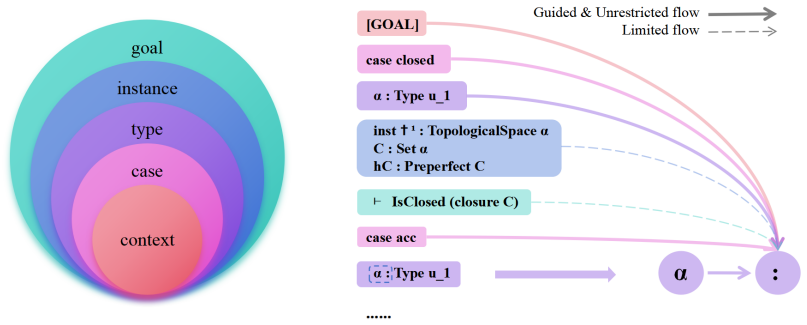
The central object is the hierarchical flow loss, a regularization term added to the standard next-token cross-entropy loss during fine-tuning. It is driven by a hand-written parser that labels each token with one of five levels, context, case, type, instance, goal, and a binary mask $M_{ij}$ that permits attention only from a token to tokens at the same or lower level. The layer-dependent factor $\alpha_l = 1 - l/L$ applies strong regularization in early transformer layers and relaxes it in later layers, which the paper argues preserves flexibility for complex proof steps. The loss is what carries the argument: it is the only mechanism through which the hierarchy enters training, and the paper's attention analyses trace its effects through constrained and unconstrained layers.
What would settle it
One decisive check is to repeat the fine-tuning with the same loss and the same data but random or adversarially shuffled level assignments; if pass@64 and proof-length reductions persist under random labels, the five-level hierarchy is not what is doing the work. A second check is to audit the parser: on proofs where the level-assignment algorithm mislabels a line, such as calling a goal-context line a 'type' line, the paper's account predicts those proofs should be where the method helps least or fails.
Extended reading notes
Core claim
The paper's central claim is that alignment between attention and mathematical proof structure is itself a learnable target: a model fine-tuned with a flow loss that suppresses attention from 'higher' to 'lower' hierarchical components will both solve more theorems and solve them more directly. The hierarchy orders tokens as $\text{context} \prec \text{case} \prec \text{type} \prec \text{instance} \prec \text{goal}$, and the loss is $L_{\text{flow}} = \frac{1}{|T|} \sum_{l=1}^{L} \alpha_l \sum_{i,j} \operatorname{ReLU}(\operatorname{att}_l(t_i,t_j)\,(1 - M_{ij}))$, with $\alpha_l = 1 - l/L$ and $M_{ij}=1$ exactly when $\operatorname{level}(t_i) \le \operatorname{level}(t_j)$. The paper shows the constrained attention pattern persists in later layers where the penalty is zero, and reports that explicit level tags in the input hurt while the soft attention guidance helps.
Load-bearing premise
The whole result rests on the hand-written rule that assigns each token to one of five levels, ordered from context up to goal; if those assignments do not match the real logical structure of Lean proofs, the regularizer is enforcing an arbitrary pattern and the benchmark gains would not show that hierarchical reasoning is the cause.
Editorial extensions
If this is right
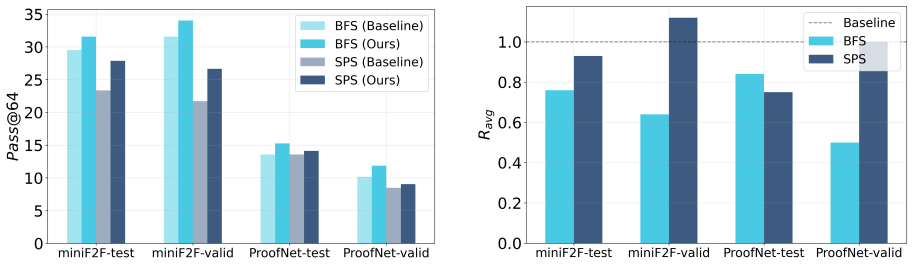
- Under best-first search with a budget of 64, the method raises pass@64 on miniF2F test from 29.51% to 31.56% and on ProofNet test from 13.56% to 15.25%.
- Successful proofs become more concise: the average complexity ratio falls to 0.76 on miniF2F test and 0.84 on ProofNet test, corresponding to the reported 23.81% and 16.50% reductions.
- Under single-pass sampling, the method raises miniF2F test pass@64 from 23.36% to 27.87% and validation from 21.72% to 26.64%, a larger relative gain than under search.
- The ablation without layer-wise adaptation still beats the baseline on every benchmark, so the five-level structure itself, not the adaptive schedule, is the core contributor.
- Explicitly tagging tokens with their levels in the input hurts performance, suggesting the benefit comes from shaping attention rather than from giving the model structural labels it can read.
Reading between the lines
- If the hierarchy is what causes the gains, the method should transfer to other tactic-based proof assistants whose syntax admits the same level ordering; the paper notes Lean-specific parsing as a limitation, so Coq or Isabelle would be a natural test.
- A random-label ablation would separate the hierarchy's content from the mere effect of extra regularization: if shuffled level labels keep the gains, the specific five-level ordering is not the active ingredient.
- Shortening successful proofs by roughly a quarter could reduce the cost of proof search in practice, since fewer steps per trajectory means less branching and fewer expansions under the same budget.
- The contrast with explicit level tags suggests a general design principle for structured domains: encode structure as a soft constraint during training rather than as a hard annotation in the input.
Signed reviews
Editorial analysis
A structured set of objections, weighed in public.
Referee Report
Summary. The paper proposes a regularization method for LLM-based Lean theorem proving. It defines a five-level hierarchy (context < case < type < instance < goal) over the tokens of a proof state, assigns levels with a hand-written rule-based parser (Algorithm 2), and adds to the standard cross-entropy loss a flow loss (Eq. 2) that penalizes attention from tokens of higher assigned levels to tokens of lower assigned levels, with layer-wise strength alpha_l = 1 - l/L. The authors fine-tune Pythia-2.8B on LeanDojo Benchmark 4 and evaluate pass@K and proof complexity on miniF2F and ProofNet under best-first search and single-pass sampling. They report consistent pass-rate gains at K=64 (e.g., 29.51% to 31.56% on miniF2F test) and reduced proof complexity (R_avg as low as 0.50 on ProofNet validation), along with ablations on layer-wise adaptation, granularity of the hierarchy, and an explicit-tags baseline.
Significance. The proposed regularizer is simple, model-agnostic, and could in principle be applied to any transformer-based formal prover; if the empirical claims survive scrutiny, the paper would make a useful contribution to the structural-reasoning literature. The manuscript is also transparent about training details, uses external benchmarks (miniF2F, ProofNet) rather than constructing a circular evaluation, and releases code. However, the central evidence is currently weakened by (i) per-benchmark selection of training hyperparameters, (ii) an unvalidated parser that is load-bearing for the method, (iii) an attention analysis that is partially circular, and (iv) proof-complexity statistics computed over a small and unquantified subset of proofs. The pass-rate gains are modest (1-2 percentage points at K=64) and are reported from a single seed without error bars. For these reasons the contribution is plausible but not yet established.
major comments (4)
- [§5.1, Appendix A.1, Table 9] The hyperparameters λ and L reported in Table 9 are chosen separately for each of the four evaluation splits (miniF2F test, miniF2F valid, ProofNet test, ProofNet valid). Because λ and L are training hyperparameters, this means the reported pass-rate and complexity numbers are not produced by a single model or a single configuration; they are the result of per-benchmark post-hoc selection on the test sets. This is a load-bearing issue for the main claim, since the headline gains (2.05 and 1.69 percentage points) could in principle be an artifact of selecting the best configuration for each benchmark. The paper should either select λ and L once on a validation set (and report the resulting test numbers), or run a proper nested selection procedure and report the variance across configurations. Please also state explicitly whether the BFS and SPS results for a given row in Table 9 come from the same trained model.
- [§4.1, Algorithm 2] The entire hierarchy is mediated by the hand-written parser in Algorithm 2, yet the parser is never validated against any ground-truth structural annotation. The line-based rules (a line is 'goal' if it contains ⊢, 'case' if it starts with 'case', 'type' if it contains 'Type' and ':', 'instance' if it contains ':' but not 'Type' or ⊢, otherwise inherit the previous level) cannot correctly capture the nested structure of Lean 4 proofs, which contain `have`, `let`, `calc`, `match`, `fun` binders, and nested tactic blocks. Since Eq. (2) penalizes every pair with level(t_i) > level(t_j), any misassignment is not a harmless approximation but an arbitrary constraint on the attention pattern. The paper should (i) evaluate parser accuracy on a sample of annotated Lean states, (ii) report the distribution of assigned levels and failure modes, and (iii) include a control experiment with randomly permuted levels to show that the specific hierarchy, rather than any level-based regularizer, is responsible for the gains.
- [§5.3, Figure 3] The attention analysis does not support the claim that the model has 'internalized' the hierarchy. In constrained layers (α_l ≠ 0), the near-zero invalid flows are a direct consequence of Eq. (2), since the loss explicitly penalizes those flows during training; observing them after training is therefore circular. The only unconstrained layer is the final layer, because α_l = 1 - l/L, so the right panel of Figure 3 reports a single layer, and the preservation of the pattern there could be a boundary effect rather than evidence of internalization. The paper should report per-layer attention statistics for all layers and compare against a control model trained with the same loss but with random or inverted level assignments; this is the minimal experiment that would isolate the effect of the hierarchy.
- [§5.2, Eq. (5)] The complexity metric is computed only over the subset of theorems for which both methods succeed with different proof lengths, which the table reports as 'Diff.' Rows like 8.11% (miniF2F test, K=64, BFS) mean that the claimed complexity reduction rests on a small, unquantified set of proofs; with a test set of about 244 problems, this could be on the order of a handful of examples. Moreover, the text states that 'the average proof length' drops from 2.10 to 1.60, which conflates the restricted subset with all common successes. Please report the number of proofs in T_com, the distribution of length differences, the mean and median complexity over all common successes (not only those with different lengths), and a confidence interval or significance test for the reduction.
minor comments (6)
- [§3.2, Algorithm 1] The definition of attention direction is ambiguous. The paper says att_l(t_i,t_j) is 'attention score from t_i to t_j' and then 'how much t_i will affect embedding of t_j', while the bullets in §1 say 'Tokens at higher levels can access information from the same level or lower levels'. The mask in Algorithm 1 allows pairs with level(t_i) ≤ level(t_j), which is a lower-to-higher flow. Please clarify which of the two tokens is the query and which is the key, and align the verbal description with the implementation.
- [Table 9, §5.1] Please state whether each row of Table 9 corresponds to a separately trained model and whether the same checkpoints were used for the best-first-search and single-pass-sampling evaluations; otherwise the reader cannot tell how many models the comparisons involve.
- [Eq. (5) and surrounding text] The definition of T_com is inconsistent: 'successfully proved by both methods with different proof lengths' appears before Eq. (4), while Eq. (5) uses T_com without restating the restriction. Please define it in one place and use a distinct symbol for the full set of common successes.
- [Related Work] There is a placeholder '?' citation near 'Liu et al., 2023', and the reference to Kovács and Voronkov contains a stray space ('V oronkov'). Please fix these.
- [Figure 3] The y-axis is said to combine attention percentages for tokens serving as source and target; this makes the 'invalid flow' percentages hard to interpret. Please plot source and target roles separately or explain the aggregation.
- [Appendix A.2] The definitions of N, S, and K are stated twice with different wording ('within N expansions' vs 'within K = N×S'), which is confusing; also for single-pass sampling, K=N since S=1. Please standardize the notation.
Circularity Check
Benchmark gains are externally grounded, but the Section 5.3 attention analysis partly reports the training loss itself as evidence; overall circularity is low.
-
fitted input called prediction
[Section 5.3.1, Figure 3 (constrained-layer analysis; Eq. 2)]
"In constrained layers (Figure 3, left), this is evidenced by the near-zero percentages of level(ti) > level(tj) attention across all hierarchical levels, compared to the baseline's substantial invalid flows ranging from 5.5% to 27.8%."
The quantity offered as evidence—attention with level(ti) > level(tj)—is exactly the term minimized by the flow loss. Eq. (2) defines L_flow = (1/|T|) Σ_l α_l Σ_{i,j} ReLU(att_l(t_i,t_j)·(1−M_ij)), and Algorithm 1 sets M_ij = 0 whenever level(t_i) > level(t_j). In constrained layers α_l > 0, near-zero invalid flow is the training objective itself, not independent confirmation that the model internalized a hierarchy. The only non-circular portion is the persistence of low invalid flow in unconstrained layers where α_l = 0, which is secondary and still depends on the unvalidated Algorithm 2 level assignment.
full rationale
The paper's central empirical claims—2.05% pass-rate gain on miniF2F and 1.69% on ProofNet—are evaluated on external benchmarks against an LLMSTEP baseline, so they do not reduce to the method's own definitions. There are no load-bearing self-citations and no imported uniqueness theorem. The one genuinely circular element is in Section 5.3.1: the 'invalid flow' statistics in constrained layers are the direct argument of Eq. (2)'s loss, so observing that they are near zero after training is a check of the optimization objective, not evidence of learned structure. The unconstrained-layer observation is non-circular but is presented as corroboration rather than as the primary evidence. The hand-written parser (Algorithm 2) is never validated against ground-truth hierarchical structure; this is a correctness risk for the causal interpretation, but it is not by itself circularity. Overall, the benchmark derivation is self-contained, so a low score is appropriate.
Assumptions & free parameters
free parameters (3)
- lambda flow-loss weight =
0.1 for miniF2F, 0.2 for ProofNet
- L number of constrained transformer layers =
4 or 16 depending on the split
- alpha_l layer-wise adaptation schedule =
1 - l/L fixed schedule
assumptions (4)
- domain assumption Lean proof states conform to the five-level hierarchy context < case < type < instance < goal, with tokens separable by the rules of Algorithm 2.
- domain assumption Restricting high-to-low attention while allowing low-to-high and same-level attention improves proof generation.
- domain assumption Attention magnitudes in transformer layers are a meaningful target for enforcing semantic information flow.
- ad hoc to paper Layer-wise decay alpha_l = 1 - l/L yields a better accuracy-complexity trade-off than uniform constraints.
Cite this review
Pith. "Pith review of Hierarchical Attention Generates Better Proofs." pith.science (2026). https://pith.science/paper/H2ECJQ75
@misc{pith2026250419188,
  author       = {Pith},
  title        = {Pith review of: Hierarchical Attention Generates Better Proofs},
  year         = {2026},
  howpublished = {\url{https://pith.science/paper/H2ECJQ75}},
  note         = {Machine review of arXiv:2504.19188}
}
read the original abstract
Large language models (LLMs) have shown promise in formal theorem proving, but their token-level processing often fails to capture the inherent hierarchical nature of mathematical proofs. We introduce \textbf{Hierarchical Attention}, a regularization method that aligns LLMs' attention mechanisms with mathematical reasoning structures. Our approach establishes a five-level hierarchy from foundational elements to high-level concepts, ensuring structured information flow in proof generation. Experiments demonstrate that our method improves proof success rates by 2.05\% on miniF2F and 1.69\% on ProofNet while reducing proof complexity by 23.81\% and 16.50\% respectively. The code is available at https://github.com/Car-pe/HAGBP.
Figures

Reference graph
Works this paper leans on
-
[1]
Ibrahim Abdelaziz, Maxwell Crouse, Bassem Makni, Vernon Austel, Cristina Cornelio, Shajith Ikbal, Pavan Kapanipathi, Ndivhuwo Makondo, Kavitha Srinivas, Michael Witbrock, et al. 2022. Learning to guide a saturation-based theorem prover. IEEE Transactions on Pattern Analysis and Machine Intelligence, 45(1):738--751
work page 2022
-
[2]
Eser Ayg \"u n, Zafarali Ahmed, Ankit Anand, Vlad Firoiu, Xavier Glorot, Laurent Orseau, Doina Precup, and Shibl Mourad. 2020. Learning to prove from synthetic theorems. arXiv preprint arXiv:2006.11259
work page Pith review arXiv 2020
-
[3]
Eser Ayg \"u n, Ankit Anand, Laurent Orseau, Xavier Glorot, Stephen M Mcaleer, Vlad Firoiu, Lei M Zhang, Doina Precup, and Shibl Mourad. 2022. Proving theorems using incremental learning and hindsight experience replay. In International Conference on Machine Learning, pages 1198--1210. PMLR
work page 2022
-
[4]
Zhangir Azerbayev, Bartosz Piotrowski, Hailey Schoelkopf, Edward W Ayers, Dragomir Radev, and Jeremy Avigad. 2023. Proofnet: Autoformalizing and formally proving undergraduate-level mathematics. arXiv preprint arXiv:2302.12433
arXiv 2023
-
[5]
Andrej Bauer, Matej Petkovi \'c , and Ljupco Todorovski. 2024. Mlfmf: data sets for machine learning for mathematical formalization. Advances in Neural Information Processing Systems, 36
work page 2024
-
[6]
Stella Biderman, Hailey Schoelkopf, Quentin Gregory Anthony, Herbie Bradley, Kyle O’Brien, Eric Hallahan, Mohammad Aflah Khan, Shivanshu Purohit, USVSN Sai Prashanth, Edward Raff, et al. 2023. Pythia: A suite for analyzing large language models across training and scaling. In International Conference on Machine Learning, pages 2397--2430. PMLR
2023
-
[7]
Shang-Ching Chou, Xiao-Shan Gao, and Jing-Zhong Zhang. 2000. A deductive database approach to automated geometry theorem proving and discovering. Journal of Automated Reasoning, 25(3):219--246
2000
-
[8]
Karel Chvalovsk \`y , Konstantin Korovin, Jelle Piepenbrock, and Josef Urban. 2023. Guiding an instantiation prover with graph neural networks. In LPAR, pages 112--123
work page 2023
Show all 78 references
-
[9]
Maxwell Crouse, Ibrahim Abdelaziz, Bassem Makni, Spencer Whitehead, Cristina Cornelio, Pavan Kapanipathi, Kavitha Srinivas, Veronika Thost, Michael Witbrock, and Achille Fokoue. 2021. A deep reinforcement learning approach to first-order logic theorem proving. In Proceedings o...
2021
-
[10]
Leonardo De Moura and Nikolaj Bj rner. 2008. Z3: An efficient smt solver. In International conference on Tools and Algorithms for the Construction and Analysis of Systems, pages 337--340. Springer
2008
-
[11]
Leonardo De Moura, Soonho Kong, Jeremy Avigad, Floris Van Doorn, and Jakob von Raumer. 2015. The lean theorem prover (system description). In Automated Deduction-CADE-25: 25th International Conference on Automated Deduction, Berlin, Germany, August 1-7, 2015, Proceedings 25, p...
2015
-
[12]
Kefan Dong and Tengyu Ma. 2025. https://arxiv.org/abs/2502.00212 Stp: Self-play llm theorem provers with iterative conjecturing and proving . Preprint, arXiv:2502.00212
2025 arXiv
-
[13]
Niklas E \'e n and Niklas S \"o rensson. 2003. An extensible sat-solver. In International conference on theory and applications of satisfiability testing, pages 502--518. Springer
2003
-
[14]
Deborah Ferreira and Andr \'e Freitas. 2020 a . Natural language premise selection: Finding supporting statements for mathematical text. arXiv preprint arXiv:2004.14959
2020 arXiv
-
[15]
Deborah Ferreira and Andr \'e Freitas. 2020 b . Premise selection in natural language mathematical texts. In Proceedings of the 58th Annual Meeting of the Association for Computational Linguistics, pages 7365--7374
2020
-
[16]
Emily First, Markus N Rabe, Talia Ringer, and Yuriy Brun. 2023. Baldur: Whole-proof generation and repair with large language models. In Proceedings of the 31st ACM Joint European Software Engineering Conference and Symposium on the Foundations of Software Engineering, pages 1...
2023
-
[17]
Achille Fokoue, Ibrahim Abdelaziz, Maxwell Crouse, Shajith Ikbal, Akihiro Kishimoto, Guilherme Lima, Ndivhuwo Makondo, and Radu Marinescu. 2023. An ensemble approach for automated theorem proving based on efficient name invariant graph neural representations. arXiv preprint ar...
2023 arXiv
-
[18]
Jesse Michael Han, Jason Rute, Yuhuai Wu, Edward W Ayers, and Stanislas Polu. 2021. Proof artifact co-training for theorem proving with language models. arXiv preprint arXiv:2102.06203
2021 arXiv
-
[19]
Edvard K Holden and Konstantin Korovin. 2025. Graph sequence learning for premise selection. Journal of Symbolic Computation, 128:102376
2025
-
[20]
Daniel Huang, Prafulla Dhariwal, Dawn Song, and Ilya Sutskever. 2018. Gamepad: A learning environment for theorem proving. arXiv preprint arXiv:1806.00608
2018 arXiv
-
[21]
Geoffrey Irving, Christian Szegedy, Alexander A Alemi, Niklas E \'e n, Fran c ois Chollet, and Josef Urban. 2016. Deepmath-deep sequence models for premise selection. Advances in neural information processing systems, 29
2016
-
[22]
Albert Q Jiang, Wenda Li, and Mateja Jamnik. 2023. Multilingual mathematical autoformalization. arXiv preprint arXiv:2311.03755
2023 arXiv
-
[23]
Albert Q Jiang, Sean Welleck, Jin Peng Zhou, Wenda Li, Jiacheng Liu, Mateja Jamnik, Timoth \'e e Lacroix, Yuhuai Wu, and Guillaume Lample. 2022 a . Draft, sketch, and prove: Guiding formal theorem provers with informal proofs. arXiv preprint arXiv:2210.12283
2022 arXiv
-
[24]
Albert Qiaochu Jiang, Wenda Li, Jesse Michael Han, and Yuhuai Wu. 2021. Lisa: Language models of isabelle proofs. In 6th Conference on Artificial Intelligence and Theorem Proving, pages 378--392
2021
-
[25]
Albert Qiaochu Jiang, Wenda Li, Szymon Tworkowski, Konrad Czechowski, Tomasz Odrzyg \'o \'z d \'z , Piotr Mi o \'s , Yuhuai Wu, and Mateja Jamnik. 2022 b . Thor: Wielding hammers to integrate language models and automated theorem provers. Advances in Neural Information Process...
2022
-
[26]
Laura Kov \'a cs and Andrei Voronkov. 2013. First-order theorem proving and vampire. In International Conference on Computer Aided Verification, pages 1--35. Springer
2013
-
[27]
Andrzej Stanis aw Kucik and Konstantin Korovin. 2018. Premise selection with neural networks and distributed representation of features. arXiv preprint arXiv:1807.10268
2018 arXiv
-
[28]
Guillaume Lample, Timothee Lacroix, Marie-Anne Lachaux, Aurelien Rodriguez, Amaury Hayat, Thibaut Lavril, Gabriel Ebner, and Xavier Martinet. 2022. Hypertree proof search for neural theorem proving. Advances in neural information processing systems, 35:26337--26349
2022
-
[29]
Haohan Lin, Zhiqing Sun, Yiming Yang, and Sean Welleck. 2024. Lean-star: Learning to interleave thinking and proving. arXiv preprint arXiv:2407.10040
2024 arXiv
-
[30]
Yong Lin, Shange Tang, Bohan Lyu, Jiayun Wu, Hongzhou Lin, Kaiyu Yang, Jia Li, Mengzhou Xia, Danqi Chen, Sanjeev Arora, and Chi Jin. 2025. https://arxiv.org/abs/2502.07640 Goedel-prover: A frontier model for open-source automated theorem proving . Preprint, arXiv:2502.07640
2025 arXiv
-
[31]
Chengwu Liu, Jianhao Shen, Huajian Xin, Zhengying Liu, Ye Yuan, Haiming Wang, Wei Ju, Chuanyang Zheng, Yichun Yin, Lin Li, et al. 2023. Fimo: A challenge formal dataset for automated theorem proving. arXiv preprint arXiv:2309.04295
2023 arXiv
-
[32]
Sarah Loos, Geoffrey Irving, Christian Szegedy, and Cezary Kaliszyk. 2017. Deep network guided proof search. arXiv preprint arXiv:1701.06972
2017 arXiv
-
[33]
Jianqiao Lu, Yingjia Wan, Zhengying Liu, Yinya Huang, Jing Xiong, Chengwu Liu, Jianhao Shen, Hui Jin, Jipeng Zhang, Haiming Wang, et al. 2024. Process-driven autoformalization in lean 4. arXiv preprint arXiv:2406.01940
2024 arXiv
-
[34]
Jack McKeown and Geoff Sutcliffe. 2023. Reinforcement learning for guiding the e theorem prover. In The International FLAIRS Conference Proceedings, volume 36
2023
-
[35]
Maciej Miku a, Szymon Tworkowski, Szymon Antoniak, Bartosz Piotrowski, Albert Qiaochu Jiang, Jin Peng Zhou, Christian Szegedy, ukasz Kuci \'n ski, Piotr Mi o \'s , and Yuhuai Wu. 2023. Magnushammer: A transformer-based approach to premise selection. arXiv preprint arXiv:2303.04488
2023 arXiv
-
[36]
Leonardo de Moura and Sebastian Ullrich. 2021. The lean 4 theorem prover and programming language. In Automated Deduction--CADE 28: 28th International Conference on Automated Deduction, Virtual Event, July 12--15, 2021, Proceedings 28, pages 625--635. Springer
2021
-
[37]
Logan Murphy, Kaiyu Yang, Jialiang Sun, Zhaoyu Li, Anima Anandkumar, and Xujie Si. 2024. Autoformalizing euclidean geometry. arXiv preprint arXiv:2405.17216
2024 arXiv
-
[38]
Aditya Paliwal, Sarah Loos, Markus Rabe, Kshitij Bansal, and Christian Szegedy. 2020. Graph representations for higher-order logic and theorem proving. In Proceedings of the AAAI Conference on Artificial Intelligence, volume 34, pages 2967--2974
2020
-
[39]
Lawrence C Paulson. 1994. Isabelle: A generic theorem prover. Springer
1994
-
[40]
Kebin Peng and Dianfu Ma. 2017. Tree-structure cnn for automated theorem proving. In Neural Information Processing: 24th International Conference, ICONIP 2017, Guangzhou, China, November 14-18, 2017, Proceedings, Part II 24, pages 3--12. Springer
2017
-
[41]
Bartosz Piotrowski and Josef Urban. 2020. Stateful premise selection by recurrent neural networks. arXiv preprint arXiv:2004.08212
2020 arXiv
-
[42]
Stanislas Polu, Jesse Michael Han, Kunhao Zheng, Mantas Baksys, Igor Babuschkin, and Ilya Sutskever. 2022. Formal mathematics statement curriculum learning. arXiv preprint arXiv:2202.01344
2022 arXiv
-
[43]
Stanislas Polu and Ilya Sutskever. 2020. Generative language modeling for automated theorem proving. arXiv preprint arXiv:2009.03393
2020 arXiv
-
[44]
Michael Rawson and Giles Reger. 2019. A neurally-guided, parallel theorem prover. In Frontiers of Combining Systems: 12th International Symposium, FroCoS 2019, London, UK, September 4-6, 2019, Proceedings 12, pages 40--56. Springer
2019
-
[45]
Michael Rawson and Giles Reger. 2020. Directed graph networks for logical reasoning. In PAAR+ SC ^2 @ IJCAR, pages 109--119
2020
-
[46]
Michael Rawson and Giles Reger. 2021. lazycop: Lazy paramodulation meets neurally guided search. In Automated Reasoning with Analytic Tableaux and Related Methods: 30th International Conference, TABLEAUX 2021, Birmingham, UK, September 6--9, 2021, Proceedings 30, pages 187--19...
2021
-
[47]
Jason Rute, Miroslav Ol s \'a k, Lasse Blaauwbroek, Fidel Ivan Schaposnik Massolo, Jelle Piepenbrock, and Vasily Pestun. 2024. Graph2tac: learning hierarchical representations of math concepts in theorem proving. arXiv preprint arXiv:2401.02949
2024 arXiv
-
[48]
Alex Sanchez-Stern, Yousef Alhessi, Lawrence Saul, and Sorin Lerner. 2020. Generating correctness proofs with neural networks. In Proceedings of the 4th ACM SIGPLAN International Workshop on Machine Learning and Programming Languages, pages 1--10
2020
-
[49]
Alex Sanchez-Stern, Emily First, Timothy Zhou, Zhanna Kaufman, Yuriy Brun, and Talia Ringer. 2023. Passport: Improving automated formal verification using identifiers. ACM Transactions on Programming Languages and Systems, 45(2):1--30
2023
-
[50]
Stephan Schulz. 2002. E--a brainiac theorem prover. Ai Communications, 15(2-3):111--126
2002
-
[51]
Martin Suda. 2021. Improving enigma-style clause selection while learning from history. In Automated Deduction--CADE 28: 28th International Conference on Automated Deduction, Virtual Event, July 12--15, 2021, Proceedings 28, pages 543--561. Springer
2021
-
[52]
The Coq Development Team . 2024. Coq. URL https://coq.inria.fr
2024
-
[53]
A Vaswani. 2017. Attention is all you need. Advances in Neural Information Processing Systems
2017
-
[54]
Haiming Wang, Mert Unsal, Xiaohan Lin, Mantas Baksys, Junqi Liu, Marco Dos Santos, Flood Sung, Marina Vinyes, Zhenzhe Ying, Zekai Zhu, Jianqiao Lu, Hugues de Saxcé, Bolton Bailey, Chendong Song, Chenjun Xiao, Dehao Zhang, Ebony Zhang, Frederick Pu, Han Zhu, Jiawei Liu, Jonas B...
2025 arXiv
-
[55]
Haiming Wang, Huajian Xin, Zhengying Liu, Wenda Li, Yinya Huang, Jianqiao Lu, Zhicheng Yang, Jing Tang, Jian Yin, Zhenguo Li, et al. 2024. Proving theorems recursively. arXiv preprint arXiv:2405.14414
2024 arXiv
-
[56]
Haiming Wang, Huajian Xin, Chuanyang Zheng, Lin Li, Zhengying Liu, Qingxing Cao, Yinya Huang, Jing Xiong, Han Shi, Enze Xie, et al. 2023 a . Lego-prover: Neural theorem proving with growing libraries. arXiv preprint arXiv:2310.00656
2023 arXiv
-
[57]
Haiming Wang, Ye Yuan, Zhengying Liu, Jianhao Shen, Yichun Yin, Jing Xiong, Enze Xie, Han Shi, Yujun Li, Lin Li, et al. 2023 b . Dt-solver: Automated theorem proving with dynamic-tree sampling guided by proof-level value function. In Proceedings of the 61st Annual Meeting of t...
2023
-
[58]
Mingzhe Wang, Yihe Tang, Jian Wang, and Jia Deng. 2017. Premise selection for theorem proving by deep graph embedding. Advances in neural information processing systems, 30
2017
-
[59]
Qingxiang Wang, Chad Brown, Cezary Kaliszyk, and Josef Urban. 2020. Exploration of neural machine translation in autoformalization of mathematics in mizar. In Proceedings of the 9th ACM SIGPLAN International Conference on Certified Programs and Proofs, pages 85--98
2020
-
[60]
Qingxiang Wang, Cezary Kaliszyk, and Josef Urban. 2018. First experiments with neural translation of informal to formal mathematics. In Intelligent Computer Mathematics: 11th International Conference, CICM 2018, Hagenberg, Austria, August 13-17, 2018, Proceedings 11, pages 255...
2018
-
[61]
Ruida Wang, Rui Pan, Yuxin Li, Jipeng Zhang, Yizhen Jia, Shizhe Diao, Renjie Pi, Junjie Hu, and Tong Zhang. 2025 b . https://arxiv.org/abs/2503.03205 Ma-lot: Multi-agent lean-based long chain-of-thought reasoning enhances formal theorem proving . Preprint, arXiv:2503.03205
2025 arXiv
-
[62]
Sean Welleck and Rahul Saha. 2023. Llmstep: Llm proofstep suggestions in lean. arXiv preprint arXiv:2310.18457
2023 arXiv
-
[63]
Qinzhuo Wu, Qi Zhang, and Xuanjing Huang. 2022 a . Automatic math word problem generation with topic-expression co-attention mechanism and reinforcement learning. IEEE/ACM Transactions on Audio, Speech, and Language Processing, 30:1061--1072
2022
-
[64]
Yuhuai Wu. 2022. Formal premise selection with language models. In Conference on Artificial Intelligence and Theorem Proving (AITP), volume 4
2022
-
[65]
Yuhuai Wu, Albert Qiaochu Jiang, Wenda Li, Markus Rabe, Charles Staats, Mateja Jamnik, and Christian Szegedy. 2022 b . Autoformalization with large language models. Advances in Neural Information Processing Systems, 35:32353--32368
2022
-
[66]
Zijian Wu, Jiayu Wang, Dahua Lin, and Kai Chen. 2024. Lean-github: Compiling github lean repositories for a versatile lean prover. arXiv preprint arXiv:2407.17227
2024 arXiv
-
[67]
Huajian Xin, Daya Guo, Zhihong Shao, Zhizhou Ren, Qihao Zhu, Bo Liu, Chong Ruan, Wenda Li, and Xiaodan Liang. 2024. Deepseek-prover: Advancing theorem proving in llms through large-scale synthetic data. arXiv preprint arXiv:2405.14333
2024 arXiv
-
[68]
Ran Xin, Chenguang Xi, Jie Yang, Feng Chen, Hang Wu, Xia Xiao, Yifan Sun, Shen Zheng, and Kai Shen. 2025. https://arxiv.org/abs/2502.03438 Bfs-prover: Scalable best-first tree search for llm-based automatic theorem proving . Preprint, arXiv:2502.03438
2025
-
[69]
Kaiyu Yang and Jia Deng. 2019. Learning to prove theorems via interacting with proof assistants. In International Conference on Machine Learning, pages 6984--6994. PMLR
2019
-
[70]
Kaiyu Yang, Aidan Swope, Alex Gu, Rahul Chalamala, Peiyang Song, Shixing Yu, Saad Godil, Ryan J Prenger, and Animashree Anandkumar. 2024. Leandojo: Theorem proving with retrieval-augmented language models. Advances in Neural Information Processing Systems, 36
2024
-
[71]
Zichao Yang, Diyi Yang, Chris Dyer, Xiaodong He, Alex Smola, and Eduard Hovy. 2016. Hierarchical attention networks for document classification. In Proceedings of the 2016 conference of the North American chapter of the association for computational linguistics: human language...
2016
-
[72]
Huaiyuan Ying, Zijian Wu, Yihan Geng, Jiayu Wang, Dahua Lin, and Kai Chen. 2024 a . Lean workbook: A large-scale lean problem set formalized from natural language math problems. arXiv preprint arXiv:2406.03847
2024 arXiv
-
[73]
Huaiyuan Ying, Shuo Zhang, Linyang Li, Zhejian Zhou, Yunfan Shao, Zhaoye Fei, Yichuan Ma, Jiawei Hong, Kuikun Liu, Ziyi Wang, Yudong Wang, Zijian Wu, Shuaibin Li, Fengzhe Zhou, Hongwei Liu, Songyang Zhang, Wenwei Zhang, Hang Yan, Xipeng Qiu, Jiayu Wang, Kai Chen, and Dahua Lin...
2024 arXiv
-
[74]
Jingyuan Zhang, Qi Wang, Xingguang Ji, Yahui Liu, Yang Yue, Fuzheng Zhang, Di Zhang, Guorui Zhou, and Kun Gai. 2025. https://arxiv.org/abs/2504.06122 Leanabell-prover: Posttraining scaling in formal reasoning . Preprint, arXiv:2504.06122
2025 arXiv
-
[75]
Xueliang Zhao, Wenda Li, and Lingpeng Kong. 2023. Decomposing the enigma: Subgoal-based demonstration learning for formal theorem proving. arXiv preprint arXiv:2305.16366
2023 arXiv
-
[76]
Kunhao Zheng, Jesse Michael Han, and Stanislas Polu. 2021. Minif2f: a cross-system benchmark for formal olympiad-level mathematics. arXiv preprint arXiv:2109.00110
2021 arXiv
-
[77]
online" 'onlinestring :=
ENTRY address archivePrefix author booktitle chapter edition editor eid eprint eprinttype howpublished institution journal key month note number organization pages publisher school series title type volume year doi pubmed url lastchecked label extra.label sort.label short.list...
-
[78]
write newline
" write newline "" before.all 'output.state := FUNCTION n.dashify 't := "" t empty not t #1 #1 substring "-" = t #1 #2 substring "--" = not "--" * t #2 global.max substring 't := t #1 #1 substring "-" = "-" * t #2 global.max substring 't := while if t #1 #1 substring * t #2 gl...
Reviewed August 16, 2026 · model on record in the stance chip above.
Discussion (0). Continue with ORCID to comment.