REVIEW 3 major objections 5 minor 51 references
Towards Ball Spin and Trajectory Analysis in Table Tennis Broadcast Videos via Physically Grounded Synthetic-to-Real Transfer
T0 review · 3 major / 5 minor · reviewed 2026-08-16 · deepseek-v4-flash
Pith's one-line read A transformer trained only on simulated table-tennis physics can infer a ball's initial spin and full 3D trajectory from ordinary broadcast video, with no real-world training labels.
desk verdict Genuinely novel first attempt at spin from monocular broadcast, but the real-data validation only supports spin direction, not the full spin vector. read the letter →
The pith
A machine-rendered reading of the paper's core claim, the machinery that carries it, and where it could break.
The reading
What carries the argument
The load-bearing mechanism is a 'Spin Prediction Transformer' (SPT), an encoder-only transformer with a learnable spin token prepended to per-frame location tokens; a position head reads 3D points from the location tokens and a spin head reads the initial spin vector from the spin token. The version that transfers best ('connect-stage') inserts a physical bottleneck: trajectory tokens are processed by most transformer layers, then the transformed tokens feed a smaller second-stage transformer that predicts spin, mimicking the causal fact that spin shapes the trajectory. Three auxiliary pieces carry the argument: a physics simulation with bounce friction and a Magnus-force model, a per-trajectory ball coordinate system that makes the topspin/backspin component $\tilde{\omega}_y$ interpretable, and three targeted augmentations (motion blur, sudden trajectory end, Gaussian keypoint noise) that close the synthetic-to-real gap.
What would settle it
Use a robot or a marked ball to create shots with independently measured spin, film them with a 50 Hz broadcast-style camera, and compare the model's predicted $\tilde{\omega}_y$ and $\tilde{\omega}_z$ with the measured values; systematic divergence between predicted and measured spin at constant low reprojection error would falsify the simulation's transfer assumption.
Extended reading notes
Core claim
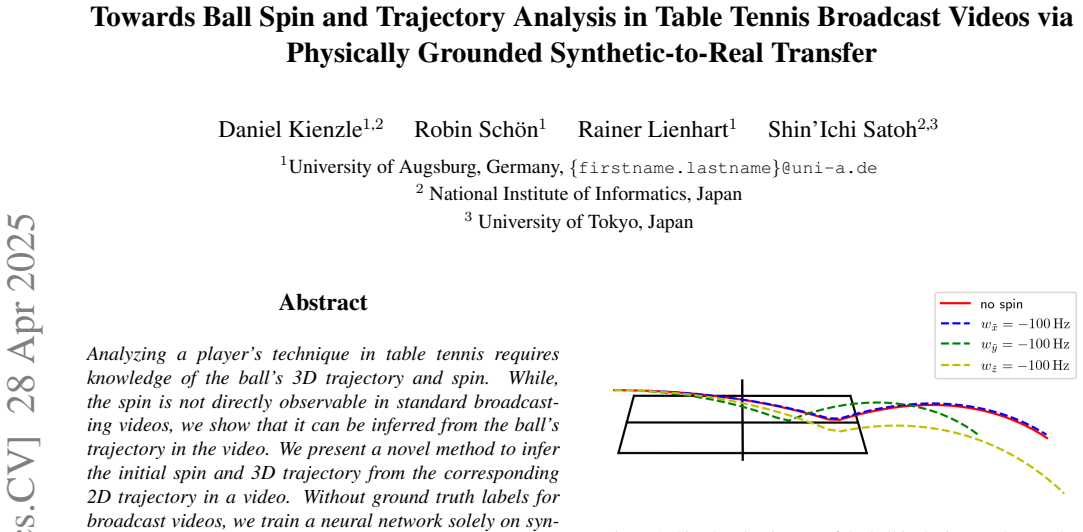
The central claim is that initial spin and the full 3D trajectory of a table-tennis ball are jointly identifiable from a single monocular broadcast video, even though spin is not directly visible. The paper argues this is possible because spin leaves a footprint in the 2D trajectory: the Magnus effect bends flight in a spin-dependent way, and bounce friction changes the post-bounce path. A transformer, fed only 2D ball positions and 13 table keypoints per frame, is trained end-to-end on 50,000 physics-simulated trajectories and predicts the initial spin vector in a per-trajectory ball coordinate system whose $\tilde{\omega}_y$ component separates topspin from backspin. On 50 manually annotated trajectories from six professional matches, the best model reaches 92.0% spin-direction accuracy and reprojects predicted 3D paths with 0.19% of the image diagonal error. The paper states this is the first spin-estimation method that works on simple monocular broadcast footage, requiring no real labels for training.
Load-bearing premise
The load-bearing premise is that the physics-simulation parameters taken from prior robot-table-tennis work, especially the Magnus coefficient and bounce friction, match real ball flight in broadcast conditions; if they are off, the inferred spins can be wrong even when the reprojected trajectory looks right.
Editorial extensions
If this is right
- Broadcast-only spin analysis becomes practical: the model classifies topspin versus backspin at 92.0% accuracy on real-match trajectories from a fixed 50 Hz camera, with a ROC-AUC of 0.990.
- Trajectory analysis no longer needs multi-camera rigs: predicted 3D paths reproject to within 0.19% of the image diagonal on real footage, so a single broadcast view can supply usable 3D trajectory data.
- Camera calibration is not required at inference: because the model ingests only 2D ball positions and table keypoints, it applies to any static-camera setup, including amateur recordings.
- A plain recipe closes the synthetic-to-real gap: 2D keypoint input, physics-based simulation with bounce and Magnus effects, and three augmentations are sufficient to transfer without real training labels.
- Enforcing a physical bottleneck helps: routing trajectory information into the spin head through a connect-stage architecture generalizes better on real data than a jointly trained single-stage model.
Reading between the lines
- If the observability analysis is right, the component $\tilde{\omega}_x$ (sidespin around the travel axis) is close to unidentifiable from ordinary 50 Hz broadcast trajectories; a model's $\tilde{\omega}_x$ output should be treated as a prior, not a measurement, until denser sampling or visual cues are added.
- The same synthetic-only recipe could transfer to other ball sports whose spin bends the flight path, such as tennis or badminton, provided a faithful bounce and Magnus model exists for that ball and surface.
- Because the paper's real evaluation labels only the sign of spin, absolute spin magnitudes on broadcast footage are untested; a robot-assisted experiment with measured spin would be the natural way to validate magnitudes, not just directions.
Signed reviews
Editorial analysis
A structured set of objections, weighed in public.
Referee Report
Summary. The paper proposes a method for estimating the 3D trajectory and initial spin vector of a table tennis ball from monocular broadcast video. The model takes as input the 2D ball trajectory plus 13 table keypoints per frame and uses a transformer (SPT) with three architectural variants (single-stage, two-stage, connect-stage) to predict the 3D positions and the initial spin. Training is performed exclusively on synthetic trajectories generated with MuJoCo, using simulation parameters adopted from [10], together with augmentations for motion blur, sudden trajectory end, and Gaussian noise. The authors evaluate on a synthetic test set and on 50 manually annotated real trajectories from WTTF matches. On real data, spin is evaluated only as a binary top/backspin classification derived from the sign of the predicted ω~y component, achieving 92.0% accuracy, while trajectory accuracy is assessed via 2D reprojection error of 0.19% of the image diagonal. The paper claims to be the first to estimate spin from simple monocular broadcast videos.
Significance. If the magnitude-level spin estimation were validated, this would be a useful contribution to sports video analysis, as spin is not directly observable in broadcast footage. The paper has several strengths: the synthetic data pipeline and code are released, the training uses no real data, the ablation study across architectures, embeddings, and augmentations is systematic, and a small real-world annotation set with spin-direction labels is made public. However, the real-world evidence supports only sign-level spin classification, not the claimed spin-vector estimation. The lack of magnitude-level ground truth, combined with the acknowledged weak observability of one spin component and the indirectness of the reprojection metric, means the central claim is currently stronger than the evidence. The paper is a solid proof-of-concept for physics-based synthetic-to-real transfer in a constrained setting, but the evaluation does not yet substantiate the headline claim of spin vector prediction.
major comments (3)
- [Section 5.2, Eq. (10); Table 3] The real-data evaluation tests only the sign of the ω~y component: Eq. (10) collapses predictions to binary topspin/backspin labels, and Section 5.2 explicitly states that exact ω~y values cannot be evaluated on real footage. The paper's abstract and conclusion, however, claim spin estimation, not spin-direction classification. This mismatch is load-bearing because the central contribution is framed as predicting the initial spin vector. Moreover, synthetic spin error is only reported as a single norm Δω (e.g., 48.7 Hz for the best model in Table 8), with no per-component breakdown and no information about the distribution of training spin magnitudes; given Section 3.3's own admission that ω~x is weakly observable, the current evidence does not support magnitude-accurate spin-vector estimation.
- [Section 5.2, Eq. (11); Section 6.4] The low 2D reprojection error (0.19% of the image diagonal) is presented as evidence of accurate 3D trajectory prediction, but this metric is not a reliable proxy for 3D or spin accuracy. The projection matrix P is estimated from the same table keypoint annotations that the model receives, and many 3D trajectories with different spin values can project to nearly identical 2D curves, especially at a 50 Hz frame rate with motion blur. Since Section 5.2 concedes that direct 3D ground truth is infeasible, the real-data evaluation does not constrain the depth component or the spin magnitude; the reprojection error primarily measures 2D consistency, not physical correctness of the predicted spin.
- [Section 5.1; Table 1] The synthetic-to-real transfer claim depends on the MuJoCo simulation parameters from [10] being accurate for broadcast conditions, but no real-world quantity other than 2D reprojection and binary spin direction is used to validate this. The paper's own Table 1 shows that synthetic performance does not predict real-world performance (the single-stage model has the best synthetic spin error but the worst real accuracy, while the two-stage model shows the opposite), so the synthetic spin error cannot serve as evidence for real spin accuracy. Without an external source of real spin magnitude ground truth (e.g., high-speed camera, event camera, robot-generated spin, or marked balls), the transfer of the spin-to-trajectory relationship to real broadcast footage remains an assumption rather than a demonstrated result.
minor comments (5)
- [Section 5.2, Eq. (11)] The definition of D appears inconsistent: Eq. (11) writes D = 1/√(H²+W²), but the text says the error is divided by the image diagonal length D. As written, dividing by this D would multiply the error by √(H²+W²), not divide by the diagonal. Please clarify the intended definition and ensure the reported percentages are computed consistently.
- [Tables 3, 5, 6, 8] All real-data metrics are computed on only 50 trajectories, yet no confidence intervals or significance tests are reported. Given the small sample, reporting exact binomial confidence intervals for the accuracy/F1 values and bootstrap intervals for the reprojection error would substantially strengthen the claims.
- [Abstract and Section 1] The phrase 'While, the ball is not directly observable' contains a stray comma, and the introduction could be tightened. More substantively, the claim of being 'the first' to perform spin estimation from monocular broadcast videos should be carefully scoped against prior physics-based trajectory-fitting work that indirectly estimates spin-related parameters, even if not from broadcast monocular video.
- [Section 4.1, Eq. (7)] The statement 'Because both losses are in the same order of magnitude, we do not introduce additional weighting factors' would be more convincing if the actual loss magnitudes during training were reported, especially since trajectory predictions are in meters and spin predictions in Hz.
- [Section 3.3, Eq. (4)] The bounce friction model in Eq. (4) is presented without derivation or reference to the MuJoCo contact model. Since the bounce interaction is central to spin observability, a brief justification or a citation to the specific MuJoCo contact parameters used in [10] would help the reader assess the physical realism of the simulation.
Circularity Check
No circularity: the synthetic-trained network is tested against independently annotated real-world spin-direction labels, with no real-data constants fitted.
full rationale
The paper's derivation chain is self-contained. It trains a transformer on MuJoCo-generated synthetic trajectories (Section 5.1), supervises spin and 3D positions with simulator ground truth (Eqs. 5-7), and evaluates on real broadcast footage using manually annotated topspin/backspin labels (Eq. 10) and 2D reprojection (Eq. 11). The real-world evaluation is external to training: no real-data spin or trajectory constant is fitted, and the classification threshold at omega_tilde_y = 0 is physically defined rather than learned from labels. The MuJoCo parameters are adopted from [10], an external prior not authored by the present authors, so no load-bearing self-citation chain is involved. The paper's own acknowledgements that omega_tilde_x is weakly observable (Section 3.3) and that exact omega_tilde_y values cannot be evaluated on real footage (Section 5.2) are limitations of evidence, not circular reductions: the predicted spin vector is a learned inverse of the assumed forward physics, not identical to the input by construction, and the 92.0% classification accuracy is measured against independent human annotations. The gap between sign-level real-data evidence and the broader spin-vector claim is a correctness/risk concern, not a circularity.
Assumptions & free parameters
free parameters (3)
- Magnus coefficient k_M =
not stated; adopted from [10]
- Bounce friction coefficient k_F =
not stated; adopted from [10]
- Augmentation parameters (motion blur window 0.4/frame rate, Gaussian noise sigma 2 px, sudden-end probability 0.5) =
hand-chosen values reported in Section D and Table 3
assumptions (4)
- domain assumption The Magnus effect and bounce-friction force model (Eqs. 3 and 4) correctly describe real table tennis ball flight.
- domain assumption The 2D ball trajectory and 13 table keypoints are already extracted or contain only small, approximately Gaussian errors.
- domain assumption Broadcast camera parameters lie within the distribution of camera parameters sampled during synthetic training.
- domain assumption Paddle orientation at impact is a reliable proxy for ground-truth topspin/backspin in the real-data evaluation.
Cite this review
Pith. "Pith review of Towards Ball Spin and Trajectory Analysis in Table Tennis Broadcast Videos via Physically Grounded Synthetic-to-Real Transfer." pith.science (2026). https://pith.science/paper/M5SLDW4G
@misc{pith2026250419863,
  author       = {Pith},
  title        = {Pith review of: Towards Ball Spin and Trajectory Analysis in Table Tennis Broadcast Videos via Physically Grounded Synthetic-to-Real Transfer},
  year         = {2026},
  howpublished = {\url{https://pith.science/paper/M5SLDW4G}},
  note         = {Machine review of arXiv:2504.19863}
}
read the original abstract
Analyzing a player's technique in table tennis requires knowledge of the ball's 3D trajectory and spin. While, the spin is not directly observable in standard broadcasting videos, we show that it can be inferred from the ball's trajectory in the video. We present a novel method to infer the initial spin and 3D trajectory from the corresponding 2D trajectory in a video. Without ground truth labels for broadcast videos, we train a neural network solely on synthetic data. Due to the choice of our input data representation, physically correct synthetic training data, and using targeted augmentations, the network naturally generalizes to real data. Notably, these simple techniques are sufficient to achieve generalization. No real data at all is required for training. To the best of our knowledge, we are the first to present a method for spin and trajectory prediction in simple monocular broadcast videos, achieving an accuracy of 92.0% in spin classification and a 2D reprojection error of 0.19% of the image diagonal.
Figures


Figures from the paper (5 more)


Reference graph
Works this paper leans on
-
[10]
D’Ambrosio, Saminda Abeyruwan, Laura Graesser, Atil Iscen, Heni Ben Amor, Alex Bewley, Bar- ney J
David B. D’Ambrosio, Saminda Abeyruwan, Laura Graesser, Atil Iscen, Heni Ben Amor, Alex Bewley, Bar- ney J. Reed, Krista Reymann, Leila Takayama, Yuval Tassa, Krzysztof Choromanski, Erwin Coumans, Deepali Jain, Navdeep Jaitly, Natasha Jaques, Satoshi Kataoka, Yuheng Kuang, Nevena Lazic, Reza Mahjourian, Sherry Moore, Kenneth Oslund, Anish Shankar, Vikas S...
arXiv 2024
-
[1]
Y .I Abdel-Aziz, H.M. Karara, and Michael Hauck. Direct linear transformation from comparator coordinates into ob- ject space coordinates in close-range photogrammetry. Pho- togrammetric Engineering and Remote Sensing , 81(2):103– 107, 2015. 12
work page 2015
-
[2]
Jan Achterhold, Philip Tobuschat, Hao Ma, Dieter B ¨uchler, Michael Muehlebach, and Joerg Stueckler. Black-box vs. gray-box: A case study on learning table tennis ball trajec- tory prediction with spin and impacts. In Proceedings of the Learning for Dynamics and Control Conference (L4DC),
-
[3]
Jason Ansel, Edward Yang, Horace He, Natalia Gimelshein, Animesh Jain, et al. Pytorch 2: Faster machine learning through dynamic python bytecode transformation and graph compilation. In Proceedings of the 29th ACM International Conference on Architectural Support for Programming Lan- guages and Operating Systems, Volume 2 , pages 929–947,
-
[4]
Monocular 3d human pose estimation for sports broadcasts using partial sports field registration
Tobias Baumgartner and Stefanie Klatt. Monocular 3d human pose estimation for sports broadcasts using partial sports field registration. In Proceedings of the IEEE/CVF Conference on Computer Vision and Pattern Recognition (CVPR) Workshops, pages 5109–5118, 2023. 2
work page 2023
-
[5]
C. G. BROYDEN. The Convergence of a Class of Double- rank Minimization Algorithms 1. General Considerations. IMA Journal of Applied Mathematics, 6(1):76–90, 1970. 12
work page 1970
-
[6]
Context-aware 3d object lo- calization from single calibrated images: A study of basket- balls
Marcello Davide Caio, Gabriel Van Zandycke, and Christophe De Vleeschouwer. Context-aware 3d object lo- calization from single calibrated images: A study of basket- balls. In Proceedings of the 6th International Workshop on Multimedia Content Analysis in Sports, page 49–54, 2023. 2
work page 2023
-
[7]
Extraction and analysis of 3d kinematic parameters of table tennis ball from a single camera
Jordan Calandre, Renaud P ´eteri, Laurent Mascarilla, and Benoit Tremblais. Extraction and analysis of 3d kinematic parameters of table tennis ball from a single camera. In 2020 25th International Conference on Pattern Recognition (ICPR), pages 9468–9475, 2021. 2
work page 2020
Show all 51 references
-
[8]
Physics-based ball tracking and 3d trajectory reconstruction with applications to shooting loca- tion estimation in basketball video
Hua-Tsung Chen, Ming-Chun Tien, Yi-Wen Chen, Wen-Jiin Tsai, and Suh-Yin Lee. Physics-based ball tracking and 3d trajectory reconstruction with applications to shooting loca- tion estimation in basketball video. Soft Computing, 20(3): 204–216, 2009. 2
2009
-
[9]
Pre- dicting 3d projectile motion in table tennis using computer vision and physics-informed neural network
Zaineb Chiha, Renaud Peteri, and Laurent Mascarilla. Pre- dicting 3d projectile motion in table tennis using computer vision and physics-informed neural network. In Interna- tional Conference on Content-Based Multimedia Indexing (CBMI), pages 1–7, 2024. 2
2024
-
[11]
Decoupling video and human motion: Towards practical event detection in athlete recordings
Moritz Einfalt and Rainer Lienhart. Decoupling video and human motion: Towards practical event detection in athlete recordings. In Proceedings of the IEEE/CVF Conference on Computer Vision and Pattern Recognition (CVPR) Work- shops, 2020. 2
2020
-
[12]
Uplift and upsample: Efficient 3d human pose estimation with up- lifting transformers
Moritz Einfalt, Katja Ludwig, and Rainer Lienhart. Uplift and upsample: Efficient 3d human pose estimation with up- lifting transformers. In Proceedings of the IEEE/CVF Win- ter Conference on Applications of Computer Vision (WACV),
-
[13]
Synthnet: Leveraging synthetic data for 3d trajectory estimation from monocular video
Morten Holck Ertner, Sofus Schou Konglevoll, Magnus Ibh, and Stella Graßhof. Synthnet: Leveraging synthetic data for 3d trajectory estimation from monocular video. In Proceed- ings of the 7th ACM International Workshop on Multimedia Content Analysis in Sports, page 51–58, 2024. 2
2024
-
[14]
Introduction to roc analysis
Tom Fawcett. Introduction to roc analysis. Pattern Recogni- tion Letters, 27:861–874, 2006. 6
2006
-
[15]
Sign language-to-text dictionary with lightweight transformer models
Jerome Fink, Pierre Poitier, Maxime Andr ´e, Loup Meurice, Benoˆıt Fr´enay, Anthony Cleve, Bruno Dumas, and Laurence Meurant. Sign language-to-text dictionary with lightweight transformer models. In Proceedings of the 32nd Inter- national Joint Conference on Artificial Intelli...
2023
-
[16]
Fischler and Robert C
Martin A. Fischler and Robert C. Bolles. Random sample consensus: a paradigm for model fitting with applications to image analysis and automated cartography.Communications of the ACM, 24(6):381–395, 1981. 12
1981
-
[17]
Spindoe: A ball spin estimation method for table tennis robot
Thomas Gossard, Jonas Tebbe, Andreas Ziegler, and An- dreas Zell. Spindoe: A ball spin estimation method for table tennis robot. In 2023 IEEE/RSJ International Conference on Intelligent Robots and Systems (IROS), pages 5744–5750,
2023
-
[18]
Table tennis ball spin estimation with an event camera
Thomas Gossard, Julian Krismer, Andreas Ziegler, Jonas Tebbe, and Andreas Zell. Table tennis ball spin estimation with an event camera. InProceedings of the IEEE/CVF Con- ference on Computer Vision and Pattern Recognition (CVPR) Workshops, pages 3347–3356, 2024. 2
2024
-
[19]
The Llama 3 Herd of Models
Aaron Grattafiori, Abhimanyu Dubey, Abhinav Jauhri, Ab- hinav Pandey, Abhishek Kadian, et al. The Llama 3 Herd of Models. arXiv e-prints, art. arXiv:2407.21783, 2024. 5
2024 arXiv
-
[20]
Textbooks are all you need, 2023
Suriya Gunasekar, Yi Zhang, Jyoti Aneja, Caio C´esar Teodoro Mendes, Allie Del Giorno, Sivakanth Gopi, Mojan Javaheripi, Piero Kauffmann, Gustavo de Rosa, Olli Saarikivi, Adil Salim, Shital Shah, Harkirat Singh Behl, Xin Wang, S´ebastien Bubeck, Ronen Eldan, Adam Tauman Kalai,...
2023
-
[21]
Hawk-eye
Hawk-Eye Innovations. Hawk-eye. https : / / www . hawkeyeinnovations.com. Accessed: 2025-02-14. 1
2025
-
[22]
Ball tracking and 3d trajectory approximation with applica- tions to tactics analysis from single-camera volleyball se- quences
Chen Huang, Wen-Jiin Tsai, Suh-Yin Lee, and Jen-Yu Yu. Ball tracking and 3d trajectory approximation with applica- tions to tactics analysis from single-camera volleyball se- quences. Multimedia Tools and Applications - MTA , 60,
-
[23]
Tempose: a new skeleton-based transformer model designed for fine-grained motion recognition in bad- minton
Magnus Ibh, Stella Grasshof, Dan Witzner, and Pascal Madeleine. Tempose: a new skeleton-based transformer model designed for fine-grained motion recognition in bad- minton. In 2023 IEEE/CVF Conference on Computer Vision 9 and Pattern Recognition Workshops (CVPRW), pages 5199– ...
2023
-
[24]
Segformer++: Efficient token-merging strategies for high-resolution semantic segmentation
Daniel Kienzle, Marco Kantonis, Robin Sch ¨on, and Rainer Lienhart. Segformer++: Efficient token-merging strategies for high-resolution semantic segmentation. IEEE Interna- tional Conference on Multimedia Information Processing and Retrieval (MIPR), 2024. 2
2024
-
[25]
Towards learning monocular 3d object localiza- tion from 2d labels using the physical laws of motion
Daniel Kienzle, Julian Lorenz, Katja Ludwig, and Rainer Lienhart. Towards learning monocular 3d object localiza- tion from 2d labels using the physical laws of motion. Pro- ceedings of the International Conference on 3D Vision 2024 (3DV), 2024. 2
2024
-
[26]
Adam: A method for stochastic optimization
Diederik Kingma and Jimmy Ba. Adam: A method for stochastic optimization. International Conference on Learn- ing Representations, 2014. 7
2014
-
[27]
Monotrack: Shuttle trajectory reconstruction from monocular badminton video
Paul Liu and Jui-Hsien Wang. Monotrack: Shuttle trajectory reconstruction from monocular badminton video. In Pro- ceedings of the IEEE/CVF Conference on Computer Vision and Pattern Recognition (CVPR) Workshops , pages 3513– 3522, 2022. 2
2022
-
[28]
Deepseek-vl: Towards real-world vision- language understanding, 2024
Haoyu Lu, Wen Liu, Bo Zhang, Bingxuan Wang, Kai Dong, Bo Liu, Jingxiang Sun, Tongzheng Ren, Zhuoshu Li, Hao Yang, Yaofeng Sun, Chengqi Deng, Hanwei Xu, Zhenda Xie, and Chong Ruan. Deepseek-vl: Towards real-world vision- language understanding, 2024. 5
2024
-
[29]
Robust estimation of flight parameters for ski jumpers
Katja Ludwig, Moritz Einfalt, and Rainer Lienhart. Robust estimation of flight parameters for ski jumpers. In2020 IEEE International Conference on Multimedia & Expo Workshops (ICMEW), pages 1–6, 2020. 1
2020
-
[30]
Recog- nition of Freely Selected Keypoints on Human Limbs
Katja Ludwig, Daniel Kienzle, and Rainer Lienhart. Recog- nition of Freely Selected Keypoints on Human Limbs . In 2022 IEEE/CVF Conference on Computer Vision and Pat- tern Recognition Workshops (CVPRW) , pages 3530–3538,
2022
-
[31]
What players do with the ball: A physically constrained interaction mod- eling
Andrii Maksai, Xinchao Wang, and Pascal Fua. What players do with the ball: A physically constrained interaction mod- eling. IEEE Conference on Computer Vision and Pattern Recognition (CVPR), pages 972–981, 2016. 2
2016
-
[32]
Com- bining physics and deep learning models to simulate the flight of a golf ball
William McNally, Jacob Lambeth, and Dustin Brekke. Com- bining physics and deep learning models to simulate the flight of a golf ball. In Proceedings of the IEEE/CVF Con- ference on Computer Vision and Pattern Recognition (CVPR) Workshops, pages 5119–5128, 2023. 2
2023
-
[33]
Event-based ball spin es- timation in sports
Takuya Nakabayashi, Kyota Higa, Masahiro Yamaguchi, Ryo Fujiwara, and Hideo Saito. Event-based ball spin es- timation in sports. In Proceedings of the IEEE/CVF Confer- ence on Computer Vision and Pattern Recognition (CVPR) Workshops, pages 3367–3375, 2024. 2
2024
-
[34]
Consensus- based trajectory estimation for ball detection in calibrated cameras systems
Pascaline Parisot and Christophe Vleeschouwer. Consensus- based trajectory estimation for ball detection in calibrated cameras systems. Journal of Real-Time Image Processing , 16, 2019. 2
2019
-
[35]
Raissi, P
M. Raissi, P. Perdikaris, and G.E. Karniadakis. Physics- informed neural networks: A deep learning framework for solving forward and inverse problems involving nonlinear partial differential equations. Journal of Computational Physics, 378:686–707, 2019. 2
2019
-
[36]
Jones, and Ming Xu
Jinchang Ren, James Orwell, Graeme A. Jones, and Ming Xu. Real-time modeling of 3-d soccer ball trajectories from multiple fixed cameras. IEEE Transactions on Circuits and Systems for Video Technology, 18(3):350–362, 2008. 2
2008
-
[37]
Instance segmentation-based markerless tracking of fencing sword tips
Takehiro Sawahata, Alessandro Moro, Sarthak Pathak, and Kazunori Umeda. Instance segmentation-based markerless tracking of fencing sword tips. In 2024 IEEE/SICE Inter- national Symposium on System Integration (SII), pages 472– 477, 2024. 1
2024
-
[38]
Roformer: Enhanced transformer with rotary position embedding
Jianlin Su, Murtadha Ahmed, Yu Lu, Shengfeng Pan, Wen Bo, and Yunfeng Liu. Roformer: Enhanced transformer with rotary position embedding. Neurocomput., 568(C), 2024. 5
2024
-
[39]
Mean teachers are better role models: Weight-averaged consistency targets improve semi-supervised deep learning results
Antti Tarvainen and Harri Valpola. Mean teachers are better role models: Weight-averaged consistency targets improve semi-supervised deep learning results. In Proceedings of the 31st International Conference on Neural Information Pro- cessing Systems, pages 1195–1204, 2017. 7
2017
-
[40]
Mujoco: A physics engine for model-based control
Emanuel Todorov, Tom Erez, and Yuval Tassa. Mujoco: A physics engine for model-based control. In 2012 IEEE/RSJ International Conference on Intelligent Robots and Systems, pages 5026–5033, 2012. 3, 6
2012
-
[41]
Real-time trajectory prediction of a ping-pong ball using a gru-tae
Baptiste Toussaint and Maxime Raison. Real-time trajectory prediction of a ping-pong ball using a gru-tae. Applied Intel- ligence, 55(339), 2025. 2
2025
-
[42]
3d ball localization from a single calibrated image
Gabriel Van Zandycke and Christophe De Vleeschouwer. 3d ball localization from a single calibrated image. In Proceed- ings of the IEEE/CVF Conference on Computer Vision and Pattern Recognition (CVPR) Workshops, pages 3472–3480,
-
[43]
Attention is all you need
Ashish Vaswani, Noam Shazeer, Niki Parmar, Jakob Uszko- reit, Llion Jones, Aidan N Gomez, Ł ukasz Kaiser, and Illia Polosukhin. Attention is all you need. In Advances in Neu- ral Information Processing Systems. Curran Associates, Inc.,
-
[44]
View 4d 2.0
Vieww GmbH. View 4d 2.0. https://vieww.com. Ac- cessed: 2025-02-14. 1
2025
-
[45]
Multi- camera asynchronous ball localization and trajectory predic- tion with factor graphs and human poses
Qingyu Xiao, Zulfiqar Zaidi, and Matthew Gombolay. Multi- camera asynchronous ball localization and trajectory predic- tion with factor graphs and human poses. In 2024 IEEE In- ternational Conference on Robotics and Automation (ICRA), pages 13695–13702, 2024. 2
2024
-
[46]
Learning dynamics of a ball with differentiable factor graph and roto- translational invariant representations, 2025
Qingyu Xiao, Zixuan Wu, and Matthew Gombolay. Learning dynamics of a ball with differentiable factor graph and roto- translational invariant representations, 2025. 2
2025
-
[47]
ViTPose++: Vision Transformer for Generic Body Pose Es- timation
Yufei Xu, Jing Zhang, Qiming Zhang, and Dacheng Tao. ViTPose++: Vision Transformer for Generic Body Pose Es- timation . IEEE Transactions on Pattern Analysis & Machine Intelligence, 46(02):1212–1230, 2024. 2
2024
-
[48]
Spin observation and trajec- tory prediction of a ping-pong ball
Yifeng Zhang, Yongsheng Zhao, Rong Xiong, Yue Wang, Jianguo Wang, and Jian Chu. Spin observation and trajec- tory prediction of a ping-pong ball. In 2014 IEEE Inter- national Conference on Robotics and Automation (ICRA) , pages 4108–4114, 2014. 2
2014
-
[49]
3d human pose estimation with spatial and temporal transformers
Ce Zheng, Sijie Zhu, Matias Mendieta, Taojiannan Yang, Chen Chen, and Zhengming Ding. 3d human pose estimation with spatial and temporal transformers. Proceedings of the IEEE International Conference on Computer Vision (ICCV),
-
[51]
to robustly filter out erroneous annotations. In each RANSAC iteration, we randomly select six non-planar key- points and compute an initial estimate of the camera matri- ces using the Direct Linear Transformation (DLT) algorithm [1]. This initial estimate is then refined usin...
-
[2021]
Further Architecture Details MLP li (a) Context-Free Method MLP li (b) Concatenation Method MLP MLP MLP Transformer table13 table1 ball li (c) Dynamic Method Figure 7
2 10 Towards Ball Spin and Trajectory Analysis in Table Tennis Broadcast Videos via Physically Grounded Synthetic-to-Real Transfer Supplementary Material A. Further Architecture Details MLP li (a) Context-Free Method MLP li (b) Concatenation Method MLP MLP MLP Transformer tabl...
Reviewed August 16, 2026 · model on record in the stance chip above.
Discussion (0). Continue with ORCID to comment.