REVIEW 4 major objections 5 minor 15 references
Black-Box Visual Prompt Engineering for Mitigating Object Hallucination in Large Vision Language Models
T0 review · 4 major / 5 minor · reviewed 2026-08-16 · deepseek-v4-flash
Pith's one-line read A black-box router that picks a per-image visual prompt reduces object hallucination in large vision-language models.
desk verdict Solid empirical study: visual prompting reduces hallucination and a learned router helps, but the six-question training signal may not fully explain the captioning gains. read the letter →
The pith
A machine-rendered reading of the paper's core claim, the machinery that carries it, and where it could break.
The reading
What carries the argument
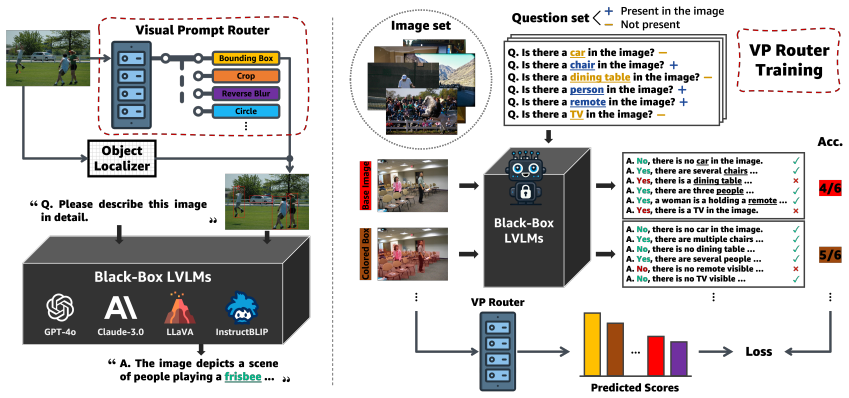
The router model is the central object: a frozen CLIP-ViT-L/14@336px vision encoder feeding a trainable MLP head that assigns a score to each candidate visual prompt and outputs the argmax as the chosen prompt. Training labels come from a discrete optimization problem defined by the paper's scoring function S, which counts correct answers to object-presence questions; each image's optimal prompt is the one maximizing S, with ties excluded. The machinery also includes the candidate pool (box, circle, arrow, center point, crop, reverse blur, and no prompt) and the object localizer (SAM 2) whose detected boxes define what the prompts highlight. The router's job is to imitate the oracle's selection rule using only the image, so at inference no LVLM query is needed to choose the prompt.
What would settle it
On the COCO validation images, compute the per-image optimal prompt under the paper's six-question score and under CHAIR's caption-level hallucinated-object ratio; if the two rankings agree at chance level, or if a router trained on the six-question labels fails to beat a fixed prompt on attribute- or relation-based questions, the transfer claim is refuted.
Extended reading notes
Core claim
On its own terms, the discovery is twofold. First, object-based visual prompts are not uniformly helpful: for a given LVLM and image, different prompts elicit different levels of hallucination, and the best prompt varies by image, model, and metric; selecting it per image (the oracle) produces large gains. Second, the per-image optimum can be approximated by a black-box router without any access to model internals. The router is trained on labels generated by the target LVLM itself: for each image, three positive and three negative presence questions are asked for each candidate prompt, the prompt with the highest answer accuracy is declared optimal, and a frozen CLIP encoder plus a trainable MLP learns to predict that prompt from the image alone. The paper demonstrates on POPE, CHAIR, and a GPT-4o-based description-quality evaluation that the routed prompting reduces hallucination relative to no prompting, random prompting, and the best fixed prompt.
Load-bearing premise
The idea rests on the assumption that the best visual prompt for an image, as judged by six yes/no questions about object presence, is also the best prompt for describing that image in full sentences and for answering other questions.
Editorial extensions
If this is right
- Adding BBVPE as a pre-processing layer requires no training of the LVLM, so it applies to proprietary APIs and to future models without re-training.
- The per-model router means deployment can tailor prompting to a model's own preferences, since the paper finds no single prompt works across models or metrics.
- The COCO-trained router transfers to GQA-style images, so cross-dataset deployment on similar natural images is plausible without per-dataset router retraining.
- The gap to the oracle quantifies remaining headroom, and the paper's preliminary results indicate that better object localization directly raises performance.
- Because the router selects without querying the LVLM, it adds only localizer plus router cost, which the paper measures as lower latency than existing decoding-based methods.
Reading between the lines
- A natural test of whether the six-question signal is really about hallucination rather than prompt-answer bias: if the router's selected prompts correlate with the LVLM's tendency to say 'yes' under a given prompt, the method may be partly re-ranking answer styles rather than suppressing hallucinated objects.
- Because the optimal prompt labels come from the target model's own answers, the framework doubles as a model-characterization tool: the per-image prompt preferences encode what visual emphasis a model needs, which could inform fine-tuning or decoding corrections.
- The paper's own limitation notes—router-training instability and sensitivity to object-localizer quality—imply that near-term gains are as likely to come from better localization and more stable routing as from a larger prompt pool.
Signed reviews
Editorial analysis
A structured set of objections, weighed in public.
Referee Report
Summary. The paper investigates whether overlaying simple object-based visual prompts (e.g., bounding boxes, circles, arrows) on images can reduce object hallucination in large vision-language models (LVLMs). It proposes Black-Box Visual Prompt Engineering (BBVPE), which trains a lightweight router (a frozen CLIP vision encoder plus a trainable MLP) on input-output pairs from a target LVLM to select, for each image, the visual prompt that maximizes the LVLM's accuracy on six binary object-presence questions. At inference, the router selects a visual prompt from image features alone, and the prompted image is fed to the LVLM. Experiments on POPE, CHAIR, and a GPT-4o-based description quality evaluation across two open-source and two proprietary LVLMs show that BBVPE outperforms no prompting, random prompting, and a fixed best prompting baseline, while remaining below an Oracle upper bound. A cross-dataset experiment on GQA and a latency/TFLOPs comparison are also reported.
Significance. If the findings hold, BBVPE is a novel and practically relevant contribution: it offers a model-agnostic, black-box approach to mitigating object hallucination, which is directly applicable to proprietary LVLMs where white-box methods cannot be used. The paper's strengths include a simple and interpretable idea, consistent improvements across multiple benchmarks and models, substantial gains on CHAIR, and a cross-dataset generalization experiment. The framework is reproducible from the provided implementation details, and the authors are transparent about several limitations. The main weaknesses are the absence of statistical significance testing, the small absolute gains on POPE, and an unexamined gap between the router's training objective and the captioning benchmark.
major comments (4)
- [§4.1, Table 1] The POPE results report only point estimates with no error bars, confidence intervals, or significance tests. The absolute gains are small (e.g., Random setup for LLaVA-1.5: 89.60 to 91.37; Popular: 86.20 to 87.23; Adversarial: 79.73 to 81.33), yet the abstract and Section 1 claim that BBVPE 'significantly reduces' object hallucination. To support this claim, the authors should report variability across the POPE question subsets or provide bootstrap confidence intervals, and ideally paired significance tests for the main comparisons against the baseline and the best-fixed-VP baseline.
- [§3 (Eq. 2), Appendix A, Table 2] The router is trained to predict the visual prompt that maximizes accuracy on exactly six object-presence questions per image (three positive, three negative), and at inference it selects a prompt from image features alone (Eq. 7; Limitation 3). The central CHAIR result in Table 2 depends on the unexamined assumption that this six-question proxy correlates with per-image visual-prompt effectiveness for open-ended captioning. The paper provides no per-image analysis linking the router's selections to CHAIR-optimal prompts, and the authors' own Limitation 8 notes a 'subtle learning signal' and convergence instability. I request either a per-image comparison of router-chosen prompts against per-image CHAIR-optimal prompts on a subset of images, or a sensitivity analysis varying the number and type of training questions to show that the CHAIR gains are robust to the choice of proxy. Additionally, Eq. 3 excludes images where multiple prompts tie; the authors should report how many images are discarded, as this may bias the training distribution.
- [§4, Tables 1-3] The 'best VP' baseline is described as 'consistently using a fixed best VP that delivers the highest overall performance for the model.' If this VP is chosen using test-set performance (as the footnotes in Tables 1 and 2 suggest), then it is an oracle-style baseline, and the comparison is not a fair reflection of a realistically selectable fixed prompt. I ask the authors to clarify the selection procedure and, if test labels are used, to instead select the best VP on a validation split or explicitly label the baseline as an oracle upper bound for fixed prompting. The same clarification is needed for the cross-dataset experiment in Table 5.
- [§4.3, Table 4] Table 4 compares latency and computational cost against existing hallucination mitigation methods (VCD, OPERA, M3ID, etc.), but the paper does not compare BBVPE to these methods on hallucination metrics such as POPE or CHAIR. Without such a comparison, it is difficult to assess the practical significance of the proposed approach: if white-box methods achieve substantially larger hallucination reductions, the small POPE gains and the black-box advantage may not be sufficient to justify the approach. The authors should add a performance comparison on open-source LVLMs (even if only for a subset of methods), or explicitly argue why such a comparison is not meaningful for their black-box setting.
minor comments (5)
- [Table 4] The citation for VCD is incorrect: Table 4 cites 'VCD (Liu et al., 2023a)', but the paper's reference list associates Liu et al. (2023a) with 'Mitigating hallucination in large multi-modal models via robust instruction tuning.' VCD refers to Leng et al. (2023). Please correct this citation.
- [Table 3 and Appendix C] The GPT-4o-based description evaluation is a model-judge metric, but the paper does not report how many images or descriptions were evaluated, nor any measure of judge reliability. Please provide these details and discuss the potential bias of using an LVLM judge to evaluate hallucination.
- [§1 and Figure 1] The qualitative examples in Figures 1 and 3 are informative but rely on a few cherry-picked images. Consider adding a quantitative breakdown (e.g., the distribution of per-image optimal prompts) to support the claim that prompt effectiveness varies across images.
- [§2] The statement 'this work is the first to extend APE to visual inputs' is too strong: prior work on visual prompt engineering, including Set-of-Mark prompting (Yang et al., 2023a) and CPT (Yao et al., 2024), also optimizes or selects visual prompts. The novelty claim should be qualified to emphasize the black-box, hallucination-focused, per-image selection aspect.
- [Appendix A] The training set size and the number of unique optimal-prompt examples after applying Eq. 3 are not reported. Please provide these statistics, as they are important for assessing the representativeness of the router's training distribution.
Circularity Check
No circularity; router training and benchmark evaluation are distinct empirical steps.
full rationale
The paper's derivation chain is empirical rather than definitional. Section 3 defines an oracle label p* = arg max S(M(I_pi,T)) over six object-presence questions (Eq. 2), trains a router by cross-entropy (Eq. 6), and at inference selects a VP from image features alone (Eq. 7). The POPE and CHAIR evaluations use unseen images, questions, and captions with external ground-truth annotations, so the reported gains are not the same as the training objective by construction. The paper does not claim Eq. 1 entails CHAIR; CHAIR results are presented as empirical measurements. Self-citations (Woo et al. 2024a,b) appear only as related-work comparisons and in the latency table, not as load-bearing premises, and no uniqueness theorem or ansatz is imported via citation. The acknowledged limitations, e.g., the router ignores question context (Limitation 3) and training exhibits a subtle learning signal and convergence instability (Limitation 8), weaken the generality of the transfer from six presence questions to open-ended captioning, but they do not reduce the central claim to its inputs. Therefore no circular step is exhibited.
Assumptions & free parameters
free parameters (4)
- Per-image question set size =
6 (3 positive, 3 negative)
- Router learning rate and epochs =
1e-4, 20 epochs
- Visual prompt pool composition =
Hand-selected set including bounding box, circle, arrow, crop, reverse blur, center point, etc.
- Router MLP parameters =
Learned weights, values not reported
assumptions (5)
- domain assumption POPE and CHAIR are valid external measures of object hallucination.
- domain assumption SAM2 (sam2-hiera-large) provides sufficiently accurate object localization.
- domain assumption Greedy decoding responses are representative of model behavior for evaluation.
- domain assumption The scoring function S based on object-presence accuracy is a sufficient proxy for object hallucination in both yes/no and open-ended generation.
- domain assumption COCO training data and POPE question protocol provide a representative training distribution for VP routing.
Cite this review
Pith. "Pith review of Black-Box Visual Prompt Engineering for Mitigating Object Hallucination in Large Vision Language Models." pith.science (2026). https://pith.science/paper/KQTKDOQK
@misc{pith2026250421559,
  author       = {Pith},
  title        = {Pith review of: Black-Box Visual Prompt Engineering for Mitigating Object Hallucination in Large Vision Language Models},
  year         = {2026},
  howpublished = {\url{https://pith.science/paper/KQTKDOQK}},
  note         = {Machine review of arXiv:2504.21559}
}
read the original abstract
Large Vision Language Models (LVLMs) often suffer from object hallucination, which undermines their reliability. Surprisingly, we find that simple object-based visual prompting -- overlaying visual cues (e.g., bounding box, circle) on images -- can significantly mitigate such hallucination; however, different visual prompts (VPs) vary in effectiveness. To address this, we propose Black-Box Visual Prompt Engineering (BBVPE), a framework to identify optimal VPs that enhance LVLM responses without needing access to model internals. Our approach employs a pool of candidate VPs and trains a router model to dynamically select the most effective VP for a given input image. This black-box approach is model-agnostic, making it applicable to both open-source and proprietary LVLMs. Evaluations on benchmarks such as POPE and CHAIR demonstrate that BBVPE effectively reduces object hallucination.
Figures


Figures from the paper (1 more)

Reference graph
Works this paper leans on
-
[1]
Accuracy: How precisely does the description reflect the actual objects, details, and attributes (such as color, shape, and number of objects) visible in the image?
-
[2]
Advances in Neural Information Processing Systems, 36
Instructblip: Towards general-purpose vision- language models with instruction tuning. Advances in Neural Information Processing Systems, 36. Alessandro Favero, Luca Zancato, Matthew Trager, Siddharth Choudhary, Pramuditha Perera, Alessan- dro Achille, Ashwin Swaminathan, and Stefano Soatto. 2024. Multi-modal hallucination control by visual information gr...
arXiv 2024
-
[3]
Mitigating object hallucinations in large vision- language models through visual contrastive decoding. arXiv preprint arXiv:2311.16922. Yifan Li, Yifan Du, Kun Zhou, Jinpeng Wang, Wayne Xin Zhao, and Ji-Rong Wen. 2023. Eval- uating object hallucination in large vision-language models. arXiv preprint arXiv:2305.10355. Tsung-Yi Lin, Michael Maire, Serge Bel...
arXiv 2023
-
[4]
arXiv preprint arXiv:2310.01779
Halle-control: Controlling object hallucina- tion in large multimodal models. arXiv preprint arXiv:2310.01779. Zhiyuan Zhao, Bin Wang, Linke Ouyang, Xiaoyi Dong, Jiaqi Wang, and Conghui He. 2023. Beyond hallu- cinations: Enhancing lvlms through hallucination- aware direct preference optimization. arXiv preprint arXiv:2311.16839. Yongchao Zhou, Andrei Ioan...
arXiv 2023
-
[5]
If nonexistent elements are included, the score decreases
Robustness: Does the description avoid mentioning any objects or attributes that are not present in the image? Descriptions without any false information score higher. If nonexistent elements are included, the score decreases. Only provide the numerical scores for each criterion and the total score, formatted as follows:
-
[7]
Detail: How thoroughly does the description capture visual details of the objects, including finer elements like positions, relative sizes, and relationships?
-
[8]
Comprehensiveness: How well does the description cover all key elements of the image, without omitting important objects or details?
-
[9]
Relevance: Does the description focus on significant and pertinent details from the image. The score decreases if the description includes unnecessary or unrelated information that distracts from the core details of the image
Show all 15 references
-
[11]
Accuracy: score1 | score2 | score3 | score4 | score5 | score6 | score7 | score8
-
[12]
Detail: score1 | score2 | score3 | score4 | score5 | score6 | score7 | score8
-
[13]
Comprehensiveness: score1 | score2 | score3 | score4 | score5 | score6 | score7 | score8
-
[14]
Relevance: score1 | score2 | score3 | score4 | score5 | score6 | score7 | score8
-
[15]
Robustness: score1 | score2 | score3 | score4 | score5 | score6 | score7 | score8 Total Score: total1 | total2 | total3 | total4 | total5 | total6 | total7 | total8 Figure 4: GPT-4o evaluation instruction
-
[2014]
Is there a/an [OBJECT] in the image?
training split, where each image is paired with 6 questions: 3 positive (about objects present in the image) and 3 negative (about objects not present in the image), following the POPE proto- col (Li et al., 2023). Each VP router is individually trained for each LVLM, as the p...
2023
-
[2023]
arXiv preprint arXiv:2311.16479
Mitigating hallucination in visual language models with visual supervision. arXiv preprint arXiv:2311.16479. Wenliang Dai, Junnan Li, Dongxu Li, Anthony Meng Huat Tiong, Junqi Zhao, Weisheng Wang, Boyang Li, Pascale N Fung, and Steven Hoi
Reviewed August 16, 2026 · model on record in the stance chip above.
Discussion (0). Continue with ORCID to comment.