Study of electron-positron annihilation into four pions within chiral effective field theory in the low energy region
Pith reviewed 2026-05-22 16:51 UTC · model grok-4.3
The pith
Resonance chiral theory boosts four-pion cross sections by one order over chiral perturbation theory yet remains one to two orders below sparse data below 0.65 GeV.
A machine-rendered reading of the paper's core claim, the machinery that carries it, and where it could break.
Core claim
In this work, the cross section for e+e- annihilation into four pions is computed using SU(3) chiral perturbation theory to next-to-leading order, yielding values smaller than the limited experimental data points in the 0.6-0.65 GeV region. Incorporating the lightest scalar and vector resonances via resonance chiral theory, with couplings determined from decay widths and masses, increases the predicted cross section by about one order of magnitude, yet it remains one to two orders of magnitude below the data. The calculation also provides the leading hadronic vacuum polarization contributions to (g-2)_mu from the two four-pion channels, giving a_mu = (0.680 ± 0.062) × 10^{-16} for π+π+π-π-0.
What carries the argument
Resonance chiral theory with the lightest scalar and vector mesons placed in effective Lagrangians whose couplings are fixed solely by measured decay widths and masses.
If this is right
- Resonance contributions exceed chiral perturbation theory by one order of magnitude but still fall short of data by one to two orders.
- New experimental data in the 0.6-0.65 GeV window are required to resolve the discrepancy.
- The four-pion channels contribute (0.680 ± 0.062) × 10^{-16} and (0.597 ± 0.058) × 10^{-16} to a_mu from threshold to 0.6 GeV.
- The framework is restricted to E_cm ≤ 0.6 GeV where only the lightest resonances are retained.
Where Pith is reading between the lines
- If improved data continue to exceed the resonance chiral prediction, higher resonances or explicit unitarization may be required even at these low energies.
- The small four-pion contributions imply that other hadronic channels dominate the hadronic vacuum polarization part of the muon anomaly.
- The same Lagrangian setup could be applied to related processes such as tau decays into four pions to test consistency of the extracted couplings.
Load-bearing premise
The lightest scalars and vectors included in the resonance chiral Lagrangians, with couplings fixed solely from their decay widths and masses, capture all relevant dynamics below 0.6 GeV without additional higher resonances or unitarization effects.
What would settle it
A precise measurement of the four-pion cross section between 0.55 and 0.65 GeV that lies within one order of the resonance chiral theory prediction or matches the higher data values would falsify the claim that the included resonances explain the enhancement over chiral perturbation theory.
Figures
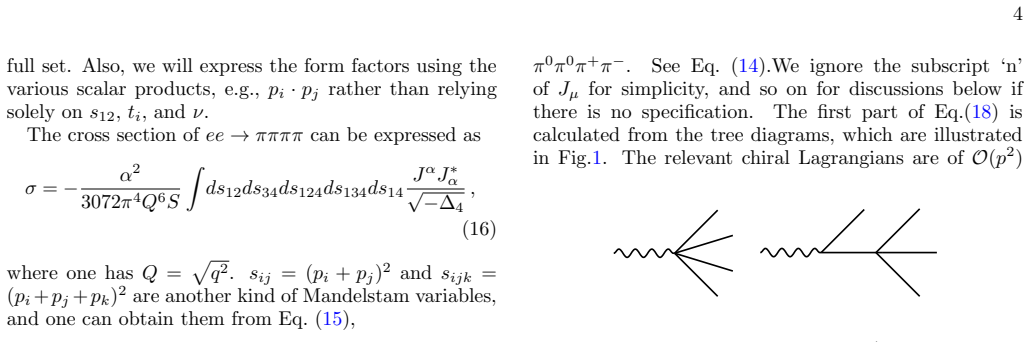


read the original abstract
In this paper, we employ chiral effective field theory to study the process of electron-positron annihilation into four pions in the low energy region within $E_{c.m.}\leq 0.6$ GeV. The prediction of the cross section is obtained through $SU(3)$ chiral perturbation theory up to the next-to-leading order, which is smaller than the experimental data in the energy region [0.6-0.65] GeV, though the data has only a few points and poor statistics. Then, the resonance chiral theory is applied to include the resonance contribution, with the lightest scalars and vectors written in the effective Lagrangians. A series of relevant decay widths and the masses of the vectors are studied to fix the unknown couplings. The resonance contribution should be one order larger than that of the chiral perturbation theory but still one to two orders smaller than the data. The significant discrepancy urged the new experimental measurements to give more guidance. We also compute the leading order hadronic vacuum polarization contribution from the four pion channels to the anomalous magnetic moment of the muon, $(g-2)_\mu$. In the energy range from threshold up to 0.6 GeV within resonance chiral theory, the contributions are $a_\mu=(0.680\pm0.062)\times10^{-16}$ and $a_\mu=(0.597\pm0.058)\times10^{-16}$ for the processes of $e^+e^-\to\pi^+\pi^+\pi^-\pi^-$, $\pi^0\pi^0\pi^+\pi^-$, respectively.
Editorial analysis
A structured set of objections, weighed in public.
Referee Report
Summary. The paper claims to compute the cross section for e⁺e⁻ → 4π in the region E_cm ≤ 0.6 GeV first via SU(3) ChPT at NLO (finding it smaller than sparse data) and then via resonance chiral theory with the lightest scalars and vectors, whose couplings are fixed from decay widths and vector masses. The resonance piece is stated to be one order larger than the ChPT result but still 1–2 orders below the data; the work also reports explicit numerical values for the leading hadronic vacuum polarization contribution to a_μ from the two charge channels.
Significance. If the central estimates hold, the calculation would quantify a small but non-negligible piece of the low-energy hadronic vacuum polarization for (g-2)_μ and would illustrate the reach of resonance chiral theory for multi-pion final states. The explicit a_μ numbers and the call for better data are concrete contributions, though the overall significance is tempered by the limited statistics of the existing data and the tree-level treatment of resonances.
major comments (2)
- [Resonance chiral theory section] The claim that the resonance contribution is reliably one order larger than NLO ChPT (and still far below data) rests on the assumption that tree-level insertion of the lightest scalars and vectors, with couplings fixed solely from two-body decay widths and masses, captures the dominant dynamics below 0.6 GeV. The four-pion amplitude receives important final-state interactions; no unitarization procedure (K-matrix, Bethe-Salpeter, or dispersive) is described, so the size of the resonance enhancement is not controlled by the power counting and may be underestimated.
- [Comparison with experimental data] The reported discrepancy with data in the narrow interval [0.6–0.65] GeV is used to motivate new measurements, yet the manuscript itself notes that the data consist of only a few points with poor statistics. This weakens the load-bearing assertion that a large, unexplained gap exists.
minor comments (1)
- [Abstract] The abstract sentence 'The significant discrepancy urged the new experimental measurements' contains a tense/grammar error and should read 'urges'.
Simulated Author's Rebuttal
We thank the referee for the careful reading and constructive comments on our manuscript. We address the major comments point by point below, indicating where revisions have been made.
read point-by-point responses
-
Referee: [Resonance chiral theory section] The claim that the resonance contribution is reliably one order larger than NLO ChPT (and still far below data) rests on the assumption that tree-level insertion of the lightest scalars and vectors, with couplings fixed solely from two-body decay widths and masses, captures the dominant dynamics below 0.6 GeV. The four-pion amplitude receives important final-state interactions; no unitarization procedure (K-matrix, Bethe-Salpeter, or dispersive) is described, so the size of the resonance enhancement is not controlled by the power counting and may be underestimated.
Authors: We thank the referee for highlighting this important aspect of the resonance chiral theory treatment. Our calculation follows the standard tree-level implementation of resonance chiral theory, in which the lightest scalars and vectors are introduced via effective Lagrangians with couplings fixed from two-body decay widths and vector masses. This framework is designed to capture the leading resonance saturation effects in the low-energy region below 0.6 GeV. We acknowledge that final-state interactions are relevant for the four-pion final state and that a unitarized treatment (via K-matrix, Bethe-Salpeter, or dispersive methods) would provide additional control over the amplitude. Such extensions, however, go beyond the tree-level scope of the present work. The reported one-order enhancement relative to NLO ChPT is consistent with the resonance-saturation expectations of the approach. In the revised manuscript we have added an explicit discussion of this limitation and noted that unitarization could lead to a further increase in the cross section. revision: partial
-
Referee: [Comparison with experimental data] The reported discrepancy with data in the narrow interval [0.6–0.65] GeV is used to motivate new measurements, yet the manuscript itself notes that the data consist of only a few points with poor statistics. This weakens the load-bearing assertion that a large, unexplained gap exists.
Authors: We agree with the referee that the existing data in the narrow interval [0.6–0.65] GeV consist of only a few points with limited statistics, a caveat already stated in the manuscript. Nevertheless, even these sparse points lie well above both the ChPT and resonance chiral theory predictions, indicating a discrepancy that warrants attention. We have revised the text to place greater emphasis on the statistical limitations of the current data set while still noting that improved measurements would be valuable for testing the theoretical description in this energy region. revision: yes
Circularity Check
No significant circularity; parameters constrained by independent observables
full rationale
The paper computes the four-pion cross section first in SU(3) ChPT to NLO, then augments it with resonance chiral theory by inserting the lightest scalars and vectors whose couplings are fixed from their decay widths and masses. These fixing observables are external to the four-pion channel under study. No equation in the provided text equates the four-pion prediction to the input fit by construction, nor does any load-bearing step reduce to a self-citation chain or ansatz smuggled from prior author work. The result is compared directly to experimental data and found discrepant, which is inconsistent with a circular construction. The derivation therefore remains self-contained against external benchmarks.
Axiom & Free-Parameter Ledger
free parameters (1)
- resonance couplings in effective Lagrangians
axioms (2)
- domain assumption SU(3) chiral symmetry governs the low-energy dynamics of light quarks
- ad hoc to paper Resonance chiral theory with only the lightest scalars and vectors suffices below 0.6 GeV
Lean theorems connected to this paper
-
IndisputableMonolith/Cost/FunctionalEquation.leanwashburn_uniqueness_aczel unclear?
unclearRelation between the paper passage and the cited Recognition theorem.
The prediction of the cross section is obtained through SU(3) chiral perturbation theory up to the next-to-leading order... Then, the resonance chiral theory is applied to include the resonance contribution, with the lightest scalars and vectors written in the effective Lagrangians. A series of relevant decay widths and the masses of the vectors are studied to fix the unknown couplings.
What do these tags mean?
- matches
- The paper's claim is directly supported by a theorem in the formal canon.
- supports
- The theorem supports part of the paper's argument, but the paper may add assumptions or extra steps.
- extends
- The paper goes beyond the formal theorem; the theorem is a base layer rather than the whole result.
- uses
- The paper appears to rely on the theorem as machinery.
- contradicts
- The paper's claim conflicts with a theorem or certificate in the canon.
- unclear
- Pith found a possible connection, but the passage is too broad, indirect, or ambiguous to say the theorem truly supports the claim.
Reference graph
Works this paper leans on
-
[1]
LargeN C in chiral perturbation theory Quantum corrections computed with the chiral La- grangian will have a 1/NC suppression for hadronic loop diagrams with pseudoscalars [54]. This can be observed clearly from the following expressions, Fπ, FV , GV , cd, cm, λV 6 , λV 22, λV V 6 , λSV 3 , λSV V ∼ O( p NC), L1, L2, L3, L5, L8, L9, L10 ∼ O(N C), 2L1 −L 2,...
-
[2]
Integrating out heavy fields at tree level Integrating out a heavy fieldHis through the follow- ing expressions, Z[l i] =e iWeff[li] ≡ Z [dH]e i R d4xL(H(x),l i(x)),(E2) leaving only the light fieldsl i. In our analysis, the com- plete Lagrangian is given as L=L ChPT +L RChT =L ChPT +L R kin +L R int.(E3) Here,L ChPT includes only the lowest order ChPT La...
- [3]
- [4]
- [5]
-
[6]
Jegerlehner,The Anomalous Magnetic Moment of the Muon, Vol
F. Jegerlehner,The Anomalous Magnetic Moment of the Muon, Vol. 274 (Springer, Cham, 2017)
work page 2017
-
[7]
G. W. Bennettet al.(Muon g-2), Phys. Rev. D73, 072003 (2006), arXiv:hep-ex/0602035
work page internal anchor Pith review Pith/arXiv arXiv 2006
-
[8]
B. Abiet al.(Muon g-2), Phys. Rev. Lett.126, 141801 (2021), arXiv:2104.03281 [hep-ex]
- [9]
-
[10]
T. Aoyamaet al., Phys. Rept.887, 1 (2020), arXiv:2006.04822 [hep-ph]
-
[11]
The muon $g-2$ and $\alpha(M_Z^2)$: a new data-based analysis
A. Keshavarzi, D. Nomura, and T. Teubner, Phys. Rev. D97, 114025 (2018), arXiv:1802.02995 [hep-ph]
work page internal anchor Pith review Pith/arXiv arXiv 2018
-
[12]
G. Colangelo, F. Hagelstein, M. Hoferichter, L. Laub, and P. Stoffer, JHEP03, 101 (2020), arXiv:1910.13432 [hep-ph]
- [13]
-
[14]
A. Keshavarzi, D. Nomura, and T. Teubner, Phys. Rev. D101, 014029 (2020), arXiv:1911.00367 [hep-ph]
- [15]
- [16]
-
[17]
G. V. Fedotovich (CMD-3), Moscow Univ. Phys. Bull. 79, 86 (2024)
work page 2024
-
[18]
Borsanyiet al., Nature593, 51 (2021), arXiv:2002.12347 [hep-lat]
S. Borsanyiet al., Nature593, 51 (2021), arXiv:2002.12347 [hep-lat]
-
[19]
M. C` eet al., Phys. Rev. D106, 114502 (2022), arXiv:2206.06582 [hep-lat]
-
[20]
Alexandrouet al.(Extended Twisted Mass), Phys
C. Alexandrouet al.(Extended Twisted Mass), Phys. Rev. D107, 074506 (2023), arXiv:2206.15084 [hep-lat]
-
[21]
Bazavovet al.(Fermilab Lattice, HPQCD,, MILC), Phys
A. Bazavovet al.(Fermilab Lattice, HPQCD,, MILC), Phys. Rev. D107, 114514 (2023), arXiv:2301.08274 [hep- lat]
-
[22]
T. Blumet al.(RBC, UKQCD), Phys. Rev. D108, 054507 (2023), arXiv:2301.08696 [hep-lat]
- [23]
-
[24]
G. Colangelo, M. Hoferichter, B. Kubis, M. Niehus, and J. R. de Elvira, Phys. Lett. B825, 136852 (2022), arXiv:2110.05493 [hep-ph]
- [25]
- [26]
-
[27]
J. A. Miranda and P. Roig, JHEP11, 038 (2018), arXiv:1806.09547 [hep-ph]
work page internal anchor Pith review Pith/arXiv arXiv 2018
-
[28]
M. Hoferichter, G. Colangelo, B.-L. Hoid, B. Kubis, J. R. de Elvira, D. Schuh, D. Stamen, and P. Stoffer, Phys. Rev. Lett.131, 161905 (2023), arXiv:2307.02532 [hep- ph]
-
[29]
Dispersive representation of the pion vector form factor in $\tau\to\pi\pi\nu_\tau$ decays
D. G´ omez Dumm and P. Roig, Eur. Phys. J. C73, 2528 (2013), arXiv:1301.6973 [hep-ph]
work page internal anchor Pith review Pith/arXiv arXiv 2013
-
[30]
The anomalous magnetic moment of the muon in the Standard Model: an update
R. Alibertiet al., (2025), arXiv:2505.21476 [hep-ph]
work page internal anchor Pith review Pith/arXiv arXiv 2025
-
[31]
Unterdorfer, JHEP07, 053 (2002), arXiv:hep- ph/0205162
R. Unterdorfer, JHEP07, 053 (2002), arXiv:hep- ph/0205162
-
[32]
Four-pion production in e+ e- annihilation
G. Ecker and R. Unterdorfer, Eur. Phys. J. C24, 535 (2002), arXiv:hep-ph/0203075
work page internal anchor Pith review Pith/arXiv arXiv 2002
- [33]
- [34]
-
[35]
Towards a consistent estimate of the chiral low-energy constants
V. Cirigliano, G. Ecker, M. Eidemuller, R. Kaiser, A. Pich, and J. Portoles, Nucl. Phys. B753, 139 (2006), arXiv:hep-ph/0603205
work page internal anchor Pith review Pith/arXiv arXiv 2006
-
[36]
Z. H. Guo, J. J. Sanz Cillero, and H. Q. Zheng, JHEP 06, 030 (2007), arXiv:hep-ph/0701232
work page internal anchor Pith review Pith/arXiv arXiv 2007
-
[37]
Basics of Resonance Chiral Theory
J. Portoles, AIP Conf. Proc.1322, 178 (2010), arXiv:1010.3360 [hep-ph]
work page internal anchor Pith review Pith/arXiv arXiv 2010
-
[38]
L. Y. Dai, J. Portoles, and O. Shekhovtsova, Phys. Rev. D88, 056001 (2013), arXiv:1305.5751 [hep-ph]
work page internal anchor Pith review Pith/arXiv arXiv 2013
- [39]
-
[40]
J. Bijnens and G. Ecker, Ann. Rev. Nucl. Part. Sci.64, 149 (2014), arXiv:1405.6488 [hep-ph]
work page internal anchor Pith review Pith/arXiv arXiv 2014
-
[41]
R. L. Workmanet al.(Particle Data Group), PTEP 2022, 083C01 (2022)
work page 2022
-
[42]
S. Scherer and M. R. Schindler,A Primer for Chiral Per- turbation Theory, Vol. 830 (2012)
work page 2012
-
[43]
P. D. Ruiz-Femenia, A. Pich, and J. Portoles, JHEP07, 003 (2003), arXiv:hep-ph/0306157
work page internal anchor Pith review Pith/arXiv arXiv 2003
-
[44]
D. G. Dumm, P. Roig, A. Pich, and J. Portoles, Phys. Rev. D81, 034031 (2010), arXiv:0911.2640 [hep-ph]
work page internal anchor Pith review Pith/arXiv arXiv 2010
-
[45]
L. Y. Dai, X. G. Wang, and H. Q. Zheng, Commun. Theor. Phys.57, 841 (2012), arXiv:1108.1451 [hep-ph]. 23
work page internal anchor Pith review Pith/arXiv arXiv 2012
- [46]
-
[47]
Strangeness-changing scalar form factors
M. Jamin, J. A. Oller, and A. Pich, Nucl. Phys. B622, 279 (2002), arXiv:hep-ph/0110193
work page internal anchor Pith review Pith/arXiv arXiv 2002
- [48]
-
[49]
Four Pion Final States with Tagged Photons at Electron Positron Colliders
H. Czyz and J. H. Kuhn, Eur. Phys. J. C18, 497 (2001), arXiv:hep-ph/0008262
work page internal anchor Pith review Pith/arXiv arXiv 2001
-
[50]
E. Weil, G. Eichmann, C. S. Fischer, and R. Williams, Phys. Rev. D96, 014021 (2017), arXiv:1704.06046 [hep- ph]
work page internal anchor Pith review Pith/arXiv arXiv 2017
- [51]
-
[52]
Two photon couplings of the lightest isoscalars from BELLE data
L.-Y. Dai and M. R. Pennington, Phys. Lett. B736, 11 (2014), arXiv:1403.7514 [hep-ph]
work page internal anchor Pith review Pith/arXiv arXiv 2014
-
[53]
L.-Y. Dai and M. R. Pennington, Phys. Rev. D90, 036004 (2014), arXiv:1404.7524 [hep-ph]
work page internal anchor Pith review Pith/arXiv arXiv 2014
-
[54]
Efron, inBreakthroughs in statistics: Methodology and distribution(Springer, 1992) pp
B. Efron, inBreakthroughs in statistics: Methodology and distribution(Springer, 1992) pp. 569–593
work page 1992
-
[55]
J. P. Leeset al.(BaBar), Phys. Rev. D85, 112009 (2012), arXiv:1201.5677 [hep-ex]
work page internal anchor Pith review Pith/arXiv arXiv 2012
-
[56]
Colourless Mesons in a Polychromatic World
A. Pich, inThe Phenomenology of Large N(c) QCD (2002) pp. 239–258, arXiv:hep-ph/0205030
work page internal anchor Pith review Pith/arXiv arXiv 2002
-
[57]
S. J. Brodsky and E. De Rafael, Phys. Rev.168, 1620 (1968)
work page 1968
-
[58]
B. E. Lautrup and E. De Rafael, Phys. Rev.174, 1835 (1968)
work page 1968
- [59]
-
[60]
Generating Functional for Strong and Nonleptonic Weak Interactions
R. Unterdorfer and G. Ecker, JHEP10, 017 (2005), arXiv:hep-ph/0507173
work page internal anchor Pith review Pith/arXiv arXiv 2005
-
[61]
B. A. Kniehl, Phys. Rept.240, 211 (1994)
work page 1994
- [62]
- [63]
- [64]
-
[65]
Quantum Loops in the Resonance Chiral Theory: The Vector Form Factor
I. Rosell, J. J. Sanz-Cillero, and A. Pich, JHEP08, 042 (2004), arXiv:hep-ph/0407240
work page internal anchor Pith review Pith/arXiv arXiv 2004
-
[66]
Towards a determination of the chiral couplings at NLO in 1/N(C): L_8(mu) and C_38(mu)
I. Rosell, J. J. Sanz-Cillero, and A. Pich, JHEP01, 039 (2007), arXiv:hep-ph/0610290
work page internal anchor Pith review Pith/arXiv arXiv 2007
-
[67]
A. Pich, I. Rosell, and J. J. Sanz-Cillero, JHEP02, 109 (2011), arXiv:1011.5771 [hep-ph]
work page internal anchor Pith review Pith/arXiv arXiv 2011
-
[68]
Large-Nc Properties of the rho and f0(600) Mesons from Unitary Resonance Chiral Dynamics
J. Nieves, A. Pich, and E. Ruiz Arriola, Phys. Rev. D 84, 096002 (2011), arXiv:1107.3247 [hep-ph]
work page internal anchor Pith review Pith/arXiv arXiv 2011
-
[69]
The inverse amplitude method in Chiral Perturbation Theory
A. Dobado and J. R. Pelaez, Phys. Rev. D56, 3057 (1997), arXiv:hep-ph/9604416
work page internal anchor Pith review Pith/arXiv arXiv 1997
-
[70]
tau -> (3 pions) nu_tau decays in the Resonance Effective Theory
D. Gomez Dumm, A. Pich, and J. Portoles, Phys. Rev. D69, 073002 (2004), arXiv:hep-ph/0312183
work page internal anchor Pith review Pith/arXiv arXiv 2004
-
[71]
Hadronic decays of the tau lepton: tau -> (3 pion) nu_tau within Resonance Chiral Theory
D. Gomez Dumm, A. Pich, and J. Portoles, AIP Conf. Proc.806, 11 (2006), arXiv:hep-ph/0509301
work page internal anchor Pith review Pith/arXiv arXiv 2006
-
[72]
D. G. Dumm, P. Roig, A. Pich, and J. Portoles, Phys. Lett. B685, 158 (2010), arXiv:0911.4436 [hep-ph]
work page internal anchor Pith review Pith/arXiv arXiv 2010
discussion (0)
Sign in with ORCID, Apple, or X to comment. Anyone can read and Pith papers without signing in.