REVIEW 3 major objections 5 minor 70 references
Can Transformers help us perform parameter estimation of overlapping signals in gravitational wave detectors?
T0 review · 3 major / 5 minor · reviewed 2026-08-16 · deepseek-v4-flash
Pith's one-line read This paper claims that a Transformer-based encoder plus Normalizing Flow can estimate the parameters of three overlapping black-hole mergers from Einstein Telescope data in about one second, with accuracy that is stable as signals become…
desk verdict A promising first demonstration of Transformer-based joint PE for overlapping BBHs in ET, with real code and calibration checks; the label-reassignment step is the part to scrutinize. read the letter →
The pith
A machine-rendered reading of the paper's core claim, the machinery that carries it, and where it could break.
The reading
What carries the argument
The central object is the joint architecture of KENN and HYPERION. KENN tokenizes each of the three ET strain channels into 0.5-second chunks, embeds each chunk with a convolutional layer into a 512-dimensional space, and processes the resulting sequence with a two-layer Transformer encoder with 32 attention heads, whose multi-head self-attention is meant to capture long-range temporal structure in the strain data. HYPERION is a Normalizing Flow with 32 affine coupling layers that learns a bijective map from physical parameters to a Gaussian latent space and is trained jointly with KENN by minimizing the KL divergence between the true and surrogate posteriors (Eq. 8). The labels of the three sources are made meaningful in simulation by ordering every injection by network SNR (Eq. 13); at analysis time, spectral clustering over the posterior samples plus a Hungarian-algorithm matching step converts arbitrary cluster labels back to the SNR-ordered labels.
What would settle it
Construct test injections in which two of the three overlapping signals have nearly equal network SNR (for example, differing by less than 1-2%) and run the full inference plus post-processing pipeline; if the spectral-clustering and Hungarian relabeling often swap the per-source labels, the error distributions reported in Fig. 7 will not hold for those close-SNR configurations.
Extended reading notes
Core claim
On simulated Einstein Telescope data, the authors show that a model combining a Transformer-based Knowledge Extractor Neural Network with the HYPERION Normalizing Flow can recover the total mass, chirp mass, mass ratio, and coalescence time of each of three overlapping binary black hole signals, producing a posterior with $10^4$ samples in about one second. The network is trained on dynamically generated injections with the sources ordered by network signal-to-noise ratio, which fixes the label-permutation degeneracy; at inference, spectral clustering and the Hungarian algorithm reassign labels and remove the bimodalities produced by near-degenerate sources. Calibration is assessed on 64 test injections with a PP-plot and Kolmogorov-Smirnov tests (combined p-value 0.489), and robustness is assessed on $10^5$ simulations by splitting them according to how many of the three signals are correlated above a 5% threshold: the relative-error distributions of the posterior medians remain essentially unchanged as the correlation level goes from 0 to 3. The authors present this as a first demonstration that Transformer-based architectures can serve as a deep-learning inference pipeline for the Einstein Telescope.
Load-bearing premise
The network is trained to output the three signals in an order fixed by their network signal-to-noise ratios, and the per-signal accuracy results assume that the post-processing step can always rediscover that ordering in real, unlabeled data.
Editorial extensions
If this is right
- Einstein Telescope analyses of three overlapping BBH mergers could produce joint posterior samples in about one second, fast enough for low-latency alerts and electromagnetic follow-up.
- If the error distributions are indeed stable across correlation levels, resolvable overlapping signals could be subtracted from the data on the fly, helping searches for the stochastic background.
- The same encoder-flow design could be retrained for binary neutron star signals and for extended parameter spaces such as spins and sky location, as the authors list as future work.
- The validation pipeline (PP-plot, KS tests, correlation-stratified error distributions) provides a template for testing any next-generation deep-learning PE method for overlapping signals.
Reading between the lines
- A natural stress test the paper does not perform is to measure how often the Hungarian relabeling swaps sources when two network SNRs are close; that failure rate could be reported as a function of SNR separation instead of being averaged over the SNR prior.
- Because the simulations use Gaussian colored noise only, a direct extension would be to run the same architecture on data containing detector glitches and non-stationarity; the model's claimed robustness to correlation level does not automatically extend to robustness to noise transients.
- The SNR-ordered training convention could be replaced by a permutation-invariant set-based output representation, which would remove the need for the clustering post-processing step and might transfer better to a variable number of overlapping signals.
- If the correlation-independence finding holds under broader priors, it would suggest that Transformer attention is learning physical features (e.g., separate inspiral chirps) rather than relying on a global template match, which is testable by visualizing the attention weights on correlated versus uncorrelated injections.
Signed reviews
Editorial analysis
A structured set of objections, weighed in public.
Referee Report
Summary. The paper proposes a Transformer-based encoder (KENN) combined with a normalizing-flow surrogate posterior (HYPERION) for rapid parameter estimation of three overlapping binary-black-hole signals in simulated Einstein Telescope data. The training set is generated dynamically from a custom pipeline, with signals ordered by network SNR (Eq. 13) to avoid label degeneracy, and a spectral-clustering plus Hungarian-algorithm post-processing step is used to reassign posterior labels. The authors report a PP-plot calibration on 64 injections, a 1e5-injection robustness study showing relative errors of posterior medians across correlation classes, and an inference time of about one second. The main claims are that the pipeline is fast, unbiased, and maintains the same level of accuracy regardless of the correlation level among overlapping signals.
Significance. If the claims are fully established, the paper would be a useful step toward fast simulation-based inference for overlapping signals in next-generation detectors, a problem for which traditional joint parameter estimation is computationally prohibitive. The strengths include the public availability of both code repositories, the dynamic on-the-fly training-data generation (3.84e7 samples), and a large 1e5-injection robustness test. The potential significance is real, but the current evidence does not yet support the abstract's quantitative accuracy claims or the stronger statement of correlation-independent posterior accuracy, because the label-assignment step is not validated and the calibration evidence is limited.
major comments (3)
- [Section 4, Eq. (13)] The label-integrity issue is load-bearing and unconverted. The network is trained on signals ordered by network SNR, but at test time the posterior labels are reassigned by an unsupervised spectral-clustering plus Hungarian-relabeling procedure. The paper never reports how often this procedure yields labels that disagree with the true injected SNR ordering, nor does it condition the Fig. 7 error statistics on label-assignment success. For events with similar network SNR, the posterior medians used by the Hungarian algorithm can be close, making misassignment plausible; in that case the per-signal posteriors shown in Fig. 5 and the per-signal error distributions in Fig. 7 no longer describe the intended sources. Please quantify the label-swap rate against the injected ordering, ideally as a function of SNR separation and correlation class, and show that the reported results are robust to those failures.
- [Section 4, Fig. 6] The calibration evidence for the claim of unbiased inference is thin. The PP plot is based on only 64 injections, and one of the KS p-values (t2 = 0.032) falls below 0.05; while this is not alarming in isolation, the large 1e5-injection robustness test in Fig. 7 evaluates only posterior medians, not full posterior coverage. A point-estimate test can pass while the posterior width is miscalibrated. The claim that accuracy is independent of correlation level would be much better supported by empirical coverage or PP checks computed separately for each correlation class C, or by a substantially larger PP study.
- [Abstract and Section 4, Fig. 7] The abstract's quantitative statement that chirp mass and coalescence times are estimated within approximately 10-20% of the true value is not backed by numbers reported in the text. Figure 7 shows violin plots of relative errors for posterior medians, but the paper does not state the fraction of injections within 10-20%, nor the median or quantile values per parameter and per correlation class. For the mass ratio q the violin plots visibly extend to relative errors around ±100%, and even for chirp mass and merger time the distributions appear to have non-negligible tails. Please report explicit error statistics (e.g., median and 90th percentile of |delta p / p_true|, or the fraction within 10-20%) and align the abstract with those numbers.
minor comments (5)
- [Section 2] There are typographical errors such as 'As highlited' (should be 'highlighted') and, in Section 3.1, 'hiders' (should be 'hinders').
- [Section 4, Fig. 6] The method used to combine the KS p-values into a single 'combined p-value' of 0.489 is not described; please state the combination procedure (e.g., Fisher's method).
- [Section 3.4] The sentence 'the model updated over 1000 Nsteps per training epoch' is unclear; please clarify the relationship between Nsteps, batch size, and the number of optimizer updates per epoch.
- [Section 3.3] The phrase 'we adopt the XYZ base instead of the AET one' would benefit from a brief explanation of why the XYZ basis is used and how it relates to the three ET channels.
- [Eqs. (12)-(13)] The notation for network SNR is introduced in Eq. (12) as rho_net but used in Eq. (13) as rho_i^net; please standardize the notation.
Circularity Check
No significant circularity: the pipeline is trained and evaluated on independent simulations, and the cited building blocks are code-reproduced components rather than assumed conclusions.
full rationale
The paper's central claim is that KENN plus HYPERION provides fast posterior estimation for overlapping BBH signals in ET. The derivation chain is: generate simulated ET data with known waveform parameters (Sec. 3.3), train the Transformer and Normalizing Flow jointly to minimize the KL loss (Sec. 3.2, Eq. 8), and evaluate calibration with a PP-plot on 64 held-out injections (Sec. 4, Fig. 6) and relative-error distributions on 1e5 injections (Sec. 4, Fig. 7). No fitted parameter is renamed as a prediction: the trained network outputs posteriors, and the test metrics compare those posteriors to independently drawn true parameters from the same priors. The SNR-based source ordering in Eq. 13 is a training-label convention, not a fitted input; the spectral clustering and Hungarian relabeling are post-processing heuristics, whose possible failure is a correctness risk rather than a circularity. The self-citations to HYPERION (Ref. [30]) and KENN (Ref. [69]) are code-reproduced building blocks; the paper does not invoke them as an external uniqueness theorem or as justification for the main result. The correlation-level stratification (Eqs. 14-16) is an independent grouping of the test set and does not by construction force the reported accuracy to be correlation-independent. Overall, the validation is internal to the simulation code, which limits external generality but does not make the derivation circular.
Assumptions & free parameters
free parameters (6)
- Transformer hyperparameters (d_model=512, encoder layers=2, attention heads=32, feed-forward units=2048, dropout… =
512, 2, 32, 2048, 0.4/0.2
- Training schedule (batch size 128, 300 epochs, N=3.84e7 samples) =
128, 300, 3.84e7
- Chunk length (0.5 s) and CNN kernel size (65) =
0.5 s, 65
- Normalizing flow coupling layers (32) =
32
- Correlation threshold (0.05) in the C statistic (Eq. 16) =
0.05
- Spectral clustering parameters (k_neigh=1000, L1 distance) =
1000, L1
assumptions (5)
- domain assumption IMRPhenomXPHM waveform model accurately represents the gravitational-wave emission of the simulated BBH systems.
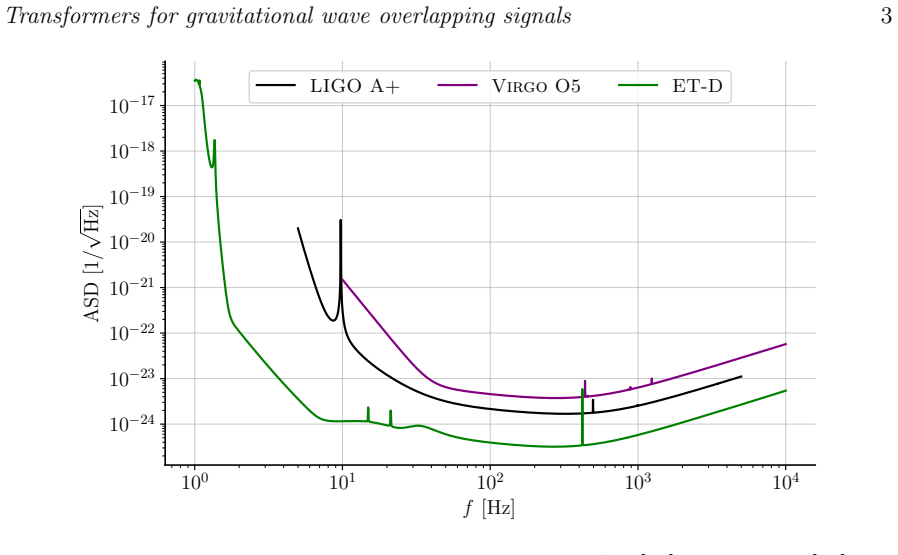
- domain assumption Gaussian colored noise shaped by the ET-D ASD is an adequate stand-in for Einstein Telescope noise in the inference task.
- domain assumption The priors in Table 1 (masses 100-800 solar masses, SNR 10-150, etc.) cover the signal space the pipeline claims to handle.
- domain assumption Ordering the sources by network SNR and the spectral-clustering post-processing resolves the label-switching degeneracy.
- standard math PP-plot and KS-test calibration on 64 injections is sufficient to validate posterior calibration.
Cite this review
Pith. "Pith review of Can Transformers help us perform parameter estimation of overlapping signals in gravitational wave detectors?." pith.science (2026). https://pith.science/paper/635X426C
@misc{pith2026250502773,
  author       = {Pith},
  title        = {Pith review of: Can Transformers help us perform parameter estimation of overlapping signals in gravitational wave detectors?},
  year         = {2026},
  howpublished = {\url{https://pith.science/paper/635X426C}},
  note         = {Machine review of arXiv:2505.02773}
}
read the original abstract
Overlapping signals represent one of the major data analysis challenges in next-generation gravitational wave detectors. We leverage Transformers and Normalizing Flows, state-of-the-art machine learning algorithms, to address the parameter estimation of overlapping binary black hole mergers in the Einstein Telescope (ET). Our proposed model combines a Transformer-based "Knowledge Extractor Neural Network" (KENN) with a Normalizing Flow (HYPERION) to perform rapid and unbiased inference over multiple overlapping black hole binary events. The choice of architecture leverages the strength of Transformers in capturing complex and long-range temporal structures in the strain time series data, while Normalizing Flows provide a powerful framework to sample posterior distributions. We demonstrate the effectiveness and robustness of our model over simulated gravitational wave signals, showing that it maintains the same level of accuracy regardless of the correlation level in the data. Moreover our model provides estimates of chirp mass and coalescence times within <10-20% from the true simulated value. The results obtained are promising and show how this approach might represent a first step toward a deep-learning based inference pipeline for ET and other future gravitational wave detectors.
Figures


Figures from the paper (4 more)


Reference graph
Works this paper leans on
-
[1]
Abbott B P et al. (LIGO Scientific, Virgo) 2016 Observation of Gravitational Waves from a Binary Black Hole Merger Phys. Rev. Lett. 116 061102 [arXiv:1602.03837]
arXiv 2016
-
[2]
Broekgaarden F S, Banagiri S and Payne E 2024 Visualizing the Number of Existing and Future Gravitational-wave Detections from Merging Double Compact Objects Astrophys. J. 969 108 [arXiv:2303.17628]
arXiv 2024
-
[3]
Maggiore M et al. (ET) 2020 Science Case for the Einstein Telescope JCAP 03 050 [arXiv:1912.02622] Transformers for gravitational wave overlapping signals 16
arXiv 2020
-
[4]
2021 A Horizon Study for Cosmic Explorer: Science, Observatories, and Community [arXiv:2109.09882]
Evans M et al. 2021 A Horizon Study for Cosmic Explorer: Science, Observatories, and Community [arXiv:2109.09882]
arXiv 2021
-
[5]
2017 Laser interferometer space antenna [arXiv:1702.00786]
Amaro-Seoane P et al. 2017 Laser interferometer space antenna [arXiv:1702.00786]
arXiv 2017
-
[6]
Iacovelli F et al. 2022 Forecasting the Detection Capabilities of Third-generation Gravitational-wave Detectors Using GWFAST Astrophys. J. 941 208 [arXiv:2207.02771]
arXiv 2022
-
[7]
Branchesi M et al. 2023 Science with the Einstein Telescope: a comparison of different designs JCAP 07 068 [arXiv:2303.15923]
arXiv 2023
-
[8]
Baker A M et al. 2025 Significant challenges for astrophysical inference with next-generation gravitational-wave observatories [arXiv:2503.04073]
arXiv 2025
Show all 70 references
-
[9]
2022 Toward inference of overlapping gravitational-wave signals Phys
Pizzati E et al. 2022 Toward inference of overlapping gravitational-wave signals Phys. Rev. D 105 104016 [arXiv:2102.07692]
2022 arXiv
-
[10]
2021 Biases in parameter estimation from overlapping gravitational-wave signals in the third-generation detector era Phys
Samajdar A et al. 2021 Biases in parameter estimation from overlapping gravitational-wave signals in the third-generation detector era Phys. Rev. D 104 044003 [arXiv:2102.07544]
2021 arXiv
-
[11]
Dang Y, Wang Z, Liang D and Shao L 2024 Impact of Overlapping Signals on Parameterized Post-Newtonian Coefficients in Tests of Gravity Astrophys. J. 964 194 [arXiv:2311.16184]
2024 arXiv
-
[12]
Sachdev S, Regimbau T and Sathyaprakash B S 2020Subtracting compact binary foreground sources to reveal primordial gravitational-wave backgrounds Phys. Rev. D102 024051 [arXiv:2002.05365]
2002 arXiv
-
[13]
2023 Subtracting compact binary foregrounds to search for subdominant gravitational- wave backgrounds in next-generation ground-based observatories Phys
Zhou B et al. 2023 Subtracting compact binary foregrounds to search for subdominant gravitational- wave backgrounds in next-generation ground-based observatories Phys. Rev. D 108 064040 [arXiv:2209.01310]
2023 arXiv
-
[14]
Himemoto Y, Nishizawa A and Taruya A 2021 Impacts of overlapping gravitational-wave signals on the parameter estimation: Toward the search for cosmological backgrounds Phys. Rev. D 104(4) 044010
2021
-
[15]
2024 Searching for cosmological stochastic backgrounds by notching out resolvable compact binary foregrounds with next-generation gravitational-wave detectors Phys
Zhong H et al. 2024 Searching for cosmological stochastic backgrounds by notching out resolvable compact binary foregrounds with next-generation gravitational-wave detectors Phys. Rev. D 110 064047 [arXiv:2406.10757]
2024 arXiv
-
[16]
2025 The Science of the Einstein Telescope [arXiv:2503.12263]
Abac A et al. 2025 The Science of the Einstein Telescope [arXiv:2503.12263]
2025 arXiv
-
[17]
2025 Applications of machine learning in gravitational-wave research with current interferometric detectors Living Rev
Cuoco E et al. 2025 Applications of machine learning in gravitational-wave research with current interferometric detectors Living Rev. Rel. 28 2 [arXiv:2412.15046]
2025 arXiv
- [18]
-
[19]
2023 Deep residual networks for gravitational wave detection Phys
Nousi P et al. 2023 Deep residual networks for gravitational wave detection Phys. Rev. D 108 024022 [arXiv:2211.01520]
2023 arXiv
-
[20]
2023 An autoencoder neural network integrated into gravitational-wave burst searches to improve the rejection of noise transients Class
Bini S et al. 2023 An autoencoder neural network integrated into gravitational-wave burst searches to improve the rejection of noise transients Class. Quant. Grav. 40 135008 [arXiv:2303.05986]
2023 arXiv
-
[21]
Chan M L, Heng I S and Messenger C 2020 Detection and classification of supernova gravitational wave signals: A deep learning approach Phys. Rev. D 102 043022 [arXiv:1912.13517]
2020 arXiv
-
[22]
Modafferi L M, Tenorio R and Keitel D 2023 Convolutional neural network search for long-duration transient gravitational waves from glitching pulsars Phys. Rev. D 108 023005 [arXiv:2303.16720]
2023 arXiv
-
[23]
2021 Real-Time Gravitational Wave Science with Neural Posterior Estimation Phys
Dax M et al. 2021 Real-Time Gravitational Wave Science with Neural Posterior Estimation Phys. Rev. Lett. 127 241103 [arXiv:2106.12594]
2021 arXiv
-
[24]
Williams M J, Veitch J and Messenger C 2021 Nested sampling with normalizing flows for gravitational-wave inference Phys. Rev. D 103 103006 [arXiv:2102.11056]
2021 arXiv
-
[25]
2022 Bayesian parameter estimation using conditional variational autoencoders for gravitational-wave astronomy Nature Phys
Gabbard H et al. 2022 Bayesian parameter estimation using conditional variational autoencoders for gravitational-wave astronomy Nature Phys. 18 112–117 [arXiv:1909.06296]
2022 arXiv
-
[26]
2023 GWitchHunters: Machine learning and citizen science to improve the performance of gravitational wave detector Nucl
Razzano M et al. 2023 GWitchHunters: Machine learning and citizen science to improve the performance of gravitational wave detector Nucl. Instrum. Meth. A 1048 167959 [arXiv:2301.05112]
2023 arXiv
-
[27]
2017 Gravity Spy: Integrating Advanced LIGO Detector Characterization, Machine Learning, and Citizen Science Class
Zevin M et al. 2017 Gravity Spy: Integrating Advanced LIGO Detector Characterization, Machine Learning, and Citizen Science Class. Quant. Grav. 34 064003 [arXiv:1611.04596]
2017 arXiv
-
[28]
Bacon P, Trovato A and Bejger M 2023Denoising gravitational-wave signals from binary black holes with a dilated convolutional autoencoder Mach. Learn. Sci. Tech. 4 035024 [arXiv:2205.13513] Transformers for gravitational wave overlapping signals 17
-
[29]
Ma P X and Vajente G 2024 A deep learning technique to control the non-linear dynamics of a gravitational-wave interferometer Class. Quant. Grav. 41 045003 [arXiv:2302.07921]
2024 arXiv
-
[30]
2024 Deep learning to detect gravitational waves from binary close encounters: Fast parameter estimation using normalizing flows Phys
De Santi F et al. 2024 Deep learning to detect gravitational waves from binary close encounters: Fast parameter estimation using normalizing flows Phys. Rev. D 109 102004 [arXiv:2404.12028]
2024
-
[31]
Vaswani A et al.2017 [arXiv:1706.03762]
2017 arXiv
-
[32]
Devlin J et al.2019 [arXiv:1810.04805]
2019 arXiv
-
[33]
2024 GPT-4 Technical Report [arXiv:2303.08774]
OpenAI et al. 2024 GPT-4 Technical Report [arXiv:2303.08774]
2024 arXiv
-
[34]
2022 Robust speech recognition via large-scale weak supervision[arXiv:2212.04356]
Radford A et al. 2022 Robust speech recognition via large-scale weak supervision[arXiv:2212.04356]
2022 arXiv
-
[35]
Publicly available at URL https://dcc.ligo.org/LIGO-T2000012/public
-
[36]
Publicly available at URL https://apps.et-gw.eu/tds/?r=14065
-
[37]
(LIGO Scientific, Virgo) 2017 GW170817: Observation of Gravitational Waves from a Binary Neutron Star Inspiral Phys
Abbott B P et al. (LIGO Scientific, Virgo) 2017 GW170817: Observation of Gravitational Waves from a Binary Neutron Star Inspiral Phys. Rev. Lett. 119 161101 [arXiv:1710.05832]
2017 arXiv
-
[38]
2023 Analyses of overlapping gravitational wave signals using hierarchical subtraction and joint parameter estimation Mon
Janquart J et al. 2023 Analyses of overlapping gravitational wave signals using hierarchical subtraction and joint parameter estimation Mon. Not. Roy. Astron. Soc. 523 1699–1710 [arXiv:2211.01304]
2023 arXiv
-
[39]
Relton P and Raymond V 2021 Parameter estimation bias from overlapping binary black hole events in second generation interferometers Phys. Rev. D 104 084039 [arXiv:2103.16225]
2021 arXiv
-
[40]
Antonelli A, Burke O and Gair J R 2021 Noisy neighbours: inference biases from overlapping gravitational-wave signals Mon. Not. Roy. Astron. Soc. 507 5069–5086 [arXiv:2104.01897]
2021 arXiv
-
[41]
Himemoto Y, Nishizawa A and Taruya A 2021 Impacts of overlapping gravitational-wave signals on the parameter estimation: Toward the search for cosmological backgrounds Phys. Rev. D 104 044010 [arXiv:2103.14816]
2021 arXiv
-
[42]
2024 Anatomy of parameter-estimation biases in overlapping gravitational-wave signals Class
Wang Z et al. 2024 Anatomy of parameter-estimation biases in overlapping gravitational-wave signals Class. Quant. Grav. 41 055011 [arXiv:2304.06734]
2024 arXiv
-
[43]
Johnson A D, Chatziioannou K and Farr W M 2024 Source confusion from neutron star binaries in ground-based gravitational wave detectors is minimal Phys. Rev. D 109 084015 [arXiv:2402.06836]
2024 arXiv
-
[44]
2017 On the likelihood of detecting gravitational waves from Population III compact object binaries Mon
Belczynski K et al. 2017 On the likelihood of detecting gravitational waves from Population III compact object binaries Mon. Not. Roy. Astron. Soc. 471 4702–4721 [arXiv:1612.01524]
2017 arXiv
-
[45]
Oguri M 2018 Effect of gravitational lensing on the distribution of gravitational waves from distant binary black hole mergers Mon. Not. Roy. Astron. Soc. 480 3842–3855 [arXiv:1807.02584]
2018 arXiv
-
[46]
(KAGRA, VIRGO, LIGO Scientific) 2023 Population of Merging Compact Binaries Inferred Using Gravitational Waves through GWTC-3 Phys
Abbott R et al. (KAGRA, VIRGO, LIGO Scientific) 2023 Population of Merging Compact Binaries Inferred Using Gravitational Waves through GWTC-3 Phys. Rev. X 13 011048 [arXiv:2111.03634]
2023 arXiv
-
[47]
2014 Learning phrase representations using rnn encoder-decoder for statistical machine translation [arXiv:1406.1078]
Cho K et al. 2014 Learning phrase representations using rnn encoder-decoder for statistical machine translation [arXiv:1406.1078]
2014 arXiv
-
[48]
Hochreiter S and Schmidhuber J 1997 Long short-term memory Neural computation 9 1735–1780
1997
-
[49]
Dey R and Salem F M 2017 Gate-variants of gated recurrent unit (gru) neural networks
2017
-
[50]
IEEE Press In 237–243
Informatik F, Bengio Y, Frasconi P and Schmidhuber J 2003 Gradient flow in recurrent nets: the difficulty of learning long-term dependencies A Field Guide to Dynamical Recurrent Neural Networks. IEEE Press In 237–243
2003
-
[51]
Ruthotto L and Haber E 2021 An introduction to deep generative modeling [arXiv:2103.05180]
2021 arXiv
-
[52]
2021 Normalizing flows for probabilistic modeling and inference [arXiv:1912.02762]
Papamakarios G et al. 2021 Normalizing flows for probabilistic modeling and inference [arXiv:1912.02762]
2021 arXiv
-
[53]
Dinh L, Sohl-Dickstein J and Bengio S 2017 Density estimation using real nvp [arXiv:1605.08803]
2017 arXiv
-
[54]
Green S R and Gair J 2021 Complete parameter inference for GW150914 using deep learning Mach. Learn. Sci. Tech. 2 03LT01 [arXiv:2008.03312]
2021 arXiv
-
[55]
2024 Characterizing the Sardinia candidate site for the Einstein Telescope Proceedings of Science (TAUP2023) 110
Naticchioni L et al. 2024 Characterizing the Sardinia candidate site for the Einstein Telescope Proceedings of Science (TAUP2023) 110
2024
-
[56]
2021 Computationally efficient models for the dominant and subdominant harmonic modes of precessing binary black holes Phys
Pratten G et al. 2021 Computationally efficient models for the dominant and subdominant harmonic modes of precessing binary black holes Phys. Rev. D 103 104056 [arXiv:2004.06503] Transformers for gravitational wave overlapping signals 18
2021 arXiv
-
[57]
2024 gwastro/pycbc: v2.3.3 release of PyCBC
Nitz A et al. 2024 gwastro/pycbc: v2.3.3 release of PyCBC
2024
-
[58]
2019 PyTorch: An Imperative Style, High-Performance Deep Learning Library [arXiv:1912.01703]
Paszke A et al. 2019 PyTorch: An Imperative Style, High-Performance Deep Learning Library [arXiv:1912.01703]
2019 arXiv
-
[59]
Chen X, Li S and Cao Z 2019 Mass–redshift degeneracy for the gravitational-wave sources in the vicinity of supermassive black holes Mon. Not. Roy. Astron. Soc. 485 L141–L145 [arXiv:1703.10543]
2019 arXiv
-
[60]
2019 Label switching problem in bayesian analysis for gravitational wave astronomy Phys
Buscicchio R et al. 2019 Label switching problem in bayesian analysis for gravitational wave astronomy Phys. Rev. D 100(8) 084041 [arXiv:1907.11631]
2019 arXiv
-
[61]
2024 Galaxy lens reconstruction based on strongly lensed gravitational waves: similarity transformation degeneracy and mass-sheet degeneracy Mon
Poon J S C et al. 2024 Galaxy lens reconstruction based on strongly lensed gravitational waves: similarity transformation degeneracy and mass-sheet degeneracy Mon. Not. Roy. Astron. Soc. 536 2212–2233 [arXiv:2406.06463]
2024 arXiv
-
[62]
Kingma D P and Ba J 2017 Adam: A method for stochastic optimization [arXiv:1412.6980]
2017 arXiv
-
[63]
von Luxburg U 2007 A Tutorial on Spectral Clustering [arXiv:0711.0189]
2007 arXiv
-
[64]
2025 Which Is Which? Identification of the Two Compact Objects in Gravitational- Wave Binaries Phys
Gerosa D et al. 2025 Which Is Which? Identification of the Two Compact Objects in Gravitational- Wave Binaries Phys. Rev. Lett. 134 121402 [arXiv:2409.07519]
2025
-
[65]
Goldberger J, Hinton G E, Roweis S and Salakhutdinov R R 2004 Neighbourhood components analysis Advances in Neural Information Processing Systems vol 17 (MIT Press) pp 513–520
2004
-
[66]
2011 Scikit-learn: Machine Learning in Python Journal of Machine Learning Research 12 2825–2830 [arXiv:1201.0490]
Pedregosa F et al. 2011 Scikit-learn: Machine Learning in Python Journal of Machine Learning Research 12 2825–2830 [arXiv:1201.0490]
2011 arXiv
-
[67]
Crouse D F 2016 On implementing 2d rectangular assignment algorithms IEEE Transactions on Aerospace and Electronic Systems 52 1679–1696
2016
-
[68]
2015 Parameter estimation for compact binaries with ground-based gravitational- wave observations using the LALInference software library Phys
Veitch J et al. 2015 Parameter estimation for compact binaries with ground-based gravitational- wave observations using the LALInference software library Phys. Rev. D 91 042003 [arXiv:1409.7215]
2015 arXiv
-
[69]
Papalini L 2025 KENN https://github.com/luciapapalini/kenn-gw-transformer.git
2025
-
[70]
De Santi F 2024 HYPERION https://github.com/fdesanti/HYPERION
2024
Reviewed August 16, 2026 · model on record in the stance chip above.
Discussion (0). Continue with ORCID to comment.