REVIEW 4 major objections 5 minor 47 references
Scalability Matters: Overcoming Challenges in InstructGLM with Similarity-Degree-Based Sampling
T0 review · 4 major / 5 minor · reviewed 2026-08-16 · deepseek-v4-flash
Pith's one-line read Replacing InstructGLM's random neighbor sampling with a similarity-degree biased random walk and hop-aware token allocation gives consistent node-classification gains and lower token cost, the paper argues.
desk verdict A sensible incremental idea with a confounded evaluation that does not support the headline accuracy claims. read the letter →
The pith
A machine-rendered reading of the paper's core claim, the machinery that carries it, and where it could break.
The reading
What carries the argument
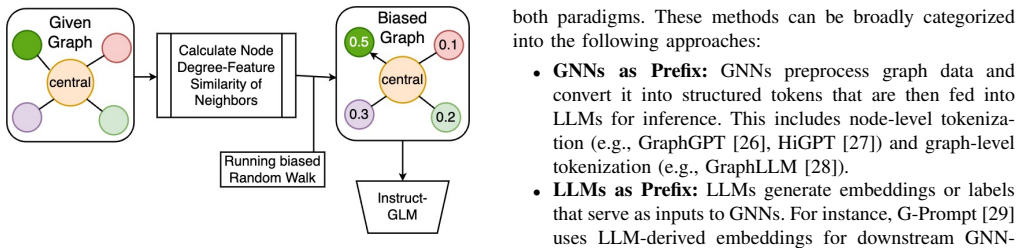
The load-bearing mechanism is a biased random walk with transition probability $$p(v|u) = \text{softmax}(\cos\text{Sim}(h_u,h_v) \cdot \deg(v)).$$ The cosine similarity term keeps the walk near nodes whose text features match the anchor, and the degree term pulls it toward hubs; the same product serves as a ranking score for ordering nodes in the sequence. A hop-aware sampling rule $$N_{\text{sample}}(h) = \min\left(N_{\text{hop}}(h), \frac{T_{\max}}{T_{\text{avg}}}\right)$$ then caps how many nodes are encoded from each hop so the prompt fits the LLM's token limit while preserving a balanced spread of local and global context.
What would settle it
Re-run the CORA and PUBMED node-classification comparison with identical node features (either both TF-IDF or both BERT) and identical training epochs (both 2 or both 4), keeping only the sampling rule different; if the accuracy gap shrinks to near zero or reverses, the central claim is not supported. A second check is to run the link-prediction experiments the abstract promises, since no link-prediction results appear in the paper.
Extended reading notes
Core claim
The central claim is that the way neighborhoods are sampled into the prompt, not the LLM's architecture, is the main lever for making LLM-only graph learning work under token constraints. Concretely, the paper claims that computing a transition score as the product of cosine similarity between node feature embeddings and the neighbor's degree, then softmax-normalizing over neighbors, produces walks that retain both semantically relevant and structurally central nodes. Combined with ordering sampled nodes by the same score and capping per-hop node counts by the token budget, this 'similarity-degree-based' sampling consistently outperforms InstructGLM's random neighbor sampling across 1-, 2-, and 3-hop settings on both CORA and PUBMED, while using fewer tokens. The ablation studies are offered as evidence that both the similarity term and the degree term contribute to the gain, especially on the sparser CORA graph.
Load-bearing premise
The reported superiority assumes the comparison isolates the sampling mechanism, but the experiments change node features from TF-IDF to BERT and cut training from 4 to 2 epochs at the same time, so those changes could explain some or all of the accuracy gap.
Editorial extensions
If this is right
- If the sampling rule is the cause of the gains, then other LLM-only graph methods can adopt the same similarity-degree walk without changing the underlying model architecture.
- Hop-aware token allocation gives a principled way to scale LLM-only graph processing to larger graphs than CORA and PUBMED, since the prompt stays within budget while coverage follows the graph's natural density.
- The strong ablation results on CORA imply that on sparse, class-heavy graphs, feature similarity and hub selection matter more, while on dense, text-rich graphs like PUBMED, the choice of sampling matters less.
- The consistent small gains on PUBMED at all hop depths suggest the method does not trade local accuracy for global context, which is a direct counter to the usual random-sampling information loss.
Reading between the lines
- A testable extension the authors leave implicit is to run the same comparison on a deliberately heterophilic graph, where connected nodes tend to differ in class; the degree term could either help by finding hubs or hurt by over-weighting dissimilar neighbors.
- Because the abstract claims link-prediction gains but the experiments only report node classification, the link-prediction claim is currently an unsupported inference of the paper, and a companion experiment would settle it.
- The degree-bias term resembles a popularity prior, so in graphs with skewed degree distributions it may push the walk toward a few hubs and reduce coverage; that is a plausible failure mode worth checking, not something the paper tests.
- The scalability claim rests on CORA and PUBMED only, and the authors state they could not run the ArXiv dataset used in the original InstructGLM because of replication issues, so scaling to large graphs remains untested.
Signed reviews
Editorial analysis
A structured set of objections, weighed in public.
Referee Report
Summary. The paper proposes SDM-InstructGLM, a modification of the InstructGLM framework for graph learning with LLMs. The method replaces InstructGLM's random neighbor sampling with a similarity-degree biased random walk, adds a structured node ordering scheme, and introduces hop-aware node selection under token constraints. The authors report node-classification accuracy on CORA and PUBMED, claiming consistent improvements over the original InstructGLM across 1-, 2-, and 3-hop settings, and they provide ablations removing the cosine-similarity and degree terms. Source code is made available on GitHub.
Significance. If the reported gains were attributable to the proposed sampling mechanism, the work would offer a simple, interpretable, and token-efficient way to scale LLM-only graph processing, which is a genuinely useful direction. The paper also provides public code and performs component-level ablations, which are strengths. However, the central comparison in Table II changes node features and training epochs simultaneously with the sampling method, so the headline accuracy gap cannot be attributed to SDM. The abstract additionally claims link-prediction improvements without reporting any link-prediction experiments, and the claimed benefit of structured node ordering is not supported by a dedicated experiment. As presented, the core contribution is not established.
major comments (4)
- [Section V-A, Table II] The headline comparison is confounded. The baseline uses TF-IDF features and was typically trained for 4 epochs, while SDM-InstructGLM uses BERT-based embeddings and is trained for 2 epochs (Section V-A explicitly states both changes). On CORA, where the reported gains are 13–19 points, the improvement could plausibly come from the stronger feature encoder or the different training budget rather than from similarity-degree sampling. A controlled comparison that runs the original random-sampling InstructGLM with BERT features, 2 epochs, and the same token budget is necessary before RQ1 can be answered.
- [Abstract, Section V-B] The abstract claims that the method 'enhances performance on graph-based tasks such as node classification and link prediction,' but no link-prediction experiment appears anywhere in the manuscript; Tables II–IV report only node-classification accuracy. The statement in Section V-A that readers should consult prior InstructGLM work for GNN and Graph Transformer comparisons does not supply the missing experiments, so the scope and evidence for the stated claims are mismatched.
- [Section IV-B, Section VI] Section IV-B asserts that 'Empirical results demonstrate that this method outperforms random ordering,' but no experiment isolating the structured-ordering component is reported. The conclusion itself lists as future work the goal of identifying the dataset characteristics that give the node-ordering method its advantage over the random-walk method, which indicates that the ordering benefit is not yet established by the present evidence.
- [Section IV-C] The hop-aware token allocation formula Nsample(h) = min(Nhop(h), Tmax/Tavg) applies the same global node cap to each hop rather than distributing the token budget according to the empirical hop distribution as the text claims. The manuscript also does not report any verification that total token consumption stays within Tmax under this rule, so the token-efficiency advantage over fixed-threshold sampling is not demonstrated.
minor comments (5)
- [References] Reference [14] appears to be a placeholder ('F. Author and S. Author') with no real venue, and references [13] and [34] are identical; reference [37] duplicates reference [8]. These should be corrected.
- [Table IV] The InstructGLM baseline numbers in Table IV (88.26, 89.53, 89.55) differ from the corresponding numbers in Table II (91.56, 90.87, 90.85) without explanation; if the limited-prompt-node setup changes the baseline, the discrepancy should be described explicitly.
- [Section I] The Introduction contains a typo: 'link prediction., graph reasoning' has a stray period before the comma.
- [Section IV-C] The sentence 'Empirical evaluations confirm that this structured sampling approach improves subgraph representation' reports a result that is not tied to any table or figure in the paper; either cite the relevant experiment or remove the sentence.
- [Section V-A] The statement that the model 'consistently surpasses previous benchmarks' is not backed by a comparison table and should be either substantiated with numbers or softened to match the reported experiments.
Circularity Check
No significant circularity: the method is a heuristic sampling rule evaluated against an external baseline, and no prediction reduces to a fitted input or self-citation chain.
full rationale
The paper's derivation chain is empirical rather than definitional. Equations (10)-(13) define the biased random walk transition probability directly from cosine similarity and degree centrality, and the hop-aware node count in Section IV-C is a heuristic allocation rule based on dataset statistics; neither is derived from the accuracy results it later reports, so no prediction is equivalent to its input by construction. Table II compares SDM-InstructGLM against the external InstructGLM baseline, and Tables III-IV are ablations within the proposed method. Although the baseline comparison simultaneously changes node features from TF-IDF to BERT embeddings and reduces training from 4 to 2 epochs, that is a valid experimental-confounding concern about attribution of the accuracy gains, not a circularity in the mathematical or argumentative sense. The self-citations [13] and [34] point to the authors' own WalkLM community-detection paper, but that work is cited only as an example of LLMs-only graph methods and is not used to justify the central claim or to forbid alternatives. No uniqueness theorem is imported from the authors' prior work, no fitted parameter is renamed as a prediction, and no known result is merely renamed. Accordingly, the paper shows no circular reasoning under the supplied criteria.
Assumptions & free parameters
free parameters (2)
- T_max (maximum token budget for node representations)
- T_avg (estimated token cost per node)
assumptions (5)
- standard math Softmax normalization of the biased transition scores yields a valid sampling distribution.
- domain assumption Cosine similarity of BERT node embeddings captures semantic relevance for node classification.
- domain assumption Degree centrality is a valid proxy for structural importance in these graphs.
- domain assumption Homophily holds: nodes with similar features and high degree are informative for classification.
- domain assumption The InstructGLM textual prompt representation (Equations 5-7) faithfully encodes graph structure.
Cite this review
Pith. "Pith review of Scalability Matters: Overcoming Challenges in InstructGLM with Similarity-Degree-Based Sampling." pith.science (2026). https://pith.science/paper/MSTBAP7N
@misc{pith2026250503799,
  author       = {Pith},
  title        = {Pith review of: Scalability Matters: Overcoming Challenges in InstructGLM with Similarity-Degree-Based Sampling},
  year         = {2026},
  howpublished = {\url{https://pith.science/paper/MSTBAP7N}},
  note         = {Machine review of arXiv:2505.03799}
}
read the original abstract
Large Language Models (LLMs) have demonstrated strong capabilities in various natural language processing tasks; however, their application to graph-related problems remains limited, primarily due to scalability constraints and the absence of dedicated mechanisms for processing graph structures. Existing approaches predominantly integrate LLMs with Graph Neural Networks (GNNs), using GNNs as feature encoders or auxiliary components. However, directly encoding graph structures within LLMs has been underexplored, particularly in the context of large-scale graphs where token limitations hinder effective representation. To address these challenges, we propose SDM-InstructGLM, a novel instruction-tuned Graph Language Model (InstructGLM) framework that enhances scalability and efficiency without relying on GNNs. Our method introduces a similarity-degree-based biased random walk mechanism, which selectively samples and encodes graph information based on node-feature similarity and degree centrality, ensuring an adaptive and structured representation within the LLM. This approach significantly improves token efficiency, mitigates information loss due to random sampling, and enhances performance on graph-based tasks such as node classification and link prediction. Furthermore, our results demonstrate the feasibility of LLM-only graph processing, enabling scalable and interpretable Graph Language Models (GLMs) optimized through instruction-based fine-tuning. This work paves the way for GNN-free approaches to graph learning, leveraging LLMs as standalone graph reasoning models. Our source code is available on GitHub.
Figures

Reference graph
Works this paper leans on
-
[14]
Challenges and opportunities in gnn-llm integration,
F. Author and S. Author, “Challenges and opportunities in gnn-llm integration,” Journal of AI Research , vol. 15, no. 4, pp. 567–589, 2023
work page 2023
-
[34]
Enhancing graph representation learning with walklm for effective community detection,
H. Lee, M. Islam, C. Yi, and C. N. Chakraborttii, “Enhancing graph representation learning with walklm for effective community detection,” in Proceedings of the 11th International Conference on Networking, Systems, and Security , ser. NSysS ’24. New York, NY , USA: Association for Computing Machinery, 2025, p. 41–47. [Online]. Available: https://doi.org/1...
arXiv 2025
-
[1]
Bert: Pre-training of deep bidirectional transformers for language understanding,
J. Devlin, M.-W. Chang, K. Lee, and K. Toutanova, “Bert: Pre-training of deep bidirectional transformers for language understanding,” 2019. [Online]. Available: https://arxiv.org/abs/1810.04805
arXiv 2019
-
[2]
Llama: Open and efficient foundation language models,
H. Touvron, T. Lavril, G. Izacard, X. Martinet, M.-A. Lachaux, T. Lacroix, B. Rozi `ere, N. Goyal, E. Hambro, F. Azhar, A. Rodriguez, A. Joulin, E. Grave, and G. Lample, “Llama: Open and efficient foundation language models,” 2023. [Online]. Available: https: //arxiv.org/abs/2302.13971
arXiv 2023
-
[3]
Learning transferable visual models from natural language supervision,
A. Radford, J. W. Kim, C. Hallacy, A. Ramesh, G. Goh, S. Agarwal, G. Sastry, A. Askell, P. Mishkin, J. Clark, G. Krueger, and I. Sutskever, “Learning transferable visual models from natural language supervision,” 2021. [Online]. Available: https://arxiv.org/abs/2103.00020
arXiv 2021
-
[4]
Flamingo: a visual language model for few-shot learning,
J.-B. Alayrac, J. Donahue, P. Luc, A. Miech, I. Barr, Y . Hasson, K. Lenc, A. Mensch, K. Millican, M. Reynolds, R. Ring, E. Rutherford, S. Cabi, T. Han, Z. Gong, S. Samangooei, M. Monteiro, J. Menick, S. Borgeaud, A. Brock, A. Nematzadeh, S. Sharifzadeh, M. Binkowski, R. Barreira, O. Vinyals, A. Zisserman, and K. Simonyan, “Flamingo: a visual language mod...
arXiv 2022
-
[5]
J. Li, D. Li, S. Savarese, and S. Hoi, “Blip-2: Bootstrapping language- image pre-training with frozen image encoders and large language models,” 2023. [Online]. Available: https://arxiv.org/abs/2301.12597
arXiv 2023
-
[6]
Coca: Contrastive captioners are image-text foundation models,
J. Yu, Z. Wang, V . Vasudevan, L. Yeung, M. Seyedhosseini, and Y . Wu, “Coca: Contrastive captioners are image-text foundation models,” 2022. [Online]. Available: https://arxiv.org/abs/2205.01917
arXiv 2022
Show all 47 references
-
[7]
Graph-bert: Only attention is needed for learning graph representations,
J. Zhang, H. Zhang, C. Xia, and L. Sun, “Graph-bert: Only attention is needed for learning graph representations,” 2020. [Online]. Available: https://arxiv.org/abs/2001.05140
2020 arXiv
-
[9]
Graphicl: Unlocking graph learning potential in llms through structured prompt design,
Y . Sun, Z. Ma, Y . Fang, J. Ma, and Q. Tan, “Graphicl: Unlocking graph learning potential in llms through structured prompt design,”
-
[10]
Llm and gnn are complementary: Distilling llm for multimodal graph learning,
J. Xu, Z. Wu, M. Lin, X. Zhang, and S. Wang, “Llm and gnn are complementary: Distilling llm for multimodal graph learning,” 2024. [Online]. Available: https://arxiv.org/abs/2406.01032
2024 arXiv
-
[11]
Can we soft prompt llms for graph learning tasks?
Z. Liu, X. He, Y . Tian, and N. V . Chawla, “Can we soft prompt llms for graph learning tasks?” in Companion Proceedings of the ACM Web Conference 2024 , ser. WWW ’24. ACM, May 2024, p. 481–484. [Online]. Available: http://dx.doi.org/10.1145/3589335.3651476
2024
-
[12]
A survey of graph meets large language model: Progress and future directions,
Y . Li, Z. Li, P. Wang, J. Li, X. Sun, H. Cheng, and J. X. Yu, “A survey of graph meets large language model: Progress and future directions,”
-
[15]
Llaga: Large language and graph assistant,
R. Chen, T. Zhao, A. Jaiswal, N. Shah, and Z. Wang, “Llaga: Large language and graph assistant,” 2024. [Online]. Available: https://arxiv.org/abs/2402.08170
2024 arXiv
-
[16]
A Note on Over-Smoothing for Graph Neural Networks,
C. Cai and Y . Wang, “A Note on Over-Smoothing for Graph Neural Networks,” 2020
2020
-
[17]
Graph neural networks exponentially lose expressive power for node classification,
K. Oono and T. Suzuki, “Graph neural networks exponentially lose expressive power for node classification,” 2021. [Online]. Available: https://arxiv.org/abs/1905.10947
2021 arXiv
-
[18]
Language is all a graph needs,
R. Ye, C. Zhang, R. Wang, S. Xu, and Y . Zhang, “Language is all a graph needs,” 2024. [Online]. Available: https://arxiv.org/abs/2308.07134
2024 arXiv
-
[19]
Semi-supervised classification with graph convolutional networks,
T. N. Kipf and M. Welling, “Semi-supervised classification with graph convolutional networks,” arXiv preprint arXiv:1609.02907 , 2016
2016 arXiv
-
[20]
Graph attention networks,
P. Veli ˇckovi´c, G. Cucurull, A. Casanova, A. Romero, P. Lio, and Y . Ben- gio, “Graph attention networks,” arXiv preprint arXiv:1710.10903, 2017
2017 arXiv
-
[21]
Inductive representation learning on large graphs,
W. L. Hamilton, R. Ying, and J. Leskovec, “Inductive representation learning on large graphs,” 2018. [Online]. Available: https://arxiv.org/ abs/1706.02216
2018 arXiv
-
[22]
Gpt-4 technical report,
OpenAI, J. Achiam, S. Adler, S. Agarwal, L. Ahmad, I. Akkaya, F. L. Aleman, D. Almeida, J. Altenschmidt, S. Altman, S. Anadkat, R. Avila, I. Babuschkin, S. Balaji, V . Balcom, P. Baltescu, H. Bao, M. Bavarian, J. Belgum, I. Bello, J. Berdine, G. Bernadett-Shapiro, C. Berner, L...
2024 arXiv
-
[23]
Scaling instruction-finetuned language models,
H. W. Chung, L. Hou, S. Longpre, B. Zoph, Y . Tay, W. Fedus, Y . Li, X. Wang, M. Dehghani, S. Brahma, A. Webson, S. S. Gu, Z. Dai, M. Suzgun, X. Chen, A. Chowdhery, A. Castro-Ros, M. Pellat, K. Robinson, D. Valter, S. Narang, G. Mishra, A. Yu, V . Zhao, Y . Huang, A. Dai, H. Y...
2022
-
[24]
Gpt4graph: Can large language models understand graph structured data ? an empirical evaluation and benchmarking,
J. Guo, L. Du, H. Liu, M. Zhou, X. He, and S. Han, “Gpt4graph: Can large language models understand graph structured data ? an empirical evaluation and benchmarking,” 2023. [Online]. Available: https://arxiv.org/abs/2305.15066
2023 arXiv
-
[25]
A survey of large language models for graphs,
X. Ren, J. Tang, D. Yin, N. Chawla, and C. Huang, “A survey of large language models for graphs,” in Proceedings of the 30th ACM SIGKDD Conference on Knowledge Discovery and Data Mining, 2024, pp. 6616– 6626
2024
-
[26]
Graphgpt: Graph instruction tuning for large language models,
J. Tang, Y . Yang, W. Wei, L. Shi, L. Su, S. Cheng, D. Yin, and C. Huang, “Graphgpt: Graph instruction tuning for large language models,” 2024. [Online]. Available: https://arxiv.org/abs/2310.13023
2024 arXiv
-
[27]
Higpt: Heterogeneous graph language model,
J. Tang, Y . Yang, W. Wei, L. Shi, L. Xia, D. Yin, and C. Huang, “Higpt: Heterogeneous graph language model,” 2024. [Online]. Available: https://arxiv.org/abs/2402.16024
2024 arXiv
-
[28]
Graphllm: Boosting graph reasoning ability of large language model,
Z. Chai, T. Zhang, L. Wu, K. Han, X. Hu, X. Huang, and Y . Yang, “Graphllm: Boosting graph reasoning ability of large language model,”
-
[29]
Prompt-based node feature extractor for few-shot learning on text-attributed graphs,
X. Huang, K. Han, D. Bao, Q. Tao, Z. Zhang, Y . Yang, and Q. Zhu, “Prompt-based node feature extractor for few-shot learning on text-attributed graphs,” 2023. [Online]. Available: https: //arxiv.org/abs/2309.02848
2023 arXiv
-
[30]
Opengraph: Towards open graph foundation models,
L. Xia, B. Kao, and C. Huang, “Opengraph: Towards open graph foundation models,” 2024. [Online]. Available: https://arxiv.org/abs/ 2403.01121
2024 arXiv
-
[31]
Greaselm: Graph reasoning enhanced language models for question answering,
X. Zhang, A. Bosselut, M. Yasunaga, H. Ren, P. Liang, C. D. Manning, and J. Leskovec, “Greaselm: Graph reasoning enhanced language models for question answering,” 2022. [Online]. Available: https://arxiv.org/abs/2201.08860
2022 arXiv
-
[32]
Disentangled representation learning with large language models for text-attributed graphs,
Y . Qin, X. Wang, Z. Zhang, and W. Zhu, “Disentangled representation learning with large language models for text-attributed graphs,” 2024. [Online]. Available: https://arxiv.org/abs/2310.18152
2024 arXiv
-
[33]
Walklm: A uniform language model fine-tuning framework for attributed graph embedding,
Y . Tan, Z. Zhou, H. Lv, W. Liu, and C. Yang, “Walklm: A uniform language model fine-tuning framework for attributed graph embedding,” in Advances in Neural Information Processing Systems , A. Oh, T. Nau- mann, A. Globerson, K. Saenko, M. Hardt, and S. Levine, Eds., vol. 36. C...
2023
-
[35]
Graphwiz: An instruction-following language model for graph problems,
N. Chen, Y . Li, J. Tang, and J. Li, “Graphwiz: An instruction-following language model for graph problems,” 2024. [Online]. Available: https://arxiv.org/abs/2402.16029
2024 arXiv
-
[36]
A generalization of transformer networks to graphs,
V . P. Dwivedi and X. Bresson, “A generalization of transformer networks to graphs,” 2021. [Online]. Available: https://arxiv.org/abs/2012.09699
2021 arXiv
-
[37]
Do transformers really perform bad for graph representation?
C. Ying, T. Cai, S. Luo, S. Zheng, G. Ke, D. He, Y . Shen, and T.-Y . Liu, “Do transformers really perform bad for graph representation?”
-
[38]
Graph convolutional neural networks for web-scale recommender systems,
R. Ying, R. He, K. Chen, P. Eksombatchai, W. L. Hamilton, and J. Leskovec, “Graph convolutional neural networks for web-scale recommender systems,” in Proceedings of the 24th ACM SIGKDD International Conference on Knowledge Discovery & Data Mining , ser. KDD ’18. ACM, Jul. 201...
2018
-
[39]
Revisiting semi- supervised learning with graph embeddings,
Z. Yang, W. W. Cohen, and R. Salakhutdinov, “Revisiting semi- supervised learning with graph embeddings,” 2016. [Online]. Available: https://arxiv.org/abs/1603.08861
2016 arXiv
-
[40]
Harnessing explanations: Llm-to-lm interpreter for enhanced text- attributed graph representation learning,
X. He, X. Bresson, T. Laurent, A. Perold, Y . LeCun, and B. Hooi, “Harnessing explanations: Llm-to-lm interpreter for enhanced text- attributed graph representation learning,” 2024. [Online]. Available: https://arxiv.org/abs/2305.19523
2024 arXiv
-
[41]
Open graph benchmark: Datasets for machine learning on graphs,
W. Hu, M. Fey, M. Zitnik, Y . Dong, H. Ren, B. Liu, M. Catasta, and J. Leskovec, “Open graph benchmark: Datasets for machine learning on graphs,” 2020
2020
-
[42]
Available: https://arxiv.org/abs/2106.05234
[Online]. Available: https://arxiv.org/abs/2106.05234
-
[43]
When do graph neural networks help with node classification? investigating the impact of homophily principle on node distinguishability,
S. Luan, C. Hua, M. Xu, Q. Lu, J. Zhu, X.-W. Chang, J. Fu, J. Leskovec, and D. Precup, “When do graph neural networks help with node classification? investigating the impact of homophily principle on node distinguishability,” 2024. [Online]. Available: https://arxiv.org/abs/2304.14274
2024 arXiv
-
[44]
Pubmed text similarity model and its application to curation efforts in the conserved domain database,
R. Islamaj, W. J. Wilbur, N. Xie, N. R. Gonzales, N. Thanki, R. Yamashita, C. Zheng, A. Marchler-Bauer, and Z. Lu, “Pubmed text similarity model and its application to curation efforts in the conserved domain database,” Database, vol. 2019, p. baz064, 07 2019. [Online]. Availa...
2019 doi
-
[47]
Decoupled weight decay regularization,
I. Loshchilov and F. Hutter, “Decoupled weight decay regularization,”
-
[2019]
Available: https://arxiv.org/abs/1711.05101
[Online]. Available: https://arxiv.org/abs/1711.05101
-
[2023]
Available: https://arxiv.org/abs/2310.05845
[Online]. Available: https://arxiv.org/abs/2310.05845
-
[2024]
Available: https://arxiv.org/abs/2311.12399
[Online]. Available: https://arxiv.org/abs/2311.12399
-
[2025]
Available: https://arxiv.org/abs/2501.15755
[Online]. Available: https://arxiv.org/abs/2501.15755
Reviewed August 16, 2026 · model on record in the stance chip above.
Discussion (0). Continue with ORCID to comment.