REVIEW 4 major objections 5 minor 28 references
Is the end of Insight in Sight ?
T0 review · 4 major / 5 minor · reviewed 2026-08-15 · deepseek-v4-flash
Pith's one-line read A physics-informed neural network trained on a Boltzmann-governed rarefied gas flow produces weight matrices that look Gaussian-random, with no visible trace of the governing physics.
desk verdict A readable perspective with a suggestive but under-supported empirical hook; the Gaussian-weight observation is real but doesn't carry the epistemological conclusion. read the letter →
The pith
A machine-rendered reading of the paper's core claim, the machinery that carries it, and where it could break.
The reading
What carries the argument
The object that carries the argument is the trained weight matrix $W_{ij}$ of the physics-informed neural network (PINN), read through the reinterpretation of a deep network as a discrete dynamical system in which the forward pass is a relaxation toward a local equilibrium $z_{eq}=f(Z)$, with $Z$ a shifted convolution of the signal by the weight kernel. In that reading, if the network's weights were related to a physical PDE, they would inherit its structure; for instance, a one-dimensional advection-diffusion operator would give a tridiagonal-dominant matrix, and the discrete Boltzmann operator would give a block-tridiagonal matrix in configuration space. The paper's inspection therefore looks for such structural signatures in the PINN's weight histograms and finds Gaussian-like distributions instead, using that contrast as the evidence for the claim.
What would settle it
Retrain the same PINN architecture on the same rarefied-gas data and compute, for each hidden layer, a quantitative distance between the empirical weight distribution and a best-fit Gaussian, for example the Kolmogorov-Smirnov statistic or the Wasserstein distance, comparing with the distribution of distances for a null ensemble of random matrices of the same shape; if any layer's departure from Gaussianity is large and varies systematically with the Knudsen number, the claim that the weights carry no physical trace is falsified.
Extended reading notes
Core claim
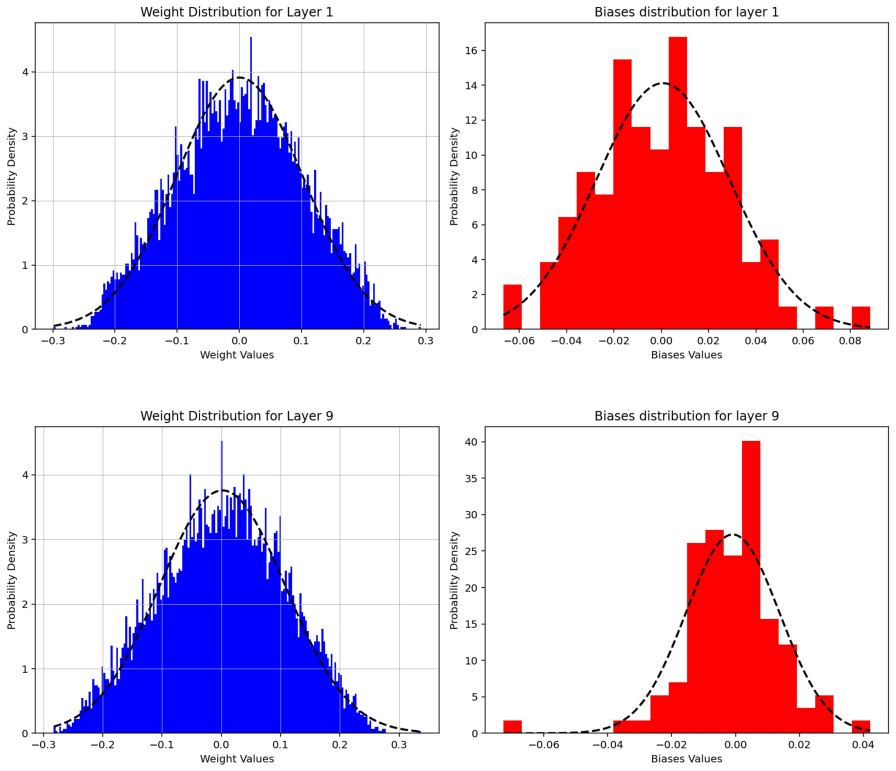
The central claim is that a PINN trained to reproduce the macroscopic fields of a body-force-driven rarefied gas flow through a periodic array of cylinders, governed by the Boltzmann equation, does not encode the governing physics in a way that is visible in its weights. The marginal probability density functions of the first and last hidden-layer weight matrices are approximately symmetric zero-mean Gaussian curves; the authors argue that products of such matrices remain effectively random, so deeper compositional structure is unlikely to restore interpretability. In contrast, the discrete Boltzmann operator on a regular spatial grid would be block-tridiagonal: blocks that may be random in velocity space but still tridiagonal in configuration space. The absence of such structure leads the authors to conclude that the PINN's success reflects a statistical interpolation path to the same solution, functionally equivalent to but epistemologically distinct from the mechanistic route of direct simulation.
Load-bearing premise
The load-bearing premise is that a trained network showing no block-tridiagonal or other visibly structured pattern in its weight values has therefore not encoded the governing physics, even though only the marginal distribution of individual weights, not the full compositional structure, was examined.
Editorial extensions
If this is right
- For a physicist trying to explain why a trained network works, the individual weight values of a PINN are not a promising place to look, even when the governing equations are fully known.
- The same numerical answer for a rarefied gas flow can be reached by two routes that differ in kind: one based on mechanistic simulation of collisions and transport, the other on statistical adjustment of parameters.
- The 'end of insight' debate gains a concrete laboratory test case, since it now concerns a problem of moderate rather than extreme complexity.
- The discrete-dynamical-system analogy between neural nets and PDE solvers is weakened for networks trained on non-metric input, because weight matrices need not inherit any coordinate ordering or local structure.
Reading between the lines
- The visual evidence presented is limited to marginal histograms; a quantitative Gaussianity test, such as comparing empirical moments or a Kolmogorov-Smirnov statistic against a Gaussian null ensemble, would determine whether the distributions are actually Gaussian or merely bell-shaped.
- The block-tridiagonal expectation applies to a discretization of the Boltzmann operator in configuration space, but a neural network is free to encode the same operator in a rotated or nonlocal basis; the absence of tridiagonal structure therefore does not by itself rule out physics being represented.
- A direct extension would be to train networks on problems whose discrete operator is exactly known and small, then check whether any regularization, such as sparsity, hard constraints, or spectral pruning, forces the learned weight statistics away from random-matrix universality.
Signed reviews
Editorial analysis
A structured set of objections, weighed in public.
Referee Report
Summary. The manuscript argues, through a case study of a physics-informed neural network (PINN) trained on a rarefied gas flow governed by the Boltzmann equation, that the trained network's weight matrices resemble Gaussian-distributed random matrices and show "no evident trace" of the underlying physical structure. The authors use the neural integro-equation (NIDE) interpretation of Section III to motivate the expectation that physical encoding would manifest as structured weight matrices, such as a block-tridiagonal discrete Boltzmann operator in configuration space. Section V reports histograms of the first and last hidden layer weights (Fig. 2) and concludes that deep learning and numerical simulation are two epistemologically distinct routes to the same outcome. Section VI then generalizes this single example to a broad claim about the limits of explainable AI.
Significance. If its central claim were quantitatively established, the paper would be a thought-provoking contribution to the interpretability debate, offering a concrete empirical case of a PINN that solves a well-understood physics problem without visibly encoding that physics. The strength of the paper is its clear, focused question and the simplicity of the weight-histogram observation, which is easily reproducible from the authors' earlier work. However, the significance depends entirely on the inferential step from visually Gaussian-looking histograms to "no structural imprint," and that step is not supported by any quantitative analysis. The paper provides no null-model comparison, no test of Gaussianity, no spectral or compositional analysis, and no comparison with the weight initialization. As it stands, the philosophical conclusion outruns the reported evidence.
major comments (4)
- [Section V, Fig. 2] The central inference that Gaussian-looking marginal histograms imply "no clear structural imprint from the underlying physics" is unsupported. Marginal Gaussianity is compatible with strongly structured matrices: for example, a block-tridiagonal matrix with i.i.d. Gaussian entries has Gaussian marginals while possessing strict sparsity and connectivity structure. The paper performs no quantitative Gaussianity test, no comparison with a null ensemble of random matrices, and no analysis of spectra, correlations, or sparsity. The conclusion in Section VI therefore outruns the evidence presented.
- [Section V] The statement that "the product of Gaussian-like matrices remains effectively random" is not substantiated and is not sufficient for the paper's conclusion. Products of Gaussian random matrices have known nontrivial spectral statistics, and the phrase "Gaussian-like" is never defined. Even if each layer's marginal distribution were exactly Gaussian, the composition of layers can encode structure through correlations, sparsity patterns, or nonlinear activation maps. To claim that the composed network carries no structure, the authors would need to analyze the composed map, the Jacobian, or the feature representations, not just the histograms of individual weight entries.
- [Sections III and IV] The benchmark against which "physical structure" is judged is mismatched with the actual network architecture. The NIDE argument in Eq. (7) treats W(q,q') as a convolution kernel acting on the physical coordinate q, which motivates the expectation of a block-tridiagonal weight matrix in configuration space. However, the PINN's hidden layers operate on internal activations, not on the physical spatial grid; the first layer consumes Fourier features of the coordinates, and subsequent layers mix abstract latent variables. There is therefore no reason for those weight matrices to resemble a discretization of the Boltzmann collision or streaming operator, and their failure to look block-tridiagonal is not evidence against physical encoding.
- [Section IV, Fig. 2] The paper does not report the network's initialization scheme or compare the trained weight distributions with the initial ones. With standard Glorot-style initialization, the weights are sampled from Gaussian-like distributions, so a Gaussian-looking histogram after training may be entirely uninformative unless the change due to training is characterized. Without such a comparison, the observation of Gaussian marginals in the trained network does not establish that learning has failed to imprint structure.
minor comments (5)
- [Equation (3)] The output-layer equation writes y = z^{L+1} = f(W^{L+1} z^l - b^{L+1}); the superscript should be z^L, not z^l, to be consistent with the notation for the last hidden layer defined in Eq. (2).
- [Fig. 2 caption and text] Fig. 2 shows only the first and last deep layers, while the text in Section V refers to "both shallow and deep layers." If the analysis is meant to cover all layers, please show all layer histograms or clarify that only two representative layers were inspected.
- [References] Reference [3], listed as "All nobel prizes (2025)", is not a standard citation and should be replaced with a proper reference or removed.
- [Throughout] There are several spacing and capitalization artifacts (e.g., "T AMING COMPLEXITY," "T able," "T ack") that should be corrected in a final version.
- [Title] The title's internal capitalization, "Is the end of Insight in Sight ?", is inconsistent with normal title conventions; please adjust to standard sentence case or title case.
Circularity Check
No significant circularity; the weight-histogram observation is empirical and not derived from fitted inputs.
full rationale
The paper's central claim—that the trained PINN's weight histograms resemble Gaussians and show no evident physical trace—is an empirical observation of a trained network, not a quantity derived from fitted parameters. No equation in the paper maps an input to a predicted output that was itself used as input; Fig. 2 reports the weight distributions, and the 'no trace' conclusion is an interpretation of that visual data. The self-references to [17] (NIDE analogy) and [19] (previous PINN training) are ordinary citations: [19] supplies the model under analysis (validated against DSMC), and [17] motivates an expectation that physical structure might appear, an expectation the paper itself labels 'naively argued.' Even if the inference from Gaussian marginals to 'no structure' is statistically weak, that is a correctness/rigor concern, not circularity. The block-tridiagonal benchmark is asserted from the Boltzmann operator, not imported as a fitted result. No step reduces by construction to its inputs; hence no significant circularity.
Assumptions & free parameters
assumptions (4)
- domain assumption The Boltzmann equation and its conservation laws are the correct governing model for the rarefied gas flow under study.
- ad hoc to paper If the network encoded the physics, its weight matrix should resemble the discrete Boltzmann operator, for example block-tridiagonal in configuration space.
- ad hoc to paper Gaussian marginal distributions of weights imply that the weights carry no structural information, and products of Gaussian-like matrices remain effectively random.
- domain assumption The trained PINN accurately reproduces the rarefied gas flow, as claimed in the abstract and Section V, based on the companion paper [19].
Cite this review
Pith. "Pith review of Is the end of Insight in Sight ?." pith.science (2026). https://pith.science/paper/4OXLZ2RJ
@misc{pith2026250504627,
  author       = {Pith},
  title        = {Pith review of: Is the end of Insight in Sight ?},
  year         = {2026},
  howpublished = {\url{https://pith.science/paper/4OXLZ2RJ}},
  note         = {Machine review of arXiv:2505.04627}
}
read the original abstract
The rise of deep learning challenges the longstanding scientific ideal of insight - the human capacity to understand phenomena by uncovering underlying mechanisms. In many modern applications, accurate predictions no longer require interpretable models, prompting debate about whether explainability is a realistic or even meaningful goal. From our perspective in physics, we examine this tension through a concrete case study: a physics-informed neural network (PINN) trained on a rarefied gas dynamics problem governed by the Boltzmann equation. Despite the system's clear structure and well-understood governing laws, the trained network's weights resemble Gaussian-distributed random matrices, with no evident trace of the physical principles involved. This suggests that deep learning and traditional simulation may follow distinct cognitive paths to the same outcome - one grounded in mechanistic insight, the other in statistical interpolation. Our findings raise critical questions about the limits of explainable AI and whether interpretability can - or should-remain a universal standard in artificial reasoning.
Figures

Reference graph
Works this paper leans on
-
[19]
D. Hassabis, D. Kumaran, C. Summerfield, and M. Botvinick, Neuroscience-inspired artificial intelligence, Neuron 95, 245 (2017)
work page 2017
-
[1]
Nonlinearity Nonlinear systems exhibit two distinguishing and far-reaching features: i) they do not re- spond proportionally to input, and ii) they transfer energy (information) across scales. This makes them erratic and hard to predict, but also capable of emergent phenomena—complex behavior arising from simple rules, biology being a goldmine of such ins...
-
[2]
Nonlocality In nonlocal systems, local behavior depends on distant states, often via long-range cou- plings. Although this interaction usually decays with the distance between the two regions, it cannot be ignored, no matter how far the interacting components are. A typical example from physics is classical gravitation, which is controlled by a potential ...
-
[3]
However, there is a subtler problem
Hyper-dimensionality High-dimensional systems often exhibit the so-called curse of dimensionality, where the effective state space grows exponentially with each added variable. However, there is a subtler problem. Indeed, due to nonlinearities, heterogeneities and other factors, hyper- dimensional systems are usually very sparse: i.e. the ”golden nuggets”...
-
[4]
A. Vaswani, N. Shazeer, N. Parmar, J. Uszkoreit, L. Jones, A. N. Gomez, L. Kaiser, and I. Polosukhin, Attention is all you need, Advances in neural information processing systems 30 (2017). 13
work page 2017
- [5]
-
[6]
N. P. O. 2025, All nobel prizes (2025)
work page 2025
-
[7]
S. Cai, Z. Mao, Z. Wang, M. Yin, and G. E. Karniadakis, Physics-informed neural networks (pinns) for fluid mechanics: A review, Acta Mechanica Sinica 37, 1727 (2021)
work page 2021
Show all 28 references
-
[8]
E. M. Bender, T. Gebru, A. McMillan-Major, and S. Shmitchell, On the dangers of stochastic parrots: Can language models be too big?, in Proceedings of the 2021 ACM Conference on Fairness, Accountability, and Transparency, FAccT ’21 (Association for Computing Machin- ery, New Y...
2021
-
[9]
Strogatz, The end of insight, in What is Your Dangerous Idea? Today’s Leading Thinkers on the Unthinkable (Simon & Schuster, 2007)
S. Strogatz, The end of insight, in What is Your Dangerous Idea? Today’s Leading Thinkers on the Unthinkable (Simon & Schuster, 2007)
2007
-
[10]
Succi, Chatbots and zero sales resistence, Frontiers in Physics 12, 1484701 (2024)
S. Succi, Chatbots and zero sales resistence, Frontiers in Physics 12, 1484701 (2024)
2024
-
[11]
LeCun, Y
Y. LeCun, Y. Bengio, and G. Hinton, Deep learning, Nature 521, 436 (2015)
2015
-
[12]
Anderson, The end of theory: The data deluge makes the scientific method obsolete, Wired magazine 16, 16 (2008)
C. Anderson, The end of theory: The data deluge makes the scientific method obsolete, Wired magazine 16, 16 (2008)
2008
-
[13]
Hasperu´ e, The master algorithm: how the quest for the ultimate learning machine will remake our world, Journal of Computer Science & Technology 15 (2015)
W. Hasperu´ e, The master algorithm: how the quest for the ultimate learning machine will remake our world, Journal of Computer Science & Technology 15 (2015)
2015
-
[14]
P. V. Coveney, E. R. Dougherty, and R. R. Highfield, Big data need big theory too, Philosoph- ical Transactions of the Royal Society A: Mathematical, Physical and Engineering Sciences 374, 20160153 (2016)
2016
-
[15]
Succi and P
S. Succi and P. V. Coveney, Big data: the end of the scientific method?, Philosophical Trans- actions of the Royal Society A 377, 20180145 (2019)
2019
-
[16]
P. V. Coveney and R. Highfield, Artificial intelligence must be made more scientific, Journal of Chemical Information and Modeling 64, 5739 (2024)
2024
-
[17]
S. H. Strogatz, Nonlinear dynamics and chaos: with applications to physics, biology, chemistry, and engineering (Chapman and Hall/CRC, 2024)
2024
-
[18]
Poggio, H
T. Poggio, H. Mhaskar, L. Rosasco, B. Miranda, and Q. Liao, Why and when can deep-but not shallow-networks avoid the curse of dimensionality: a review, International Journal of Automation and Computing 14, 503 (2017). 14
2017
-
[20]
Succi, A note on the physical interpretation of neural pde’s, arXiv preprint arXiv:2502.06739 (2025)
S. Succi, A note on the physical interpretation of neural pde’s, arXiv preprint arXiv:2502.06739 (2025)
2025 arXiv
-
[21]
J. Han, A. Jentzen, and W. E, Solving high-dimensional partial differential equations using deep learning, Proceedings of the National Academy of Sciences 115, 8505 (2018)
2018
-
[22]
Tucny, M
J.-M. Tucny, M. Lauricella, M. Durve, G. Guglielmo, A. Montessori, and S. Succi, Physics- informed neural networks for microflows: Rarefied gas dynamics in cylinder arrays, Journal of Computational Science 87, 102575 (2025)
2025
-
[23]
Dong and N
S. Dong and N. Ni, A method for representing periodic functions and enforcing exactly peri- odic boundary conditions with deep neural networks, Journal of Computational Physics 435, 110242 (2021)
2021
-
[24]
L. Lu, R. Pestourie, W. Yao, Z. Wang, F. Verdugo, and S. G. Johnson, Physics-informed neural networks with hard constraints for inverse design, SIAM Journal on Scientific Computing 43, B1105 (2021)
2021
-
[25]
Succi, The lattice Boltzmann equation: for complex states of flowing matter (Oxford uni- versity press, 2018)
S. Succi, The lattice Boltzmann equation: for complex states of flowing matter (Oxford uni- versity press, 2018)
2018
-
[26]
Cal` ı, S
A. Cal` ı, S. Succi, A. Cancelliere, R. Benzi, and M. Gramignani, Diffusion and hydrodynamic dispersion with the lattice boltzmann method, Phys. Rev. A 45, 5771 (1992)
1992
-
[27]
F. J. Rybicki, S. Melchionna, D. Mitsouras, A. U. Coskun, A. G. Whitmore, M. Steigner, L. Nallamshetty, F. G. Welt, M. Bernaschi, M. Borkin, et al. , Prediction of coronary artery plaque progression and potential rupture from 320-detector row prospectively ecg-gated single hea...
2009
-
[28]
G. A. Bird, Molecular gas dynamics, NASA STI/Recon Technical Report A 76, 40225 (1976). 15
1976
Reviewed August 15, 2026 · model on record in the stance chip above.
Discussion (0). Continue with ORCID to comment.