REVIEW 3 major objections 5 minor 4 references
Is spacetime curved? Assessing the underdetermination of general relativity and teleparallel gravity
T0 review · 3 major / 5 minor · reviewed 2026-08-16 · deepseek-v4-flash
Pith's one-line read This paper argues that teleparallel gravity, an empirically equivalent rival to general relativity set in a flat but torsionful spacetime, blocks any confident realist inference from general relativity to spacetime curvature.
desk verdict Solid, honest critique of Knox on GR/TEGR underdetermination; the central conclusion is conditional on an unresolved boundary-term issue the authors flag but never settle. read the letter →
The pith
A machine-rendered reading of the paper's core claim, the machinery that carries it, and where it could break.
The reading
What carries the argument
The load-bearing mathematical identity is $T = -R - 2\nabla_\nu T^\rho{}_{\rho\nu}$: the TEGR torsion scalar equals the Ricci scalar plus a boundary term, which makes the two actions dynamically equivalent while leaving the choice of fundamental geometry open. The torsion tensor $T^\tau{}_{\mu\nu} := \Gamma^\tau{}_{\mu\nu} - \Gamma^\tau{}_{\nu\mu}$ and the contorsion tensor $K^\rho{}_{\mu\nu}$ with the relation $\bar\Gamma^\rho{}_{\mu\nu} = \Gamma^\rho{}_{\mu\nu} - K^\rho{}_{\mu\nu}$ translate between the curved and torsionful descriptions. On the philosophical side, the machinery is a taxonomy of objections: three arguments from a 2011 paper by Knox, plus the problems of operationalisability and visualisability, each isolated and answered in turn.
What would settle it
Find an experiment or exact calculation in which the boundary term in the TEGR action leaves an observable trace that the pure Einstein-Hilbert action cannot reproduce, for example a measurable gravitational boundary or edge-mode effect whose value depends on whether the action is written as $T$ or as $-R$ plus a boundary term. A confirmed difference of that kind would break the equivalence on which the paper's undefused underdetermination rests.
Extended reading notes
Core claim
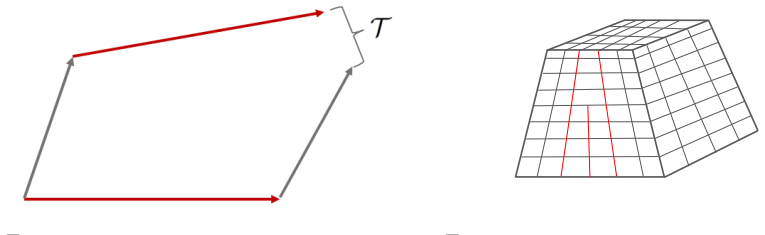
General relativity and the teleparallel equivalent of general relativity (TEGR) are dynamically equivalent because the TEGR torsion scalar is the Ricci scalar plus a boundary term, yet they attribute the same phenomena to different geometric objects: curvature in GR, torsion in TEGR. The paper's central claim is that this underdetermination is not dissolved by the arguments offered against it. The metric used in TEGR is not a hidden GR ontology, because TEGR can be formulated metrically or in tetrads and either theory can be presented either way; the extra tetrad gauge freedom is not a reason to dismiss TEGR once gauge variables are understood as unphysical; and Knox's inertial-frame functionalism only identifies TEGR's spacetime with GR's if one also accepts additional metaphysical commitments such as realiser functionalism. The paper further claims that spacetime torsion can be operationalised through gradiometer-type readouts and spin-coupled probe particles, and that torsion is visualisable through the non-closure of parallelograms and crystal-dislocation models, with intrinsic torsion no harder to visualise than intrinsic curvature. The conclusion the authors draw is negative for realism about curvature: as long as the equivalence holds, the evidence does not choose between curved and torsionful spacetime.
Load-bearing premise
The whole argument depends on treating general relativity and teleparallel gravity as genuinely empirically equivalent; if boundary terms ever turn out to have observable consequences that distinguish the two theories, the underdetermination would be spurious.
Editorial extensions
If this is right
- If the underdetermination stands, a scientific realist cannot cite general relativity alone as evidence that spacetime is curved; teleparallel gravity blocks that inference.
- Dissolving the GR/TEGR underdetermination requires rejecting or supplementing the empirical-equivalence premise, not just showing that TEGR's ontology resembles GR's ontology.
- Torsion is no worse than curvature on operational grounds: the same gradiometer-style devices that read out curvature can, through the Bianchi identities, be arranged to read out torsion components and their derivatives.
- Torsion is no worse than curvature on visualisability grounds: extrinsic torsion has direct pictures (non-closure of parallelograms, crystal dislocations), and intrinsic torsion is trainable in the same way intrinsic curvature is.
- The alternatives left for the realist are explicit: agnosticism, conventionalism about geometry, or a supra-empirical principle for choosing between the theories.
Reading between the lines
- A direct extension the authors leave open: look for gravitational boundary or edge effects whose value depends on whether the action is written as $T$ or as $-R$ plus its boundary term; any such measurable difference would break the empirical equivalence and collapse the underdetermination.
- The same underdetermination pattern plausibly extends to the wider family of equivalent geometric formulations of gravity, so any claim that spacetime has one specific geometric property is hostage to equally supported rival formulations.
- If visualisability is taken as the motivationalist's notion of perspicuity, then the paper's visualisability argument gives torsion-based models the same representational standing as curvature-based models, not merely a heuristic advantage.
- The paper's strategy generalises into a caution for realism: when two theories are empirically equivalent, committing to one geometric quantity as real requires a further meta-argument for why that quantity rather than its equivalent counterpart is the one nature instantiates.
Signed reviews
Editorial analysis
A structured set of objections, weighed in public.
Referee Report
Summary. The paper argues that the putative underdetermination between general relativity (GR) and the teleparallel equivalent of general relativity (TEGR) is not defused by Knox's (2011) arguments, and that two further worries—the operationalisability and visualisability of torsion—can be met. Section 2 presents the TEGR formalism, noting the dynamical equivalence with GR up to a boundary term. Section 3 reconstructs and criticises Knox's three central arguments: that TEGR only reverse-engineers the metric and Levi-Civita connection of GR, that TEGR carries surplus gauge structure, and that TEGR cannot supply the right inertial structure. Sections 4 and 5 argue that torsion can be operationalised (via a gradiometer-like construction and spin-coupling considerations) and that torsion has no visualisability problems beyond those already faced by curvature. The conclusion is that the GR/TEGR underdetermination remains a live threat to realism about spacetime curvature.
Significance. If the paper's conclusion is correct, it sharpens the philosophical cost of realism about GR: a confident assertion that spacetime is curved would require additional, non-empirical commitments that Knox's arguments do not themselves provide. The paper is valuable for isolating Knox's dialectic, for making the operative metaphysical commitments (functionalism, realiser functionalism, operationalisability, visualisability) explicit, and for connecting the GR/TEGR debate to recent work on boundary terms and the geometric trinity of gravity. The symmetry point in Section 3.1 against reverse-engineering is a genuine and well-made contribution. The paper is clearly written and engages carefully with the relevant literature, including the Wolf and Read (2023) boundary-term results. However, the central underdetermination claim depends on an unaddressed boundary-term qualification, and the operationalisation argument contains a technical flaw that needs correction.
major comments (3)
- [Section 2, Eq. (2.6), fn. 5; Section 3.2] The paper's central conclusion requires that GR and TEGR be empirically equivalent, but the paper explicitly leaves open that boundary terms can have empirical consequences. Footnote 5 and Section 3.2 cite Wolf and Read (2023) for the claim that actions differing by a boundary term can have empirical consequences; if those consequences differ between GR and TEGR in finite spacetimes, the premise that no experiment could discern the two theories fails. The paper should either argue that the boundary effects do not discriminate between GR and TEGR in the sense of empirical equivalence relevant to underdetermination, or restrict the conclusion accordingly. As written, the main conclusion is conditional on an unresolved empirical question.
- [Section 4, Eq. (4.1)] Equation (4.1) is the first Bianchi identity for a single connection with torsion, but in TEGR the Weitzenböck connection is flat, so the left-hand side of that identity vanishes identically; it therefore cannot show that a gravitational gradiometer, which reads the Levi-Civita curvature, can read out components of the torsion tensor. The gradiometer-based operationalisation needs the explicit formula relating the Levi-Civita Riemann tensor to the contorsion tensor and its derivatives, which is not what Eq. (4.1) provides. Please supply the correct formula and adjust the inference.
- [Section 3.3, Problem 3] The response to Problem 3 that the Weitzenböck connection's affine geodesics provide a notion of inertial structure is in tension with the paper's own description in Section 3.1 of TEGR as coupling matter to the Levi-Civita connection. In that standard formulation, force-free matter follows Levi-Civita geodesics, not Weitzenböck affine geodesics, so the geodesic response does not meet Knox's dynamical criterion as stated. The paper should either defend an alternative coupling of matter to the teleparallel connection or rest the defusing of Problem 3 on the rejection of Knox's functionalism and realiser functionalism rather than on the geodesic argument.
minor comments (5)
- [Abstract and Section 1] The abstract and the opening of Section 1 assert that TEGR is empirically equivalent to GR without the boundary-term caveat that appears in footnote 1; please qualify the initial statement to match the later discussion.
- [Section 2, Eq. (2.6)] The same symbol T is used for the torsion scalar and for the torsion tensor trace in Eq. (2.6); a notational distinction would help readers avoid confusion.
- [Section 5.2, Figure 2] The crystal-structure visualisation of torsion is described as indirect; a brief sentence explaining how the lattice-site picture maps onto a manifold would make the visualisation argument easier to evaluate.
- [Section 4, footnote 29] The notation f(R,T,Q) introduces Q without definition; please define the nonmetricity scalar or omit the symbol.
- [References] Several works are cited as unpublished or in preparation (e.g., Weatherall and Meskhidze 2024; Wolf et al. 2024); please update to published versions where available.
Circularity Check
No significant circularity: the argument is an independent philosophical assessment, though the boundary-term caveat leaves the equivalence premise conditional.
full rationale
The paper makes no empirical predictions and fits no parameters; its argument is philosophical. The central claim that Knox's objections do not conclusively defuse GR/TEGR underdetermination is supported by direct engagement with Knox (2011) and by external sources (e.g., Baker 2020; Lam and Wuthrich 2020; Reichenbach 1928), not by a derivation equivalent to its own inputs. The identity T = -R - 2 div(T) (Eq. 2.6) is a mathematical fact, not a fitted result. Self-citations (Wolf and Read 2023; Read and Teh 2018; Mulder 2021, etc.) are contextual or supplementary. The most relevant one, Wolf and Read 2023, is invoked in fn. 1 and Sec. 3.2 for the proposition that boundary terms can have empirical consequences and that TEGR has merits regarding boundary phenomena; that is a substantive published argument, not a bare self-assertion, and it does not make the conclusion true by definition. The paper itself flags the unresolved boundary issue (fn. 1, fn. 5, Sec. 3.2): if boundary effects discriminate between GR and TEGR, the equivalence premise is threatened. That is a genuine limitation and a correctness risk, but it is not circularity. Score reflects only the presence of self-citations, which are not load-bearing in a circular way.
Assumptions & free parameters
assumptions (4)
- standard math The TEGR Lagrangian equals the Einstein-Hilbert Lagrangian up to a boundary term (T = -R - 2∇_ν T^ρ_ρν, Eq. (2.6)), so the theories are dynamically equivalent.
- domain assumption The empirical equivalence between GR and TEGR holds for standard gravitational tests, modulo boundary effects.
- domain assumption The metric formulation of TEGR exists and is on equal footing with the tetrad formulation.
- domain assumption A scientific realist stance that equates realism about a theory with a commitment to its spacetime ontology is presupposed.
Cite this review
Pith. "Pith review of Is spacetime curved? Assessing the underdetermination of general relativity and teleparallel gravity." pith.science (2026). https://pith.science/paper/TU2IQCDC
@misc{pith2026250504632,
  author       = {Pith},
  title        = {Pith review of: Is spacetime curved? Assessing the underdetermination of general relativity and teleparallel gravity},
  year         = {2026},
  howpublished = {\url{https://pith.science/paper/TU2IQCDC}},
  note         = {Machine review of arXiv:2505.04632}
}
read the original abstract
Realism about general relativity (GR) seems to imply realism about spacetime curvature. The existence of the teleparallel equivalent of general relativity (TEGR) calls this into question, for (a) TEGR is set in a torsionful but flat spacetime, and (b) TEGR is empirically equivalent to GR. Knox (2011) claims that there is no genuine underdetermination between GR and TEGR; we call this verdict into question by isolating and addressing her individual arguments. In addition, we anticipate and evaluate two further worries for realism about the torsionful spacetimes of TEGR, which we call the "problem of operationalisability" and the "problem of visualisability".
Figures
Reference graph
Works this paper leans on
-
[1]
Primitive Ontology in a Nutshell
Aldrovandi, R. and Pereira, J. G. (2012). Teleparallel Gravity: An Introduction . Fun- damental Theories of Physics. Springer Netherlands (cit. on pp. 1, 4, 6). Allori, Valia (2015). “Primitive Ontology in a Nutshell”.International Journal of Quan- tum Foundations 1.2, pp. 107–122 (cit. on p. 19). Bahamonde, Sebastian et al. (2023). “Teleparallel gravity:...
work page 2012
-
[85]
Gravitational redshift revisited: inertia, geometry, and charge
Available here, pp. 16–29 (cit. on p. 15). Fankhauser, Johannes and Read, James (Aug. 2023). “Gravitational redshift revisited: inertia, geometry, and charge”. Preprint (cit. on p. 1). Fletcher, Samuel (2020). “Approximate Local Poincar´ e Spacetime Symmetry in Gen- eral Relativity”, pp. 247–267 (cit. on p. 14). Fletcher, Samuel C. and Weatherall, James O...
work page 2020
-
[173]
Compar- ing Equivalent Gravities: common features and differences
eprint: 1903.06830 (cit. on pp. 2, 18). Capozziello, Salvatore, Falco, Vittorio De, and Ferrara, Carmen (2022). “Compar- ing Equivalent Gravities: common features and differences”. European Physical Journal C 82.865 (cit. on p. 7). Cartan, ´Elie (1922). “Sur une g´ en´ eralisation de la notion de courbure de Riemann et les espaces ` a torsion”.Comptes ren...
arXiv 2022
-
[199]
The local validity of special relativity from a scale-relative perspective
Suppl 2, pp. 1–19 (cit. on p. 15). Lazar, Markus (2001). “An elastoplastic theory of dislocations as a physical field theory with torsion”. Journal of Physics A 35, pp. 1983–2004 (cit. on p. 21). Lazar, Markus and Hehl, Friedrich W. (2010). “Cartan’s Spiral Staircase in Physics and, in Particular, in the Gauge Theory of Dislocations”.Foundations of Physic...
work page Pith review arXiv 2001
Reviewed August 16, 2026 · model on record in the stance chip above.
Discussion (0). Continue with ORCID to comment.