REVIEW 4 major objections 6 minor 32 references
Overview of the NLPCC 2025 Shared Task 4: Multi-modal, Multilingual, and Multi-hop Medical Instructional Video Question Answering Challenge
T0 review · 4 major / 6 minor · reviewed 2026-08-15 · deepseek-v4-flash
Pith's one-line read The M4IVQA shared task offers a valid bilingual, multimodal, multi-hop benchmark for medical video QA, and its leaderboard scores capture genuine progress.
desk verdict Useful shared-task overview with a solid dataset extension, but the Track 1 metric is undefined and the leaderboard numbers don't reproduce from the paper. read the letter →
The pith
A machine-rendered reading of the paper's core claim, the machinery that carries it, and where it could break.
The reading
What carries the argument
The mechanism that carries the evaluation is the compound scoring protocol. For temporal grounding, the paper computes Intersection over Union between predicted and ground-truth time spans and reports the mean IoU together with R@1 at IoU thresholds 0.3, 0.5, and 0.7. For retrieval, it uses R@n with n equal to 1, 10, and 50 plus Mean Reciprocal Rank, folded into a single Overall score. For the joint track, it takes the average IoU at each retrieval depth (R@1|mIoU, R@10|mIoU, R@50|mIoU) and averages those three values. These formulas make the three tracks comparable on a common unit—how much of the correct temporal segment the system found—and they let one number rank every team within a track.
What would settle it
Independent back-translation of the Chinese and English question pairs by a third party that reveals systematic meaning differences, or a subtitle-only system matching the top Track 1 score, would show that the reported leaderboard is not measuring the claimed multimodal, multilingual, multi-hop competence.
Extended reading notes
Core claim
The core claim is that the M4IVQA benchmark—built on an existing bilingual medical instructional video corpus, augmented with per-video knowledge graphs and machine-generated subtitles, and annotated with timestamped answers by medical professionals—is a valid instrument for measuring whether AI systems can ground answers in a single video, retrieve a relevant video from a corpus, and do both at once, in both Chinese and English. The reported results are presented as the current state of that capability: the top entries reach mIoU(R@1)=0.3717 in the single-video track, Overall=1.6059 in the retrieval track, and Average=0.2314 in the joint track, while random pick baselines sit far lower at 0.0397, 0.1674, and 0.0384 respectively. The paper treats that gap as evidence that the tasks are solvable but far from solved.
Load-bearing premise
The load-bearing premise is that the physician-written Chinese questions and their English translations are semantically equivalent and that the automatically generated subtitles are accurate enough to support answer grounding.
Editorial extensions
If this is right
- The three tracks form a graded capability ladder: single-video grounding tests fine-grained localization, corpus retrieval isolates ranking, and the joint track requires both, so a system's failure can be assigned to the specific missing skill.
- Because every video carries equivalent Chinese and English questions, the benchmark makes cross-lingual gaps measurable, giving a concrete target for language-agnostic medical video understanding.
- Since knowledge graphs are supplied as additional input, systems that exploit structured medical knowledge can be separated from those that rely on text and video alone.
- The reported top scores and random baselines define a practical operating range for medical video QA, so future improvements can be assessed as real progress toward deployment.
- Using the same test videos and knowledge graphs across all three tracks keeps the leaderboards comparable; a team's retrieval decisions can be traced from Track 2 to Track 3 without re-running the whole pipeline.
Reading between the lines
- A direct test the paper leaves implicit: back-translating the Chinese and English question pairs and having a second panel of physicians re-check equivalence would show how much of the cross-lingual score depends on translation quality.
- Because answer timestamps are aligned to subtitles, a system that reads only the subtitle text and ignores visual frames might score well on Tracks 1 and 3; measuring that gap would reveal whether the benchmark truly requires visual understanding.
- The knowledge-graph augmentations used by the leading teams could be ablated track by track; the paper's design suggests KG facts should aid retrieval more than localization, since they enrich query and subtitle text directly.
- The same protocol could be adapted to other instructional video domains, such as equipment repair or software tutorials, to test whether the measured skills are specific to medicine or general to multimodal instructional QA.
Signed reviews
Editorial analysis
A structured set of objections, weighed in public.
Referee Report
Summary. This paper presents an overview of the NLPCC 2025 Shared Task 4 (M4IVQA), which introduces three tracks for medical instructional video question answering: temporal answer grounding in a single video (M4TAGSV), video corpus retrieval (M4VCR), and joint temporal grounding and retrieval in a video corpus (M4TAGVC). The paper describes the dataset (1,628 videos, 7,845 QA pairs, bilingual Chinese/English questions, knowledge graphs, and Whisper-generated subtitles), defines evaluation metrics for each track, reports final leaderboard results from 10 participating teams, and briefly describes the winning systems. The central claim is that the shared task constitutes a valid benchmark for multimodal, multilingual, multi-hop medical video QA and that the reported scores reflect relative system performance.
Significance. If the evaluation framework is sound, the M4IVQA dataset and the three-track setup would be a useful resource for the video QA community, with the unusual addition of a multilingual (Chinese/English) dimension and a multi-hop requirement. The inclusion of a random-pick baseline in all three leaderboards is good practice. However, the paper currently has a load-bearing defect in the definition of the primary metric for Track 1, and the validity of the multilingual comparisons rests on unverified assumptions about translation equivalence and subtitle quality. The significance of the results is therefore conditional on correction of these issues; the underlying dataset and task design remain potentially valuable.
major comments (4)
- [Section 2.2, Eq. (1), Table 2] Equation (1) is internally inconsistent: it defines mIoU as the average of three quantities labeled 'IoU = 0.3/0.5/0.7' with N=3, but IoU is a per-prediction overlap ratio, not a threshold, and the recall-at-threshold metric 'R@n, IoU=µ' is never formally defined. The reported mIoU(R@1) values do not match the average of the three R@1 columns in Table 2: for Baichuan, (0.5133+0.3612+0.2103)/3 = 0.3616 versus the reported 0.3717; for Random Pick Method, (0.0571+0.0465+0.0358)/3 = 0.0465 versus the reported 0.0397. The paper must supply a correct, unambiguous definition of mIoU(R@1), and ideally the official evaluation script, so the Track 1 leaderboard can be independently reproduced.
- [Section 2.3] The multilingual evaluation rests on two unverified assumptions: that the manually crafted Chinese questions and their English translations are semantically equivalent, and that the Whisper-generated Chinese and English subtitles are accurate enough to support answer grounding. The paper asserts that English questions were translated and reviewed by native-speaking physicians and that subtitles were automatically generated, but it reports no human evaluation, inter-annotator agreement, or sample quality checks, nor does it discuss this as a limitation. Without such evidence, the cross-lingual comparisons in Tables 2-4 cannot be interpreted as measuring the same task across languages. Please add either a quality assessment of a sample or an explicit limitation paragraph.
- [Section 3, Tables 2-4] The 'Random Pick Method' baseline is cited as references [1] and [2], but these references are overview papers of previous shared tasks, not descriptions of a random-pick implementation. The random-pick scores in Tables 2-4 are therefore not reproducible from the cited sources. The paper should either describe the random-pick protocol explicitly (e.g., uniform sampling of segments/videos) or cite the actual implementation used.
- [Section 2.2, Eq. (4), Table 4] The Track 3 composite metric 'Average' depends on R@1—mIoU, R@10—mIoU, and R@50—mIoU, but the paper does not specify how these quantities are computed. In particular, it is unclear whether a query whose relevant video is not retrieved within the top-k contributes zero IoU, whether the IoU is averaged only over queries that retrieve at least one candidate, and how the predicted segment is selected within each retrieved video. This ambiguity prevents verification of the Track 3 leaderboard and should be resolved with a precise formula.
minor comments (6)
- [Section 2.3 heading] The section heading contains a typo: 'Dateset' should be 'Dataset'.
- [Section 2.2, Track 2 paragraph] The text reads 'the primary ranking metric is the "verall" score'; this should be 'Overall'.
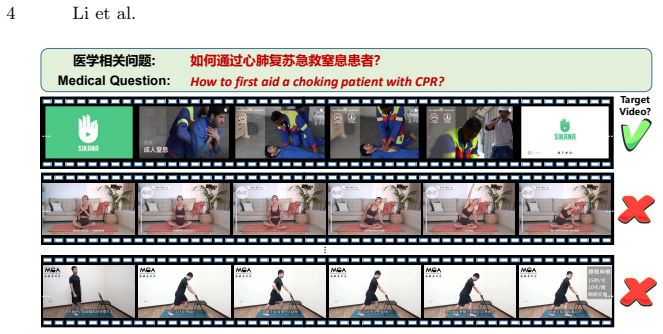
- [Figure 1 caption] The caption spells 'Singe Video'; it should be 'Single Video'.
- [Section 2.3] The dataset description mentions the 'M4TAGV task', but the corresponding track abbreviation used throughout the paper is M4TAGSV. Please standardize the terminology.
- [Figure 1] The example temporal answer is shown as '1:541:40', which appears to be a formatting error for '1:40-1:54'.
- [References] Several references appear unrelated to the claims they support (e.g., [3] on infectious disease prediction and [15] on thyroid disease prediction in the context of medical imaging diagnosis). Please verify that each citation is relevant to the statement it accompanies.
Circularity Check
No circularity: the shared-task overview reports independently produced leaderboard results, and its metric-definition problems are correctness concerns, not circular reasoning.
full rationale
This paper is a shared-task overview, not a derivation with inputs and outputs, so the standard circularity patterns do not apply. The central claim, that the NLPCC 2025 M4IVQA challenge was run and produced the reported leaderboard scores, rests on submissions from 10 independent teams plus a random-pick baseline, not on any equation fitted to the reported results. The track definitions, dataset description, and evaluation metrics are presented as external specifications; no parameter is fitted to a subset of data and then renamed as a prediction, and no equation equates a derived quantity to its own input by construction. The paper does cite the authors' prior CMIVQA and MMIVQA shared-task papers and other work by the same group, but those citations are contextual references to the origin of the dataset and to baseline methods; the load-bearing leaderboard comparisons come from external participant systems, so the self-citations are not load-bearing. The most notable technical issue is in Section 2.2, where Equation (1) defines mIoU as an average of three quantities labeled 'IoU = 0.3/0.5/0.7' with N=3, and the reported mIoU(R@1) values in Table 2 do not match a simple average of the three R@1 columns. This is a reproducibility or correctness concern about the metric's formal definition, not a case of circularity, because the metric is intended to measure agreement with independently annotated ground truths rather than to reproduce an input used to construct the benchmark. No circular step can be quoted and reduced to an input, so the appropriate finding is no significant circularity.
Assumptions & free parameters
assumptions (4)
- standard math The evaluation metrics IoU, R@n, and MRR are standard and correctly implemented as described.
- domain assumption The YouTube videos used in the dataset are legally accessible and can be redistributed for research purposes.
- domain assumption The knowledge graphs derived from Wikipedia or common knowledge bases provide semantically relevant external knowledge for multi-hop reasoning.
- domain assumption Whisper-generated Chinese and English subtitles are accurate enough to support temporal answer grounding.
Cite this review
Pith. "Pith review of Overview of the NLPCC 2025 Shared Task 4: Multi-modal, Multilingual, and Multi-hop Medical Instructional Video Question Answering Challenge." pith.science (2026). https://pith.science/paper/SAECKLFI
@misc{pith2026250506814,
  author       = {Pith},
  title        = {Pith review of: Overview of the NLPCC 2025 Shared Task 4: Multi-modal, Multilingual, and Multi-hop Medical Instructional Video Question Answering Challenge},
  year         = {2026},
  howpublished = {\url{https://pith.science/paper/SAECKLFI}},
  note         = {Machine review of arXiv:2505.06814}
}
read the original abstract
Following the successful hosts of the 1-st (NLPCC 2023 Foshan) CMIVQA and the 2-rd (NLPCC 2024 Hangzhou) MMIVQA challenges, this year, a new task has been introduced to further advance research in multi-modal, multilingual, and multi-hop medical instructional question answering (M4IVQA) systems, with a specific focus on medical instructional videos. The M4IVQA challenge focuses on evaluating models that integrate information from medical instructional videos, understand multiple languages, and answer multi-hop questions requiring reasoning over various modalities. This task consists of three tracks: multi-modal, multilingual, and multi-hop Temporal Answer Grounding in Single Video (M4TAGSV), multi-modal, multilingual, and multi-hop Video Corpus Retrieval (M4VCR) and multi-modal, multilingual, and multi-hop Temporal Answer Grounding in Video Corpus (M4TAGVC). Participants in M4IVQA are expected to develop algorithms capable of processing both video and text data, understanding multilingual queries, and providing relevant answers to multi-hop medical questions. We believe the newly introduced M4IVQA challenge will drive innovations in multimodal reasoning systems for healthcare scenarios, ultimately contributing to smarter emergency response systems and more effective medical education platforms in multilingual communities. Our official website is https://cmivqa.github.io/
Figures


Figures from the paper (2 more)


Reference graph
Works this paper leans on
-
[1]
Overview of the nlpcc 2023 shared task: Chinese medical instructional video question answering
Bin Li, Yixuan Weng, Hu Guo, Bin Sun, Shutao Li, Yuhao Luo, Mengyao Qi, Xufei Liu, Yuwei Han, Haiwen Liang, et al. Overview of the nlpcc 2023 shared task: Chinese medical instructional video question answering. InCCF International Conference on Natural Language Processing and Chinese Computing, pages 233–
work page 2023
-
[2]
Bin Li, Yixuan Weng, Qiya Song, Lianhui Liang, Xianwen Min, and Shoujun Zhou. Overview of the nlpcc 2024 shared task 7: Multi-lingual medical instructional video question answering. InCCF International Conference on Natural Language Pro- cessing and Chinese Computing, pages 429–439. Springer, 2024
work page 2024
-
[3]
Yiting Wang, Jiachen Zhong, and Rohan Kumar. A systematic review of machine learning applications in infectious disease prediction, diagnosis, and outbreak fore- casting. 2025. Overview of the NLPCC 2025 Shared Task 4 11
work page 2025
-
[4]
Tf-icon: Diffusion-based training-free cross-domain image composition
Shilin Lu, Yanzhu Liu, and Adams Wai-Kin Kong. Tf-icon: Diffusion-based training-free cross-domain image composition. InProceedings of the IEEE/CVF International Conference on Computer Vision, pages 2294–2305, 2023
work page 2023
-
[5]
Xinlei Yu, Ahmed Elazab, Ruiquan Ge, Jichao Zhu, Lingyan Zhang, Gangyong Jia, Qing Wu, Xiang Wan, Lihua Li, and Changmiao Wang. Ich-prnet: a cross-modal intracerebral haemorrhage prognostic prediction method using joint-attention in- teraction mechanism.Neural Networks, 184:107096, 2025
work page 2025
-
[6]
Xinlei Yu, Ahmed Elazab, Ruiquan Ge, Hui Jin, Xinchen Jiang, Gangyong Jia, Qing Wu, Qinglei Shi, and Changmiao Wang. Ich-scnet: Intracerebral hemorrhage segmentation and prognosis classification network using clip-guided sam mecha- nism. In2024 IEEE International Conference on Bioinformatics and Biomedicine (BIBM), pages 2795–2800. IEEE, 2024
work page 2024
-
[7]
Boris Baˇ ci´ c, Claudiu Vasile, Chengwei Feng, and Marian G Ciuc˘ a. Towards nation- wide analytical healthcare infrastructures: A privacy-preserving augmented knee rehabilitation case study.arXiv preprint arXiv:2412.20733, 2024
arXiv 2024
-
[8]
Zhibin Wen and Bin Li. Learning to unify audio, visual and text for audio-enhanced multilingual visual answer localization.arXiv preprint arXiv:2411.02851, 2024
arXiv 2024
Show all 32 references
-
[9]
Prism: Self-pruning intrinsic selection method for training-free multi- modal data selection, 2025
Jinhe Bi, Yifan Wang, Danqi Yan, Xun Xiao, Artur Hecker, Volker Tresp, and Yunpu Ma. Prism: Self-pruning intrinsic selection method for training-free multi- modal data selection, 2025
2025
-
[10]
Robust watermarking using generative priors against image editing: From benchmarking to advances.arXiv preprint arXiv:2410.18775, 2024
Shilin Lu, Zihan Zhou, Jiayou Lu, Yuanzhi Zhu, and Adams Wai-Kin Kong. Robust watermarking using generative priors against image editing: From benchmarking to advances.arXiv preprint arXiv:2410.18775, 2024
2024 arXiv
-
[11]
Set you straight: Auto-steering denoising trajectories to sidestep unwanted concepts.arXiv preprint arXiv:2504.12782, 2025
Leyang Li, Shilin Lu, Yan Ren, and Adams Wai-Kin Kong. Set you straight: Auto-steering denoising trajectories to sidestep unwanted concepts.arXiv preprint arXiv:2504.12782, 2025
2025 arXiv
-
[12]
Lingyi: medical conversational question answering system based on multi-modal knowledge graphs.arXiv preprint arXiv:2204.09220, 2022
Fei Xia, Bin Li, Yixuan Weng, Shizhu He, Kang Liu, Bin Sun, Shutao Li, and Jun Zhao. Lingyi: medical conversational question answering system based on multi-modal knowledge graphs.arXiv preprint arXiv:2204.09220, 2022
2022 arXiv
-
[13]
Llava steering: Visual instruction tuning with 500x fewer parameters through modality linear representation-steering, 2025
Jinhe Bi, Yujun Wang, Haokun Chen, Xun Xiao, Artur Hecker, Volker Tresp, and Yunpu Ma. Llava steering: Visual instruction tuning with 500x fewer parameters through modality linear representation-steering, 2025
2025
-
[14]
Visual answer localization with cross-modal mutual knowledge transfer
Yixuan Weng and Bin Li. Visual answer localization with cross-modal mutual knowledge transfer. InICASSP 2023-2023 IEEE International Conference on Acoustics, Speech and Signal Processing (ICASSP), pages 1–5. IEEE, 2023
2023
-
[15]
Enhancing thyroid disease prediction using ma- chine learning: A comparative study of ensemble models and class balancing tech- niques
Jiachen Zhong and Yiting Wang. Enhancing thyroid disease prediction using ma- chine learning: A comparative study of ensemble models and class balancing tech- niques. 2025
2025
-
[16]
A generative adversarial network-based investor sentiment in- dicator: Superior predictability for the stock market.Mathematics, 13(9):1476, 2025
Shiqing Qiu, Yang Wang, Zong Ke, Qinyan Shen, Zichao Li, Rong Zhang, and Kaichen Ouyang. A generative adversarial network-based investor sentiment in- dicator: Superior predictability for the stock market.Mathematics, 13(9):1476, 2025
2025
-
[17]
Multimodal high- order relationship inference network for fashion compatibility modeling in internet of multimedia things.IEEE Internet of Things Journal, 11(1):353–365, 2024
Peiguang Jing, Kai Cui, Jing Zhang, Yun Li, and Yuting Su. Multimodal high- order relationship inference network for fashion compatibility modeling in internet of multimedia things.IEEE Internet of Things Journal, 11(1):353–365, 2024
2024
-
[18]
De- tection of ai deepfake and fraud in online payments using gan-based models.arXiv preprint arXiv:2501.07033, 2025
Zong Ke, Shicheng Zhou, Yining Zhou, Chia Hong Chang, and Rong Zhang. De- tection of ai deepfake and fraud in online payments using gan-based models.arXiv preprint arXiv:2501.07033, 2025
2025
-
[19]
Enhancing intent understanding for ambiguous prompts through human-machine co-adaptation.arXiv preprint arXiv:2501.15167, 2025
Yangfan He, Jianhui Wang, Kun Li, Yijin Wang, Li Sun, Jun Yin, Miao Zhang, and Xueqian Wang. Enhancing intent understanding for ambiguous prompts through human-machine co-adaptation.arXiv preprint arXiv:2501.15167, 2025. 12 Li et al
2025
-
[20]
Mace: Mass concept erasure in diffusion models
Shilin Lu, Zilan Wang, Leyang Li, Yanzhu Liu, and Adams Wai-Kin Kong. Mace: Mass concept erasure in diffusion models. InProceedings of the IEEE/CVF Con- ference on Computer Vision and Pattern Recognition, pages 6430–6440, 2024
2024
-
[21]
Score: Story coherence and retrieval enhancement for ai narratives.arXiv preprint arXiv:2503.23512, 2025
Qiang Yi, Yangfan He, Jianhui Wang, Xinyuan Song, Shiyao Qian, Miao Zhang, Li Sun, and Tianyu Shi. Score: Story coherence and retrieval enhancement for ai narratives.arXiv preprint arXiv:2503.23512, 2025
2025
-
[22]
Learning to locate visual answer in video corpus using question
Bin Li, Yixuan Weng, Bin Sun, and Shutao Li. Learning to locate visual answer in video corpus using question. InICASSP 2023 - 2023 IEEE International Con- ference on Acoustics, Speech and Signal Processing (ICASSP), pages 1–5, 2023
2023
-
[23]
Improving multilingual temporal answering grounding in single video via llm-based translation and ocr enhancement
Huan Zhang, Chen Zheng, Yuanjing He, Yan Zhao, and Yuxuan Lai. Improving multilingual temporal answering grounding in single video via llm-based translation and ocr enhancement. InCCF International Conference on Natural Language Processing and Chinese Computing, pages 145–156....
2024
-
[24]
Improv- ing cross-modal visual answer localization in chinese medical instructional video using language prompts
Zineng Zhou, Jun Liu, Shuang Cheng, Haiyong Luo, Yang Gu, and Jian Ye. Improv- ing cross-modal visual answer localization in chinese medical instructional video using language prompts. InCCF International Conference on Natural Language Processing and Chinese Computing, pages 2...
2023
-
[25]
Mqua: Multi-level query-video augmentation for multilingual video corpus retrieval
Guyang Yu, Xiaoyang Bi, Jielong Tang, Ming Gu, Tianbai Chen, Zhiqiang Li, and Miankuan Zhu. Mqua: Multi-level query-video augmentation for multilingual video corpus retrieval. InCCF International Conference on Natural Language Processing and Chinese Computing, pages 353–364. S...
2024
-
[26]
A two-stage chinese medical video retrieval framework with llm
Ningjie Lei, Jinxiang Cai, Yixin Qian, Zhilong Zheng, Chao Han, Zhiyue Liu, and Qingbao Huang. A two-stage chinese medical video retrieval framework with llm. InCCF International Conference on Natural Language Processing and Chinese Computing, pages 211–220. Springer, 2023
2023
-
[27]
Mul- tilingual temporal answer grounding in video corpus with enhanced visual-textual integration
Tianxing Ma, Yueyue Hu, Shuang Jiang, Zhenhao Yin, and Tianning Zang. Mul- tilingual temporal answer grounding in video corpus with enhanced visual-textual integration. InCCF International Conference on Natural Language Processing and Chinese Computing, pages 471–483. Springer, 2024
2024
-
[28]
A uni- fied framework for optimizing video corpus retrieval and temporal answer ground- ing: fine-grained modality alignment and local-global optimization
Shuang Cheng, Zineng Zhou, Jun Liu, Jian Ye, Haiyong Luo, and Yang Gu. A uni- fied framework for optimizing video corpus retrieval and temporal answer ground- ing: fine-grained modality alignment and local-global optimization. InCCF In- ternational Conference on Natural Langua...
-
[29]
Correlation-aware cross-modal attention net- work for fashion compatibility modeling in ugc systems.ACM Transactions on Multimedia Computing, Communications and Applications, 2024
Kai Cui, Shenghao Liu, Wei Feng, Xianjun Deng, Liangbin Gao, Minmin Cheng, Hongwei Lu, and Laurence T Yang. Correlation-aware cross-modal attention net- work for fashion compatibility modeling in ugc systems.ACM Transactions on Multimedia Computing, Communications and Applicat...
2024
-
[30]
Language-agnostic bert sentence embedding.arXiv preprint arXiv:2007.01852, 2020
Fangxiaoyu Feng, Yinfei Yang, Daniel Cer, Naveen Arivazhagan, and Wei Wang. Language-agnostic bert sentence embedding.arXiv preprint arXiv:2007.01852, 2020
2007 arXiv
-
[31]
Vpai lab at medvidqa 2022: a two-stage cross-modal fusion method for medical instructional video classi- fication
Bin Li, Yixuan Weng, Fei Xia, Bin Sun, and Shutao Li. Vpai lab at medvidqa 2022: a two-stage cross-modal fusion method for medical instructional video classi- fication. InProceedings of the 21st Workshop on Biomedical Language Processing, pages 212–219, 2022
2022
-
[32]
Category-aware multimodal attention network for fashion compatibility modeling.IEEE Transac- tions on Multimedia, 25:9120–9131, 2023
Peiguang Jing, Kai Cui, Weili Guan, Liqiang Nie, and Yuting Su. Category-aware multimodal attention network for fashion compatibility modeling.IEEE Transac- tions on Multimedia, 25:9120–9131, 2023
2023
Reviewed August 15, 2026 · model on record in the stance chip above.
Discussion (0). Continue with ORCID to comment.