A Survey on Foundation Models for Personalized Federated Intelligence
Pith reviewed 2026-05-22 15:27 UTC · model grok-4.3
The pith
Personalized federated intelligence adapts foundation models to individual users while preserving privacy.
A machine-rendered reading of the paper's core claim, the machinery that carries it, and where it could break.
Core claim
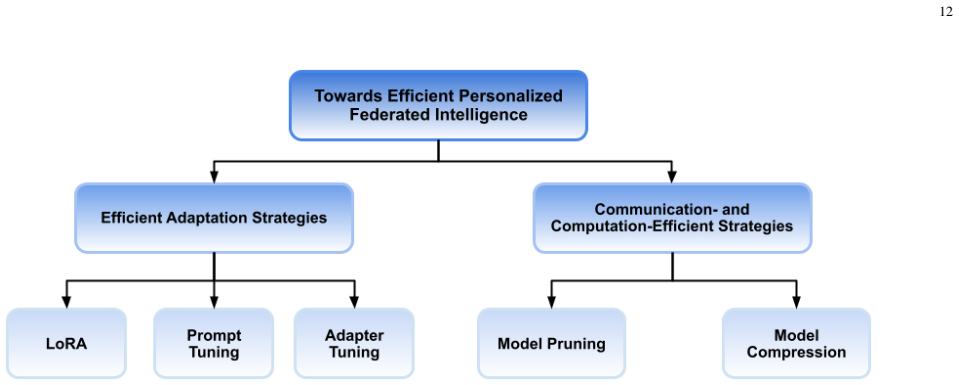
The paper proposes personalized federated intelligence (PFI) as a new paradigm that integrates the privacy benefits of federated learning with the generalization capabilities of foundation models while placing personalization at its core, thereby enabling artificial personalized intelligence (API). It surveys advances in federated learning and foundation models, then details the PFI pipeline through three stages: efficient personalization at the edge, trustworthy adaptation, and adaptive refinement via retrieval-augmented generation, before outlining future directions.
What carries the argument
The PFI pipeline consisting of efficient edge personalization, trustworthy adaptation, and adaptive refinement via retrieval-augmented generation.
If this is right
- Users receive customized responses from large models without transmitting raw personal data to central servers.
- Edge devices perform model adaptation with reduced computational load compared to full retraining.
- Trust mechanisms maintain model reliability and security during the personalization process.
- Retrieval augmentation supplies dynamic, user-specific knowledge to refine outputs over time.
Where Pith is reading between the lines
- PFI could extend to multi-user scenarios where indirect contributions improve shared models while each user retains private personalization.
- Existing federated learning platforms might adopt PFI stages to lower deployment barriers for foundation model customization.
- Testing PFI under highly heterogeneous user data distributions would reveal practical limits not covered in the survey.
Load-bearing premise
The stages of efficient edge personalization, trustworthy adaptation, and retrieval-augmented refinement can be combined without major trade-offs in privacy, performance, or scalability.
What would settle it
A working implementation of the full PFI pipeline that exhibits either privacy leakage, accuracy below that of separate federated learning or foundation model baselines, or inability to scale past a modest number of users would show the stages cannot be integrated as described.
Figures




read the original abstract
The rise of large language models (LLMs), such as ChatGPT, Gemini, and Grok, has reshaped the AI landscape. As prominent instances of foundational models (FMs), they exhibit remarkable capabilities in generating human-like content, pushing the boundaries towards artificial general intelligence (AGI). However, their large-scale nature, privacy sensitivity, and substantial computational demands pose significant challenges for personalized customization for end users. To bridge this gap, we present the vision of artificial personalized intelligence (API), which focuses on adapting FMs to individual users while ensuring privacy. As a central enabler of API, we propose personalized federated intelligence (PFI), a new paradigm that not only integrates the privacy benefits of federated learning (FL) with the generalization capabilities of FMs but also places personalization at its core. To this end, we first survey recent advances in FL and FMs that lay the foundation for PFI. We then explore core stages of the PFI pipeline: efficient personalization at the edge, trustworthy adaptation, and adaptive refinement via retrieval-augmented generation. Finally, we highlight future directions for enabling PFI. Overall, this survey aims to lay a foundation for the development of API as a complementary direction to AGI, with PFI as a key enabling paradigm.
Editorial analysis
A structured set of objections, weighed in public.
Referee Report
Summary. The paper surveys advances in federated learning and foundation models to introduce Personalized Federated Intelligence (PFI) as a paradigm integrating FL privacy benefits with FM generalization capabilities while centering personalization. It outlines a PFI pipeline with three stages—efficient personalization at the edge, trustworthy adaptation, and adaptive refinement via retrieval-augmented generation—and discusses future directions toward artificial personalized intelligence (API) as a complement to AGI.
Significance. If the integration of the proposed stages holds, the survey could establish a useful conceptual roadmap for privacy-preserving, user-specific adaptation of large models, highlighting a practical direction complementary to general-purpose foundation model scaling.
major comments (1)
- [Core stages of the PFI pipeline] The description of the PFI pipeline (efficient edge personalization, trustworthy adaptation, and retrieval-augmented refinement) presents these stages as combinable in a coherent framework but supplies only high-level overviews without citing concrete mechanisms, communication bounds, or empirical references that address potential trade-offs in privacy leakage, edge compute overhead, or erosion of zero-shot FM capabilities.
minor comments (1)
- [Abstract] The abstract introduces 'artificial personalized intelligence (API)' and 'personalized federated intelligence (PFI)' in quick succession; a brief sentence clarifying their relationship would improve readability for readers new to the framing.
Simulated Author's Rebuttal
We thank the referee for their constructive review and for recognizing the potential of the PFI framework as a conceptual roadmap. We address the single major comment below and describe the revisions we will undertake.
read point-by-point responses
-
Referee: The description of the PFI pipeline (efficient edge personalization, trustworthy adaptation, and retrieval-augmented refinement) presents these stages as combinable in a coherent framework but supplies only high-level overviews without citing concrete mechanisms, communication bounds, or empirical references that address potential trade-offs in privacy leakage, edge compute overhead, or erosion of zero-shot FM capabilities.
Authors: We agree that the current manuscript presents the three stages at a conceptual level. As a survey introducing a new paradigm, this was intentional to establish the overall vision; however, the referee is correct that additional specificity would strengthen the paper. In the revised version we will expand each stage with citations to concrete mechanisms (e.g., parameter-efficient federated fine-tuning, differential-privacy bounds for adaptation, and retrieval-augmented generation pipelines), include references that quantify communication and compute costs, and explicitly discuss the cited trade-offs in privacy leakage, edge-device overhead, and possible degradation of zero-shot performance, drawing on the most relevant empirical studies available in the literature. revision: yes
Circularity Check
Survey proposes PFI vision without any self-referential derivations or fitted predictions
full rationale
This is a survey and vision paper that defines personalized federated intelligence (PFI) as a paradigm integrating the privacy benefits of federated learning with the generalization capabilities of foundation models while centering personalization. It surveys external advances in FL and FMs, then outlines high-level pipeline stages (efficient edge personalization, trustworthy adaptation, retrieval-augmented refinement) and future directions. No equations, parameter fits, or derivations appear that could reduce by construction to the paper's own inputs; the proposal explicitly builds on cited prior literature rather than self-citations as load-bearing uniqueness results or ansatzes. The structure is therefore self-contained against external benchmarks with no circular steps.
Axiom & Free-Parameter Ledger
invented entities (1)
-
Personalized Federated Intelligence (PFI)
no independent evidence
Lean theorems connected to this paper
-
IndisputableMonolith/CostJcost definition and uniqueness unclear?
unclearRelation between the paper passage and the cited Recognition theorem.
We then explore core stages of the PFI pipeline: efficient personalization at the edge, trustworthy adaptation, and adaptive refinement via retrieval-augmented generation.
-
IndisputableMonolith/Foundation/ArithmeticFromLogicLogicNat recovery and embed_strictMono unclear?
unclearRelation between the paper passage and the cited Recognition theorem.
RAG-assisted Fine-Tuning and Continual Pre-Training for Foundation Models
What do these tags mean?
- matches
- The paper's claim is directly supported by a theorem in the formal canon.
- supports
- The theorem supports part of the paper's argument, but the paper may add assumptions or extra steps.
- extends
- The paper goes beyond the formal theorem; the theorem is a base layer rather than the whole result.
- uses
- The paper appears to rely on the theorem as machinery.
- contradicts
- The paper's claim conflicts with a theorem or certificate in the canon.
- unclear
- Pith found a possible connection, but the passage is too broad, indirect, or ambiguous to say the theorem truly supports the claim.
Reference graph
Works this paper leans on
-
[1]
J. Achiam, S. Adler, S. Agarwal, L. Ahmad, I. Akkaya, F. L. Aleman, D. Almeida, J. Altenschmidt, S. Altman, S. Anadkat, et al. , “Gpt-4 technical report,” ArXiv:2303.08774, 2023
work page internal anchor Pith review Pith/arXiv arXiv 2023
-
[2]
Gemini: A Family of Highly Capable Multimodal Models
G. Team, R. Anil, S. Borgeaud, J.-B. Alayrac, J. Yu, R. Soricut, J. Schalkwyk, A. M. Dai, A. Hauth, K. Millican, et al. , “Gemini: a family of highly capable multimodal models,”ArXiv:2312.11805, 2023
work page internal anchor Pith review Pith/arXiv arXiv 2023
-
[3]
DeepSeek-R1: Incentivizing Reasoning Capability in LLMs via Reinforcement Learning
D. Guo, D. Yang, H. Zhang, J. Song, R. Zhang, R. Xu, Q. Zhu, S. Ma, P. Wang, X. Bi, et al., “Deepseek-r1: Incentivizing reasoning capability in llms via reinforcement learning,” ArXiv:2501.12948, 2025
work page internal anchor Pith review Pith/arXiv arXiv 2025
-
[4]
Deepseek-inspired exploration of rl-based llms and synergy with wireless networks: A survey,
Y . Qiao, P.-N. Tran, J. S. Yoon, L. X. Nguyen, and C. S. Hong, “Deepseek-inspired exploration of rl-based llms and synergy with wireless networks: A survey,” Authorea Preprints, 2025
work page 2025
-
[5]
M. A. AlAfnan, “Large language models as computational linguistics tools: A comparative analysis of chatgpt and google machine transla- tions,” Journal of Artificial Intelligence and Technology , 2024
work page 2024
-
[6]
Chatgpt in content cre- ation: Techniques, applications, and ethical implications,
A. Htet, S. R. Liana, T. Aung, and A. Bhaumik, “Chatgpt in content cre- ation: Techniques, applications, and ethical implications,” in Advanced Applications of Generative AI and Natural Language Processing Mod- els, pp. 43–68, IGI Global, 2024
work page 2024
-
[7]
S. R. Bogireddy and N. Dasari, “Comparative analysis of chatgpt-4 and llama: Performance evaluation on text summarization, data analysis, and question answering,” in Proc. 15th Int. Conf. Comput. Commun. Netw. Technol. (ICCCNT), 2024
work page 2024
-
[8]
Z. Gao, L. Li, S. Ma, Q. Wang, L. Hemphill, and R. Xu, “Examining the potential of chatgpt on biomedical information retrieval: fact-checking drug-disease associations,” Annals of biomedical engineering , vol. 52, no. 8, pp. 1919–1927, 2024
work page 1919
-
[9]
A. Kirillov, E. Mintun, N. Ravi, H. Mao, C. Rolland, L. Gustafson, T. Xiao, S. Whitehead, A. C. Berg, W.-Y . Lo, et al. , “Segment anything,” in Proc. IEEE Int. Conf. Comput. Vis., pp. 4015–4026, 2023
work page 2023
-
[10]
Robustness of sam: Segment anything under corruptions and beyond,
Y . Qiao, C. Zhang, T. Kang, D. Kim, S. Tariq, C. Zhang, and C. S. Hong, “Robustness of sam: Segment anything under corruptions and beyond,” ArXiv:2306.07713, 2023
-
[11]
Segment anything model aided beam prediction for the millimeter wave communication,
A. D. Raha, A. Adhikary, M. S. Munir, Y . Qiao, and C. S. Hong, “Segment anything model aided beam prediction for the millimeter wave communication,” inProc. Asia–Pacific Netw. Operations Manage. Symp. (APNOMS), pp. 113–118, Jan. 2023
work page 2023
-
[12]
Efficientvit-sam: Accelerated segment anything model without performance loss,
Z. Zhang, H. Cai, and S. Han, “Efficientvit-sam: Accelerated segment anything model without performance loss,” in Proc. of the IEEE/CVF Conf. Comput. Vis. Pattern Recognit. , pp. 7859–7863, 2024
work page 2024
-
[13]
Segment and recognize anything at any granularity,
F. Li, H. Zhang, P. Sun, X. Zou, S. Liu, C. Li, J. Yang, L. Zhang, and J. Gao, “Segment and recognize anything at any granularity,” in Proc. Eur. Conf. Comput. Vis., pp. 467–484, Springer, 2024
work page 2024
-
[14]
L. X. Nguyen, A. D. Raha, P. S. Aung, D. Niyato, Z. Han, and C. S. Hong, “A contemporary survey on semantic communications: Theory of mind, generative ai, and deep joint source-channel coding,” ArXiv:2502.16468, Feb. 2025
-
[15]
Segment anything in medical images,
J. Ma, Y . He, F. Li, L. Han, C. You, and B. Wang, “Segment anything in medical images,” Nat. Commun., vol. 15, no. 1, p. 654, 2024
work page 2024
-
[16]
SAM 2: Segment Anything in Images and Videos
N. Ravi, V . Gabeur, Y .-T. Hu, R. Hu, C. Ryali, T. Ma, H. Khedr, R. Rädle, C. Rolland, L. Gustafson, et al., “Sam 2: Segment anything in images and videos,” ArXiv:2408.00714, 2024
work page internal anchor Pith review Pith/arXiv arXiv 2024
-
[17]
Few-shot adaptation of training-free foundation model for 3d medical image segmentation,
X. He, Y . Hu, Z. Zhou, M. Jarraya, and F. Liu, “Few-shot adaptation of training-free foundation model for 3d medical image segmentation,” ArXiv:2501.09138, 2025
-
[18]
When sam2 meets video camouflaged object segmentation: A comprehensive eval- uation and adaptation,
Y . Zhou, G. Sun, Y . Li, L. Benini, and E. Konukoglu, “When sam2 meets video camouflaged object segmentation: A comprehensive eval- uation and adaptation,” ArXiv:2409.18653, 2024
- [19]
-
[20]
A survey on federated learning,
C. Zhang, Y . Xie, H. Bai, B. Yu, W. Li, and Y . Gao, “A survey on federated learning,” Knowl.-Based Syst., vol. 216, p. 106775, 2021
work page 2021
-
[21]
Federated learning in mobile edge networks: A comprehensive survey,
W. Y . B. Lim, N. C. Luong, D. T. Hoang, Y . Jiao, Y .-C. Liang, Q. Yang, D. Niyato, and C. Miao, “Federated learning in mobile edge networks: A comprehensive survey,”IEEE Commun. Surveys Tuts., vol. 22, no. 3, pp. 2031–2063, 2020
work page 2031
-
[22]
Survey of personalization techniques for federated learning,
V . Kulkarni, M. Kulkarni, and A. Pant, “Survey of personalization techniques for federated learning,” in Proc. 4th World Conference on Smart Trends in Systems, Security and Sustainability (WorldS4) , pp. 794–797, 2020
work page 2020
-
[23]
The future of digital health with federated learning,
N. Rieke, J. Hancox, W. Li, F. Milletari, H. R. Roth, S. Albarqouni, S. Bakas, M. N. Galtier, B. A. Landman, K. Maier-Hein, et al., “The future of digital health with federated learning,” NPJ digital medicine , vol. 3, no. 1, p. 119, 2020
work page 2020
-
[24]
Federated learning for medical image analysis: A survey,
H. Guan, P.-T. Yap, A. Bozoki, and M. Liu, “Federated learning for medical image analysis: A survey,” Pattern Recognit., p. 110424, 2024
work page 2024
-
[25]
Federated learning for internet of things: A comprehensive survey,
D. C. Nguyen, M. Ding, P. N. Pathirana, A. Seneviratne, J. Li, and H. Vincent Poor, “Federated learning for internet of things: A comprehensive survey,” IEEE Commun. Surveys Tuts. , vol. 23, no. 3, pp. 1622–1658, 2021
work page 2021
-
[26]
Threats to federated learning: A survey,
L. Lyu, H. Yu, and Q. Yang, “Threats to federated learning: A survey,” Preprint ArXiv:2003.02133, Mar. 2020
-
[27]
Federated learn- ing: A survey on enabling technologies, protocols, and applications,
M. Aledhari, R. Razzak, R. M. Parizi, and F. Saeed, “Federated learn- ing: A survey on enabling technologies, protocols, and applications,” IEEE Access, vol. 8, pp. 140699–140725, 2020
work page 2020
-
[28]
S. Abdulrahman, H. Tout, H. Ould-Slimane, A. Mourad, C. Talhi, and M. Guizani, “A survey on federated learning: The journey from centralized to distributed on-site learning and beyond,” IEEE Internet Things J., vol. 8, no. 7, pp. 5476–5497, 2021
work page 2021
-
[29]
Federated learning on non-iid data: A survey,
H. Zhu, J. Xu, S. Liu, and Y . Jin, “Federated learning on non-iid data: A survey,” Neurocomputing, vol. 465, pp. 371–390, 2021
work page 2021
-
[30]
Model aggregation techniques in federated learning: A comprehensive survey,
P. Qi, D. Chiaro, A. Guzzo, M. Ianni, G. Fortino, and F. Piccialli, “Model aggregation techniques in federated learning: A comprehensive survey,” Future Generation Computer Systems , January 2023
work page 2023
-
[31]
When foundation model meets federated learning: Motivations, challenges, and future directions,
W. Zhuang, C. Chen, and L. Lyu, “When foundation model meets federated learning: Motivations, challenges, and future directions,” ArXiv:2306.15546, 2023. 27
-
[32]
Advances and open challenges in federated foundation models,
C. Ren, H. Yu, H. Peng, X. Tang, B. Zhao, L. Yi, A. Z. Tan, Y . Gao, A. Li, X. Li, et al. , “Advances and open challenges in federated foundation models,” IEEE Commun. Surveys Tuts. , 2025
work page 2025
-
[33]
A survey on efficient federated learning methods for foundation model training,
H. Woisetschläger, A. Erben, S. Wang, R. Mayer, and H.-A. Jacobsen, “A survey on efficient federated learning methods for foundation model training,” in Proc. of the Thirty-Third International Joint Conference on Artificial Intelligence , IJCAI, Jeju, Korea, 2024
work page 2024
-
[34]
A comprehensive survey on pretrained foundation models: A history from bert to chatgpt,
C. Zhou, Q. Li, C. Li, J. Yu, Y . Liu, G. Wang, K. Zhang, C. Ji, Q. Yan, L. He, et al. , “A comprehensive survey on pretrained foundation models: A history from bert to chatgpt,” International Journal of Machine Learning and Cybernetics , pp. 1–65, 2024
work page 2024
-
[35]
Pushing large language models to the 6g edge: Vision, challenges, and oppor- tunities,
Z. Lin, G. Qu, Q. Chen, X. Chen, Z. Chen, and K. Huang, “Pushing large language models to the 6g edge: Vision, challenges, and oppor- tunities,” ArXiv:2309.16739, 2023
-
[36]
Zhao, Optimizing Memory Usage when Training Deep Neural Networks
X. Zhao, Optimizing Memory Usage when Training Deep Neural Networks. PhD thesis, Université de Bordeaux, 2024
work page 2024
-
[37]
Unveiling security, privacy, and ethical concerns of chatgpt,
X. Wu, R. Duan, and J. Ni, “Unveiling security, privacy, and ethical concerns of chatgpt,” J. Intell. Inf. Syst. , vol. 2, no. 2, pp. 102–115, Mar. 2024
work page 2024
-
[38]
A pathway towards responsible ai generated content.,
L. Lyu, C. Chen, and J. Fu, “A pathway towards responsible ai generated content.,” in IJCAI, pp. 7033–7038, 2023
work page 2023
-
[39]
Chameleon: Dual memory replay for online continual learning on edge devices,
S. Aggarwal, K. Binici, and T. Mitra, “Chameleon: Dual memory replay for online continual learning on edge devices,” IEEE Trans. Comput.- Aided Design Integr. Circuits Syst. , 2023
work page 2023
-
[40]
Communication-efficient learning of deep networks from decentral- ized data,
B. McMahan, E. Moore, D. Ramage, S. Hampson, and B. A. y Arcas, “Communication-efficient learning of deep networks from decentral- ized data,” in Artificial Intelligence and Statistics (AISTATS) , Laud- erdale, FL, April 2017
work page 2017
-
[41]
Federated hybrid training and self-adversarial distillation: Towards robust edge networks,
Y . Qiao, A. Adhikary, K. Kim, E.-N. Huh, Z. Han, and C. S. Hong, “Federated hybrid training and self-adversarial distillation: Towards robust edge networks,” ArXiv:2412.19354, 2024
-
[42]
An efficient federated learning framework for training semantic communication systems,
L. X. Nguyen, H. Q. Le, Y . L. Tun, P. S. Aung, Y . K. Tun, Z. Han, and C. S. Hong, “An efficient federated learning framework for training semantic communication systems,” IEEE Trans. Veh. Technol., vol. 73, no. 10, pp. 15872–15877, 2024
work page 2024
-
[43]
L. X. Nguyen, S. S. Hassan, Y . M. Park, Y . K. Tun, Z. Han, and C. S. Hong, “SemSpaceFL: A collaborative hierarchical federated learning framework for semantic communication in 6G LEO satellites,”Preprint Arxiv:2505.00966, May 2025
-
[44]
Logit calibration and feature contrast for robust federated learning on non-iid data,
Y . Qiao, C. Zhang, A. Adhikary, and C. S. Hong, “Logit calibration and feature contrast for robust federated learning on non-iid data,” IEEE Trans. Netw. Sci. Eng. , vol. 12, no. 2, pp. 636–652, March 2025
work page 2025
-
[45]
Towards communication-efficient adversarial federated learning for robust edge intelligence,
Y . Qiao, H. Q. Le, A. Adhikary, and C. S. Hong, “Towards communication-efficient adversarial federated learning for robust edge intelligence,” ArXiv:2501.15257, 2025
-
[46]
Towards personalized federated learning,
A. Z. Tan, H. Yu, L. Cui, and Q. Yang, “Towards personalized federated learning,” IEEE Trans. Neural Netw. Learn. Syst. , vol. 34, no. 12, pp. 9587–9603, 2022
work page 2022
-
[47]
Fedccl: Federated dual-clustered feature contrast under domain heterogeneity,
Y . Qiao, H. Q. Le, M. Zhang, A. Adhikary, C. Zhang, and C. S. Hong, “Fedccl: Federated dual-clustered feature contrast under domain heterogeneity,” Inf. Fusion, vol. 113, p. 102645, Jan. 2025
work page 2025
-
[48]
Adaptive personalized federated learning,
Y . Deng, M. M. Kamani, and M. Mahdavi, “Adaptive personalized federated learning,” ArXiv:2003.13461, 2020
-
[49]
Federated learning for healthcare: Systematic review and architecture proposal,
R. S. Antunes, C. André da Costa, A. Küderle, I. A. Yari, and B. Eskofier, “Federated learning for healthcare: Systematic review and architecture proposal,” ACM Trans. Intell. Syst. Technol., vol. 13, no. 4, pp. 1–23, May 2022
work page 2022
-
[50]
C. Ju, R. Zhao, J. Sun, X. Wei, B. Zhao, Y . Liu, H. Li, T. Chen, X. Zhang, D. Gao, et al. , “Privacy-preserving technology to help millions of people: Federated prediction model for stroke prevention,” ArXiv:2006.10517, 2020
-
[51]
Federated learning for open banking,
G. Long, Y . Tan, J. Jiang, and C. Zhang, “Federated learning for open banking,” in Federated Learning: Privacy and Incentive , pp. 240–254, Springer, Nov. 2020
work page 2020
-
[52]
Fate: An industrial grade platform for collaborative learning with data protection,
Y . Liu, T. Fan, T. Chen, Q. Xu, and Q. Yang, “Fate: An industrial grade platform for collaborative learning with data protection,” Journal of Machine Learning Research , vol. 22, no. 226, pp. 1–6, 2021
work page 2021
-
[53]
Vertical federated learning: Concepts, advances, and challenges,
Y . Liu, Y . Kang, T. Zou, Y . Pu, Y . He, X. Ye, Y . Ouyang, Y .-Q. Zhang, and Q. Yang, “Vertical federated learning: Concepts, advances, and challenges,” IEEE Trans. Knowl. Data Eng. , 2024
work page 2024
-
[54]
S. Jaghouar, J. M. Ong, M. Basra, F. Obeid, J. Straube, M. Keiblinger, E. Bakouch, L. Atkins, M. Panahi, C. Goddard, et al. , “Intellect-1 technical report,” ArXiv:2412.01152, 2024
-
[55]
Photon: Federated llm pre-training,
L. Sani, A. Iacob, Z. Cao, R. Lee, B. Marino, Y . Gao, D. Cai, Z. Li, W. Zhao, X. Qiu, et al. , “Photon: Federated llm pre-training,” ArXiv:2411.02908, 2024
-
[56]
Mp-fedcl: Multiprototype federated contrastive learn- ing for edge intelligence,
Y . Qiao, M. S. Munir, A. Adhikary, H. Q. Le, A. D. Raha, C. Zhang, and C. S. Hong, “Mp-fedcl: Multiprototype federated contrastive learn- ing for edge intelligence,” IEEE Internet Things J. , vol. 11, no. 5, pp. 8604–8623, September 2023
work page 2023
-
[57]
An encouraging design for data owners to join multiple co-existing federated learning,
L. X. Nguyen, L. Zou, H. Q. Le, and C. S. Hong, “An encouraging design for data owners to join multiple co-existing federated learning,” in Proc. Asia–Pacific Netw. Operations Manage. Symp. (APNOMS) , Sep. 2022
work page 2022
-
[58]
Edge-based federated deep reinforcement learning for iot traffic management,
A. Jarwan and M. Ibnkahla, “Edge-based federated deep reinforcement learning for iot traffic management,” IEEE Internet Things J. , vol. 10, no. 5, pp. 3799–3813, 2022
work page 2022
-
[59]
Knowledge distillation in federated learning: Where and how to distill?,
Y . Qiao, C. Zhang, H. Q. Le, A. D. Raha, A. Adhikary, and C. S. Hong, “Knowledge distillation in federated learning: Where and how to distill?,” in Proc. Asia–Pacific Netw. Operations Manage. Symp. (APNOMS), Sejong, South Korea, September 2023
work page 2023
-
[60]
Knowledge distillation assisted robust federated learning: Towards edge intelligence,
Y . Qiao, A. Adhikary, K. T. Kim, C. Zhang, and C. S. Hong, “Knowledge distillation assisted robust federated learning: Towards edge intelligence,” in Proc. IEEE Int. Conf. Commun. (ICC) , Denver, CO, June 2024
work page 2024
-
[61]
Fedmekt: Distillation-based embedding knowledge transfer for multimodal fed- erated learning,
H. Q. Le, M. N. Nguyen, C. M. Thwal, Y . Qiao, et al. , “Fedmekt: Distillation-based embedding knowledge transfer for multimodal fed- erated learning,” Neural Networks, vol. 183, p. 107017, Mar. 2025
work page 2025
-
[62]
Fedproto: Federated prototype learning across heterogeneous clients,
Y . Tan, G. Long, L. Liu, T. Zhou, Q. Lu, J. Jiang, and C. Zhang, “Fedproto: Federated prototype learning across heterogeneous clients,” in Proc. AAAI Conf. Artif. Intell. , New York, USA, Feb. 2022
work page 2022
-
[63]
Towards robust federated learning via logits calibration on non-iid data,
Y . Qiao, A. Adhikary, C. Zhang, and C. S. Hong, “Towards robust federated learning via logits calibration on non-iid data,” in Proc. IEEE/IFIP Netw. Operations Manage. Symp (NOMS) , Seoul, South Korea, May 2024
work page 2024
-
[64]
Multi-level personalized federated learning on heterogeneous and long-tailed data,
R. Zhang, Y . Chen, C. Wu, and F. Wang, “Multi-level personalized federated learning on heterogeneous and long-tailed data,” IEEE Trans. Mobile Comput., June 2024
work page 2024
-
[65]
Federated machine learning: Concept and applications,
Q. Yang, Y . Liu, T. Chen, and Y . Tong, “Federated machine learning: Concept and applications,” ACM Trans. Intell. Syst. Technol. , vol. 10, no. 2, pp. 1–19, 2019
work page 2019
-
[66]
Hifgl: A hierarchical framework for cross-silo cross-device federated graph learning,
Z. Guo, D. Yao, Q. Yang, and H. Liu, “Hifgl: A hierarchical framework for cross-silo cross-device federated graph learning,” in Proc. ACM SIGKDD Int. Conf. Knowl. Discov. Data Min. , pp. 968–979, 2024
work page 2024
-
[67]
On privacy and personaliza- tion in cross-silo federated learning,
K. Liu, S. Hu, S. Z. Wu, and V . Smith, “On privacy and personaliza- tion in cross-silo federated learning,” Adv. Neural Inf. Process. Syst. (NeurIPS), vol. 35, pp. 5925–5940, 2022
work page 2022
-
[68]
A practical cross-device federated learning framework over 5g networks,
W. Yang, N. Wang, Z. Guan, L. Wu, X. Du, and M. Guizani, “A practical cross-device federated learning framework over 5g networks,” IEEE Wireless Communications, vol. 29, no. 6, pp. 128–134, 2022
work page 2022
-
[69]
Foundation models defining a new era in vision: a survey and outlook,
M. Awais, M. Naseer, S. Khan, R. M. Anwer, H. Cholakkal, M. Shah, M.-H. Yang, and F. S. Khan, “Foundation models defining a new era in vision: a survey and outlook,” IEEE Trans. Pattern Anal. Mach. Intell., vol. 47, no. 4, pp. 2245–2264, 2025
work page 2025
-
[70]
The ai index 2021 annual report,
D. Zhang, S. Mishra, E. Brynjolfsson, J. Etchemendy, D. Ganguli, B. Grosz, T. Lyons, J. Manyika, J. C. Niebles, M. Sellitto, et al., “The ai index 2021 annual report,” ArXiv:2103.06312, 2021
-
[71]
On the Opportunities and Risks of Foundation Models
R. Bommasani, D. A. Hudson, E. Adeli, R. Altman, S. Arora, S. von Arx, M. S. Bernstein, et al. , “On the opportunities and risks of foundation models,” ArXiv:2108.07258, Jul. 2021
work page internal anchor Pith review Pith/arXiv arXiv 2021
-
[72]
Transformers in vision: A survey,
S. Khan, M. Naseer, M. Hayat, S. W. Zamir, F. S. Khan, and M. Shah, “Transformers in vision: A survey,” ACM Comput. Surv. , vol. 54, no. 10s, pp. 1–41, 2022
work page 2022
-
[73]
An introduction to deep reinforcement learning,
V . François-Lavet, P. Henderson, R. Islam, M. G. Bellemare, J. Pineau, et al. , “An introduction to deep reinforcement learning,” Foundations and Trends® in Machine Learning, vol. 11, no. 3-4, pp. 219–354, 2018
work page 2018
-
[74]
Improv- ing language understanding by generative pre-training,
A. Radford, K. Narasimhan, T. Salimans, I. Sutskever, et al., “Improv- ing language understanding by generative pre-training,” Preprint, 2018
work page 2018
-
[75]
Visual reasoning eval- uation of grok, deepseek janus, gemini, qwen, mistral, and chatgpt,
N. Jegham, M. Abdelatti, and A. Hendawi, “Visual reasoning eval- uation of grok, deepseek janus, gemini, qwen, mistral, and chatgpt,” ArXiv:2502.16428, 2025
-
[76]
Learning transferable visual models from natural language supervision,
A. Radford, J. W. Kim, C. Hallacy, A. Ramesh, G. Goh, S. Agarwal, G. Sastry, A. Askell, P. Mishkin, J. Clark, et al., “Learning transferable visual models from natural language supervision,” in Proc. Int. Conf. Mach. Learn., pp. 8748–8763, PMLR, 2021
work page 2021
-
[77]
Grounding DINO: Marrying DINO with Grounded Pre-Training for Open-Set Object Detection
S. Liu, Z. Zeng, T. Ren, F. Li, H. Zhang, J. Yang, C. Li, J. Yang, H. Su, J. Zhu, et al., “Grounding dino: Marrying dino with grounded pre-training for open-set object detection,” ArXiv:2303.05499, 2023
work page internal anchor Pith review Pith/arXiv arXiv 2023
-
[78]
Clip-vip: Adapting pre-trained image-text model to video-language representa- tion alignment,
H. Xue, Y . Sun, B. Liu, J. Fu, R. Song, H. Li, and J. Luo, “Clip-vip: Adapting pre-trained image-text model to video-language representa- tion alignment,” ArXiv:2209.06430, 2022. 28
-
[79]
Y . Wu, X. Li, J. Li, K. Yang, P. Zhu, and S. Zhang, “Dino is also a semantic guider: Exploiting class-aware affinity for weakly supervised semantic segmentation,” in Proc. of the 32nd ACM International Conference on Multimedia , pp. 1389–1397, 2024
work page 2024
-
[80]
Sam-event- adapter: Adapting segment anything model for event-rgb semantic segmentation,
B. Yao, Y . Deng, Y . Liu, H. Chen, Y . Li, and Z. Yang, “Sam-event- adapter: Adapting segment anything model for event-rgb semantic segmentation,” in Proc. IEEE International Conference on Robotics and Automation (ICRA) , pp. 9093–9100, 2024
work page 2024
discussion (0)
Sign in with ORCID, Apple, or X to comment. Anyone can read and Pith papers without signing in.