REVIEW 3 major objections 6 minor 31 references
Scaling Multi Agent Reinforcement Learning for Underwater Acoustic Tracking via Autonomous Vehicles
T0 review · 3 major / 6 minor · reviewed 2026-08-15 · deepseek-v4-flash
Pith's one-line read This paper claims that a GPU-vectorized approximation of a high-fidelity underwater vehicle simulator can accelerate multi-agent reinforcement learning by up to 30,000x while still producing policies that transfer back to the simulator…
desk verdict A genuine engineering advance—30,000x speedup and real Gazebo transfer for tracking error—but 'seamless transfer' overreaches once you look at the collision mismatch. read the letter →
The pith
A machine-rendered reading of the paper's core claim, the machinery that carries it, and where it could break.
The reading
What carries the argument
The load-bearing machinery is a simplified trajectory model $p_{t+1}=p_t+v\,\delta t\,(\cos(\psi_t+\delta\psi),\sin(\psi_t+\delta\psi))$ with heading change $\delta\psi=\theta(\gamma)$ modelled as a linear function of rudder angle $\gamma$, fitted to simulator trajectories with mean absolute error below 0.015 radians and $R^2=0.99$, plus injected Gaussian noise with standard deviation 0.02 radians. This model lets thousands of environments be vectorized on a GPU while keeping vehicle dynamics close to the high-fidelity simulator. The second piece of machinery is a Transformer actor and critic in which agents and targets are input tokens; self-attention learns a latent coordination graph whose size is independent of the number of entities, which is what makes the policy invariant to fleet and target counts and enables the curriculum procedure.
What would settle it
Run the final curriculum-trained policy in the high-fidelity simulator for the full 1000-step (8-hour) mission and compare average tracking error and target-loss probability with the JaxLrauv training values; if the error diverges beyond the reported five-metre range or target loss rises sharply, the linear heading-change model has failed to preserve long-horizon dynamics. A more direct check is to record yaw drift over 1000 steps and compare it with the 0.02-radian Gaussian noise envelope assumed during training.
Extended reading notes
Core claim
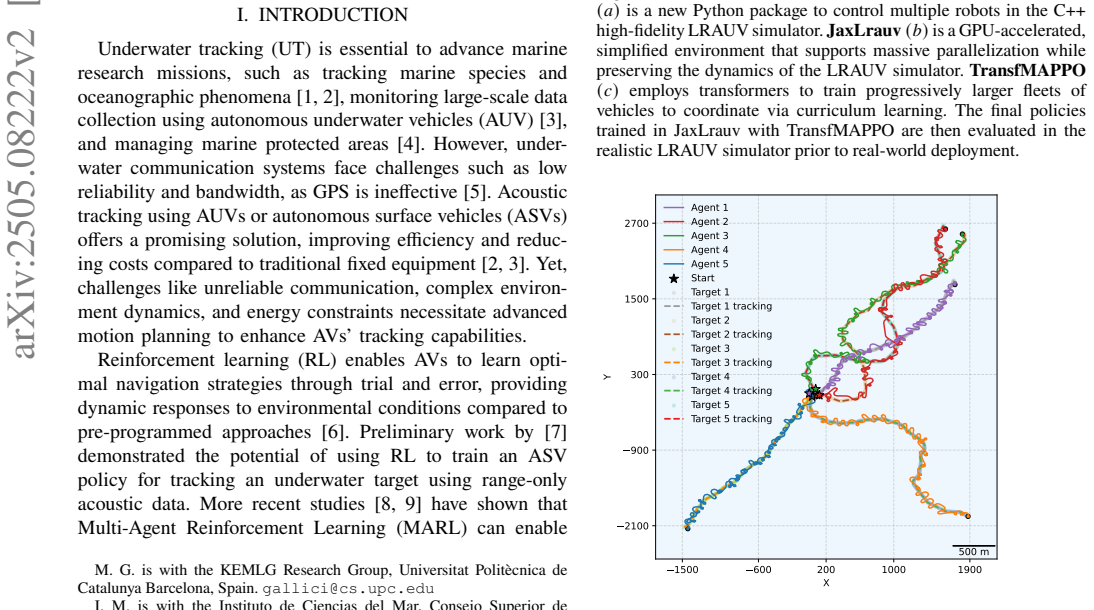
The central discovery is a training-to-evaluation pipeline in which the expensive simulator is used only for data collection and final testing, while reinforcement learning happens in a simplified environment whose dynamics are aligned to the simulator. The simplified environment models each vehicle's next position from current heading and speed, with heading change treated as a linear function of rudder angle fitted to simulator trajectories plus Gaussian noise; sensor noise, communication dropouts, and partial observability are reproduced from simulator data. On top of this environment, TransfMAPPO uses self-attention over agent and target tokens to produce decentralized actor policies and a centralized critic that are permutation-invariant and hence defined for arbitrary fleet sizes and target counts. Curriculum training starts with a single agent tracking a fast target, extends the horizon, then fine-tunes for cooperative multi-agent and multi-target tasks. The paper claims this yields a policy that tracks up to five targets with five vehicles and, in the high-fidelity simulator, maintains average tracking errors near three metres for very fast targets and below five metres in multi-target configurations, with the same control interface usable on real vehicles.
Load-bearing premise
The load-bearing premise is that a vehicle's heading change over a 30-second step is well approximated by a linear function of rudder angle plus small Gaussian noise, so a policy trained in that cheap model remains valid over hundreds of steps in the high-fidelity simulator and ultimately at sea.
Editorial extensions
If this is right
- A single-target tracking policy can be trained in about ten minutes on one GPU, a run the authors estimate would take months in the high-fidelity simulator, making iterative reinforcement-learning experiments practical.
- The same final policy can be deployed with one to five agents tracking one to five targets, so operators no longer need a separate trained model for each fleet configuration.
- Policies trained only in the simplified environment transfer to the high-fidelity simulator with comparable tracking errors, supporting the idea that sim-to-real transfer can be addressed without massive simulator compute.
- With five vehicles the method tracks five simultaneously moving targets, whereas the authors report earlier multi-agent reinforcement learning approaches needed up to twelve vehicles to track four targets.
- Because the Python control interface works with both the simulator and physical long-range autonomous underwater vehicles, the same trained policy is positioned for direct field deployment.
Reading between the lines
- Because the only fidelity-critical component is the fitted heading-change function, the same pipeline should transfer to other underwater vehicles or simulators by refitting that function from logged trajectories, leaving the architecture and curriculum unchanged; the paper does not test this portability.
- The authors note that the linear heading model cannot capture long-term dependencies and diverges when used autoregressively, which suggests a cheap stress test: compare predicted and simulated trajectories over the full 1000-step mission and check whether divergence stays inside the injected 0.02-radian noise envelope.
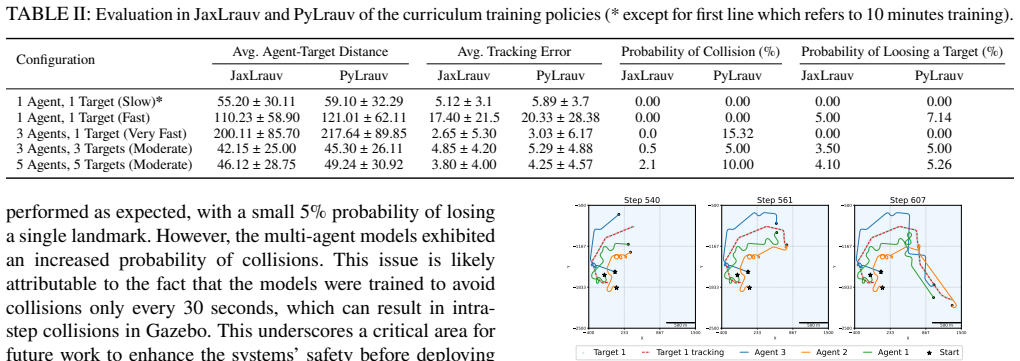
- The higher collision probability observed in the high-fidelity simulator for multi-agent runs implies that a collision-avoidance layer or intra-step safety check would be needed before field deployment; the paper flags this as future work, and the reported numbers already motivate it.
- The token-based policy representation may extend naturally to heterogeneous fleets, such as vehicles with different speeds or sensors, by adding per-vehicle features to the token embeddings; the paper does not investigate this, but it follows from the architecture's permutation-invariant design.
Signed reviews
Editorial analysis
A structured set of objections, weighed in public.
Referee Report
Summary. The paper proposes a training pipeline for multi-agent reinforcement learning (MARL) in underwater acoustic tracking. It introduces PyLrauv, a ROS2-based Python interface to the Gazebo LRAUV high-fidelity simulator; JaxLrauv, a JAX-vectorized simplified environment whose per-step heading change is a linear function of rudder angle fit to PyLrauv trajectories; and TransfMAPPO, a transformer-based MAPPO variant with curriculum learning for progressively larger fleets. The authors report up to 30,000x speedup of JaxLrauv over Gazebo, training curves showing curriculum superiority over from-scratch MAPPO, and Gazebo evaluations in Table II with average tracking errors mostly between 3 and 6 m. The central claims are that JaxLrauv preserves LRAUV Sim dynamics and that policies trained in it transfer seamlessly to Gazebo, while being invariant to the number of agents and targets.
Significance. If the fidelity and transfer claims held, this would be a practical and timely advance: MARL training that would take months in Gazebo could run in minutes to hours on a single H100 GPU. The vectorized particle filter, the direct JaxLrauv-versus-Gazebo comparisons, and the curriculum from single-agent to multi-agent scenarios are useful contributions. However, the load-bearing 'preserving dynamics' and 'seamless transfer' claims are only partially supported: the simplified heading model is acknowledged to diverge when used autoregressively, and Table II shows nontrivial collision-probability gaps between JaxLrauv and Gazebo. The invariance-to-fleet-size claim is also tested only on configurations seen in training, except for single-target agent counts. The paper is promising, but the central claims currently outrun the evidence.
major comments (3)
- [IV-C and Table II] Section IV-C states that the simplified heading model 'cannot capture long-term dependencies and diverges when used autoregressively for long trajectories,' yet the abstract claims that JaxLrauv preserves Gazebo dynamics and enables seamless transfer. Table II provides a direct check and shows a safety-relevant mismatch: collision probability is 0.0% in JaxLrauv versus 15.32% in PyLrauv for the 3-agents/1-very-fast-target configuration, and 2.1% versus 10.0% for the 5-agents/5-targets configuration. Since collision avoidance is encoded in the reward through the crash penalty, this gap is not peripheral; it shows that the simplified environment is not dynamically equivalent in multi-agent close encounters. The authors should either provide additional analysis showing that this mismatch does not affect the tracking-error conclusions, or substantially temper the 'preserving dynamics' and 'seamless transfer' claims.
- [V-C and Table II] The Gazebo transfer evaluation in Table II is based on 50 episodes per configuration and reports only means with large standard deviations; for example, the 1-agent/1-fast-target tracking error is 17.40 +/- 21.5 in JaxLrauv and 20.33 +/- 28.38 in PyLrauv. Without confidence intervals, significance tests, or per-episode distribution comparisons, the phrase 'comparable evaluation measures' and the abstract's 'seamless transfer' claim are not established over the full 300-1000 step mission horizons. The authors should report more episodes, confidence intervals, or additional statistical comparisons to support the transfer claim.
- [V and Figure 6] The abstract claims that TransfMAPPO learns policies 'invariant to fleet size and number of targets.' Figure 6 varies the number of agents from 1 to 7 for a single target, which supports agent-count invariance in that setting, but no experiment varies the number of targets independently of the number of agents. The multi-target evaluations use only the symmetric configurations seen during curriculum training (2x2, 3x3, 5x5), so invariance to the number of targets is not demonstrated. Adding cross-configuration tests such as 4 agents with 5 targets or 6 agents with 3 targets would be needed to support the claim; otherwise, the claim should be revised to something like 'policies trained on multiple symmetric configurations.'
minor comments (6)
- [IV-B] In the reward function description, 'nεmax' appears to be a typo for 'and εmax'.
- [IV-E] The curriculum description contains unclear numerical expressions: '1 10 timesteps' and '1 8 timesteps' appear to have missing superscripts, and 'for a maximum 29 timesteps' is ambiguous; these should be specified precisely for reproducibility.
- [V-C] Please clarify whether the '50 episodes' are per configuration or total across all five configurations listed in Table II, and report episode counts alongside each row.
- [IV-A and I] The paper calls PyLrauv an 'open-source Python package' but provides no repository URL; please include the code or a clear availability statement.
- [Figure 6] The caption says the highlighted area 'represents the values seen in training,' but it is not clear which training configurations this area corresponds to; please define it in the caption or text.
- [Throughout] There are several typographical and formatting issues, such as 'ros gz1' and 'f.i.' instead of 'e.g.'; a careful proofreading pass would improve readability.
Circularity Check
No significant circularity: the fitted JaxLrauv surrogate is disclosed, and the Gazebo transfer results are independent measurements rather than consequences of the fit.
full rationale
The load-bearing claim is that policies trained in JaxLrauv transfer to Gazebo with low tracking error. Section IV-C explicitly states that the simplified heading dynamics are obtained by collecting trajectories in PyLrauv and fitting a linear model: "we collect trajectories in PyLrauv and train a supervised model that predicts δψ from θ(γ)" with "mean absolute error below 0.015 radians and a global R2 score of 0.99." This is a disclosed calibration of a surrogate, not a first-principles derivation, so the subsequent Gazebo evaluation in Table II is an independent check rather than a consequence of the fit by construction. The paper's own limitation — "such a simple model cannot capture long-term dependencies and diverges when used autoregressively for long trajectories" — and the higher Gazebo collision rates in Table II (e.g., 15.32% vs 0.0% for 3 agents and 1 very fast target) are correctness and robustness concerns, not circularity. Self-citations to TransfQMix [15] and to [31] are architectural inspiration and a LayerNorm implementation detail, respectively; neither injects an unverified premise that defines the tracking-error outcome. The speedup numbers are direct measurements of the implemented environments. Thus no load-bearing step reduces to its inputs by definition or through a self-citation chain.
Assumptions & free parameters
free parameters (6)
- Heading-change linear model coefficients theta(gamma) for each (speed, dt) pair =
not reported, R^2=0.99, MAE below 0.015 rad
- Trajectory perturbation Gaussian noise standard deviation =
0.02 rad
- Reward threshold epsilon_min =
10 m
- Reward threshold epsilon_max =
50 m
- Follow threshold d_min =
50 m, and 100 m for fast targets
- Collision-safe distance d_safe =
not explicitly stated
assumptions (5)
- domain assumption A 2D piecewise-constant velocity model with heading rotation is an adequate representation of LRAUV motion over the action interval.
- domain assumption A linear map from rudder angle to heading change fitted once in Gazebo, plus Gaussian noise, preserves enough dynamics for policy transfer.
- domain assumption The modeled sensor noise, communication dropouts, and partial observability in JaxLrauv match PyLrauv and Gazebo.
- standard math PPO and MAPPO with a centralized critic and decentralized execution form a sound backbone for the cooperative tracking task.
- domain assumption The transformer's permutation-invariant token representation over agents and targets yields policies invariant to fleet size and target count.
Cite this review
Pith. "Pith review of Scaling Multi Agent Reinforcement Learning for Underwater Acoustic Tracking via Autonomous Vehicles." pith.science (2026). https://pith.science/paper/OTUK6HWZ
@misc{pith2026250508222,
  author       = {Pith},
  title        = {Pith review of: Scaling Multi Agent Reinforcement Learning for Underwater Acoustic Tracking via Autonomous Vehicles},
  year         = {2026},
  howpublished = {\url{https://pith.science/paper/OTUK6HWZ}},
  note         = {Machine review of arXiv:2505.08222}
}
read the original abstract
Autonomous vehicles (AVs) offer a cost-effective solution for scientific missions such as underwater tracking. Reinforcement learning (RL) has emerged as a powerful method for controlling AVs, but scaling to fleets (essential for multi-target tracking or rapidly moving targets) is challenging. Multi-Agent RL (MARL) is notoriously sample-inefficient, and while high-fidelity simulators like Gazebo's LRAUV provide up to 100x faster-than-real-time single-robot simulations, they offer little speedup in multi-vehicle scenarios, making MARL training impractical. Yet, high-fidelity simulation is crucial to test complex policies and close the sim-to-real gap. To address these limitations, we develop a GPU-accelerated environment that achieves up to 30,000x speedup over Gazebo while preserving its dynamics. This enables fast, end-to-end GPU training and seamless transfer to Gazebo for evaluation. We also introduce a Transformer-based architecture (TransfMAPPO) that learns policies invariant to fleet size and number of targets, enabling curriculum learning to train larger fleets on increasingly complex scenarios. After large-scale GPU training, we perform extensive evaluations in Gazebo, showing our method maintains tracking errors below 5m even with multiple fast-moving targets.
Figures


Figures from the paper (7 more)




Reference graph
Works this paper leans on
-
[1]
Nikolaos D Zarokanellos et al. “Frontal dynamics in the Alboran sea: 1. Coherent 3D pathways at the Almeria- Oran front using underwater glider observations”. In:Journal of Geophysical Research: Oceans127.3 (2022), e2021JC017405
work page 2022
-
[2]
Mobile robotic platforms for the acoustic tracking of deep-sea demersal fishery resources
Ivan Masmitja et al. “Mobile robotic platforms for the acoustic tracking of deep-sea demersal fishery resources”. In:Science Robotics5.48 (2020), eabc3701
work page 2020
-
[3]
Yanwu Zhang et al. “A system of coordinated au- tonomous robots for Lagrangian studies of microbes in the oceanic deep chlorophyll maximum”. In:Science Robotics6.50 (2021), eabb9138.doi:10 . 1126 / scirobotics.abb9138
work page 2021
-
[4]
Maria Vigo et al. “Spatial ecology of Norway lobster Nephrops norvegicus in Mediterranean deep-water en- vironments: implications for designing no-take marine reserves”. In:Marine Ecology Progress Series674 (2021), pp. 173–188
work page 2021
-
[5]
Underwater sensor networks: applications, advances and challenges
John Heidemann, Milica Stojanovic, and Michele Zorzi. “Underwater sensor networks: applications, advances and challenges”. In:Philosophical Transactions of the Royal Society A: Mathematical, Physical and Engi- neering Sciences370.1958 (2012), pp. 158–175
work page 2012
-
[6]
David Cote et al. “Characterizing snow crab (Chionoe- cetes opilio) movements in the Sydney Bight (Nova Sco- tia, Canada): a collaborative approach using multiscale acoustic telemetry”. In:Canadian Journal of Fisheries and Aquatic Sciences76.2 (2019), pp. 334–346
work page 2019
-
[7]
Dynamic robotic tracking of under- water targets using reinforcement learning
I. Masmitja et al. “Dynamic robotic tracking of under- water targets using reinforcement learning”. In:Science Robotics8.80 (2023), eade7811.doi:10 . 1126 / scirobotics.ade7811
work page 2023
-
[8]
Shengbo Wang et al. “Multi-AUV cooperative underwa- ter multi-target tracking based on dynamic-switching- enabled multi-agent reinforcement learning”. In:IEEE Transactions on Mobile Computing(2024)
work page 2024
Show all 31 references
-
[9]
Secure and cooperative target tracking via AUV swarm: A reinforcement learning approach
Zhaoqi Yang et al. “Secure and cooperative target tracking via AUV swarm: A reinforcement learning approach”. In:2021 IEEE Global Communications Conference (GLOBECOM). IEEE. 2021, pp. 1–6
2021
-
[10]
From Concept to Field Tests: Accelerated Development of Multi-AUV Mis- sions Using a High-Fidelity Faster-than-Real-Time Simulator
Timothy R. Player et al. “From Concept to Field Tests: Accelerated Development of Multi-AUV Mis- sions Using a High-Fidelity Faster-than-Real-Time Simulator”. In:2023 IEEE International Conference on Robotics and Automation (ICRA). IEEE, May 2023, pp. 3102–3108.doi:10 . 1109 /...
2023
-
[11]
Robot Operating System 2: Design, architecture, and uses in the wild
Steven Macenski et al. “Robot Operating System 2: Design, architecture, and uses in the wild”. In:Science Robotics7.66 (2022), eabm6074.doi:10 . 1126 / scirobotics.abm6074
2022
-
[12]
JaxMARL: Multi- Agent RL Environments in JAX
Alexander Rutherford et al. “JaxMARL: Multi- Agent RL Environments in JAX”. In:arXiv preprint arXiv:2311.10090(2023)
2023 arXiv
-
[13]
The Surprising Effectiveness of PPO in Cooperative, Multi-Agent Games
Chao Yu et al. “The Surprising Effectiveness of PPO in Cooperative, Multi-Agent Games”. In: (2022). arXiv: 2103.01955 [cs.LG].url:https://arxiv. org/abs/2103.01955
2022 arXiv
-
[14]
Synchronization of Multiagent Systems Using Event-Triggered and Self-Triggered Broadcasts
Jo ˜ao Almeida, Carlos Silvestre, and Ant ´onio Pas- coal. “Synchronization of Multiagent Systems Using Event-Triggered and Self-Triggered Broadcasts”. In: IEEE Transactions on Automatic Control62.9 (2017), pp. 4741–4746.doi:10 . 1109 / TAC . 2017 . 2671029
2017
-
[15]
TransfQMix: Transformers for Leveraging the Graph Structure of Multi-Agent Reinforcement Learning Problems
Matteo Gallici, Mario Martin, and Ivan Masmitja. “TransfQMix: Transformers for Leveraging the Graph Structure of Multi-Agent Reinforcement Learning Problems”. In:Proceedings of the 2023 International Conference on Autonomous Agents and Multiagent Systems. AAMAS ’23. London, Un...
2023
-
[16]
Scalable multi-agent rein- forcement learning through intelligent information ag- gregation
Siddharth Nayak et al. “Scalable multi-agent rein- forcement learning through intelligent information ag- gregation”. In:International conference on machine learning. PMLR. 2023, pp. 25817–25833
2023
-
[17]
Graph neural network- based multi-agent reinforcement learning for resilient distributed coordination of multi-robot systems
Anthony Goeckner et al. “Graph neural network- based multi-agent reinforcement learning for resilient distributed coordination of multi-robot systems”. In: 2024 IEEE/RSJ International Conference on Intel- ligent Robots and Systems (IROS). IEEE. 2024, pp. 5732–5739
2024
-
[18]
Transformer-based multi-agent rein- forcement learning for generalization of heterogeneous multi-robot cooperation
Yuxin Cai et al. “Transformer-based multi-agent rein- forcement learning for generalization of heterogeneous multi-robot cooperation”. In:2024 IEEE/RSJ Interna- tional Conference on Intelligent Robots and Systems (IROS). IEEE. 2024, pp. 13695–13702
2024
-
[19]
UPDeT: Universal Multi-agent RL via Policy Decoupling with Transformers
Siyi Hu et al. “UPDeT: Universal Multi-agent RL via Policy Decoupling with Transformers”. In:Interna- tional Conference on Learning Representations. 2020
2020
-
[20]
Multi-agent reinforcement learning is a sequence modeling problem
Muning Wen et al. “Multi-agent reinforcement learning is a sequence modeling problem”. In:Advances in Neural Information Processing Systems35 (2022), pp. 16509–16521
2022
-
[21]
Automatic curriculum learning for large-scale cooperative multiagent systems
Tianle Zhang et al. “Automatic curriculum learning for large-scale cooperative multiagent systems”. In:IEEE Transactions on Emerging Topics in Computational Intelligence7.3 (2022), pp. 912–930
2022
-
[22]
From few to more: Large-scale dynamic multiagent curriculum learning
Weixun Wang et al. “From few to more: Large-scale dynamic multiagent curriculum learning”. In:Proceed- ings of the AAAI conference on artificial intelligence. Vol. 34. 05. 2020, pp. 7293–7300
2020
-
[23]
Robust Range-Only Beacon Localization
Edwin Olson, John J. Leonard, and Seth Teller. “Robust Range-Only Beacon Localization”. In:IEEE Journal of Oceanic Engineering31.4 (2006), pp. 949–958
2006
-
[24]
Observ- ability based control in range-only underwater vehicle localization
Jake D. Quenzer and Kristi A. Morgansen. “Observ- ability based control in range-only underwater vehicle localization”. In:2014 American Control Conference. 2014, pp. 4702–4707.doi:10.1109/ACC.2014. 6859032
2014 doi
-
[25]
Positioning and navigation sys- tems for robotic underwater vehicles
Alex Alcocer Penas. “Positioning and navigation sys- tems for robotic underwater vehicles”. In:Doctor thesis, Instituto Superior Tcnico(2009)
2009
-
[26]
Observ- ability based control in range-only underwater vehicle localization
Jake D Quenzer and Kristi A Morgansen. “Observ- ability based control in range-only underwater vehicle localization”. In:2014 American control conference. IEEE. 2014, pp. 4702–4707
2014
-
[27]
Robust range-only beacon localization
Edwin Olson, John J Leonard, and Seth Teller. “Robust range-only beacon localization”. In:IEEE Journal of Oceanic Engineering31.4 (2006), pp. 949–958
2006
-
[28]
Springer, 2016
Frans A Oliehoek and Christopher Amato.A concise in- troduction to decentralized POMDPs. Springer, 2016
2016
-
[29]
Tabish Rashid et al.QMIX: Monotonic Value Func- tion Factorisation for Deep Multi-Agent Reinforcement Learning. 2018. arXiv:1803.11485 [cs.LG].url: https://arxiv.org/abs/1803.11485
2018 arXiv
-
[30]
John Schulman et al.Proximal Policy Optimization Algorithms. 2017. arXiv:1707 . 06347 [cs.LG]. url:https://arxiv.org/abs/1707.06347
2017 arXiv
-
[31]
Matteo Gallici et al.Simplifying Deep Temporal Differ- ence Learning. 2024. arXiv:2407.04811 [cs.LG]. url:https://arxiv.org/abs/2407.04811
2024 arXiv
Reviewed August 15, 2026 · model on record in the stance chip above.
Discussion (0). Continue with ORCID to comment.