REVIEW 4 major objections 4 minor 1 cited by
Crowd Scene Analysis using Deep Learning Techniques
T0 review · 4 major / 4 minor · reviewed 2026-08-15 · deepseek-v4-flash
Pith's one-line read This thesis claims crowd counting works without any annotated images, using rotation classification plus Sinkhorn density matching in a five-column CNN, and that a VGG19-LSTM flags violent frames one at a time.
desk verdict The paper's central zero-annotation counting claim is contradicted by its own supervised pre-training and ground-truth density loss; without aggregate results or a defined prior, it is not ready for review. read the letter →
The pith
A machine-rendered reading of the paper's core claim, the machinery that carries it, and where it could break.
The reading
What carries the argument
The load-bearing object for counting is the Sinkhorn matching step in stage 2: the predicted density distribution is aligned, via optimal transport, to a 'prior distribution that approximates the statistical characteristics of natural crowds,' and this matching is what is supposed to make the density regressor trainable without annotation. Around it sit the five-column M-CNN — parallel convolutional branches with filters of sizes 3×3, 5×5, 7×7, 9×9, and 11×11 that capture local and global scale — and the rotation-classification head (0°, 90°, 180°, 270°) that supplies the stage-1 pseudo-labels. For anomaly detection the machinery is the modified VGG-19, whose fully connected layers are replaced by wide dense residual blocks, feeding an LSTM that captures motion between frames at times t and t−1, ending in a binary normal-versus-abnormal classification.
What would settle it
Reproduce stage 2 on the ShanghaiTech Part A test set: write down the prior distribution the Sinkhorn step must match to, train the density regressor against that target only, and compute aggregate MAE and MSE over the whole test set. If no concrete prior can be stated from the thesis, or if the predicted counts are no better than a constant-density baseline, the self-supervised counting claim is not settled.
Extended reading notes
Core claim
The central discovery the thesis argues for is that the supervision signal for crowd counting does not have to come from annotated heads. Stage 1 trains the feature extractor on a rotation-classification pretext task — predicting whether a 112×112 crop was rotated by 0°, 90°, 180°, or 270° — which forces the network to learn crowd-relevant structure from raw images alone. Stage 2 freezes those features, appends two further convolutional blocks, and trains the density regressor by minimizing the Sinkhorn distance (an optimal-transport measure) between the predicted density map and a prior distribution assumed to capture the statistical character of natural crowds, so the prediction is pulled toward a statistical target rather than compared with ground-truth annotations. For anomaly detection, the thesis claims that replacing VGG-19's fully connected layers with wide dense residual blocks and passing the extracted spatial features through an LSTM yields a frame-level binary normal/abnormal classifier that reports F1 scores of 0.86 on the Hockey Fight dataset and 0.90 on the SCVD dataset and claims to outperform other state-of-the-art approaches.
Load-bearing premise
The entire counting pipeline rests on the 'prior distribution' of natural crowd densities that stage 2's Sinkhorn matching targets, but the thesis never defines that distribution's form, its parameters, or how it is estimated (Section 3.2.4); if that target is wrong or arbitrary, the density estimation has nothing principled to match to.
Editorial extensions
If this is right
- Crowd-counting models could be trained from raw, unannotated surveillance footage, eliminating the manual head-annotation step that currently restricts deployment to new scenes.
- The five-column design asserts that widening a counting network with more parallel scale-specific filters improves accuracy on occluded scenes, non-uniform density, and scale variation without making the network deeper.
- A density regressor trained purely by distribution matching would transfer across datasets such as ShanghaiTech and UCF-QNRF without re-annotating for each new scene.
- Frame-level violence classification lets an operator act on short-duration incidents that clip-level or video-level detectors would smooth away.
Reading between the lines
- The same two-stage recipe — rotation pretext followed by matching a prediction to a statistical prior — could transfer to other counting problems whose objects have predictable statistics (vehicles, animals, cells), because the prior plays the role that ground-truth density maps play in supervised training.
- The frame-level anomaly formulation, if it holds up, points toward temporal action segmentation: frame scores from the VGG19-LSTM could be pooled to label intervals of a surveillance clip as normal or violent without clip-level annotations.
- A careful reader should not assume the strongest reading of 'completely self-supervised': Sections 4.1.2 and 4.2.1 describe supervised pre-training on annotated density maps before the self-supervised stage, so the no-annotation claim is best understood as applying to the counting stage proper unless the author states otherwise.
- The counting results chapter reports per-image predicted counts and rotation-accuracy curves but no aggregate MAE/MSE over the full ShanghaiTech or UCF-QNRF test sets, despite the abstract promising those metrics; an independent replication would need to supply the aggregate numbers to confirm the headline claim.
Signed reviews
Editorial analysis
A structured set of objections, weighed in public.
Referee Report
Summary. This manuscript, based on an M.Sc. thesis, proposes two systems for crowd scene analysis: a self-supervised multi-column CNN for crowd counting and a VGG19-LSTM model for crowd anomaly detection. The counting pipeline is described as a two-stage method in which stage one uses rotation classification as a pretext task and stage two uses Sinkhorn distribution matching for density estimation; the abstract and contribution list claim that this method is completely self-supervised and does not use a single annotated image. Results are reported on ShanghaiTech and UCF-QNRF, while the anomaly detection model is evaluated on the Hockey Fight and SCVD datasets with precision, recall, and F1-score metrics.
Significance. If the central claim were correct, a crowd counting method that requires no annotated images would be a substantial contribution because it would remove the dominant annotation bottleneck in the field. The paper also proposes a five-branch M-CNN and a VGG19-LSTM architecture with wide dense residual blocks, and it reports frame-level anomaly detection rather than clip-level prediction. However, the central zero-annotation claim is directly contradicted by the manuscript's own training description, the quantitative evaluation is missing the promised aggregate MAE/MSE numbers, and the anomaly detection comparisons with prior state-of-the-art methods are not presented. The paper does not ship code, trained models, or a derivation of the loss functions, so the strengths are mainly the clear problem motivation and the architectural description rather than verified empirical results.
major comments (4)
- [Sections 4.1.2, 4.2.1, and 4.2.2(B)] The paper's central claim, stated in the abstract and in Section 1.9.1, is that crowd counting is performed by 'completely self-supervised learning without using a single annotated image.' This is contradicted by the manuscript's own training description. Section 4.1.2 states that 'annotated and unannotated data is used for training purposes' and that the annotated dataset, consisting of crowd photos with manually annotated density maps, is used for pre-training. Section 4.2.1 then describes a supervised pre-training step in which the model is fed images and their ground-truth maps. Section 4.2.2(B) states that the distribution matching objective is to minimize the difference between ground-truth density maps and predicted density maps. Since the pipeline regresses toward manually annotated density maps, either in pre-training or in distribution matching, the zero-annotation claim is not supported. This is a load-bearing point because the paper's main novelty rests on eliminating the annotation bottleneck.
- [Section 3.2.4] Stage 2 is described as matching the predicted density distribution to 'a prior distribution that approximates the statistical characteristics of natural crowds' using Sinkhorn matching, but the prior is never defined. No equation specifies the prior's parametric form, how it is estimated, or what data is used to derive it. Likewise, the Sinkhorn objective is not written out, and no algorithm or implementation detail is given. Because the entire density estimation stage is built on matching to this prior, the unspecified prior makes the method non-reproducible and prevents the reader from verifying whether the claimed self-supervised density estimation is even well posed.
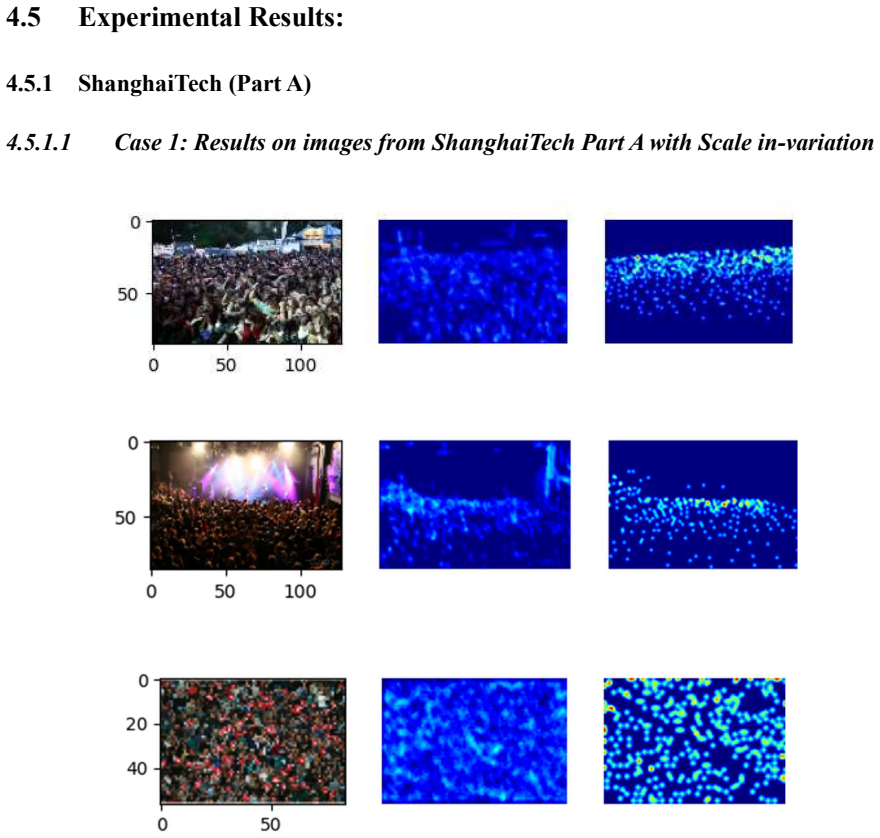
- [Section 4.5 and Tables 4.1-4.5] Although Section 4.4 defines MAE and MSE, and the abstract claims evaluation on ShanghaiTech and UCF-QNRF, no aggregate MAE or MSE values are reported for any test set. The experimental section only presents per-image ground-truth versus predicted counts for a few selected images, and those numbers include substantial errors, e.g., Table 4.3 Image 3 reports 707 ground truth versus 431.64 predicted, and Table 4.5 reports 975 versus 577. Without aggregate errors or a comparison against existing crowd counting methods on the full test splits, the quantitative evaluation claims in the abstract and in Section 7 are unsupported.
- [Sections 6.4 and 6.5] The claim that the anomaly detection model outperforms other state-of-the-art approaches is not supported by any comparative table. Section 6.4 reports only precision (0.91), recall (0.82), and F1-score (0.86) on the Hockey Fight dataset without comparing to prior published results, and Section 6.5 reports one result on SCVD. Additionally, Table 6.2 is mislabeled: the section heading refers to SCVD, the table's first column says 'Hockey Fight Dataset,' and the row also says 'Hockey Fight Dataset,' making the reported SCVD result ambiguous. Without a comparison to existing methods and a clear reporting of the experimental setup, the 'outperform state-of-the-art' statement is not verifiable.
minor comments (4)
- [Equations 1 and 2 (Section 4.4)] The notation in the MAE and MSE formulas is inconsistent: y_c is defined as 'number of peoples counted' and the denominator symbols are garbled, while the predicted count is not clearly distinguished from the ground-truth count. Please define y_pred and y_GT explicitly and rewrite the equations with standard notation.
- [Tables 4.4 and 4.5] Table 4.4 and Table 4.5 have the same caption, 'Ground Truth vs. Predicted Count for Images with Scale In-variation,' but Table 4.5 appears in the complex-background subsection. The captions should be corrected.
- [Table 6.2] The row label in Table 6.2 says 'Hockey Fight Dataset' while the section heading is 'Experimental Results on SCVD.' This typo should be fixed so the reported 0.93/0.92/0.90 result is attributed to the correct dataset.
- [Section 3.1.1] The subsection numbering in Chapter 3 is inconsistent: '3.1 Theoretical Background' is followed by '3. Data Augmentation' instead of '3.1.1 Data Augmentation.' This should be corrected throughout the chapter.
Circularity Check
No circular derivation: the counting and anomaly-detection pipelines do not assume their own conclusions, although the zero-annotation counting claim is contradicted by the paper's own supervised pre-training and ground-truth density-map losses.
full rationale
The derivation chain is not circular in the technical sense. Stage 1 of the counting method uses rotation classification with labels generated from the input crops; that pretext task is independent of the crowd count, so it can provide a genuine initialization that is not defined in terms of the final count. Stage 2 matches a predicted density to an unspecified 'prior distribution' via Sinkhorn distance, but no equation in the paper shows the predicted density is defined as the prior or as a fitted parameter, so there is no Eq X = Eq Y reduction. The main problem is that the paper labels its method 'completely self-supervised learning without using a single annotated image' (Section 1.9.1), while Section 4.1.2 states 'Annotated and unannotated data is used for training purposes,' Section 4.2.1 says the model is 'trained on a labeled dataset with the help of an annotated dataset' using 'images and their relevant ground-truth maps,' and Section 4.2.2 says 'The density maps are compared to the ground truth density maps created with Gaussian kernels.' That is a factual contradiction about supervision, not a circular derivation: the prediction is not being defined as its own input, and no fitted parameter is renamed as a prediction. The undefined prior in Section 3.2.4 is a serious reproducibility gap, and the claimed MAE/MSE evaluations on ShanghaiTech and UCF-QNRF are not reported as aggregate numbers in Sections 4.5.1-4.5.2, but these are missing-evidence issues outside the circularity rubric. Citations to M-CNN [13] and ConvLSTM [14,15] are external prior works, not author self-citations carrying a uniqueness theorem. Therefore the circularity score is 0.
Assumptions & free parameters
free parameters (3)
- M-CNN branch count =
5
- Rotation pretraining crop size =
112x112
- LSTM hidden units =
256
assumptions (4)
- domain assumption Rotation classification on 112x112 crops learns features relevant to crowd density estimation.
- ad hoc to paper A prior distribution approximating natural crowd statistics exists and is suitable for Sinkhorn matching.
- domain assumption Ground-truth density maps are available for the second-stage loss.
- domain assumption ImageNet pretrained VGG19 weights transfer to crowd violence detection.
invented entities (1)
-
Crowd-density prior distribution for Sinkhorn matching
Cite this review
Pith. "Pith review of Crowd Scene Analysis using Deep Learning Techniques." pith.science (2026). https://pith.science/paper/QC26RSNM
@misc{pith2026250508834,
  author       = {Pith},
  title        = {Pith review of: Crowd Scene Analysis using Deep Learning Techniques},
  year         = {2026},
  howpublished = {\url{https://pith.science/paper/QC26RSNM}},
  note         = {Machine review of arXiv:2505.08834}
}
read the original abstract
Our research is focused on two main applications of crowd scene analysis crowd counting and anomaly detection In recent years a large number of researches have been presented in the domain of crowd counting We addressed two main challenges in this domain 1 Deep learning models are datahungry paradigms and always need a large amount of annotated data for the training of algorithm It is timeconsuming and costly task to annotate such large amount of data Selfsupervised training is proposed to deal with this challenge 2 MCNN consists of multicolumns of CNN with different sizes of filters by presenting a novel approach based on a combination of selfsupervised training and MultiColumn CNN This enables the model to learn features at different levels and makes it effective in dealing with challenges of occluded scenes nonuniform density complex backgrounds and scale invariation The proposed model was evaluated on publicly available data sets such as ShanghaiTech and UCFQNRF by means of MAE and MSE A spatiotemporal model based on VGG19 is proposed for crowd anomaly detection addressing challenges like lighting environmental conditions unexpected objects and scalability The model extracts spatial and temporal features allowing it to be generalized to realworld scenes Spatial features are learned using CNN while temporal features are learned using LSTM blocks The model works on binary classification and can detect normal or abnormal behavior The models performance is improved by replacing fully connected layers with dense residual blocks Experiments on the Hockey Fight dataset and SCVD dataset show our models outperform other stateoftheart approaches
Figures



Figures from the paper (65 more)










Forward citations
Cited by 1 Pith paper
-
Advancements in Crop Analysis through Deep Learning and Explainable AI
A thesis reports roughly 99 percent CNN accuracy on five rice grain varieties and four rice leaf diseases with LIME/SHAP overlays, replicating prior published results on the same public datasets.
Reference graph
Works this paper leans on
-
[1]
Elliott, S
G. Elliott, S. Rundle-Thiele, S. Smith, D. Waller, L. Eades and I. Bentrott, Marketing, John Wiley & Sons, Limited, 2017
2017
-
[2]
User, Physical, Virtual or Hybrid Events - Which Approach Is Best? — Think Global Forum — thinkglobalforum.org
G. User, Physical, Virtual or Hybrid Events - Which Approach Is Best? — Think Global Forum — thinkglobalforum.org
-
[3]
Physical Meetings: What Works and What Doesn’t — openaudience.com
Contact, Virtual vs. Physical Meetings: What Works and What Doesn’t — openaudience.com
-
[4]
Visual crowd analysis: Open research problems,
M. A. Khan, H. Menouar and R. Hamila, "Visual crowd analysis: Open research problems," AI Magazine, vol. 44, p. 296–311, 2023
2023
-
[5]
Meel, People Counting System: How To Make Your Own in Less Than 10 Minutes - viso.ai — viso.ai
V . Meel, People Counting System: How To Make Your Own in Less Than 10 Minutes - viso.ai — viso.ai
-
[6]
Crowd Anomaly Detection in Video Frames Using Fine- Tuned AlexNet Model,
A. A. Khan, M. A. Nauman, M. Shoaib, R. Jahangir, R. Alroobaea, M. Alsafyani, A. Binmahfoudh and C. Wechtaisong, "Crowd Anomaly Detection in Video Frames Using Fine- Tuned AlexNet Model," Electronics, vol. 11, p. 3105, 2022
2022
-
[7]
Multi-source multi-scale counting in extremely dense crowd images,
H. Idrees, I. Saleemi, C. Seibert and M. Shah, "Multi-source multi-scale counting in extremely dense crowd images," in Proceedings of the IEEE conference on computer vision and pattern recognition, 2013
2013
-
[8]
Cross-scene crowd counting via deep convolutional neural networks,
C. Zhang, H. Li, X. Wang and X. Yang, "Cross-scene crowd counting via deep convolutional neural networks," in Proceedings of the IEEE conference on computer vision and pattern recognition, 2015
2015
Show all 155 references
-
[9]
Learning to count objects in images,
V . Lempitsky and A. Zisserman, "Learning to count objects in images," Advances in neural information processing systems, vol. 23, 2010
2010
-
[10]
Fully convolutional crowd counting on highly congested scenes,
M. Marsden, K. McGuinness, S. Little and N. E. O'Connor, "Fully convolutional crowd counting on highly congested scenes," arXiv preprint arXiv:1612.00220, 2016
2016 arXiv
-
[11]
Crowdnet: A deep convolutional network for dense crowd counting,
L. Boominathan, S. S. S. Kruthiventi and R. V . Babu, "Crowdnet: A deep convolutional network for dense crowd counting," in Proceedings of the 24th ACM international conference on Multimedia, 2016
2016
-
[12]
Density-aware person detection and tracking in crowds,
M. Rodriguez, I. Laptev, J. Sivic and J.-Y . Audibert, "Density-aware person detection and tracking in crowds," in 2011 International Conference on Computer Vision, 2011
2011
-
[13]
Single-image crowd counting via multi-column convolutional neural network,
Y . Zhang, D. Zhou, S. Chen, S. Gao and Y . Ma, "Single-image crowd counting via multi-column convolutional neural network," in Proceedings of the IEEE conference on computer vision and pattern recognition, 2016. 115
2016
-
[14]
Learning to detect violent videos using convolutional long short- term memory,
S. Sudhakaran and O. Lanz, "Learning to detect violent videos using convolutional long short- term memory," in 2017 14th IEEE international conference on advanced video and signal based surveillance (AVSS), 2017
2017
-
[15]
Bidirectional convolutional lstm for the detection of violence in videos,
A. Hanson, K. Pnvr, S. Krishnagopal and L. Davis, "Bidirectional convolutional lstm for the detection of violence in videos," in Proceedings of the European conference on computer vision (ECCV) workshops, 2018
2018
-
[16]
Unified crowd segmentation,
P. Tu, T. Sebastian, G. Doretto, N. Krahnstoever, J. Rittscher and T. Yu, "Unified crowd segmentation," in Computer Vision–ECCV 2008: 10th European Conference on Computer Vision, Marseille, France, October 12-18, 2008, Proceedings, Part IV 10, 2008
2008
-
[17]
Granular-based dense crowd density estimation,
V . J. Kok and C. S. Chan, "Granular-based dense crowd density estimation," Multimedia Tools and Applications, vol. 77, p. 20227–20246, 2018
2018
-
[18]
Cnn-based density estimation and crowd counting: A survey,
G. Gao, J. Gao, Q. Liu, Q. Wang and Y . Wang, "Cnn-based density estimation and crowd counting: A survey," arXiv preprint arXiv:2003.12783, 2020
2003 arXiv
-
[19]
An introduction to convolutional neural networks,
K. O'Shea and R. Nash, "An introduction to convolutional neural networks," arXiv preprint arXiv:1511.08458, 2015
2015 arXiv
-
[20]
Fully convolutional networks for semantic segmentation,
J. Long, E. Shelhamer and T. Darrell, "Fully convolutional networks for semantic segmentation," in Proceedings of the IEEE conference on computer vision and pattern recognition, 2015
2015
-
[21]
Generative adversarial nets,
I. Goodfellow, J. Pouget-Abadie, M. Mirza, B. Xu, D. Warde-Farley, S. Ozair, A. Courville and Y . Bengio, "Generative adversarial nets," Advances in neural information processing systems, vol. 27, 2014
2014
-
[22]
Generative adversarial networks: An overview,
A. Creswell, T. White, V . Dumoulin, K. Arulkumaran, B. Sengupta and A. A. Bharath, "Generative adversarial networks: An overview," IEEE signal processing magazine, vol. 35, p. 53–65, 2018
2018
-
[23]
Attention mechanisms in computer vision: A survey,
M.-H. Guo, T.-X. Xu, J.-J. Liu, Z.-N. Liu, P.-T. Jiang, T.-J. Mu, S.-H. Zhang, R. R. Martin, M.- M. Cheng and S.-M. Hu, "Attention mechanisms in computer vision: A survey," Computational visual media, vol. 8, p. 331–368, 2022
2022
-
[24]
A survey of the recent architectures of deep convolutional neural networks,
A. Khan, A. Sohail, U. Zahoora and A. S. Qureshi, "A survey of the recent architectures of deep convolutional neural networks," Artificial intelligence review, vol. 53, p. 5455–5516, 2020
2020
-
[25]
A survey of recent advances in cnn-based single image crowd counting and density estimation,
V . A. Sindagi and V . M. Patel, "A survey of recent advances in cnn-based single image crowd counting and density estimation," Pattern Recognition Letters, vol. 107, p. 3–16, 2018
2018
-
[26]
Revisiting crowd counting: State-of-the-art, trends, and future perspectives,
M. A. Khan, H. Menouar and R. Hamila, "Revisiting crowd counting: State-of-the-art, trends, and future perspectives," Image and Vision Computing, p. 104597, 2022
2022
-
[27]
Analysis of various optimizers on deep convolutional neural network model in the application of hyperspectral remote sensing image classification,
S. Bera and V . K. Shrivastava, "Analysis of various optimizers on deep convolutional neural network model in the application of hyperspectral remote sensing image classification," International Journal of Remote Sensing, vol. 41, p. 2664–2683, 2020. 116
2020
-
[28]
Novel sensitive nanocoatings based on SWCNT composites for advanced fiber optic chemo-sensors,
A. Crescitelli, M. Consales, A. Cutolo, A. Cusano, M. Penza, P. Aversa and M. Giordano, "Novel sensitive nanocoatings based on SWCNT composites for advanced fiber optic chemo-sensors," in SENSORS, 2008 IEEE, 2008
2008
-
[29]
Resnetcrowd: A residual deep learning architecture for crowd counting, violent behaviour detection and crowd density level classification,
M. Marsden, K. McGuinness, S. Little and N. E. O'Connor, "Resnetcrowd: A residual deep learning architecture for crowd counting, violent behaviour detection and crowd density level classification," in 2017 14th IEEE international conference on advanced video and signal based s...
2017
-
[30]
Improving the learning of multi-column convolutional neural network for crowd counting,
Z.-Q. Cheng, J.-X. Li, Q. Dai, X. Wu, J.-Y . He and A. Hauptmann, "Improving the learning of multi-column convolutional neural network for crowd counting," arXiv preprint arXiv:1909.07608, 2019
1909 arXiv
-
[31]
Multi-scale convolutional neural networks for crowd counting,
L. Zeng, X. Xu, B. Cai, S. Qiu and T. Zhang, "Multi-scale convolutional neural networks for crowd counting," in 2017 IEEE International Conference on Image Processing (ICIP), 2017
2017
-
[32]
Rethinking counting and localization in crowds: A purely point-based framework,
Q. Song, C. Wang, Z. Jiang, Y . Wang, Y . Tai, C. Wang, J. Li, F. Huang and Y . Wu, "Rethinking counting and localization in crowds: A purely point-based framework," in Proceedings of the IEEE/CVF International Conference on Computer Vision, 2021
2021
-
[33]
Detection, tracking, and counting meets drones in crowds: A benchmark,
L. Wen, D. Du, P. Zhu, Q. Hu, Q. Wang, L. Bo and S. Lyu, "Detection, tracking, and counting meets drones in crowds: A benchmark," in Proceedings of the IEEE/CVF Conference on Computer Vision and Pattern Recognition, 2021
2021
-
[34]
Dense scale network for crowd counting,
F. Dai, H. Liu, Y . Ma, X. Zhang and Q. Zhao, "Dense scale network for crowd counting," in Proceedings of the 2021 international conference on multimedia retrieval, 2021
2021
-
[35]
CRANet: cascade residual attention network for crowd counting,
Z. Wu, J. Sang, Y . Shi, Q. Liu, N. Sang and X. Liu, "CRANet: cascade residual attention network for crowd counting," in 2021 IEEE International Conference on Multimedia and Expo (ICME), 2021
2021
-
[36]
Spatiotemporal dilated convolution with uncertain matching for video-based crowd estimation,
Y .-J. Ma, H.-H. Shuai and W.-H. Cheng, "Spatiotemporal dilated convolution with uncertain matching for video-based crowd estimation," IEEE Transactions on Multimedia, vol. 24, p. 261– 273, 2021
2021
-
[37]
MSPNET: Multi-supervised parallel network for crowd counting,
B. Wei, Y . Yuan and Q. Wang, "MSPNET: Multi-supervised parallel network for crowd counting," in ICASSP 2020-2020 IEEE International Conference on Acoustics, Speech and Signal Processing (ICASSP), 2020
2020
-
[38]
Dilated convolutional neural networks for understanding the highly congested scenes/Y . Li, X. Zhang, D. Chen,
Y . C. Li, "Dilated convolutional neural networks for understanding the highly congested scenes/Y . Li, X. Zhang, D. Chen," in Proceedings of the IEEE conference on computer vision and pattern recognition.–IEEE, 2018
2018
-
[39]
CLRNet: a cross locality relation network for crowd counting in videos,
L. Dong, H. Zhang, J. Ma, X. Xu, Y . Yang and Q. J. Wu, "CLRNet: a cross locality relation network for crowd counting in videos," IEEE Transactions on Neural Networks and Learning Systems, 2022. 117
2022
-
[40]
Self-supervised domain adaptation in crowd counting,
P. Nguyen, T.-D. Truong, M. Huang, Y . Liang, N. Le and K. Luu, "Self-supervised domain adaptation in crowd counting," in 2022 IEEE International Conference on Image Processing (ICIP), 2022
2022
-
[41]
Tafnet: A three-stream adaptive fusion network for rgb-t crowd counting,
H. Tang, Y . Wang and L.-P. Chau, "Tafnet: A three-stream adaptive fusion network for rgb-t crowd counting," in 2022 IEEE International Symposium on Circuits and Systems (ISCAS), 2022
2022
-
[42]
Boosting crowd counting via multifaceted attention,
H. Lin, Z. Ma, R. Ji, Y . Wang and X. Hong, "Boosting crowd counting via multifaceted attention," in Proceedings of the IEEE/CVF Conference on Computer Vision and Pattern Recognition, 2022
2022
-
[43]
Nonlinear regression via deep negative correlation learning,
L. Zhang, Z. Shi, M.-M. Cheng, Y . Liu, J.-W. Bian, J. T. Zhou, G. Zheng and Z. Zeng, "Nonlinear regression via deep negative correlation learning," IEEE transactions on pattern analysis and machine intelligence, vol. 43, p. 982–998, 2019
2019
-
[44]
Crowd counting with deep negative correlation learning,
Z. Shi, L. Zhang, Y . Liu, X. Cao, Y . Ye, M.-M. Cheng and G. Zheng, "Crowd counting with deep negative correlation learning," in Proceedings of the IEEE conference on computer vision and pattern recognition, 2018
2018
-
[45]
CrowdCLIP: Unsupervised Crowd Counting via Vision-Language Model,
D. Liang, J. Xie, Z. Zou, X. Ye, W. Xu and X. Bai, "CrowdCLIP: Unsupervised Crowd Counting via Vision-Language Model," in Proceedings of the IEEE/CVF Conference on Computer Vision and Pattern Recognition, 2023
2023
-
[46]
People count from the crowd using unsupervised learning technique from low resolution surveillance videos,
A. Kowcika, "People count from the crowd using unsupervised learning technique from low resolution surveillance videos," in 2017 international conference on energy, communication, data analytics and soft computing (ICECDS), 2017
2017
-
[47]
Almost unsupervised learning for dense crowd counting,
D. B. Sam, N. N. Sajjan, H. Maurya and R. V . Babu, "Almost unsupervised learning for dense crowd counting," in Proceedings of the AAAI conference on artificial intelligence, 2019
2019
-
[48]
Auto-encoding variational bayes,
D. P. Kingma and M. Welling, "Auto-encoding variational bayes," arXiv preprint arXiv:1312.6114, 2013
2013 arXiv
-
[49]
CrowdFormer: Weakly-supervised crowd counting with improved generalizability,
S. S. Savner and V . Kanhangad, "CrowdFormer: Weakly-supervised crowd counting with improved generalizability," Journal of Visual Communication and Image Representation, vol. 94, p. 103853, 2023
2023
-
[50]
Transcrowd: weakly-supervised crowd counting with transformers,
D. Liang, X. Chen, W. Xu, Y . Zhou and X. Bai, "Transcrowd: weakly-supervised crowd counting with transformers," Science China Information Sciences, vol. 65, p. 160104, 2022
2022
-
[51]
Exploiting unlabeled data in cnns by self- supervised learning to rank,
X. Liu, J. Van De Weijer and A. D. Bagdanov, "Exploiting unlabeled data in cnns by self- supervised learning to rank," IEEE transactions on pattern analysis and machine intelligence, vol. 41, p. 1862–1878, 2019
2019
-
[52]
Self-Supervised Learning With Data- Efficient Supervised Fine-Tuning for Crowd Counting,
R. Wang, Y . Hao, L. Hu, J. Chen, M. Chen and D. Wu, "Self-Supervised Learning With Data- Efficient Supervised Fine-Tuning for Crowd Counting," IEEE Transactions on Multimedia, 2023. 118
2023
-
[53]
Unsupervised learning of visual representations by solving jigsaw puzzles,
M. Noroozi and P. Favaro, "Unsupervised learning of visual representations by solving jigsaw puzzles," in European conference on computer vision, 2016
2016
-
[54]
Context encoders: Feature learning by inpainting,
D. Pathak, P. Krahenbuhl, J. Donahue, T. Darrell and A. A. Efros, "Context encoders: Feature learning by inpainting," in Proceedings of the IEEE conference on computer vision and pattern recognition, 2016
2016
-
[55]
Colorization as a proxy task for visual understanding,
G. Larsson, M. Maire and G. Shakhnarovich, "Colorization as a proxy task for visual understanding," in Proceedings of the IEEE conference on computer vision and pattern recognition, 2017
2017
-
[56]
Learning deep event models for crowd anomaly detection,
Y . Feng, Y . Yuan and X. Lu, "Learning deep event models for crowd anomaly detection," Neurocomputing, vol. 219, p. 548–556, 2017
2017
-
[57]
Unsupervised representation learning by predicting image rotations,
S. Gidaris, P. Singh and N. Komodakis, "Unsupervised representation learning by predicting image rotations," arXiv preprint arXiv:1803.07728, 2018
2018 arXiv
-
[58]
Context-aware crowd counting,
W. Liu, M. Salzmann and P. Fua, "Context-aware crowd counting," in Proceedings of the IEEE/CVF conference on computer vision and pattern recognition, 2019
2019
-
[59]
Recent trends in crowd analysis: A review,
M. Bendali-Braham, J. Weber, G. Forestier, L. Idoumghar and P.-A. Muller, "Recent trends in crowd analysis: A review," Machine Learning with Applications, vol. 4, p. 100023, 2021
2021
-
[60]
Modeling representation of videos for anomaly detection using deep learning: A review,
Y . S. Chong and Y . H. Tay, "Modeling representation of videos for anomaly detection using deep learning: A review," arXiv preprint arXiv:1505.00523, 2015
2015 arXiv
-
[61]
Shape-based human detection and segmentation via hierarchical part- template matching,
Z. Lin and L. S. Davis, "Shape-based human detection and segmentation via hierarchical part- template matching," IEEE transactions on pattern analysis and machine intelligence, vol. 32, p. 604–618, 2010
2010
-
[62]
Pedestrian detection via classification on riemannian manifolds,
O. Tuzel, F. Porikli and P. Meer, "Pedestrian detection via classification on riemannian manifolds," IEEE transactions on pattern analysis and machine intelligence, vol. 30, p. 1713– 1727, 2008
2008
-
[63]
Counting people by clustering person detector outputs,
I. S. Topkaya, H. Erdogan and F. Porikli, "Counting people by clustering person detector outputs," in 2014 11th IEEE international conference on advanced video and signal based surveillance (AVSS), 2014
2014
-
[64]
Object detection with discriminatively trained part-based models,
P. F. Felzenszwalb, R. B. Girshick, D. McAllester and D. Ramanan, "Object detection with discriminatively trained part-based models," IEEE transactions on pattern analysis and machine intelligence, vol. 32, p. 1627–1645, 2009
2009
-
[65]
Estimating the number of people in crowded scenes by mid based foreground segmentation and head-shoulder detection,
M. Li, Z. Zhang, K. Huang and T. Tan, "Estimating the number of people in crowded scenes by mid based foreground segmentation and head-shoulder detection," in 2008 19th international conference on pattern recognition, 2008
2008
-
[66]
Locate, size, and count: accurately resolving people in dense crowds via detection,
D. B. Sam, S. V . Peri, M. N. Sundararaman, A. Kamath and R. V . Babu, "Locate, size, and count: accurately resolving people in dense crowds via detection," IEEE transactions on pattern analysis and machine intelligence, vol. 43, p. 2739–2751, 2020. 119
2020
-
[67]
Point in, box out: Beyond counting persons in crowds,
Y . Liu, M. Shi, Q. Zhao and X. Wang, "Point in, box out: Beyond counting persons in crowds," in Proceedings of the IEEE/CVF Conference on Computer Vision and Pattern Recognition, 2019
2019
-
[68]
A self-training approach for point-supervised object detection and counting in crowds,
Y . Wang, J. Hou, X. Hou and L.-P. Chau, "A self-training approach for point-supervised object detection and counting in crowds," IEEE Transactions on Image Processing, vol. 30, p. 2876– 2887, 2021
2021
-
[69]
Count forest: Co-voting uncertain number of targets using random forest for crowd density estimation,
V .-Q. Pham, T. Kozakaya, O. Yamaguchi and R. Okada, "Count forest: Co-voting uncertain number of targets using random forest for crowd density estimation," in Proceedings of the IEEE international conference on computer vision, 2015
2015
-
[70]
A deeply-recursive convolutional network for crowd counting,
X. Ding, Z. Lin, F. He, Y . Wang and Y . Huang, "A deeply-recursive convolutional network for crowd counting," in 2018 IEEE International Conference on Acoustics, Speech and Signal Processing (ICASSP), 2018
2018
-
[71]
Switching convolutional neural network for crowd counting,
D. Babu Sam, S. Surya and R. Venkatesh Babu, "Switching convolutional neural network for crowd counting," in Proceedings of the IEEE conference on computer vision and pattern recognition, 2017
2017
-
[72]
Multi-resolution attention convolutional neural network for crowd counting,
Y . Zhang, C. Zhou, F. Chang and A. C. Kot, "Multi-resolution attention convolutional neural network for crowd counting," Neurocomputing, vol. 329, p. 144–152, 2019
2019
-
[73]
Image crowd counting using convolutional neural network and markov random field,
K. Han, W. Wan, H. Yao and L. Hou, "Image crowd counting using convolutional neural network and markov random field," Journal of Advanced Computational Intelligence and Intelligent Informatics, vol. 21, p. 632–638, 2017
2017
-
[74]
Csrnet: Dilated convolutional neural networks for understanding the highly congested scenes,
Y . Li, X. Zhang and D. Chen, "Csrnet: Dilated convolutional neural networks for understanding the highly congested scenes," in Proceedings of the IEEE conference on computer vision and pattern recognition, 2018
2018
-
[75]
Relational attention network for crowd counting,
A. Zhang, J. Shen, Z. Xiao, F. Zhu, X. Zhen, X. Cao and L. Shao, "Relational attention network for crowd counting," in Proceedings of the IEEE/CVF international conference on computer vision, 2019
2019
-
[76]
Cnn-based cascaded multi-task learning of high-level prior and density estimation for crowd counting,
V . A. Sindagi and V . M. Patel, "Cnn-based cascaded multi-task learning of high-level prior and density estimation for crowd counting," in 2017 14th IEEE international conference on advanced video and signal based surveillance (AVSS), 2017
2017
-
[77]
Dense crowd counting from still images with convolutional neural networks,
Y . Hu, H. Chang, F. Nian, Y . Wang and T. Li, "Dense crowd counting from still images with convolutional neural networks," Journal of Visual Communication and Image Representation, vol. 38, p. 530–539, 2016
2016
-
[78]
Auxiliary learning for crowd counting via count-net,
Y . Zhang, F. Chang, M. Wang, F. Zhang and C. Han, "Auxiliary learning for crowd counting via count-net," Neurocomputing, vol. 273, p. 190–198, 2018
2018
-
[79]
Mixture of counting cnns: Adaptive integration of cnns specialized to specific appearance for crowd counting,
S. Kumagai, K. Hotta and T. Kurita, "Mixture of counting cnns: Adaptive integration of cnns specialized to specific appearance for crowd counting," arXiv preprint arXiv:1703.09393, 2017. 120
2017 arXiv
-
[80]
Violence detection in surveillance videos with deep network using transfer learning,
A. Mumtaz, A. B. Sargano and Z. Habib, "Violence detection in surveillance videos with deep network using transfer learning," in 2018 2nd European Conference on Electrical Engineering and Computer Science (EECS), 2018
2018
-
[81]
Violence detection in videos based on fusing visual and audio information,
W.-F. Pang, Q.-H. He, Y .-j. Hu and Y .-X. Li, "Violence detection in videos based on fusing visual and audio information," in ICASSP 2021-2021 IEEE international conference on acoustics, speech and signal processing (ICASSP), 2021
2021
-
[82]
Violence content classification using audio features,
T. Giannakopoulos, D. Kosmopoulos, A. Aristidou and S. Theodoridis, "Violence content classification using audio features," in Advances in Artificial Intelligence: 4th Helenic Conference on AI, SETN 2006, Heraklion, Crete, Greece, May 18-20, 2006. Proceedings 4, 2006
2006
-
[83]
CASSANDRA: audio-video sensor fusion for aggression detection,
W. Zajdel, J. D. Krijnders, T. Andringa and D. M. Gavrila, "CASSANDRA: audio-video sensor fusion for aggression detection," in 2007 IEEE conference on advanced video and signal based surveillance, 2007
2007
-
[84]
Detecting violent scenes in movies by auditory and visual cues,
Y . Gong, W. Wang, S. Jiang, Q. Huang and W. Gao, "Detecting violent scenes in movies by auditory and visual cues," in Advances in Multimedia Information Processing-PCM 2008: 9th Pacific Rim Conference on Multimedia, Tainan, Taiwan, December 9-13, 2008. Proceedings 9, 2008
2008
-
[85]
DOVE: Detection of movie violence using motion intensity analysis on skin and blood,
C. Clarin, J. Dionisio, M. Echavez and P. Naval, "DOVE: Detection of movie violence using motion intensity analysis on skin and blood," PCSC, vol. 6, p. 150–156, 2005
2005
-
[86]
A comprehensive review on vision-based violence detection in surveillance videos,
F. U. M. Ullah, M. S. Obaidat, A. Ullah, K. Muhammad, M. Hijji and S. W. Baik, "A comprehensive review on vision-based violence detection in surveillance videos," ACM Computing Surveys, vol. 55, p. 1–44, 2023
2023
-
[87]
Spatio-temporal anomaly detection in crowd movement using SIFT,
N. Ojha and A. Vaish, "Spatio-temporal anomaly detection in crowd movement using SIFT," in 2018 2nd International Conference on Inventive Systems and Control (ICISC), 2018
2018
-
[88]
Object tracking using SIFT features and mean shift,
H. Zhou, Y . Yuan and C. Shi, "Object tracking using SIFT features and mean shift," Computer vision and image understanding, vol. 113, p. 345–352, 2009
2009
-
[89]
Speeded-up robust features (SURF),
H. Bay, A. Ess, T. Tuytelaars and L. Van Gool, "Speeded-up robust features (SURF)," Computer vision and image understanding, vol. 110, p. 346–359, 2008
2008
-
[90]
BRISK: Binary robust invariant scalable keypoints,
S. Leutenegger, M. Chli and R. Y . Siegwart, "BRISK: Binary robust invariant scalable keypoints," in 2011 International conference on computer vision, 2011
2011
-
[91]
ORB: An efficient alternative to SIFT or SURF,
E. Rublee, V . Rabaud, K. Konolige and G. Bradski, "ORB: An efficient alternative to SIFT or SURF," in 2011 International conference on computer vision, 2011
2011
-
[92]
Evaluating bag-of-visual-words representations in scene classification,
J. Yang, Y .-G. Jiang, A. G. Hauptmann and C.-W. Ngo, "Evaluating bag-of-visual-words representations in scene classification," in Proceedings of the international workshop on Workshop on multimedia information retrieval, 2007. 121
2007
-
[93]
Violent flows: Real-time detection of violent crowd behavior,
T. Hassner, Y . Itcher and O. Kliper-Gross, "Violent flows: Real-time detection of violent crowd behavior," in 2012 IEEE computer society conference on computer vision and pattern recognition workshops, 2012
2012
-
[94]
Social mil: Interaction-aware for crowd anomaly detection,
S. Lin, H. Yang, X. Tang, T. Shi and L. Chen, "Social mil: Interaction-aware for crowd anomaly detection," in 2019 16th IEEE international conference on advanced video and signal based surveillance (AVSS), 2019
2019
-
[95]
Application of deep learning for crowd anomaly detection from surveillance videos,
K. Pawar and V . Attar, "Application of deep learning for crowd anomaly detection from surveillance videos," in 2021 11th International Conference on Cloud Computing, Data Science & Engineering (Confluence), 2021
2021
-
[96]
Anomaly and activity recognition using machine learning approach for video based surveillance,
A. Mohan, M. Choksi and M. A. Zaveri, "Anomaly and activity recognition using machine learning approach for video based surveillance," in 2019 10th International Conference on Computing, Communication and Networking Technologies (ICCCNT), 2019
2019
-
[97]
Efficient anomaly detection in crowd videos using pre-trained 2D convolutional neural networks,
A. Mehmood, "Efficient anomaly detection in crowd videos using pre-trained 2D convolutional neural networks," IEEE Access, vol. 9, p. 138283–138295, 2021
2021
-
[98]
Self-supervised representation learning by rotation feature decoupling,
Z. Feng, C. Xu and D. Tao, "Self-supervised representation learning by rotation feature decoupling," in Proceedings of the IEEE/CVF Conference on Computer Vision and Pattern Recognition, 2019
2019
-
[99]
An automated deep learning based anomaly detection in pedestrian walkways for vulnerable road users safety,
I. V . Pustokhina, D. A. Pustokhin, T. Vaiyapuri, D. Gupta, S. Kumar and K. Shankar, "An automated deep learning based anomaly detection in pedestrian walkways for vulnerable road users safety," Safety science, vol. 142, p. 105356, 2021
2021
-
[100]
Joint detection and recounting of abnormal events by learning deep generic knowledge,
R. Hinami, T. Mei and S. Satoh, "Joint detection and recounting of abnormal events by learning deep generic knowledge," in Proceedings of the IEEE international conference on computer vision, 2017
2017
-
[101]
Future frame prediction for anomaly detection–a new baseline,
W. Liu, W. Luo, D. Lian and S. Gao, "Future frame prediction for anomaly detection–a new baseline," in Proceedings of the IEEE conference on computer vision and pattern recognition, 2018
2018
-
[102]
Image data augmentation for deep learning: A survey,
S. Yang, W. Xiao, M. Zhang, S. Guo, J. Zhao and F. Shen, "Image data augmentation for deep learning: A survey," arXiv preprint arXiv:2204.08610, 2022
2022 arXiv
-
[103]
A survey on image data augmentation for deep learning,
C. Shorten and T. M. Khoshgoftaar, "A survey on image data augmentation for deep learning," Journal of big data, vol. 6, p. 1–48, 2019
2019
-
[104]
Data augmentation: A comprehensive survey of modern approaches,
A. Mumuni and F. Mumuni, "Data augmentation: A comprehensive survey of modern approaches," Array, p. 100258, 2022
2022
-
[105]
Can artificial intelligence assist project developers in long-term management of energy projects? The case of CO2 capture and storage,
E. Buah, L. Linnanen, H. Wu and M. A. Kesse, "Can artificial intelligence assist project developers in long-term management of energy projects? The case of CO2 capture and storage," Energies, vol. 13, p. 6259, 2020. 122
2020
-
[106]
Data augmentation in classification and segmentation: A survey and new strategies,
K. Alomar, H. I. Aysel and X. Cai, "Data augmentation in classification and segmentation: A survey and new strategies," Journal of Imaging, vol. 9, p. 46, 2023
2023
-
[107]
Review of deep learning: Concepts, CNN architectures, challenges, applications, future directions,
L. Alzubaidi, J. Zhang, A. J. Humaidi, A. Al-Dujaili, Y . Duan, O. Al-Shamma, J. Santamarı́a, M. A. Fadhel, M. Al-Amidie and L. Farhan, "Review of deep learning: Concepts, CNN architectures, challenges, applications, future directions," Journal of big Data, vol. 8, p. 1–74, 2021
2021
-
[108]
How Do Neural Network Systems Work? - CHM — computerhistory.org
-
[109]
A multimetric predictive ANN-based routing protocol for vehicular ad hoc networks,
L. L. Cárdenas, A. M. Mezher, P. A. B. Bautista, J. P. A. León and M. A. Igartua, "A multimetric predictive ANN-based routing protocol for vehicular ad hoc networks," IEEE access, vol. 9, p. 86037–86053, 2021
2021
-
[110]
Development and application of artificial neural network,
Y .-c. Wu and J.-w. Feng, "Development and application of artificial neural network," Wireless Personal Communications, vol. 102, p. 1645–1656, 2018
2018
-
[112]
Activation functions in deep learning: A comprehensive survey and benchmark,
S. R. Dubey, S. K. Singh and B. B. Chaudhuri, "Activation functions in deep learning: A comprehensive survey and benchmark," Neurocomputing, 2022. [113]
2022
-
[114]
Pramoditha, Overview of a Neural Network’ s Learning Process — medium.com
R. Pramoditha, Overview of a Neural Network’ s Learning Process — medium.com
-
[115]
A Guide to Convolutional Neural Networks — the ELI5 way | Saturn Cloud Blog — saturncloud.io
-
[116]
Mandal, Introduction to Convolutional Neural Networks (CNN) — analyticsvidhya.com
M. Mandal, Introduction to Convolutional Neural Networks (CNN) — analyticsvidhya.com
-
[117]
Multi-column deep neural networks for image classification,
D. Ciregan, U. Meier and J. Schmidhuber, "Multi-column deep neural networks for image classification," in 2012 IEEE conference on computer vision and pattern recognition, 2012
2012
-
[118]
Deep learning using rectified linear units (relu),
A. F. Agarap, "Deep learning using rectified linear units (relu)," arXiv preprint arXiv:1803.08375, 2018
2018 arXiv
-
[119]
Composition loss for counting, density map estimation and localization in dense crowds,
H. Idrees, M. Tayyab, K. Athrey, D. Zhang, S. Al-Maadeed, N. Rajpoot and M. Shah, "Composition loss for counting, density map estimation and localization in dense crowds," in Proceedings of the European conference on computer vision (ECCV), 2018
2018
-
[120]
Very deep convolutional networks for large-scale image recognition,
K. Simonyan and A. Zisserman, "Very deep convolutional networks for large-scale image recognition," arXiv preprint arXiv:1409.1556, 2014
2014 arXiv
-
[121]
Imagenet classification with deep convolutional neural networks,
A. Krizhevsky, I. Sutskever and G. E. Hinton, "Imagenet classification with deep convolutional neural networks," Advances in neural information processing systems, vol. 25, 2012
2012
-
[122]
Training very deep networks,
R. K. Srivastava, K. Greff and J. Schmidhuber, "Training very deep networks," Advances in neural information processing systems, vol. 28, 2015. 123
2015
-
[123]
Deep residual learning for image recognition,
K. He, X. Zhang, S. Ren and J. Sun, "Deep residual learning for image recognition," in Proceedings of the IEEE conference on computer vision and pattern recognition, 2016
2016
-
[124]
Deep residual network in network,
H. Alaeddine and M. Jihene, "Deep residual network in network," Computational Intelligence and Neuroscience, vol. 2021, p. 1–9, 2021
2021
-
[125]
Wide residual networks,
S. Zagoruyko and N. Komodakis, "Wide residual networks," arXiv preprint arXiv:1605.07146, 2016
2016 arXiv
-
[126]
Deep autoaugment,
Y . Zheng, Z. Zhang, S. Yan and M. Zhang, "Deep autoaugment," arXiv preprint arXiv:2203.06172, 2022
2022 arXiv
-
[127]
Colorful image colorization,
R. Zhang, P. Isola and A. A. Efros, "Colorful image colorization," in Computer Vision–ECCV 2016: 14th European Conference, Amsterdam, The Netherlands, October 11-14, 2016, Proceedings, Part III 14, 2016
2016
-
[128]
Data-driven crowd understanding: A baseline for a large-scale crowd dataset,
C. Zhang, K. Kang, H. Li, X. Wang, R. Xie and X. Yang, "Data-driven crowd understanding: A baseline for a large-scale crowd dataset," IEEE Transactions on Multimedia, vol. 18, p. 1048– 1061, 2016
2016
-
[129]
A comparison of pooling methods for convolutional neural networks,
A. Zafar, M. Aamir, N. Mohd Nawi, A. Arshad, S. Riaz, A. Alruban, A. K. Dutta and S. Almotairi, "A comparison of pooling methods for convolutional neural networks," Applied Sciences, vol. 12, p. 8643, 2022
2022
-
[130]
Multi-scale generative adversarial networks for crowd counting,
J. Yang, Y . Zhou and S.-Y . Kung, "Multi-scale generative adversarial networks for crowd counting," in 2018 24th international conference on pattern recognition (ICPR), 2018
2018
-
[131]
Detecting anomalous events in videos by learning deep representations of appearance and motion,
D. Xu, Y . Yan, E. Ricci and N. Sebe, "Detecting anomalous events in videos by learning deep representations of appearance and motion," Computer Vision and Image Understanding, vol. 156, p. 117–127, 2017
2017
-
[132]
NWPU-crowd: A large-scale benchmark for crowd counting and localization,
Q. Wang, J. Gao, W. Lin and X. Li, "NWPU-crowd: A large-scale benchmark for crowd counting and localization," IEEE transactions on pattern analysis and machine intelligence, vol. 43, p. 2141–2149, 2020
2020
-
[133]
The effectiveness of data augmentation in image classification using deep learning,
J. Wang, L. Perez and others, "The effectiveness of data augmentation in image classification using deep learning," Convolutional Neural Networks Vis. Recognit, vol. 11, p. 1–8, 2017
2017
-
[134]
Learning to count with cnn boosting,
E. Walach and L. Wolf, "Learning to count with cnn boosting," in Computer Vision–ECCV 2016: 14th European Conference, Amsterdam, The Netherlands, October 11-14, 2016, Proceedings, Part II 14, 2016
2016
-
[135]
Going deeper with convolutions,
C. Szegedy, W. Liu, Y . Jia, P. Sermanet, S. Reed, D. Anguelov, D. Erhan, V . Vanhoucke and A. Rabinovich, "Going deeper with convolutions," in Proceedings of the IEEE conference on computer vision and pattern recognition, 2015
2015
-
[136]
Pushing the frontiers of unconstrained crowd counting: New dataset and benchmark method,
V . A. Sindagi, R. Yasarla and V . M. Patel, "Pushing the frontiers of unconstrained crowd counting: New dataset and benchmark method," in Proceedings of the IEEE/CVF International Conference on Computer Vision, 2019. 124
2019
-
[137]
Rapid growth of the world population and its socioeconomic results,
R. Sadigov and others, "Rapid growth of the world population and its socioeconomic results," The Scientific World Journal, vol. 2022, 2022
2022
-
[138]
Impact of training set batch size on the performance of convolutional neural networks for diverse datasets,
P. M. Radiuk, "Impact of training set batch size on the performance of convolutional neural networks for diverse datasets," 2017
2017
-
[139]
W. M. Pride, G. Elliott, S. Rundle-Thiele, D. Waller, A. Paladino and O. C. Ferrell, Marketing: Core concepts and applications, John Wiley & Sons, 2006
2006
-
[140]
Towards perspective-free object counting with deep learning,
D. Onoro-Rubio and R. J. López-Sastre, "Towards perspective-free object counting with deep learning," in Computer Vision–ECCV 2016: 14th European Conference, Amsterdam, The Netherlands, October 11–14, 2016, Proceedings, Part VII 14, 2016
2016
-
[141]
Review on self-supervised image recognition using deep neural networks,
K. Ohri and M. Kumar, "Review on self-supervised image recognition using deep neural networks," Knowledge-Based Systems, vol. 224, p. 107090, 2021
2021
-
[142]
Towards a universal model for cross-dataset crowd counting,
Z. Ma, X. Hong, X. Wei, Y . Qiu and Y . Gong, "Towards a universal model for cross-dataset crowd counting," in Proceedings of the IEEE/CVF International Conference on Computer Vision, 2021
2021
-
[143]
RGB-T Multi-Modal Crowd Counting Based on Transformer,
Z. Liu, W. Wu, Y . Tan and G. Zhang, "RGB-T Multi-Modal Crowd Counting Based on Transformer," arXiv preprint arXiv:2301.03033, 2023
2023 arXiv
-
[144]
Deep people counting with faster R-CNN and correlation tracking,
Z. Li, L. Zhang, Y . Fang, J. Wang, H. Xu, B. Yin and H. Lu, "Deep people counting with faster R-CNN and correlation tracking," in Proceedings of the international conference on internet multimedia computing and service, 2016
2016
-
[145]
Crowded scene analysis: A survey,
T. Li, H. Chang, M. Wang, B. Ni, R. Hong and S. Yan, "Crowded scene analysis: A survey," IEEE transactions on circuits and systems for video technology, vol. 25, p. 367–386, 2014
2014
-
[146]
Gradient-based learning applied to document recognition,
Y . LeCun, L. Bottou, Y . Bengio and P. Haffner, "Gradient-based learning applied to document recognition," Proceedings of the IEEE, vol. 86, p. 2278–2324, 1998
1998
-
[147]
Self-supervised learning to increase the performance of skin lesion classification,
A. Kwasigroch, M. Grochowski and A. Mikołajczyk, "Self-supervised learning to increase the performance of skin lesion classification," Electronics, vol. 9, p. 1930, 2020
1930
-
[148]
Densely connected convolutional networks,
G. Huang, Z. Liu, L. Van Der Maaten and K. Q. Weinberger, "Densely connected convolutional networks," in Proceedings of the IEEE conference on computer vision and pattern recognition, 2017
2017
-
[149]
Mobilenets: Efficient convolutional neural networks for mobile vision applications,
A. G. Howard, M. Zhu, B. Chen, D. Kalenichenko, W. Wang, T. Weyand, M. Andreetto and H. Adam, "Mobilenets: Efficient convolutional neural networks for mobile vision applications," arXiv preprint arXiv:1704.04861, 2017
2017 arXiv
-
[150]
Reducing the dimensionality of data with neural networks,
G. E. Hinton and R. R. Salakhutdinov, "Reducing the dimensionality of data with neural networks," science, vol. 313, p. 504–507, 2006
2006
-
[151]
Gaussian error linear units (gelus),
D. Hendrycks and K. Gimpel, "Gaussian error linear units (gelus)," arXiv preprint arXiv:1606.08415, 2016. 125
2016 arXiv
-
[152]
A survey of self-supervised learning from multiple perspectives: Algorithms, theory, applications and future trends,
J. Gui, T. Chen, Q. Cao, Z. Sun, H. Luo and D. Tao, "A survey of self-supervised learning from multiple perspectives: Algorithms, theory, applications and future trends," arXiv preprint arXiv:2301.05712, 2023
2023 arXiv
-
[153]
Rich feature hierarchies for accurate object detection and semantic segmentation,
R. Girshick, J. Donahue, T. Darrell and J. Malik, "Rich feature hierarchies for accurate object detection and semantic segmentation," in Proceedings of the IEEE conference on computer vision and pattern recognition, 2014
2014
-
[154]
Fast R-CNN,
R. Girshick, "Fast R-CNN," in 2015 IEEE International Conference on Computer Vision (ICCV), 2015
2015
-
[155]
Deep learning-based crowd scene analysis survey,
S. Elbishlawi, M. H. Abdelpakey, A. Eltantawy, M. S. Shehata and M. M. Mohamed, "Deep learning-based crowd scene analysis survey," Journal of Imaging, vol. 6, p. 95, 2020
2020
-
[156]
An aggregated multicolumn dilated convolution network for perspective-free counting,
D. Deb and J. Ventura, "An aggregated multicolumn dilated convolution network for perspective-free counting," in Proceedings of the IEEE conference on computer vision and pattern recognition workshops, 2018
2018
-
[157]
From semi-supervised to transfer counting of crowds,
C. Change Loy, S. Gong and T. Xiang, "From semi-supervised to transfer counting of crowds," in Proceedings of the IEEE International Conference on Computer Vision, 2013
2013
Reviewed August 15, 2026 · model on record in the stance chip above.
Discussion (0). Continue with ORCID to comment.