REVIEW 2 major objections 4 minor 58 references
Optimized Couplings for Watermarking Large Language Models
T0 review · 2 major / 4 minor · reviewed 2026-08-15 · deepseek-v4-flash
Pith's one-line read This paper derives a closed-form limit for single-token LLM watermark detection under worst-case token distributions, and proves that a zero-perception coupled random-partition scheme, the Correlated Channel watermark, attains it.
desk verdict The CC watermark and fixed-partition analysis are solid, but Theorem 3's balanced-class optimality is asserted, not proven, for general k and λ. read the letter →
The pith
A machine-rendered reading of the paper's core claim, the machinery that carries it, and where it could break.
The reading
What carries the argument
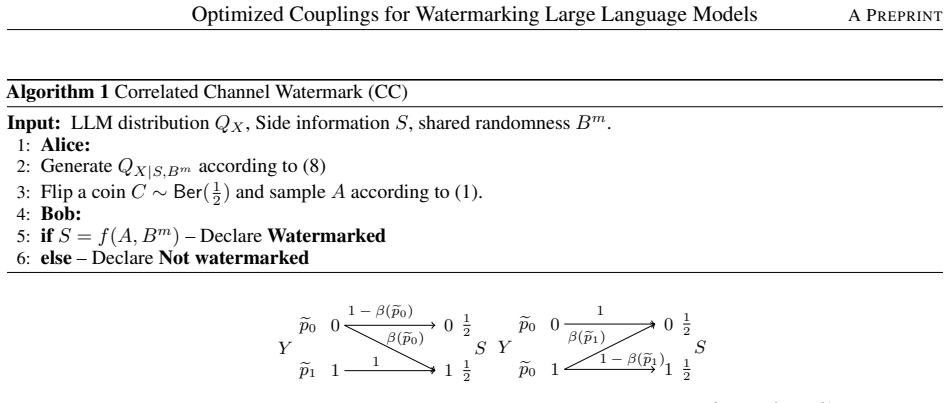
The load-bearing object is the correlated channel: an optimal coupling between the uniform side information $S \sim \mathrm{Unif}([k])$ and the random partition variable $Y = f(X, B_m)$ that maximizes the acceptance probability $\Pr(S = Y)$, constructed through the dual representation of total variation and reducing to a Z-channel when $k = 2$. Its job is to convert a public random assignment of colors to tokens ($B_m$, shared by watermarker and detector) into a private signal: the distribution of $Y$ is coupled to $S$ so that detector and watermarker agree on the color far more often than chance, while the marginal over tokens is untouched. This mechanism delivers zero perception ($\mathbb{E}_S[Q_{X|S}] = Q_X$), collapses the detection probability to the closed form $R_d = 1 - \frac{1}{2k} - \frac{1}{2}\mathrm{TV}(P_Y, P_S)$, and reduces the whole design problem to choosing the distribution of $B_m$; Theorem 3 then solves that choice in the max-min sense with the balanced permutation class.
What would settle it
Take a small instance, say $m = 12$ tokens with $k = 3$ colors, pick $\lambda$ strictly between $1/3$ and $1/2$, and compare the balanced class $(4,4,4)$ against unbalanced classes such as $(6,3,3)$ and $(8,2,2)$ by evaluating the formula (48) for $\mathbb{E}[g(Q^*_\lambda, B_m)]$ in each class; any unbalanced class with a smaller value refutes the optimality half of Theorem 3. The same verdict can be reached numerically by solving the max-min problem (6) directly over the finitely many extreme distributions $\{Q : \lVert Q\rVert_\infty \le \lambda\}$ for small $m$ and $k$ and checking whether $R^*_d(\lambda)$ is actually attained.
Extended reading notes
Core claim
The paper's central claim is Theorem 3: for a vocabulary of $m$ tokens, side information uniform over $k$ values, and the min-entropy constraint $\lVert Q_X\rVert_\infty \le \lambda$ (equivalently, $H_\infty(Q_X) \ge -\log\lambda$), the optimal max-min one-shot detection probability is $R^*_d(\lambda) = 1 - \frac{1}{2k} - \frac{1}{4}\mathbb{E}[g(Q^*_\lambda, B_m)]$, where the expectation is taken over $B_m$ sampled uniformly from the balanced permutation class (each of the $k$ colors appears exactly $m/k$ times) and $Q^*_\lambda$ is the extreme worst-case token distribution with $t = \lfloor 1/\lambda \rfloor$ entries equal to $\lambda$, one entry equal to $1-t\lambda$, and the rest zero. The scheme that achieves this, the Correlated Channel watermark, couples the shared side information $S$ with the partition label $Y = f(X, B_m)$ so as to maximize $\Pr(S = Y)$; for $k=2$ this optimal coupling is the Z-channel, and the detector simply announces 'watermarked' when $S = f(A, B_m)$. The paper further claims that this test is equivalent to the likelihood-ratio test at threshold $1$, that the scheme has zero perception in the sense $\mathbb{E}_S[Q_{X|S}] = Q_X$, and that sampling the partition i.i.d. Bernoulli$(1/k)$ is near-optimal with approximation error at most $2k\lceil 1/\lambda \rceil/m$.
Load-bearing premise
The closed-form optimum assumes that for every number of colors $k$ and every allowed peak probability $\lambda$, the best choice of partition randomness is the balanced permutation class in which each color appears exactly $m/k$ times; the appendix establishes this optimality only for $k = 2$ over restricted ranges of $\lambda$, so for general $k$ an unbalanced permutation class could in principle perform better, and that would invalidate the claimed closed-form maximum.
Editorial extensions
If this is right
- With binary side information ($k=2$) the worst-case single-token detection probability is capped at $3/4$ no matter how the vocabulary is partitioned, so any practical detector must spread its gains across many tokens rather than chase a higher per-token rate.
- Because the approximation error of i.i.d. Bernoulli$(1/k)$ sampling is $O(1/m)$, real vocabularies of roughly 100,000 tokens can sample partitions simply and stay within a negligible distance of the balanced-class optimum.
- The zero-perception property means detection power is bought without shifting the expected next-token distribution, which the paper's language-model experiments show as lower perplexity than the tilting red-green scheme at comparable or better detection statistics.
- The sequential extension has a binomial test statistic with known null probability $1/k$ per token, so false-positive rates can be controlled without any access to the underlying token distribution.
- Larger $k$ raises the single-token ceiling, but the gain diminishes as $k$ grows and depends on $m$ being divisible by $k$; when it is not, the balanced class does not exist and detection degrades.
Reading between the lines
- A natural extension the paper does not work out is the asymmetric-prior regime $\pi_0 \ne \pi_1$: Proposition 1 carries the factor $\gamma = \pi_1/\pi_0$ into the detection expression, and a max-min version of the balanced-partition argument would plausibly give closed forms $R^*_d(\lambda, \gamma)$ interpolating between random guessing and the $\gamma = 1$ values.
- The construction reads as a zero-perception single-token embedding result: choosing $k$ colors effectively encodes $\log_2 k$ bits of shared randomness per token, so the balanced-class optimization doubles as a capacity statement for invisible single-token watermarks, a connection the paper leaves implicit.
- Because the worst-case distributions $Q^*_\lambda$ are exactly the extreme points of the min-entropy polytope, Theorem 3 could serve as the atomic step of a fully adversarial sequential analysis in which the adversary picks the worst distribution at every position; Proposition 4 already moves that way under an i.i.d. assumption.
Signed reviews
Editorial analysis
A structured set of objections, weighed in public.
Referee Report
Summary. This paper studies one-shot LLM watermarking as a hypothesis-testing problem with side information. The authors formulate a max-min detection probability over randomized partitions of the vocabulary under a min-entropy constraint on the worst-case token distribution, propose the 'correlated channel' (CC) scheme, and claim a closed-form optimal detection rate R*_d(λ) given in Eq. (10), achieved by uniform sampling over the balanced permutation class. They also provide a simpler Bernoulli-sampling approximation with O(1/m) error, a sequential extension bound, and experiments on synthetic data and the WaterBench LLM benchmark. The paper is clearly written and includes code.
Significance. If the optimality theorem were fully proven, the paper would provide a fundamental single-token detection limit within the considered restricted test class and show that a zero-perception scheme can attain it. The formulation is clean, the max-min analysis is parameter-free (no fitted constants), and the closed-form expressions are useful for benchmarking practical watermarks. However, the central optimality claim currently rests on an unproven assertion about the balanced permutation class, so the theoretical contribution is not yet established at the level claimed.
major comments (2)
- [Appendix A.9, Eqs. (40)-(49)] The proof of Theorem 3 reduces the max-min problem to selecting a permutation class that minimizes E[g(q*_λ,B_m)] (Eq. (42)), but it computes E[g] only for the balanced class (Eq. (49)) and proves optimality of that class only for k=2 in the restricted ranges 1/2≤λ≤1 and 1/3≤λ<1/2 (Eqs. (58)-(61)). For k>2, and for λ<1/3 with k=2, no argument rules out a permutation class with unequal color counts yielding a smaller E[g]. Since Eq. (10) and Corollary 1 assert the balanced class achieves the optimum for all k and λ, this is a load-bearing gap: if a non-balanced class is better, R*_d(λ) in Eq. (10) is not the max-min detection rate and the optimality narrative of the central theorem is unsupported. The authors should either supply a complete proof of the balanced-class optimality (e.g., via a swap/majorization argument across color counts) or restrict the claim of the theorem accordingly.
- [Appendix A.9, Eq. (42)] In the reduction following Eq. (42), the text states that it is sufficient to select a b uniformly over the permutation class 'that maximizes 1/|B_i| Σ_{b∈B_i} g(q*_λ,b)'. The min over w in Δ_K of a linear function in Eq. (42) is attained at the vertex corresponding to the class with the minimum average of g, not the maximum. If this is a typo, it should be corrected; as written, the proof appears to optimize the wrong objective when choosing the balanced class.
minor comments (4)
- [Appendix A.9, after Eq. (59)] The line 'As m→∞, R*_d(λ)→3/4 − m/4' should read '3/4 − λ/4'; the main text's subsequent statement that the penalty equals λ/4 is correct, so the appendix expression appears to be a typo.
- [Appendix A.11 and A.12] Sections A.11 and A.12 contain identical proofs of Proposition 4; one of the two copies should be removed.
- [Table 1 caption] The caption says 'We compare C with two values of k and RG with two values of δ'; this should read 'We compare CC with two values of k'.
- [Section 3.3] The notation for the optimal distribution P*_Bm and the distinction between 'uniform sampling over the balanced permutation class' and 'i.i.d. Bernoulli sampling' is introduced informally; a formal definition of the distribution underlying the expectation in Eq. (10) would improve readability.
Circularity Check
No circularity: the max-min detection rate is derived from an explicit optimization over couplings and partition randomness, with no fitted inputs or load-bearing self-citations.
full rationale
The paper's derivation chain is self-contained rather than circular. The one-shot watermarking task is posed as a hypothesis-testing problem (Proposition 1), and the correlated-channel construction follows from a standard maximum-coupling/TV-distance identity (Proposition 2). The central max-min detection rate in Theorem 3 is a closed-form expression obtained by optimizing over the partition-randomization distribution PB_m against the worst-case token distribution in the constraint set {Q_X : ||Q_X||_inf <= lambda}; the only inputs are m, k, and lambda, and no parameter is fitted to data or to a desired detection outcome. The numerical sections benchmark the scheme against an independent exact solver (GUROBI solution of Eq. 4) and against the external red-green baseline, so the empirical claims are not validated by re-inserting the theorem's conclusion. The only self-citation is a non-load-bearing footnote in Remark 1 referring to [39] for a convention about the residual term in E_gamma divergence. The skeptical concern that Theorem 3's optimality of the balanced permutation class is not fully proved for general k and lambda is a proof gap or correctness risk, not circularity: the balanced class is asserted as the optimum of an explicit minimization, not assumed as an input, and the closed form does not reduce to the constraint set by construction. Therefore no circular step is present.
Assumptions & free parameters
assumptions (6)
- standard math Neyman-Pearson lemma and E-gamma divergence representation for optimal hypothesis tests
- standard math Dual representation of total variation distance as a coupling problem
- standard math de Finetti's theorem for finite exchangeable sequences
- domain assumption The detector has no access to the token distribution QX, so detection is restricted to equality tests of the form 1[f(A,B_m)=S]
- domain assumption The adversarial next-token distribution lies in the set {QX : ||QX||infinity <= lambda}
- ad hoc to paper The balanced permutation class, equal counts of each color, is the optimal choice of partition randomness for all k and lambda
Cite this review
Pith. "Pith review of Optimized Couplings for Watermarking Large Language Models." pith.science (2026). https://pith.science/paper/ITFUGWS7
@misc{pith2026250508878,
  author       = {Pith},
  title        = {Pith review of: Optimized Couplings for Watermarking Large Language Models},
  year         = {2026},
  howpublished = {\url{https://pith.science/paper/ITFUGWS7}},
  note         = {Machine review of arXiv:2505.08878}
}
read the original abstract
Large-language models (LLMs) are now able to produce text that is, in many cases, seemingly indistinguishable from human-generated content. This has fueled the development of watermarks that imprint a ``signal'' in LLM-generated text with minimal perturbation of an LLM's output. This paper provides an analysis of text watermarking in a one-shot setting. Through the lens of hypothesis testing with side information, we formulate and analyze the fundamental trade-off between watermark detection power and distortion in generated textual quality. We argue that a key component in watermark design is generating a coupling between the side information shared with the watermark detector and a random partition of the LLM vocabulary. Our analysis identifies the optimal coupling and randomization strategy under the worst-case LLM next-token distribution that satisfies a min-entropy constraint. We provide a closed-form expression of the resulting detection rate under the proposed scheme and quantify the cost in a max-min sense. Finally, we provide an array of numerical results, comparing the proposed scheme with the theoretical optimum and existing schemes, in both synthetic data and LLM watermarking. Our code is available at https://github.com/Carol-Long/CC_Watermark
Figures


Figures from the paper (5 more)


Reference graph
Works this paper leans on
-
[17]
Watermarking language models with error correcting codes
Patrick Chao, Edgar Dobriban, and Hamed Hassani. Watermarking language models with error correcting codes. arXiv preprint arXiv:2406.10281, 2024
arXiv 2024
-
[1]
TrustLLM: Trustworthiness in large language models.arXiv preprint arXiv:2401.05561, 2024
Yue Huang, Lichao Sun, Haoran Wang, Siyuan Wu, Qihui Zhang, Yuan Li, Chujie Gao, Yixin Huang, Wenhan Lyu, Yixuan Zhang, et al. TrustLLM: Trustworthiness in large language models.arXiv preprint arXiv:2401.05561, 2024
arXiv 2024
-
[2]
Constitutional ai: Harmlessness from ai feedback
Yuntao Bai, Saurav Kadavath, Sandipan Kundu, Amanda Askell, Jackson Kernion, Andy Jones, Anna Chen, Anna Goldie, Azalia Mirhoseini, Cameron McKinnon, et al. Constitutional ai: Harmlessness from ai feedback. arXiv preprint arXiv:2212.08073, 2022
arXiv 2022
-
[3]
Transformer feed-forward layers are key-value memories
Mor Geva, Roei Schuster, Jonathan Berant, and Omer Levy. Transformer feed-forward layers are key-value memories. In Proceedings of the 2021 Conference on Empirical Methods in Natural Language Processing, pages 5484–5495, 2021
2021
-
[4]
Truthfulqa: Measuring how models mimic human falsehoods
Stephanie Lin, Jacob Hilton, and Owain Evans. Truthfulqa: Measuring how models mimic human falsehoods. In Proceedings of the 60th Annual Meeting of the Association for Computational Linguistics (Volume 1: Long Papers), pages 3214–3252, 2022
work page 2022
-
[5]
A watermark for large language models
John Kirchenbauer, Jonas Geiping, Yuxin Wen, Jonathan Katz, Ian Miers, and Tom Goldstein. A watermark for large language models. In International Conference on Machine Learning, pages 17061–17084. PMLR, 2023
2023
-
[6]
Undetectable watermarks for language models
Miranda Christ, Sam Gunn, and Or Zamir. Undetectable watermarks for language models. In The Thirty Seventh Annual Conference on Learning Theory, pages 1125–1139. PMLR, 2024
2024
-
[7]
Robust distortion-free watermarks for language models
Rohith Kuditipudi, John Thickstun, Tatsunori Hashimoto, and Percy Liang. Robust distortion-free watermarks for language models. arXiv preprint arXiv:2307.15593, 2023
arXiv 2023
Show all 58 references
-
[8]
Provable robust watermarking for ai-generated text
Xuandong Zhao, Prabhanjan Vijendra Ananth, Lei Li, and Yu-Xiang Wang. Provable robust watermarking for ai-generated text. In The Twelfth International Conference on Learning Representations, 2024
2024
-
[9]
Watermarking of large language models
Scott Aaronson. Watermarking of large language models. https://simons.berkeley.edu/talks/ scott-aaronson-ut-austin-openai-2023-08-17 , August 2023. Accessed: 2025-01-1-
2023
-
[10]
Universally optimal watermarking schemes for llms: from theory to practice
Haiyun He, Yepeng Liu, Ziqiao Wang, Yongyi Mao, and Yuheng Bu. Universally optimal watermarking schemes for llms: from theory to practice. arXiv preprint arXiv:2410.02890, 2024
2024
-
[11]
A watermark for black-box language models
Dara Bahri, John Wieting, Dana Alon, and Donald Metzler. A watermark for black-box language models. arXiv preprint arXiv:2410.02099, 2024
2024
-
[12]
Scalable watermarking for identifying large language model outputs
Sumanth Dathathri, Abigail See, Sumedh Ghaisas, Po-Sen Huang, Rob McAdam, Johannes Welbl, Vandana Bachani, Alex Kaskasoli, Robert Stanforth, Tatiana Matejovicova, et al. Scalable watermarking for identifying large language model outputs. Nature, 634(8035):818–823, 2024
2024
-
[13]
Water- marking text generated by black-box language models
Xi Yang, Kejiang Chen, Weiming Zhang, Chang Liu, Yuang Qi, Jie Zhang, Han Fang, and Nenghai Yu. Water- marking text generated by black-box language models. arXiv preprint arXiv:2305.08883, 2023
2023 arXiv
-
[14]
Subtle signatures, strong shields: Advancing robust and imper- ceptible watermarking in large language models
Yubing Ren, Ping Guo, Yanan Cao, and Wei Ma. Subtle signatures, strong shields: Advancing robust and imper- ceptible watermarking in large language models. In Findings of the Association for Computational Linguistics ACL 2024, pages 5508–5519, 2024
2024
-
[15]
Unbiased watermark for large language models
Zhengmian Hu, Lichang Chen, Xidong Wu, Yihan Wu, Hongyang Zhang, and Heng Huang. Unbiased watermark for large language models. In The Twelfth International Conference on Learning Representations, 2024
2024
-
[16]
Permute-and-flip: An optimally robust and watermarkable decoder for llms
Xuandong Zhao, Lei Li, and Yu-Xiang Wang. Permute-and-flip: An optimally robust and watermarkable decoder for llms. arXiv preprint arXiv:2402.05864, 2024
2024 arXiv
-
[18]
Provably robust multi-bit watermarking for AI-generated text via error correction code
Wenjie Qu, Dong Yin, Zixin He, Wei Zou, Tianyang Tao, Jinyuan Jia, and Jiaheng Zhang. Provably robust multi-bit watermarking for AI-generated text via error correction code. arXiv preprint arXiv:2401.16820, 2024
2024 arXiv
-
[19]
Debiasing watermarks for large language models via maximal coupling
Yangxinyu Xie, Xiang Li, Tanwi Mallick, Weijie J Su, and Ruixun Zhang. Debiasing watermarks for large language models via maximal coupling. arXiv preprint arXiv:2411.11203, 2024
2024 arXiv
-
[20]
Adaptive text watermark for large language models
Yepeng Liu and Yuheng Bu. Adaptive text watermark for large language models. In Forty-first International Conference on Machine Learning, 2024
2024
-
[21]
Three bricks to consolidate watermarks for large language models
Pierre Fernandez, Antoine Chaffin, Karim Tit, Vivien Chappelier, and Teddy Furon. Three bricks to consolidate watermarks for large language models. In 2023 IEEE International Workshop on Information Forensics and Security (WIFS), pages 1–6. IEEE, 2023. 14 Optimized Couplings f...
2023
-
[22]
Coding for channels with random parameters
Israel Gel’Fand and Mark Pinsker. Coding for channels with random parameters. Probl. Contr. Inform. Theory, 9(1):19–31, 1980
1980
-
[23]
An informationtheoretical approach to information embedding
Frans MJ Willems. An informationtheoretical approach to information embedding. In 2000 Symposium on Information Theory in the Benelux, SITB 2000, pages 255–260. Werkgemeenschap voor Informatie-en Communi- catietheorie (WIC), 2000
2000
-
[24]
Design and analysis of digital watermarking, information embedding, and data hiding systems
Brian Chen. Design and analysis of digital watermarking, information embedding, and data hiding systems. PhD thesis, Massachusetts Institute of Technology, 2000
2000
-
[25]
Information-theoretic analysis of information hiding
Pierre Moulin and Joseph A O’Sullivan. Information-theoretic analysis of information hiding. IEEE Transactions on information theory, 49(3):563–593, 2003
2003
-
[26]
Authentication with distortion criteria
Emin Martinian, Gregory W Wornell, and Brian Chen. Authentication with distortion criteria. IEEE Transactions on Information Theory, 51(7):2523–2542, 2005
2005
-
[27]
Text data-hiding for digital and printed documents: Theoretical and practical considerations
Renato Villán, Sviatoslav V oloshynovskiy, Oleksiy Koval, J Vila, Emre Topak, Frédéric Deguillaume, Yuri Rytsar, and Thierry Pun. Text data-hiding for digital and printed documents: Theoretical and practical considerations. In Security, Steganography, and Watermarking of Multi...
2006
-
[28]
Rethinking lossy compression: The rate-distortion-perception tradeoff
Yochai Blau and Tomer Michaeli. Rethinking lossy compression: The rate-distortion-perception tradeoff. In International Conference on Machine Learning, pages 675–685. PMLR, 2019
2019
-
[29]
A coding theorem for the rate-distortion-perception function
Lucas Theis and Aaron B Wagner. A coding theorem for the rate-distortion-perception function. arXiv preprint arXiv:2104.13662, 2021
2021 arXiv
-
[30]
On the rate-distortion-perception function
Jun Chen, Lei Yu, Jia Wang, Wuxian Shi, Yiqun Ge, and Wen Tong. On the rate-distortion-perception function. IEEE Journal on Selected Areas in Information Theory, 3(4):664–673, 2022
2022
-
[31]
Information theory: From coding to learning
Yury Polyanskiy and Yihong Wu. Information theory: From coding to learning. Cambridge university press, 2024
2024
-
[32]
Waterbench: Towards holistic evaluation of watermarks for large language models
Shangqing Tu, Yuliang Sun, Yushi Bai, Jifan Yu, Lei Hou, and Juanzi Li. Waterbench: Towards holistic evaluation of watermarks for large language models. arXiv preprint arXiv:2311.07138, 2023
2023 arXiv
-
[33]
Towards optimal statistical watermarking
Baihe Huang, Hanlin Zhu, Banghua Zhu, Kannan Ramchandran, Michael I Jordan, Jason D Lee, and Jiantao Jiao. Towards optimal statistical watermarking. arXiv preprint arXiv:2312.07930, 2023
2023 arXiv
-
[34]
Sok: Watermarking for ai-generated content
Xuandong Zhao, Sam Gunn, Miranda Christ, Jaiden Fairoze, Andres Fabrega, Nicholas Carlini, Sanjam Garg, Sanghyun Hong, Milad Nasr, Florian Tramer, et al. Sok: Watermarking for ai-generated content. arXiv preprint arXiv:2411.18479, 2024
2024 arXiv
-
[35]
Testing statistical hypotheses, volume 3
Erich Leo Lehmann, Joseph P Romano, and George Casella. Testing statistical hypotheses, volume 3. Springer, 1986
1986
-
[36]
Channel coding: Non-asymptotic fundamental limits
Yury Polyanskiy. Channel coding: Non-asymptotic fundamental limits. Princeton University, 2010
2010
-
[37]
Channel coding rate in the finite blocklength regime.IEEE Transactions on Information Theory, 56(5):2307–2359, 2010
Yury Polyanskiy, H Vincent Poor, and Sergio Verdú. Channel coding rate in the finite blocklength regime.IEEE Transactions on Information Theory, 56(5):2307–2359, 2010
2010
-
[38]
IEEE Transactions on Information Theory, 63(5):2629– 2658, 2016
Jingbo Liu, Paul Cuff, and Sergio Verdú.eγ-resolvability. IEEE Transactions on Information Theory, 63(5):2629– 2658, 2016
2016
-
[39]
Contraction of eγ-divergence and its applications to privacy
Shahab Asoodeh, Mario Diaz, and Flavio P Calmon. Contraction of eγ-divergence and its applications to privacy. arXiv preprint arXiv:2012.11035, 2020
2012 arXiv
-
[40]
Information Theory: From Coding to Learning
Yury Polyanskiy and Yihong Wu. Information Theory: From Coding to Learning. Cambridge University Press, 2022
2022
-
[41]
Elements of Information Theory
Thomas M Cover and A Joy Thomas. Elements of Information Theory. Wiley, New-York, 2nd edition, 2006
2006
-
[42]
Finite exchangeable sequences
Persi Diaconis and David Freedman. Finite exchangeable sequences. The Annals of Probability, pages 745–764, 1980
1980
-
[43]
The llama 3 herd of models
Aaron Grattafiori, Abhimanyu Dubey, Abhinav Jauhri, Abhinav Pandey, Abhishek Kadian, Ahmad Al-Dahle, Aiesha Letman, Akhil Mathur, Alan Schelten, Alex Vaughan, et al. The llama 3 herd of models. arXiv preprint arXiv:2407.21783, 2024
2024 arXiv
-
[44]
Gurobi Optimizer Reference Manual, 2024
Gurobi Optimization, LLC. Gurobi Optimizer Reference Manual, 2024
2024
-
[45]
On the reliability of watermarks for large language models
John Kirchenbauer, Jonas Geiping, Yuxin Wen, Manli Shu, Khalid Saifullah, Kezhi Kong, Kasun Fernando, Aniruddha Saha, Micah Goldblum, and Tom Goldstein. On the reliability of watermarks for large language models. arXiv preprint arXiv:2306.04634, 2023. 15 Optimized Couplings fo...
2023 arXiv
-
[46]
A statistical framework of watermarks for large language models: Pivot, detection efficiency and optimal rules
Xiang Li, Feng Ruan, Huiyuan Wang, Qi Long, and Weijie J Su. A statistical framework of watermarks for large language models: Pivot, detection efficiency and optimal rules. arXiv preprint arXiv:2404.01245, 2024
2024 arXiv
-
[47]
Mark my words: Analyzing and evaluating language model watermarks
Julien Piet, Chawin Sitawarin, Vivian Fang, Norman Mu, and David Wagner. Mark my words: Analyzing and evaluating language model watermarks. arXiv preprint arXiv:2312.00273, 2023
2023 arXiv
-
[48]
Markllm: An open-source toolkit for llm watermarking
Leyi Pan, Aiwei Liu, Zhiwei He, Zitian Gao, Xuandong Zhao, Yijian Lu, Binglin Zhou, Shuliang Liu, Xuming Hu, Lijie Wen, et al. Markllm: An open-source toolkit for llm watermarking. arXiv preprint arXiv:2405.10051, 2024
2024 arXiv
-
[49]
Evaluating durability: Benchmark insights into image and text watermarking
Jielin Qiu, William Han, Xuandong Zhao, Shangbang Long, Christos Faloutsos, and Lei Li. Evaluating durability: Benchmark insights into image and text watermarking. Journal of Data-centric Machine Learning Research, 2024
2024
-
[50]
A survey of text watermarking in the era of large language models
Aiwei Liu, Leyi Pan, Yijian Lu, Jingjing Li, Xuming Hu, Xi Zhang, Lijie Wen, Irwin King, Hui Xiong, and Philip Yu. A survey of text watermarking in the era of large language models. ACM Computing Surveys, 57(2):1–36, 2024. 16 Optimized Couplings for Watermarking Large Language...
2024
-
[51]
In this case, there is at least one possible value for eachqj that results in a nonnegative value off(qj)
Thus we will focus on γ∈ (1,m ). In this case, there is at least one possible value for eachqj that results in a nonnegative value off(qj). First, we note that the mappingx7→x−γx2 is a concave function ofx forγ >0, whose maximum is obtained inx⋆ = 1 2γ . Therefore, we would li...
-
[52]
Generate B∼ Bernoulli(t)
-
[53]
If B = 0, drawZ∼R and setS =Y =Z
-
[54]
To show that this is a valid coupling, we verify the marginal distribution is kept the same
If B = 1, drawS∼P′ andY ∼Q′ independently. To show that this is a valid coupling, we verify the marginal distribution is kept the same. We have: PS(a) = P(B = 0)R(a) + P(B = 1)P′(a) = (1 −t) P∧Q 1−t (a) +t P−P∧Q t (a) = P (a) Similarly, PY (a) = P(B = 0)R(a) + P(B = 1)Q′(a) = ...
-
[55]
Hence,H0 is rejected by CC detection test
By construction of the Z-S channel, S =f(X,Bm). Hence,H0 is rejected by CC detection test. A.8 Proof of Proposition 3 We start by proving the following identity: TV QX,QX|(S,Bm)|PS,Bm = TV PS,PS|Y|PY Proof: Recall that in the correlated channel watermark we have side informati...
-
[56]
(60) 25 Optimized Couplings for Watermarking Large Language Models A PREPRINT Next, we consider the case for 1 3≤λ< 1
-
[57]
q∗ λ has three non-zero entries: q∗ λ = (λ,λ, 1− 2λ, 0,..., 0). Consequently, there are 4 cases with the corresponding ˆP (q∗ λ, b) andg(q∗ λ, b): a.B1 =B2 =B3 : ˆP = [1, 0,..., 0] g(q∗ λ, b) = 2(1− 1 k ) b.B1 =B2,B 3 :̸=B1 ˆP = [2λ, 1− 2λ, 0..., 0] g(q∗ λ, b) = (2λ− 1 k ) +|1...
-
[58]
1− s PS|Y (s|Y (X,bm)) P (s) # , whereP (S|Y ) is the correlated channel. AssumingS∼ Ber 1 2 , we have H2 PQ,P eQ = 2ES,X
(61) Asm→∞ ,R∗ d(λ)→ 5 8. A.10 Proof of Theorem 4 Our results so far have been based on the discussion that it is sufficient to consider the optimal distributionP∗ Bm as one that selects b uniformly over a single permutation classB∗∈P m. Recall that b is a sequence ofm element...
Reviewed August 15, 2026 · model on record in the stance chip above.
Discussion (0). Continue with ORCID to comment.